
Key Takeaways
- Define the measurement contract before shortlisting vendors, so metrics tied to organic value and pipeline drive selection rather than referring domain counts alone.
- Treat referring domains as an input signal and evaluate link investment inside a marketing-mix view, since attributing revenue to backlinks alone misleads finance teams.
- Apply a seven-area diligence framework adapted from federal procurement to grade vendors on quality, cost, schedule, relations, compliance, sourcing diversity, and client-specific factors.
- Tie referring domains to pipeline through full-funnel attribution and a recurring monthly review template, because sustained measurement is what actually improves vendor outcomes.
- Treat FTC disclosure on sponsored placements and Google spam policy adherence as pass/fail gates, since one enforcement action can erase measured lift entirely.
- For multi-location portfolios, price in hidden oversight costs, compare delivery models on reproducibility, and enforce governance patterns that survive vendor turnover.
- Contract for outcomes with fees tied to measured lift, a metric hand-off clause requiring reproducibility, and a compliance warranty covering vendor-funded replacements.
The measurement contract comes before the vendor shortlist
Agency heads evaluating outsourced link partners often begin with a shortlist, assuming they already know what to measure, how to attribute results, and what constitutes success. This often leads to procurement cycles that prioritize metrics like referring domain counts and monthly deliverables, making it difficult to justify invoices to clients later.
A more effective approach is to first define the measurement contract: the metrics, their scope, and how they contribute to organic traffic value and pipeline. Only then should vendors be invited to demonstrate how they fit into this framework. Metrics chosen this way should meet NIST standards for service performance: representative, accurate, and reproducible. For example, a referring domain count fails this test, while a monthly change in organic sessions to a specific URL cluster, attributed to campaigns with documented anchor and placement metadata, passes it. This approach ensures that vendor selection is a diligence exercise built on a clear, defensible contract.
This guide frames vendor selection as a diligence exercise based on a clear measurement contract. It adapts the seven assessment areas used in federal procurement to grade contractors, integrates link investment into a broader marketing-mix view, and addresses the specific needs of portfolio operators managing link programs across multiple locations.
Why link count is the wrong unit of ROI
Referring domains as an input, not an outcome
Referring domain growth is a leading indicator, not a final result. While a vendor delivering 40 new referring domains in a quarter shows activity, the true return depends on downstream effects: improved rankings for valuable queries, increased organic sessions to converting pages, assisted conversions, and pipeline attribution that aligns with the client's financial reporting. The disconnect between input and outcome often undermines vendor reporting.
A referring domain report indicates work performed but doesn't characterize service performance according to NIST standards, which require metrics to be representative of what the buyer values, accurate under repeated observation, and reproducible by another analyst using the same inputs. Two agencies reporting 40 links in a month can yield vastly different outcomes based on factors like topical fit, page authority, placement context, and the linked URL's ability to rank. Agency heads should view referring domains as a necessary input to track, but insufficient for evaluating overall performance.
Fitting link investment into a marketing-mix model
Link acquisition rarely operates in isolation. It complements other marketing efforts such as on-page SEO, technical SEO, paid search, paid social, PR, and CRO, all of which influence organic sessions and conversion events. Attributing a lift in organic revenue solely to backlinks assumes other variables remained constant, which is rarely the case.
Marketing-mix modeling (MMM) addresses this attribution challenge by identifying which drivers affect performance, quantifying the impact of various levers on revenue and traffic, and optimizing marketing spend across channels rather than crediting a single channel in isolation. For link programs, this means that a vendor reporting ROI solely from a backlink dashboard provides an incomplete view. Clients' finance teams will notice, jeopardizing renewals. Vendors should be required to report link-attributed lift alongside other active channels, with a clear method for isolating contributions. Vendors who embrace this approach often have more robust underlying work, as their outputs have already withstood scrutiny.
KPI sets that differ by campaign objective
Applying a single ROI template across all client engagements will misrepresent at least half of them. For instance, a brand-defense campaign for a healthcare network and a direct-response campaign for a law firm have almost no shared relevant metrics beyond basic site performance. Research on digital content marketing indicates its effectiveness varies significantly with objectives, performing well for engagement and brand-related goals but less consistently for direct-response goals. This underscores the need to select KPIs based on the specific campaign objective, rather than adopting a vendor's default report.
For branding-oriented link campaigns, reporting should focus on reach and authority signals, such as referring domains from topically relevant publications, branded search volume trends, share of voice for key queries, and the topical breadth of the referring surface. In contrast, direct-response campaigns should emphasize conversion mechanics: organic sessions to high-value pages, assisted conversions from organic entry points, cost per acquired lead attributed to organic, and revenue per referring domain over time. Agency heads should require vendors to first state the campaign objective, then propose a tailored KPI set. Proposals that arrive with pre-selected, generic KPIs suggest a measurement contract that is more decorative than operational.
A seven-area diligence framework for link vendors
Adapting CPARS assessment areas to link acquisition
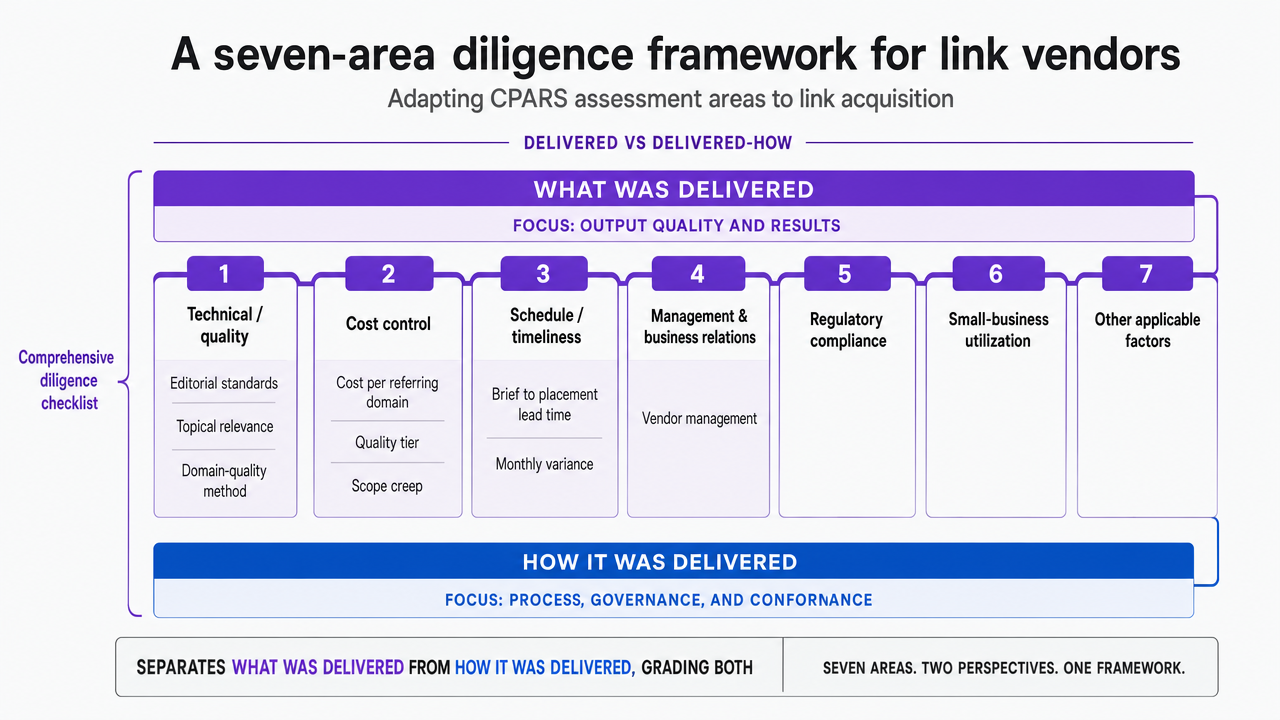
Federal procurement evaluates contractors across seven areas: technical/quality, cost control, schedule/timeliness, management and business relations, regulatory compliance, small-business utilization, and other applicable factors. This framework is effective because it separates what was delivered from how it was delivered, grading both. When applied to link acquisition, these areas provide a comprehensive diligence checklist.
For link acquisition, the seven areas translate as follows:
- Technical/quality translates to editorial standards, topical relevance scoring, and the vendor's domain-quality methodology.
- Cost control becomes cost per referring domain by quality tier, maintained against scope creep.
- Schedule refers to lead time from campaign brief to placement and monthly variance.
- Management and business relations covers account continuity, escalation paths, and audit trails for placement decisions.
- Regulatory compliance addresses disclosure practices for sponsored placements and adherence to Google's spam policies.
- Small-business utilization rephrases as the diversity and quality of the vendor's publisher network, indicating whether they rely on a narrow set of recycled surfaces or maintain a robust sourcing pipeline.
- Other encompasses client-specific factors like vertical experience, data security, and willingness to accept outcome-based renewal clauses.
Vendors capable of providing evidence across all seven areas are rare, highlighting the framework's value in exposing areas where vendors may lack preparedness.
Defining representative, accurate, reproducible link metrics
The effectiveness of diligence areas depends on the quality of the metrics used. NIST's guidance for service metrics provides a strong benchmark: a metric should be representative of what the buyer values, accurate under measurement, and reproducible by another analyst using the same inputs. Most link vendor scorecards fall short on at least two of these criteria.
Representative : A metric that directly correlates with something the client would financially value. Examples include organic sessions to a defined URL cluster, ranked keyword coverage for a shared query list, and assisted conversions from organic entry paths. Metrics like domain rating averages, however, are not representative, as client finance teams do not recognize DR as revenue.
Accurate : The reported number remains consistent upon re-measurement. A referring domain claimed this month should still be verifiable next quarter using the same tool and date range. Vendors who report from different data sources across months signal instability.
Reproducible : A second analyst—whether an in-house SEO, an incoming vendor, or an auditor—can reconstruct the number from documented inputs. This protects the client during account manager transitions.
Any metric a vendor cannot document sufficiently for hand-off should not be included in the ROI report.
Supplier evaluation crosswalk: quality and reliability signals
NIST's supplier evaluation crosswalk views vendor assessment as a quality-management discipline, linking supply-chain expectations to structured evaluations of reliability and consistency. Applied to link vendors, this framework emphasizes judging the process that generates the output, not just the output itself.
Three key signals differentiate reliable link vendors from unreliable ones:
- Documented sourcing standards: written criteria for publisher qualification, updated with changes in Google's spam policies, and applied consistently.
- Sample auditability: the ability to provide outreach records, editorial exchanges, and post-placement quality checks for any given placement from a recent period.
- Defect handling: a clear process for addressing removed, deindexed, or flagged placements, including whether replacements are covered at the vendor's cost.
Agency heads should request these artifacts before signing contracts; vendors who find such requests unusual may pose a higher risk.
 Visualize the seven CPARS-derived diligence assessment areas adapted to link vendor evaluation, directly supporting the section's framework explanation
Test Data-Driven Link Building at Scale
See live ROI impact from real, published link building campaigns during your trial—no commitments required.
Attribution: tying referring domains to pipeline
Full-funnel measurement across the decision journey
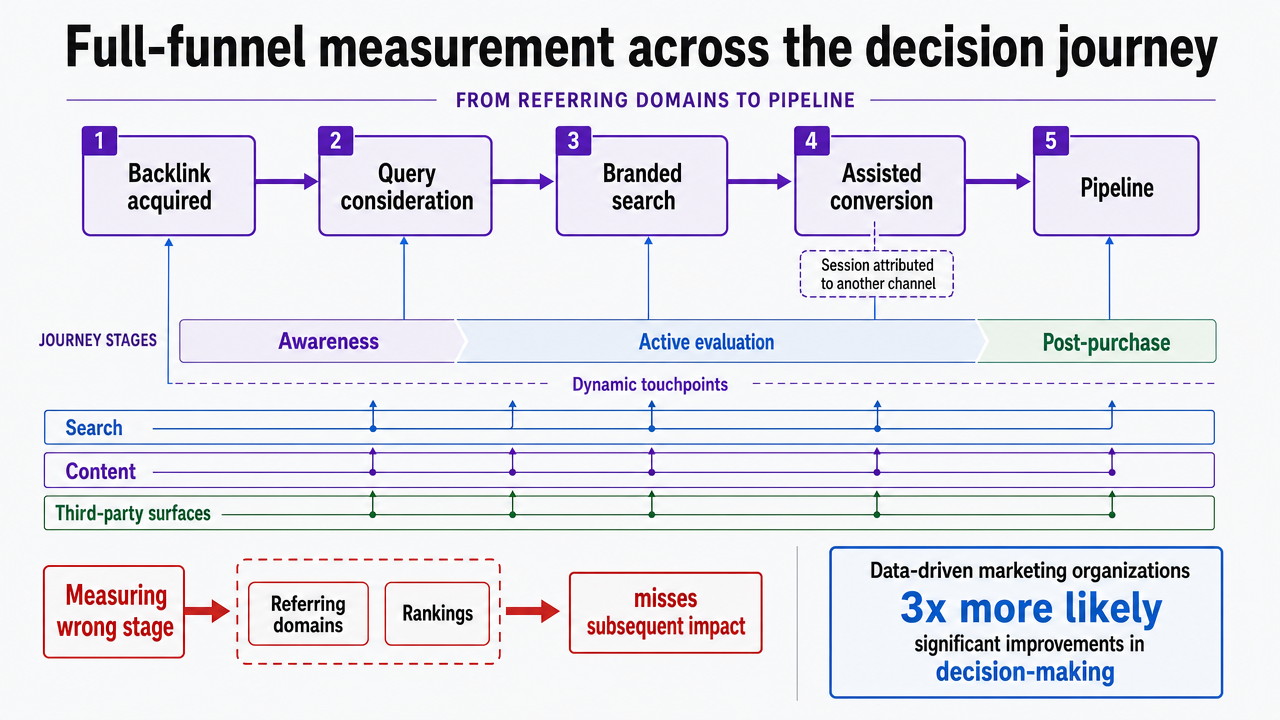
Attribution failures in link programs often stem from measuring the wrong stage of the customer journey. A backlink acquired in one quarter rarely results in an immediate form fill. Instead, it influences query consideration, drives a branded search weeks later, and appears as an assisted conversion within a session attributed to another channel. Reporting that stops at rankings or referring domain counts misses the subsequent impact.
McKinsey's work on the decision journey redefines the funnel as dynamic touchpoints where search, content, and third-party surfaces influence awareness, active evaluation, and post-purchase behavior. Data-driven marketing organizations are three times more likely to report significant improvements in decision-making. While this finding applies broadly to marketing decision quality, the procedural transfer to link programs is clear: link programs require instrumentation at every stage a referring domain touches. This includes impressions on the linking page, referral sessions, branded search lift in subsequent weeks, organic entry to high-value pages, and assisted conversions within multi-touch paths. Vendors who report only on the initial stage are evaluating themselves on the easiest, and least complete, metric.
 Illustrate the multi-stage attribution flow the section describes, from backlink acquisition through branded search and assisted conversion, tying referring domains to pipeline
Recurring performance measurement as a determinant of outcomes
One-off attribution reports do not drive sustained vendor improvement; recurring measurement does. Research on content marketing effectiveness defines performance measurement as establishing objective-aligned metrics and evaluating performance regularly to demonstrate effectiveness and efficiency. This discipline is positively associated with better outcomes. While this study covers content marketing broadly, the principle holds for link programs: what is measured consistently tends to improve.
For link vendors, this means a monthly attribution review using a consistent template. This template should include acquired referring domains mapped to target URL clusters, organic session deltas, ranked keyword movement, assisted conversions, and revenue (where client analytics permit). Quarterly, this data should be rolled into a cohort view, evaluating placements from one quarter for downstream conversions in subsequent quarters, acknowledging that link value accrues over time. Agency heads should stipulate this cadence in the contract; vendors who resist recurring measurement are often protecting a scorecard that would not withstand such scrutiny.
Compliance gates that void ROI if ignored
A link program that generates measurable lift can still destroy client value through a single enforcement action. Compliance failures manifest not as lower ROI, but as manual actions, deindexed pages, or FTC inquiries that erase gains and trigger unbudgeted legal reviews. Vendor diligence must treat compliance as a pass/fail gate, not merely a reporting line item.
Two compliance gates are paramount. First, disclosure on sponsored placements. The FTC's guidance on native advertising emphasizes transparency, requiring clear and prominent disclosures for paid or incentivized content. Agencies that accept ambiguously labeled or unlabeled vendor placements inherit the client's exposure. Every sponsored, gifted, or incentivized placement in the reporting stack must have documented disclosure language, reviewed against current FTC standards before going live. Second, adherence to Google's spam policies on link schemes. Private blog networks, undisclosed paid links passing ranking signals, and reciprocal placement rings are clear violations that lead to algorithmic and manual penalties. Agencies should request a written statement from vendors detailing tactics they refuse, then cross-check this against recent placement samples. Vendors with short refusal lists or samples that contradict their stated policies should not be engaged, regardless of price or reported lift.
See How Leading Agencies Quantify Link Building ROI at Scale
Connect with a strategist to review frameworks for tracking, benchmarking, and reporting link building impact across multiple clients—without increasing overhead or sacrificing transparency.
If you manage multiple locations: portfolio economics
Where oversight cost hides in per-location retainers
For agency heads managing link programs across numerous client locations (e.g., 20, 50, or 200), the problem shifts from single-site optimization to portfolio management. While the measurement contract remains crucial, the economic viability of a vendor model hinges on an often-unseen cost: oversight. Per-location retainers typically cover visible work like outreach hours, placements, and monthly reports, but they rarely account for the coordination burden an agency absorbs to ensure vendor quality across a portfolio.
This oversight burden includes:
- Reviewing placement samples for topical fit at each location
- Reconciling disparate reporting templates from different vendor account managers
- Verifying disclosure language on sponsored content against FTC standards
- Rebuilding attribution when a location's analytics setup changes
- Managing escalations when a placement is deindexed
For a single location, this might be a few hours per month. For 50 locations, it becomes a full-time role that is not funded by any line item. This hidden cost scales almost linearly with the number of locations under human vendor models, a factor that must be surfaced before renewal discussions, rather than focusing solely on the retainer fee.
Comparing three delivery models across N locations
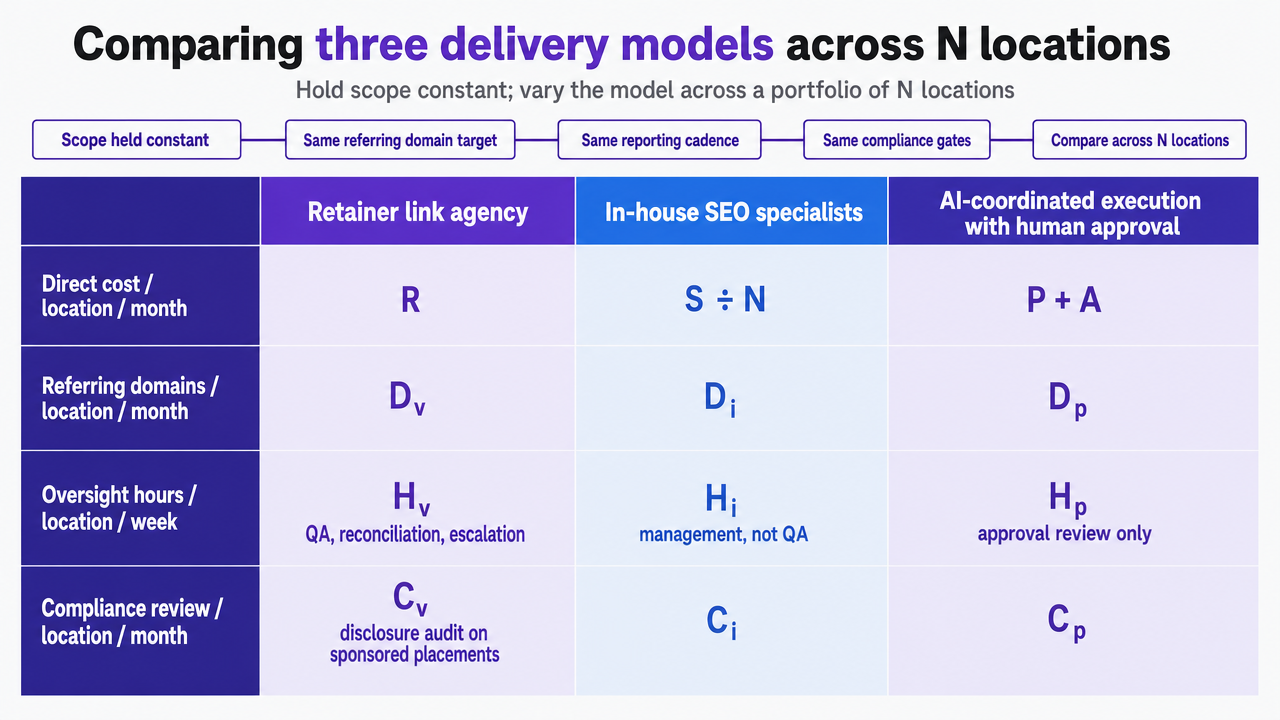
To compare delivery models effectively, hold scope constant—e.g., the same referring domain target, reporting cadence, and compliance gates—and vary the model across a portfolio of N locations. The table below uses variables instead of specific dollar figures, allowing agency heads to input their own contracted rates.
| Cost or capacity line | Retainer link agency | In-house SEO specialists | AI-coordinated execution with human approval |
|---|---|---|---|
| Direct cost per location per month | R (contracted retainer) | S ÷ N (salary load allocated) | P (platform seat) + A (approver time) |
| Referring domains delivered per location per month | Dv | Di | Dp |
| Agency oversight hours per location per week | Hv (QA, reconciliation, escalation) | Hi (management, not QA) | Hp (approval review only) |
| Compliance review hours per location per month | Cv (disclosure audit on sponsored placements) | Ci | Cp (built into approval step) |
| Reporting reproducibility across locations | Variable by account manager | Standard if templated | Standard by design |
| Marginal cost of adding location N+1 | R + Hv + Cv | Salary step function at capacity limit | P + incremental A |
Two factors often dictate the most suitable model. First, oversight hours per location, which determines the maximum number of locations an agency lead can manage effectively before quality deteriorates. Second, reporting reproducibility, which ensures portfolio-level attribution can be aggregated without manual reconciliation each quarter. Metrics that are not reproducible across locations by design will not withstand repeated quarterly reviews.
 Reinforce the section's comparison table by visualizing the three delivery models side-by-side across the key cost and capacity dimensions discussed in the article
Governance patterns that survive vendor turnover
Vendor turnover within a portfolio is not merely a risk to manage but a certainty to plan for. Account managers change, agencies restructure, and clients renegotiate. Governance patterns that withstand such turnover share three key properties:
- A single reporting schema, defined by the agency and used by every vendor. This ensures that referring domains, target URL clusters, session deltas, and assisted conversions are recorded in consistent fields, regardless of the partner.
- Placement-level auditability: every link should have an associated outreach record, disclosure language, and post-placement quality check stored in a shared repository accessible to incoming vendors.
- An agency-controlled approval layer. Every placement must clear an internal review before going live, with review criteria versioned to reflect evolving Google spam policies and FTC guidance.
Portfolios governed in this manner can absorb vendor changes in weeks, not quarters.
Contracting for outcomes, not deliverables
Most link building agency contracts price work based on vendor-controlled units, such as placements per month, outreach volume, or minimum domain rating. This often leads to renewal discussions focused on whether the vendor met these unit counts, rather than whether the client's organic revenue increased. The contract structure itself is often the problem.
Outcome-based terms shift accountability. Three clauses are particularly effective:
- Fees tied to measured lift: a defined portion of fees should be tied to measured lift on agreed-upon KPIs, such as organic sessions to target URL clusters, assisted conversions, or ranked keyword coverage on a shared query list, with the measurement method explicitly detailed in the agreement.
- Metric hand-off clause: every reported number must be reproducible by a second analyst from documented inputs, a standard derived from NIST's definition of service metrics.
- Compliance warranty: a compliance warranty should require vendor-funded replacement and a documented root-cause review for any placement later flagged for undisclosed sponsorship under FTC standards or removed due to Google's spam policies.
Contracts structured this way naturally select for a smaller pool of vendors, as those who decline these terms are typically the ones whose reporting would not withstand rigorous quarterly review.
Frequently Asked Questions
References
- 1.The consumer decision journey.
- 2.Determinants of content marketing effectiveness: Conceptual model and empirical validation.
- 3.Evaluating the Effectiveness of Digital Content Marketing Under Different Advertising Goals.
- 4.Native Advertising: A Guide for Businesses.
- 5.Making data-driven marketing decisions.
- 6.Cloud Computing Service Metrics Description.
- 7.Guidance for the Contractor Performance Assessment Reporting System.
- 8.NIST Releases Cloud Computing Service Metrics Description (NIST Special Publication 500-307).
- 9.Supplier Evaluation Crosswalk.