
Key Takeaways
- Connectively and Featured deliver editorial placements because reporters choose the citation, keeping spam exposure low even though per-pitch throughput stays modest 1.
- Muck Rack and Roxhill unlock earned placements when paired with original data, inverting marketplace economics through FTE-heavy work that compounds across adjacent-vertical clients.
- Collaborator and Adsy offer high throughput but every paid placement fits Google's definition of buying links that pass PageRank, with marketplace-heavy profiles absorbing the worst March 2024 hits 1, 3.
- Niche edit vendors frequently resell inventory through multiple layers, concentrating placements on the same articles and creating the footprint pattern SpamBrain is built to detect 8, 9.
- Qwoted and SourceBottle trade volume for topical fit, producing trade and regional placements whose relevance often outperforms higher-DR generalist links 2.
- Institutional and .edu acquisition through real scholarships, sponsored research, and academic partnerships produces durable links that survive updates, provided programs actually fund students 7.
- Vectoron functions as a coordination layer across content, outreach, anchors, and QA, cutting the handoff drag that erodes margin and editorial integrity in scaled link programs 2.
Why the agency link stack split into two tiers in 2024
Google's March 2024 spam update ran from March 5 to March 20, alongside a parallel core update that produced some of the most violent SERP movement agencies had tracked in years 3. The link inventory that survived was not the cheapest, and it was not always the most expensive. It was the inventory that looked editorial under scrutiny. Everything else got reweighted or quietly devalued by SpamBrain, the AI system Google now uses to detect repeated patterns, fake backlinks, and content engineered for ranking rather than readers 9.
That update did not kill link building. It bifurcated the stack. On one side sit platforms that source genuine editorial demand: journalist queries, digital PR contact databases, and institutional relationships. On the other sit marketplaces and niche-edit vendors that resell inventory of wildly variable quality, often skating along the edge of Google's prohibition on buying or selling links that pass PageRank 1.
Volume still correlates with position. Backlinko's analysis of 11.8 million search results found the #1 Google result carries, on average, 3.8 times more backlinks than results in positions 2 through 10 5. That gap is correlational, not causal, and it reflects ranking pages that earn links because they deserve them. The operator question for 2024 and beyond is not how many links to acquire, but which acquisition channels survive the next update without burning a client domain.
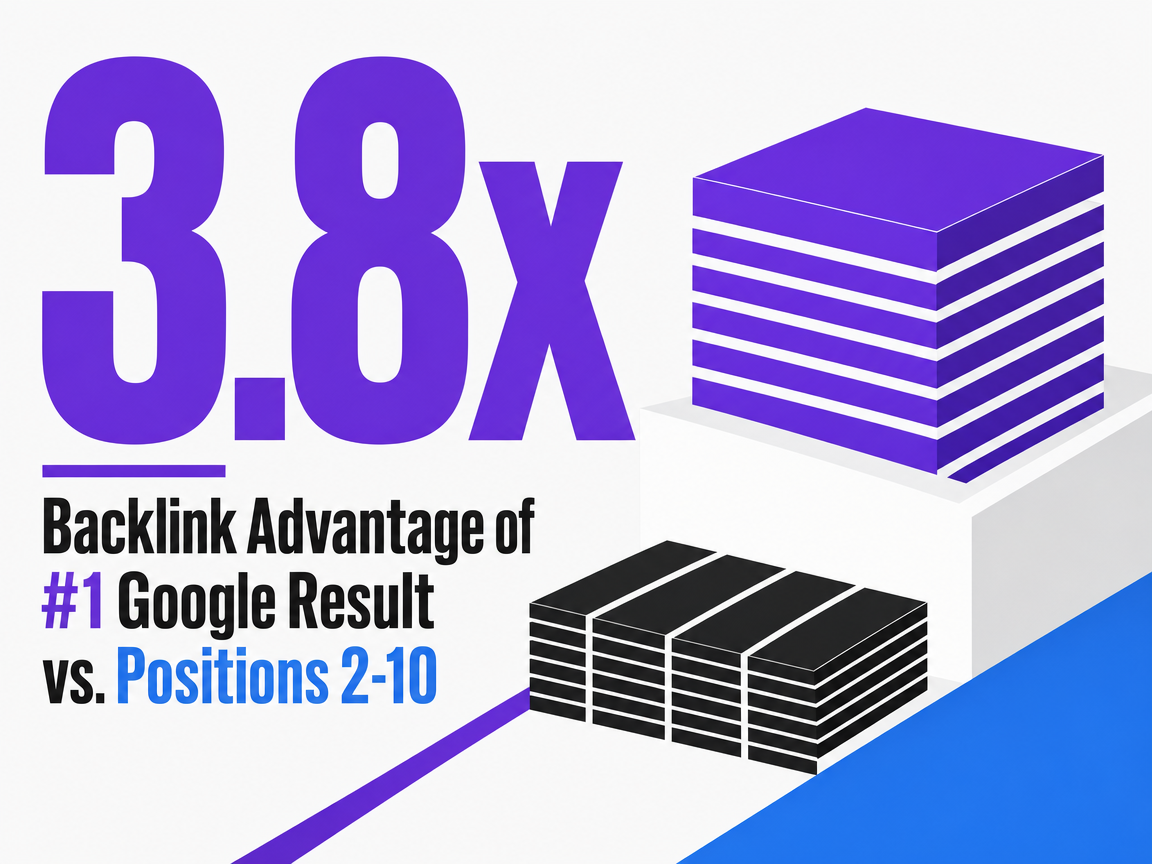 Backlink Advantage of #1 Google Result vs. Positions 2-10
Backlink Advantage of #1 Google Result vs. Positions 2-10
How each source was scored: editorial integrity, throughput, spam exposure
Each of the seven sources below was evaluated against three axes that map directly to agency delivery economics rather than vendor marketing copy.
Editorial integrity asks whether the placement exists because a publisher made an editorial decision. Journalist queries, digital PR pitches, and institutional partnerships score high because a third party decides whether the link belongs. Paid guest posts and niche edits score lower because the publisher's incentive is the fee, which is exactly the condition Google flags as buying or selling links that pass PageRank 1.
Throughput per FTE measures how many defensible placements a senior link strategist can ship per month against that source without footprint repetition. Marketplaces post high theoretical throughput but collapse once anchor diversity, vertical relevance, and resold-inventory checks are enforced.
Spam-policy exposure scores how visible the source's footprint is to SpamBrain's pattern detection, which targets repeated patterns, fake backlinks, and mass-produced content engineered for ranking 9. Scores run low, moderate, and high. Anything rated high requires either client-side disclosure or removal from the active stack.
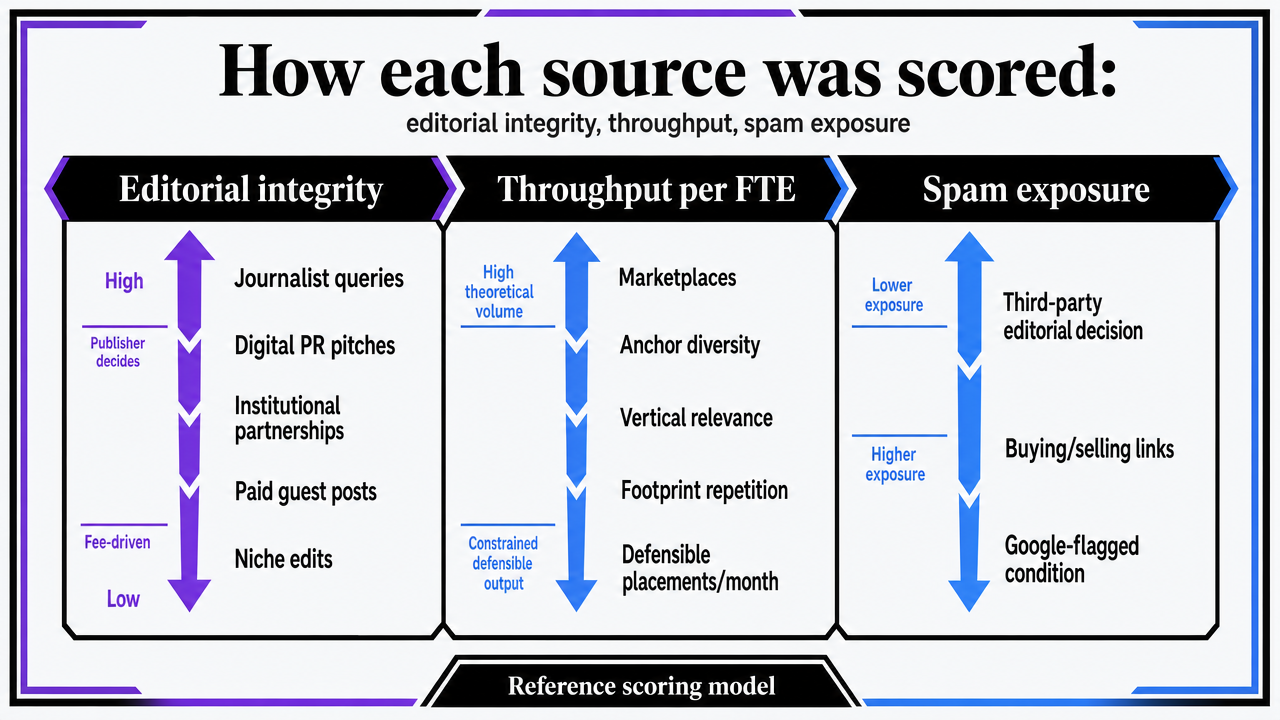 Visualize the three-axis scoring framework the article uses to evaluate every link source, giving readers a reference model for the listicle that follows
The seven sources agencies actually deploy
Connectively and Featured (formerly HARO): journalist-demand platforms
Connectively (the rebranded HARO) and Featured represent the cleanest editorial signal an agency can buy access to without buying the link itself. Reporters post queries, contributors respond with quotable expertise, and a fraction of those responses land in published stories with attribution and, often, a link back to the contributor's site. The publisher decides whether the link belongs, which is exactly the editorial condition that keeps a placement outside Google's prohibition on buying or selling links that pass PageRank 1.
The operational catch is response economics. A senior link strategist can write five to ten substantive pitches per day, with placement rates that typically run in the single digits per ten responses depending on vertical and source authority. Healthcare verticals see lower hit rates because reporters require credentialed sources and many pitches get filtered out before review. Agencies that treat these platforms as a volume play lose money on writer time.
The defensible workflow pairs a domain expert at the client with a strategist who packages quotes, credentials, and original data into pitches the reporter can paste. The link is incidental to the citation, which is precisely why it survives spam updates. Editorial integrity scores high, throughput per FTE scores low to moderate, and spam-policy exposure is minimal as long as the responses are genuine expert contributions rather than ghostwritten boilerplate optimized for anchor placement 9.
Muck Rack and Roxhill: digital PR contact databases for earned placements
Muck Rack and Roxhill sit one tier upstream from journalist-demand platforms. Rather than waiting for queries, agencies use these databases to identify reporters covering a specific beat, study their recent coverage, and pitch original research, data drops, or commentary tied to a news hook. The placement, when it lands, is a fully earned editorial mention from a publication that chose to cite the source.
This is the tier white-hat link building literature describes as building genuine relationships with legitimate publishers and producing valuable content worth citing 10. Original data is the unlock. A proprietary survey, a benchmark study from client first-party data, or an analysis of public datasets gives reporters something to quote that competitors cannot. Without a linkable asset, contact databases just produce inbox fatigue.
Throughput is the constraint agencies underestimate. A senior PR strategist running a dedicated campaign typically lands two to six top-tier placements per month per asset, with a long tail of secondary pickups. The cost structure is FTE-heavy rather than placement-heavy, which inverts the marketplace model. Per-link cost looks expensive on a spreadsheet until the spam-exposure column is added, at which point digital PR usually wins on risk-adjusted basis.
The agencies that scale this tier build an internal data-and-pitch engine, then run it across multiple clients in adjacent verticals. The asset compounds. The marketplace model does not.
Collaborator and Adsy: guest-post marketplaces and the spam-policy line
Collaborator and Adsy operate as transactional marketplaces. Publishers list inventory, agencies filter by metrics like Domain Rating and traffic, and a fee changes hands per placement. The pitch is throughput: a single strategist can place dozens of links per month if budget permits. The structural problem is that every placement involves a publisher accepting money in exchange for a link that passes ranking signal, which is the textbook definition of what Google's spam policies prohibit 1.
Google's documentation does not parse marketplace branding. Buying or selling links that pass PageRank is a violation regardless of whether the platform calls the transaction a sponsorship, a content fee, or a publishing service. The operational question is detection probability rather than policy alignment. SpamBrain targets repeated patterns, fake backlinks, and mass-produced content engineered for ranking 9, and marketplace inventory tends to share footprints: similar publisher templates, recycled author bios, anchor distributions that skew toward exact-match commercial terms.
Agencies that still use these platforms run aggressive vetting. They reject any site with thin original content, unusual outbound link ratios, or evidence of resold placements. They diversify anchor text heavily toward branded and naked URL variants. They cap each client's marketplace mix to a minority of the overall link profile. The honest framing is that these placements operate in a gray zone with declining half-lives. The agencies that built their delivery model on marketplace volume took the largest hits during the March 2024 update window 3, and the inventory that survived will face the next update too.
Niche edit vendors: link insertions and the resold-placement trap
Niche edits, sometimes called link insertions, place a client's link inside an existing published article on a third-party site. The pitch is that aged content carries more weight than freshly published guest posts and that no new article needs to be written. The economics look attractive on a per-placement basis. The risk profile rarely does.
The industry has documented how niche edit inventory frequently moves through multiple resellers before reaching an agency, with each layer marking up the placement and obscuring the original publisher relationship 8. Resold placements concentrate on a narrow set of compliant publishers, which means several agencies often own link insertions on the same article. That is the footprint pattern SpamBrain is built to detect 9.
The due-diligence checklist that separates usable inventory from burn risk:
- confirm the article was indexed before the insertion request,
- verify the publisher is not running a PBN disguised as a real site,
- check outbound link counts on the target article,
- and require a screenshot of the editorial calendar showing the article was not created specifically to host paid insertions.
Most vendors fail at least one check.
Agencies that keep niche edits in the stack treat them as a small percentage of any client's link profile and reserve them for supporting pages rather than primary money pages. The asymmetry of upside versus penalty risk does not justify a larger allocation.
Qwoted and SourceBottle: lower-volume HARO alternatives
Qwoted and SourceBottle occupy a smaller corner of the journalist-demand category. Query volume is lower than Connectively or Featured, but the noise floor drops accordingly. Reporters using these platforms tend to be writing for trade publications, regional outlets, and niche verticals, which produces placements that often score better on topical relevance even if domain authority looks modest on the surface.
For agencies running healthcare, B2B SaaS, or financial services clients, topical fit usually outperforms raw authority. A link from a specialty trade publication that covers the client's exact category signals relevance to Google more reliably than a higher-DR placement on a general news site that has never covered the topic before. Google's link best practices emphasize that links help establish context, which is a function of relevance rather than volume 2.
The operational use case is a complement to the larger journalist platforms, not a replacement. A strategist might allocate one hour daily across Qwoted and SourceBottle queries while running the primary pitch workflow on Connectively. Hit rates are higher per response because the response pool is smaller and the credential bar is often lower for trade-specific commentary. Editorial integrity rates high, throughput is modest, and spam-policy exposure stays minimal.
Institutional and .edu acquisition: scholarships, resources, partnerships
Backlinks from .edu domains are described in the SEO literature as vouching for a site's authority and credibility and are treated as among the more valuable ranking signals available 7. The acquisition methods that survive scrutiny:
- funding genuine scholarships administered through university financial aid offices,
- contributing to open educational resources,
- sponsoring research that universities publish,
- and building partnerships with academic programs in adjacent fields.
The controversy is real and worth naming. Scholarship campaigns engineered purely to harvest .edu links have been a documented manipulation tactic, and the SEO literature flags the practice as contested under Google's guidelines 7. The distinguishing factor is whether the scholarship actually funds a student. Programs with real award amounts, public selection criteria, and named recipients land on financial aid pages and survive scrutiny. Programs that exist only as a landing page with optimized anchor text do not.
For agency clients with genuine community-investment budgets, this tier produces some of the most durable links in any portfolio. Healthcare operators that fund nursing scholarships, SaaS companies that sponsor undergraduate research, and professional services firms that host case competitions all have legitimate angles. The throughput is low and the lead time is long, often two to four months from program design to link placement. The links rarely move under spam updates because they reflect actual institutional relationships.
Vectoron: coordinated execution across content, outreach, and QA
The seventh source is not a directory or a marketplace. It is a coordination layer. Most agencies running link acquisition at scale lose margin not on placement costs but on the handoffs between content production, outreach, anchor strategy, and QA. A guest post drafted by one team, pitched by another, and approved by a third typically takes three to five times longer than the writing itself, and the coordination drag is where defensibility leaks out.
A coordinated execution platform sits across those workflows rather than inside one of them. Content briefs, linkable-asset production, outreach sequences, anchor-text distribution, and placement QA run from a single account-level plan rather than per-tactic procurement. The output is fewer placements that look more editorial, with anchor profiles and topical relevance managed against Google's guidance on descriptive, contextual link patterns 2.
The Vectoron platform operates in this category for agencies and multi-location healthcare operators that need link acquisition coordinated with content production and technical SEO rather than purchased as a separate line item. Editorial integrity depends on the inputs the team feeds into the system. Throughput per FTE rises sharply because the coordination tax falls. Spam-policy exposure stays low when the platform is used for digital PR and earned placements rather than as a procurement front-end for marketplace inventory.
Test AI-driven link building at agency scale
Trial delivers live agency-grade backlinks and measurable SEO impact for your client accounts in one week.
Operator economics: per-link cost, FTE load, and spam exposure across the seven
The scoring framework collapses into a single matrix once each source is mapped against the three operator axes. The variables that move per agency, per vertical, and per client budget are labeled accordingly. Per-placement cost ranges are intentionally left as variables because they shift with vertical, target domain authority, and current marketplace pricing, and inventing fixed dollar figures would mislead more than it would clarify.
| Source | Type | Editorial integrity | Spam-policy exposure 1| FTE hours per placement | Per-placement cost ||---|---|---|---|---|---|| Connectively / Featured | Journalist demand | High | Low | 3–6 hours | Subscription + FTE || Muck Rack / Roxhill | Digital PR database | High | Low | 8–20 hours (asset-amortized) | Subscription + FTE || Collaborator / Adsy | Guest-post marketplace | Low | High | 1–2 hours | Variable, per placement || Niche edit vendors | Link insertion | Low | High | 1–3 hours (plus vetting) | Variable, per placement || Qwoted / SourceBottle | Journalist demand (niche) | High | Low | 2–4 hours | Subscription + FTE || Institutional / .edu | Partnerships, scholarships | High | Low (with real funding) | 20–40+ hours, multi-month | Program budget || Coordinated execution platform | Production layer | Depends on inputs | Low when used for earned work | 1–3 hours net (coordination removed) | Platform + asset cost |
The pattern that emerges is not cost-driven. Marketplaces and niche edits show the lowest hours per placement and the most predictable per-link price, which is why they remain attractive on a spreadsheet. They also carry the highest exposure to Google's prohibition on buying or selling links that pass PageRank 1and the largest pattern-detection surface for SpamBrain. The sources with the highest editorial integrity carry the highest FTE load per individual placement, but the load drops sharply when linkable assets are reused across multiple clients in adjacent verticals. That asset leverage is what separates an agency running digital PR profitably from one losing margin on every campaign.
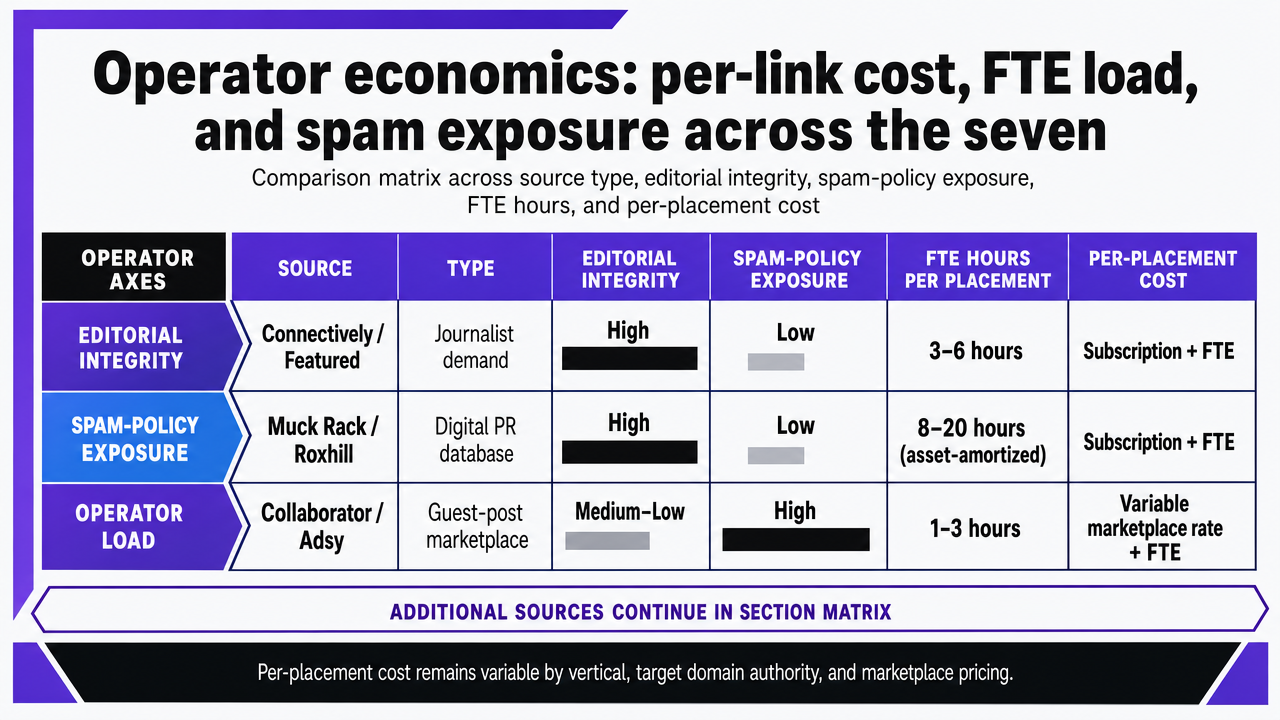 Render the in-article comparison table as a scannable matrix infographic since the section explicitly compares seven sources across editorial integrity, spam exposure, FTE hours, and cost
Anchor strategy and QA: where most agencies leak quality
Anchor distribution is the single variable that betrays a manufactured link profile faster than any other. A natural profile skews heavily toward branded anchors, naked URLs, and generic phrases, with exact-match commercial anchors landing as a small minority of total inbound links. Profiles that invert that ratio, even when the underlying domains look clean, flag the kind of repeated pattern SpamBrain is built to surface across mass-produced backlink campaigns 9.
Google's own link guidance is direct on the implementation side. Anchors should be descriptive and contextual, written for readers trying to understand what sits on the other side of the click rather than for ranking the destination page on a target keyword 2. The QA gap most agencies carry is treating anchor strategy as a per-placement decision rather than a portfolio-level distribution. A strategist approving links one at a time will overshoot exact-match without noticing.
The operational fix is a running anchor ledger per client, refreshed monthly, with hard caps on exact-match commercial variants and a default toward branded and contextual phrases. Placements get rejected at QA when they push the ratio past threshold, regardless of domain authority. Agencies that enforce this lose roughly 15 to 25 percent of otherwise approvable inventory and protect the rest of the profile in exchange.
See How Leading Agencies Automate Link Acquisition at Scale
Connect with our team to benchmark your agency’s link building workflow and discover AI-driven solutions for efficiently managing high-volume, high-authority backlink campaigns across multiple client accounts.
If you manage multiple healthcare locations: where per-location billing wastes link budget
A note on audience scope: this section speaks to agencies running multi-location healthcare clients, where link budgets are typically allocated and billed per site rather than per brand.
The per-location billing model creates a footprint problem before it creates a budget problem. When each location buys guest posts independently, the vendor list converges. Three locations under the same brand end up with placements on the same five publisher templates, often with anchor variants pointing at near-duplicate service pages. That is precisely the repeated pattern SpamBrain is built to surface, since the system targets fake backlinks, recurring patterns, and mass-produced content engineered for ranking rather than readers 9.
The budget waste compounds the risk. A 12-location dermatology group spending a modest per-location guest-post allocation each month is funding overlapping inventory, duplicated outreach hours, and anchor profiles that look identical across locations. The same dollars consolidated at the brand level fund linkable assets—original procedure-volume data, regional health reports, clinician commentary—that earn placements across all locations from publishers no per-location budget could reach alone.
The operational fix is structural. Move link strategy to the brand account, allocate asset production once, and distribute earned coverage to location pages through internal architecture rather than buying it separately at each site.
Building a production system, not a procurement checklist
The agencies that survived the March 2024 update window did not have better vendor lists. They had better production systems. The link inventory question is downstream of an asset question: what does the client own that a reporter, editor, or institutional partner would cite without being paid to do so? If the answer is nothing, every source on this list becomes a procurement exercise with declining returns and rising spam exposure.
The production model treats link acquisition as an output of coordinated work across content, data, outreach, and QA. Linkable assets get briefed against publisher demand, not against keyword spreadsheets. Outreach runs against a real contact graph rather than a rented database. Anchor distribution gets managed at the portfolio level instead of the placement level. Approvals route through a single accountable strategist rather than three handoffs that each add a week.
That is the operator shift worth making. Agencies running this model, including teams using the Vectoron platform to coordinate execution across multi-client portfolios, ship fewer placements with higher editorial integrity and lower margin leak. The procurement checklist gets replaced by a system that produces links as a byproduct of work publishers actually want to cite.
Frequently Asked Questions
References
- 1.Spam Policies for Google Web Search.
- 2.SEO Link Best Practices for Google.
- 3.Google March 2024 spam update done rolling out.
- 4.We Analyzed 11.8 Million Google Search Results. Here's What We Learned.
- 5.Backlinks and Content Quality Correlate With Higher Google Rankings.
- 6.Link Building Statistics 2026 | 80+ Backlink Data & Benchmarks.
- 7.How SEO Edu Guest Post Backlinks Can Help in Ranking – Inspire.
- 8.SEO Warning: 6 Backlink Scams To Avoid Before You Buy.
- 9.Google Spam Policies 2025: What Every Website Owner Must Know.
- 10.White Hat Link Building Techniques 2022 – Mind, Body and Soul.