Key Takeaways
- Durable SaaS link acquisition runs on four production lines: linkable assets, targeted earned media, programmatic internal linking, and pipeline-tied measurement, each audited separately against Google's published guidance 4, 5.
- Compounding referring domains come from four asset classes: original research, in-depth guides, comparison content, and free tools, where the asset itself does the recruiting work outreach would otherwise repeat 6.
- Mass guest posting, reciprocal exchanges, and sponsored placements with follow links now fit Google's link scheme definition and are exactly the patterns SpamBrain is built to detect 3, 4.
- Replace Domain Rating and referring domain counts with organic sessions, conversion rate on link-targeted pages, and qualified leads, benchmarked against the 2.3% SaaS visitor-to-lead average 8, 9.
Why SaaS link programs stalled, and what changed under SpamBrain
Most SaaS link programs hit a ceiling between nine and eighteen months. The pattern is familiar: an outreach team books 40 to 80 placements per quarter, referring domain counts climb, and then a Google update arrives, flattening or reversing the curve. The tactics did not get worse; the detection got better.
Google's spam updates now run on SpamBrain, an AI-based detection system explicitly applied to link spam, which can cause individual pages or entire sites to rank lower or drop from results 3. Google's spam policies identify participation in link schemes as a violation that can lead to ranking suppression or removal. The policy language focuses on intent and manipulative patterns as the trigger, rather than any single tactic 4. This distinction means a program does not need to appear obviously spammy to be caught; it merely needs to exhibit a detectable pattern.
The downstream effect on SaaS budgets has been a quiet reallocation. B2B SaaS leaders are increasing investment in owned digital properties and content to reduce dependence on volatile paid channels 10. This raises the bar for any link tactic that consumes similar headcount. If acquiring a referring domain costs four hours of senior SEO time and carries detection risk, it must compete with content investment that produces compounding organic returns without that risk.
Teams still achieving results have shifted focus from optimizing outreach throughput. They now treat link acquisition as a production problem with four discrete inputs: linkable assets, targeted editorial relationships, internal architecture, and conversion measurement. Each input is audited against Google's published guidance rather than conventional agency practices 4, 5.
The four-pillar operating model for durable link acquisition
Durable link programs at SaaS companies share a structural pattern: they treat link acquisition as the output of four production lines rather than a single outreach pipeline. These pillars are linkable assets, targeted earned media, programmatic internal linking, and pipeline-tied measurement. Each pillar has a defined input, output, and a separate audit standard derived from Google's published guidance 4, 5.
This division of labor is crucial because the failure modes differ:
- An asset pillar fails when the team publishes generic explainers that no editor would cite.
- An earned media pillar fails when outreach patterns resemble those Google's spam policies identify as link schemes.
- An internal linking pillar fails when anchor text becomes overly branded or generic, stripping relevance signals.
- A measurement pillar fails when Domain Rating (DR) replaces conversion as the primary success metric.
The subsequent four subsections detail each pillar, including its production input, output, and the guardrails that ensure its durability through algorithm updates. This model is intentionally narrow. Tactics that do not map cleanly to one of these four pillars are considered either decayed, redundant, or carry detection risk that outweighs their potential yield.
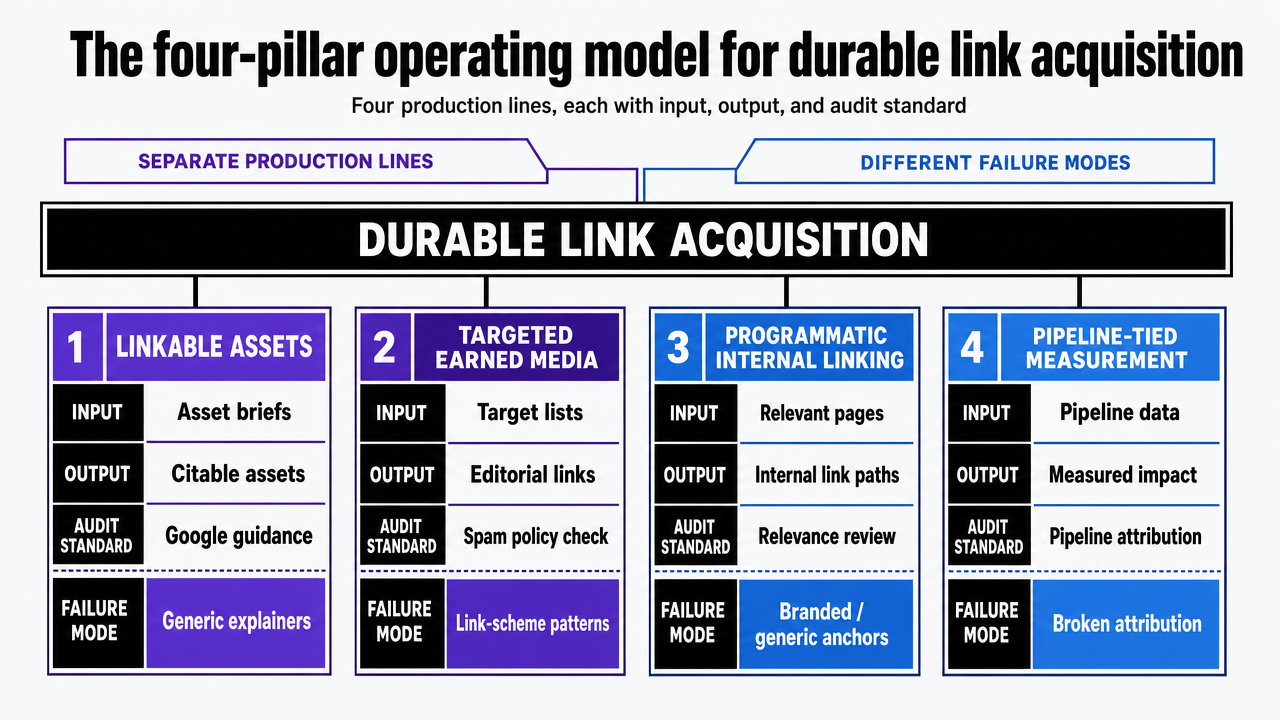 Visualize the four production pillars described in the section as a clear operating model framework readers can scan
Inside the four pillars
Pillar one: linkable assets that compound referring domains
Linkable assets are the only input in a SaaS link program that generates compounding referring domains without proportional outreach effort. The production input for this pillar is editorial-grade content that an external writer would cite unsolicited. The output is unsolicited referring domains accumulating against a single URL over multiple quarters.
CXL's analysis of SaaS link-earning content identifies four asset classes that consistently attract editorial citations: original research, in-depth guides, comparison content, and free tools 6. Each class earns links for distinct editorial reasons, and growth directors planning a quarterly production calendar should understand these mechanisms before allocating resources.
Original research : Earns links because journalists, analysts, and competitors require primary data to support their arguments. A survey of 400 procurement leaders, an analysis of pricing pages across 200 SaaS companies, or a benchmark study from an installed customer base provides external writers with unique data.
In-depth guides : Earn links by becoming the definitive reference for a topic; in niches lacking a canonical 8,000-word resource, the first credible one absorbs citations from subsequent related content.
Comparison content : Earns links because vendors, review sites, and category analysts cite head-to-head evaluations, and it also enhances authority on bottom-funnel sales pages by improving overall site signal 6.
Free tools : Earn links because utility is a highly durable citation trigger in B2B: calculators, generators, and audit utilities are linked by anyone teaching the underlying process.
The production economics are significant. A single original research asset typically requires 60 to 120 senior hours for survey design, data analysis, and visualization. However, a well-positioned study can accumulate 40 to 120 referring domains over 18 months without additional outreach. A comparison page consumes 20 to 40 hours and earns links as long as the compared products remain relevant. The common characteristic across all four classes is that the asset itself performs the recruiting work that outreach would otherwise have to do for each placement.
Teams that staff this pillar correctly treat it as an editorial production line with a quarterly release schedule, not a one-off campaign. Three to four major assets per year, supported by promotion, will outperform a 200-placement outreach program with the same headcount.
Pillar two: targeted earned media instead of mass outreach
The second pillar replaces mass outreach with a smaller set of editorial relationships where the published asset from pillar one is the primary reason for placement. The production input is a shortlist of 30 to 80 publications, analysts, and topical newsletters whose audience aligns with the SaaS product's buyer. The output is referring domains earned through editorial judgment rather than transactional placement.
The critical distinction here is policy-driven, not preference-based. Google's spam policies explicitly name participation in link schemes as a violation that can result in pages or entire sites ranking lower or being removed from results, with the policy focusing on intent and manipulative patterns as the trigger 4. This language provides a clear filter for operators: a proposed tactic either earns its link through editorial relevance or it exhibits a pattern resembling a scheme. There is no middle ground.
Three categories apply to any tactic under consideration.
- Scale: The placement is editorially motivated, the writer chose to cite the asset, and no exchange of value occurred for the link itself. This includes original research distribution, expert commentary placement, and resource page inclusion based on genuine fit.
- Limit: The tactic possesses some editorial substance but borders on patterns flagged by spam policies, such as high-volume guest posting with optimized anchors or transactional-looking contributor arrangements. These should be part of the program at low single-digit monthly volumes, using branded or descriptive anchors, and only on publications with independent editorial standards.
- Avoid: Tactics where the link is the product being purchased—paid placements disguised as sponsorships with follow links, link exchanges, private blog networks, and reciprocal arrangements designed for ranking benefit. Google's spam policies define these as link schemes 4.
Operators managing this pillar should maintain a written log of every placement, the editorial reason it was earned, and the anchor text used. This log serves as an evidence trail for auditing the program against Google's policy language during a spam update.
Pillar three: programmatic internal linking and descriptive anchors
Internal linking is often undervalued by SaaS teams, yet it carries the lowest detection risk and offers the fastest implementation cycle. The production input is the site's existing content inventory. The output is improved discovery, clearer topical relevance, and ranking lift on commercial pages that absorb authority from informational hubs.
Google's link best practices state that links help its crawler discover new pages and that descriptive anchor text aids both users and search engines in understanding the linked page's content 5. Two operational rules stem from this guidance:
- Every published asset requires inbound internal links from the most topically related pages, placed within the body copy where context exists. Orphaned assets do not compound, regardless of external referring domains.
- Anchors should describe the destination page's content, not just the brand or a generic phrase. Phrases like "Click here" and bare URLs diminish the relevance signal a link is intended to convey.
Programmatic execution is essential given the volume of SaaS content. A growth team publishing 30 to 50 pages per quarter cannot rely on writers to retrospectively interlink. The repeatable pattern involves a quarterly internal link audit that maps each new asset to its three to five most relevant existing pages, adds contextual anchors from those pages to the new one, and updates the new page's outbound internal links to point to the strongest commercial destinations downstream.
The compounding effect manifests in two ways: faster discovery for new pages, which shortens the time between publication and initial rankings, and authority distribution to sales pages, enabling an informational link program to eventually drive pipeline, not just traffic.
Pillar four: measurement tied to pipeline, not DR
The fourth pillar frequently fails in SaaS link programs due to incorrect success metrics set during planning. Domain Rating and referring domain count are inputs, not outcomes. The production input here is analytics instrumentation; the output is a defensible link between link-driven organic traffic and pipeline contribution.
The benchmark for this pillar is the SaaS visitor-to-lead conversion rate. The average B2B SaaS website converts 2.3% of visitors to leads, with top performers exceeding 10% 8. This range defines the operating impact a link program should aim to influence. A campaign that adds 40,000 monthly organic sessions to a site converting at 2.3% generates approximately 920 leads per month; the same traffic at 10% yields 4,000 leads. The link-building effort is identical in both scenarios; the underlying conversion infrastructure determines the pipeline's effectiveness.
Umbrex's framework for organic conversion rate analysis outlines the operating loop: segment organic traffic by entry page, identify high-converting pages, and direct content and UX investment toward pages where visitor expectations and conversion paths are already aligned 9. Applied to link building, this means the link team should know which referring-domain-attracting pages convert and which do not, prioritizing new linkable assets that precede pages already converting above the site average.
The reporting cadence effective for growth directors is a monthly view with four metrics:
- Referring domains acquired by pillar
- Organic sessions to link-targeted pages
- Conversion rate on those pages
- Qualified leads attributable to organic entry
DR appears in the report as a diagnostic, not a target. Referring domain count appears as an input volume, not a measure of success.
This shift in measurement also changes the conversation with finance. A link program reported solely by referring domains acquired is a cost center. The same program reported by organic leads contributed at a known conversion rate becomes a pipeline channel with a calculable cost per lead, which is the format in which growth budgets are defended.
Test Data-Driven Link Building at Scale Now
Experience automated, multi-channel link building workflows with real campaign results in your own SaaS environment.
Tactics that have decayed: mass guest posts, exchanges, dressed-up sponsorships
Three tactics that were central to SaaS link programs through the mid-2010s now yield diminishing returns and carry significant detection risk. Each was effective when its volume was rare; each became a pattern Google's systems learned to recognize.
Mass guest posting is the first. This tactic was viable when 200 to 400 placements per quarter, with optimized anchors pointing at commercial pages, could influence rankings without consequence. Google's spam policies now explicitly name large-scale guest posting with keyword-rich anchors as an example of a link scheme, and SpamBrain is designed to detect precisely this category of pattern at scale 3, 4. A program publishing the same author bio across 60 mid-tier blogs monthly generates the exact signal the system is built to find. Guest posting remains viable only at low volume, on publications with independent editorial review, and with branded or descriptive anchors that adhere to link best practices guidance 5.
Link exchanges are the second. Reciprocal arrangements between SaaS companies—often framed as partner cross-promotion or co-marketing—fall within the link scheme definition when the exchange is engineered for ranking benefit rather than audience value 4. This pattern is easily detectable because the link graph is symmetric. Even three-way exchanges routed through a partner's secondary domain do not alter the underlying signal.
Paid placements disguised as sponsorships are the third, and represent a common decay path because they appear legitimate on the surface. A sponsored post with a follow link, a podcast partnership where the link is the deliverable, or a niche newsletter placement priced per backlink all fall within the spam policy's definition of buying or selling links that pass ranking signal 4. The mechanical fix is to use nofollow or sponsored attributes on any link where money changed hands. This fix is also why the tactic ceased to scale, as the ranking benefit was its sole budgetary justification.
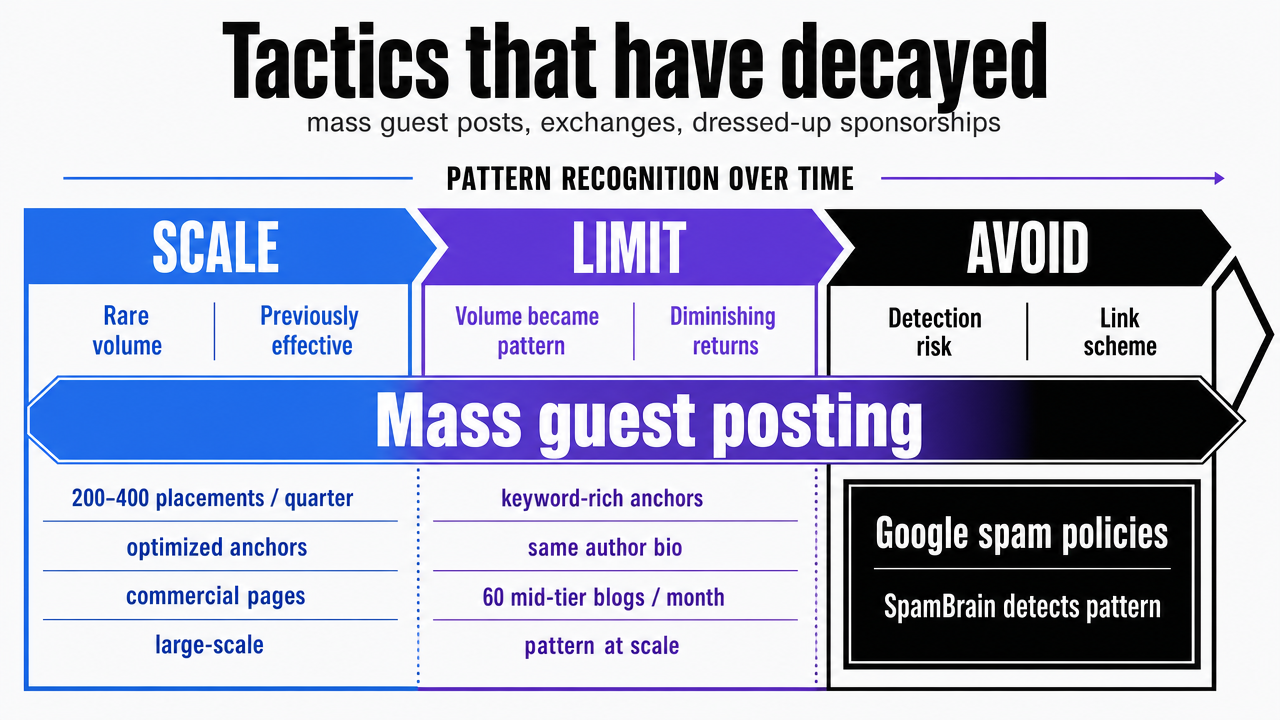 Visualize the Scale / Limit / Avoid tactic classification framework introduced in pillar two and reinforced in this section
Production economics: in-house, agency retainer, or AI-assisted output
The build-versus-buy question for a SaaS link program ultimately reduces to two numbers: the fully-loaded cost per published linkable asset, and the cost per referring domain acquired against that asset. Three operating models compete for the same budget line, and their unit economics diverge sharply once headcount, throughput, and risk-adjusted yield are considered.
An in-house team running the four-pillar model requires approximately 80 to 160 senior hours per major linkable asset—covering survey design, analysis, writing, visualization, and targeted outreach for distribution. At a fully-loaded blended rate of H dollars per hour for senior content and SEO staff, a single asset costs 80H to 160H. A quarterly cadence of three to four such assets consumes most of a two-to-three-person production allocation before any other content work begins. The yield, when assets are well-positioned against the four classes CXL identifies as link-earning 6, is 30 to 100 referring domains per asset over 12 to 18 months.
A traditional agency retainer reassigns that production load to external staff, typically billed at a monthly fee R with a defined asset and outreach quota. The variable that complicates comparison is what the retainer actually produces. A retainer focused on outreach throughput tends to surface tactics Google's spam policies identify as link schemes—volume guest posting with optimized anchors, paid placements, reciprocal arrangements 4—because these tactics generate reportable referring domain counts within a monthly cycle. A retainer focused on asset production at the same monthly fee delivers fewer published pieces, but each piece compounds.
AI-assisted production, such as platforms like Vectoron (available on a $599 monthly trial), sits between the two models on cost and closer to in-house on editorial control. These platforms handle asset production and internal linking pillars at a fraction of agency cost, while keeping the earned media pillar within the team that owns editorial relationships. The unit economics shift accordingly: cost per published asset drops, throughput rises, and the human team's hours are redirected to outreach work that still requires judgment.
See How Scalable Link Building Drives Consistent SaaS Pipeline Growth
Request a walkthrough of data-backed link acquisition workflows purpose-built for SaaS and agency teams—streamline outreach, monitor impact, and measure ROI at scale using automated systems.
Staffing a three-to-eight-person team for repeatable output
The headcount question simplifies once the four pillars are treated as separate production lines. A three-person team covers the minimum viable program; an eight-person team runs all four pillars at a quarterly cadence with integrated measurement.
For a three-person team, the allocation is one senior content lead for asset production, one SEO operator for internal linking and on-page work, and one outreach manager for the earned media pillar. Measurement is handled by the growth director until volume justifies dedicated analytics time. This configuration can produce two major linkable assets per quarter and sustain a 15 to 25 placement monthly outreach cadence at the editorial threshold described by Google's link best practices 5. However, it cannot execute original research at the survey-design depth required for the highest yield from the asset classes CXL identifies 6.
With six to eight people, the program splits cleanly: two content producers, a data analyst or researcher for primary studies, two outreach specialists with separate publication shortlists, an SEO operator running monthly internal linking audits, and an analytics owner reporting the four pipeline metrics. Three to four major assets per quarter become sustainable, and the outreach pillar can maintain its anchor distribution and placement log to the standard effectively required by spam policies 4.
Prioritize hiring the analyst before the second outreach specialist, as asset quality determines the program's ceiling.
A Skyscraper 2.0 production loop, adapted for SaaS topics
The Skyscraper 2.0 model, as documented by Backlinko, reportedly produced a 652.1% increase in organic traffic within seven days of launch 11. This figure represents a single-page case study, not a category benchmark, and SaaS topics differ from the consumer SEO topic covered in that study. However, the underlying loop adapts cleanly to B2B when treated as a production system rather than a one-off campaign.
The adapted loop operates in four steps:
- Identify a topic where current top-ranking pages are thin, outdated, or aggregate sources without primary data.
- Produce a single asset that fits one of the four link-earning classes—original research, definitive guide, comparison, or tool—rather than a marginally longer version of existing content 6.
- Distribute the asset to the 30 to 80 publications and analysts on the earned media shortlist, highlighting the specific data point or utility a writer would cite.
- Measure referring domains and conversion rate on the target page, then use these insights to inform the next topic selection.
Scope discipline is crucial. SaaS topics rarely generate seven-day traffic spikes; instead, they produce 12 to 18 month referring domain curves on assets that become category references.
Frequently Asked Questions
References
- 1.Search Engine Optimization Starter Guide.
- 2.The Significant Role of SEO in Effective Web Marketing.
- 3.Google Search Spam Updates.
- 4.Spam Policies for Google Web Search.
- 5.Link Best Practices for Google.
- 6.SaaS Content Marketing: 5 Proven Strategies to Earn Links.
- 7.How to Build Links for SEO.
- 8.60+ SaaS Marketing Statistics & Benchmarks for 2026.
- 9.Conversion Rate from Organic Traffic Analysis.
- 10.Digital Marketing Trends for B2B SaaS.
- 11.SEO Case Study: How I Increased My Organic Traffic 652% in 7 Days.