
Key Takeaways
- Profound monitors share-of-citation across ChatGPT, Perplexity, and Gemini, giving account leads prompt-cluster prioritization data but leaving production, provenance, and attribution to other systems.
- Peec AI delivers per-prompt scorecards with sentiment and position data that account leads can bring into QBRs, though it reads model outputs rather than steering them.
- Writesonic GEO orchestrates briefs, drafts, and structured output at speed, but the real test is brief fidelity and whether handoff shortens or relocates senior-editor time.
- AthenaHQ organizes monitoring around entities (brands, executives, products, competitors), which fits regulated verticals where brand consistency matters as much as traffic.
- Scrunch AI produces page-level audits scored for retrieval readiness across engines, slotting into onboarding cycles but leaving execution, approval history, and conversion attribution outside the platform.
- Otterly.AI gives lean teams quick citation monitoring across ChatGPT, Perplexity, and AI Overviews, but its lightweight format limits competitive breakdowns and historical cohort analysis.
- Surfer AI Tracker folds generative-visibility tracking into an existing technical-SEO dashboard, which helps Surfer-standardized teams but offers narrower monitoring than visibility-first tools.
- Vectoron pairs multi-channel production with a Command Center approval workflow that logs model, prompt, sources, editor decisions, and client sign-off, mapping to NTIA provenance and Copyright Office human-contribution expectations 4, 1.
Why agency SEO leaders are rethinking the LLM optimizer category
The question in agency SEO leadership meetings has shifted. It is no longer whether to add generative-answer visibility to client scopes, but which platform to standardize on across a 20-plus account portfolio without multiplying QA headcount. Stanford's 2025 AI Index found that 78% of organizations used AI in at least one business function in 2024, up from 55% a year earlier, with generative-AI use climbing from 33% to 71% over the same period across the surveyed respondent base 11. Those are reported-use figures, not maturity scores, which is precisely why agency buyers are now asking harder questions of the tool category.
The common framing of "LLM optimizer" as a smarter AI writer misses where the delivery margin actually leaks. Writing speed stopped being the constraint months ago. The constraint is governed review across many clients at once: tracking which brand gets cited in ChatGPT answers for which prompts, documenting human contribution on every published asset, and tying generative visibility back to pipeline rather than impressions. A tool that only drafts content pushes those costs downstream into senior editor time.
Read this piece as a strategist's evaluation of a tool category, not a vendor roundup. The sections that follow apply one four-layer model to eight platforms, flag what the category cannot deliver, and lay out a 30-day pilot structure for picking one to standardize on.
A four-layer evaluation model for LLM optimizer tools
Retrieval visibility: tracking citations across ChatGPT, Perplexity, and AI Overviews
Retrieval visibility is the layer that answers one question: when a prospect types a client-relevant prompt into ChatGPT, Perplexity, Gemini, or an AI Overview, does the client's brand or domain appear in the cited sources, and against which competitors? This is the layer most agencies underinvest in because it looks like a dashboard problem rather than a strategy problem.
An optimizer evaluated at this layer should sweep a defined prompt set on a scheduled cadence across multiple engines, log the cited URLs and brand mentions, and let an account lead compare share-of-citation against a competitive set over time. The useful outputs are prompt-level diagnostics (which prompts the client wins, which it never appears in, which competitor dominates a cluster) and surface-level deltas after a content change ships.
The caution: generative answers vary by engine, user context, and model updates, and no tool controls the retrieval ranking itself. Treat the dashboard as a signal source for prioritization, not a performance guarantee. Agencies that confuse the two end up writing client reports the FTC's September 2024 enforcement action against deceptive AI claims directly cautions against 3.
Production: briefs, drafts, and structured output at client scale
Production is the layer most "LLM optimizer" blog posts stop at. It covers brief generation, draft output, structured markup, FAQ blocks, entity coverage, internal linking suggestions, and the mechanical work of turning a target prompt cluster into a shippable page. McKinsey's 2025 global survey of 1,993 respondents across 105 countries found that marketing-strategy content support is one of the most-reported AI use cases inside organizations, which maps directly to where agencies are already saving brief and first-draft hours 5.
The honest read on this layer: raw draft speed is now commodity. The differentiator is how cleanly the production system hands a draft into review. An optimizer that writes 3,000 words in four minutes but produces a draft a senior editor rewrites from scratch has pushed cost sideways, not down. Evaluate production tools on brief fidelity, source citation inside drafts, and the structural quality handed to the next layer, not on word-per-minute throughput.
Provenance and governance: the control layer agencies now have to deliver
This is the layer that separates a tool an agency can standardize on from a tool an agency has to wrap in spreadsheets. Provenance means a durable record of where an output came from: which model, which prompt, which source documents, which human editor reviewed it, which revisions were made, and when the client approved it. The NTIA's 2024 AI report defines provenance as information about the origin of data or AI-system outputs, and treats it as foundational infrastructure for AI-generated content at scale 4.
NIST's Generative AI Profile (AI 600-1) is the control reference agencies should hold any optimizer against. It names confabulation (a system generating and confidently presenting erroneous or false content) as a core risk and recommends pre-deployment testing, human review of generated content, continuous monitoring, documented data and content provenance, intellectual-property controls, and incident disclosure as the operational responses 10. An LLM optimizer that cannot produce an audit trail covering those control areas has moved compliance work onto the agency, not off it.
For regulated verticals (legal, behavioral health, dental, senior living, healthcare), the U.S. Copyright Office's Part 2 report, released in January 2025, adds a second obligation: documenting the human contribution that makes a client deliverable copyrightable in the first place 1, 9. The 2023 registration guidance already asks applicants to disclose more-than-de-minimis AI-generated material 2. An approval workflow that logs who edited what, when, is now a client-deliverable artifact, not an internal nicety.
Outcome measurement: connecting generative visibility to pipeline, not pageviews
The fourth layer is the one that keeps the first three honest. An LLM optimizer earns its line item when citation share, published assets, and governance records can be tied back to qualified leads, calls, bookings, or pipeline for a specific client. Pageviews and prompt-win counts are intermediate signals; they are not what a client renews on.
McKinsey's 2025 survey found that marketing and sales is one of the functions where respondents most commonly report revenue effects from AI use, which is the macro case for building this measurement layer into the stack rather than bolting it on later 5. The caveat sits in the same evidence base: self-reported revenue gains from a cross-sectional survey do not establish that any specific tool caused the lift for any specific client 5.
Evaluate optimizers on whether they can ingest client-side conversion data (form fills, qualified calls, booked appointments), attribute movement to specific prompt clusters or published assets, and produce a report an account lead can defend in a renewal conversation. Tools that stop at visibility metrics force the agency to build the attribution layer in a BI tool, which is where the headcount savings quietly disappear.
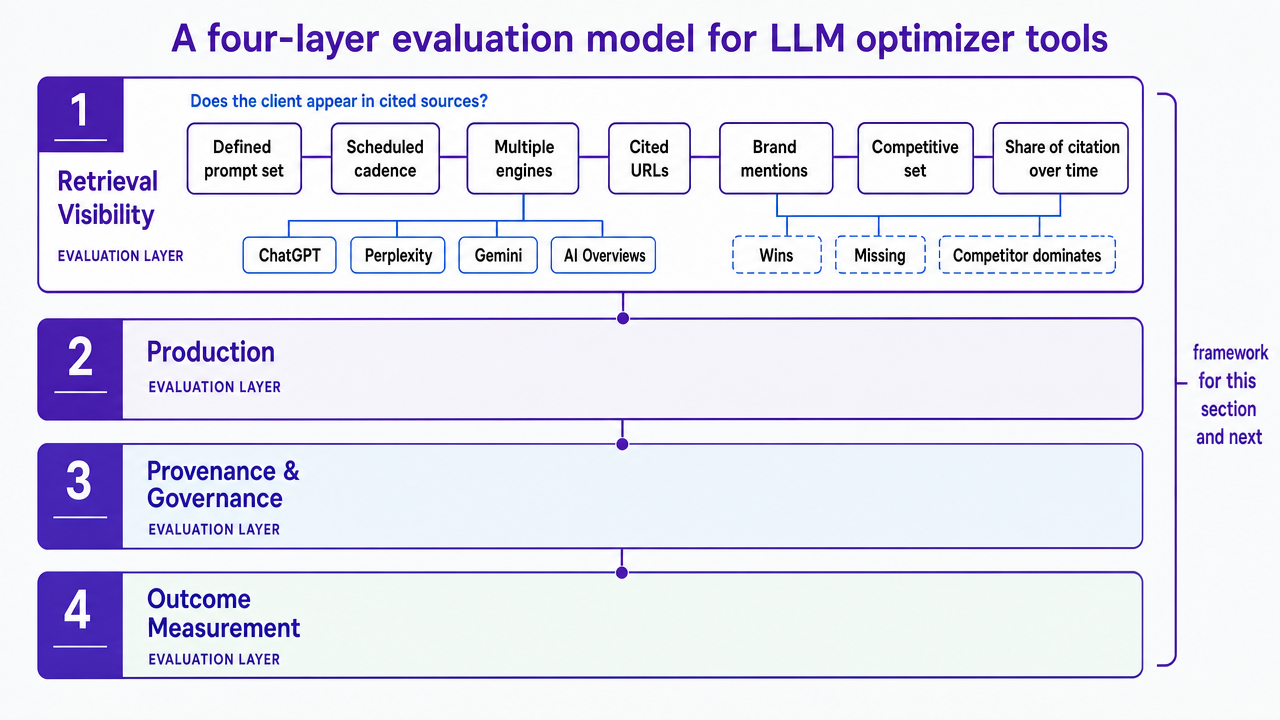 Visualize the four-layer evaluation framework (Retrieval Visibility, Production, Provenance & Governance, Outcome Measurement) that structures the entire tool evaluation in this section and the next
Test AI-driven SEO workflows on live projects
Experience hands-on LLM optimization and publish real client content during your full-access trial, risk-free.
What LLM optimizers cannot do, and why that matters for client scoping
No LLM optimizer controls the retrieval ranking inside ChatGPT, Perplexity, Gemini, or Google's AI Overviews. There is no equivalent of a sitemap submission, no schema shortcut that forces inclusion, and no vendor relationship that guarantees a client brand appears in a generated answer. Agencies that scope deliverables around "we will get you cited" are writing a promise the tool category cannot keep, and the FTC's September 2024 enforcement action on deceptive AI claims applies to that language whether it sits in a pitch deck or a monthly report 3.
Generative visibility also varies by engine, prompt phrasing, user context, and model version. A content change that lifts citation share in Perplexity may not move anything in AI Overviews the same week, and a model update can erase a gain overnight. The implication for scoping: generative-answer work has to be sold and measured as a controlled, client-level experiment, not as a universal optimization service. One prompt set, one engine panel, one baseline, one review cadence per account.
Two other limits are worth naming in scopes. AI content detectors are not a quality gate; NIST's 2024 GenAI pilot study found detector performance varies significantly by generator and discriminator, so pass/fail output cannot stand in for factuality or source review 6. And no optimizer removes the human-authorship work required for client ownership of the asset 1.
The tools: eight LLM optimizer platforms evaluated against the four layers
Profound: generative-answer monitoring built for competitive citation share
Profound sits firmly in the retrieval-visibility layer. The platform sweeps defined prompt sets across ChatGPT, Perplexity, Gemini, and other generative engines, logs which brands and URLs get cited, and reports share-of-citation against a competitive set. For an agency account lead running a legal or healthcare portfolio, that output translates into prompt-cluster prioritization: which questions a client already wins, which ones a named competitor dominates, and which clusters have no incumbent to displace.
The platform does not produce content and does not maintain an approval trail, so production, provenance, and outcome measurement sit outside its scope. Agencies standardizing on Profound typically pair it with a separate production workflow and a BI layer for attribution. Treat the dashboard as a signal source for prioritization rather than a performance claim, since no monitoring tool controls what the models cite.
Peec AI: retrieval visibility and prompt-level diagnostics
Peec AI focuses tightly on prompt-level diagnostics. The platform runs scheduled queries across major generative engines, decomposes each response into cited sources, sentiment around the brand mention, and the position of the client in the answer, and surfaces week-over-week deltas when a page changes or a competitor publishes.
For agencies, the useful artifact is the per-prompt scorecard that an account lead can walk into a QBR with. The limit is the same one every monitoring tool shares: Peec AI reads what the models return, it does not steer what they return. Agencies pairing it with their existing content workflow get a clean visibility feed; agencies expecting it to double as a production or governance system will push both of those costs back onto senior editors and account managers.
Writesonic GEO (formerly AirOps-style stacks): production throughput with brief orchestration
Writesonic's GEO stack is a production-layer tool. It generates briefs oriented toward prompt clusters, drafts long-form content with embedded citations and FAQ blocks, and orchestrates multi-step workflows that chain research, outline, draft, and structured-data output. McKinsey's 2025 global survey of 1,993 respondents found that marketing-strategy content support is one of the most-reported AI use cases inside organizations, which is the hour-saving zone this category targets 5.
The honest evaluation for an agency head: raw draft throughput is now a commodity, and the differentiator at this layer is brief fidelity and the structural quality of the handoff to review. Writesonic produces drafts quickly; whether those drafts shorten senior-editor time or just relocate it depends on how disciplined the brief inputs are. Visibility monitoring and provenance records are not part of the stack.
AthenaHQ: entity coverage and brand-mention tracking in generative answers
AthenaHQ organizes its monitoring around entities rather than keywords. The platform tracks how a client brand, its executives, its products, and its competitor set appear across generative answers, and reports entity-level coverage gaps that correlate with absent citations. For agencies working regulated verticals where brand consistency matters as much as traffic (law firms, DSO rollups, senior living operators), the entity view is the operationally useful cut.
The platform is strongest when paired with a content system that can act on the entity gaps it surfaces. AthenaHQ does not draft or approve content, and its outcome layer stops at mention tracking rather than qualified-call or booking attribution. Agencies that already have production and attribution infrastructure in place can plug it in as a diagnostic feed; agencies without that scaffolding will still need to build it.
Scrunch AI: audit-first optimization and multi-engine coverage reporting
Scrunch AI positions around audit output. The platform crawls client sites, scores pages for retrieval readiness across generative engines, and produces page-level recommendations tied to a multi-engine coverage report. The deliverable an account lead gets is closer to a technical SEO audit in format, mapped to generative-answer surfaces rather than SERP positions.
For agencies, the audit format slots cleanly into existing onboarding and quarterly review cycles. Where it falls short of a four-layer standard: Scrunch AI does not execute the recommended changes, does not maintain the approval history that the U.S. Copyright Office Part 2 report treats as material to copyrightability of client assets 1, and does not close the loop to conversion data. It is a diagnostic layer, best used alongside a production system and a documented review workflow that handles the governance obligations 9.
Otterly.AI: lightweight citation monitoring for lean account teams
Otterly.AI is built for lean teams that need generative-visibility monitoring without a platform-sized commitment. The tool tracks prompts across ChatGPT, Perplexity, and Google AI Overviews, logs brand mentions and cited links, and sends alert digests when the citation pattern shifts for a tracked query.
For an agency piloting generative-answer deliverables on a handful of accounts, Otterly.AI reduces the time cost of maintaining a baseline. The constraint is depth: the lightweight format that makes it quick to onboard also limits the per-prompt diagnostics, competitive breakdowns, and historical cohort analysis a larger portfolio eventually needs. Agencies tend to use it as a sandbox for the pilot stage, then re-evaluate against heavier monitoring tools once the service line is standardized across more than a few accounts.
Surfer AI Tracker: hybrid technical-SEO and generative-visibility dashboard
Surfer's AI Tracker extends the platform's existing technical-SEO workflow with generative-visibility monitoring in the same dashboard. Account leads already using Surfer for on-page scoring and content audits get prompt-level citation tracking alongside the SERP data they report on, which reduces the number of tabs an editor has to reconcile.
The hybrid framing is the strength and the limit. For agencies already standardized on Surfer, the AI Tracker extends what the team already knows how to run. For agencies evaluating the category fresh, the generative-visibility feature set is narrower than monitoring-first tools, and the production features sit inside the same content-brief paradigm Surfer has always used. Provenance records and conversion attribution still live outside the platform and have to be assembled elsewhere in the stack.
Vectoron: approval-first workflow with multi-channel execution and provenance trail
Vectoron is evaluated here against the same four-layer grammar. The platform combines production (specialist strategists that generate content, SEO, PPC, backlink, social, and call-intelligence recommendations) with a Command Center approval workflow that routes every recommendation for human sign-off before execution, and logs the model, prompt context, source documents, editor decisions, and client approval against each shipped asset. That log maps directly to the provenance information the NTIA's 2024 report describes as foundational for AI-generated content at scale 4and to the human-contribution record the U.S. Copyright Office treats as material to copyrightability of client deliverables 1.
The outcome layer ingests live client signals (qualified calls, bookings, cost per lead, pipeline) and attributes movement back to approved work. Retrieval-visibility monitoring is not the platform's primary surface; agencies that want engine-by-engine citation dashboards typically pair it with a monitoring tool.
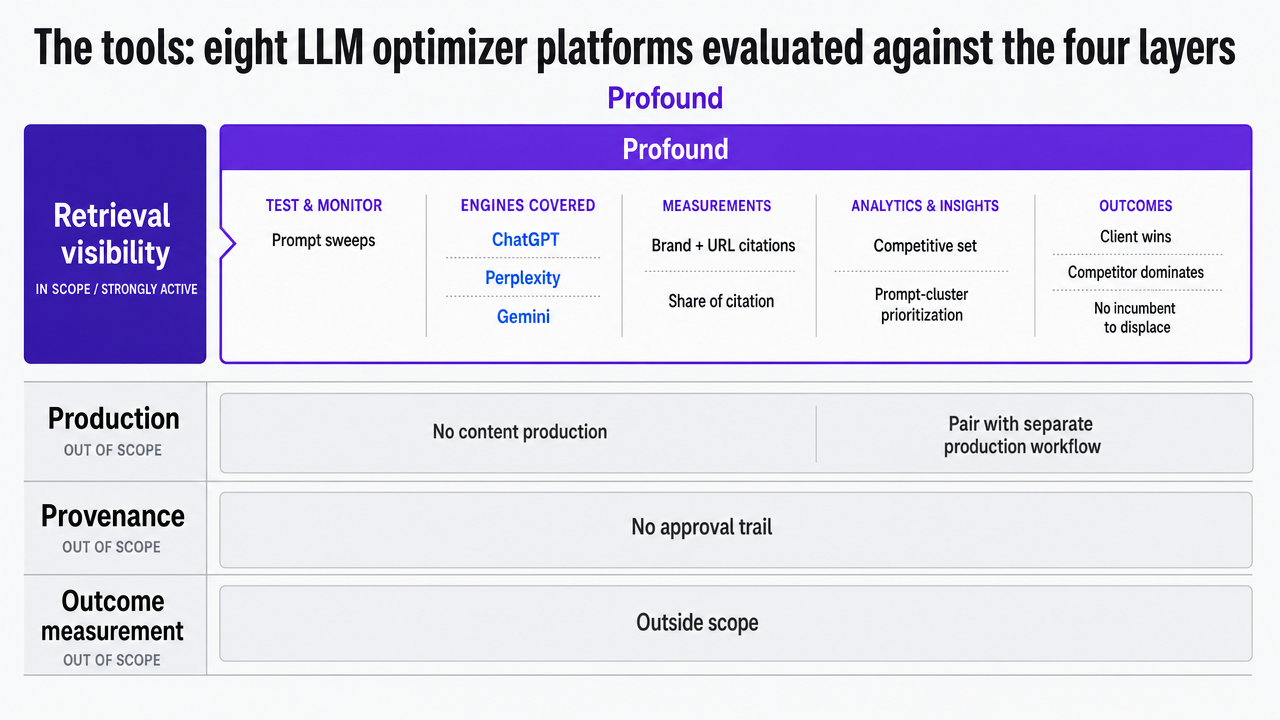 Comparison matrix of the eight evaluated tools against the four layers, directly summarizing the subsections that follow
See How Leading Agencies Use LLM Optimizers to Multiply SEO Output—Without Expanding Teams
Request a demo to benchmark AI-driven SEO workflows, content governance, and multi-client campaign scaling—purpose-built for agencies managing high-volume, high-stakes SEO programs.
If you manage multiple client accounts: the per-account economics of standardizing on one optimizer
Audience scope shift: this section is written for delivery leads running an agency portfolio, not for in-house marketers evaluating a single-brand use case. The unit of analysis is per-client contribution margin across 20 or more accounts, not a single pilot's output.
The per-account cost structure an LLM optimizer should move has four variables, not one:
- Production hours per brief
- QA and factual-review hours per published asset
- Citation-monitoring hours per prompt cluster
- Reporting hours per client per month
A tool that compresses the first variable while expanding the other three has not improved portfolio margin; it has shifted hours into roles that cost more per hour. The margin test is the sum, not the headline draft-speed number.
Agency buyers should also calibrate expectations against the macro evidence before building a renewal pitch around generative-visibility work. Stanford's 2025 AI Index Economy chapter reports that 71% of respondents using AI in marketing and sales reported revenue gains, with the most common level of increase below 5% 12. That is a cross-sectional, self-reported survey across many functions and tool categories, not a controlled study of any one LLM optimizer, which is exactly why portfolio economics have to be measured per client rather than assumed across the book.
The operational implication: standardize on one optimizer only after a two-account baseline shows the four-variable sum moving in the right direction, and price the service line against modal uplift (sub-5%), not against a best-case account. Agencies that underwrite retainers to a 20%+ lift assumption will miss margin on three accounts out of four and lose the service line in the second renewal cycle.
A 30-day pilot framework for choosing one optimizer to standardize on
Pick two client accounts in different verticals, not five. The pilot's job is to produce defensible per-account data on the four-variable sum from the previous section, and a two-account cohort is the smallest sample that reveals vertical-specific noise without turning the pilot itself into a staffing event.
- Week one is baseline capture. Freeze a prompt set of 40 to 60 queries per account that map to the client's actual pipeline questions, record current citation share across ChatGPT, Perplexity, and AI Overviews, and log the existing per-brief production, QA, monitoring, and reporting hours.
- Week two is instrumentation: wire the optimizer into the content workflow, define the approval checkpoints that document human contribution on each asset 1, and confirm the provenance log captures model, prompt context, sources, editor decisions, and client sign-off in a format that survives an audit 4.
- Weeks three and four are controlled execution. Ship three to five assets per account against the prompt clusters where the baseline showed no incumbent, then re-sweep the prompt set and compare citation movement, hours per asset, and any attributable conversion signal.
The exit decision is a go/no-go on standardization, written against the four-variable sum and the modal-uplift expectation, not against the single best asset. Client reports from the pilot should state what moved, what did not, and what the measurement limits are, which keeps the service line clear of the deception standards the FTC applied in its September 2024 action 3.
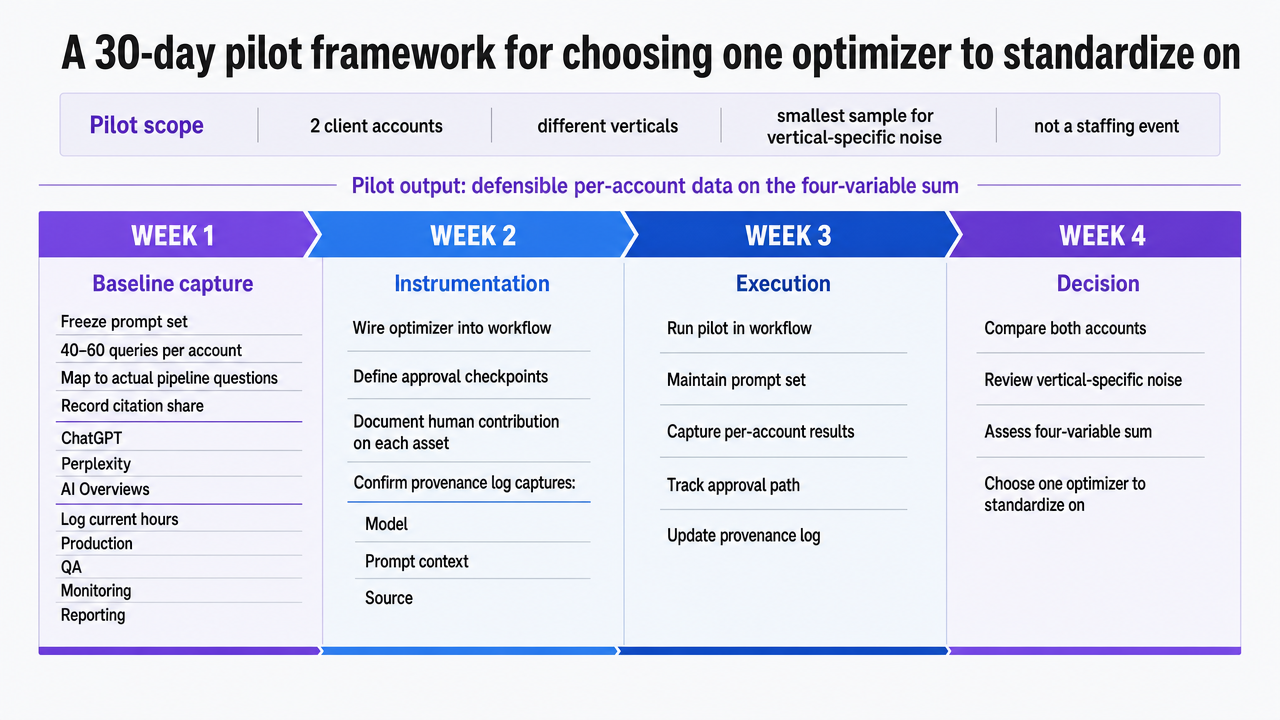 Visualize the 4-week pilot workflow explicitly described in the section (baseline, instrumentation, execution, decision)
Frequently Asked Questions
References
- 1.Copyright and Artificial Intelligence, Part 2: Copyrightability.
- 2.Works Containing Material Generated by Artificial Intelligence.
- 3.FTC Announces Crackdown on Deceptive AI Claims and Schemes.
- 4.Artificial Intelligence.
- 5.The State of AI: Global Survey 2025 - McKinsey.
- 6.2024 NIST GenAI (Pilot Study): Text-to-Text Evaluation Overview and Results.
- 7.Artificial Intelligence Risk Management Framework: Generative Artificial Intelligence Profile.
- 8.Economy | The 2024 AI Index Report | Stanford HAI.
- 9.Copyright Office Releases Part 2 of Artificial Intelligence Report.
- 10.Artificial Intelligence Risk Management Framework: Generative Artificial Intelligence Profile.
- 11.The 2025 AI Index Report.
- 12.Economy | The 2025 AI Index Report.