
Key Takeaways
- Profound monitors prompt sets across ChatGPT, Perplexity, Gemini, and Claude, giving agencies clean multi-workspace reporting on mention rate and share, but stops short of factual-support scoring 10.
- Peec AI centers on competitive share-of-voice and citation-source breakdowns, mapping directly to the four gatekeepers isolated in the 252,000-trial competitive citation study 4.
- AthenaHQ reaches into citation-position and source-support scoring, addressing the 51.5% sentence-support ceiling documented across prior GEO systems 10— useful for regulated verticals.
- Otterly.AI prioritizes prompt-library throughput across ChatGPT, Perplexity, and AI Overviews, making visibility monitoring viable for mid-book agencies where volume, not metric depth, is the constraint.
- Scrunch AI diagnoses why owned pages lose citations, scoring content against topical alignment, price transparency, recency, and list depth rather than tracking live engine responses 4.
- Vectoron sits above the monitoring stack, converting signals from other tools into ranked, brand-consistent recommendations and drafts held for human approval, reducing analyst hours per client.
Why Client QBRs Now Open With 'Are We Showing Up in ChatGPT?'
The question has moved from curiosity to line item. Agency SEO leads running 15 to 80 accounts are being asked to explain, on the same slide as ranking gains, why organic sessions dropped even as positions held. The answer usually points to AI answer surfaces absorbing the click before it leaves the search page.
The scale of that absorption varies sharply by study, and the variance itself is the reporting problem. A Digital Content Next member survey covering an eight-week window in mid-2025 pegged median Google referral traffic down 10%, with non-news publishers down 14% and news brands down 7% 6. A randomized field experiment isolating AI Overview queries reported a 38% reduction in organic clicks where the Overview appeared 7. A portfolio-level report across 64 sites, drawn from Google Search Console data, put the aggregate drop at 42% since AI Overviews began expanding 17. DMG Media told the BBC that click-through rates on some of its properties fell by as much as 89% 9.
Four studies, four scopes, four numbers between -10% and -89%. None of them are wrong. They measure different populations across different windows, which is why a client asking one question deserves an agency answer that separates publisher-wide medians from query-level experiments from single-property extremes.
That separation is exactly what an LLM visibility analysis tool is supposed to enable at the account level: not a single headline percentage, but a measurable read on where a specific brand appears, where it is cited, and where it is losing ground inside the AI answer itself. The rest of this piece grades six tools against that job.
The Four-Layer Visibility Model Agencies Should Actually Measure
Mention, Citation Position, Factual Support, Competitive Share
A defensible tool evaluation starts with a clear read on what the tool is measuring. Four distinct layers show up across the GEO research base, and each one behaves differently in a client report.
The first layer is mention : whether a brand name, product, or URL appears anywhere in the generated answer. This is the baseline the original GEO paper operationalized when it built GEO-bench across 10,000 queries spanning multiple domains 1. It answers a binary question and nothing more.
The second layer is citation position : C-SEO Bench argues that whether a model cites a document matters less than where the citation lands in the ranked source list, because downstream user clicks and model reasoning weight are not distributed evenly across cited sources 11. A brand cited fifth in a Perplexity answer is not equivalent to the same brand cited first, and any tool that reports them as identical is throwing away signal.
The third layer is factual support : whether the sentence attributed to a source is actually substantiated by that source. A critical survey of GEO systems including Bing Chat, NeevaAI, Perplexity, and YouChat found that only 51.5% of sentences were fully supported and 74.5% of citations supported the proposition they were attached to 10. Roughly half the sentences in a generated answer are shaky, which is a competitive opening and a client risk in the same measurement.
The fourth layer is competitive share : A controlled study running 252,000 trials of two-document citation competition isolated four gatekeepers determining which source wins: topic mismatch, price omission, recency, and lower list position 4. Share-of-voice is the layer that ties directly to client revenue conversations.
Why Mention-Counting Fails as a Client Metric
Most dashboards default to the first layer because it is the cheapest to compute. Run a prompt, string-match the brand name, tally the hits, chart the trend. The output looks like rank tracking, which makes it easy to fold into an existing QBR template.
The problem is that mention rate correlates poorly with what a client actually wants: consideration, clicks, and revenue. A brand can appear in every ChatGPT answer for a given prompt set and still lose every deal, because it is being named as the incumbent while a competitor is cited as the recommended alternative. Framing is not captured by a count.
The generalization problem compounds this. A feature-level study across GPT-4o-mini, Gemini, and Qwen-plus found that token-level GEO heuristics — the tactics most likely to move raw mention counts — often failed to beat the baseline once tested across engines, while a feature-level approach reached 18.31% citation visibility on GPT-4o-mini, a 37% relative gain 3. Optimization tactics that lift mentions on one engine can be flat or negative on another.
An agency reporting only mention rate is reporting the layer least likely to survive scrutiny at renewal. The tools graded in the next section vary considerably in how far up the four-layer stack they actually reach.
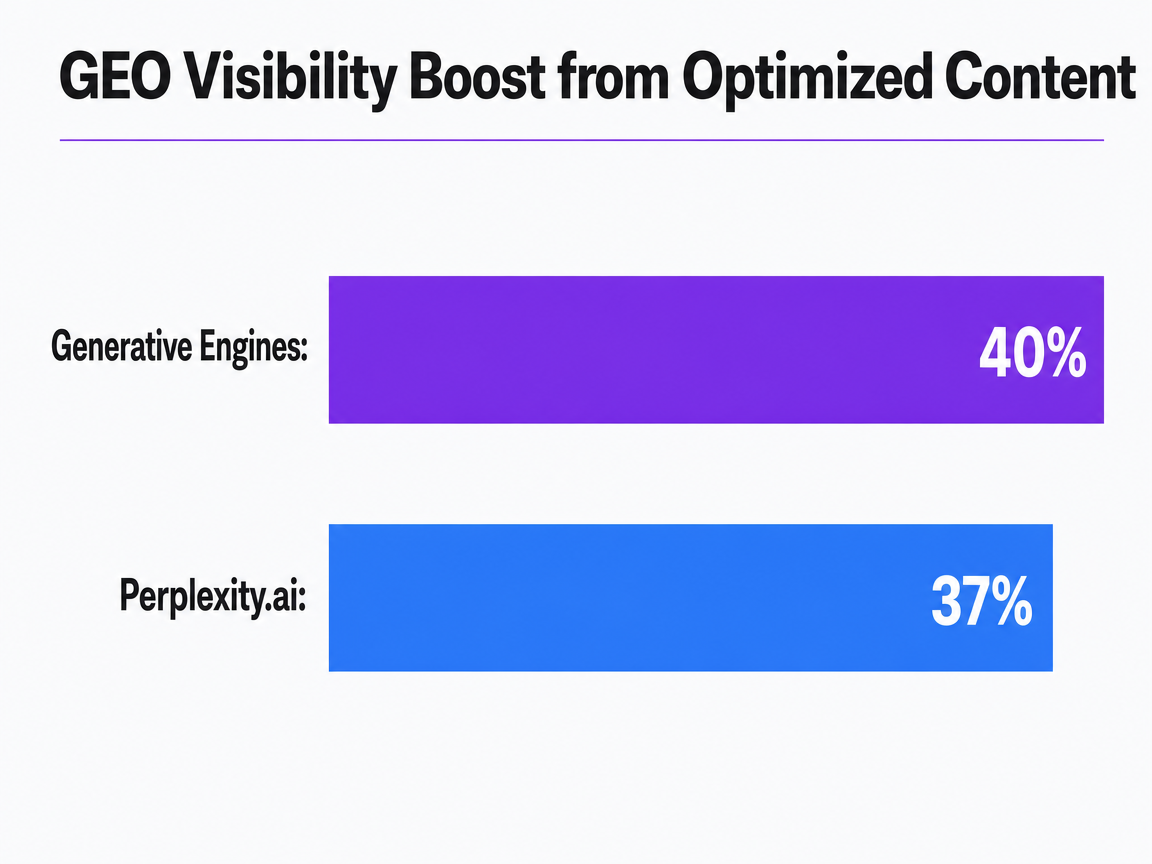 GEO Visibility Boost from Optimized Content
Percentage increase in visibility in generative engine responses for content optimized using GEO methods.
Six LLM Visibility Analysis Tools Graded for Agency Delivery
Profound — Prompt-Set Monitoring Across ChatGPT, Perplexity, Gemini, and Claude
Profound is built around prompt-set monitoring: an agency loads a defined list of buyer-intent prompts per client, and the platform runs them at scheduled intervals across ChatGPT, Perplexity, Gemini, and Claude, then reports how often the client brand appears in the generated answer and which competing brands appear alongside it.
The measurement ceiling sits at layers one and two of the four-layer model. Mention rate is the primary metric. Citation-source lists are captured where the underlying engine exposes them — Claude's web search tool returns cited sources with each response 22, and Perplexity surfaces citations natively, so Profound can attribute position for those engines. Gemini and ChatGPT citation extraction is less complete because those surfaces expose sources inconsistently.
For an agency running 30 to 60 accounts, the operational fit is the multi-workspace structure. Each client sits in its own prompt library with separate competitor sets, which keeps QBR exports clean. The gap is factual support scoring; Profound does not evaluate whether a cited passage actually substantiates the sentence it is attached to, which matters because prior systems left roughly half of generated sentences unsupported 10.
Profound suits agencies whose clients ask primarily about presence and share-of-mention across engines and who do not yet need citation-support audits inside the same tool.
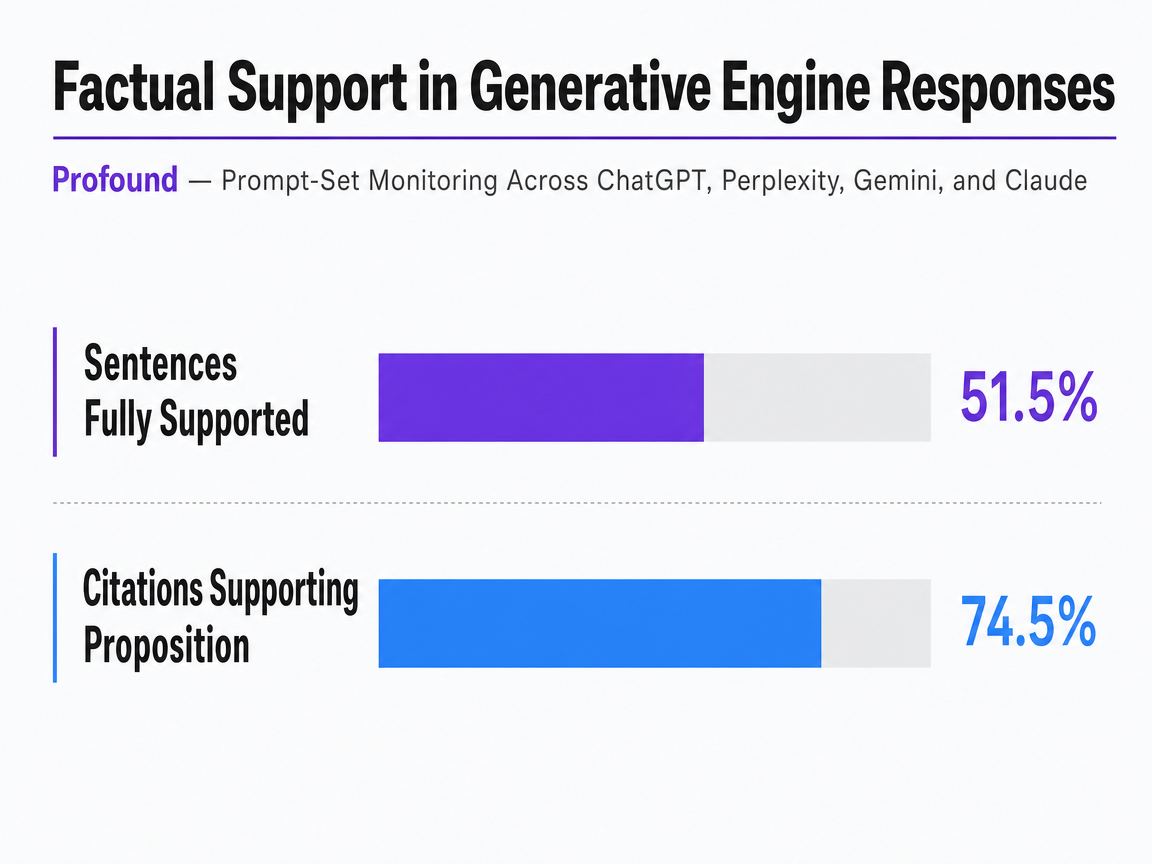 Factual Support in Generative Engine Responses
Breakdown of factual accuracy and citation support in answers from generative engines like Bing Chat, NeevaAI, Perplexity, and YouChat, according to a critical survey.
Peec AI — Competitive Share-of-Voice and Citation-Source Breakdowns
Where Profound emphasizes prompt-level presence, Peec AI centers on competitive share-of-voice. The platform tracks the percentage of monitored prompts in which each competitor is named, then breaks down the citation sources the engine drew from to construct the answer — Reddit threads, review aggregators, industry publications, and the client's own domain.
That source breakdown maps directly to the four gatekeepers isolated in the 252,000-trial competitive citation study: topic mismatch, price omission, recency, and lower list position 4. If a competitor is winning citations because it is being pulled from a G2 category page or a recent Reddit thread that the client is absent from, Peec AI surfaces the source, which turns the analysis into an actionable content and PR brief rather than a mention count.
The workspace model handles competitor-set overlap well: an agency running two SaaS clients in adjacent categories can share a competitor library and diff the citation-source mix between them. The weakness is citation-position weighting. Peec AI reports whether a source was cited, not where it ranked in the citation list, which C-SEO Bench identifies as a distinct and more informative metric 11.
Peec AI fits agencies whose renewal conversations turn on competitive positioning rather than raw visibility trending.
AthenaHQ — Citation-Position Tracking and Source-Support Scoring
AthenaHQ pushes measurement into layers two and three. In addition to mention and citation frequency, it tracks the ordinal position of each citation in the engine's source list and runs a support-scoring pass that flags citations where the attributed sentence is not substantiated by the linked page.
Citation-position matters because the lift ceilings reported in the GEO literature are meaningful only if a tool can detect where those gains land. The original GEO paper reported up to a 40% visibility boost in generative engine responses and up to 37% on Perplexity from optimized content 1. A later feature-level study across GPT-4o-mini, Gemini, and Qwen-plus reached 18.31% citation visibility on GPT-4o-mini, a 37% relative gain over baseline, while token-level heuristics often failed to beat that baseline at all 3. An agency running an optimization program needs a tool that can distinguish a first-position citation gain from a fifth-position gain, because those two outcomes have different downstream value.
AthenaHQ's support-scoring is closest to what the critical GEO survey identified as the missing measurement layer, where only 51.5% of sentences were fully supported across prior systems 10. The cost is throughput: support scoring per citation is slower than mention counting, which constrains how many prompts an account can run daily.
AthenaHQ fits agencies with clients in regulated verticals where citation accuracy carries brand risk.
Otterly.AI — Prompt Library Scaling for Mid-Book Agencies
Otterly.AI is engineered for prompt throughput. The platform's core capability is running large prompt libraries — hundreds to low thousands of prompts per client — against ChatGPT, Perplexity, and Google AI Overviews on a scheduled cadence, then rolling results into weekly delta reports.
For an agency with 40 accounts and a lean analyst team, prompt-library scale is the constraint that determines whether visibility monitoring is a viable service line or a bottleneck. A single client's decision funnel typically requires 80 to 200 prompts to cover awareness, comparison, and conversion-adjacent queries. Multiply that by a book of business and the manual-audit alternative becomes impossible to staff.
Otterly.AI's tradeoff is analytical depth. The tool reports mention rate, sentiment, and source lists, but competitive share-of-voice and citation-position analysis are lighter than in Peec AI or AthenaHQ. It also does not run factual-support scoring, so the 51.5% sentence-support ceiling identified in the critical GEO survey remains a blind spot inside the platform 10.
Otterly.AI fits agencies whose primary constraint is prompt volume across many clients rather than metric depth on any single account, and it pairs cleanly with a secondary tool that handles citation-position or support-scoring on a smaller set of high-priority prompts.
Scrunch AI — Content-Diagnostic Layer for Why a Brand Loses Citation
Scrunch AI takes a diagnostic angle. Rather than monitoring visibility trends, the platform ingests a client's content library and scores individual pages against the citation gatekeepers that determine whether an answer engine pulls from that page or from a competitor's.
The scoring model tracks against the four factors isolated in the competitive citation study: topical alignment to the prompt, price and specification transparency, recency signals, and list-position depth on the source page 4. When a client is present in mention tracking but consistently losing citation to a competitor, Scrunch AI's diagnostic pass identifies which pages are failing on which gatekeepers, converting the analysis into a content brief rather than a dashboard observation.
The platform's limit is that it audits owned content, not the live engine response. It infers why a page should or should not be cited based on the gatekeeper model, then relies on a separate monitoring tool to confirm whether re-optimized pages actually moved position. C-SEO Bench frames this as the difference between predicting citation eligibility and measuring citation ranking outcomes 11.
Scrunch AI fits agencies that already run a monitoring tool and need a diagnostic layer to explain movement to clients and prioritize content-team work against a fixed retainer.
Vectoron — Workflow Layer Above the Monitoring Stack
The five tools above measure. Vectoron sits one layer up: it takes visibility signals from an agency's monitoring stack — prompt performance, competitor share, citation-source gaps, content-diagnostic scores — and routes them into a specialist-strategist workflow that ranks recommendations, produces the content or PR work required to address them, and holds every output for human approval before it ships.
The category is different on purpose. Answer engines have shifted information seeking from ranked lists to synthesized answers 14, which means the response to a visibility gap is rarely a single tactic. Winning a citation position typically requires coordinated moves across content structure, source-page recency, competitive comparison coverage, and off-domain mentions on the sources the engine actually pulls from. Vectoron's Brand Intelligence layer maintains the client's positioning, competitor set, and voice so that the recommendations and drafts routed for approval stay consistent across those coordinated moves.
What it does not do is replace the monitoring tools. Vectoron consumes their outputs. The operational value shows up in the analyst-hours line: instead of one specialist per client translating dashboards into briefs, the workflow layer produces the ranked, reasoned recommendations directly, and the SEO lead approves or edits before execution.
Run live LLM visibility analysis on competitors now
Test advanced visibility tools risk-free and benchmark your clients’ LLM performance against industry leaders in real time.
Agency Delivery Economics: Tool Stack Cost vs. Manual Prompt Audits
The unit economics of LLM visibility monitoring get decided at the prompt-library level. A typical mid-market client needs 80 to 200 prompts to cover awareness, comparison, and conversion-adjacent queries across the engines that matter — ChatGPT, Perplexity, Google AI Overviews, Claude, and Gemini. Running that library once, manually, across five engines produces 400 to 1,000 individual answer captures per refresh cycle.
At an analyst loaded cost of roughly one hour per 40 to 60 captures — including screenshotting, competitor tagging, citation extraction, and QA — a single monthly refresh on one client absorbs 8 to 25 analyst hours. Multiply by a book of 30 accounts and the manual path consumes a full-time analyst before any diagnostic work, brief writing, or client communication happens. The math gets worse with scheduled cadence: weekly refreshes for high-priority accounts push the same book past two headcount.
Tooling replaces the capture-and-tag layer, not the analytical layer. Public pricing across the category clusters into three models:
- Per-brand monthly seats (Profound, Peec AI, Otterly.AI typically publish in the low-to-mid three figures per brand per month)
- Per-prompt volume tiers (AthenaHQ and Scrunch AI meter on prompt runs and citation-audit depth)
- Per-workspace enterprise contracts (gated, quoted per engagement)
Where pricing is gated, the reliable comparison is the pricing axis itself — per-brand pricing scales predictably with client count, per-prompt pricing scales with library depth, and per-workspace pricing amortizes across an agency's full book.
The break-even is straightforward: if a tool subscription costs less than the analyst hours it replaces at the refresh cadence the client actually needs, the tool ships. If it costs more, the client is paying for dashboard access rather than analysis, and the retainer economics do not survive audit.
What These Tools Cannot Do Yet
Every platform graded above measures a subset of the four-layer model, and none of them close the measurement gap that matters most for defensible client reporting: whether the answer engine is actually telling the truth about the brand it cites.
The critical GEO survey covering Bing Chat, NeevaAI, Perplexity, and YouChat found that only 51.5% of sentences were fully supported by their attached sources, and 74.5% of citations actually substantiated the proposition they were attached to 10. A tool can report that a client is cited in position two, and the sentence attributed to the client can still misrepresent the source page. Support scoring is expensive to run at prompt-library scale, which is why most platforms either skip it or sample it, and why the ceiling on citation-accuracy claims stays low across the category.
Cross-engine generalization is the second gap. A feature-level study across GPT-4o-mini, Gemini, and Qwen-plus showed that token-level GEO tactics that lifted one engine often flattened on another 3. Tools that report a single visibility score across engines are averaging out signal that a client needs disaggregated to act on.
Citation-ranking evaluation is the third. C-SEO Bench argues that whether a citation moved from position five to position two is a more informative measure than whether it appeared at all 11, and most tools still report the binary. Agencies should note these gaps in QBRs rather than paper over them — clients audit dashboards, and a measured admission of measurement limits protects the retainer better than a confident number that cannot be reproduced.
See How Top Agencies Use LLM Visibility Data for Competitive SEO Edge
Request a tailored walkthrough of advanced LLM visibility analysis tools and methodologies leveraged by leading agencies to benchmark content performance and uncover competitor strategies across key digital channels.
If a Book of Business Skews Toward News, Retail, or Local Verticals
Vertical mix changes which visibility metrics matter most, and the click-loss data makes the divergence concrete. A book weighted toward news publishers is running against DCN's -7% median for news brands over an eight-week window in mid-2025 6on one end, and DMG Media's reported CTR declines of up to 89% on individual properties on the other 9. Two news clients with similar traffic profiles can sit two orders of magnitude apart on the same underlying trend, which means mention-rate dashboards will look identical while the revenue conversations diverge sharply.
Retail and comparison-heavy books have a different tell. The competitive citation study found that price omission was one of four gatekeepers determining which source wins citation 4, so a retail client whose product pages hide pricing behind a lead form is losing citation share on a structural attribute a mention-rate tool will not surface. Peec AI's source-breakdown view and Scrunch AI's diagnostic pass both address this directly; Profound and Otterly.AI do not.
Local-services books face a portfolio-wide 42% drop in organic clicks reported across 64 sites since AI Overviews expanded 17. Prompt libraries for local clients need geo-modified variants per market, which pushes the constraint back to Otterly.AI's throughput advantage. Match the tool to the vertical's actual failure mode, not to the demo.
What Agencies Can Measure Natively Before Buying a Tool
A defensible tool purchase starts with a clear read on what an agency can already measure without adding a subscription. Google Search Console logs AI Overview impressions and clicks inside the standard Performance report 20, which means a client's AI Overview exposure and residual click-through are visible in the same data source the SEO team already reports against. Filtering by query cohorts where Overviews are known to trigger produces a directional read on the CTR compression documented in field studies — a 38% organic click reduction on AI Overview queries in one randomized experiment 7.
Google's own AI Features guidance confirms that pages need only be indexed and eligible for Search snippets to appear as supporting links in AI surfaces, with no additional technical requirements 19. Agencies can audit snippet eligibility across a client's priority URLs before assuming a visibility gap is a monitoring problem rather than an indexing one.
For Claude, the platform's web search tool exposes cited sources in the response payload 22, and Anthropic's API returns citation references when the citation flag is enabled on search-result outputs 23. A small scripted harness against those endpoints produces a manual citation-share baseline per client. If native measurement flags a real gap, tool spend is justified. If it does not, the retainer holds without one.
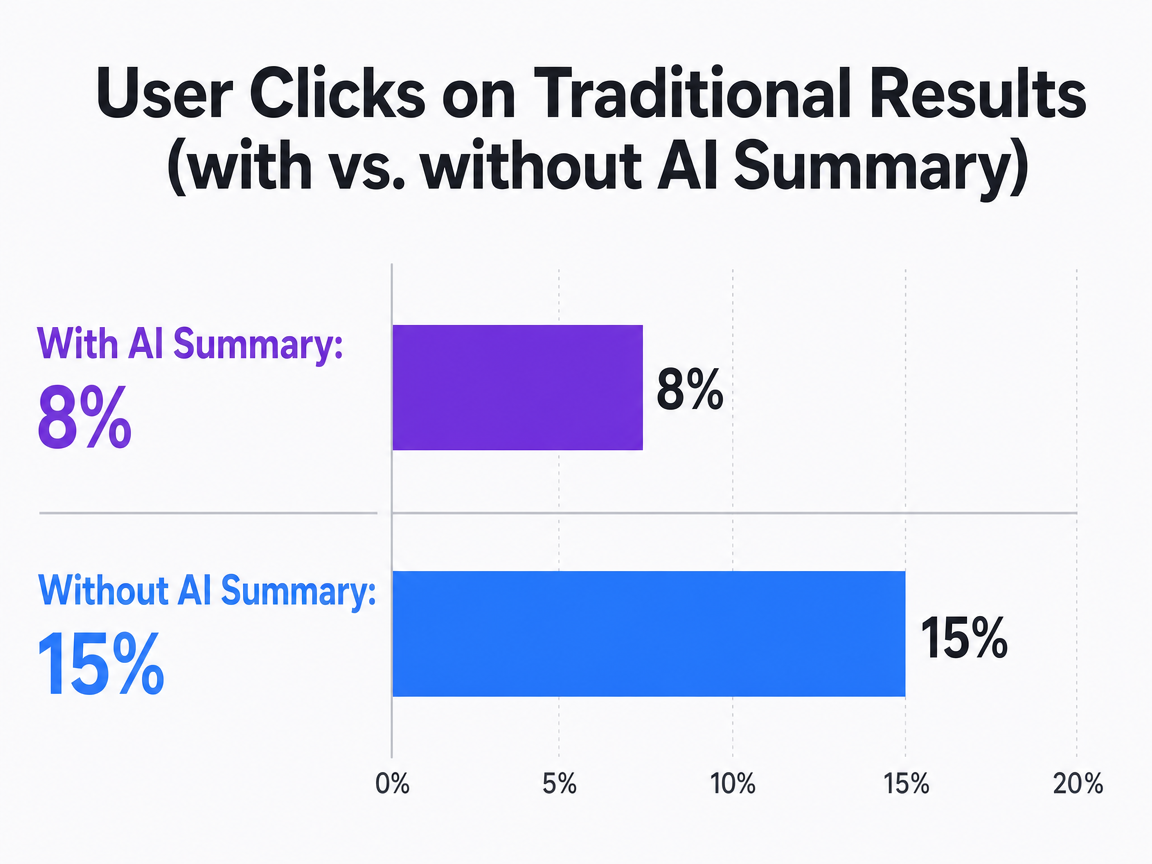 User Clicks on Traditional Results (with vs. without AI Summary)
Comparison of the percentage of user visits that result in a click on a traditional search link when a Google AI summary is present versus when it is not.
Frequently Asked Questions
References
- 1.GEO: Generative Engine Optimization.
- 2.Do people click on links in Google AI summaries?.
- 3.Feature-Level Multi-Objective Optimization for Generative Engines.
- 4.What Gets Cited: Competitive GEO in AI Answer Engines.
- 5.The Impact of Google AI Summaries and Google AI Overviews ....
- 6.Facts: Google's push to AI hurts publisher traffic.
- 7.Study Confirms Google AI Overviews Cut Organic Clicks 38%.
- 8.Google's AI overviews linked to lower publisher clicks.
- 9.Publishers fear AI summaries are hitting online traffic.
- 10.A Critical Survey of Generative Engine Optimization (2023– ...).
- 11.C-SEO Bench: Does Conversational SEO Work?.
- 12.A benchmark for REtrieval and Automated citationS Of ....
- 13.ALCE: An Automatic Benchmark for Large Language Model ....
- 14.Position: Generative Engine Optimization ....
- 15.Will Google's AI Overviews kill news sites as we know them?.
- 16.AI overviews: How are publishers adapting to the rise of ....
- 17.Google AI Overviews cut search clicks 42%: Report.
- 18.Impact of Google AI Overviews on Click-Through Rates.
- 19.AI Features and Your Website | Google Search Central.
- 20.Google Search updates.
- 21.Generative AI in Search: Let Google do the searching for you.
- 22.Web search tool - Claude Platform Docs.
- 23.- Anthropic API.