
Key Takeaways
- Query specificity, not word count, predicts lead quality—score keywords against geography, eligibility, comparison, service modifier, urgency, and named entity signals rather than ranking lists by length 12.
- Tag every long-tail candidate by intent before briefing a page, because transactional queries are scarce and templates built for Target Finding, Decision Making, and Exploration each demand different page jobs 7, 11.
- Build one resource per intent cluster instead of a page per wording variation; per-variation spinning risks Google's scaled-content-abuse policy and dilutes the helpful-content criteria that actually rank 5, 6.
- Demote impressions and average position to diagnostics and lead reporting with qualified-lead rate by intent cluster, wiring Search Console, Analytics, and CRM stages into one attribution chain 1, 10.
Specificity, Not Word Count, Is the Real Lead-Quality Signal
The long-tail conversation inside most agencies still runs on a shortcut: longer queries convert better. The underlying research does not support that claim as cleanly as the pitch decks suggest. What actually predicts qualified-lead behavior is query specificity, and specificity is a semantic property, not a character count.
The clearest evidence comes from a CHI study of 5,115 unique queries that classified searches as narrow or general and measured length across both groups. Narrow queries averaged 4.51 terms and 26.6 characters, while general queries averaged 2.10 terms and 13.06 characters 12. That is a meaningful gap, and it is the reason the “longer = better” heuristic keeps surviving despite its limits. Narrow queries really are longer on average, and 62% of the sample fell into the narrow category 12.
The same study is explicit that specificity sits on a continuum and that short queries can be narrow. A three-word phrase naming a city, an eligibility condition, or a competitor brand carries more commercial signal than a seven-word informational question. A separate information-retrieval review reinforces the point directly: query specificity cannot be defined primarily by query length, and long queries can express complex needs that are difficult to satisfy, sometimes producing worse click behavior than shorter ones 8.
For an agency running SEO delivery across a portfolio, the operational consequence is straightforward. Keyword lists ranked by word count will misallocate production budget. Lists ranked by specificity signals—geography, eligibility, comparison, service modifier, urgency, named entity—will not. The next section names those signals so they can be scored consistently across clients rather than inferred one keyword at a time.
The Six Specificity Signals That Actually Predict Intent
Specificity in a query comes from identifiable linguistic markers, not from stretching a phrase to five or seven words. The CHI specificity study catalogued the practical markers directly: locations, comparisons, questions, instructions, dates, numbers, names, and URLs 12. Six of those, adapted for commercial SEO delivery, form a scoring rubric an agency can apply the same way across a legal client, a DSO group, and a home services brand.
- Geography. A city, neighborhood, ZIP, or “near me” construction. “Brooklyn personal injury lawyer” is three words and unmistakably transactional. Geography is the single strongest specificity signal for local service verticals because it filters non-serviceable traffic before the click.
- Eligibility. Language that narrows the searcher to a qualifying condition—insurance carrier, age bracket, diagnosis, income threshold, licensure status. “Medicaid dentist accepting new patients” qualifies the lead in the query itself. Eligibility modifiers are the reason a shorter phrase can outperform a longer informational question on booked-consult rate.
- Comparison. Bracket structures like “vs,” “or,” “alternative to,” and “best.” Comparison queries sit in Decision Making territory and tend to generate more clicks per session because the searcher is actively evaluating 9. They are not the closest to conversion, but they are the closest to a shortlist.
- Service modifier. The verb or product qualifier that narrows the offering: “emergency,” “same-day,” “pediatric,” “flat-fee,” “no-appointment.” These modifiers change which landing page can legitimately satisfy the query, which is why generic service pages under-perform against them.
- Urgency. Time markers—“tonight,” “24 hour,” “walk-in,” “next-day”—and instruction verbs like “book,” “schedule,” “call.” Urgency compresses the funnel; an HVAC “emergency AC repair tonight” query behaves closer to a transactional single-click pattern than a comparison search does 9.
- Named entity. Brand, competitor, product line, procedure name, statute, or drug name. Named entities were the defining trait of Target Finding behavior in the CWI product-search study, where users with a specific target commonly issued queries containing brands and product features 7. Scope matters: that study measured product search, so the signal transfers cleanly to retail and e-commerce and needs interpretation for professional services, where the “entity” is more often a procedure, statute, or condition than a SKU.
Scored together, these six signals give a keyword a specificity profile independent of word count. A query hitting three or more signals—say, “same-day emergency root canal Brooklyn”—deserves a dedicated landing page and CRM-stage tracking. A query hitting one or none belongs in a cluster resource, not a standalone page.
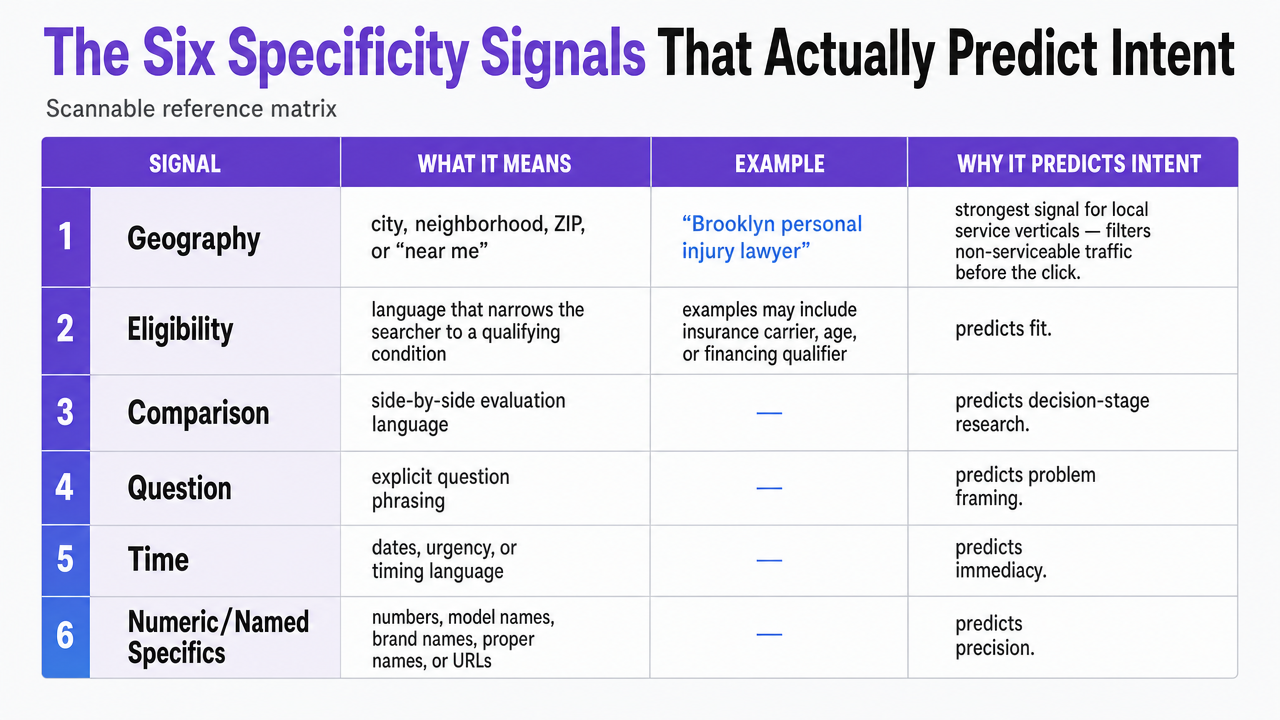 Visualize the six specificity signals framework introduced in this section as a scannable reference matrix for the reader
An Intent Taxonomy Agencies Can Operate Against
Informational, Navigational, and Transactional Baselines
The oldest and most durable intent taxonomy in web search sorts queries into three buckets: informational, navigational, and transactional. In the peer-reviewed classification study that analyzed roughly 1.5 million queries, 80.6% were informational, 10.2% navigational, and 9.2% transactional 11. That distribution matters more than it looks. Transactional intent—the intent that closes a booked consult, a scheduled procedure, or a service call—is scarce. Fewer than one in ten queries in that dataset carried it.
Scope the number honestly before using it in a client conversation. The dataset was drawn from Dogpile and historical search logs, not current Google behavior, and the automated classifier reached 74% accuracy with roughly a quarter of queries flagged as vague or multifaceted 11. The distribution is directional, not a live benchmark. What survives is the shape of the problem: informational queries dominate volume, transactional queries dominate revenue, and an agency that ranks keyword lists by search volume will systematically over-invest in the wrong bucket.
The operating consequence is that long-tail programs have to be engineered to surface transactional intent inside a much larger informational sea. A keyword taxonomy that tags every candidate with one of the three baselines, before any page is briefed, prevents the default drift toward informational blog posts—the cheapest to produce and the least likely to book a lead.
Target Finding, Decision Making, and Exploration in Commercial Search
The three-bucket baseline is coarse. A more useful overlay for lead qualification comes from a CWI study that combined survey responses with search logs from a commercial product-search engine and identified three behavioral groups: Target Finding, Decision Making, and Exploration 7. Each maps to a different landing-page job and a different CRM outcome.
Target Finding users arrive with a specific target in mind. In the study, their initial queries averaged 7.35 words and commonly contained brand names and product features, and their sessions showed more focused behavior than the other two groups 7. In commercial terms, these are the searchers closest to a booked appointment or a completed form. Decision Making users are actively evaluating options and generate more clicks per session as they compare. Exploration users are browsing without a defined target and produce the loosest signal for lead qualification.
Two scope caveats keep this overlay honest. The 7.35-word Target Finding average is a product-search finding and transfers cleanly to retail and e-commerce; in professional services, the equivalent behavior often appears in shorter queries containing a procedure, statute, condition, or provider name rather than a SKU string 7. And behavior groups are probabilistic, not deterministic—the same query can serve Target Finding for one visitor and Decision Making for another.
For agency delivery, the overlay is most useful as a landing-page brief filter. Target Finding queries deserve pages built to convert in a single visit: direct booking, clear eligibility, a phone number that rings a qualified intake. Decision Making queries deserve pages that support comparison without forcing a premature decision. Exploration queries belong in cluster hubs that capture the visit and hand it back later.
Navigational, Support, and Comparison Sub-Intents That Change Page Design
Underneath the baselines, a finer product-search taxonomy separates queries into navigational, transactional, support, comparison, and informational sub-intents, and reports behavioral differences that matter for page design. Navigational queries are significantly shorter. Support queries tend to be longer and more descriptive. Transactional queries commonly involve a single click, while comparison and informational queries generate more clicks because they are exploratory 9.
Those behavioral fingerprints change what a landing page has to do. A transactional long-tail page—“same-day crown replacement,” “file a workers comp claim in Ohio”—has one job: satisfy the query in a single visit and route to a conversion event. Extra navigation, related-content rails, and comparison widgets drain the click. A comparison long-tail page—“invisalign vs traditional braces cost,” “assisted living vs memory care Michigan”—has to hold the visitor across multiple internal clicks and structured comparisons without forcing a premature conversion. A support long-tail page answers a descriptive question thoroughly enough that the visitor either self-serves or converts into a qualified call.
Practically, this means the intent tag assigned during keyword research should drive the page template, not just the meta description. Agencies that ship the same template against every long-tail query lose transactional efficiency at the top of the funnel and comparison depth in the middle—and neither loss shows up cleanly in a rankings report.
Test long-tail keyword strategies in real time
See how targeted content attracts higher-intent leads by publishing and measuring real campaign results during your trial.
AI Overviews Broke Impression-Based Reporting
The reporting cadence most agencies inherited—impressions up, average position improving, click-through rate steady—was built for a results page that no longer exists on a growing share of queries. AI Overviews sit above the organic results, answer the question inline, and route a much smaller fraction of visitors to any cited source. A 2026 preprint analyzing panel data on Google Search behavior reported that clicks to sources cited within AI Overviews occurred in roughly 1% of visits to pages containing an AI Overview, and that AI Overviews were associated with fewer clicks overall and more browsing sessions ending on the results page itself 1.
Scope that number before it becomes a slide. The study is a preprint, its estimate depends on the panel composition, query mix, interface version, and reporting period, and it should be read as directional evidence rather than a settled per-query benchmark 1. Long-tail exposure to AI Overviews also varies by vertical and question type—definitional and comparison queries surface Overviews more consistently than a “book same-day” transactional query does. The direction of travel is clear enough to act on regardless: impression growth on long-tail keywords no longer converts to click growth at the ratio SEO programs quoted three years ago.
For agency delivery, two reporting habits stop working. Ranking-and-impression dashboards inflate the appearance of progress on exactly the informational long-tail terms most likely to be intercepted by an Overview. And Search Console CTR, defined as clicks divided by impressions 10, drifts downward on those same terms without any drop in content quality—because the denominator now includes impressions that were structurally unlikely to click through in the first place.
The defensible move is to demote impressions and average position to diagnostic metrics and promote qualified-lead outcomes to the headline. Long-tail programs earn their budget on booked consults, qualified calls, and CRM-stage progression, not on visibility counts that the SERP itself has decoupled from clicks. Section 8 wires that measurement chain end to end; the point here is that the old chain broke, and continuing to lead client conversations with impression trends now understates good work on transactional terms and overstates thin work on informational ones.
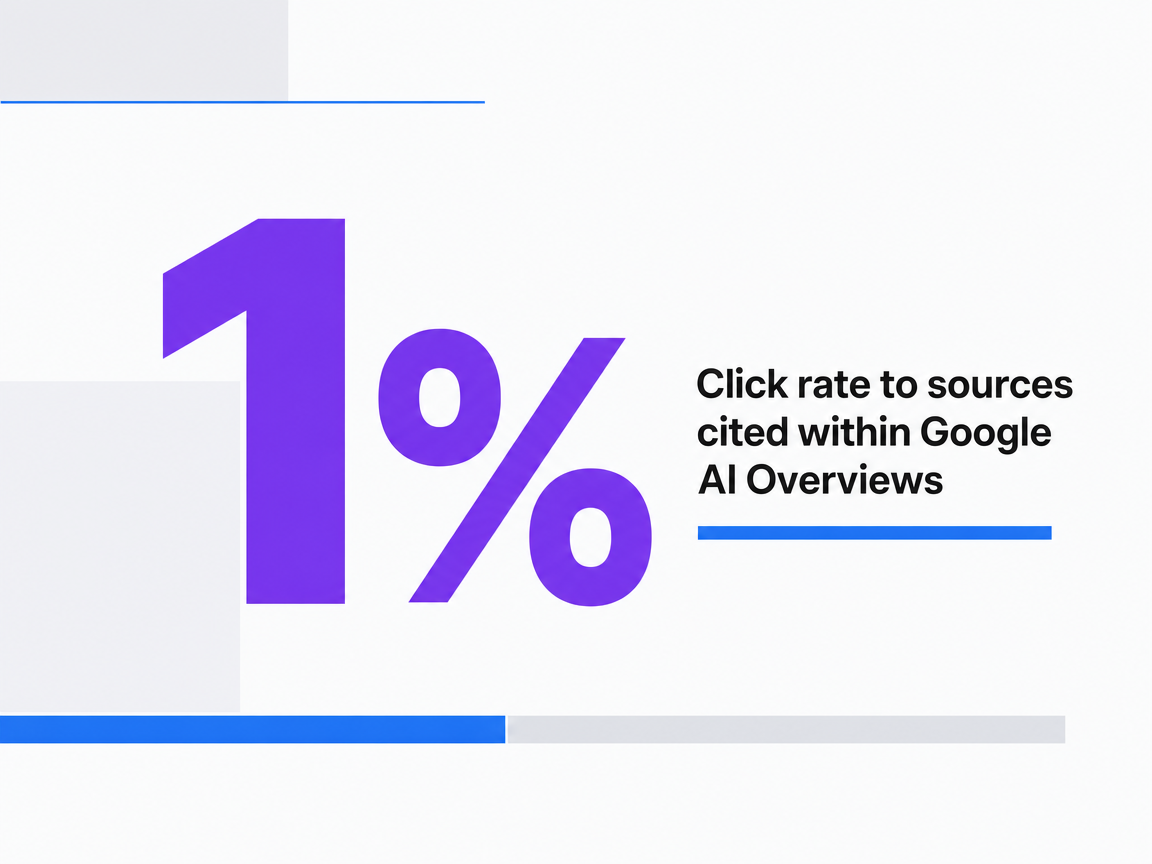 Click rate to sources cited within Google AI Overviews
Click rate to sources cited within Google AI Overviews
One Strong Resource per Intent Cluster Beats a Page per Variation
The instinct to spin up a page for every wording variation of a long-tail phrase is the fastest way to burn production budget on assets that neither rank nor convert. Google's own generative-AI optimization guide is direct about it: teams should focus on what users want and avoid excessive content creation for every possible search variation, because pages produced primarily to manipulate rankings or AI responses can violate the scaled-content-abuse policy 6.
The alternative is a cluster resource sized to the underlying intent, not the underlying phrase count. Ten variations of “affordable dental implants near me,” “cheap tooth implant cost,” and “low-cost dental implant financing” describe one Decision Making intent with one landing-page job: help a price-sensitive patient compare options and book a consult. One page built to satisfy that intent—original pricing information, financing eligibility, comparison tables, first-hand clinical explanation—matches the quality criteria Google's helpful-content guidance actually asks for: original information or analysis, substantial value compared with other results, demonstrated expertise, and clear sourcing for a defined audience 4.
Structured data earns its keep on those cluster pages by making the page's classification legible to search systems. Google's documentation notes case-study results including a 25% higher CTR for Rotten Tomatoes pages enhanced with structured data and an 82% higher CTR for Nestlé pages appearing as rich results—site-specific case studies, not benchmarks any agency should promise a client 2. Structured data does not create intent or guarantee rankings; it clarifies what the page is once the underlying resource is worth clarifying.
The operating rule for agency delivery is one page per intent cluster, template chosen by the intent tag from Section 3, and structured data applied to help search systems interpret the resource accurately. Wording variations belong in on-page copy, headings, and internal anchors—not in duplicated URLs.
Where AI-Assisted Production Crosses Google's Scaled-Content Line
AI assistance is not the violation. Purpose is. Google's spam policy defines scaled content abuse as generating many pages primarily to manipulate rankings rather than help users, and it names generative AI output that adds no value and pages built around search keywords that make little sense to readers as the archetypal examples 5. The policy applies the same test to human-written, AI-assisted, and hybrid production: does the page provide meaningful value to the person who arrived from the query, or does it exist because the query exists?
Three production patterns fail that test in long-tail programs. The first is per-variation page spinning—taking one intent and shipping fifteen URLs that reword the same phrase to catch every modifier permutation. The second is template-filled landing pages that swap city or service names into identical body copy without original information about the local market, the specific service, or the client's actual expertise. The third is AI-generated answers to long-tail questions that summarize what other pages already say without first-hand analysis, original data, or the sourcing and audience definition Google's helpful-content guidance treats as quality criteria 4.
The approval gate that keeps AI-assisted production on the right side of the line is editorial, not technical. Every long-tail page needs a named human reviewer who can attest to three things before publish: the page contains original information the reviewer verified, it targets a defined audience the client actually serves, and the intent tag from the keyword taxonomy matches what the page delivers. Volume is a symptom, not the offense; a hundred AI-assisted pages that each pass that gate are safer than ten hand-written pages that do not.
See How AI Pinpoints High-Intent Long-Tail Keywords for Scalable Lead Quality
Request a demo to explore data-driven workflows that automate long-tail keyword discovery, prioritization, and approval—enabling your team to deliver higher-qualified leads without additional headcount.
If You Manage Multiple Clients: Allocating Long-Tail Investment Across a Portfolio
The frame shifts here. Everything through Section 6 assumed a single program with a single keyword universe. An agency Head of SEO running 20 to 80 accounts is not solving that problem. The problem is deciding, across a mixed portfolio, which clients get aggressive long-tail investment this quarter, which get maintenance, and which get their production budget rerouted to a channel where AI Overview click erosion is not eating the ROI curve 1.
Two variables do most of the sorting work. The first is the density of transactional and Target Finding intent inside a vertical's long-tail universe—a legal intake keyword like “file workers comp claim [city]” carries more transactional weight per phrase than a senior living query like “what is memory care,” which sits deeper in informational and Exploration territory 7, 11. The second is a client's exposure to AI Overview interception on its dominant query types. Definitional and comparison long-tail queries surface Overviews more consistently than urgent transactional queries do, so a vertical whose lead flow depends on informational discovery bears more click erosion risk than one whose leads arrive on “same-day” and “near me” phrasing 1.
The table below is an allocation heuristic, not a pricing model. It uses illustrative verticals and qualitative exposure ratings grounded in the directional evidence from 1; it does not claim measured per-vertical click-loss figures the research does not provide.
| Client Vertical | Dominant Long-Tail Intent | Specificity Signals to Prioritize | AI Overview Click Erosion Exposure | Primary Lead-Quality KPI |
|---|---|---|---|---|
| Legal intake (PI, workers comp) | Transactional, Target Finding 7, 11 | Geography, eligibility, urgency 12 | Medium | Qualified intake call 10 |
| DSO / multi-location dental | Transactional, Comparison 9 | Geography, service modifier, eligibility (insurance) 12 | Low to Medium | Booked new-patient appointment 10 |
| Home services (HVAC, plumbing) | Transactional, single-click 9 | Urgency, geography, service modifier 12 | Low | Qualified service call 10 |
| Senior living | Decision Making, Exploration 7 | Geography, comparison, eligibility (care level) 12 | High | Tour request or form-to-SQL 10 |
Read the table as a triage tool. High-exposure verticals with Decision Making dominance—senior living is the clearest case—need long-tail investment concentrated on cluster resources deep enough to survive Overview interception and route the visit into a form or tour request, not thin pages chasing definitional volume. Low-exposure verticals with dense transactional intent—home services on urgent queries—can absorb more per-page production because each ranked page has a shorter path to a qualified call. The KPI column is the discipline: every account's long-tail budget defends itself on a CRM-stage outcome measured through the Search Console to Analytics to CRM chain in Section 8 10, not on the impression trend that the SERP has already decoupled from clicks.
Closing the Loop: Search Console to CRM Stage as One Reporting Chain
The reporting chain that defends a long-tail program has three links, and each measures a different stage of the same journey. Search Console reports query-level impressions and clicks on the results page itself, defining CTR as clicks divided by impressions 10. Google Analytics picks up after the click and measures sessions, on-site behavior, and conversion events; a Search Console click is an interaction with a search result, while an Analytics session is a period of interaction with the site 10. The CRM measures what happens after the conversion event: whether the form fill became a qualified intake, whether the phone call reached a booked consult, whether the tour request advanced to a signed agreement.
Long-tail programs earn their budget on the third link, not the first. Search Console alone cannot establish lead quality, sales qualification, or revenue attribution—those require analytics events, call tracking, CRM stages, and closed-loop attribution back to the query that started the visit 10. The practical wiring is a landing-page URL structure that carries the intent tag from Section 3 through UTM parameters or a query-string convention, an Analytics event that fires on the qualified action (form submit, tracked call over a duration threshold, booking confirmation), and a CRM stage field that records the downstream outcome against the originating page.
Once that chain is wired, the report a client sees changes shape. Impressions and average position stay in the appendix as diagnostic reads on visibility. The headline becomes qualified-lead rate by intent cluster: how many booked consults did the transactional cluster produce this month, how many form-to-SQL conversions did the Decision Making cluster feed, how many exploratory sessions did the informational hub capture and hand back later. That framing survives the click erosion documented in Section 4 because it stops treating impressions as the product. The product is a CRM-stage outcome, and the long-tail keyword is the input the program can defend on its contribution to that outcome.
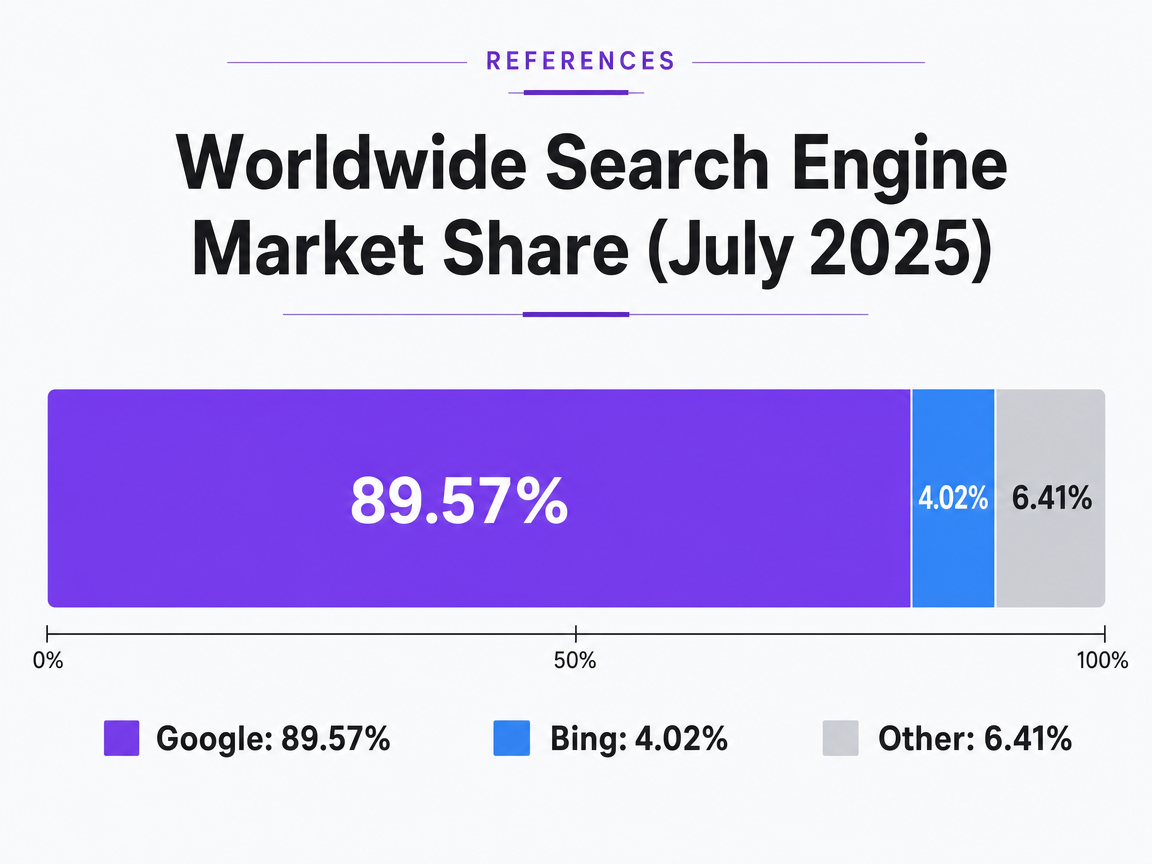 Worldwide Search Engine Market Share (July 2025)
According to StatCounter data for July 2025, Google held approximately 89.57% of the worldwide search engine market share, followed by Bing at 4.02%.
Frequently Asked Questions
References
- 1.Investigating Click Behaviors On Google Search Result Pages with AI Overviews.
- 2.Intro to How Structured Data Markup Works.
- 3.Search Engine Market Share Worldwide.
- 4.Creating Helpful, Reliable, People-First Content.
- 5.Spam Policies for Google Web Search.
- 6.Google's Guide to Optimizing for Generative AI Features on Search.
- 7.User Intent, Behaviour, and Perceived Satisfaction in Product Search.
- 8.Lookup or Exploratory: What is Your Search Intent?.
- 9.Analyzing Product Intents in Web Search.
- 10.Using Search Console and Google Analytics Data for SEO.
- 11.Determining the informational, navigational, and transactional intent of Web queries.
- 12.Understanding the specificity of web search queries.