
Key Takeaways
- Targeted reminder calls to high no-show-risk segments cut absenteeism from 29.2% to 22.8% when live agent time concentrates on the risky tail 1.
- Live-conversation outreach beats voicemail blasts because patients reached live were 2.43 times more likely to book and 2.39 times more likely to keep appointments 2.
- Predictive-model prioritization routes top-ranked contacts to live agents, dropping no-show rates to 26.4% versus 32.4% for voicemail-only recipients 3.
- Paid search built for ad-click-to-call conversion, with call extensions and tracking, achieved a 15.21% click-to-call rate in a high-intent hotline trial 10.
- Structured outbound calling to warm lists with defined attempt sequences booked appointments in 24% of 1,235 attempted calls in one clerkship program 7.
- Reminder cadence layered across text, email, and live call — each doing a distinct job — outperforms stacking the same message across three channels 11.
- Triage-first call handling routes qualified callers to bookers within 20 seconds, preventing volume spikes from collapsing call-to-booking rates during untriaged surges 5, 6.
- Mystery-call access audits use structured calls to expose broken intake scripts and quoted wait times before campaigns launch into a system that cannot convert 9.
- Trust-framed outreach messaging, which names the reason for the call before asking for a booking, reduces perceived barriers and outperforms availability-led scripts 8.
- DTC telehealth funnels require a qualification layer between click and consult to pull appropriate volume rather than the wrong volume that erodes retention 13.
- Approval-first AI execution lets agencies run these patterns across more locations without adding seats by automating production while humans keep judgment on every decision.
Why Qualified-Call Campaigns Look Nothing Like Brand Listicles
Most articles ranking for "marketing campaign examples" hand agency owners the same recycled deck: Nike, Dove, Old Spice, a 1984 Apple reference. None of that copy helps a strategist running paid and organic programs for a 12-location dental group whose CFO grades performance in booked chairs, not brand lift.
The campaigns that move the needle in legal, behavioral health, dental, home services, and senior living operate on a different physics. Success is a live human on the phone, a booked appointment, and a kept one. Peer-reviewed evidence across large-scale outreach programs confirms that structured, call-centered campaigns produce measurable booking outcomes when the mechanics are right 4.
This piece profiles ten campaign patterns built for that outcome, plus an eleventh execution model relevant to agencies scaling multi-channel work. Each pattern is anchored to a specific conversion lever: reaching high-intent contacts live, prioritizing outreach with prediction, and building the scheduling capacity to absorb what the campaign produces. Read it as a playbook, not a highlight reel.
The Three Mechanics Behind Every High-Converting Call Campaign
Strip away the creative variance and campaigns that produce booked, qualified calls in service verticals share three mechanics. Miss one and the media spend converts to noise, not appointments.
- The first is reaching intent live. A campaign that generates 400 form fills and 40 voicemails is not a campaign that generates 40 conversations — and conversations are the unit of conversion. Evidence from multi-center outreach programs shows that structured, call-centered workflows produce measurable appointment booking outcomes when live contact is the primary success event, not the intermediate one 4.
- The second is predictive prioritization. Blast outreach treats every contact as equivalent; predictive campaigns concentrate agent time on the segments most likely to book and least likely to no-show. The result is not just efficiency — it is a different unit economics per hour of caller labor.
- The third is absorption capacity. A campaign that produces 200 qualified calls into a scheduling system that can handle 80 same-week appointments loses the surplus. The bottleneck moves from acquisition to operations, and the client's CFO does not care where the leak sprang.
The ten patterns below each pull on at least one of these three levers. The strongest pull on all three.
Test Campaigns That Drive Qualified Call Volume
Launch and measure real call-focused campaigns risk-free for seven days to validate performance gains firsthand.
Ten Campaign Patterns That Produce Booked, Qualified Calls
Targeted Reminder Calls for High-Risk No-Show Segments
The reminder-call campaign is the oldest pattern in service marketing, and the version that works looks almost nothing like the mass SMS blast most agencies default to. The mechanic is segmentation: score the appointment book for no-show risk, then route a live agent call only to the high-risk tail.
A randomized trial of primary care patients flagged as high-risk showed the intervention arm posted a 22.8% no-show rate against 29.2% in the control arm, an absolute risk difference of 6.4 points 1. Scope matters here. The population was high-risk primary care patients, not a general book of business, and the labor cost of live calling was non-trivial even at that concentration.
For agencies, the pattern translates cleanly to legal intake follow-ups, dental recall queues, and behavioral health first-appointment risk. The lift is real, but the economics only work when the model concentrates caller time on the segments where a saved appointment covers several calls of labor. Blanket reminder calling on a full book is not this campaign.
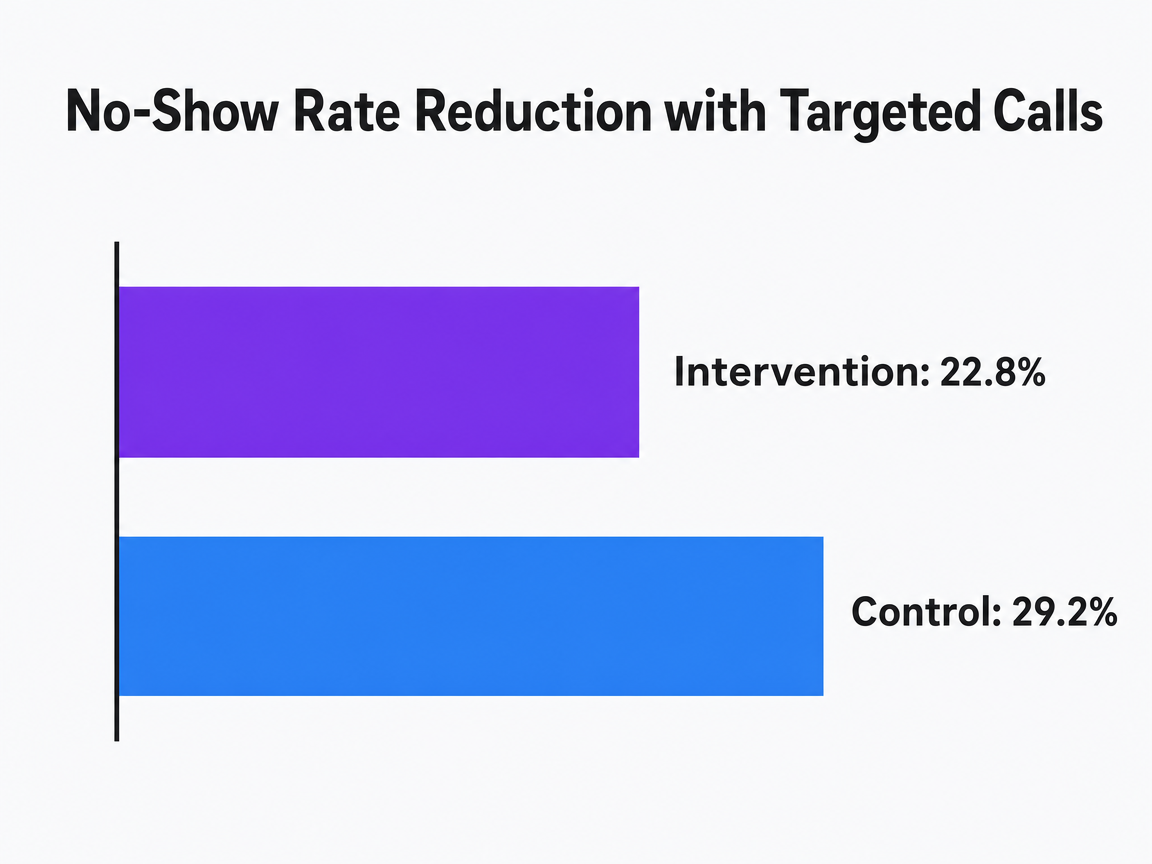 No-Show Rate Reduction with Targeted Calls
Compares no-show rates for patients who received targeted reminder calls (intervention) versus those who did not (control).
Live-Conversation Outreach Instead of Voicemail Blasts
Most outbound programs measure dials and leave voicemails. That measurement lies about the campaign's actual output. The conversion event is a two-way conversation, and everything upstream of it is production noise.
An observational study of diabetes patients during a sustained care disruption compared three outreach outcomes: reached live, voicemail only, and no contact. Patients reached live were 2.43 times more likely to book an appointment and 2.39 times more likely to keep the one they booked, versus no-contact patients 2. The cohort is narrow — COVID-era diabetes care — and the authors bundled portal messaging with phone contact, so the odds ratios sit on a specific setting rather than a universal benchmark.
The operational implication for a campaign brief is unambiguous. Agents should be graded on connect rate, not dial count, and dial windows should be tuned to when a segment actually answers. For a legal intake team or a home services phone room, that usually means evenings and weekend mornings, not the 9-to-5 block a call center runs by default. Voicemail is a delivery failure, not a soft touch.
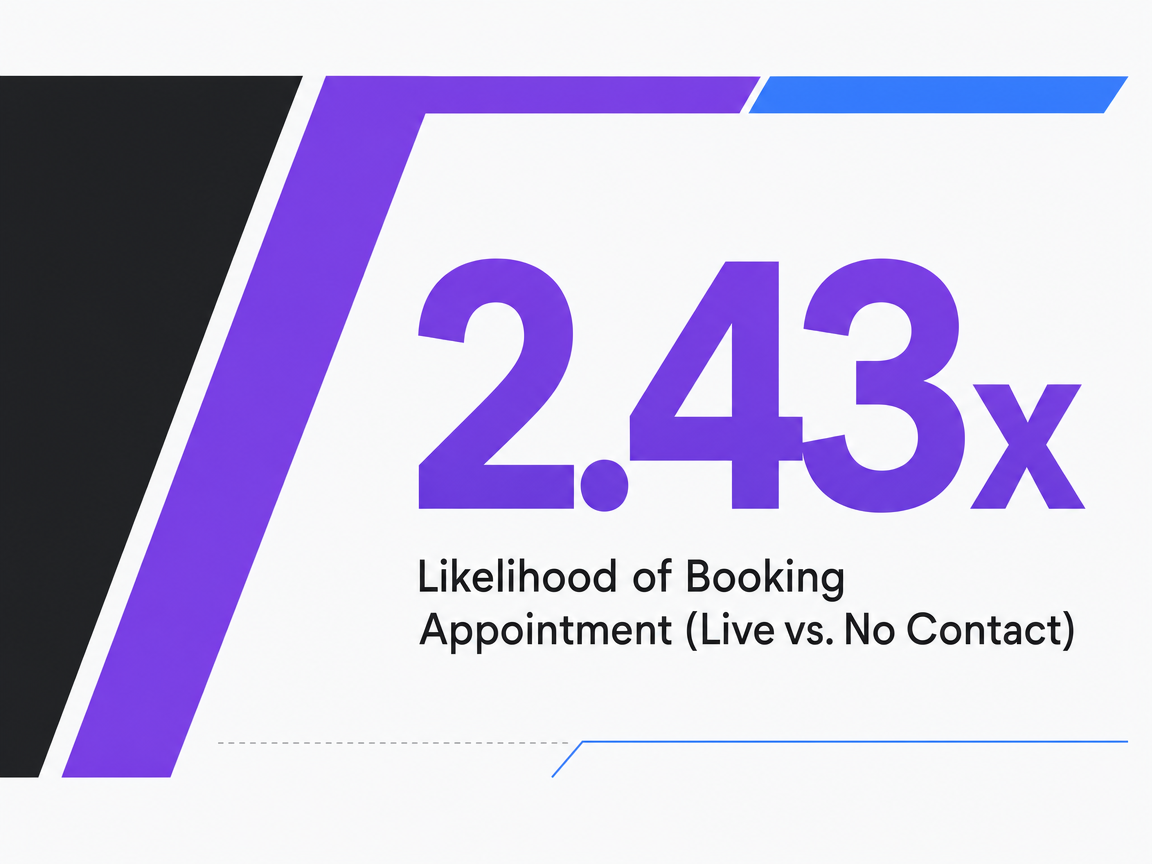 Likelihood of Booking Appointment (Live vs. No Contact)
Likelihood of Booking Appointment (Live vs. No Contact)
Predictive-Model Prioritization Instead of Blast Outreach
Predictive prioritization is the mechanic that separates a modern outreach campaign from a 2015 call list. Instead of dialing an alphabetized export, the model ranks contacts by probability of booking and probability of showing, then routes the top of the ranking to live agents.
A 2023 randomized quality improvement study paired a predictive model with telephone outreach against standard automated reminders. Among patients reached, the no-show rate was 26.4%, compared with 32.4% for patients who received only a voicemail 3. The intervention also narrowed access disparities across the studied population — a secondary outcome that matters when clients care about equitable access, but the primary read is that connection quality, not just contact volume, drives the delta.
For agencies, the campaign asset is not the dialer. It is the scoring model and the workflow that feeds prioritized contacts to human callers. Building that layer separates a phone room from a targeting program, and it is the piece most agencies still outsource to a spreadsheet.
Paid Search Built for Ad-Click-to-Call Conversion
Paid search campaigns aimed at booked calls are architected differently than campaigns aimed at form fills. Call extensions, call-only ads, and mobile-first bidding push the conversion event to the phone, and the landing page — if there is one — exists to reinforce the number, not to capture an email.
A randomized controlled trial of Google Ads placed against suicide-prevention keywords recorded 101 hotline calls from ad clickers, a 15.21% ad-click-to-call conversion rate 10. Scope discipline is required before that number travels into a client deck: this was a hotline context with unusually high intent and a single, obvious next step. It is not a universal benchmark for personal injury, HVAC, or dental.
What the study does validate is that paid search can be optimized against a call outcome with the same rigor as a form outcome, provided the tracking is set up to attribute calls to the click. Campaigns that skip call tracking or bury the number below the fold are optimizing against the wrong event and will underperform the achievable ceiling by a wide margin.
Structured Outbound Calling to Warm Lists
A warm-list outbound campaign works when the list has recent intent and the script has a clear next action. Skip either, and the program burns caller time on cold conversations that should never have been staffed.
A family medicine clerkship documented the mechanics at small scale. Of 1,235 attempted calls to an existing patient list, 24% resulted in a scheduled appointment 7. The setting was educational and the list was already tied to a care relationship, so the absolute rate is not a benchmark for a cold acquisition file. What transfers is the shape: a structured attempt sequence against a warm audience with a defined offer produces a measurable booking rate that operators can price against caller hours.
Agency application is direct. Reactivation of dormant leads, past patient recall for a dental group, and post-consultation follow-up for a personal injury firm all fit this pattern. The campaign artifact is a call playbook with defined attempt sequences, objection paths, and a booking hand-off — not a script and a phone.
Reminder Cadence Layered Across Channels
Single-channel reminders leave conversions on the table. The evidence brief on comparative effectiveness of appointment recall strategies synthesizes multiple recall approaches and informs how phone outreach layers with automated reminders in a broader kept-appointment strategy 11.
The design choice is cadence, not channel volume. A high-performing recall program stages an automated text at seven days, an email at three days, and a live call to the flagged high-risk subset at 24 to 48 hours. Each channel does a job the others cannot: text confirms, email documents, and the live call resolves ambivalence. Stacking three of the same message across three channels produces fatigue, not confirmation.
For a multi-location client, the campaign asset is the cadence rulebook and the exception logic — which contacts skip to a live call, which appointments trigger a two-day text instead of one. Agencies that ship a reminder program without those rules are selling a delivery service, not a campaign.
Triage-First Call Handling for Volume Spikes
A campaign that spikes inbound volume without a triage layer will drop qualified callers into hold queues and lose the ones who matter. This is where the front-of-line workflow becomes part of the campaign, not an operations concern.
AHRQ guidance on telephone triage and advice services emphasizes structured protocols to route callers safely and consistently, especially when volume surges 5. Real-world triage performance data reinforces the operational load: substantial out-of-hours call volume shifts the workload curve and exposes staffing gaps that a 9-to-5 model cannot absorb 6.
For agency-run campaigns in legal, home services, or specialty medical, triage translates to a call-flow design: identify the caller's intent in the first 20 seconds, route the qualified segment to a booker, and hand the rest to information capture or callback. Campaigns launched into an untriaged front desk will show a strong ad-to-call rate and a weak call-to-booking rate, and the client will blame the ads.
Access Audits and Mystery-Call Diagnostics
Before scaling a campaign, mystery-call diagnostics measure whether the client can actually take the calls the campaign will produce. This is a campaign pattern most agencies do not price for and most clients do not realize they need.
A study of addiction treatment access used repeated calls as an audit instrument: researchers made 28 monthly calls to 192 clinics to assess first available appointments 9. The design is the point. Structured calling reveals the true booking availability, staff responsiveness, and quoted wait times that a client's own dashboards will not surface.
For a multi-location brand, a pre-launch audit — 10 to 20 mystery calls per location — establishes baseline conversion rates, exposes intake scripts that torpedo qualified callers, and gives the agency defensible before-and-after metrics for the QBR. It also protects margin: campaigns launched into a broken intake produce complaints, not renewals.
Trust-Framed Outreach Messaging for Qualification
Outreach that leads with a service offer converts differently than outreach that leads with a reason the recipient should trust the caller. A qualitative study of telephone outreach for HIV testing uptake found that patients reported the outreach increased their understanding and reduced perceived barriers to acting 8. The mechanism was framing, not repetition.
The pattern applies well beyond preventive care. Behavioral health intake, senior living inquiries, and legal consultations all sit behind trust barriers that a service pitch will not clear. Scripts that open by naming the reason for the call, referencing a prior interaction, and stating what the next step involves — before asking for a booking — outperform scripts that lead with availability.
For agencies, the campaign work is script architecture and objection mapping. It is unglamorous, does not screenshot well, and is often the highest-leverage change in the entire program.
DTC Telehealth Funnels Built Around the Call or Video Visit
Direct-to-consumer telehealth campaigns are a distinct pattern because the conversion is a video visit or a phone consult, not a physical appointment. A peer-reviewed review of DTC telemedicine notes the model's rapid growth and its reliance on electronic-media advertising to move consumers into remote consults 13. The same review flags quality-of-care, continuity, and overuse concerns that aggressive DTC marketing can amplify.
For agencies working with telehealth clients, the campaign design has to reconcile two pressures: conversion efficiency and appropriate-use guardrails. Ad copy that promises immediacy will pull volume; funnels that skip clinical screening will pull the wrong volume.
The operational asset is a qualification layer between click and consult — a short pre-visit questionnaire, a callback-first path for complex cases, and clear routing for out-of-scope inquiries. Campaigns that skip this layer post strong top-line numbers and weak retention, which is the exact profile that loses accounts at renewal.
Approval-First AI Execution as the Eleventh Pattern
Scope shift: this pattern is aimed at agency operators running the previous ten across a client portfolio, not at a single-location client. The bottleneck for most agencies scaling call-driven campaigns is not strategy — it is production. Briefing cycles, status meetings, and vendor coordination consume the hours that should be spent tuning scoring models and rewriting scripts.
Approval-first AI execution collapses that overhead. Specialist AI strategists analyze live signals — qualified calls, cost per lead, kept-appointment rates — rank recommendations, and route each decision through a human approval step before anything ships. The pattern preserves creative control and oversight while removing the coordination tax on the agency's margin.
Vectoron is one instance of this pattern, priced at $599 per month after a two-week trial. The relevant point for agency owners is not the tool but the model: production automation that keeps humans on the judgment, not on the assembly. Agencies that adopt this model can run the previous ten patterns across more locations without adding headcount.
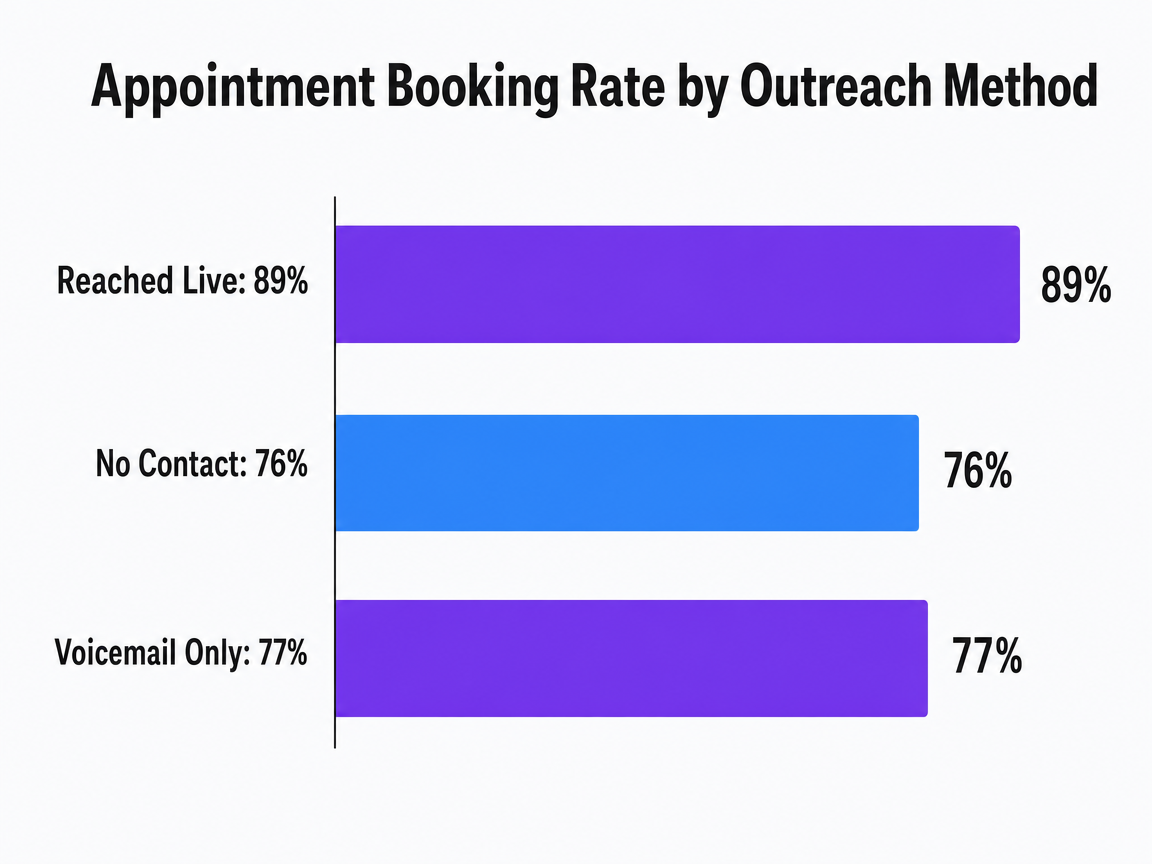 Appointment Booking Rate by Outreach Method
Compares the percentage of patients booking appointments based on whether they were reached live, only received a voicemail, or had no contact.
The Absorption Problem: Campaigns Fail When Scheduling Cannot Keep Up
A campaign that produces qualified calls into a scheduling system that cannot book them is a campaign that manufactures complaints. The bottleneck moves downstream, but the client sees the same symptom: media spend without booked revenue.
An AHRQ report on scheduling process improvements at community health centers found that many safety-net centers lacked effective same-day scheduling processes, leaving qualified inquiries to age out before they converted 12. The finding is specific to safety-net operations, but the mechanic transfers to any multi-location service brand: if the first available appointment is 11 days out and the caller has intent right now, the campaign is funding a competitor's booking.
Absorption capacity is three things in practice:
- It is calendar depth — enough near-term slots to match the intent window.
- It is booker availability during the hours the campaign drives calls, not just business hours.
- It is a hand-off protocol between the intake agent and the scheduling system that does not require the caller to repeat themselves.
Agencies that pre-launch without auditing all three are underwriting a lead-generation number that will not translate into a bookings number, and the QBR will not survive it.
See How Top Agencies Streamline Campaigns That Deliver Qualified Calls
Request a walkthrough of data-backed workflows that leading agencies use to coordinate, approve, and execute multi-channel campaigns proven to convert high-value inbound calls at scale.
If You Manage Multiple Locations: Campaign Economics Across a Portfolio
Scope shift: this section is for agency owners running the ten patterns across a portfolio of five to fifty locations, not for a single-location operator. The math changes at scale, and so does the failure mode.
A single-location dental practice can run a reminder-call campaign with one part-time coordinator. A twelve-location group cannot. Each pattern in the list has fixed strategy work — the scoring model, the cadence rulebook, the triage flow — and variable production work that multiplies by location count. Traditional agency staffing prices the variable work by the seat, which is why portfolio clients see retainers climb faster than their booked-appointment counts.
The table below is a planning frame, not a bid sheet. Dollar ranges are RFP-dependent and vary by market, so the useful columns are staff hours and execution model.
| Campaign Pattern | Monthly Agency Cost | Staff Hours (10 locations) | Execution Model |
|---|---|---|---|
| Predictive reminder calls | RFP-dependent | 40–80 | Hybrid |
| Live-conversation outreach | RFP-dependent | 60–120 | Human-led |
| Paid search-to-call | RFP-dependent | 20–40 | Hybrid |
| Reminder cadence rulebook | RFP-dependent | 15–30 | AI-orchestrated with approval |
| Mystery-call access audits | RFP-dependent | 25–50 per audit cycle | Human-led |
Approval-first AI execution priced at $599 per month per workspace after a two-week trial changes the variable side of that equation: the strategy work still requires human judgment, but the production layer scales without adding seats. That is the lever agency owners should be modeling in their next portfolio pitch.
What Agency Owners Should Take Into Their Next QBR
The through-line across the ten patterns is that qualified-call campaigns are engineered systems, not creative assets. Reach intent live, prioritize with a model, and audit whether scheduling can absorb the demand before the media plan launches. Everything else is production detail.
The defensible metrics for a client review are connect rate, call-to-booking rate, kept-appointment rate, and cost per booked appointment. Dial counts, impressions, and form fills belong in the appendix. Agencies that lead the QBR with the four booking-tier metrics reframe the conversation from activity to outcomes, and outcomes are what survive a renewal cycle.
The portfolio question is separate. Running these patterns across ten or fifty locations without adding seats requires an execution layer that keeps humans on judgment and offloads production. That is the lever worth modeling before the next pitch.
Frequently Asked Questions
References
- 1.Targeted Reminder Phone Calls to Patients at High Risk of No-Show for Primary Care Appointment: A Randomized Trial.
- 2.Outreach Method Predicts Patient Re-engagement in Diabetes Care During Sustained Care Disruption.
- 3.Reducing Disparities in No Show Rates Using Predictive Model-Driven Telephone Outreach and Standard Automated Reminders.
- 4.Evaluating a Large-Scale Multi-Center Outreach Program for Appointment Booking.
- 5.Telephone Triage and Advice Services.
- 6.Evaluation of the performance of telephone triage service.
- 7.A Patient Outreach Activity in a Family Medicine Clerkship.
- 8.Patient experiences of telephone outreach to enhance uptake of HIV testing in primary care.
- 9.Examining access to addiction treatment: Scheduling processes and appointment availability.
- 10.Suicide Prevention Using Google Ads: Randomized Controlled Trial.
- 11.Evidence Brief: Comparative Effectiveness of Appointment Recall Strategies.
- 12.Testing New Ways to Schedule Appointments at Community Health Centers.
- 13.Direct to Consumer Telemedicine: Is Healthcare From Home Best?.