
Key Takeaways
- The meta keywords tag has no enforced character limit because Google, Bing, Yahoo, and DuckDuckGo do not use it as a ranking input 11.
- Circulating figures like 256 and 874 characters trace back to a SitePoint forum myth and a warning from Microsoft Expression Web, a tool retired in 2012 12.
- Bing parses the tag mainly for spam detection, so long keyword-stuffed strings are more likely to hurt performance than help it 13.
- Default portfolio policy should omit the tag entirely, reserving three-to-five-keyword use only for documented Yandex or Baidu targeting 1.
The Real Question Behind the Character Count
The query "meta keywords character limit" is often posed by those working with outdated SEO information. The answer is not a specific number but a policy decision.
Google's own developer documentation states that the meta-keyword tag is unsupported and has no effect on indexing or ranking 7. Bing, Yahoo, and DuckDuckGo also do not document any ranking use of the tag. These four engines cover the vast majority of search demand, rendering the tag's practical value effectively zero 11. Therefore, whether the string is 50, 256, or 874 characters is irrelevant for ranking in these search engines.
This reframes the operational question for any agency SEO lead. The debate is not "how long should the tag be," but rather "should the tag exist in our templates at all, and how do we explain this to clients?" The various circulating character limits—256 from community forums 6, 874 from a discontinued Microsoft authoring tool 12, and 5 to 10 keywords from modern SEO guides 3—each refer to different contexts: a myth, a tooling warning, and conservative practical guidance, respectively. None of these describe current search engine behavior.
The following sections will clarify the origins of these numbers, explain how major engines handle the tag in 2026, and outline how to establish a consistent portfolio-wide policy that addresses client inquiries and audit requirements.
Origins of Meta Keyword Character Limits
The 874-Character Microsoft Tooling Rule
The 874-character limit for meta keywords originates from Microsoft Expression Web, a discontinued visual authoring tool. Its WEB1030 design-time rule would issue a warning if a page's meta keywords tag exceeded 874 characters, advising that "the <meta name="keywords"/> tag should not exceed 874 characters" 12.
This was a tooling warning, not a search engine specification. Expression Web was designed for web designers, and the rule aimed to prevent excessive markup that could increase page weight and signal keyword stuffing to human reviewers. The rule made no reference to Google, Bing, Yahoo, or any crawler's parsing behavior. No search engine has ever confirmed 874 characters as a threshold for indexing, ranking, truncation, or penalization.
This number has persisted in SEO blogs and audit checklists for over a decade due to its authoritative appearance, stemming from Microsoft and its precise value in official developer documentation. Agencies citing this as a search engine limit are referencing a linter for a product retired in 2012. Any audit checkpoint requiring "meta keywords under 874 characters" measures compliance with a defunct authoring tool, not a live ranking system.
The 256-Character SitePoint Myth
Another figure, 256 characters, is found in older SEO forums and inherited checklists. Its most cited origin is a SitePoint community thread where a contributor listed "Meta Title Length = 65-70 characters, Meta Keyword tag = 256 characters, Meta Description tag = 160-180 characters" as if these numbers held equal authority 6. A respondent in the same thread directly refuted this, stating:
"There is no such limitations, this is absolutely wrong"
6.
The 256-character figure lacks any documented source in search engine specifications. It likely stems from a common database field length (256 being a typical VARCHAR size in early CMS platforms) that was retrofitted into SEO advice through repetition. Unlike the 874-character rule, which at least points to a real linter, the 256 number cannot be traced to any tool, standard, or engineering document.
This figure continues to appear in outdated audit templates and "SEO best practices" PDFs used for onboarding junior strategists. When a client mentions a 256-character limit, they are almost certainly quoting an inherited checklist from a 2010-era SEO agency, not a current technical requirement. The appropriate response is to clarify its origin, rather than debating the number itself.
The 5-10 Keyword Practical Ceiling
The third figure in circulation is a range of 5 to 10 keywords. Modern SEO guides that mention meta keywords at all often recommend limiting the tag to "5–10 highly relevant keywords" when used, presenting this as conservative practical guidance rather than a technical constraint 3. A 2026 canonical reference further tightens this, advising "3–5 keywords maximum" if the tag must be included 1.
This range is not a search engine specification but rather guidance based on two observations: keyword lists exceeding roughly ten terms tend to trigger anti-spam heuristics on engines that still parse the tag, and such long lists often indicate keyword stuffing rather than deliberate targeting. The 5-10 range is a practical recommendation for legitimate edge cases like Yandex or Baidu targeting, not an enforcement by any crawler.
In summary, the 256-character figure is a myth without documented origin 6. The 874-character rule is a warning from a retired Microsoft authoring tool 12. The 5-10 keyword range is conservative practitioner guidance for specific, narrow use cases 3. None of these describe search engine enforcement. Google, Bing, Yahoo, and DuckDuckGo do not document any use of the tag for ranking, and these engines collectively account for the vast majority of search demand, making any character limit practically irrelevant 11.
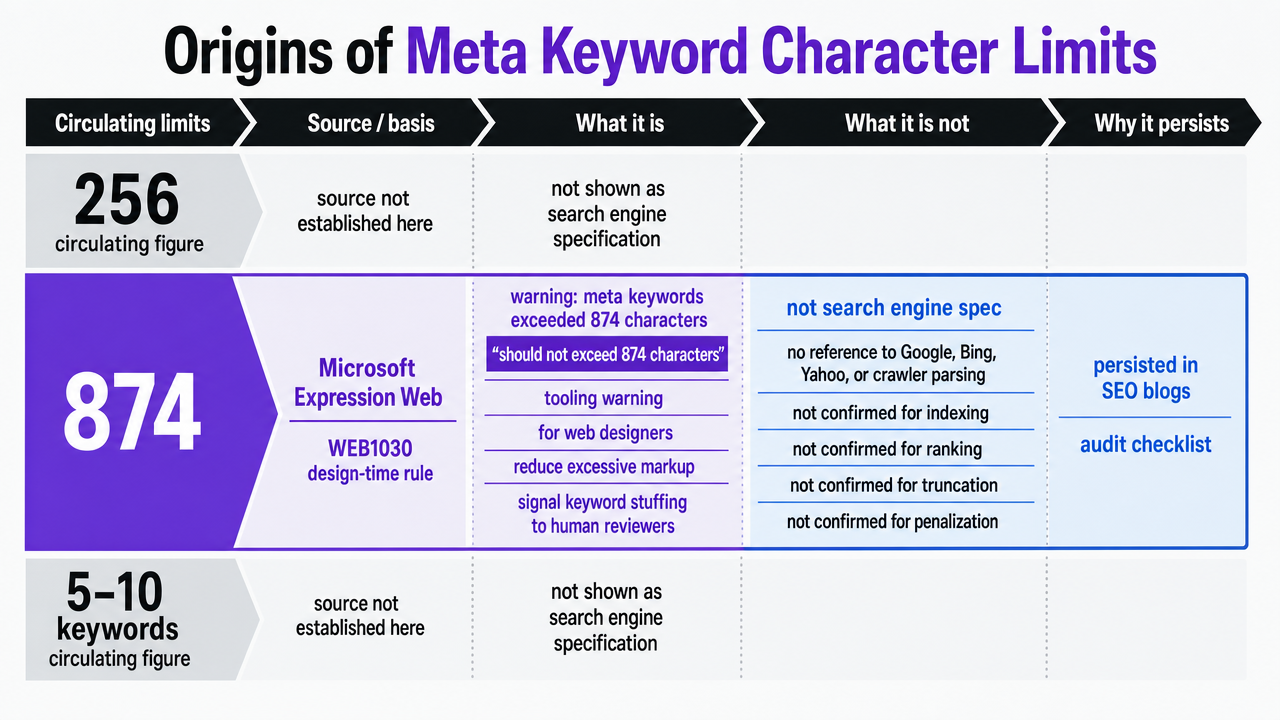 Visualize the three circulating character limit figures, their sources, and why each is not a search engine specification, directly supporting the section's comparison of 256, 874, and 5-10 keyword limits
Test advanced SEO execution workflows at scale
See how data-driven automation handles SEO production and approvals without manual oversight or added headcount.
Search Engine Treatment of the Meta Keywords Tag
Google: Ignored Since 2009
Google's stance on meta keywords is clear and well-documented. In September 2009, Google published a Search Central post explicitly stating that
"Google doesn't use the keywords meta tag in our web search ranking"
8. The post explained that widespread abuse rendered the tag useless as a signal. It also clarified that this applied to Google.com web search, distinguishing it from the enterprise Google Search Appliance, which could still parse meta tags for internal deployments.This position has remained consistent for over sixteen years. Google's current developer documentation on supported meta tags explicitly lists the meta-keyword tag as unsupported, with the categorical statement that
"the meta-keyword tag is not used by Google Search, and it has no effect on indexing and ranking at all"
7. There are no character thresholds, penalty bands, or truncation rules because Google's parser does not utilize the tag.
For agency SEO leads, the operational implication is straightforward: any debate about meta keywords character limits—whether framed as a compliance checkpoint, a client concern, or a template default—pertains to a field that Google's own documentation classifies as ignored. Auditing the length of an unsupported tag for a Google-focused site yields no ranking benefit. The defensible position with clients is to directly cite Google's supported-tags documentation, rather than engaging in debates about forum-derived numbers.
Bing, Yahoo, and DuckDuckGo: No Ranking Use, Potential Spam Signal
Practically, Bing, Yahoo, and DuckDuckGo largely treat meta keywords similarly to Google. A comparative technical review of major engines concludes that Google, Bing, Yahoo, and DuckDuckGo do not document any use of the meta keywords tag for ranking, and that
"together those engines cover the overwhelming majority of search demand, so the practical value of the tag is zero"
11. Yahoo has effectively relied on Bing's algorithm since their 2010 search alliance, so its behavior mirrors Bing's. DuckDuckGo, which sources results from various providers and its own crawler, has never claimed to use the tag.Bing is the only one of these four engines that treats meta keywords as more than obsolete markup, but not in a way that benefits rankings. Bing primarily parses the tag for spam detection, with only minor residual relevance signaling 1. A 2026 guide is more explicit, describing the tag as
"ignored by Google and treated as a potential spam signal by Bing"
13. This means long, keyword-stuffed strings are more likely to harm than help performance on Bing, inverting the premise of character-count optimization.
This clarifies the situation across these four engines: the meta keywords character limit is either irrelevant to ranking or poses a downside risk. For portfolio delivery, any template default that populates meta keywords on Bing-indexed properties should be reviewed for stuffing risk, not lengthened to meet a heuristic count. The safer default is an empty tag or no tag at all.
Yandex and Baidu: Narrow Exceptions
Two engines still consider the meta keywords tag as a live ranking input, relevant only if a client's audience extends to them. Yandex and Baidu continue to use meta keywords as a ranking factor for some queries, according to a 2026 technical reference consolidating engine behaviors 1. Another synthesis of engine positions reaches the same conclusion, noting that Yandex and Baidu retain limited residual value while Google, Bing, and Yahoo do not 2.
The scope of this exception is narrow. Yandex is primarily relevant for Russian-language SEO, and Baidu for mainland China. If a client's target market does not include these geographies, the tag has no ranking implication within their crawl footprint. For agency SEO leads managing portfolios of North American service businesses—such as law firms, dental groups, or senior living facilities—the Yandex/Baidu exception is a documentation footnote, not an operational input.
When this exception applies, the practical ceiling recommended by the canonical 2026 reference is three to five keywords maximum, chosen for relevance over volume 1. This range helps prevent anti-spam triggers on engines that still parse the tag and ensures the keyword set is concise enough for editorial review. The takeaway for portfolio policy is that this exception should be flagged during client onboarding, linked to a documented geographic requirement, and applied only to specific pages targeting those markets, never as a global template default.
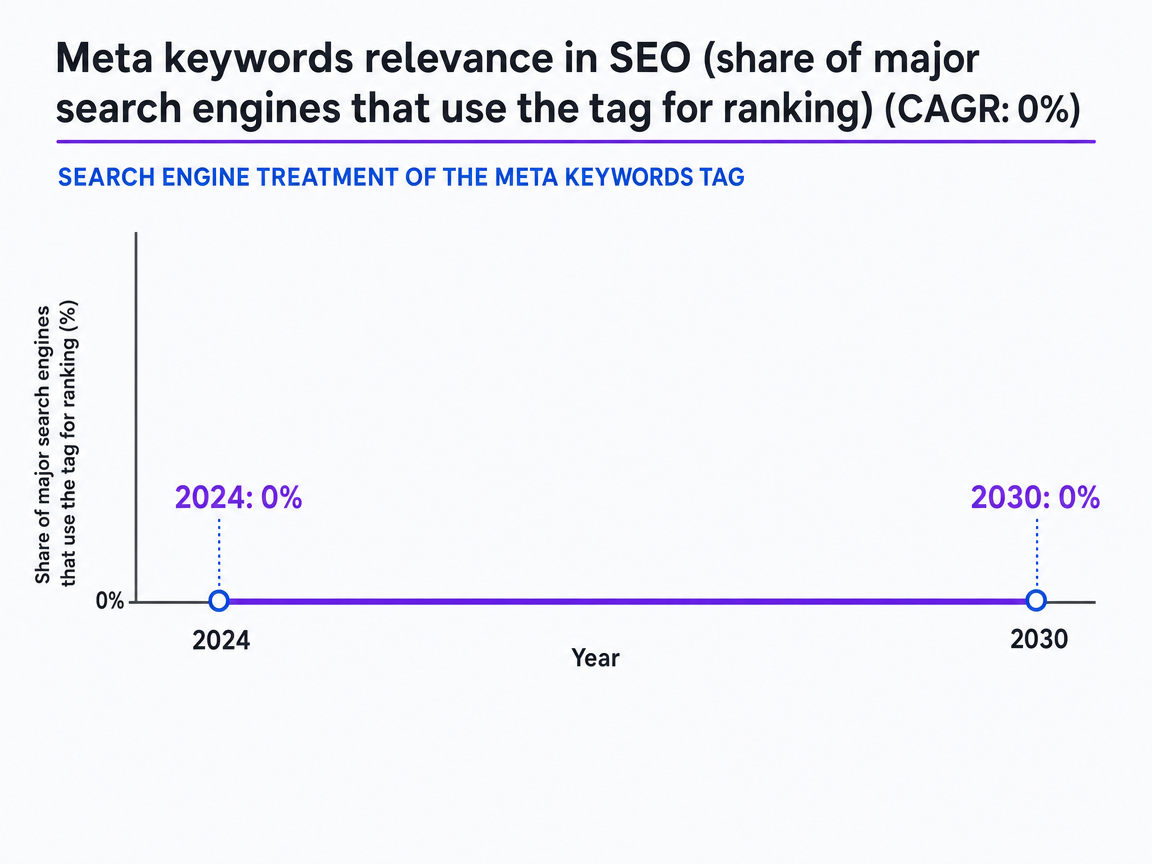 Meta keywords relevance in SEO (share of major search engines that use the tag for ranking) (CAGR: 0%)
Source: Meta Tags and Attributes that Google Supports
A Portfolio Policy for Meta Keywords
The Three-Branch Decision for Client Sites
A comprehensive portfolio policy replaces the character-count debate with three distinct branches, each tied to documented client requirements rather than arbitrary numbers. These branches cover every scenario an agency delivery team might encounter across a client portfolio.
Branch one is the default for most client work: omit the tag entirely. This applies to any site targeting audiences primarily using Google, Bing, Yahoo, or DuckDuckGo, as none of these engines use the tag for ranking 11. This covers virtually all North American and Western European service business SEO. The template should not include a meta keywords element, and audit checklists should not include length or content checks for it.
Branch two addresses the geographic exception. Sites with documented traffic or business intent in Russian-language markets (Yandex) or mainland China (Baidu) may include the tag, limited to three to five highly relevant keywords per page 1. This ceiling helps avoid anti-spam heuristics and encourages deliberate keyword selection. This exception is applied only to specific pages targeting those markets, never as a global template default, and must be linked to a written geographic requirement in the client's brief during onboarding.
Branch three covers non-search uses. Some enterprise CMS platforms and internal site search tools utilize the meta keywords field for taxonomy or facet input. If a client's system requires the tag for such a purpose, it should be populated according to the platform's specifications and excluded from SEO scope entirely, treated as a data field rather than a ranking signal 3. This framing keeps the tag out of SEO reporting and prevents scope creep.
Codifying Template Defaults and Audit Rules
These three branches translate into four codified rules that a delivery team can apply consistently. Each rule streamlines decision-making for strategists by embedding it into templates or audit scripts.
- First, the CMS page template should ship without a meta keywords element by default. New client onboarding should not add one. Removing the element from existing client templates should be a batch task during the next scheduled technical SEO sprint, not a per-page effort.
- Second, audit checklists should remove any line item related to meta keywords length, content, or presence for sites focused on Google, Bing, Yahoo, or DuckDuckGo. This includes the 874-character Microsoft rule, the 256-character forum figure, and any "missing meta keywords" flag from legacy crawler configurations 11. Modern audit templates in current SEO practice entirely omit meta keywords from optimization checklists 4.
- Third, the Yandex/Baidu exception must be documented in the client's SEO brief, with a named business owner and page-level scope. Junior strategists should not add the tag on their own initiative; it should only be added when authorized by the brief, capped at three to five keywords per page 1.
- Fourth, if a Bing-indexed site is inherited with existing keyword-stuffed meta tags, the audit should flag them for removal rather than optimization, as Bing treats overpopulated tags as a potential spam signal 13.
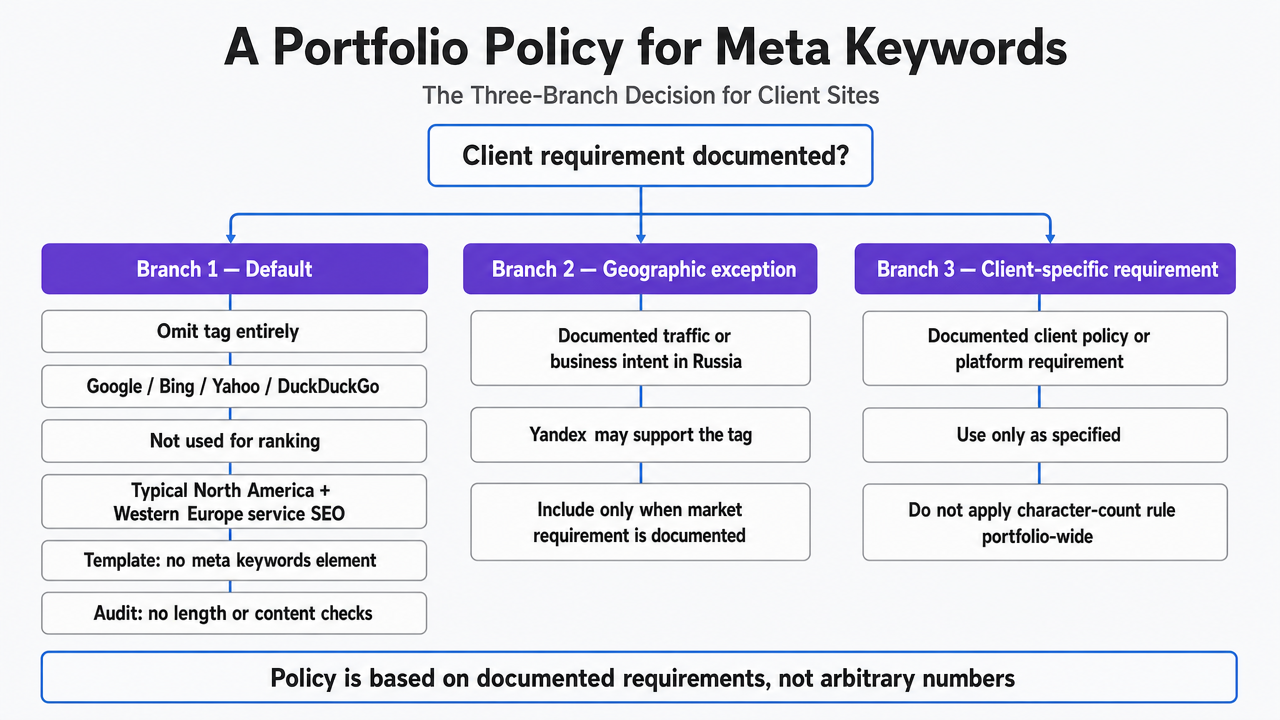 A decision-tree process infographic visualizing the three-branch policy for handling meta keywords across a client portfolio, directly supporting the section's operational framework
Ready to Eliminate Outdated Meta Keyword Practices from Your SEO Workflow?
Connect with a strategist to review your current metadata processes and identify measurable efficiencies for scaling SEO execution—no redundant fields, no wasted cycles, just data-driven improvements.
Managing Meta Tags Across a Client Portfolio
The Opportunity Cost of Auditing a Deprecated Tag
The financial implications shift significantly when analyzing a portfolio of client sites rather than a single one. An agency SEO lead managing dozens or hundreds of properties isn't just deciding whether to check meta keywords once. They are deciding whether every quarterly technical audit, new-client onboarding audit, and CMS migration checklist includes a line item for a tag that Google's own documentation explicitly states has
"no effect on indexing and ranking at all"
7.
The capacity reclaimed by eliminating this task can be calculated using three variables: sites audited per quarter, minutes spent per site on meta keywords review, and the blended strategist hourly rate. Consider the arithmetic for a mid-sized portfolio:
| Sites audited per quarter | Minutes per site on meta keywords | Strategist hours reclaimed per quarter | Strategist hours reclaimed per year | |---|---|---|---| | 50 | 10 | 8.3 | 33.3 | | 100 | 10 | 16.7 | 66.7 | | 100 | 15 | 25.0 | 100.0 | | 250 | 15 | 62.5 | 250.0 |
These hours represent strategist time currently spent counting characters, flagging length "violations" against the 874-character Microsoft rule for a retired authoring tool 12, and documenting audit notes about a tag that Google, Bing, Yahoo, and DuckDuckGo do not use as a ranking input 11. Multiplying this time by a blended internal rate reveals the annual cost of this unnecessary checkpoint. For a hundred-site portfolio, at fifteen minutes per audit and a $95 blended rate, this line item consumes approximately $9,500 per year in strategist capacity, yielding no ranking outcome on any engine relevant to the client's audience.
Redirecting Reclaimed Hours to Impactful SEO Tasks
The hours reclaimed from auditing deprecated meta keywords can be reallocated to tasks with measurable impact. Modern SEO guidelines, while omitting meta keywords, still provide pixel-based truncation guidance for meta titles (around 60 characters) and meta descriptions (155 to 160 characters). These elements directly influence snippet display and click-through rates on high-traffic engines 4. Redirecting a ten-minute meta keywords review can fund a title and description rewrite for a high-intent commercial page, directly affecting impressions-to-clicks.
Structured data is another prime target for reallocated time. Google's supported-tags documentation directs practitioners towards schema, robots directives, and canonical signals as the metadata layer that actually influences indexing behavior 7. A quarter of reclaimed strategist hours across a hundred-site portfolio could fund a schema deployment sprint—implementing LocalBusiness, FAQ, Article, or Product markup at scale rather than page by page.
A third redirection is to enhance content depth on pages already ranking on page two. Reallocating audit hours from a deprecated tag to on-page optimization for positions 11 through 20 often produces measurable movement, whereas auditing an unsupported tag does not 9. The portfolio-level decision is not whether to keep or drop a checklist item, but whether the delivery team's finite hours are spent on signals engines document as ranking inputs or on a field they explicitly ignore.
Handling Client Conversations About Meta Keywords
Client inquiries about meta keywords rarely come as technical questions. They often arise from a marketing director forwarding an outdated 2012 audit template, an in-house SEO manager questioning a missing line item in a quarterly report, or a legal-industry founder recalling paying an agency to "optimize keywords" a decade ago. While the technical answer is settled, the challenge lies in communicating it effectively to preserve the client relationship.
The most defensible and concise script is sourced directly from Google's own supported-tags documentation, which classifies the meta-keyword tag as unsupported and states it
"is not used by Google Search, and it has no effect on indexing and ranking at all"
7. This is the primary citation to present to a skeptical client, rather than a blog post, forum thread, or agency opinion. If the follow-up question concerns Bing or Yahoo, the answer is that neither documents any ranking use of the tag, and Bing primarily parses it for spam detection rather than positive signals 1. If the client mentions a "last agency" advising a limit of "under 874 characters," explain that this number originated from a design-time warning in a discontinued Microsoft authoring tool, not from any search engine 12.
The reframe to rehearse with account managers involves a swap, not a rejection. Clients are not wrong to care about metadata; they are simply focusing on the wrong tag. Meta titles, typically around 60 characters, and meta descriptions, at 155 to 160 characters, directly influence snippet display and click-through rates on the engines that drive their traffic 4. Trading a meta keywords review for a title and description rewrite on the client's ten highest-intent pages represents a tangible upgrade that an account manager can highlight in the next report. This converts a defensive conversation into a scoped, valuable deliverable, addressing the client's underlying concern effectively.
Frequently Asked Questions
References
- 1.HTML meta keywords: canonical reference | ThatDevPro.
- 2.Are meta keywords tag still used by search engines? Should I add them?.
- 3.Meta Keywords for SEO: Still Worth Using in 2026?.
- 4.Meta Tags Cheat Sheet for SEO in 2026.
- 5.SEO Meta Tags and Descriptions | Best Practice Guide 2023.
- 6.Meta Tags (SitePoint Community Discussion).
- 7.Meta tags and attributes that Google supports.
- 8.Google does not use the keywords meta tag in web ranking.
- 9.Does Google Still Use Meta Keywords in 2026? The Answer.
- 10.Meta Keywords: What They Are and Why Google Ignores Them.
- 11.Meta Keywords: Dead Tag, Live Fixes.
- 12.WEB1030 - The <meta name="keywords"> tag contents are too long.
- 13.Meta Keywords in SEO 2026: Do They Matter or Are They Dead?.