
Key Takeaways
- The old titling playbook broke because Google now rewrites titles, refuses fixed character limits, and reshapes SERPs with AI Overviews and features that shift click math independently of wording 1.
- Google's 2026 guidance requires populated, unique, accurate titles aligned to page content and H1, since boilerplate, duplication, keyword stuffing, or half-empty strings trigger rewrites 1.
- Segment CTR by SERP archetype before rewriting, because AI Overviews and 24 catalogued SERP features can move click rates independently of the title itself 6, 7.
- Map titles to query intent using distinct patterns for informational, navigational, and transactional pages, since eye-tracking work shows contextual wording lifts informational click accuracy from 28% to 39% 8.
- Write for perceived relevance by naming the task outcome in concrete nouns, then test paired variants within the same intent class and SERP archetype rather than trusting taste 13, 14.
- Treat title, meta description, and structured-data eligibility as one result unit, since snippets may pull from either source and rich features change the surface competing for the click 3, 5.
- Govern portfolio titling with a pattern library keyed to intent, exception-based checkpoints, and versioned approvals, so senior reviewers handle flagged drafts rather than every string 1.
- Plan titling capacity against URL count and refresh rate, not client count, because exception-based review is what shifts a large book from unsustainable senior load to a governable one.
- Run CTR reviews on a quarterly cadence with a change log, matched-SERP comparison, and rewrite log, so title effects separate from feature-driven or ranking-driven shifts 1, 4, 7.
Why the Old Titling Playbook Broke
The meta title advice circulating in most SEO handbooks was written for a SERP that no longer exists. Hard 60-character limits, exact-match keyword front-loading, and pipe-delimited brand suffixes were rules of thumb built for a ten-blue-links page where Google displayed the HTML <title> element roughly as written. That page is now the exception. Google's own guidance explicitly rejects a fixed character cutoff and states that title links may be truncated based on device width, while the displayed title can be generated from the title element, visible page headings, prominent text, anchor text, or other on-page signals 1.
For an agency head managing delivery across dozens of client sites, this changes the unit of work. The deliverable is no longer a well-crafted string in a CMS field. It is a title system that survives Google's rewriting, holds up across informational and navigational queries, and gets measured against the actual SERP a searcher sees, not a rank-tracker screenshot.
Three shifts broke the old playbook:
- Google routinely regenerates titles when the supplied text is boilerplate, keyword-stuffed, or misaligned with page content 1.
- SERP features and AI-generated summaries reshape the click math above and around organic listings, so identical title copy can perform very differently depending on what else appears on the page 7.
- Research on how searchers actually read result cards shows that perceived relevance, not raw keyword density, drives the click decision 13.
The sections that follow rebuild the practice around those realities: current Google guidance, SERP-aware measurement, intent-mapped patterns, and a governance layer that lets a portfolio scale without every title routing through a senior reviewer.
Rebuild the Baseline: What Google Actually Says in 2026
Google's current title-link documentation, updated in September 2026, does two things that most legacy checklists ignore. It refuses to name a character limit, noting instead that title links may be truncated based on device width, and it lists the signals Google may draw from when generating the displayed title: the <title> element, the main visual heading, other prominent text, anchor text on the page, and text inside on-page elements 1. The HTML title element is one input, not the final output.
The same guidance is direct about what triggers a rewrite. Half-empty titles, boilerplate repeated across a template, inaccurate descriptions of the page, and keyword stuffing all make Google more likely to substitute its own version 1. The SEO Starter Guide reinforces the baseline expectation in plainer terms: titles should be unique, clear, concise, and accurate, because the title link is the headline searchers use to decide whether to click 2.
For agency teams auditing client sites, that reframes the specification. A titling standard should require a populated title element, alignment with the H1 and page content, no cross-template duplication, and no keyword pileups, rather than a fixed length rule that Google itself does not enforce. The 60-character convention still has a use as a soft desktop-preview guide, but it is a display heuristic, not a ranking or eligibility criterion.
Segment CTR Analysis by SERP Type Before Touching a Title
Rewriting a title before segmenting the SERP it appears on is guesswork. A page ranking third on a plain organic layout, a page ranking third under an AI Overview with cited sources, and a page ranking third below a People Also Ask block, sitelinks, and a video carousel are not comparable click environments, even when the query and the title text are identical. Treating them as one CTR pool masks what the title is actually doing.
Recent behavioral evidence makes the gap concrete. A 2026 arXiv preprint on Google result pages that generate AI Overviews reports 8% traditional-result click rates when an AI Overview is present versus 15% when it is not, with sessions ending without any click on 26% of AI Overview pages compared with 16% of pages without one 6. The paper is a preprint, its sample is bounded, and its numbers should not be projected onto every vertical or query class. The directional signal, however, is that a substantial share of the click delta on AI-mediated SERPs comes from the SERP itself, not from title wording.
The broader cross-website work on SERP features points the same direction. Rankings still dominate CTR, but 24 catalogued SERP features can meaningfully modulate organic click rates and, on average, exert a negative pull on ordinary listings 7. A featured snippet, a shopping unit, or a video carousel in the same slot changes the click ceiling for everything beneath it. Attributing that movement to a title rewrite would be a measurement error.
For agency delivery, this means Search Console analysis needs a segmentation layer before it becomes a title brief. Practical cuts include SERP archetype (AI Overview present or absent, feature-heavy or plain), device, and query intent class. Each client property should carry a tagged sample of its top revenue queries with the SERP composition recorded at the point of measurement, so that pre- and post-rewrite CTR is compared within the same archetype rather than across a mixed pool.
The operational rule for the portfolio: no title rewrite goes into production without a matched-SERP baseline and a matched-SERP recheck window. That single discipline prevents the most common misread on modern agency dashboards, which is crediting a title change for a CTR shift that a Google feature change actually caused.
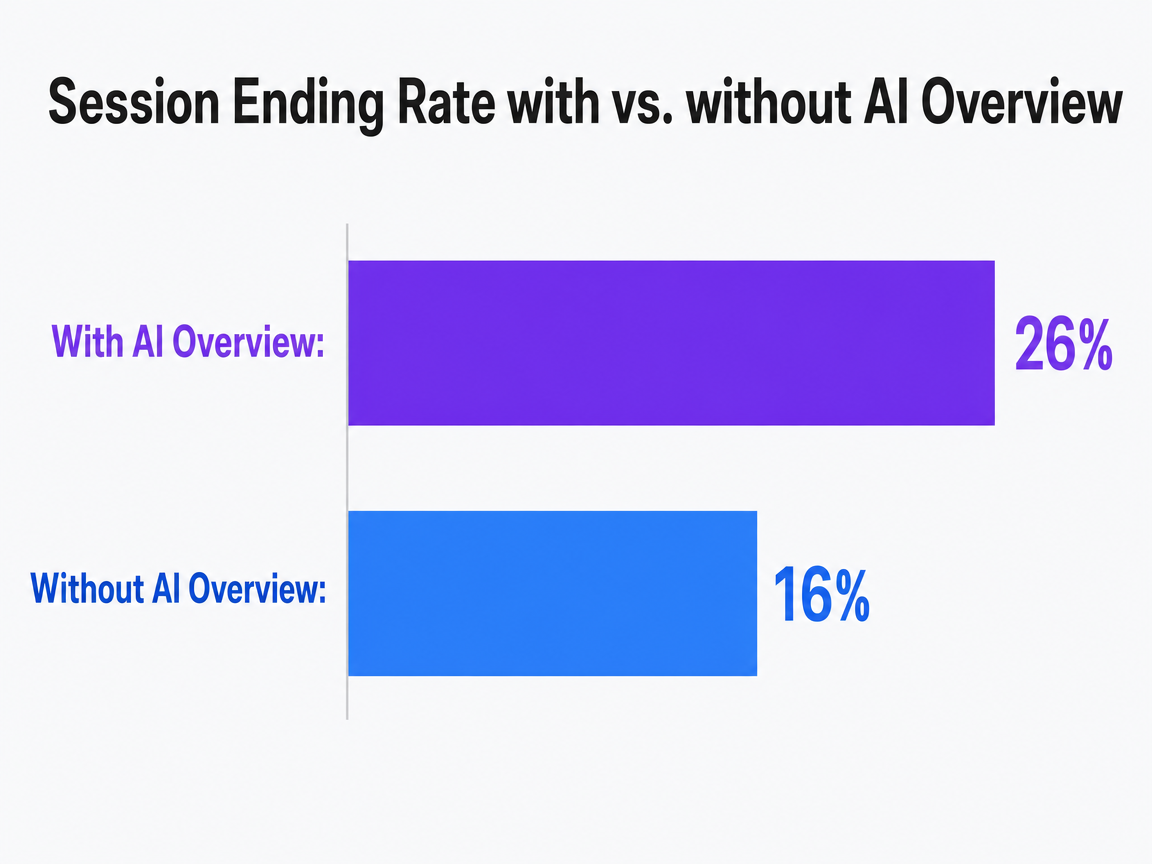 Session Ending Rate with vs. without AI Overview
Comparison of the percentage of search sessions that end without a click when a Google AI Overview is present versus when it is not.
Test AI-Optimized Meta Titles on Live Sites
Measure real CTR impact by publishing optimized meta titles during your trial with full platform capabilities.
Map Title Patterns to Query Intent, Not to a Universal Formula
Universal title templates fail because searchers evaluating a result card are not doing the same cognitive work across queries. A user looking for a specific bank's login page scans differently from a user comparing treatment options for a family member, and result-page wording that helps one actively hinders the other. Microsoft Research's eye-tracking work on how people read titles, snippets, and URLs makes the split concrete: for informational queries, extending the contextual messaging around a result improved click accuracy from 28% to 39%, while shorter, sparser wording performed better for navigational tasks 8. The study predates current Google layouts and AI Overviews, so the numbers should be read as a behavioral principle rather than a modern CTR benchmark, but the direction has been replicated in follow-up work on the same task split 11.
The operational translation for a portfolio is a small set of intent-mapped title patterns, not a house style. Three patterns cover most client pages.
Informational queries (how, what, why, comparisons, symptom or problem searches) : Reward titles that name the specific outcome the page delivers and the shape of the answer. "Meta Title Best Practices for Agency SEO Leads: Governance, Patterns, Measurement" tells a searcher what task the page completes. A stripped "Meta Title Best Practices" leaves the reader guessing whether the page is a beginner definition, a checklist, or an operator framework, and users who cannot judge that from the visible result are measurably less likely to click 12.
Navigational queries (brand names, specific product pages, login and account paths) : Reward brevity and unmistakable identification. Extra descriptive language creates friction here. "Client Login" beats "Client Login Portal for Existing Account Holders and Returning Users" when the searcher already knows what they want 11.
Transactional queries (pricing, booking, hiring, purchase intent) : Reward titles that name the action and the qualifier that removes hesitation. "Book a Free Consultation With a Board-Certified Estate Attorney in Austin" carries the action, the credential, and the location a searcher is verifying before clicking. The page must actually deliver on each element, since Google rewrites titles it judges inaccurate or misaligned with page content 1.
The portfolio-level move is to tag every URL by dominant intent class during audit, then apply the matching pattern rather than a single 55-to-60-character template. That single tagging pass turns titling from a per-page judgment call into a repeatable production step, and it gives senior reviewers a fast heuristic for spotting misaligned drafts: a transactional pattern on an informational page is a rework before it ever reaches CTR measurement.
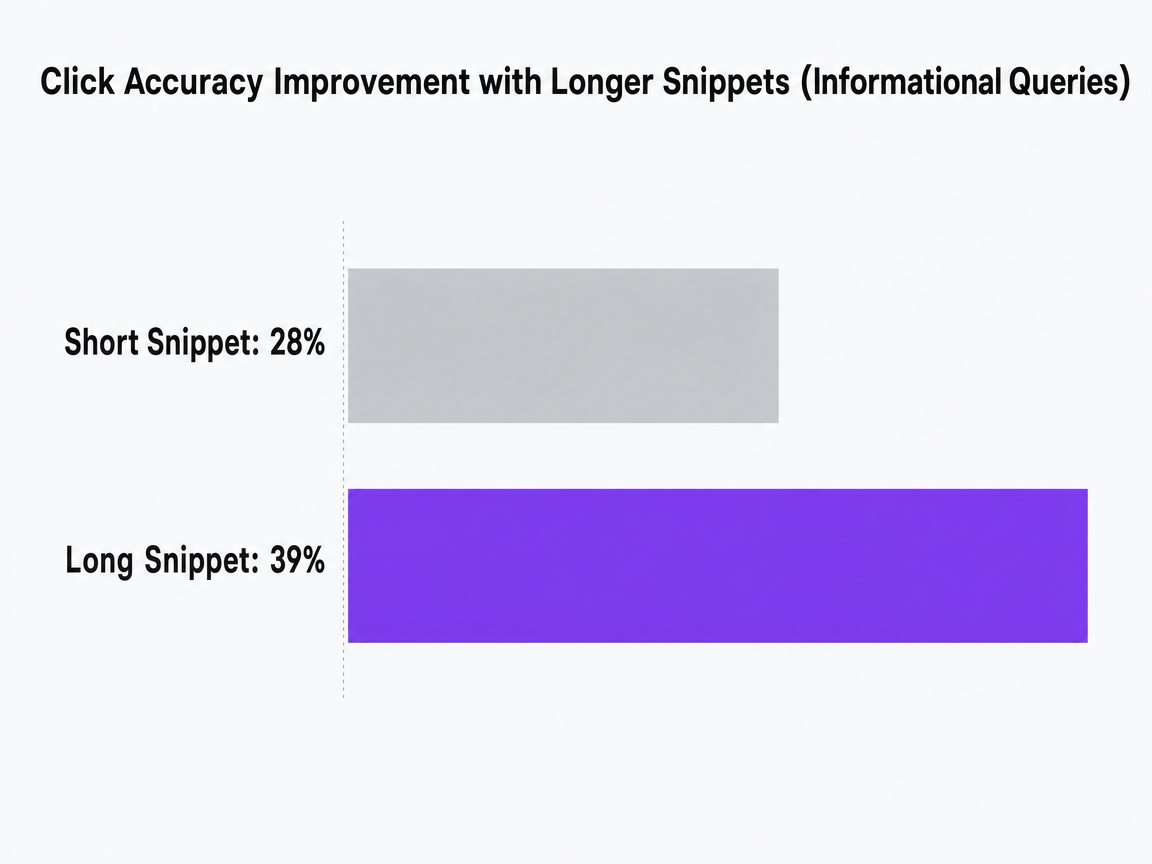 Click Accuracy Improvement with Longer Snippets (Informational Queries)
Improvement in click accuracy for informational search tasks when the length of the contextual snippet was increased, based on an eye-tracking study.
Write for Perceived Relevance, Then Test the Wording
Searchers do not judge a page. They judge the visible result card and infer whether the destination will complete their task. That distinction, drawn out in the perceived-relevance literature, matters because a title tag can be topically accurate and still fail to earn the click if a searcher cannot tell from the wording what the page actually does 13. The corollary from interpretability research is direct: users are measurably less likely to click when they cannot understand why a result surfaced or cannot assess whether it will be useful 12.
The operational implication for title drafting is to name the task outcome in concrete nouns, not to compress a keyword list. "Estate Planning Checklist for Blended Families in Texas (2026)" tells a searcher which situation the page addresses and what artifact they will get. "Estate Planning Services | Firm Name" does neither. The first version aligns with how searchers read result copy; the second forces inference and loses the click before ranking has a chance to matter.
Tone is a second, smaller lever. A Microsoft Research analysis of Bing query logs found that purely positive title-and-snippet sentiment increased the log odds of a click by 6.64 points after accounting for rank and relevance, with a stronger effect among topically relevant results 9. The scope matters: this is a Bing-log correlation on aggregate sentiment, not a license to load titles with superlatives, and Google will rewrite titles it judges inaccurate or promotional 1. The usable read is that measured, honest value language, when it reflects the page, tends to outperform flat descriptive copy.
Wording is a testable signal, not a matter of taste. Google Research's micro-browsing work on snippets modeled how users read result copy and used that model to predict which of two variants would earn the higher CTR with meaningful accuracy 14. For portfolio delivery, that supports a discipline of running paired title variants on comparable URLs within the same intent class and SERP archetype, then reviewing the CTR delta on a matched-SERP basis rather than crediting the winner from a mixed pool.
Pair Titles With Snippets and Structured Data as One Result
A title never ships alone. The searcher sees a title link, a URL breadcrumb, a snippet, and whatever rich elements the page's structured data has made eligible. Treating the title as an isolated field misreads what the searcher is actually evaluating, and it hands CTR credit or blame to the wrong lever.
Start with the snippet. Google generates snippets primarily from page content and may draw on the meta description when it better matches a particular query, but it does not guarantee the supplied description will appear 3. That has two implications for portfolio work. First, a title written as if the snippet will echo it produces redundant result cards, and searchers reading duplicated wording learn less about the destination. Second, the meta description is worth writing not as an SEO ritual but as a candidate the algorithm can pull when the on-page text is thin for the query. Pair the two: the title names the task outcome, the description supplies the qualifiers a searcher needs to confirm the match, such as scope, audience, format, or location.
Structured data changes the shape of the result itself. Google defines it as a standardized way to help Search understand page content and lists the feature types that can produce richer appearances, from FAQs to product data to breadcrumbs 4, 5. Eligibility is not a guarantee of display, and richer features do not directly guarantee higher CTR, but they change the visible surface a title has to compete with, both on the page's own listing and on the listings above and below it 5.
The operational rule is simple: audit the title, the description, and the structured-data eligibility as one result unit. When a rewrite is queued, review the live SERP screenshot alongside the draft, and compare pre- and post-change Search Console performance filtered to that URL over a multi-month window, which is the measurement window Google itself recommends for structured-data changes 4. That discipline keeps the team from crediting a title tweak for a lift that a newly earned rich result produced, or missing a title problem hidden by a strong snippet.
See How AI-Driven Meta Title Optimization Increases Client CTR at Scale
Request a data-backed walkthrough of workflow automation for meta title testing, approval, and deployment—built for agencies managing high-volume SEO campaigns across multiple clients.
Governance at Portfolio Scale: Patterns, Checkpoints, Approvals
At single-site scale, a senior SEO can write every title and catch every misfire in review. At portfolio scale, that model collapses. An agency running fifty client sites with an average of four hundred indexed URLs each is governing roughly twenty thousand title elements, and the constraint is not writing ability. It is enforcement: keeping intent patterns consistent, catching template boilerplate before it ships, and preventing the drift that Google penalizes with rewrites 1.
The governance layer has three moving parts, and each should exist as a documented artifact rather than tribal knowledge held by a senior lead.
- A pattern library keyed to intent class. Not a style guide of adjectives, but a short set of approved title structures tied to informational, navigational, and transactional pages, with worked examples per client vertical. A legal client's transactional pattern differs from a home-services client's, but both should be codified so a mid-level specialist can draft a compliant title without escalation. The library also lists what triggers a rewrite by Google, drawn directly from the current documentation: boilerplate, keyword stuffing, inaccurate descriptions, and half-empty titles 1.
- Checkpoints that trigger review, not blanket review. Every title change routing through a senior reviewer is the bottleneck agencies most often describe. A better rule is exception-based: automated checks flag drafts that duplicate across a template, exceed a soft length threshold on mobile preview, fail intent-class pattern match, or land on a URL flagged as revenue-critical. Everything else clears on the specialist's approval. The checks themselves are cheap to build once and pay back across every client.
- Approval workflows with a written audit trail. Titles ship, Google rewrites some of them, and CTR moves for reasons that include but do not reduce to the wording. Without a record of what was published, when, on which URL, and against which SERP archetype, the team cannot separate title effects from feature-driven or ranking-driven shifts 7. The audit trail is what makes the later CTR review a diagnosis rather than a guess. It also protects the account when a client asks why a title changed and whether the change caused a traffic swing.
The underlying principle is that titling at portfolio scale is a production system, not a series of creative decisions. Documented patterns, exception-based checkpoints, and versioned approvals let a small senior team govern a large surface area without personally touching every string. That is the operating model that scales without adding headcount, and it is the one clients feel through consistency across their pages rather than through any single rewrite.
If You Manage Multiple Client Accounts: The Labor Math of Titling
This item shifts scope from a single site to portfolio delivery. The math is what forces the operating-model change, so it is worth putting on paper before defending headcount or tooling decisions to a client or a CFO.
Consider the surface area a mid-size agency actually governs. If titling is treated as a per-page creative task with senior review on each string, the hours scale linearly with URLs, and the senior bench becomes the bottleneck long before quality does. Google's rewriting behavior compounds the problem: titles that ship as boilerplate or template duplicates get regenerated by Google anyway 1, so the manual hours produced a string the searcher never sees.
The table below uses variables, not invented rates, so an agency lead can drop in a blended cost and run the number for their own book.
| Input | Small book | Mid book | Large book |
|---|---|---|---|
| Clients | 15 | 50 | 120 |
| Indexed URLs per client | 200 | 400 | 600 |
| Quarterly refresh rate | 20% | 20% | 20% |
| Titles reviewed per quarter | 600 | 4,000 | 14,400 |
| Minutes per title (manual senior review) | 6 | 6 | 6 |
| Senior hours per quarter | 60 | 400 | 1,440 |
| Senior hours at exception-based review (est. 15% flagged) | 9 | 60 | 216 |
Multiply the last two rows by the agency's blended senior rate to get the quarterly labor cost of each model. The delta is where documented patterns and automated checkpoints pay back. Exception-based review, described in the governance section above, is what shifts a large book from an unsustainable senior load to a governable one without dropping the quality bar.
Two operating consequences follow directly:
- Titling capacity should be planned against URL count and refresh rate, not client count, because a fifteen-client book with deep sites can outweigh a fifty-client book of thin ones.
- The CTR review cadence covered next should map to the same quarterly cycle, so measurement and production run on one calendar rather than two.
Measure What Moved: A CTR Review Cadence That Survives Rewrites
The last piece of the system is the review cadence. Without one, a portfolio accumulates title changes that no one attributes to outcomes, and clients start asking whether any of it worked. The trap is running CTR reviews on the same monthly rhythm as ranking reports, because titles ship, Google rewrites some of them, SERP features come and go, and a four-week window rarely separates the signal from the noise.
A quarterly cadence, aligned to the same refresh cycle used for production, is what the underlying measurement guidance supports. Google itself recommends recording Search Console performance for several months and filtering by URL when comparing results after a change, which is written for structured data but applies equally to title-and-snippet changes that alter the visible result 4. A shorter window invites false positives from feature churn; a longer one buries the change under too many other moving parts.
Three review artifacts do the work:
- A change log tied to each URL, capturing the title shipped, the date, the intent class, and the SERP archetype recorded at publication.
- A matched-SERP CTR comparison that filters Search Console impressions and clicks to the same archetype pre and post, so a rewrite is not credited for a lift that followed an AI Overview disappearing from the SERP 7.
- A rewrite log capturing which titles Google replaced with its own version, since a regenerated title is a signal that the supplied string failed the alignment or boilerplate tests in the current guidance 1.
The output of each quarterly review is a short list of decisions, not a dashboard: which patterns to retire, which to promote across the library, and which URLs to leave alone because the CTR movement traces to the SERP rather than the title. That is the discipline that turns titling from a recurring cost line into a governed, measurable input to client organic performance.
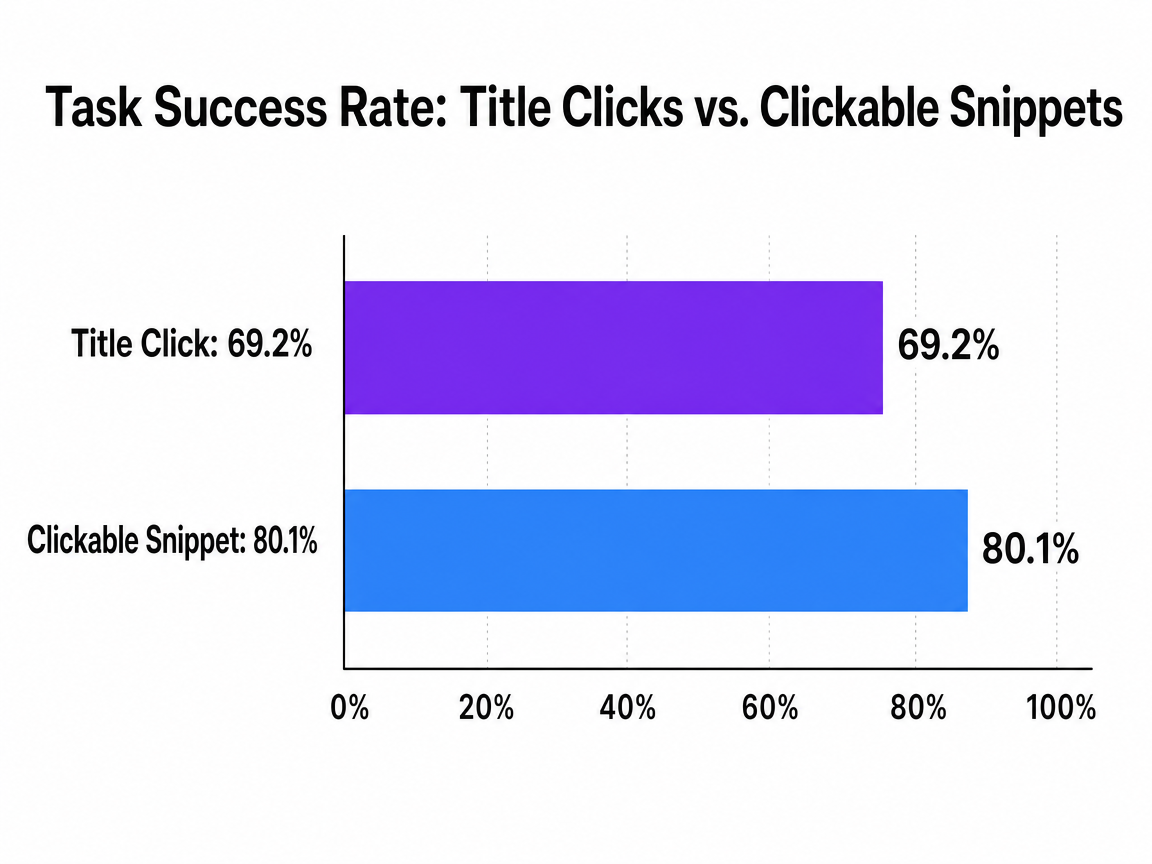 Task Success Rate: Title Clicks vs. Clickable Snippets
Percentage of participants who reached the correct answer when clicking on a standard title link versus an experimental 'clickable snippet' interface.
Frequently Asked Questions
References
- 1.Influencing Title Links in Google Search.
- 2.SEO Starter Guide: The Basics.
- 3.How to Write Meta Descriptions.
- 4.Intro to How Structured Data Markup Works.
- 5.Structured Data Markup that Google Search Supports.
- 6.Investigating Click Behaviors On Google Search Result Pages That Produce an AI Overview.
- 7.Beyond Rankings: Exploring the Impact of SERP Features on Organic Click-through Rates.
- 8.What Are You Looking For? An Eye-tracking Study of Information Usage in Web Search.
- 9.The Emotion Profile of Web Search.
- 10.Supporting Orientation During Search Result Examination.
- 11.An eye-tracking study of information usage in Web search.
- 12.Understanding the Interpretability of Search Result Summaries.
- 13.The Anatomy of Relevance.
- 14.Micro-Browsing Models for Search Snippets.