
Key Takeaways
- Single-location rank checks misrepresent client visibility: 98% of sampled Google searches produced at least one inconsistent result set, with geographic location alone driving organic differences on 97.76% of queries 2.
- Position is a coordinate, not visibility. Treat the query-location-device pair as the baseline unit, and pair rank with feature stack, AI Overview citations, paid displacement, and technical signals.
- AI Overview citations, sponsored displacement, indexing and schema health, and information-quality drift for regulated verticals each form independent surveillance layers that fail before rank reacts 5, 9.
- At 50 clients, manual review of ~24,000 weekly observations is impossible. Shift to approval-first architecture where collection and detection are automated and analyst time moves to deciding on escalated exceptions.
The single-SERP assumption is quietly breaking agency reporting
Most agency SERP reports still rest on an assumption that stopped being true years ago: that one search, run from one location, on one browser, at one moment, represents what a client's customers actually see. It does not. A peer-reviewed measurement study found that 98% of sampled Google searches produced at least one inconsistent result set, and 97.76% of sampled queries generated at least one organic-result difference attributable to geographic location alone 2. Google infers user geolocation from IP address, and the divergence widens as the physical distance between searchers grows 1.
For a head of SEO running 15 to 75 client accounts, this is not a measurement curiosity. It means the weekly rank export sent to a dental services organization with 40 offices, or to a law firm with practice areas in six metros, is describing a search environment that no actual patient or prospect inhabits. The report is internally consistent and externally fictional.
The problem compounds because the SERP itself has stopped being a list. A single query now returns a layered interface: AI Overviews above the fold on a growing share of searches 5, local packs, sponsored labels, People Also Ask, rich results, and shopping modules, each of which can displace a client's blue link without changing its reported position. Rank tracking captures a coordinate on a surface that has become multidimensional.
The sections that follow treat SERP monitoring as a surveillance discipline across five layers, scoped for agency portfolios rather than single-site owners, and built around signal detection instead of weekly screenshots.
Rank is a coordinate, not visibility
Position three on a tracker dashboard describes where a URL sits on one rendered page. It does not describe whether a prospective client ever reached that page, whether the result above it absorbed the click, or whether the search session ended on page one at all. Rank is a coordinate on a surface. Visibility is behavior on that surface, and the two correlate only loosely.
A study of search behavior and personalization found that approximately 60% of clicked result links in its sessions were located on pages 2 or later, while an unpersonalized version of the same scenarios produced roughly 10% of clicks on pages 2 or later 6. The sample is narrow—a controlled task-based study, not a representative measure of all Google traffic—but the direction is enough to disqualify the single rank-to-CTR curve that most agency forecasting models still use. Click distribution is a function of the user, the task, the interface, and the personalization layer applied to that session, not of position alone.
Paid-search research reaches a parallel conclusion from the opposite direction. An empirical analysis of search advertising reported that click and conversion rates decrease as advertisement position moves lower on the page, but that the value of a click is not uniform across positions 7. Higher position does not translate linearly into higher economic return, which means organic visibility models borrowed from position-weighted CTR tables understate variance in both directions.
For an agency head managing a portfolio, the operational consequence is specific. A client's keyword can hold position two for a quarter while qualified calls fall, because an AI Overview absorbed the informational intent, a local pack repositioned above the organic block, or a sponsored label displaced the first screen. The rank export shows stability. The business shows erosion. Monitoring that stops at coordinates will miss both the cause and the moment it began.
Visibility measurement has to pair position with the surface state around it—features present, personalization vector, device, location—and with the downstream event the client actually pays for: a booking, a qualified call, a form submission. A rank that does not resolve to a conversion signal within a defined window is a hypothesis, not a result.
Location-personalized SERPs as the baseline unit of measurement
For agencies managing multi-location clients—a DSO with 40 practices, a law firm with offices in six metros, a home-services franchise spanning two states—the operational unit of SERP monitoring cannot be the query. It has to be the query-location pair. A measurement study of geographic variation in Google results found that 98% of sampled Google searches produced at least one inconsistent result set, and 97.76% of sampled queries generated at least one organic-result difference attributable to geographic location alone 2. The sample was a controlled measurement experiment rather than a live Google traffic snapshot, so the specific percentages describe that study's protocol, not a current universal rate. The direction is what matters: geographic variation is not an edge case, it is the dominant source of divergence in the result set.
The mechanism is straightforward. Google infers user geolocation from IP address, and the companion research reports that result divergence widens as the physical distance between searchers grows 1. A ranking recorded from an agency's office in Chicago describes the Chicago SERP. It does not describe the SERP a prospective patient sees in a suburb thirty miles out, and it describes almost nothing about what shows up in a different metro.
The implication for portfolio reporting is concrete. A dashboard showing "orthodontist near me" at position two for a DSO client, pulled from one monitoring node, is a measurement of one node. If the client operates 40 locations, the honest minimum is 40 location-anchored measurements for that query, each with its own local pack composition, its own competitor set, and its own feature stack. Collapsing those into a single average rank hides the locations where visibility has already collapsed and inflates the ones that happen to carry the composite.
Operationally, this means every tracked query needs three metadata fields attached before it enters a client report: the location vector used, the device profile, and the personalization state. Queries without location scope should be flagged as portfolio-level signals rather than client visibility. The baseline unit of measurement is not "keyword rank." It is "keyword at location on device in state," and anything less granular is a hypothesis about client visibility, not a measurement of it.
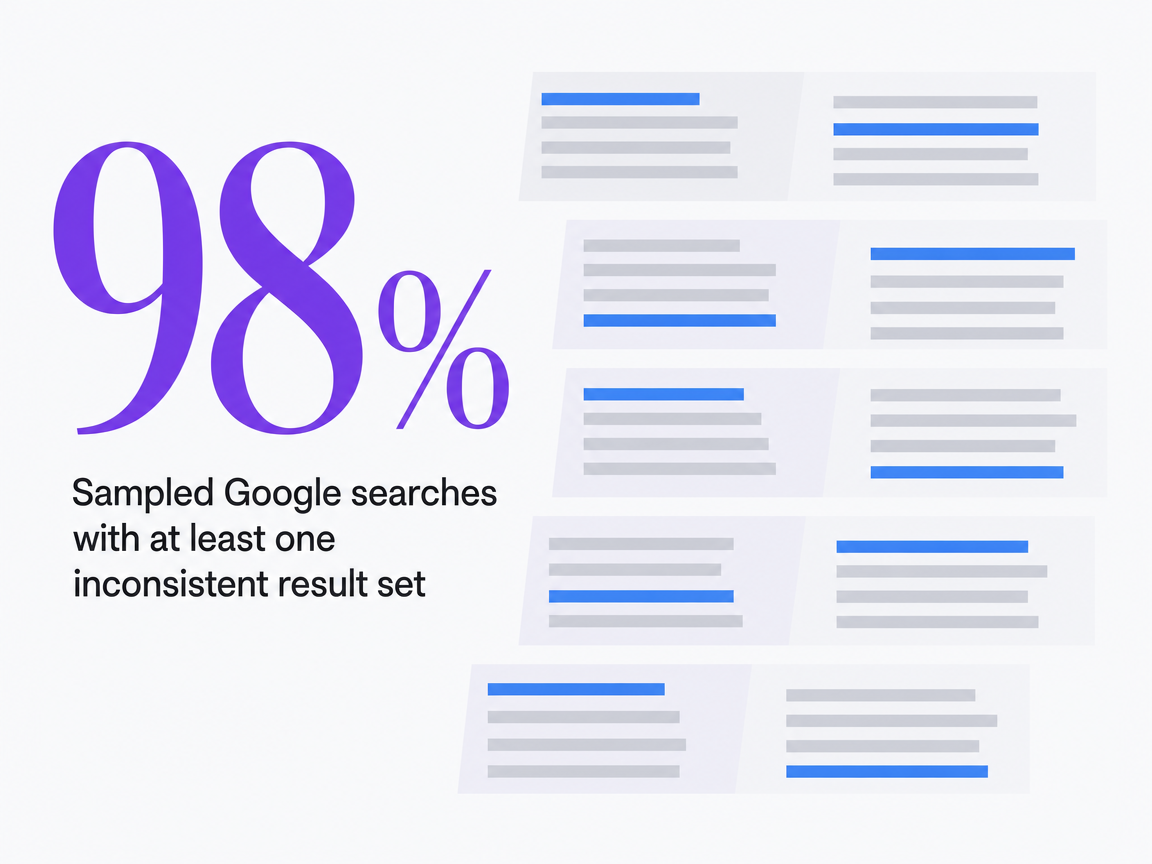 Sampled Google searches with at least one inconsistent result set
Sampled Google searches with at least one inconsistent result set
Test automated SERP monitoring on real client accounts
See live SERP changes and content impact across multiple clients in just one week.
AI Overview citations are a separate visibility surface
A client's blue link at position two is now routinely sitting below a generative answer that may or may not cite the client's domain. That answer is a different surface with its own eligibility rules, its own citation logic, and its own displacement effect on the organic block beneath it. Monitoring it as if it were a SERP feature flag misses the point. AI Overview presence is one signal; AI Overview citation is a separate one, and the two have to be tracked independently.
An empirical study comparing Google Search, Gemini, and AI Overviews across 14,212 queries found that AI Overviews appear for a substantial share of real-user searches and render above organic results 5. The study's query set and collection window define that specific appearance rate, so the useful conclusion for an agency is directional rather than numerical: on a non-trivial portion of commercially relevant queries, the first screen a prospect sees is a synthesized answer, and the client's organic rank is a measurement of what sits beneath it.
For portfolio reporting, three distinct states need their own columns on every tracked query:
- Whether an AI Overview rendered.
- Whether the client's domain was cited inside it.
- Whether a competitor was cited instead.
A client ranking first organically but absent from an AI Overview that cites three competitors is losing visibility at the exact query the dashboard says it owns. The inverse also happens: a client ranked fifth but cited inside the Overview captures the first click intention a user forms on the page.
The operational discipline is to log the Overview's citation set as a named entity list per query, per location, per check. Changes in that set—additions, removals, reordering—are the signal. A citation dropping out of an Overview is a visibility event with the same weight as a page falling off page one, and often happens on a faster cycle than organic rank changes. Agencies that do not instrument this surface will keep reporting stable rankings while the client's share of first-screen attention erodes query by query.
Paid displacement and label integrity in client reporting
Every organic rank line in a client report assumes the surface above it is stable. It is not. Sponsored results, shopping units, and local service ads can appear, shift, or multiply between audits, pushing the client's organic result off the first screen without changing its tracked position. A visibility report that does not log what sits above the organic block is reporting half of what the user actually encountered.
Paid-search research found that click and conversion rates decrease as advertisement position moves lower on the page, and that the value of a click is not uniform across positions 7. Applied to organic monitoring, the same logic runs in reverse: when paid units expand above an organic result, the effective position of that result degrades even though its coordinate holds. An agency reporting "position two, stable" to a home-services client whose top sponsored block grew from one ad to three has described the ranking accurately and misrepresented the visibility entirely.
Label integrity is the second half of this audit. The FTC's guidance on paid-search disclosure states that consumers should be able to distinguish natural search results from advertising and recommends prominent labels such as "sponsored" or "ad" with visual separation 4. Its native-advertising guidance adds that commercial content should not be presented in a way that implies it is ordinary editorial or organic material, and that disclosures should be clear, prominent, and close to the claim 3. For client reporting, this creates a specific obligation: when the agency's own screenshots or dashboards blur paid and organic results, the report itself misrepresents earned visibility to the client paying for it.
The operational discipline is to log four fields on every tracked query alongside position:
- Count of sponsored results above the organic block.
- Presence of a local service ads unit.
- Presence of a shopping or product module.
- Vertical pixel distance from the top of the viewport to the client's result.
Changes in any of these are visibility events, even when rank is unchanged, and they belong in the same escalation queue as a lost position.
Technical signal loss: indexing, schema, and rich-result eligibility
Rank monitoring observes the surface. Technical signal monitoring observes whether the client's pages are still eligible to appear on it. The two fail independently, and the technical failure usually arrives first without any movement on a tracker dashboard.
Three failure modes recur across agency portfolios:
- An indexing drop removes a page from the eligible set entirely, so the query no longer has a candidate URL to rank.
- A schema break—malformed JSON-LD, a missing required property, a validation error introduced by a template change—removes rich-result eligibility without removing the page from the index.
- A canonical conflict or a rogue noindex directive pushed by a staging deployment can quietly reassign ranking signals or evict the page between crawls.
In each case, the position line on the client dashboard holds steady until the next recrawl exposes the gap, at which point the drop is already weeks old.
The operational discipline is to pair every tracked query with a page-level health check on its target URL: index status, canonical target, robots directive, structured-data validation state, and the specific rich-result types the page currently qualifies for. Changes in any of these fields are visibility events in their own right, even when the SERP has not yet responded. Agencies that route technical-signal changes into the same escalation queue as ranking changes catch displacement before the client's analytics does. Those that wait for the rank chart to react are reporting the damage, not preventing it.
See Real-Time SERP Shifts Before They Impact Client KPIs
Connect with our team to learn how enterprise agencies automate SERP monitoring at scale, ensuring immediate visibility into ranking changes and competitive movements across all client accounts.
Information-quality drift for regulated verticals
For agencies serving healthcare, legal, behavioral health, and senior living accounts, ranking a client's page is only half of the delivery. The other half is whether the information surrounding it—on the client's own URL and on the competitor pages Google elevates alongside it—meets the quality standards that regulators, licensing bodies, and plaintiffs' attorneys use to evaluate harm. A SERP that looks healthy on a position dashboard can be a liability surface the moment a quality audit runs across it.
The empirical case for a quality layer is specific. A 2025 peer-reviewed study compared traditional search engines and generative AI platforms on consumer health information using DISCERN, JAMA benchmark, and readability measures across a standardized sample of 20 webpages per platform. Google received the highest mean DISCERN score at 3.33 ± 0.53 and the highest mean JAMA benchmark score at 3.70 ± 0.44 among the evaluated platforms 8. Highest among the sample is not the same as high in absolute terms—DISCERN tops out at 5—and the sample size defines the scope. The useful read is that even the best-performing surface in the comparison left meaningful quality headroom on the first screen of health queries.
A separate query-specific study evaluated Google results for "supplements for cancer" using a health-information quality index and found that only about one-quarter of analyzed results were rated high quality, that quality scores were not correlated with earlier appearance in the result sequence, and that the page returned 496 advertisements against the analyzed organic result set 11. Prominent placement did not predict quality on that query, and the commercial density around the organic results was more than twice the result count itself.
The structural picture is older and broader. A meta-analysis of 153 cross-sectional studies covering 11,785 websites and 14 quality-assessment tools identified seven recurring quality principles—authorship, content, currency, usefulness, disclosure, user support, and privacy and confidentiality—as the dimensions that fail most often on health information online 9. A separate peer-reviewed argument on vaccine information extends the same logic to search-engine responsibility, concluding that privacy-aware design and filter-bubble avoidance are insufficient without mechanisms to test information quality on health-related webpages 10.
For portfolio operations, this translates into a seventh monitoring layer on top of rank, features, Overview citations, paid displacement, and technical signals. Every tracked query for a regulated client needs quality metadata attached to the client's own ranking URL: authorship and credential disclosure present, last-reviewed date within policy, citation to primary sources, advertising disclosure where applicable, and absence of claims that would fail a DISCERN or JAMA review. Drift on any of these is a visibility event, because the client's exposure is not only whether the page ranks but what the page says while it ranks. Route quality-drift signals into the same escalation queue as rank drops, with the regulated-vertical queue prioritized ahead of general organic alerts.
If you manage a portfolio: the economics of signal detection at 50 clients
Scope shift: this section is written for the agency head running a 50-client book, not for the single-site operator. The arithmetic changes at portfolio scale, and the way most agencies currently resource SERP monitoring does not survive it.
Consider the honest minimum established in the preceding sections. Every tracked query needs a location vector, a device profile, a feature-stack snapshot, an AI Overview citation set, a paid-displacement count, and a technical-signal check on the target URL. For regulated clients, add quality metadata on the ranking page. A modest tracking footprint—say 80 queries per client across three locations and two devices—produces 480 observation units per client per check cycle. Across 50 clients, that is 24,000 observation units per cycle. Weekly cycles push the number past 100,000 per month before any analyst has opened a dashboard.
Manual review of that volume is not a staffing question. It is an impossible one. The table below holds the variables an agency head can plug into their own labor rate rather than inventing benchmarks that would not survive scrutiny.
| Monitoring Dimension | Manual Hours / Client / Month (variable) | Automatable Signal | Escalation Trigger |
|---|---|---|---|
| Rank by location-device pair | H₁ × locations × devices | Position delta per query-location-device | Drop ≥ N positions or exit of first screen |
| SERP feature changes | H₂ × queries | Feature add/remove per query | New feature displacing client result |
| AI Overview citations | H₃ × queries | Citation set diff per query-location 5 | Client removed or competitor added |
| Paid displacement | H₄ × queries | Sponsored count and pixel offset above organic 4 | First-screen loss despite stable rank |
| Indexing and schema signals | H₅ × URLs | Index status, canonical, structured-data validity | Rich-result eligibility loss or deindex |
| Information-quality drift (regulated only) | H₆ × URLs | Authorship, currency, disclosure, source citation presence 9 | Missing credential, stale review date, undisclosed claim |
The economic insight is not that automation is cheaper per observation, though it is. It is that the manual column caps the number of dimensions an agency can monitor at all. Analysts triaging 24,000 observations a week will cover rank and skip the other five layers, which is why most portfolio reports still describe a single coordinate on a surface the client's prospects no longer see. Signal detection reverses the economics: cost scales with escalations, not observations, and the analyst's hour moves from data collection to decision-making on the exceptions the system surfaced.
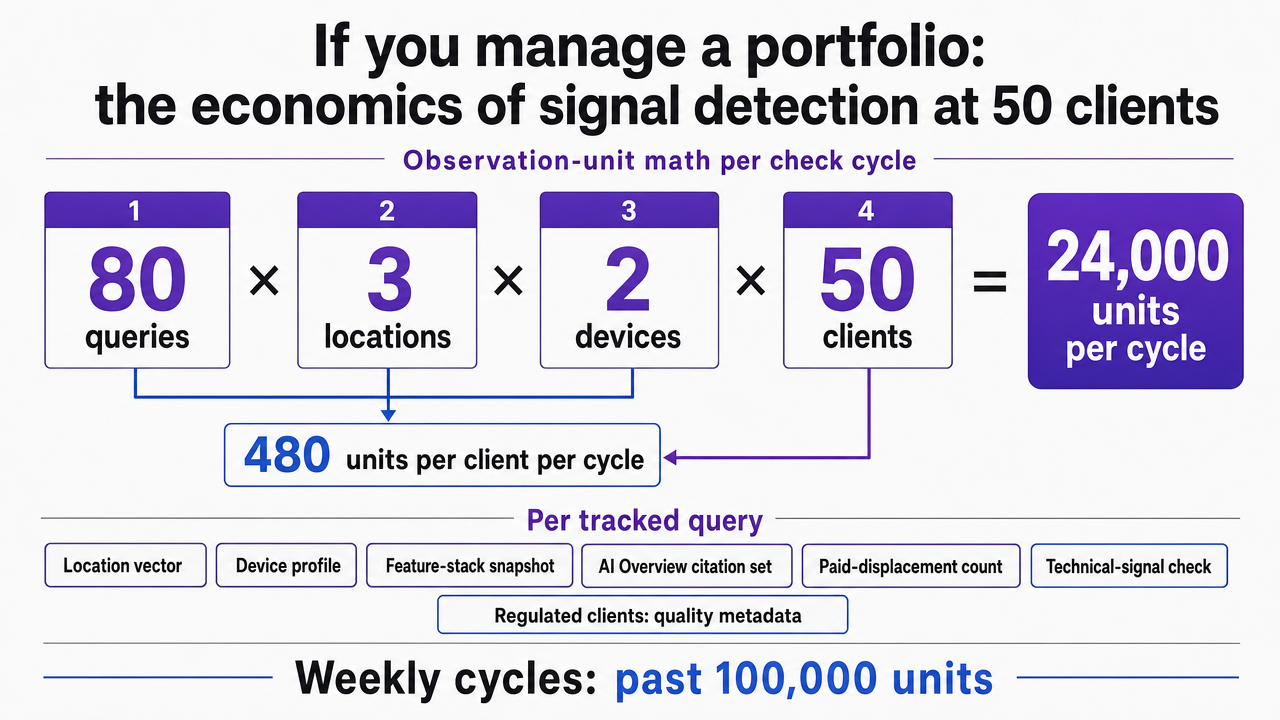 Visualize the article's stated observation-unit math (80 queries × 3 locations × 2 devices × 50 clients = 24,000 units per cycle) that drives the section's core economic argument
Building the approval-first monitoring stack
The architecture that survives at portfolio scale has three layers, and they are not interchangeable.
- Collection sits at the bottom: location-anchored queries, device profiles, feature-stack snapshots, AI Overview citation sets, paid-displacement counts, technical-signal checks, and quality metadata on ranking URLs for regulated accounts.
- Detection sits above it: deltas against the prior cycle, scored against escalation thresholds the agency defines per client and per vertical.
- Decision sits on top: a human reviewing exceptions and approving the response before anything ships to the client's site, ad account, or report.
The failure mode most agencies hit is building collection without detection, which produces dashboards. The second failure mode is building detection without approval, which produces autonomous changes the client's compliance team did not sanction. Both collapse at scale. The first drowns analysts in observations; the second drowns the agency in client-trust incidents, which arrive faster in regulated verticals where disclosure, labeling 3, and information-quality obligations attach to every published change 9.
What approval-first means operationally is narrow and specific. Every signal that crosses an escalation threshold routes to a queue with the context attached—query, location, device, surface state, prior value, current value, suggested response, and the reference check that produced it. A human approves, modifies, or rejects. Only then does execution run. The analyst's hour moves off data collection entirely and onto the decisions the system cannot make for them: whether a rank drop reflects a template regression worth a developer ticket, whether an AI Overview citation loss warrants a content revision, whether a paid-displacement event changes the bid strategy on the companion campaign.
Platforms built on this pattern—Vectoron is one category example—exist to collapse the collection and detection layers so the agency's remaining labor is judgment, not observation. The discipline matters more than the vendor. An agency that instruments five surveillance layers, routes exceptions into a single approval queue, and keeps the human on the decision is monitoring SERPs. Everything else is screenshots.
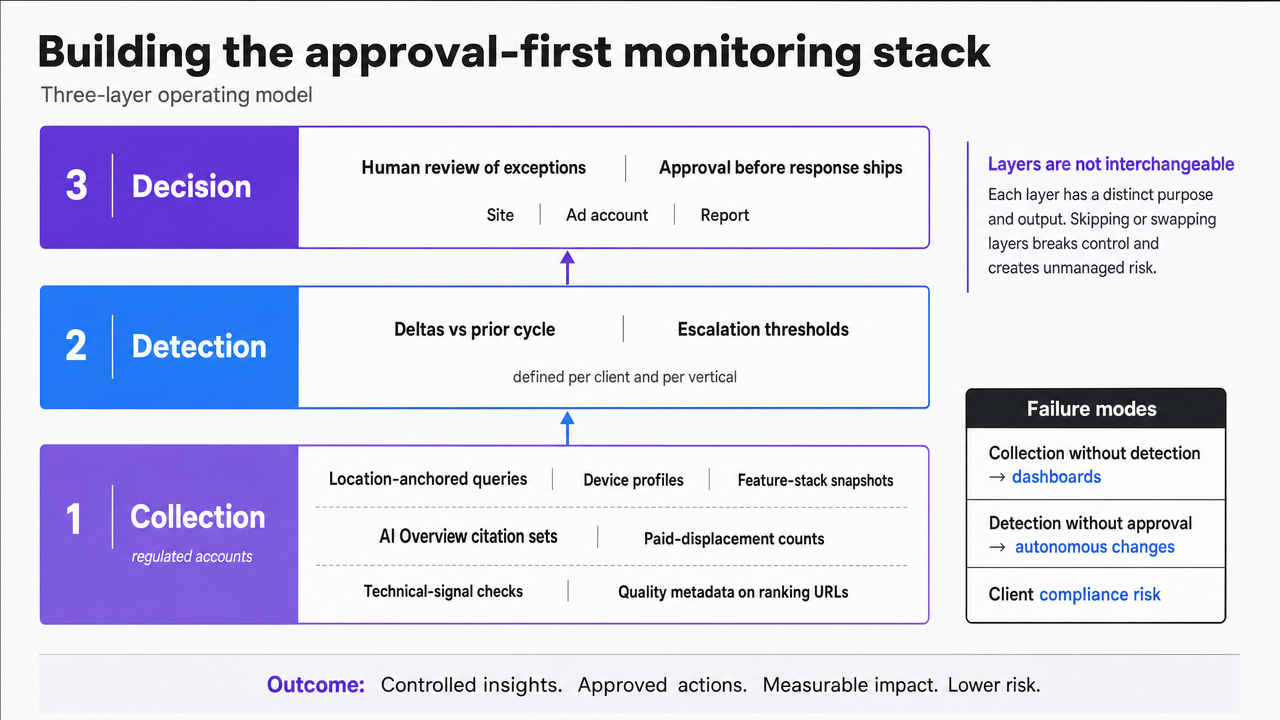 Diagram the three-layer architecture (Collection, Detection, Decision) described in this section as the operating model
Frequently Asked Questions
References
- 1.Location, Location, Location:.
- 2.Exposing Inconsistent Web Search Results with Bobble.
- 3.Native Advertising: A Guide for Businesses.
- 4.Sample Letter to General Purpose Search Engines.
- 5.An Empirical Study of Google Search, Gemini, and AI Overviews.
- 6.Use of Web search engines and personalisation in information retrieval.
- 7.An Empirical Analysis of Search Engine Advertising.
- 8.The Reliability Gap: How Traditional Search Engines and Generative AI Platforms Compare in Consumer Health Information.
- 9.Can Patients Trust Online Health Information? A Meta-Analysis of the Quality of Health Information on the Internet.
- 10.Online Information of Vaccines: Information Quality, Not Only Privacy, Is an Ethical Responsibility of Search Engines.
- 11.Using the Google™ Search Engine for Health Information.