
Key Takeaways
- B2B buyers complete roughly 70% of their journey before contacting vendors, so national SEO functions as a category-presence system that determines shortlist inclusion, not a traffic exercise 4.
- A hub-and-segment architecture borrowed from multi-location SEO governs national coverage: the .com root anchors brand, while segment hubs ship industry, use-case, integration, and comparison page systems on fixed templates.
- AI answer engines reward retrieval over ranking, so evaluative pages need direct answers in the first 60-90 words, structured data, and explicit naming of competitors, integrations, and stakeholders 5.
- Replace session counts with shortlist inclusion rate, segment-qualified demo volume, influenced ARR, and third-party citation share, reported monthly against the eight-month buying window rather than quarterly.
Why national organic became the primary buyer surface for SaaS
The center of gravity in B2B software buying has moved upstream, into the months before a sales team ever sees the deal. Synthesized buyer-journey research now puts B2B buyers roughly 70% of the way through their purchasing process before they engage a vendor, often after about eight months of independent research across search, review sites, and peer communities 4. For a Head of Growth at a Series B-to-D SaaS company, that means the surface area where the pipeline is actually won or lost is organic, distributed, and largely invisible to the CRM.
The composition of that pre-sales window matters more than its length. Corporate Visions' analysis of recent B2B buying data found that 92% of buyers start the journey with at least one vendor already in mind, and 41% start with a single preferred vendor in the lead position 9. National SEO, in that context, stops being a traffic-acquisition exercise and becomes a category-presence exercise: the program either gets a SaaS brand into the initial consideration set, or that brand spends the rest of the cycle fighting from behind against an incumbent the buyer named in the first ten minutes.
This is the frame the rest of the article will use. A national organic program is not a stack of ranking tactics; it is the operating system that determines whether a SaaS company shows up across the search queries, AI assistants, review pages, and segment-specific evaluations that fill those eight months. The implication for budget is direct. If most of the journey happens before a demo request, then session counts and keyword positions describe symptoms, not outcomes. The metrics that matter are shortlist inclusion, segment-qualified demo volume, and influenced ARR, all of which depend on whether the program can produce structured, segment-specific content at the cadence buyers are actually consuming it.
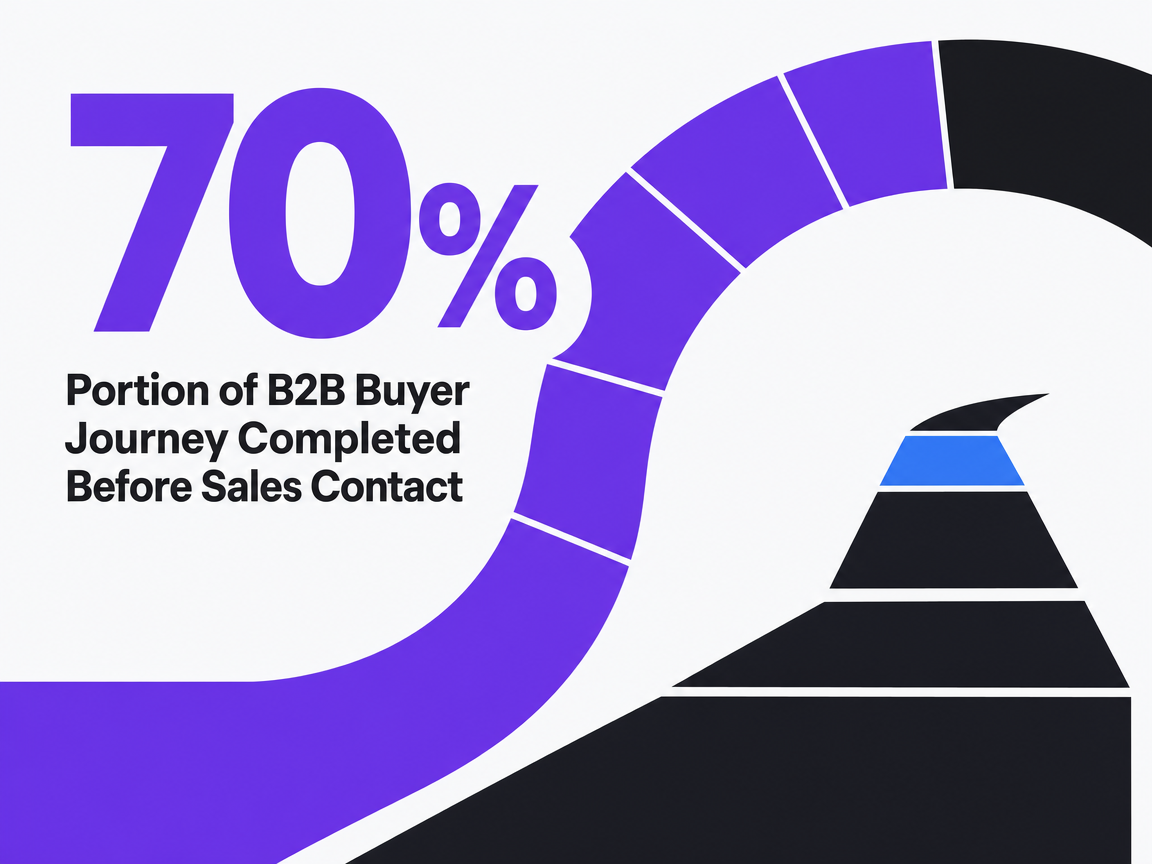 Portion of B2B Buyer Journey Completed Before Sales Contact
Portion of B2B Buyer Journey Completed Before Sales Contact
What 'national SEO services' actually means in 2025-2026
The phrase still appears on agency proposals as a deliverable list: keyword research, on-page optimization, technical audits, link building, monthly reporting. For a SaaS Head of Growth running a distributed buyer base, that scope language describes the wrong unit of work. A national SEO program in 2025-2026 is a production system that has to feed five surfaces at once:
- classic organic results,
- AI answer engines,
- third-party review platforms,
- segment-specific landing experiences,
- and the off-site reputation graph that B2B buyers cross-reference before they ever land on a vendor site.
G2's survey of roughly 1,900 software buyers found that search engines, review platforms, and peer recommendations operate as a single discovery layer rather than separate channels 1. Wynter's research on senior SaaS marketing leaders reinforces the same point from the buyer side: the initial consideration set is built from Google searches, review sites, and community recommendations in parallel, not in sequence 2. National SEO services that only optimize the .com root miss most of the surface area where the shortlist actually forms.
The operating definition this article will use is narrower and more demanding. National SEO is the continuous production and governance of structured content, technical infrastructure, and off-site signals that determine whether a SaaS brand is retrievable, citable, and credible across every geography and segment its ideal customer profile spans. Three implications follow. The output cadence has to match how fast buyers are consuming evaluative content, not the quarterly rhythm of a retainer. The content unit is the segment or use-case page system, not the individual blog post. And the measurement contract is pipeline contribution by segment, not aggregate organic sessions.
Site architecture for national plus segment coverage
The hub-and-segment system, translated from multi-location SEO
A note on where this pattern comes from. The cleanest blueprint for governing a national SaaS site at scale does not live in SaaS playbooks. It lives in multi-location SEO, where enterprise operators have already solved the problem of producing thousands of pages that share a brand spine while staying locally relevant. MarTech's enterprise multi-location framework treats scalable templates, centralized governance, and cross-location dashboards as the foundation rather than the polish 7. Outliant's content work on multi-location sites describes the operating tension directly: success depends on a balance of scalability and personalization, supported by structured profiles and locally relevant assets 10. SaaS growth teams serving distributed buyers face the same governance problem with different inputs. Geography is replaced by segment, industry, and use case, but the architecture pattern transfers cleanly.
The translation looks like this. The .com root operates as the brand hub, carrying category-defining content, the product narrative, and the highest-intent commercial pages. Beneath it sit segment hubs, each owning a single dimension of the ICP: an industry, a buyer role, a use case, or a regional go-to-market motion when one exists. Each segment hub then governs its own page system, with shared templates, shared schema, and locally written content that answers the evaluative queries specific to that segment. Centralized templates protect technical SEO consistency. Local content protects relevance. Neither alone is enough.
What this avoids is the failure mode most SaaS sites exhibit by Series C. The blog grows faster than the segment surface, ranking pages accumulate around informational queries, and the commercial architecture stays thin. Buyers researching a specific vertical land on generic pillar content that does not name their stakeholders, their compliance constraints, or the integrations they actually run. The hub-and-segment system inverts that. The blog supports the segments, not the other way around.
Industry, use-case, integration, and comparison pages as the production unit
Inside each segment hub, the unit of production is the page system, not the individual article. Four page types do most of the work, and each one maps to a distinct phase of the pre-sales research window.
- Industry pages establish category fit for a vertical: the language, the regulatory backdrop, the workflows the product touches.
- Use-case pages narrow further, addressing a specific job the buyer is trying to get done and the stakeholders involved in approving it.
- Integration pages cover the systems of record the buyer is already running, which is where Wynter's research on stakeholder counts and content overwhelm becomes operational 2, 3. When five or more stakeholders are involved in a typical SaaS decision, the integration surface is what their technical reviewer searches for, and a thin page loses the account before the demo is booked.
- Comparison pages are the most underbuilt of the four, and the most consequential.
Buyers narrowing a shortlist actively search for vendor-versus-vendor and category-alternative queries, and they trust organic results in those queries more than paid placements covering the same terms 8. A comparison page that names the alternative honestly, structures the differences in a scannable table, and links into the relevant integration and use-case pages does three jobs at once: it captures the shortlist query, it reinforces category presence for buyers who arrived through a different door, and it gives AI answer engines a structured asset to cite.
The production discipline is what makes this scale. Each page type has a fixed template, fixed schema, and a fixed set of evidence requirements. The variable inputs are the segment-specific language, customer evidence, and integration details. That separation is what lets a small growth team ship segment coverage at retainer-breaking velocity.
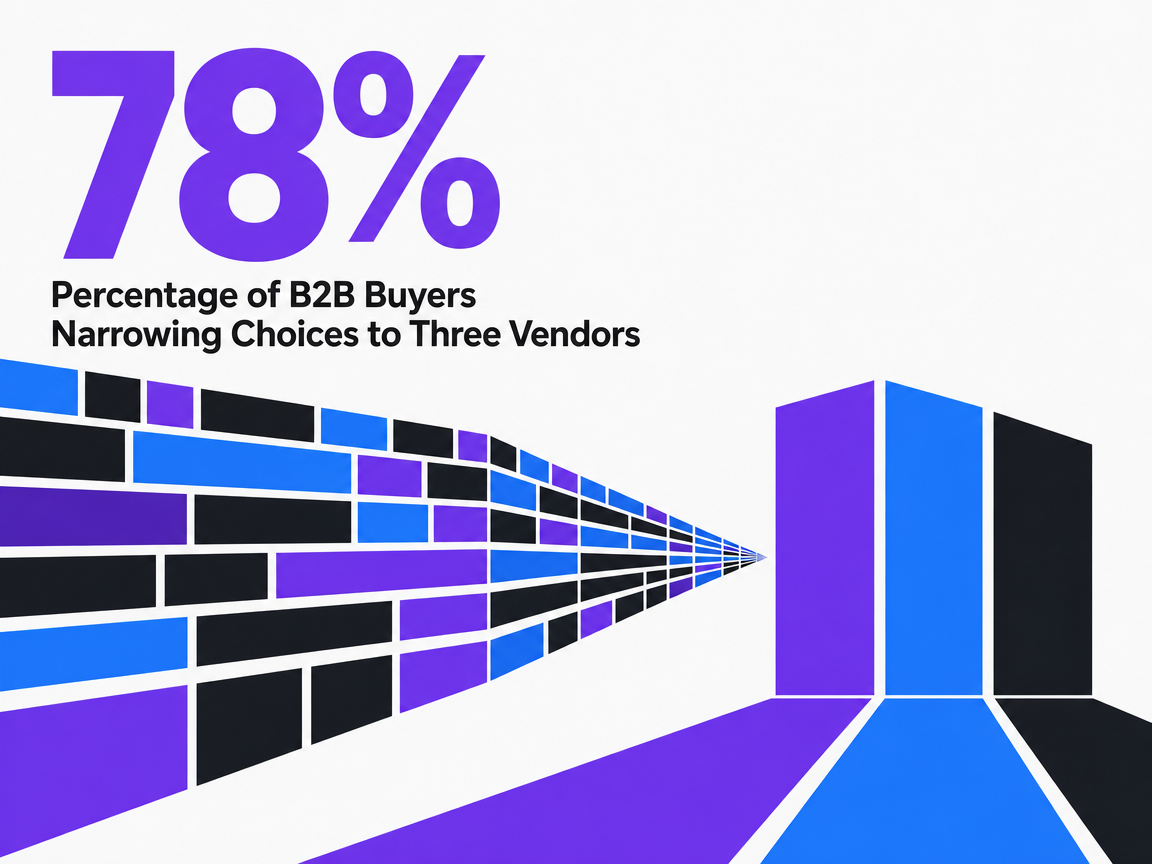 Percentage of B2B Buyers Narrowing Choices to Three Vendors
Percentage of B2B Buyers Narrowing Choices to Three Vendors
Test National SEO Execution With Live Content
Publish actual SEO-optimized content nationally and measure ranking impact before you commit.
AI search optimization as a first-class channel
Answer engines have already moved inside the buying process. A Forrester survey synthesized in recent B2B journey research found that 89% of B2B buyers use generative AI at least one point during their purchase, often to summarize vendor differences, generate comparison criteria, or pre-screen a shortlist before any human touchpoint 4. The corresponding workplace shift is just as steep: Deloitte's enterprise AI study reports that worker access to AI rose roughly 50% in 2025, and the share of companies running at least 40% of their AI projects in production is expected to double inside six months 11. The buyer using ChatGPT to compare three SaaS vendors is the same person who now has an internal copilot wired into their workflow.
This changes what an organic asset has to do. As one practitioner framing in recent coverage puts it, in AI-driven discovery
"retrieval beats ranking" — clarity, structure, and language alignment determine whether content is surfaced and cited inside an AI answer, not where it sits on a results page 5.
The blue-link competition for position three matters less when the buyer never sees the results page, and instead reads a synthesized answer that may or may not mention the SaaS brand at all. National SEO programs that still treat rank tracking as the primary scoreboard are measuring a surface that a meaningful share of buyers no longer visits.
The production prescription is concrete. Each evaluative page — comparisons, integrations, pricing logic, use-case explanations — needs a structural shape an answer engine can lift cleanly:
- a direct answer in the first 60 to 90 words,
- scannable subheads that mirror the actual buyer question,
- structured data that defines the entity and its relationships,
- and explicit naming of competitors, integrations, and stakeholders.
Early visibility data on AI search experiences suggests brands publishing structured, clearly formatted content are more likely to earn citations inside AI answers, though specific rates vary by study 6. The asymmetry favors disciplined producers. A page that ranks well but reads like a 2019 listicle gets passed over by retrieval; a page that is clear, sourced, and entity-rich gets pulled into the answer.
Two operational consequences follow. First, the audit unit shifts from keyword rankings to citation surfaces — which AI assistants name the brand, in which queries, and against which alternatives — and that monitoring needs to run continuously, not quarterly. Second, content velocity becomes a moat. When the in-house copilot of every buyer's procurement team is summarizing the category weekly, a SaaS brand that ships fresh, structured evidence on a weekly cadence appears in more synthesized answers than one shipping a long-form pillar each quarter. National SEO services that cannot match that cadence are optimizing for a channel the buyer has already left.
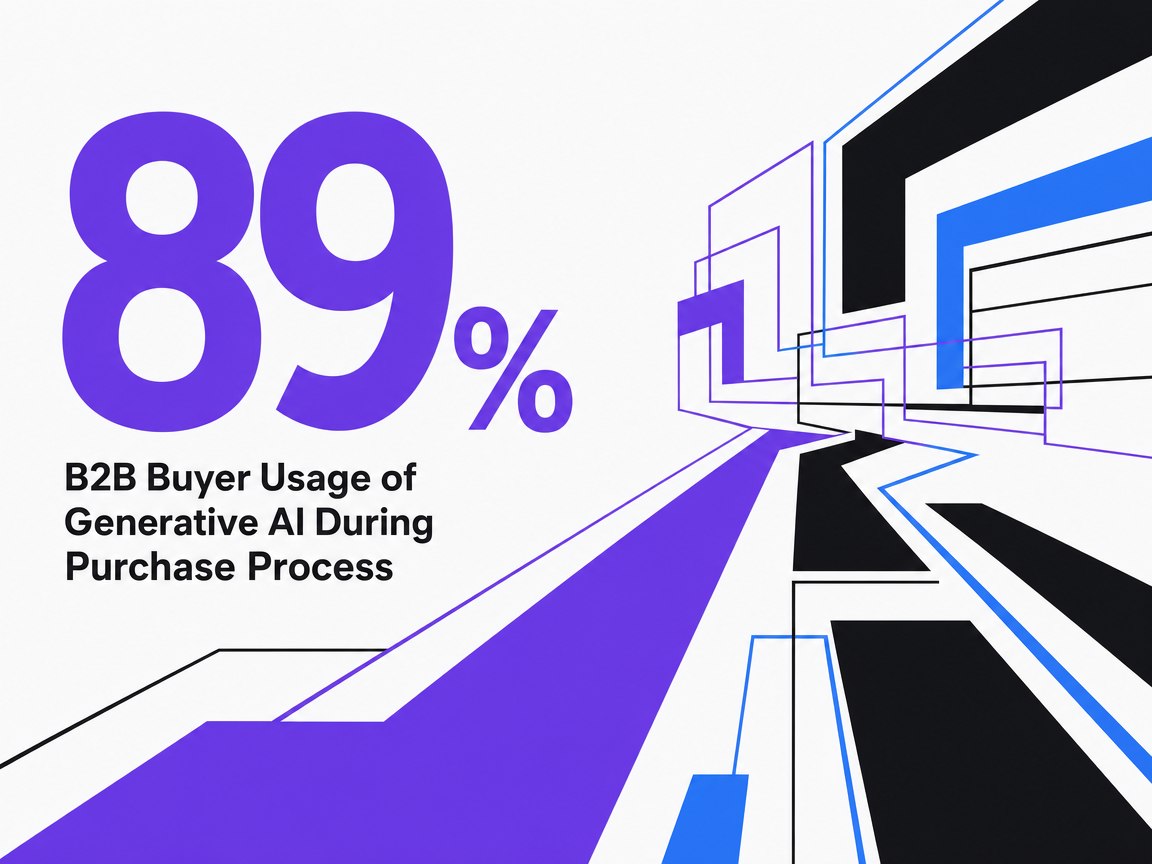 B2B Buyer Usage of Generative AI During Purchase Process
B2B Buyer Usage of Generative AI During Purchase Process
Pipeline-grade measurement: from sessions to shortlist inclusion
A B2B SaaS marketer captured the measurement problem in one line on LinkedIn: organic traffic can look
"insane" on paper while driving "ZERO pipeline," which is the gap a Head of Growth gets asked to explain in the next board meeting 13.
The fix is not a better dashboard. It is a different scoreboard, built around what buyers actually do during the pre-sales window rather than what shows up in Search Console.
Three buyer behaviors define what the scoreboard should track. Wynter's study of B2B SaaS revenue and marketing leaders found that 78% of buyers narrow their consideration set to three vendors after conducting online research and demos, typically with around five stakeholders in the room 3. Sopro's roundup of B2B buyer data reports that over four-fifths of B2B decision-makers — roughly 80% — trust organic search results significantly more than paid ads 8. Read together, the two figures describe the actual job a national SEO program is being hired to do: earn a slot inside a three-vendor shortlist through the channel buyers trust most when forming it. Sessions describe none of that. Shortlist inclusion does.
A pipeline-grade frame replaces aggregate traffic metrics with four operational measures:
- Shortlist inclusion rate, tracked by sampling AI-assistant answers, branded-versus-competitor query share, and inbound demo notes that name the brand alongside named alternatives.
- Segment-qualified demo volume, broken out by industry hub, use-case page, and comparison page rather than rolled into a single "organic" bucket.
- Influenced ARR, attributed to the segment page systems a closed-won account touched during research, not to the last click before form fill.
- Category presence on third-party surfaces — review platforms, peer communities, AI citations — measured as appearance rate inside the queries a target segment actually runs.
The reporting cadence changes too. Quarterly traffic reviews map poorly to a buying window that runs roughly eight months across five stakeholders. A monthly readout that tracks shortlist inclusion by segment, demo conversion by page system, and citation share inside AI answers gives a growth team the early signal that a segment hub is working or starving, before the pipeline lag confirms it. National SEO services that cannot produce that readout are billing for activity, not outcomes.
See How National SEO Automation Delivers Measurable Pipeline Gains for SaaS Growth Teams
Request a walkthrough of AI-powered national SEO workflows proven to increase lead volume and organic footprint for SaaS and agency portfolios—without increasing headcount or management complexity.
The operating-model decision: in-house, agency, or AI-platform
Comparing delivery models on throughput, coverage, and cost
A note on framing before the table. This is a delivery-model comparison for the same national SEO scope described above, not a vendor comparison. The variables a Head of Growth controls are:
- throughput (pages and updates shipped per month),
- coverage (which surfaces the program actually touches),
- time-to-publish,
- measurement integration,
- and cost.
The three delivery models below are the realistic options for a Series B-to-D SaaS team running a national organic program in 2025-2026.
The macro context matters when reading the cost column. Menlo Ventures' enterprise AI analysis reports generative AI spending grew from $1.7 billion to $37 billion in a single year, with the application layer alone capturing roughly $19 billion in 2025 12. Deloitte's 2026 enterprise AI study finds the share of companies running 40% or more of their AI projects in production is on track to double inside six months 11. The economics of AI-platform-led production are no longer a forecast; they are a current-market input the CFO is already modeling against agency line items.
| Variable | In-house team (2-6 marketers) | Traditional agency retainer | AI-platform-led production |
|---|---|---|---|
| Monthly content output | 4-8 long-form assets, limited segment pages | 6-12 assets, scoped quarterly | Continuous: weekly segment, comparison, and integration pages |
| Technical SEO coverage | Depends on in-house specialist; often gapped | Quarterly audits, slow remediation cycles | Continuous monitoring with automated remediation queues |
| Segment/landing page capacity | Constrained by writer headcount | Billed per page or scoped change order | Templated production at account level, no per-page billing |
| Time-to-publish | 2-4 weeks per asset | 4-8 weeks with revision loops | Days, governed by approval cadence |
| Measurement integration | Whatever the team has wired into GA4 and Search Console | Agency dashboard, often siloed from CRM | Account-level integration with GA4, Search Console, and ad platforms |
| Cost structure | Fully loaded headcount per FTE plus tooling | Monthly retainer plus scope-creep fees | Flat platform subscription |
Two patterns surface when growth leaders run this comparison honestly. First, in-house teams hit a throughput ceiling well before they hit a strategy ceiling; a four-person marketing team owning demand, lifecycle, brand, and product marketing cannot also ship the page volume a segment hub system requires. Second, agency retainers solve the throughput problem at a cost that increasingly fails the trust-versus-paid math, since 80% of B2B decision-makers report trusting organic results significantly more than paid ads — meaning the channel deserves operating-system treatment, not a retainer that bills like a project 8. The AI-platform model is the one delivery option that decouples output from headcount while keeping governance inside the growth team.
Where hybrid setups actually earn their keep
Pure-play setups are rare in practice. Most Series B-to-D SaaS programs end up running a hybrid, and the question is which seam to put where. Two hybrid patterns hold up under scrutiny.
The first keeps strategy and brand voice in-house, moves production and technical execution to an AI-platform layer, and reserves a narrow specialist retainer for work the platform cannot do well yet — original analyst research, primary data studies, executive thought leadership tied to a named voice. The growth team owns the segment map and the measurement contract. The platform ships the page systems against that map. The specialist retainer fills the credibility surface that requires a human byline.
The second pattern inverts the seam for earlier-stage teams. A two-person growth function uses the AI-platform as the strategist and producer for the segment hub system, while a part-time fractional SEO lead reviews architecture decisions and handles the messy edge cases — migrations, schema disputes, international hreflang questions. This keeps fixed costs low while preserving senior judgment on the decisions that are expensive to reverse.
The hybrid pattern to avoid is the legacy one: a full retainer agency producing blog content while an in-house team duplicates segment work and a separate freelancer manages technical SEO. That setup carries three sets of coordination overhead and almost always underweights the comparison and integration page surface where shortlist decisions actually get made. The operating-model question is not whether to use AI, agency, or in-house talent. It is which seam each one sits on, and whether the segment hub system gets shipped on the cadence buyers are researching at.
A 90-day operating plan for the first national SEO cycle
Most national SEO programs fail in the first quarter not because the strategy is wrong, but because the production system never gets built. A 90-day cycle is enough time to ship the spine of the segment hub system, instrument pipeline-grade measurement, and produce early citation signal inside AI answer engines — provided the work is sequenced against buyer behavior rather than against a generic SEO checklist.
- Days 1-30: segment map and architecture. The first month is a mapping exercise, not a content sprint. The growth team defines the segment hubs the program will own — industries, use cases, buyer roles, and any regional motions — and audits which surfaces already exist for each one. The output is a coverage matrix that names every industry, use-case, integration, and comparison page the segment hub system requires, ranked by the queries each target ICP actually runs. Technical foundation work runs in parallel: schema templates, internal linking rules, and the analytics joins between GA4, Search Console, and the CRM that will later support segment-level pipeline attribution. No new content ships yet.
- Days 31-60: production at template velocity. Month two converts the matrix into pages. Comparison and integration pages take priority, since those are the surfaces where shortlist decisions get made and where 78% of buyers narrow to three vendors after research 3. Each page ships against the fixed template — direct answer in the first 60-90 words, scannable subheads mirroring buyer questions, structured data, explicit naming of alternatives and stakeholders — so retrieval systems can lift it cleanly. A realistic cadence for a small growth team supported by AI production is 8-15 segment pages per week, an order of magnitude above what a quarterly retainer ships.
- Days 61-90: measurement, citation audit, and the next cycle. The final month closes the loop. Shortlist inclusion gets sampled by running target queries through the AI assistants buyers actually use and recording which vendors get cited. Segment-qualified demo volume is tagged back to the page systems that influenced it. The monthly readout names the segments that are working, the segments that are starving, and the next 30 pages the system will ship. The 90-day cycle ends with a production engine running, not a deck recommending one.
Frequently Asked Questions
References
- 1.2024 Buyer Behavior Report - G2.
- 2.The B2B Buyer Journey Research: How B2B SaaS Marketing Leaders Buy.
- 3.B2B Buyer Journey Insights 2024.
- 4.How AI Is Reshaping the B2B SaaS Buyer Journey.
- 5.5 ways generative AI is changing organic search traffic in B2B.
- 6.AI Search Visibility Stats That Might Surprise B2B SaaS Marketers.
- 7.Enterprise Multi-Location SEO: Scale Local Search Success.
- 8.68 B2B buyer statistics and insights.
- 9.B2B Buying Behavior in 2026: 57 Stats and Five Hard Truths That Matter.
- 10.Effective Content Strategies for Multi-Location Websites - Outliant.
- 11.The State of AI in the Enterprise - 2026 AI report | Deloitte US.
- 12.2025: The State of Generative AI in the Enterprise | Menlo Ventures.
- 13.Sam Dunning's Post - LinkedIn.