
Key Takeaways
- Treating on-page analysis as a linear craft deliverable consumes roughly a third of senior strategist capacity across an 80-account book, forcing agencies to redirect recurring work into automated layers.
- A three-tier pipeline separates deterministic crawling across all URLs, templated manual review on representative pages, and senior escalation for ambiguous calls, so expert hours concentrate on judgment work.
- Moving from fully manual audits to a tiered pipeline reclaims roughly 225 senior hours per 50 accounts per quarter, provided human review layers and approval gates stay intact 1.
- Scoring findings on revenue exposure, defect weight, and remediation cost at ingestion produces a ranked backlog per account and prevents strategists from arbitrating severity scales deck by deck 3.
- AI-assisted analysis survives client scrutiny only when documented inputs, named approvers, output provenance, and sensitive-content escalation are enforced as non-negotiable controls 9.
- Vertical risk tiering routes healthcare, legal, and public-sector-adjacent accounts through tighter approvals and dedicated WCAG 2.1 AA queues, reflecting DOJ Title II compliance timelines 10.
- Multi-location and franchise portfolios require re-architecting Tier 1 and Tier 2 around templates and location clusters so one schema regression surfaces as a single ticket with an impact count 3.
- Renewal-grade reporting fits on one page, leading with money-page movement and template-level fixes while relegating findings-detected counts and crawl coverage to the appendix.
The Portfolio Math That Breaks Senior Strategist Capacity
Consider the arithmetic facing a director of SEO at a 40-person agency carrying 80 client accounts. If each account requires a quarterly on-page review, and a thorough manual pass runs four to six hours per site, that single deliverable consumes 320 to 480 strategist hours per quarter before anyone writes a recommendation, briefs a client, or responds to an algorithm update. Divide that across a bench of six senior specialists and on-page analysis alone claims roughly a third of their billable capacity.
The pressure is compounding. Stanford's 2025 AI Index reports that 78% of organizations surveyed used AI in 2024, up from 55% in 2023, and that among organizations deploying AI in marketing and sales, 71% reported revenue gains, most commonly below 5% 4. Those figures are survey-based and context-dependent, not a promise of margin expansion, but they shape buyer expectations. Agency prospects now assume AI-assisted delivery is baked into the engagement, and renewal conversations increasingly include questions about how AI is governed, not whether it is used.
The operational trap is treating on-page analysis as a craft deliverable that scales linearly with headcount. It does not. Research on web evaluation consistently finds that defect detection is better handled through combined automated and human review rather than a single scan or a single reviewer 1. That finding reframes the capacity problem. The question is not how many strategists an agency can afford to hire; it is how much of the recurring work can be redirected to automated layers so senior hours concentrate on the ambiguous findings that actually move rankings, revenue, and client retention.
A Three-Tier Pipeline for Recurring On-Page Review
Tier 1: Automated Crawling and Rendering Across 100% of URLs
Tier 1 runs continuously against every indexable URL in every client account. The crawl executes JavaScript, captures rendered DOM, pulls Search Console performance data, and writes findings to a normalized schema that treats a 50-page law firm site and a 40,000-page multi-location brand as rows in the same database. The output is not a report. It is a dataset.
The checks that belong here are the ones that are deterministic and template-agnostic:
- missing or duplicate title tags
- canonical conflicts
- noindex directives on money pages
- broken internal links
- orphan URLs
- hreflang errors
- structured data validation
- image weight
- Core Web Vitals field data
- mobile parity between rendered and raw HTML
- status code anomalies
These are findings a machine can detect with high recall and that a senior strategist should never spend an hour hand-checking across 80 accounts.
Scheduling matters more than scan depth. Running full crawls weekly on tier-one revenue pages and monthly on long-tail URLs keeps the dataset fresh without saturating infrastructure or triggering client rate limits. Delta reports, which flag only what changed since the last crawl, cut review volume by an order of magnitude and surface the regressions that CMS deployments, plugin updates, or content refreshes introduce between quarters.
Research on web evaluation is explicit that automated scans have incomplete coverage and should not be treated as a substitute for expert review 1. Tier 1 is designed to accept that limit. It is a filtering layer, not a verdict layer. Its job is to eliminate the 60 to 75 percent of recurring, detectable issues from the human queue so Tier 2 and Tier 3 inherit a smaller, sharper backlog.
Tier 2: Templated Manual Review on Representative Pages
Tier 2 narrows the aperture. Instead of auditing every URL, a mid-level strategist reviews a representative page per template: the homepage, one service or product detail page, one location page, one blog article, one conversion landing page. On a 40,000-URL multi-location site, that is typically six to twelve pages per quarter. The logic is that most on-page defects are not URL-specific; they are inherited from shared templates, component libraries, and CMS behavior that developers, designers, and content creators maintain in common 3. Fix the template, and the defect clears across every page built from it.
The manual pass covers what Tier 1 cannot: intent alignment between query cluster and page content, internal linking logic within a topical hub, heading hierarchy that reflects actual information architecture rather than just H1-H6 presence, schema that matches the entity the page is actually about, and above-the-fold composition on real devices. Reviewers work from a documented checklist with pass/fail criteria and screenshot evidence attached to each finding, which makes the output auditable and consistent across strategists.
Sampling discipline is what keeps Tier 2 scalable. Representative does not mean random. The sample is stratified: highest-traffic template, highest-converting template, newest template deployed since the last audit, and any template flagged by Tier 1 for recurring defects. That selection logic is documented per account and reviewed quarterly, which prevents the sample from drifting into whatever pages the reviewer happens to open first.
Tier 2 output feeds two downstream actions: a template-level remediation ticket for the client's development team and a flagged subset of findings that cannot be resolved without senior judgment.
Tier 3: Senior Strategist Escalation for Ambiguous and Client-Specific Calls
Tier 3 is where senior hours actually belong. The queue is small by design: ambiguous findings Tier 2 could not resolve, trade-offs between competing SEO objectives, vertical-sensitive recommendations in regulated industries, and anything that touches client strategy rather than client execution. A senior strategist might see 15 to 30 escalations per account per quarter instead of the 200 to 400 raw findings a traditional audit surfaces.
The escalation criteria are explicit. A finding moves to Tier 3 when it requires knowledge the pipeline does not have: brand voice constraints, legal review requirements, competitive positioning, pending site migrations, or client-specific commercial priorities. It also escalates when two defensible recommendations conflict, such as consolidating thin location pages that still convert, or when the fix carries revenue risk the junior reviewer cannot size.
Section 508 guidance identifies automated, manual, and hybrid testing as valid approaches and recommends documented, consistent, repeatable manual processes 2. The three-tier model applies that same precedent to on-page analysis: automation handles scale, templated manual review handles representative judgment, and expert escalation handles context. Approval gates sit between each tier, so no finding advances without a documented reviewer, timestamp, and rationale. That audit trail is what makes the pipeline defensible in a client QBR, in a renewal RFP, and in any subsequent dispute about why a recommendation shipped or did not.
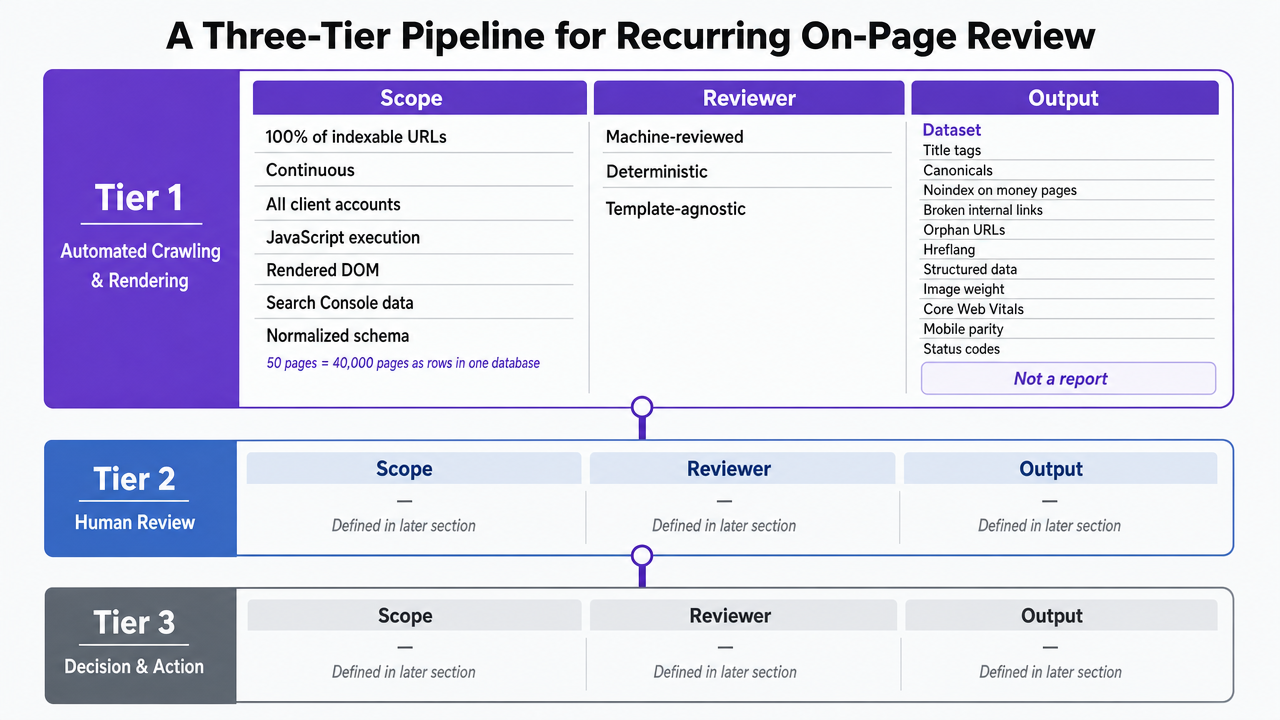 Visualize the three-tier operating model that defines the article's core framework, showing scope, reviewer, and output at each tier
Unit Economics: Hours Reclaimed Per 50 Accounts Per Quarter
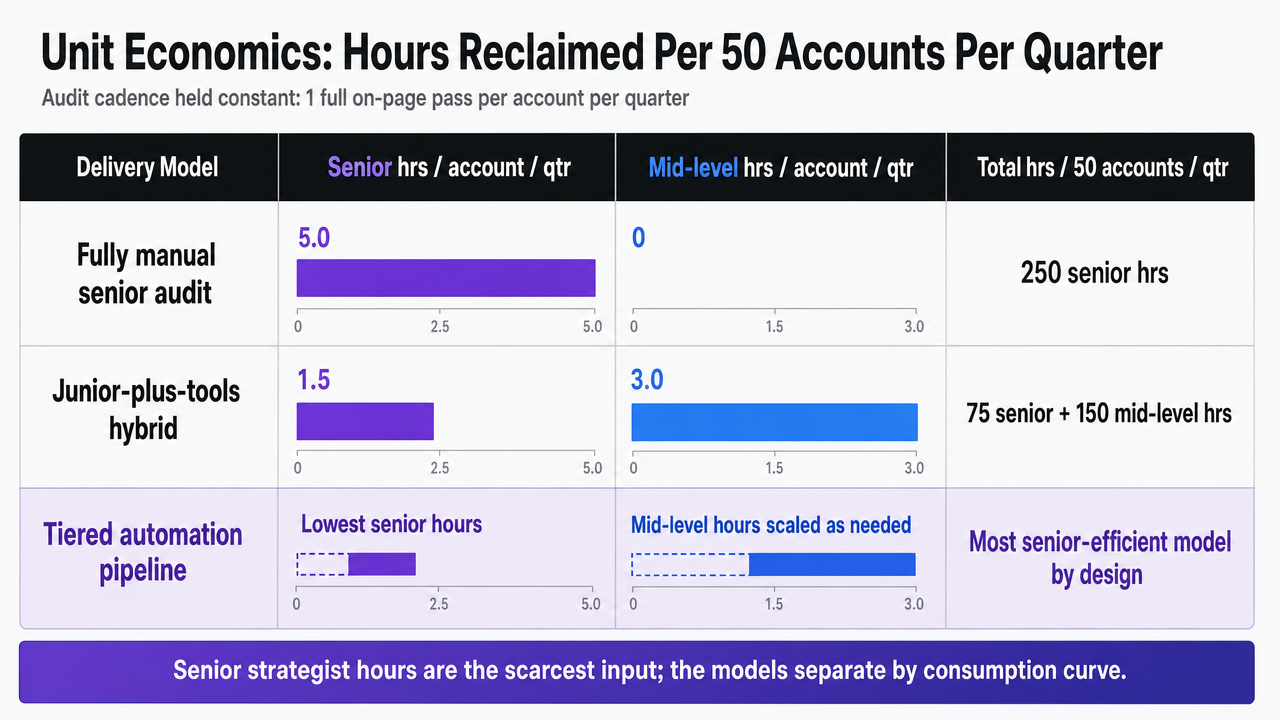
The case for a tiered pipeline is not aesthetic. It is arithmetic. Senior strategist hours are the scarcest input in an SEO agency, and recurring on-page analysis is one of the few deliverables where the hour count can be modeled before the quarter starts. The three delivery models in common use produce dramatically different consumption curves across a 50-account book of business.
Let H represent the fully loaded hourly cost of a senior strategist and J the hourly cost of a mid-level reviewer. Hold the audit cadence constant at one full on-page pass per account per quarter. The hour profiles separate cleanly:
| Delivery Model | Senior Hrs / Account / Qtr | Mid-Level Hrs / Account / Qtr | Total Hrs / 50 Accounts / Qtr |
|---|---|---|---|
| Fully manual senior audit | 5.0 | 0 | 250 senior hrs |
| Junior-plus-tools hybrid | 1.5 | 3.0 | 75 senior + 150 mid-level hrs |
| Tiered automated pipeline with expert escalation | 0.5 | 1.25 | 25 senior + 62.5 mid-level hrs |
The variables are deliberately conservative. A fully manual audit of five hours per account reflects the lower end of what thorough on-page review takes on a mid-sized site. The hybrid model assumes a junior reviewer runs scans and compiles the deck while a senior spot-checks and signs off. The tiered model assumes Tier 1 automation absorbs the bulk of detectable defects, Tier 2 handles templated manual review on a stratified sample, and Tier 3 escalation receives a focused queue.
Across 50 accounts per quarter, the delta is 225 senior hours reclaimed moving from manual to tiered, and 50 senior hours plus 87.5 mid-level hours reclaimed moving from hybrid to tiered. At a reader's own blended rate, those hours convert directly to either margin, redeployment into strategy work clients actually renew on, or additional accounts absorbed without a hire. Scale the book to 100 or 150 accounts and the gap widens linearly.
The economics only hold if the pipeline is governed. Research on web evaluation is explicit that automated scans have incomplete coverage and that hybrid approaches combining automated tooling with human review are the defensible standard 1. An agency that strips out Tier 2 and Tier 3 to chase lower unit cost reintroduces the defect-detection gap the pipeline was built to close, and the saved hours get spent later on client escalations, ranking regressions, and remediation disputes. The reclaimed capacity is real, but it is contingent on keeping the human layers intact and the approval gates documented. That is the trade a delivery leader is actually making: not automation versus expertise, but recurring detectable work versus concentrated judgment work, priced in hours per account per quarter.
 Compare senior and mid-level hours consumed per 50 accounts per quarter across the three delivery models cited in the section
Test AI-driven on page analysis workflows now
Experience streamlined on page audits and publish real client optimizations during your trial period.
Prioritizing Findings Across a Portfolio Without Rewriting Every Audit
A tiered pipeline produces more findings per quarter, not fewer. Across 50 accounts, Tier 1 alone can surface tens of thousands of flagged items. Without a shared prioritization layer, every account manager invents a severity scale, every client deck ranks differently, and senior strategists spend their reclaimed hours arbitrating what should have shipped first. The scoring logic has to live in the pipeline, not in the reviewer's head.
A workable model scores each finding on three dimensions and resolves them in order.
- Revenue exposure: does the URL carry commercial intent, convert, or sit in a cluster that does? Pages pulling qualified traffic or driving booked revenue outrank orphaned blog posts regardless of defect severity.
- Defect weight: an uncrawlable money page outranks a missing meta description on the same URL.
- Remediation cost: template-level fixes that clear defects across hundreds of pages outrank one-off edits, which is why Tier 2's representative sampling matters here 3.
A composite score, calculated at ingestion, lets the pipeline produce a ranked backlog per account without a strategist opening the file.
Portfolio-level prioritization layers on top. Delta reports surface what regressed since the last crawl, which usually matters more than static backlog items that have persisted for quarters without consequence. New defects correlated with ranking drops or Core Web Vitals shifts get flagged for same-week review. Everything else enters the standard queue. This separation is what prevents the pipeline from producing 400-item audits that no client's development team will ever work through.
The scoring rubric is documented once per account and version-controlled. When a client's commercial priorities shift, the weights change, not the workflow.
Governing AI-Assisted Analysis With Approval Gates and Provenance
AI assistance accelerates on-page analysis across a portfolio in three places: summarizing crawl deltas into plain-language findings, drafting template-level remediation tickets, and proposing intent-aligned revisions for Tier 2 reviewers to approve. The productivity gain is real, but it only survives contact with a client QBR if the pipeline can show what the model saw, what it recommended, who approved it, and when.
NIST's Generative AI Profile, published July 2024 as a companion to the broader AI Risk Management Framework, identifies privacy, inaccurate outputs, provenance, security, and accountability as the risk categories organizations must manage across the design, development, use, and evaluation of generative systems 9. Translated into an agency on-page workflow, that means four controls stay non-negotiable regardless of model vendor.
- Documented inputs. Every AI-generated finding records the crawl snapshot, prompt template, model version, and client data scope it was built from.
- Approval gates. No AI recommendation ships to a client deck or a developer ticket without a named human reviewer signing off, and the sign-off is logged with timestamp and rationale 7.
- Provenance on outputs. Each recommendation carries a traceable link back to the Tier 1 finding, the ranking rule, and the reviewer who approved it, so a strategist can reconstruct the chain six months later during a renewal conversation or a dispute.
- Escalation for sensitive content. AI-drafted recommendations touching medical claims, legal copy, financial disclosures, or regulated health content route to Tier 3 before anything leaves the pipeline.
The model proposes; the senior strategist decides. That boundary is what lets an agency answer the AI-governance question on an RFP with a specific workflow rather than a reassurance, and it is the operational difference between AI as a leverage layer and AI as an unmanaged liability.
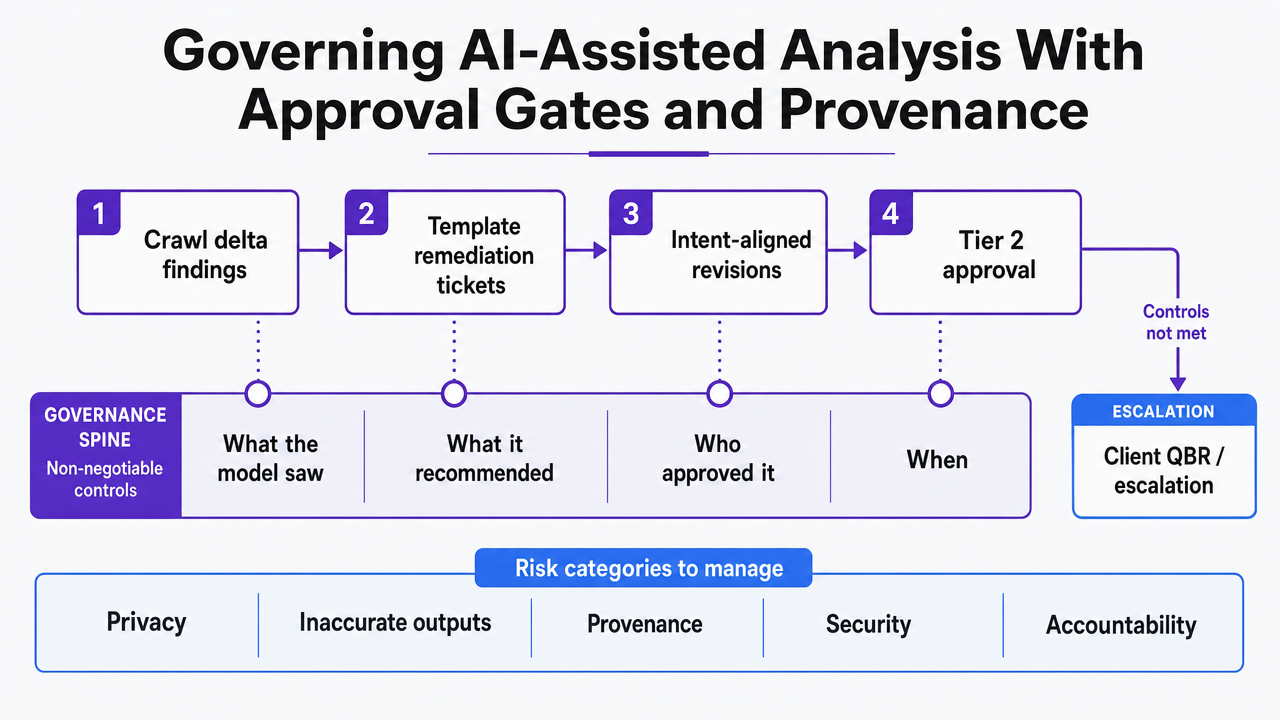 Visualize the four non-negotiable AI governance controls described in the section as a sequential flow with escalation branch
Vertical Risk Tiering for Healthcare, Legal, and Public-Sector-Adjacent Accounts
Not every account in the book carries the same downside. A home services client with a WordPress site and a plumber persona can absorb a mistitled service page for a quarter. A behavioral health network, a plaintiff firm, or a county-contracted senior living operator cannot. Vertical risk tiering is the layer that tells the pipeline which accounts need slower approvals, broader manual coverage, and tighter escalation thresholds, regardless of where their findings sit in the standard severity scoring.
Three tiers hold up across most agency books.
- Standard-risk accounts (home services, retail, SaaS, non-regulated B2B) run the default Tier 1 to Tier 3 cadence.
- Elevated-risk accounts (healthcare providers, legal practices, financial services, education) require that any AI-drafted on-page recommendation touching clinical claims, legal copy, outcome language, or regulated disclosures route to a senior strategist before leaving the pipeline, consistent with the escalation posture NIST's Generative AI Profile recommends for sensitive outputs 9.
- Public-sector-adjacent accounts (government contractors, publicly funded clinics, Medicaid-serving dental groups, agencies supporting state or local programs) carry a third constraint: inherited accessibility exposure.
The 2024 DOJ Title II final rule set WCAG 2.1 Level AA as the technical standard for covered state and local government web content and mobile applications, with compliance dates of April 24, 2026 for entities serving populations of 50,000 or more and April 26, 2027 for smaller entities and special district governments 10. DOJ guidance under Titles II and III separately explains that inaccessible web content can create barriers to goods, services, and information for people with disabilities 8. Private clients are not automatically covered by the Title II rule, but agencies serving contractors, grantees, or vendors inside the public-entity supply chain often inherit the standard through procurement contracts 5.
Operationally, this means two adjustments to the pipeline. First, elevated and public-sector-adjacent accounts get WCAG 2.1 AA checks pulled from Tier 1 scanning into a dedicated accessibility queue reviewed on the same cadence as revenue findings, not deferred to an annual compliance pass. Second, remediation tickets separate technical defects from legal interpretation; the audit reports what the scan found, and qualified counsel determines what any specific obligation requires. That boundary protects the agency from making compliance promises it cannot defend and protects the client from treating a passing automated score as legal cover.
See How Top Agencies Automate On-Page Analysis at Scale
Request a walkthrough of workflow-driven on-page analysis—learn how leading teams coordinate multi-account audits, prioritize actions, and maintain oversight with AI-powered efficiency.
If You Manage Multi-Location Brands and Franchise Portfolios
Multi-location brands and franchise portfolios distort the pipeline math in a specific way. A single master services agreement can cover 60, 300, or 1,200 location pages built from two or three templates, with content ownership split between corporate marketing, local operators, and sometimes franchisees who edit their own pages through a self-serve portal. The account count stays low; the URL count, the governance complexity, and the regression risk do not.
The adjustment is to re-architect Tier 1 and Tier 2 around templates and location clusters, not accounts. One multi-location client is really N template instances multiplied by L locations. Tier 1 scans every URL as before, but delta reports group findings by template fingerprint so a schema regression on the location-detail template surfaces once with an impact count of 847 pages rather than 847 separate tickets. Tier 2's representative sample pulls one page per template per market tier (flagship metro, mid-market, rural) so manual review catches the content-level drift that corporate QA misses when local operators swap imagery, hours, or service descriptions. Shared component libraries and CMS behavior produce most of the recurring defects on these portfolios, which is why template-level remediation clears the backlog faster than any per-page edit campaign 3.
Two governance rules keep the arrangement defensible. Approval authority for template changes stays with corporate marketing even when findings originate from a franchisee's page, and local-override edits route through a separate review queue so a well-meaning operator does not reintroduce a defect the pipeline just cleared.
Reporting Outcomes Clients Will Renew On
A client does not renew because the pipeline surfaced 12,000 findings last quarter. They renew because something they care about moved. The reporting layer has to translate pipeline activity into the two or three outcomes a CMO or founder can defend in their own board meeting: revenue-linked ranking shifts on commercial URLs, template fixes that cleared defect classes at scale, and the specialist judgment calls that shaped strategy between quarters.
A defensible monthly report fits on one page. It leads with movement on tracked money pages, not aggregate traffic. It shows what regressed, what was remediated, and what is queued, with each item carrying a timestamped approval chain back to the reviewer who signed off 9. It separates automated findings from human judgment, which is the honest version of the AI-governance story clients increasingly ask for during renewals and RFPs.
Volume metrics belong in the appendix. Findings-detected counts, crawl coverage, and automation throughput prove the pipeline is running; they do not prove it is working. The front page stays reserved for the handful of movements the client's commercial team will actually act on. That is the report format that converts a tiered pipeline from a cost story into a renewal story.
Frequently Asked Questions
References
- 1.Accessibility engineering in web evaluation process: a systematic literature review.
- 2.Overview of Testing Methods for 508 Conformance.
- 3.Guide to Accessible Web Design & Development.
- 4.Economy | The 2025 AI Index Report.
- 5.Justice Department's Final Rule to Improve Web and Mobile App Access for People with Disabilities.
- 6.Justice Department Issues Web Accessibility Guidance Under the Americans with Disabilities Act.
- 7.Artificial Intelligence Risk Management Framework.
- 8.Guidance on Web Accessibility and the ADA.
- 9.Artificial Intelligence Risk Management Framework: Generative Artificial Intelligence Profile.
- 10.web-rule.pdf.