
Key Takeaways
- Effective on-page audits map every finding to one of five Google decision gates—Crawl, Render, Index, Understand, and Select—rather than relying on generic checklist rubrics.
- Crawlability separates reachability from intent: anchor href attributes drive discovery, while robots.txt, sitemaps, and canonicals govern which URLs Google should prioritize 12.
- Rewriting title tags rarely changes SERP display alone because Google constructs titles from six inputs including H1, anchor text, and structured data 3.
- AI Overview visibility requires no special markup—only that pages clear the same crawl, render, index, understand, and snippet-eligibility gates as conventional Search 17.
Why Most Agency Audits Miss the Real Ranking Defects
The typical on-page SEO audit often produces extensive spreadsheets without leading to significant ranking improvements. This isn't due to a lack of effort but rather a flawed diagnostic approach.
Many agency audits rely on outdated rubrics that predate mobile-first indexing, JavaScript rendering, and AI Overviews. These checklists focus on surface-level elements like title length and keyword density, failing to account for Google's explicit statements that the mobile version of a site's content is indexed and ranked 10, and that JavaScript applications undergo distinct crawling, rendering, and indexing phases, each prone to independent failure 11.
When a page fails to rank, the issue typically falls into one of five categories: Google cannot crawl it, render it, index it, understand it, or select it for a given query. A generic checklist that conflates symptoms from all categories provides no clear prioritization for strategists or verification method for clients.
A robust audit, however, maps every finding to a specific Google decision point, references the primary documentation governing that decision 1, and links to a verifiable Search Console or conversion metric. This shift from a simple checklist to a framework based on decision gates is crucial for audits that drive revenue.
The Five Decision Gates: A Framework Anchored in Google Documentation
Google's own documentation outlines a sequential path for a page from discovery to ranking eligibility, not a mere checklist 7. An effective audit reconstructs this sequence in reverse, assigning each finding to one of five critical decision gates:
- Crawl: Can Googlebot access the URL?
- Render: Does the rendered output contain the intended content?
- Index: Is the URL selected as canonical and admitted to the index?
- Understand: Is the content's meaning clear to Google's systems?
- Select: Does the page earn clicks when competing for a query?
Each gate has specific documentation, diagnostic tools within Search Console, and distinct failure modes. For example, a missing href attribute is a crawl defect 12. A component that loads content client-side after initial render indicates a render defect 11. Conflicting rel=canonical signals across parameter URLs point to an index defect 8. A title element that conflicts with heading text and anchor text on the SERP suggests an understanding defect 3. Finally, a page with a high Largest Contentful Paint (LCP) of 4.1 seconds at the 75th percentile, even if it clears the first four gates, indicates a selection defect 14.
Categorizing findings this way helps strategists prioritize fixes and enables account leads to clearly explain to clients how a specific fix will impact a particular metric.
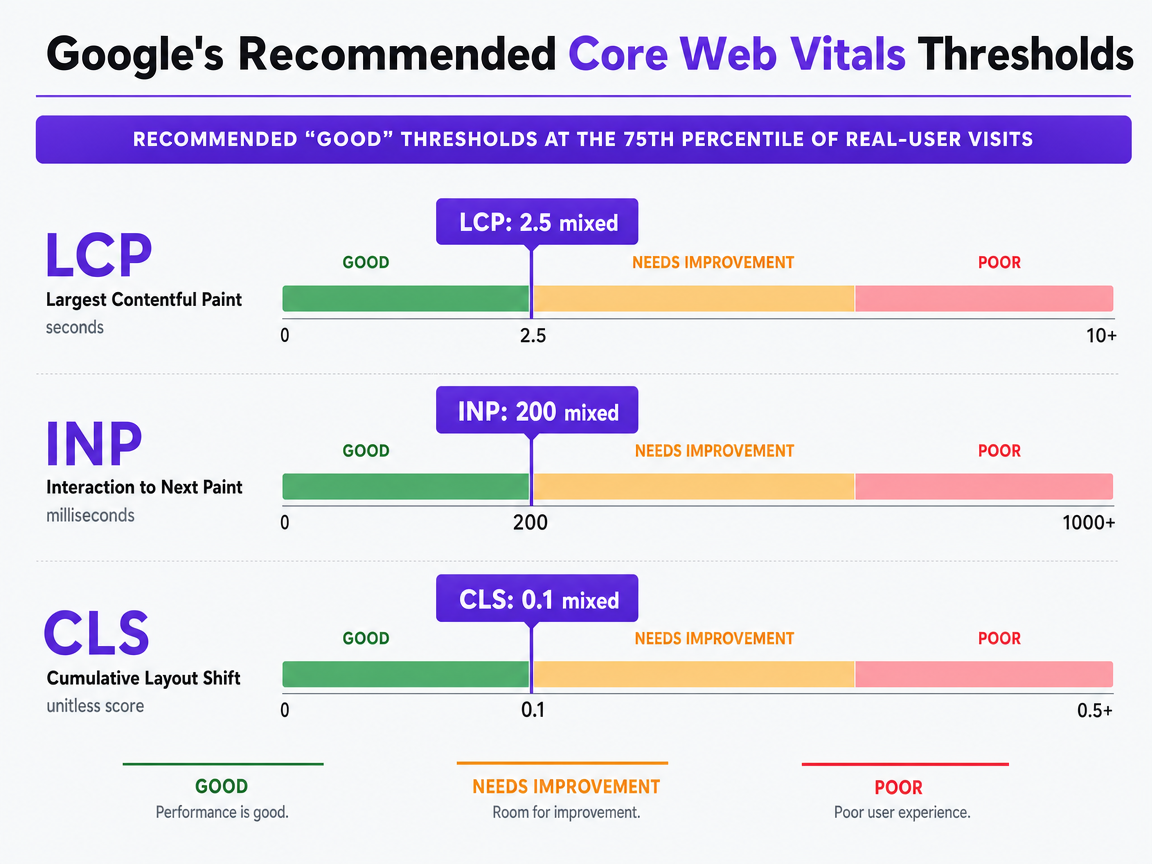 Google's Recommended Core Web Vitals Thresholds
Recommended 'good' thresholds for Core Web Vitals at the 75th percentile of real-user visits. Units are seconds for LCP, milliseconds for INP, and a unitless score for CLS.
Gate One: Crawlability Diagnostics That Separate Access from Intent
Crawlability audits often fail by confusing two distinct questions: whether Googlebot can reach a URL and whether the site wants it to. These are separate decisions with different documentation, tools, and remedies.
Reachability is a mechanical concern. Google primarily discovers URLs through HTML anchor elements with an href attribute 12. A navigation menu built with a <div> and an onclick handler, or a product tile whose destination only resolves after client-side routing, will not contribute to discovery. The initial crawlability assessment should identify all navigation surfaces (header, footer, filters, pagination) and confirm they resolve to a static href in the rendered DOM.
Intent is a governance concern. Robots.txt controls crawler access, sitemaps declare preferred URLs, and canonical annotations resolve duplicates 7. These signals are not interchangeable. A disallowed URL can still be indexed without its content being crawled, meaning blocking is not equivalent to removal 7. Sitemaps should only list canonical, indexable, 200-status URLs; including others creates noise that degrades Google's prioritization signals 9.
The audit deliverable for this gate includes a reachability inventory and a signal-integrity check. For each template, the strategist verifies if primary navigation is anchor-based, if the XML sitemap aligns with the canonical set, if robots.txt blocks sitemap-advertised URLs, and if Search Console's Pages report shows discovery gaps. Findings here are routed to Search Console's Crawl Stats and Pages reports. A crawl defect that hasn't yet caused an indexing gap is still a defect; one that has is a priority.
Gate Two: Rendering Audits for JavaScript and Mobile Parity
Rendering is a common point of failure for modern client sites, often without visible traces in the source HTML. Google processes JavaScript applications in three phases—crawling, rendering, and indexing—each capable of independent failure 11. A page might return a 200 status and be in the sitemap, yet its rendered DOM could be missing crucial elements like the H1, product copy, structured data, or internal links.
A critical input for this audit gate is rendered HTML, not source HTML. Search Console's URL Inspection tool provides the rendered output Google actually processes. Strategists should compare this output against the intended template. If a target keyword appears in a component that hydrates client-side after user interaction, it's not indexable. If a canonical tag is injected by a tag manager post-render, its behavior is unpredictable. Internal links in a related-content module that resolve via a client-side router without an href on the anchor are invisible to discovery 12.
Mobile parity is another non-negotiable aspect. Google uses the mobile version of a site's content, crawled by its smartphone agent, for indexing and ranking 10. Responsive design alone doesn't guarantee parity. While content hidden in a mobile accordion is still indexable, content conditionally rendered differently at mobile breakpoints is not. Dynamic delivery, adaptive layouts, and mobile-specific templates all necessitate comparing rendered pages across both desktop and mobile agents.
The audit deliverable is a template-level parity matrix. For each primary template (home, category, product, article), the strategist records whether the mobile rendered DOM matches the desktop rendered DOM for H1, body copy, structured data, canonical, meta robots directives, and internal links. Discrepancies are prioritized by revenue exposure. Findings here are routed to Search Console's URL Inspection and the Pages report filtered by mobile usability. A rendering defect that clears crawl but removes primary content from the indexed version can lead to a sudden traffic collapse.
Run real on-page SEO tests this week
Experience measurable SEO impact by publishing, analyzing, and iterating live content during your trial period.
Gate Three: Indexability and the Canonical Signal Hierarchy
Even if a URL clears the crawl and render gates, it might still fail to be indexed. Indexability is where issues like duplicate content, parameter sprawl, and syndicated copy either consolidate into a single ranking candidate or fragment into competing versions, diluting ranking signals.
The central question at this gate is which URL Google will select as canonical. Strategists often mistakenly believe that declaring rel=canonical resolves the issue. However, Google's documentation explicitly states that a declared canonical is a recommendation, and Google determines the canonical URL based on multiple weighted signals 8.
These signals form a hierarchy: redirects and rel=canonical annotations are strong signals, while sitemap inclusion is weaker. Internal linking consistency, HTTPS, and URL structure also provide context 8. When these signals conflict—e.g., a page declares rel=canonical to URL A, is linked internally as URL B, and appears in the sitemap as URL C—Google resolves the conflict on its own terms, often with unintended outcomes.
Triage at this gate follows the signal hierarchy. Faceted navigation and parameter URLs that should not rank should receive 301 redirects or noindex directives, rather than relying on rel=canonical patches over existing internal links. Syndicated content should use rel=canonical pointing to the original source, with internal links reinforcing this choice. Product variants with substantial shared content should consolidate to a single canonical, with parameters excluded from the sitemap 9.
The audit deliverable is a canonical-conflict register. For each template, the strategist records the declared canonical, internal link target, sitemap entry, and any redirect chain, flagging discrepancies. Rows with strong-signal conflicts (e.g., conflicting redirects and rel=canonical) are prioritized for remediation. Robots.txt is not a canonicalization mechanism; a disallowed URL can still be indexed without its content being crawled 7. Findings here route to Search Console's Pages report, filtered by "Duplicate" and "Alternate page with proper canonical tag" statuses, where the gap between declared and Google-selected canonicals is visible.
Gate Four: Understanding—Titles, Headings, Structured Data, and What Google Actually Reads
The understanding gate is where many audits revert to basic keyword hygiene, often overlooking Google's comprehensive documentation. The title element is a prime example: strategists rewrite it, but the SERP might still show the old headline. This indicates a misunderstanding of how Google processes titles.
Google's title-link documentation lists six inputs for constructing the displayed headline: the <title> element, the main visual title on the page, heading elements, anchor text on the page, text in links pointing to the page, and WebSite structured data 3. Changing only the <title> tag modifies just one of these signals. If the H1 differs, inbound anchor text is generic, or the visible page title contradicts metadata, Google often selects a different formulation. A thorough title audit reconciles all six inputs against the target query, not just the tag in the head.
Headings are more than organizational tools. They contribute to title-link construction, reflect searcher language, and signal topical scope to Google's classification systems 2. An H1 as an image, a heading hierarchy skipping from H1 to H4 for CSS convenience, or reusing the same H1 across category and subcategory pages all degrade understanding, regardless of body copy quality.
Structured data is frequently misused at this gate. Google's documentation is precise: structured data provides explicit clues about a page's meaning 5, and only schema types listed in the search gallery are supported for rich results 6. Markup describing non-visible content, using unsupported schema types, or failing validation offers no benefit and can even trigger manual actions if it misrepresents the page. The audit deliverable is a schema-to-content match: for each template, the strategist confirms the markup type is supported, properties describe visible content, and JSON-LD passes validation in the Rich Results Test.
Meta descriptions are relevant here, but not as ranking factors. Google automatically generates snippets from page content and uses the meta description when it better suits a specific query 4. Therefore, opening copy, subheadings, and the meta description should be audited as a cohesive unit that dictates how the page previews across various queries, rather than a standalone character-count exercise.
Findings at this gate route to Search Console's Performance report, filtered by page. Unexpected query impressions and depressed click-through rates on target queries reveal understanding defects that a simple head-of-page tag audit would miss.
Gate Five: Selection—Core Web Vitals, Snippets, and the Metrics That Predict Clicks
A page that successfully navigates the crawl, render, index, and understand gates must still earn the click. The selection gate is where Google's systems evaluate page experience against competing candidates for a query, determining whether a SERP display converts an impression into a session.
Core Web Vitals are paramount at this gate. Google recommends "good" thresholds of LCP within 2.5 seconds, INP below 200 milliseconds, and CLS below 0.1, all measured at the 75th percentile of real-user field data 14. The 75th-percentile qualifier is often overlooked. A lab score of 1.8 seconds from a PageSpeed run doesn't tell a client if the slowest quarter of their actual visitors (e.g., mobile users on congested networks) met the threshold. Field data from the Chrome User Experience Report provides this crucial insight. Audits that prioritize lab numbers are easily invalidated by client-provided Search Console screenshots.
However, Vitals should not overshadow other selection factors. Google describes page experience as one signal among broader ranking systems 14. A page with an LCP of 2.1 seconds and a generic title like "Home | Client Name" might lose to a slower competitor whose SERP display directly answers the query. This highlights the importance of snippets at this gate.
Snippets are automatically generated, usually from page content, though Google may use the meta description if it better describes the page for a specific query 4. This means opening copy, subheadings, and the meta description function as a unified element that dictates how the page previews across the query set. Auditing the meta description in isolation (e.g., by character count or keyword presence) misses this broader mechanism.
The audit deliverable for this gate has two components. First, a template-level Core Web Vitals reading from field data, reporting LCP, INP, and CLS at the 75th percentile, linked to the specific page elements driving each metric. Second, a query-level snippet review for top revenue pages, comparing displayed SERP text against target queries and flagging instances where Google draws from unintended body copy.
Findings route to Search Console's Core Web Vitals report and the Performance report filtered by page and query. Metrics that predict clicks—impressions, position, and click-through rate on the target query set—are essential for connecting on-page fixes to verifiable revenue outcomes.
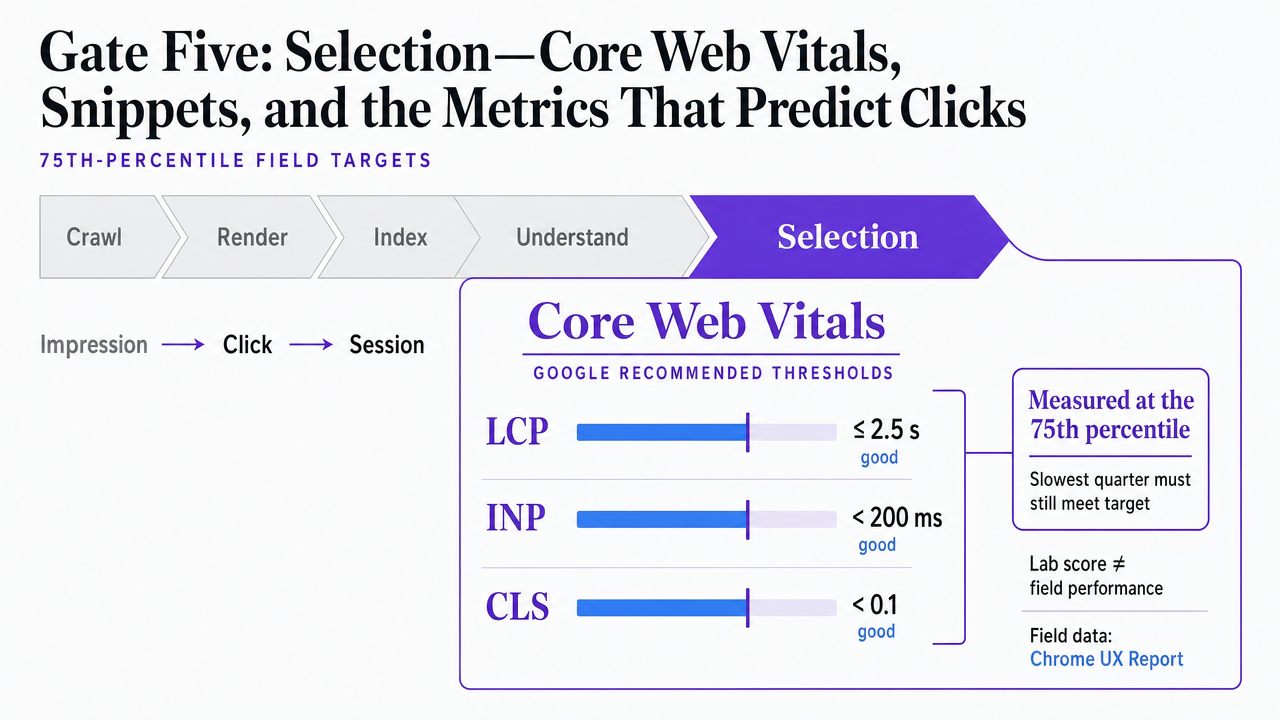 Display Google's recommended Core Web Vitals thresholds cited in the section, giving strategists a reference for the 75th-percentile targets
AI Overviews and AI Mode: What Google's Documentation Actually Requires
The push to "optimize for AI Overviews" has often outpaced Google's actual guidance. Google's documentation clearly states that a page needs no special technical markup to appear as a supporting link in AI Overviews or AI Mode. The primary requirement is that the page must be indexed and eligible to appear in Search with a snippet 17. Google's optimization guide for generative AI features reiterates these same requirements—indexing, Search eligibility, snippet eligibility—without adding any further technical prerequisites 18.
This means that the audit surface for AI-search visibility is identical to that for conventional Search: Crawl, Render, Index, Understand, and Select. A page failing any of the first four gates cannot be cited in an AI Overview because it's not a candidate for the index. A page that clears all four but suppresses snippets via a nosnippet directive or max-snippet:0 voluntarily removes itself from eligibility.
For agency teams, this implies a focus on foundational SEO rather than speculative AI-only tactics. Practices like adding FAQ schema to pages already answering questions in body copy, using entity markup for content Google can already parse, or writing prompt-style headings for large language models instead of searchers are not mentioned in Google's stated requirements. The work that earns AI citations is the same work that earns snippets: clear content, accurate structured data where supported by the search gallery 6, and no self-imposed snippet suppression.
Streamline On-Page SEO Analysis for Scalable, Measurable Impact
Connect with experts to see how leading agencies leverage AI-driven workflows to accelerate on-page SEO analysis, eliminate manual bottlenecks, and deliver consistent, data-backed results across high-value client portfolios.
Encoding Judgment: Quality Gates for AI-Assisted Audit Production
AI acceleration in audit production presents a quality-control challenge, which Google's documentation directly addresses. Google permits generative AI assistance if the output is accurate, high-quality, relevant, and consistent with Search Essentials. This expectation extends explicitly to titles, meta descriptions, structured data, and image alt text 16—precisely the deliverables of an on-page audit produced at scale.
Google's concern isn't automation itself, but "scaled content abuse": generating many pages primarily to manipulate rankings rather than help users, regardless of whether automation, humans, or a combination produced them 15. This logic applies to audit recommendations. An AI system that generates 400 title-tag rewrites without a strategist reconciling each against Google's six inputs for title-link construction 3 is not a productivity gain; it's a defect factory.
The crucial quality gate is a robust review architecture. Every AI-generated finding must be reviewed by a strategist who verifies three points: whether the recommendation aligns with the decision gate it addresses, if the cited Google documentation supports the claim, and if the proposed fix links to a verifiable Search Console metric. Recommendations failing any of these criteria are not implemented. This approval process is what differentiates a scaled audit from a scaled violation.
If the Agency Manages a Portfolio: Unit Economics of a Systematized Audit Model
This section addresses agency principals responsible for delivery margins across a client portfolio, rather than strategists working on a single site. The economics of audits change significantly when they are a recurring obligation for 40, 80, or 150 clients.
Consider the variables:
H : represents the hours a senior strategist spends on a manual audit;
C : is the number of clients on a recurring audit cadence;
F : is the audit frequency per client per year.
Total senior capacity consumed by audits is H × C × F. In most agencies, this product is the largest non-billable drain on strategists who are also expected to interpret findings, defend recommendations, and set channel direction.
A systematized model alters what H represents. Instead of the strategist generating every finding, a codified audit—structured around the five decision gates, linked to Google's documentation 7, and executed with tooling or AI assistance—surfaces candidate findings. The strategist's time is then spent reviewing, reconciling findings against factors like Google's title-link construction inputs 3 or the canonical signal hierarchy 8, and approving what ships. A review-and-approve hour is distinct from a generate-from-scratch hour, and this difference compounds across C × F.
Two constraints ensure the integrity of this model. First, the systematized output must meet the same quality standards as a manual audit; otherwise, margin gains are offset by exposure to Google's scaled-content-abuse policies 15. Second, the freed strategist hours must be reallocated to billable work clients value—strategic interpretation, roadmap defense, cross-channel coordination—rather than being absorbed back into audit rework. Margin per retained client improves when the audit becomes an accountable input to the strategist's judgment, not a replacement for it.
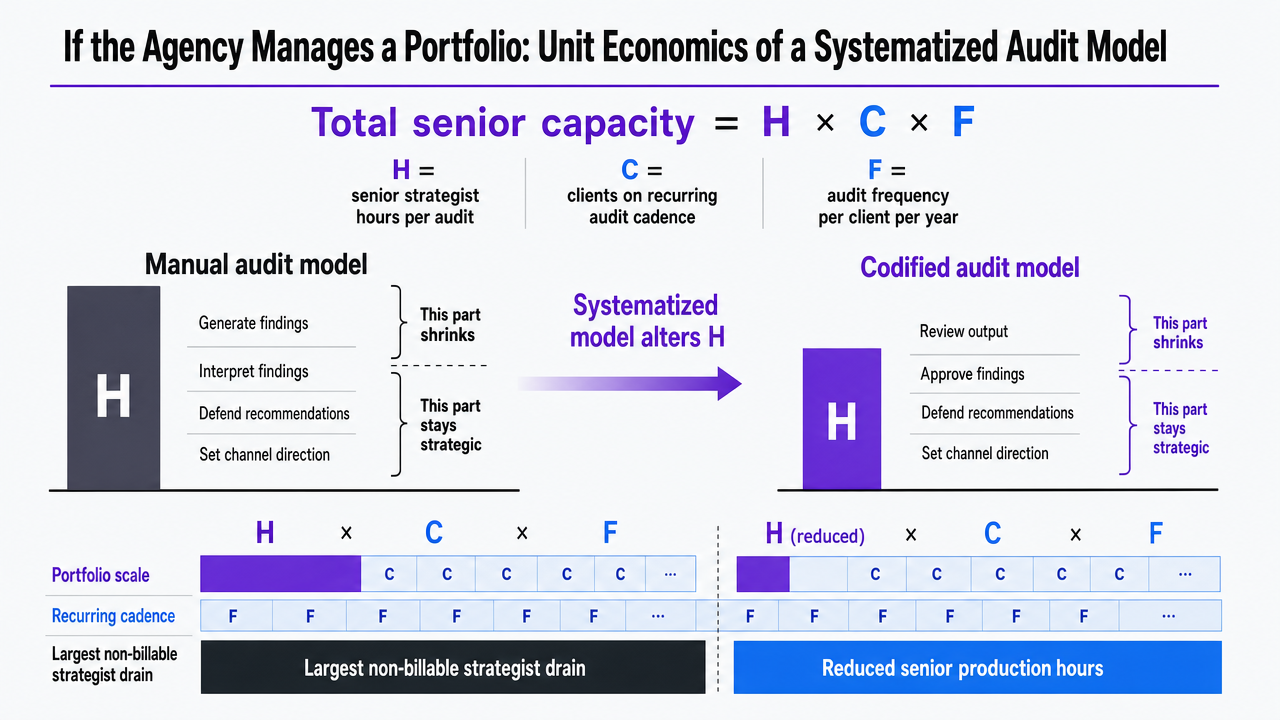 Visualize the formula H × C × F and the shift from generate-from-scratch hours to review-and-approve hours described in the section's operating model
Tying Every Finding to a Search Console or Conversion Metric
Audit findings that lack a client-verifiable metric are difficult to defend and often deprioritized. Every recommendation should specify the Search Console report or conversion signal where the fix will register, along with the expected direction of change.
This mapping is not arbitrary:
- Crawl and index findings appear in the Pages report, where "discovered-not-indexed" and "duplicate" statuses shift as canonical conflicts are resolved and sitemap integrity improves 9.
- Rendering defects are visible in URL Inspection, showing whether the rendered DOM contains the intended content 11.
- Understanding findings surface in the Performance report, filtered by page and query, revealing whether Google's systems interpret the page as intended through impressions on unexpected queries and click-through rates on target queries 2.
- Selection findings appear in the Core Web Vitals report and in click-through rate for the target query set, with field data at the 75th percentile providing diagnostic weight 14.
Rankings alone do not complete the feedback loop. A position gain on a non-converting query is merely a reporting artifact. The audit deliverable that withstands quarterly review pairs each finding with two numbers: the Search Console signal confirming Google processed the change, and the conversion metric (e.g., form submissions, qualified calls, bookings, revenue per session) proving the change impacted the business. Findings without both numbers are candidates for removal, not inclusion in client presentations.
Frequently Asked Questions
References
- 1.Google Search Essentials (formerly Webmaster Guidelines).
- 2.SEO Starter Guide: The Basics.
- 3.Influencing Title Links in Google Search.
- 4.How to Write Meta Descriptions.
- 5.Intro to How Structured Data Markup Works.
- 6.Structured Data Markup that Google Search Supports.
- 7.Google Crawling and Indexing.
- 8.How to Specify a Canonical with rel="canonical" and Other Methods.
- 9.Build and Submit a Sitemap.
- 10.Mobile-first Indexing Best Practices.
- 11.Understand JavaScript SEO Basics.
- 12.SEO Link Best Practices for Google.
- 13.Image SEO Best Practices.
- 14.Core Web Vitals and Google Search Results.
- 15.Spam Policies for Google Web Search.
- 16.Google Search's guidance on using generative AI content.
- 17.AI Features and Your Website.
- 18.Google's Guide to Optimizing for Generative AI Features on Google Search.