
Key Takeaways
- Screaming Frog delivers best-in-class crawl depth for onboarding audits, but lacks workflow features, so specialists still shoulder triage and remediation tracking across accounts.
- Semrush earns its seat as a reporting backbone with cross-account dashboards, though its on-page recommendations and content templates often require strategist filtering and rewrites.
- Ahrefs Site Audit prioritizes over 140 issue types by severity, making it useful when link and keyword work already lives in Ahrefs, but it offers minimal content workflow.
- Clearscope reduces writer QA hours through term coverage and live scoring against ranking pages, making it valuable for content-heavy accounts but ineffective as a standalone platform.
- Surfer SEO's SERP-anchored scoring compresses brief-to-draft cycles for high-velocity publishing, though rigid adherence to its score can homogenize voice without strategist oversight.
- Sitebulb converts crawl data into client-ready narrative audits with prioritized hints, cutting report-writing time significantly for agencies selling technical audits as billable deliverables.
- AI-native workflow platforms like Vectoron treat on-page as a governed execution pipeline where signals feed ranked queues, humans approve, and outcomes are measured 6.
Why on-page tooling now decides agency margin, not client wins
On-page SEO software is no longer a competitive differentiator for agencies. The key to maintaining a 40% delivery margin, rather than seeing it diminish, lies in how effectively an on-page stack reduces specialist hours per client per month and preserves strategic judgment for human experts.
On-page SEO constituted roughly 45% of the U.S. enterprise SEO platforms market in 2024, making it the largest of three product segments tracked by Emergen Research. This market is projected to grow from $1.5 billion in 2024 to $4.5 billion by 2034 2. This is not a niche; it's the revenue center of the enterprise SEO software market where agencies perform high volumes of repeatable specialist work like title tag rewrites, schema deployment, content briefs, internal linking, and Core Web Vitals remediation.
Heads of SEO managing 15 to 100+ accounts understand the functions of on-page tools. The crucial evaluation question is which tools act as production infrastructure, and which are merely diagnostic dashboards that create more work than they solve. The following sections evaluate each candidate against this distinction.
The rubric: five criteria that separate production infrastructure from diagnostic dashboards
Each tool in this evaluation is scored against five criteria, each representing a delivery cost an agency already incurs, regardless of whether the software helps mitigate it.
- On-page audit depth. This criterion assesses the thoroughness of the crawl and how much of it translates into actionable, prioritized fixes, rather than overwhelming spreadsheets requiring specialist triage. MarTech's guide identifies on-page optimization, technical SEO, and analytics as core capabilities agencies should expect 1. Depth without prioritization functions as a report generator, not true infrastructure.
- Content optimization workflow. This evaluates whether the tool generates briefs, scoring, and revision passes that a writer can execute without a strategist extensively rewriting the output. This area typically accounts for the largest specialist-hour drain on most agency profit and loss statements.
- Workflow governance and approvals. This criterion examines whether the tool facilitates routing changes for review or if it publishes without oversight. For agencies managing 15+ accounts, ungoverned automation presents a client-retention risk, not a productivity gain.
- Multi-client scaling. This considers seat economics, project templating, cross-account reporting, and permissioning. A tool that performs well for a single site but fails when managing 50 is not suitable for agency use.
- Human strategic oversight retained. This assesses which critical judgments remain with the Head of SEO and which are ceded to a scoring model that the team cannot effectively defend to a client.
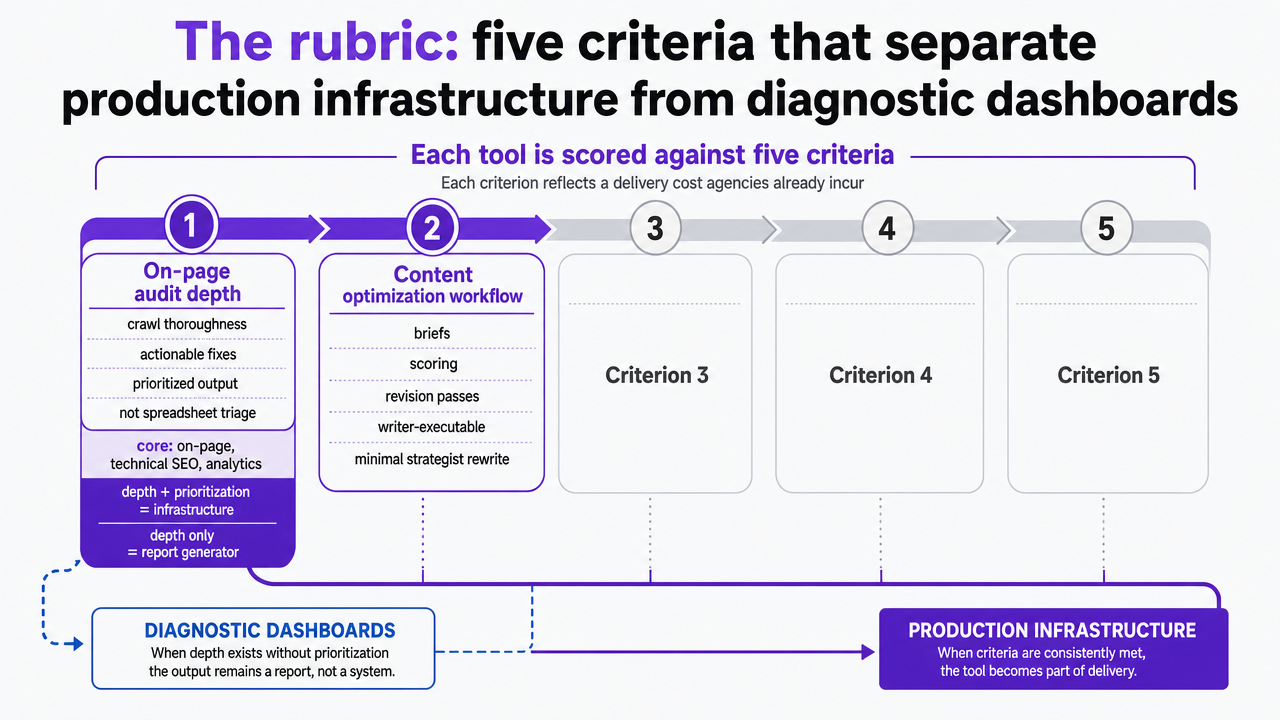 Visualize the five evaluation criteria used throughout the article as a scannable framework that mirrors the section's cited rubric
Seven tools evaluated through the delivery-economics lens
Screaming Frog: the technical crawler that still earns its seat
Screaming Frog remains the benchmark for site crawling in agency operations. Its SEO Spider identifies the technical foundation of on-page optimization, including indexation errors, canonicalization conflicts, redirect chains, orphaned pages, missing or duplicate meta descriptions, and hreflang mismatches. For new client onboarding, it condenses what was once a two-week discovery audit into a same-day export.
Its value lies in the depth of its crawl and the raw data fidelity. However, its weakness is workflow. Screaming Frog provides evidence, not actionable queues. A specialist must still translate the crawl data into a prioritized fix list, assign ownership, and track remediation across sprints. While manageable for a 15-client roster, for 50+ accounts, using Screaming Frog as the primary on-page tool means specialists spend more time triaging spreadsheets than implementing changes.
Scored against the rubric: audit depth is best-in-class. Content optimization workflow is intentionally absent. Governance and approvals are non-existent as the tool does not handle publishing. Multi-client scaling is functional through scheduled crawls and cloud integration but lacks robust templating. Human oversight retained is high, which is beneficial for technical leads but a cost for delivery teams.
Verdict: Retain Screaming Frog as the crawl engine supporting a workflow tool, rather than as the workflow tool itself.
Semrush: the all-in-one suite as agency reporting backbone
Semrush is a widely adopted all-in-one suite. Its on-page toolkit includes site audits, on-page SEO checker recommendations, content templates, position tracking, and a content marketing platform that has integrated features previously sold separately by standalone brief builders. MarTech's guide highlights on-page optimization, keyword research, content optimization, and analytics as standard capabilities for modern agency platforms 1, all of which Semrush provides.
The primary benefit of Semrush for agencies is not that any single module is category-leading, but rather its reporting layer, shared project structure, and client-facing dashboards. These features consolidate coordination work that would otherwise span multiple tools and spreadsheets. A single seat can support monthly reporting for numerous accounts, contributing significantly to margin.
Limitations arise in two main areas. First, on-page checker recommendations can be voluminous, requiring a specialist to filter noise before handing tasks to a writer. Second, content templates generate competent briefs, but often lack the strategic depth needed for clients in regulated industries or highly competitive commercial SERPs, necessitating a strategist's rewrite.
Scored: audit depth is strong but less comprehensive than a dedicated crawler. Content workflow is present but not highly prescriptive. Governance is limited to project roles. Multi-client scaling is a significant strength. Human oversight required is medium-high for strategy and low for reporting.
Use Semrush as the reporting backbone, but not as the sole source of technical truth or the exclusive content brief engine.
Ahrefs Site Audit: crawl depth without the workflow ambition
Ahrefs Site Audit offers a balance between Semrush's breadth and Screaming Frog's crawl quality. It detects over 140 issue types, prioritizes them by severity, and integrates seamlessly with other Ahrefs tools for backlink and keyword context. For diagnostic purposes, it serves as reliable infrastructure.
Ahrefs does not focus on production workflow. It lacks a comprehensive content brief builder, approval routing, or publishing integrations. The tool assumes a human strategist will translate audit findings into executed changes, which is transparent positioning but does not reduce specialist hours in the way an all-in-one suite claims to.
Scored: audit depth is high, and its issue prioritization is more immediately useful than a raw Screaming Frog export. Content workflow is minimal. Governance is outside its scope. Multi-client scaling is robust through project-level organization. Human oversight remains high for both content and strategy.
Verdict: Ahrefs Site Audit is valuable when an agency's link and keyword work already resides within Ahrefs, consolidating subscriptions. It is not recommended as a secondary crawler alongside Screaming Frog or as a replacement for a dedicated content optimizer.
Clearscope: content optimization for briefs, not audits
Clearscope focuses specifically on content optimization, offering term coverage, readability grading, competitor content analysis, and brief generation. It performs this function with less complexity than the content modules found in all-in-one suites. For agencies where the primary delivery bottleneck is writer output quality rather than technical remediation, Clearscope reduces more specialist hours per seat than broader platforms.
Its workflow value is precise: a strategist inputs a target query, Clearscope provides a term set weighted against ranking pages, and the writer drafts content while receiving live scoring feedback. This streamlines editing cycles by providing structured feedback before a strategist's review. For content-intensive accounts, such as those in law firm, healthcare, or home services sectors, this efficiency directly impacts delivery margin.
Clearscope does not perform site crawls, audits, portfolio-scale ranking tracking, or publishing governance. It is a single-purpose tool that complements a crawler and a reporting suite, but it is ineffective as a standalone platform.
Scored: audit depth is not applicable. Content workflow is category-leading. Governance is minimal. Multi-client scaling is feasible, but seat costs can accumulate rapidly at scale. Human oversight is appropriately preserved at the strategist and editor levels.
Use Clearscope for content briefs and writer scoring. Do not attempt to use it for audit or governance tasks for which it was not designed.
Surfer SEO: SERP-anchored content scoring at production speed
Surfer SEO operates in a similar space to Clearscope, but with a different emphasis. Its content editor scores drafts based on SERP-derived signals, including term frequency, structure, word count ranges, and image density. Its Content Planner organizes keywords into topical maps. The key differentiator is its SERP anchoring: Surfer's scoring adapts as the ranking set changes, which is crucial in categories with dynamic SERP compositions.
For agency delivery, Surfer's speed is a significant advantage. Writers can progress from brief to scored draft to revision within a single session, and its AI-assisted outline builder substantially reduces the strategist's brief creation time. This time compression is a compelling argument for the tool on accounts producing 20+ pieces per month.
A caution with Surfer is that optimizing too rigidly to a SERP-derived score can homogenize voice and push content towards a generic format already prevalent in search results. Strategist oversight is essential to maintain differentiation, particularly for commercial queries where competitors may be using similar tools.
Scored: audit depth is not applicable. Content workflow is strong and efficient. Governance is limited. Multi-client scaling is manageable through workspace organization. Human oversight required is medium; the tool ensures competence, while the strategist ensures distinctiveness.
Use Surfer where publishing velocity is critical and the SERP is dynamic. Pair it with an editorial standard that the scoring system cannot enforce on its own.
Sitebulb: the auditor's tool that translates crawl data into client-ready narrative
Sitebulb is highly regarded by technical SEOs. Its crawls rival Screaming Frog and Ahrefs in depth, but its unique selling proposition is the audit report itself: prioritized hints, visual crawl paths, and explanatory text that resembles a senior consultant's narrative. For agencies that provide technical audits as a billable service, Sitebulb reduces the report-writing phase from days to hours.
This is more impactful than it might seem. Agency profit and loss statements often price audit deliverables against the specialist hours spent formatting findings into a client-ready narrative. Sitebulb automates much of this formatting, directly impacting the hours saved per client per month.
Sitebulb is a desktop or cloud crawler with robust reporting capabilities, but it is not a content workflow tool or a governance layer. It does not generate briefs for writers, score drafts, or manage approvals.
Scored: audit depth is high, comparable to leading crawlers. Content workflow is absent. Governance is not within its scope. Multi-client scaling is solid with the cloud version. Human oversight required is high for strategy and low for report production.
Verdict: Sitebulb is valuable when an agency offers technical audits as a distinct engagement or onboarding milestone. It is not intended as a general-purpose on-page platform.
AI-native workflow platforms: on-page as governed execution, not diagnosis
This category, which includes Vectoron and other emerging competitors, fundamentally redefines the approach to on-page optimization. Unlike traditional tools that diagnose and then hand execution to a specialist, AI-native workflow platforms treat on-page optimization as a governed production pipeline. Audit signals feed a ranked recommendation queue, a human approves or edits, and the platform executes the approved change, then measures its impact.
This category emerged due to a market shift away from the audit-first model. The global enterprise SEO platforms outlook indicates that AI-powered SEO tools driving automation and predictive analytics, along with enterprise-grade solutions integrating with CRM and marketing automation, are leading segments for the market's future growth 6. This represents a new unit of value: hours saved per approved recommendation, rather than issues identified per crawl.
These platforms excel at streamlining the brief-review-revise loop for content, routing on-page changes through explicit approval before publishing, and closing the loop between recommendations and measured outcomes. However, they do not yet replace a senior strategist's judgment on positioning, competitive angle, or brand voice. The category assumes, and in the best implementations enforces, human strategist involvement.
Scored: audit depth is respectable but not the primary focus. Content workflow and governance are the categorical strengths. Multi-client scaling is where this model delivers its margin benefits. Human oversight is preserved by design, not merely by team discipline.
Verdict: Workflow platforms are essential for agencies where delivery hours per client are the primary constraint on portfolio growth.
Mapping the seven tools to specialist hours absorbed
The tools can be grouped into four categories:
- Technical crawlers (Screaming Frog, Sitebulb)
- All-in-one suites (Semrush, Ahrefs Site Audit)
- Content optimizers (Clearscope, Surfer SEO)
- AI-native workflow platforms
Each category reduces different types of specialist hours. The goal is not to identify a single "winning" category, but to determine which combination of tools best addresses an agency's specific hour-related costs. The stakes are high: on-page SEO accounted for approximately 45% of the U.S. enterprise SEO platforms market in 2024, a segment projected to grow from $1.5 billion to $4.5 billion by 2034 . This market concentration reflects where agency delivery hours are most heavily invested.
| Category | Primary role in the stack | Specialist time absorbed | Human judgment still required |
|---|---|---|---|
| Technical crawler | Diagnostic substrate; audit exports | High on technical discovery; Low on remediation | High — triage, prioritization, execution |
| All-in-one suite | Reporting backbone; cross-account visibility | High on reporting; Medium on audit and briefs | Medium-High — strategy, content defensibility |
| Content optimizer | Brief generation and writer scoring | High on writer QA and revision cycles | Medium — voice, differentiation, editorial standard |
| AI workflow platform | Governed execution from signal to publish | High on brief-review-revise loop and publish routing | Medium — positioning, competitive angle, approvals |
No single category eliminates all types of specialist hours. Crawlers and optimizers offer deep, narrow functionality; suites provide broad but shallower coverage; and workflow platforms streamline the process from recommendation to execution. Heads of SEO should assess current specialist utilization against these categories before renewing any tool subscriptions.
Where on-page tools are absorbing adjacent technical work
The distinction between on-page and technical SEO is blurring. Functions like schema validation, Core Web Vitals monitoring, JavaScript rendering diagnostics, and hreflang integrity checks, once part of separate technical audit workflows, are now integrated into current on-page tools. These are often presented within the same interface used by content strategists for title tag recommendations.
Market data explains this convergence: Technical SEO is projected to be the fastest-growing segment of the U.S. enterprise SEO platforms market, with a 14% CAGR through 2034 . Vendors are capitalizing on this growth by incorporating technical diagnostics into on-page software, rather than maintaining separate product lines. MarTech's guide lists on-page optimization, technical SEO, and analytics as the three essential capabilities expected from a single modern platform .
For Heads of SEO, this means the "on-page tool" budget line item is increasingly covering work that previously required a dedicated technical specialist. This presents either an opportunity for consolidation or a governance risk, depending on whether the platform prioritizes issues by revenue impact or simply adds them to an unmanaged backlog.
If a Head of SEO manages a portfolio of 50+ accounts: consolidation choices that hold up
For portfolios exceeding 50 accounts, seat economics, template reusability, and cross-account governance become primary buying constraints. Below 50 accounts, most tool combinations are viable. Above 50, an inefficient stack can rapidly erode specialist hours and margins.
Three consolidation strategies are effective at this scale.
- The first involves retaining a technical crawler—Screaming Frog for raw data fidelity, or Sitebulb when audits are billable deliverables—paired with an all-in-one suite for reporting and cross-account visibility. This approach maintains technical depth but leaves content brief-review-revise cycles to specialists. It suits agencies focused on technical remediation and monthly reporting.
- The second strategy adds a dedicated content optimizer, such as Clearscope or Surfer SEO, to the suite-plus-crawler foundation. This addresses the writer-scoring hours that all-in-one content modules often overlook. While seat costs increase, the economics for 50+ accounts favor specialization: a strategist's time spent triaging brief quality is more expensive than the tool's subscription.
- The third strategy routes on-page execution through an AI-native workflow platform, relegating the all-in-one suite to reporting. This is a more challenging shift for traditional teams but aligns with market trends, as AI-powered SEO tools and CRM-integrated platforms are identified as leading segments in the enterprise SEO platforms outlook through 2033 . Heads of SEO considering this approach should pilot it on accounts with high brief-review-revise cycles, rather than those dominated by technical debt.
The verdict: what to buy, what to keep, what to retire
Invest in tools that address the specific hour-related costs currently impacting your P&L, rather than those that merely perform well in demonstrations. For agencies struggling with technical remediation and billable audit deliverables, Sitebulb is a strong addition, with Screaming Frog serving as the underlying crawl engine. If the bottleneck is high-volume writer output, Clearscope or Surfer SEO will save more hours per seat than expanding an all-in-one suite's content module.
Maintain either Semrush or Ahrefs as your reporting backbone. Their cross-account visibility and client-facing dashboards streamline coordination that would otherwise be fragmented across multiple subscriptions. Their on-page audit modules are also competent enough to identify initial issues. Avoid keeping both, as their overlap can lead to compounding seat costs that erode margins.
Eliminate any tool that generates more work than your team can execute. A crawler that identifies 400 issues that no one triages is a liability. A content module that produces briefs requiring complete rewrites by a strategist represents negative leverage.
The more complex decision involves adopting an AI-native workflow platform. Vectoron and similar platforms shift the value proposition from issues identified to approved changes implemented, with human judgment preserved at the approval stage. Agencies where delivery hours constrain portfolio growth should pilot such a platform on their most content-heavy accounts before their next renewal cycle.
Frequently Asked Questions
References
- 1.Enterprise SEO Platforms: A Marketer’s Guide.
- 2.US Enterprise SEO Platforms Market Size, Share & Growth Report [2024–2034].
- 3.Enterprise SEO Platforms Market Share, Size, Trends | 2035.
- 4.Enterprise SEO Platforms Market Size, Share and Forecast 2032.
- 5.Enterprise SEO Platforms Market Size Share & Growth Outlook.
- 6.Global Enterprise SEO Platforms Market Outlook 2026–2033.
- 7.SEO (Enterprise SEO Platforms Market Analysis to 2031).
- 8.Top Enterprise SEO Platforms Companies & How to Compare Them 2026.
- 9.Enterprise SEO Platforms Market Outlook 2024–2033: Trends, Growth Drivers & Segmentation.
- 10.Enterprise SEO Platforms Analysis 2025 and Forecasts 2033.