
Key Takeaways
- Peer-reviewed evidence shows combined content and link-building strategies outperform either discipline alone, making the on-page vs off-page rivalry framing the wrong question for portfolio delivery 3.
- On-page E-E-A-T signals gate whether off-page authority converts into rankings in YMYL SERPs, so readability, authorship, and sourcing must clear the vertical's bar before outreach begins 4, 7.
- Vertical weightings differ: healthcare and legal skew on-page, dental sits closer to an even split, and home services leans on off-page trust signals like reviews and local citations 7, 8.
- Senior strategist hours are the scarce input across a 20 to 80 client portfolio, and on-page production consumes that calendar unless it is systematized under governed workflows with review at brief and final pass.
- The defensible sequencing is on-page remediation first, systematized production second, then senior hours routed to association and editorial relationships against URLs already ready to rank.
Why the On-Page vs Off-Page Debate Misfires for Agency Portfolios
The framing that treats on-page and off-page SEO as rival disciplines belongs to an earlier era of single-site optimization. Agency SEO leads running 20 to 80 client portfolios face a different problem: the two workstreams draw from the same pool of senior strategist hours, and neither one wins by starving the other.
A systematic review of empirical SEO research across sectors reached a conclusion that should end the argument outright. Combined content optimization and link-building strategies produced better visibility outcomes than either approach used alone, though the authors flagged heterogeneity in study designs as a limit on precise effect sizes 3. The debate over which discipline matters more is asking the wrong question.
The right question is where the constraint actually sits. On-page work scales linearly with URL count. A 400-location dental group needs 400 sets of location pages optimized, schema deployed, and patient-education content maintained. Off-page work scales with relationships, editorial calls, and the credibility of the domains a strategist can approach. Both compete for the attention of the same senior people.
The stakes rise in YMYL verticals. Peer-reviewed work on health and legal content shows on-page quality gates whether off-page authority converts into rankings at all, because search systems apply stricter evaluation to pages that influence health, safety, or financial decisions 4, 7. Portfolio operators who staff on-page and off-page as parallel workstreams without sequencing them tend to burn margin on links that never move rankings for pages that were not ready to rank.
What the Peer-Reviewed Evidence Actually Says
Combined Content and Link Strategy Beats Either Discipline Alone
The academic literature is less ambiguous than the practitioner debate suggests. A systematic review synthesizing empirical SEO studies across sectors reported that a combination of content optimization and link-building strategies produced better visibility outcomes than either approach applied alone. The authors qualified the finding by noting heterogeneity in study designs and metrics, which limits precise effect-size claims but does not disturb the direction of the result 3.
For an agency SEO lead defending a mix in a QBR, that qualification matters. The review does not say on-page contributes X percent and off-page contributes Y percent. It says the two workstreams are additive, and starving one to fund the other tends to underperform running both. That is a defensible position in front of a client who wants to know why the retainer covers both content production and outreach.
The finding also reframes what a good SEO scorecard looks like for a portfolio. Reporting that shows link acquisitions this month without matching on-page coverage on the URLs those links point at leaves the client without a way to judge whether the spend converted into rankings. Reporting that shows optimized pages shipped without any authority signal work leaves the same gap on the other side.
The practical read for delivery leads is that neither discipline earns its keep in isolation. Off-page investment against thin or unoptimized target pages tends to waste link equity. On-page investment against pages that never accumulate external signals tends to plateau in mid-SERP positions where competitive queries are decided by domain authority. The review's conclusion is the spine of the sequencing model that follows.
Where Rankings and Content Quality Diverge in YMYL SERPs
The evidence gets more interesting where it complicates the story. A study evaluating search ranking positions, readability, and information quality on health websites found that many top-ranked health pages exhibited poor readability despite their high visibility. The mismatch between SEO performance and patient comprehension was substantial enough that the authors flagged it as a policy concern for how health queries should be ranked 5.
That gap is an opening for agencies serving YMYL clients. If pages currently occupying the top of a healthcare SERP demonstrate weak readability and quality, then a competitor page built with stronger clarity, sourcing, and structure is not fighting an unbeatable incumbent. The incumbent is ranking on legacy authority, and the underlying content asset is soft.
The wider systematic review of online health information quality reached a similar conclusion at scale. Many online health resources were rated as suboptimal for accuracy and lay-audience readability, posing risks for user decision-making. The review did not evaluate SEO directly, but its finding aligns with the argument that on-page quality gaps in YMYL are widespread rather than isolated 10.
For an agency SEO lead, this reframes the on-page investment case. On-page work in healthcare is not a hygiene task competing with off-page work for budget. It is the workstream most likely to produce a defensible ranking gain against incumbents whose content quality does not match their position. The next section turns to how on-page E-E-A-T gates whether off-page authority converts into rankings at all.
On-Page as the Ranking-Conversion Prerequisite in YMYL
Readability, E-E-A-T, and the Gating Effect on Off-Page Authority
The sequencing argument rests on a specific mechanism: in YMYL SERPs, on-page signals decide whether accumulated off-page authority converts into visible ranking movement. A 2024 study of diabetic retinopathy patient education websites measured this directly. Pages with better Flesch-Kincaid readability scores correlated with improved SEO metrics and tended to appear earlier in Google results for that query set 1. The scope matters. The study examined patient education content in a single ophthalmology subtopic, not general web pages, and the authors did not claim readability alone drives rankings. What the finding does establish is that in a healthcare content vertical where search systems apply stricter evaluation, clarity tracks with position.
A review of SEO practice in health information websites reached a compatible conclusion from the other direction. SEO techniques improved accessibility of health content when the underlying material was evidence-based and transparently authored, but the review flagged the risk that aggressive optimization applied to weak clinical content produces misleading visibility rather than durable rankings 4. A parallel healthcare-focused paper argued the same point in operational terms: accurate clinical content and transparent authorship are prerequisites for both search visibility and patient safety, and manipulative off-page tactics do not compensate for gaps in either 7.
The gating effect this produces is what agency SEO leads need to plan around. Links pointed at pages with weak readability, thin authorship signals, or unclear sourcing tend to underdeliver on ranking impact in health and legal SERPs. Links pointed at pages that meet the vertical's on-page bar tend to move positions faster than the same links would in a less regulated space. The practical consequence is a sequencing rule for portfolio delivery. On-page E-E-A-T remediation runs first on any URL flagged as a ranking target, and off-page investment against that URL begins only after the readability, authorship, and sourcing signals clear the vertical's threshold. Reversing the order wastes link equity that senior strategists spent scarce hours earning.
Accessibility and Engagement Signals Without Overreach
Accessibility work sits inside the on-page bucket, and the evidence on its ranking effect is more qualified than practitioner rhetoric suggests. An experimental study measuring WCAG contrast compliance against user preferences and eye-tracking data found that the ranking of visual elements by contrast differed depending on whether the perspective was user experience, commercial goals, or objective recording of attention 2. Strict WCAG conformance did not always match what users preferred to look at or what advertisers wanted emphasized.
That tension has an operational read for portfolio delivery. Accessibility work in YMYL clients earns its keep on regulatory and duty-of-care grounds, and it supports engagement signals like time on page and readable content structure. It does not act as a standalone ranking lever that competes with content quality or off-page authority for budget. Agency SEO leads who report accessibility remediation as a ranking tactic set client expectations they cannot defend in the next QBR.
The defensible framing is narrower. Accessibility fixes belong in the on-page workstream because they improve comprehension and reduce risk exposure for regulated clients, and they contribute to the readability and clarity signals that do correlate with position in health content 1. Treating them as a proxy for ranking movement overstates the evidence and burns hours that off-page relationship work could absorb.
Test on-page and off-page impact in real campaigns
Experience measurable SEO gains by running live optimizations before you commit.
Off-Page as the Amplifier: Where Senior Judgment Still Wins
Authority Signals That Actually Move Regulated Verticals
Off-page work in YMYL SERPs is not a volume game. The systematic review of SEO practice in health information websites made the point directly: SEO techniques improved accessibility of health content when the underlying material was evidence-based and transparently authored, and manipulative optimization produced misleading visibility rather than durable position 4. The same principle carries into which off-page signals actually move rankings.
Links from professional bodies, medical associations, academic institutions, and regulatory publishers carry weight that broad guest-post placements do not. The healthcare-focused review of visibility and accuracy trade-offs framed this as an operational constraint rather than a preference. Accurate clinical content and transparent authorship set the ceiling on what off-page reputation signals can accomplish, and links from professional bodies act as the reputation signals that most reliably clear that ceiling 7. In legal SERPs, the peer-reviewed work on online legal information quality reached the same conclusion from a different angle. Users need access to reliable legal information from authoritative publishers, and the credibility of the source domain is part of what search systems appear to weight when ranking pages that influence legal decisions 9.
The staffing implication is where senior judgment earns its keep. Identifying which associations, journals, and regulator-adjacent publishers will accept a client's authored content is not a task that scales through templated outreach. It requires a strategist who knows the vertical's editorial norms, the client's genuine subject-matter claims, and which relationships convert into placements that carry ranking signal. That work does not systematize well, and portfolio operators who try to industrialize it tend to accumulate links that never move regulated SERPs.
Vertical Weightings: Legal, Healthcare, Dental, Home Services
The mix that wins in one vertical loses in another. The evidence base supports different weightings across the four service categories most agency portfolios cover, and stating those weightings explicitly is what lets a delivery lead defend the retainer allocation in a QBR.
- In healthcare, the balance skews on-page. The review of SEO in healthcare argued that accurate, up-to-date clinical content and transparent authorship outweigh aggressive link-building, because manipulative off-page tactics do not compensate for gaps in the underlying content and can create ethical exposure for the client 7. On-page E-E-A-T remediation and clinical accuracy earn a larger share of hours, and off-page work concentrates on a smaller set of high-signal placements from professional bodies rather than broad outreach volume.
- Legal weights similarly, with a sharper penalty for on-page gaps. The academic reviews of online legal information quality documented that many consumer-facing legal sites lack depth, currency, or clarity, and that users evaluating legal content depend on authoritative sourcing and clear authorship to make decisions 6, 11. Off-page authority from bar associations, law schools, and legal publishers matters, but the on-page authorship and citation apparatus has to be built first or the authority signals attach to pages that do not convert them.
- Dental sits closer to a genuine blend. The peer-reviewed study of digital marketing for dental practices found that structured information, patient-focused content, and local schema markup drove visibility, while reviews from patients and backlinks from dental associations reinforced credibility. Both workstreams appeared necessary for patient acquisition in a local high-stakes vertical, rather than one dominating the other 8. Portfolio operators serving dental groups can allocate closer to an even split, with location-page systematization on the on-page side and association-relationship work on the off-page side.
- Home services shifts the weighting toward off-page trust signals. The academic base is thinner for this vertical specifically, so the defensible position is narrower: local reviews, local citations, and geographic authority signals carry more of the ranking load than deep authorship credentials do, and on-page work concentrates on location coverage, service schema, and clarity of offer rather than E-E-A-T remediation at YMYL depth.
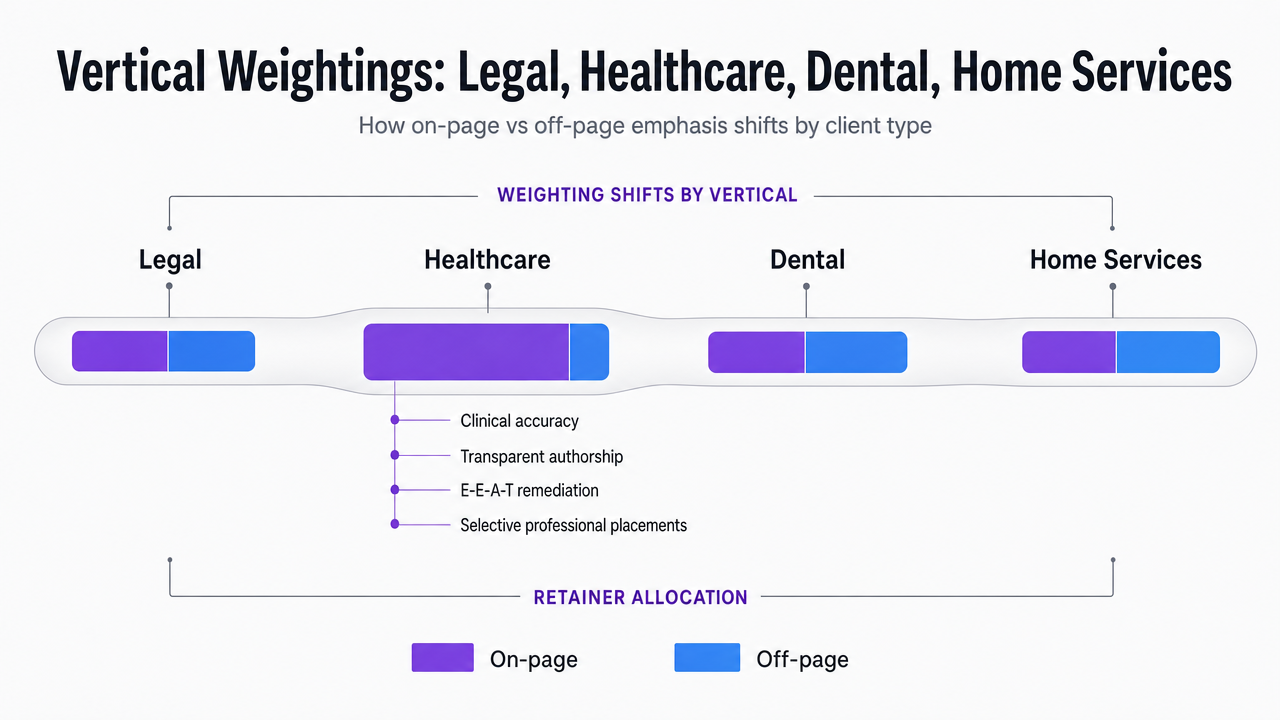 Visualize the four vertical-specific on-page vs off-page weightings the section describes, giving readers a scannable framework of how the mix shifts by client type
If the Team Manages a Portfolio: Delivery Economics Across Clients
Hours per URL, Hours per Link, and the Senior Strategist Bottleneck
The economics shift once the frame moves from a single site to a book of 20 to 80 clients. Agency delivery leads are not solving for the theoretically ideal SEO program on one domain. They are solving for how a fixed roster of specialists absorbs work across a portfolio where every client wants the same senior brain on their retainer.
On-page work has a predictable shape. A URL that needs E-E-A-T remediation in a healthcare context requires clinical accuracy review, authorship attribution, sourcing, readability edits, schema, and internal linking. The senior strategist touches the brief and the final pass. A trained mid-level or a systematized workflow can carry the middle. Hours per URL vary with vertical depth, but the work decomposes into steps that different roles can hold.
Off-page work resists that decomposition. Identifying a professional body that will accept an authored contribution from a specific client, developing the editorial angle, and getting the placement approved by a real editor is relationship work. The healthcare SEO literature is direct that manipulative off-page tactics do not compensate for gaps in clinical content, and durable authority signals in YMYL come from placements that a senior strategist earns rather than a template sends 7. Legal SERPs follow the same pattern, where credibility of the source domain is part of what search systems appear to weight 9.
The bottleneck is where those two shapes meet. Senior strategist hours are the scarce input, and the on-page workstream will consume them at scale unless it is systematized. Every hour a senior spends rewriting a location page for the twelfth dental client is an hour not spent on the association relationship that would actually move a competitive SERP. Portfolio operators who do not separate the two workstreams by role tend to hit a ceiling around 15 to 20 clients per senior FTE, not because the work is impossible but because the wrong person is doing it.
Cost Structure Comparison Table for On-Page vs Off-Page Workstreams
The variables below use ratios rather than invented dollar figures. Agency leads can substitute their own rate cards, but the relative shape of the two workstreams holds across most portfolios serving YMYL and local service verticals.
| Variable | On-Page Workstream | Off-Page Workstream |
|---|---|---|
| Unit of work | URL optimized or produced | Placement earned or authority signal secured |
| Senior strategist involvement | Brief and final review; middle carried by mid-level or systematized workflow | End-to-end; relationship and editorial calls do not delegate cleanly |
| Hours per deliverable | Decomposable across roles; predictable per vertical | Concentrated in senior hours; variable per placement |
| Scalability ceiling per senior FTE | High when production is systematized | Low; capped by relationship bandwidth |
| Marginal cost of the Nth client | Declines as templates and QA stabilize | Flat or rising; each client needs distinct outreach |
| Where evidence supports the spend | Readability and clarity correlate with position in YMYL content 1 | Authoritative placements clear the E-E-A-T bar that determines whether authority converts 4, 7 |
The read for delivery leads is direct. On-page is the workstream most amenable to systematization, which is where portfolio margin comes from. Off-page is the workstream where senior human judgment retains the highest marginal value per hour, which is where portfolio differentiation comes from. Any staffing model that inverts those two loses on both ends.
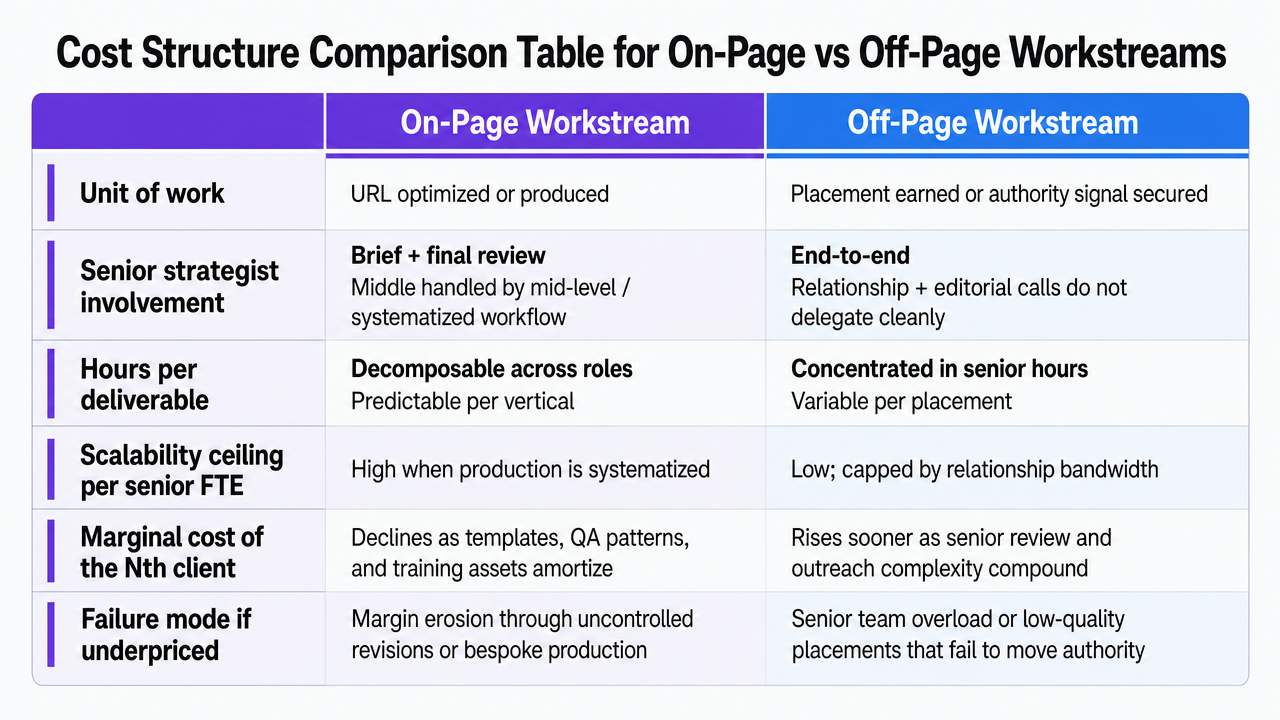 Render the article's comparison table as a scannable side-by-side visual, since the section explicitly presents a structured comparison of the two workstreams across six variables
See How Leading Agencies Quantify the Impact of On Page vs Off Page SEO
Connect with our team to access data-backed frameworks for measuring and optimizing both on-page and off-page SEO at scale—tailored for agencies managing multi-client portfolios.
A Sequencing Model for Agency Delivery
The sequencing rule the evidence supports is simpler than most agency playbooks make it. On-page E-E-A-T remediation runs first on any URL flagged as a ranking target. Off-page investment against that URL begins only after readability, authorship, and sourcing signals clear the vertical's threshold. The systematic review's finding that combined strategies outperform either alone assumes both workstreams land on pages that can convert the authority they receive 3.
- Phase one audits target URLs against the vertical's on-page bar: Flesch-Kincaid readability, transparent authorship, current sourcing, and structured presentation. In healthcare and legal portfolios, the peer-reviewed base is direct that these signals gate whether external authority converts into position 4, 6. Pages that fail the audit enter the on-page production queue before any outreach hours attach to them.
- Phase two ships the on-page fixes through systematized workflows with senior review at brief and final pass. This is where portfolio margin gets protected, because the middle of the work does not need to sit on a senior calendar.
- Phase three routes senior strategist hours to off-page relationships against URLs that have already cleared the on-page bar. Placements from professional bodies, associations, and regulator-adjacent publishers attach to pages ready to rank.
Agency leads who run these three phases in order tend to see faster position gains per link earned than teams working both tracks in parallel from day one.
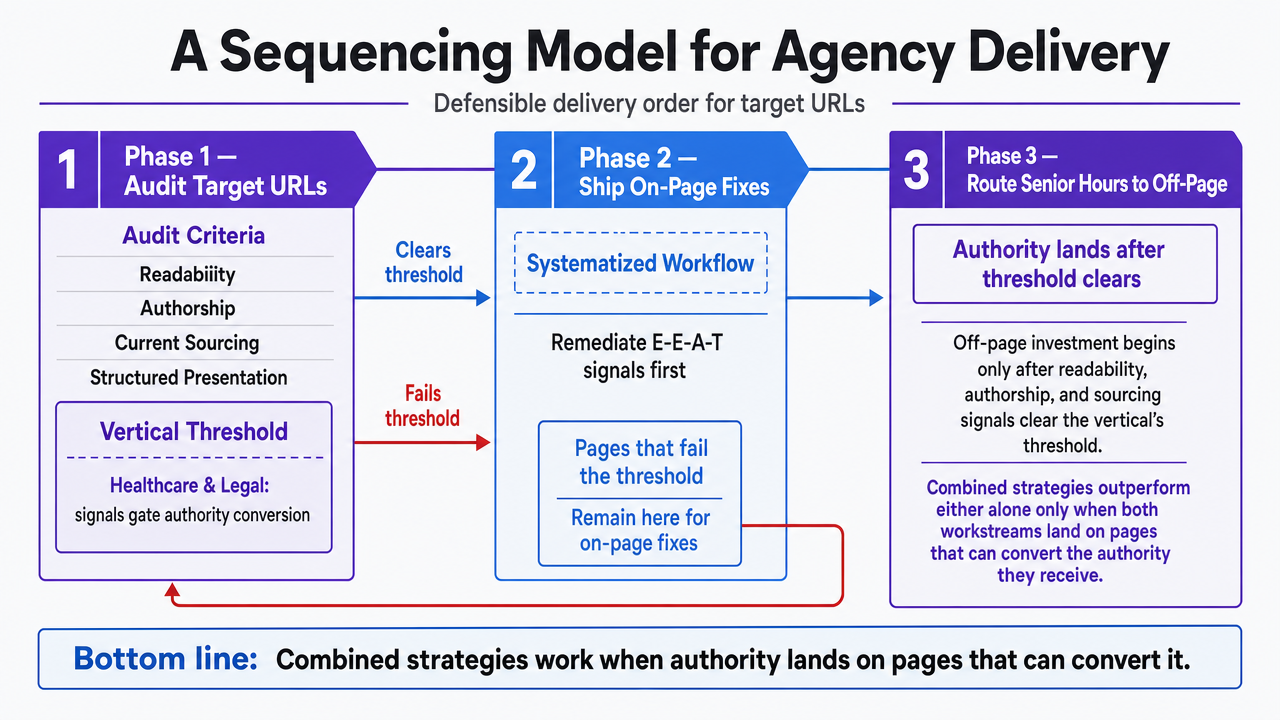 Visualize the three-phase sequencing model (audit target URLs, ship on-page fixes through systematized workflow, route senior hours to off-page) that the section explicitly describes as the defensible delivery order
Systematizing On-Page Production so Senior Hours Move Off-Page
The delivery model the evidence points to is a division of labor by workstream, not by client. On-page production is where systematization protects portfolio margin. Off-page relationship work is where senior strategist hours earn their differential rate. Agency leads who staff both tracks with the same seniority tier lose on the first axis and cap out on the second.
The on-page workstream decomposes cleanly. Readability edits against a Flesch-Kincaid target, authorship attribution, citation apparatus, schema deployment, and internal linking are steps that a governed workflow can hold, with senior review reserved for the brief and the final pass. The healthcare literature is direct that accuracy and transparent authorship are the signals that matter for both visibility and safety, and those signals are auditable at each step rather than dependent on a single strategist's judgment 7. Approval-governed AI execution platforms such as Vectoron sit in this workstream as a category example: they carry the middle of the production work under human sign-off, so the senior calendar is not the bottleneck for the twelfth location page of the day.
The off-page workstream stays with senior strategists. Association placements, editorial relationships, and the judgment calls about which credentials a client can defensibly claim do not template well 4. Portfolio operators who route on-page through systematized production and reserve senior hours for off-page tend to break the 15-to-20-client ceiling per FTE without degrading the ranking outcomes clients renew for.
Frequently Asked Questions
References
- 1.Search engine optimization and its association with readability of patient educational material on diabetic retinopathy.
- 2.Subjective and Objective User Behavior Disparity: Towards Balanced Visual Design and Color Adjustment.
- 3.Search Engine Optimization for Improving Web Visibility: A Systematic Review.
- 4.Search Engine Optimization in Health Information Websites: A Review.
- 5.Online Health Information: Quality, Readability, and Search Ranking.
- 6.Assessing the Quality of Online Legal Information.
- 7.Search engine optimization in healthcare: Balancing visibility and accuracy.
- 8.Digital marketing and search visibility for dental practices.
- 9.Assessing the quality of online legal information: A review (PDF).
- 10.Quality and readability of online health information: Systematic review.
- 11.Assessing the quality of online legal information: A review.