
Key Takeaways
- Report on-site SEO in the CFO's units by building a five-stage chain from ranking to qualified session, per-template conversion, booked revenue, and lifetime value with named owners at each stage.
- Treat rank as a conversion input rather than a status metric, since top positions capture the majority of clicks and landing page quality lifts both conversion rates and paid economics 6, 7.
- Model organic and paid as a joint system on shared query clusters, because their interdependence is positive and asymmetric, with organic influencing paid roughly three to four times more strongly than the reverse 5, 9.
- For multi-location operators, consolidate fragmented vendor definitions into one measurement standard so booked revenue per location becomes forecastable and each new site enters the model as another query cluster 3.
Why marketing leaders keep losing the SEO budget argument
The SEO budget conversation tends to fail at the same point every fiscal year. A marketing VP walks into the review with rankings, sessions, and a domain authority score. The CFO asks how any of it produced revenue. The deck goes quiet.
The problem is not that on-site search engine optimization lacks a revenue story. The problem is that most programs report the inputs (keywords targeted, pages optimized, backlinks earned) and stop short of the chain that connects those inputs to booked business. Peer-reviewed work has been narrowing that gap. A 2024 study found that SEO strategy is a significant determinant of website performance, and that website performance in turn contributes to broader organizational outcomes—not just marketing KPIs 1. Separate empirical work across retail contexts shows that improvements in on-page and off-page factors produce measurable lifts in organic traffic tied to sales performance 2.
Neither finding is a slogan. Both point to the same operational gap: marketing leaders who cannot articulate the sequence from ranking to session to conversion to revenue lose the argument to channels that report in dollars by default. The rest of this article builds that sequence explicitly, using empirical evidence from Columbia, NYU Stern, Wharton, CMU, and Clemson, so a marketing VP can walk into the next budget review with a model instead of a scoreboard.
The measurement chain from ranking to booked revenue
Where clicks actually go on the results page
Revenue attribution for on-site search engine optimization has to start with an uncomfortable number. In a large-scale study of consumer click behavior at a major search engine, researchers found that click activity was heavily concentrated on the organic list, with nearly 95% of clicks landing on organic links rather than paid ads 7. The dataset was drawn from general web search sessions, not a single vertical, which matters when translating the finding to legal, dental, or home services queries where intent skews commercial. Still, the direction is unambiguous: the organic block captures the overwhelming majority of attention on the results page.
That figure reframes what an on-site SEO program is actually competing for. It is not competing for a marginal share of clicks alongside paid. It is competing for the position that harvests the bulk of them. A ranking movement from position eight to position three on a query with 4,000 monthly searches is not a vanity change; it shifts the site into the click band where the study's concentration effect lives.
The same paper adds a scope caveat marketing leaders should carry into every forecast. Click patterns vary by keyword popularity, meaning organic traffic quality is query-dependent rather than uniform across a site 7. A high-volume informational query and a low-volume booking query do not produce the same downstream economics, even when both sit at rank one. Any measurement chain that treats sessions as a single pooled number will understate the value of a small set of high-intent queries and overstate the value of a large set of shallow ones. Segmenting by query intent is where the chain begins.
How position translates into booking behavior
Rank is not a status metric. It is a conversion input. A Wharton study of sponsored search using retailer keyword data found that conversion rates are highest at the top position and decrease as rank falls, and that landing page quality scores are associated with higher conversion rates and lower cost per click 6. The paper studied paid listings, but the mechanism—position drives attention density, and attention density interacts with page quality to produce conversions—applies directly to how organic positions feed booking behavior on service sites.
The CMU ranking experiments extend the point into revenue rather than clicks alone. Using archival data and randomized experiments on a travel search platform, the researchers showed that a consumer-utility-based ranking mechanism can produce a significant increase in overall search engine revenue compared with default or price-based rankings 8. The study measured platform revenue, not advertiser revenue, and the vertical is travel booking rather than legal or behavioral health. The transferable finding is that visibility ordering changes not only who clicks but what they eventually purchase. Position and downstream monetization move together, and the effect is measurable.
For a marketing VP building a forecast, this converts into two operational rules. First, model rank changes as conversion events, not traffic events. A movement into the top three on a booking-intent query should be entered into the forecast with an expected lift in booked consultations, not just an expected lift in sessions. Second, treat landing page quality as a rank multiplier. The Wharton finding that quality scores correlate with both higher conversion and lower CPC 6means the same page that earns better organic rankings also lowers the blended cost of everything the paid team runs against the same query set.
On-page structure as the conversion layer
Rankings deliver the session. The on-page structure decides whether that session becomes a booking. This is the stage where most SEO reporting goes silent, because it requires connecting technical and editorial decisions to a conversion metric the marketing team actually owns.
The retail organic traffic study from Clemson found that improvements in on-page and off-page SEO factors produced significant increases in organic traffic, and those traffic gains were associated with higher sales performance on retail sites 2. The scope is retail e-commerce, where the conversion event is a completed purchase inside the same session. For service verticals, the equivalent event is a booked consultation, a submitted intake form, or a qualified phone call, which typically involves a longer decision window and heavier reliance on trust signals within the page. The mechanism—on-page factors shape whether a visitor converts—holds in both contexts, but the conversion definition and the page elements doing the work differ.
The broader digital marketing literature supports treating on-page structure as a revenue variable rather than a hygiene item. A PMC review concluded that digital marketing strategies including SEO are positively associated with business performance, including financial metrics, while also noting that fragmented measurement often understates SEO's actual contribution 3. That fragmentation is the specific gap the measurement chain closes. When on-page elements—headline clarity, intake form placement, proof density, page speed, schema that populates the SERP snippet—are tied to a per-page conversion rate, and that rate is tied to booked revenue, the reporting stops being a list of optimizations and starts being a per-page P&L.
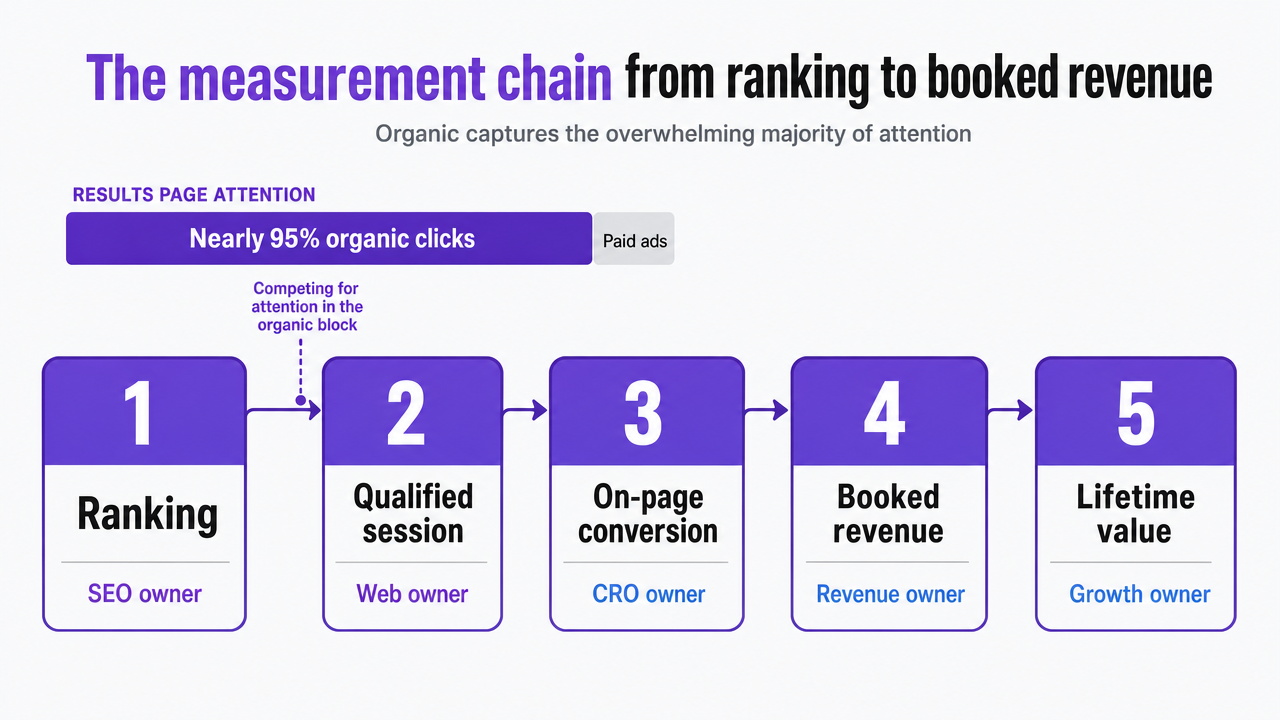 Visualize the five-stage measurement chain described in the section, showing how ranking flows to qualified session, on-page conversion, booked revenue, and lifetime value, each with a named owner
Keyword and content choices as revenue decisions
Keyword targeting is often treated as an editorial exercise. It is a pricing exercise. The Ghose and Yang analysis of a large retailer's search data used hierarchical Bayesian modeling on keyword-level performance and found that specific keyword characteristics move order value in organic search by economically meaningful amounts: the presence of retailer information in the keyword raises order value by 67.61%, brand information raises it by 45.19%, and each additional word in the keyword lowers order value by 20.01% 4. The study population is retail e-commerce, where order value is a completed transaction. For legal, dental, and behavioral health sites, the analogous variable is the value of a booked consultation or intake, and the direction of the effects—retailer and brand signals concentrate higher-value intent, longer tail queries dilute it—translates cleanly.
The operational read is that a page targeted at a five-word informational phrase and a page targeted at a two-word branded service phrase should not carry the same expected revenue in a forecast, even if both rank on page one. Content teams making assignments on volume and difficulty alone are optimizing for sessions the model already predicts will convert at lower value.
The same paper adds a finding that reframes channel budgeting. Many keyword characteristics have stronger effects on performance metrics in natural search than in paid search 4, which means the leverage of choosing the right terms sits disproportionately in the organic column. Editorial calendars, page templates, and internal linking decisions that concentrate on high-signal keywords—service-defining nouns, geographic modifiers, brand-adjacent phrases—are compounding the same effect the study measured, just on the service side of the ledger. Treating those choices as revenue decisions, with an expected booked value attached to each target, is what turns an on-site SEO program into a forecastable line item rather than a content backlog.
Test On-Site SEO Impact With Real Content
Measure SEO-driven pipeline growth using your live site and data before making a commitment.
The organic-paid interdependence CFOs need to hear
The strongest revenue argument for on-site search engine optimization is the one most marketing decks omit: organic visibility measurably improves the economics of paid search on the same query set. Empirical work from Ghose and Yang, summarized by NYU Stern, found that click-through rates, conversion rates, and total revenues are higher when paid and organic listings are present simultaneously than when paid ads appear without organic coverage, and that the combined presence lifts advertiser profits by at least 6.15% and combined conversion rates by 11.7% compared with organic alone 10. The study analyzed a retailer's search performance across a large keyword set, so the absolute magnitudes reflect e-commerce economics, but the mechanism—coexistence produces a measurable multiplier—is what a CFO needs to understand about the channel mix.
The direction of the effect is what changes the budget conversation. Synthesis of the underlying empirical work reports that higher organic click-throughs lead to higher paid click-throughs, and vice versa, but the effect is asymmetric: organic-to-paid is roughly three to four times stronger than paid-to-organic 9. Cutting on-site SEO to fund paid, in other words, degrades the very channel the reallocation was meant to protect. The econometric modeling in the underlying interdependence paper reaches the same conclusion, showing that click-throughs on organic listings have a positive interdependence with click-throughs on paid listings rather than the substitution pattern many mix models assume 5.
For a marketing VP presenting a budget, that reframes the pitch. On-site SEO is not a parallel channel competing with paid for the same dollars. It is a coefficient on the paid budget. A dollar removed from the organic program does not migrate cleanly into paid performance; it lowers the ceiling on what paid can convert against branded and service-defining queries where both listings appear together. The corollary is that a dollar added to on-site SEO—content depth on service pages, schema that stabilizes rich results, page-quality signals that lift the same landing pages the paid team uses—shows up in two line items, not one.
The forecasting move is to model paid and organic as a joint system on shared query clusters rather than reporting them as separate P&Ls. When conversion and profit lifts from combined presence 10and the asymmetric organic-to-paid influence 9are entered as coefficients on the paid forecast, the SEO investment stops being defended on its own traffic and starts being defended on total search revenue. That is the version of the story a CFO signs off on.
A defensible model for forecasting SEO's revenue contribution
Naming the metric owned at each stage
A forecast holds up in a CFO review when every stage of the chain has a metric, an owner, and a conversion assumption tied to the next stage. Abstract dashboards break down at the handoff between marketing language and finance language. A defensible model closes those handoffs by naming what moves and who moves it.
The chain runs in five stages. Ranking is the first metric, owned by the SEO lead, and its unit is position on a defined query cluster segmented by intent. Qualified session is the second, owned jointly by SEO and analytics, and its unit is a session from a query in the booking-intent cluster rather than pooled organic traffic—a segmentation the Columbia click data supports by showing organic traffic quality is query-dependent rather than uniform across a site 7. On-page conversion is the third, owned by the content and CRO leads, and its unit is a per-template conversion rate from qualified session to intake event. Booked revenue is the fourth, owned by sales or intake operations, and its unit is a completed consultation or matter valued at the vertical's average engagement price. Lifetime value is the fifth, owned by finance, and its unit is expected revenue net of servicing cost across the client relationship.
Each stage carries a conversion coefficient into the next. When those coefficients are stated explicitly, a rank movement enters the forecast as a booked-revenue delta rather than a session count, and the model can be audited line by line.
Translating website performance into organizational outcomes
The chain ends at booked revenue for marketing, but the CFO argument requires one more translation. The 2024 peer-reviewed analysis of SEO strategy found that SEO is a significant determinant of website performance, and that improved website performance contributes positively to broader organizational outcomes rather than to marketing KPIs alone 1. The study spans service settings, which makes the finding directly usable for legal, dental, and healthcare operators building the case at the executive level.
In practice, that translation means routing the same measurement chain into three organizational metrics finance already tracks: customer acquisition cost, contribution margin per new client, and pipeline coverage against the revenue plan. When the SEO forecast reports expected booked consultations at a defined conversion coefficient, CAC becomes program spend divided by booked clients rather than divided by sessions. Contribution margin follows from the vertical's average engagement value minus servicing cost, which finance can validate independently. Pipeline coverage becomes the ratio of forecasted organic bookings to the revenue gap paid and referral channels are not expected to close.
The broader digital marketing literature reinforces the operational point: SEO's contribution is often understated because measurement is fragmented across teams that do not share definitions 3. A single model with named stages, named owners, and finance-facing outputs is what removes the fragmentation and gives the program a defensible line in the operating plan.
Quantify the Revenue Impact of Advanced On-Site SEO Execution
Connect with a specialist to review how enterprise-grade on-site SEO workflow can directly link optimization efforts to pipeline and booked revenue—without expanding your team or adding agency overhead.
If the program spans multiple locations: consolidation math
The framework above assumes a single site. Marketing leaders running organic for multi-location service operators—regional dental groups, DSO networks, behavioral health platforms, home services franchises, senior living portfolios—work against a different cost structure, and the consolidation math is where the revenue argument either compounds or collapses.
Distributed programs typically carry a per-location tax: a content freelancer for each region, a technical SEO retainer at the group level, a local listings vendor, a schema contractor, and an analytics contractor stitching the reporting together. Each vendor sets its own definitions for a qualified session and an on-page conversion, which is precisely the fragmentation the broader digital marketing literature identifies as the reason SEO's contribution gets understated at the executive level 3. Consolidating those functions into one program with shared definitions is what makes the measurement chain in the previous section usable across every location instead of resetting it site by site.
The forecasting model for multi-location operators uses five inputs the reader already owns and two sourced coefficients from the research base. The variables are location count, average booked-client value, current blended CAC, current organic session volume per location, and the per-template conversion rate on booking-intent pages. The coefficients are the combined conversion lift when organic and paid coexist on shared query clusters, previously cited at 11.7% 10, and the asymmetric organic-to-paid influence running roughly three to four times stronger than the reverse 9. Both coefficients were measured on retailer data, so multi-location service operators should apply them as directional multipliers on branded and service-defining query clusters rather than as sitewide constants.
| Model input | Distributed vendor stack | Consolidated on-site SEO program |
|---|---|---|
| Definition of qualified session | Set by each vendor | Single query-cluster segmentation |
| On-page conversion ownership | Split across content and CRO vendors | One per-template conversion rate |
| Coordination with paid on shared queries | Manual, quarterly | Modeled as joint coefficient 10 |
| Forecast unit at CFO review | Sessions per location | Booked revenue per location |
| Marginal cost of adding a location | New vendor onboarding | Additional query cluster in existing model |
The operational takeaway for multi-location VPs is that consolidation is not a procurement decision. It is what makes the revenue coefficients enterable into the forecast at all. A group operating twenty locations under one measurement definition can defend an organic program in the same language the CFO uses for every other line in the plan.
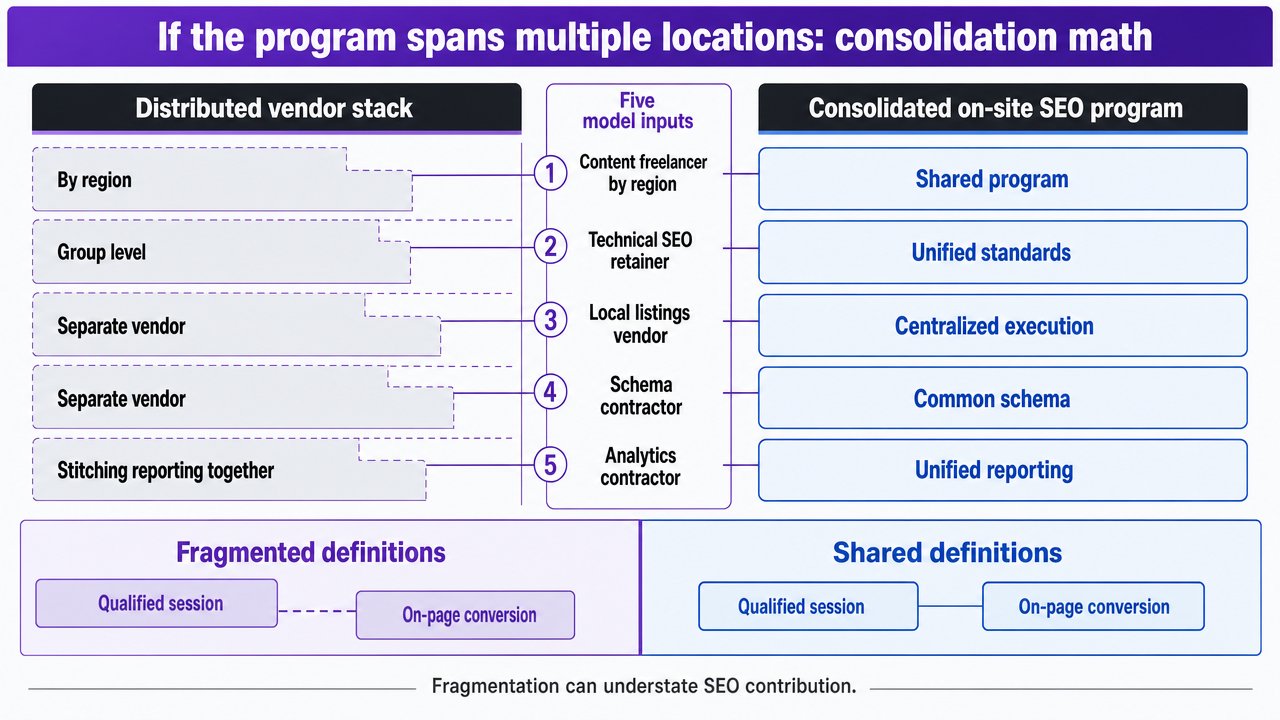 Reinforce the comparison table in the section by visualizing the contrast between a distributed vendor stack and a consolidated on-site SEO program across the five model inputs already cited in the article
Running the program without expanding headcount
The measurement chain in the previous sections assumes the work actually gets done. That is the constraint most in-house VPs run into next. A defensible model does not staff itself, and the traditional response—hire another content manager, add a technical SEO retainer, contract a schema specialist, bring on an analytics vendor to reconcile the definitions—reintroduces the fragmentation the peer-reviewed literature already identified as the reason SEO's business contribution gets understated at the executive level 3.
The alternative is to route the measurement chain through one governed workflow rather than one hire per stage. Ranking analysis, query-cluster segmentation, per-template conversion tracking, and joint modeling with paid on shared clusters are all pattern-recognition tasks that AI-driven marketing platforms now execute against live business data, with human approval at the point of decision. That structure preserves the coefficients the forecast depends on, because definitions do not reset each time a vendor rotates or a freelancer's contract ends.
The operational takeaway is narrow. A marketing VP defending SEO in CFO language needs continuity in how a qualified session, an on-page conversion, and a booked consultation are counted. Platforms like Vectoron are built to hold that continuity while the marketing leader retains approval over what ships. The revenue argument compounds only when the same measurement chain runs quarter after quarter under the same definitions.
Frequently Asked Questions
References
- 1.Search engine optimisation (SEO) strategy as determinants to website performance and organizational outcomes.
- 2.What Drives Organic Traffic to Retail Sites?.
- 3.Digital marketing strategies and their impact on business performance.
- 4.Comparing Performance Metrics in Organic Search with Sponsored Search Advertising.
- 5.Analyzing the Relationship Between Organic and Sponsored Search Advertising: The Role of Click Attribution.
- 6.An Empirical Analysis of Search Engine Advertising: Sponsored Search in Electronic Markets.
- 7.Consumer Click Behavior at a Search Engine.
- 8.Examining the Impact of Ranking on Consumer Behavior and Search Engine Revenue.
- 9.Advanced Database Marketing (chapter discussing SEO and paid search).
- 10.Organic and Paid Search: A Winning Combination.