
Key Takeaways
- Google Search Console anchors any 2026 stack as the free truth layer, now reporting isolated AI Overviews and AI Mode impressions after its June 2026 Generative AI report launch 1, 11.
- Semrush Position Tracking earns agency shortlists because it hits five of six criteria and explicitly covers AI Overview monitoring alongside People Also Ask and video carousels 5.
- Ahrefs Rank Tracker suits agencies bundling content strategy with reporting, since its keyword-analysis depth inside an all-in-one suite keeps the delivery team already inside the platform 12.
- SE Ranking wins on portfolio math at roughly $0.027 per keyword per month, while still exposing the API and white-label reporting agency SLAs require 13.
- Nightwatch fits multi-location clients like dental groups and home services franchises by delivering highly localized, grid-level tracking rather than national position averages 6.
- SERPWatcher (Mangools) works for small rosters at entry pricing near $9 per month, but thinner API depth and AI SERP coverage force migration as books grow 5, 7.
- ProRankTracker rounds out the shortlist by pairing AI Overview coverage with white-label client reporting, making it a strong client-facing layer over daily rank data 5, 13.
Why agency rank tracking got harder in June 2026
On June 3, 2026, Google Search Console shipped a dedicated Search Generative AI performance report, giving site owners their first isolated view of how URLs surface inside AI Overviews and AI Mode 1, 11. For agency heads running SEO delivery at scale, that single release changed what a rank tracker has to cover. Classic position tracking now sits alongside a second, non-negotiable question from clients: how often is our content showing up when Google answers with AI?
The new report exposes five dimensions and nothing more: impressions, pages, countries, devices, and dates, with historical data starting May 18, 2026 3, 10. Clicks, CTR, and query-level detail are not included at launch 3, 9. That is the analytical hinge for the rest of this shortlist. An agency reporting stack that relied on keyword positions plus organic clicks is now missing the middle layer where a growing share of client visibility actually happens.
Two operational consequences follow. First, Search Console becomes the truth layer for AI visibility because no third party currently has better access to Google's own impression counts inside generative features 1, 15. Second, commercial rank trackers have to earn their seat by covering what GSC will not: query attribution, competitor movement, local pack and grid data, international engines, and daily refresh across hundreds of client portfolios. The tools worth an agency shortlist in 2026 are the ones that treat AI Overviews coverage as a first-class metric rather than a marketing bullet, and that expose it through APIs and white-label reports the delivery team can actually run against a 50- or 200-client book.
The six criteria that separate agency-grade trackers from the rest
The 2026 review that anchors this shortlist judges rank trackers against six capabilities, not marketing copy: accuracy and refresh rate, mobile/desktop/local tracking, AI SERP feature coverage, international engine support, API and reporting options, and pricing scalability 5. An agency head running delivery across dozens of client portfolios should treat these as a scoring rubric. A tool that hits four of six is a candidate; a tool that hits five or six earns a seat in the stack.
Accuracy and refresh rate : Determines whether daily client standups can trust yesterday's numbers. Sub-24-hour refresh is the practical floor for competitive verticals; on-demand refresh matters when a legal or dental client calls about a pushed update.
Mobile, desktop, and local tracking : Non-optional for anyone serving multi-location clients. A tool that reports a national position for a home services franchise with 40 metros is quietly hiding the movement that actually drives booked jobs. Grid or geo-pin tracking separates trackers built for local from trackers that bolted it on.
AI SERP feature coverage : The criterion that moved from nice-to-have to mandatory in 2026 5. AI Overviews, People Also Ask, and video carousels now displace organic results on high-intent queries. A tracker that cannot flag when a client's URL is cited inside an AI Overview is leaving the client's actual visibility unreported.
International engine support : Matters for any agency with cross-border clients — Bing, Yandex, Baidu, and localized Google indexes.
API and reporting options : Decides whether the team pushes rank data into an existing warehouse or spends analyst hours copy-pasting into slide decks; white-label output is where reporting SLAs live or die 13.
Pricing scalability : The last filter: per-keyword economics that work at 500 keywords can collapse the delivery margin at 50,000 13.
Each tool below is graded against these six. Fewer than four hits, and it does not belong on an agency shortlist in 2026.
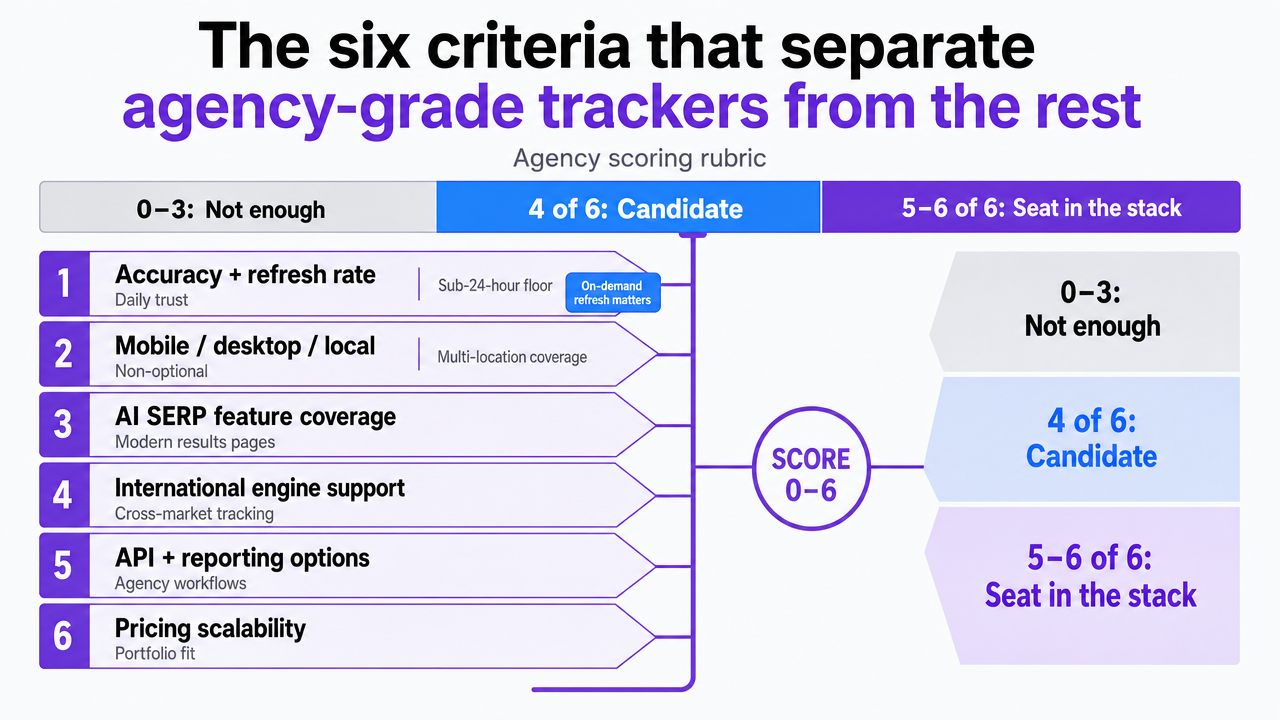 Visualize the six-criteria evaluation framework agencies should use to score rank trackers, directly supporting the section's rubric
Test real-time ranking insights on live projects
Experience accurate keyword tracking on actual client campaigns for a full week, risk-free.
The shortlist: seven online rank trackers agency heads should evaluate
Google Search Console: the free truth layer that now reports AI visibility
Search Console earns the first slot not because it competes with commercial trackers on refresh or coverage, but because it is the only source with Google's own impression counts for both classic search and AI features. Serious SEO teams already treat it as the baseline truth layer for diagnostics, paired with a commercial tool for enhanced analytics and reporting 15.
The June 2026 addition of the Generative AI performance report changes what that pairing has to do. Site owners now see isolated visibility inside AI Overviews and AI Mode, exposed through impressions, pages, countries, devices, and dates, with historical data starting May 18, 2026 1, 8. That is a genuinely new signal an agency can pull into client reports today. It is also a narrower signal than the classic Performance report: clicks, CTR, and query-level detail are not part of the Generative AI view at launch 3, 9.
Agency fit profile. GSC scales to any portfolio size because it is per-property and free, but it forces the delivery team to do the aggregation. Multi-client reporting requires pulling each property through the API and stitching it together downstream. There is no competitor tracking, no local pack coverage, no scheduled white-label output, and no rank position for keywords the client is not already ranking for. Grade against the six criteria: it hits accuracy, device breakdown, AI SERP coverage, and (in a narrow way) pricing scalability. It misses on local grid data, international engine coverage beyond Google, and turnkey agency reporting. Every shortlist below assumes GSC is already wired in.
Semrush Position Tracking: agency-oriented coverage with AI Overview monitoring
Semrush Position Tracking is positioned in industry roundups as the agency-oriented option inside a broader all-in-one SEO suite, with reviewers pointing to comprehensive keyword tracking, research, and analysis as its core pitch to SEO agencies 6, 12. For a Head of SEO already running Semrush for keyword research and site audits, adding Position Tracking removes a data-portability tax between tools.
The 2026 review that anchors this shortlist singles it out for AI SERP feature coverage, including AI Overview monitoring alongside People Also Ask and video carousels 5. That matters because it moves the AI visibility question out of GSC's impression-only view and into a competitor-aware, query-level dataset the delivery team can actually use in a client debrief.
Agency fit profile. Scales cleanly to portfolios in the low hundreds of clients because projects, tags, and scheduled PDF reports are built for that structure. Against the six criteria it credibly hits five: daily refresh, device and local tracking, AI SERP coverage, international engines, and API and reporting depth. The weak criterion is per-keyword pricing at very large scale, where dedicated cheap trackers pull ahead. Best used when the delivery team also wants the surrounding suite; treating Position Tracking as a standalone purchase leaves most of its economic advantage on the table.
Ahrefs Rank Tracker: keyword-analysis depth inside an all-in-one suite
Ahrefs Rank Tracker occupies a similar structural position to Semrush: a rank tracking module inside an all-in-one platform rather than a standalone product. Editorial roundups consistently frame it as the strongest option when keyword analysis is the reason the tool is in the stack in the first place 12. That framing matters for agencies whose delivery model leans on content briefs, cluster mapping, and competitor gap analysis rather than pure position monitoring.
Where it fits the six-criteria rubric: strong on accuracy and international engine coverage, competent on device and local tracking, and integrated with the Ahrefs API for teams pushing data into their own warehouses. AI SERP feature coverage exists but is less foregrounded in 2026 reviews than Semrush or ProRankTracker 5.
Agency fit profile. Best used by agencies whose retainer scopes bundle content strategy with rank reporting, because the delivery team is already inside the platform every day. Pricing scales by project and keyword allotment rather than pure per-keyword economics, so it is a weaker fit for pure-tracking books in the tens of thousands of keywords where SE Ranking's per-keyword rate wins on math alone.
SE Ranking: the low per-keyword cost option for large portfolios
SE Ranking is on the shortlist for a specific reason: it prices for scale. The 2026 comparison table shows entry pricing around $52 per month for 750 keywords, which works out to roughly $0.027 per keyword per month for daily tracking 13. In the same table, AccuRanker sits at $129 per month for 1,000 keywords, or about $0.129 per keyword — nearly five times the unit cost 13. For an agency running 10,000 tracked keywords across a 50-client portfolio, that ratio is the difference between rank tracking as a rounding error and rank tracking as a line item that has to be defended in the delivery margin.
The same review confirms API availability and white-label reporting, which are the non-negotiables for agency use 13. Roundups also include it in the working stacks of serious SEO teams alongside GSC and the all-in-one suites 15.
Agency fit profile. Scales to portfolios in the multi-hundred-client range where per-keyword economics dominate. Weaker on AI SERP feature coverage than Semrush or ProRankTracker in current 2026 reviews, so agencies serving verticals where AI Overviews already dominate the SERP should pair it with GSC's Generative AI report rather than rely on it alone for AI visibility.
Nightwatch: localized grid tracking for multi-location clients
This tool earns its slot for a specific delivery pattern. Multi-location clients — dental groups with 30 practices, home services franchises across 40 metros, senior living operators across regional markets — need position data at the location level, not the national level. Nightwatch is described across 2026 roundups as highly localized keyword tracking built for exactly that use case 6.
Against the six-criteria rubric, it hits hardest on local coverage and customizable reporting, with a keyword footprint the 2026 review references alongside Semrush, Ahrefs, and AccuRanker as recognized options for large-business tracking 6. Accuracy and refresh are competitive; AI SERP feature coverage and international engine breadth are less foregrounded than at Semrush or ProRankTracker in the same reviews 5.
Agency fit profile. The strongest choice when the delivery team is answering the question "which locations moved this week" rather than "where does the brand rank nationally." Pair it with GSC's Generative AI report on the AI visibility side and a suite-level tool for content and backlink workflows; Nightwatch is not built to be the only tracker in a mixed-vertical agency stack.
SERPWatcher (Mangools): lightweight tracking for small client rosters
SERPWatcher is the shortlist entry for agencies whose portfolio has not yet crossed the point where per-keyword economics or API depth decide the tool. It appears across curated 2026 keyword-tracking lists alongside Nightwatch, Ahrefs, Semrush, and AccuRanker, positioned as a lightweight tracker within the Mangools suite 6. Some vendors in the same market publish entry pricing as low as $9 per month for basic tiers, which sets the current floor for what a small-roster tracker costs 7.
On the six-criteria rubric it hits accuracy, device tracking, and pricing scalability at the low end. It is weaker on international engine coverage, AI SERP feature depth, and the API and white-label reporting an agency needs once client reporting SLAs get formal 5.
Agency fit profile. Works for rosters in the single-digit to low-double-digit client count where the head of SEO is still doing delivery hands-on. Once the book pushes past that, the missing API depth and thinner AI SERP coverage force a migration to Semrush, SE Ranking, or ProRankTracker.
ProRankTracker: white-label reporting with AI SERP feature coverage
ProRankTracker rounds out the shortlist because it targets the two capabilities agency heads care about most on the reporting side: AI SERP feature coverage and white-label output. The 2026 review lists it alongside Semrush Position Tracking as one of the tools singled out for AI Overview tracking within its six-criteria framework 5. That is a small group in the current market.
Reporting is the second reason it is on the list. Independent 2026 comparisons flag white-label capability and API availability as differentiators for agency use, and ProRankTracker is consistently referenced in that agency-reporting bracket 13. For a delivery team producing branded client PDFs on a weekly or monthly cadence, that shifts hours out of analyst copy-paste work.
Agency fit profile. Best used as the client-facing reporting layer over daily rank data, especially when the portfolio includes verticals where AI Overviews are already displacing organic results. It is less suited as the sole research tool for content strategy — pair it with a suite-level platform for keyword research and gap analysis, and let ProRankTracker own the tracking and reporting surface.
Portfolio cost math: what per-keyword pricing does at scale
Rank tracking looks cheap at 500 keywords. It stops looking cheap somewhere around 10,000. That inflection point is where the tool choice stops being a preference and starts eating the delivery margin, so the sourced numbers matter more than the sales page.
The 2026 comparison table anchoring this shortlist lists SE Ranking at roughly $52 per month for 750 keywords, which comes out to about $0.027 per keyword per month for daily tracking. The same table puts AccuRanker at $129 per month for 1,000 keywords, or about $0.129 per keyword 13. The unit-cost gap is close to 5x. At the low end of the market, some rank trackers pitch entry pricing as low as $9 per month, aimed at solo operators rather than agency books 7.
Apply those two sourced rates to a delivery-sized portfolio: 50 clients, 200 tracked keywords each, 10,000 keywords total. At SE Ranking's rate, daily tracking runs approximately $270 per month across the book. At AccuRanker's rate, the same coverage runs approximately $1,290 per month — a delta of roughly $1,020 every month, or about $12,240 a year, for the same keyword count on the same cadence 13. That number is the actual line item an agency head has to defend against gross margin on retainers.
Two operator points follow. First, per-keyword economics only matter if the cheaper tool also clears the API and white-label bars; the same 2026 review confirms SE Ranking exposes both, which is why it belongs on this list rather than being priced off it 13. Second, the sourced numbers cover a subset of the shortlist. Semrush Position Tracking, Ahrefs Rank Tracker, Nightwatch, SERPWatcher, ProRankTracker, and Google Search Console are not priced in comparable per-keyword terms in the supplied research, so their portfolio cost has to be modeled against project or suite pricing rather than a single unit rate. Treat the SE Ranking versus AccuRanker delta as the calibration point, not a ranking of every tool in the stack.
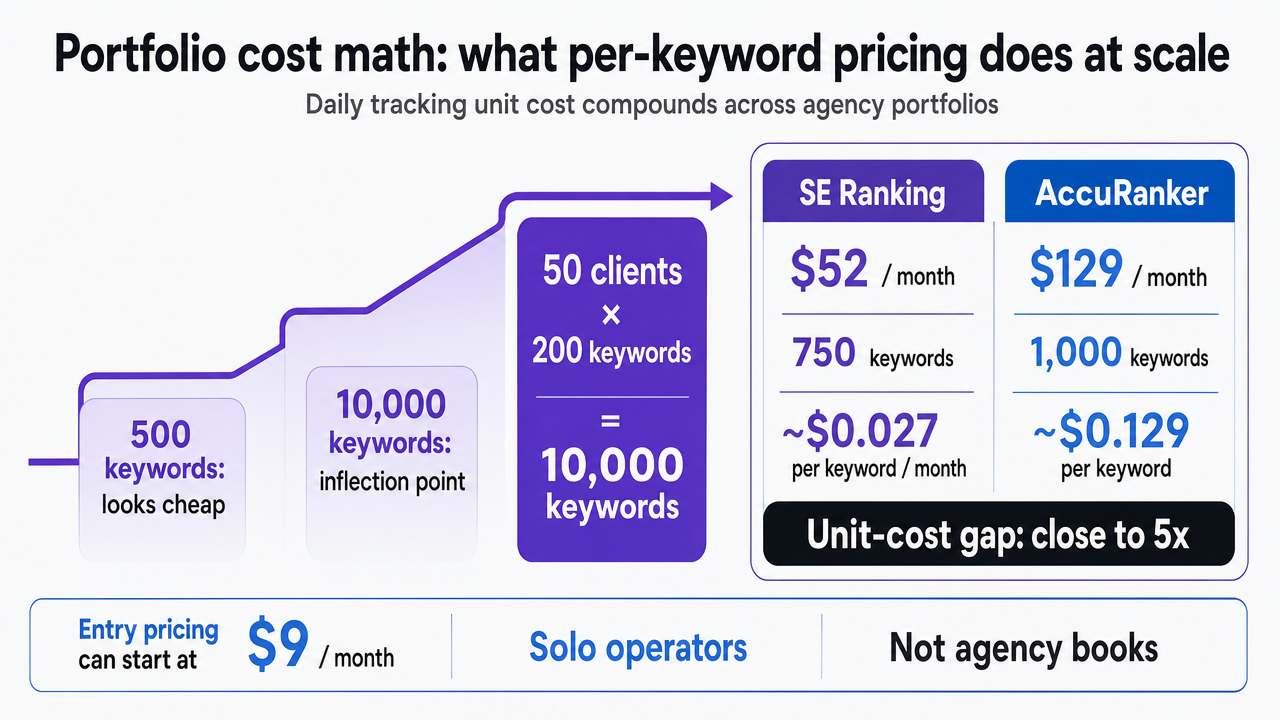 Show the per-keyword cost differential between SE Ranking and AccuRanker at agency portfolio scale, using the exact sourced figures cited in the section
See How Leading Agencies Monitor Rankings at Scale—Without Manual Overhead
Get a walkthrough of AI-powered rank tracking solutions built for high-volume, multi-client portfolios. Learn how to automate SERP monitoring, reporting, and action workflows across all your accounts.
If you manage multiple client verticals: matching trackers to delivery model
Vertical mix changes what a rank tracker has to prove. A legal book runs on individual-attorney and practice-area queries where AI Overviews now sit above the pack; Semrush Position Tracking and ProRankTracker are the two options the 2026 review flags for AI Overview monitoring inside its six-criteria framework, which puts them at the top of a legal-heavy stack 5.
Dental groups and DSOs read differently. The delivery question is which of 30 practices moved this week on "[procedure] near me" queries, and that is grid tracking, not national position. Nightwatch is described across 2026 roundups as highly localized keyword tracking built for that pattern, and it pairs cleanly with GSC as the impression layer on the AI side 6.
Home services franchises push the same shape harder — 40 metros, high keyword counts per location, thin retainer margins. This is where SE Ranking's per-keyword economics decide whether the delivery team can afford daily refresh at all, and the same 2026 comparison confirms it exposes the API and white-label reporting the franchise reports need 13.
Behavioral health portfolios sit in between: fewer locations than home services, higher regulatory sensitivity in the copy, and a heavier reliance on educational content ranking. Ahrefs Rank Tracker fits agencies whose retainer scopes bundle content strategy with reporting, since the delivery team is inside the platform for keyword research anyway 12. Score every candidate against the six criteria — accuracy and refresh, device and local, AI SERP, international, API and reporting, pricing scalability — before it enters the stack, and pair whatever wins with GSC as the truth layer underneath 5, 15.
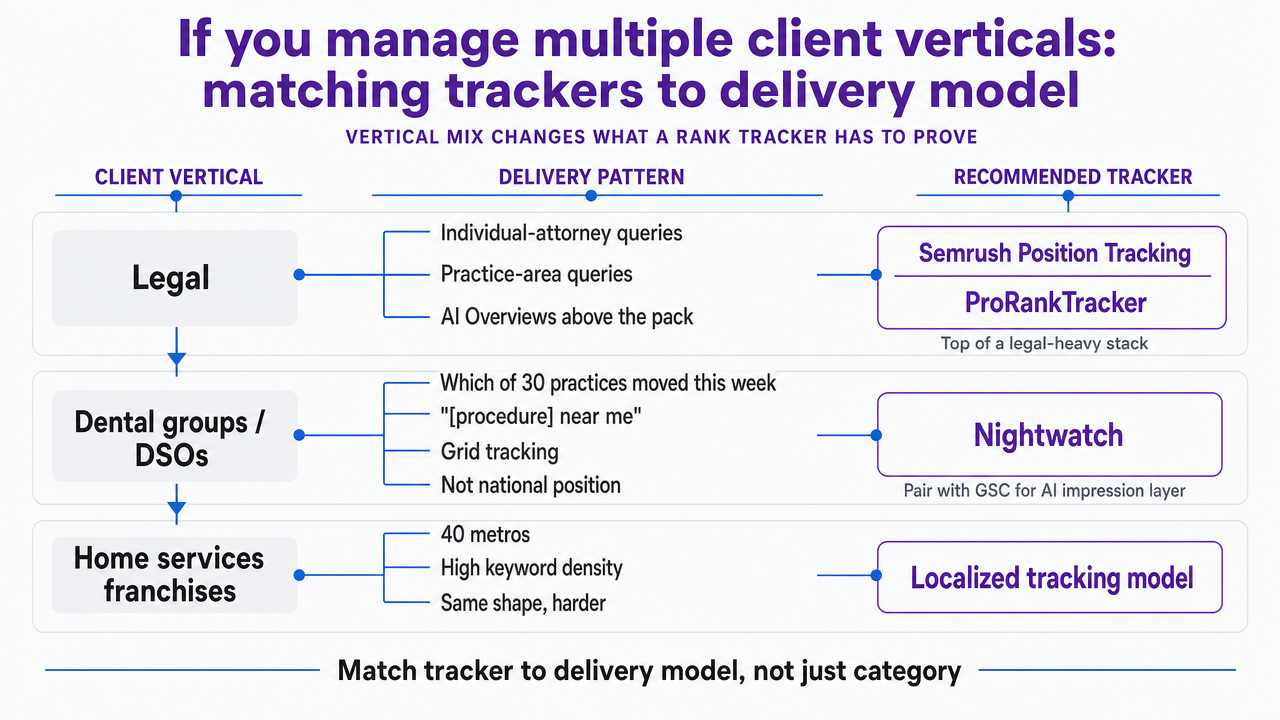 Map client verticals to the recommended tracker based on the section's delivery-model reasoning
Where an approval-first execution layer fits alongside the tracker stack
A rank tracker stack answers what moved. It does not decide what the delivery team should do next Monday across a 50-client book, and it does not route that decision through a partner or head of SEO before the work ships. That gap is where an approval-first execution layer sits — on top of the rank data, not in place of it.
The mechanics are straightforward. GSC feeds impression counts for classic search and, since June 2026, isolated visibility inside AI Overviews and AI Mode across pages, countries, devices, and dates 1, 8. A commercial tracker adds query attribution, competitor movement, local grid data, and white-label reporting 5, 13. An execution layer consumes both signals, ranks the next actions by client-level KPI impact, and holds every recommendation at a human approval gate before content, on-page fixes, or backlink outreach ship.
For an agency head, the operational payoff is that the delivery team stops triaging tracker exports by hand. Vectoron is built to occupy that role — reading rank and impression signals, prioritizing work across content, SEO, PPC, backlinks, and social, and routing each recommendation for sign-off before execution — so the tracker stack drives action instead of another dashboard.
Frequently Asked Questions
References
- 1.Introducing Search Generative AI performance reports in Search Console.
- 2.Google finally gives Search Console its own generative AI visibility reports.
- 3.Google Search Console Adds AI Performance Reports.
- 4.GSC AI Reports: Should You Block Google AI Responses?.
- 5.Best Rank Tracking Tools for 2026: Honest Review.
- 6.Best Keyword Tracking Tools in SEO 2025.
- 7.Top Rank Tracking Tools for SEO Success in 2026.
- 8.Search Console: Generative AI Performance Reports.
- 9.Google GenAI Performance Reports: What the New GSC Data Offers.
- 10.Search Generative AI Performance Reports in GSC.
- 11.Today (June 3, 2026), Google launched a new Search Generative AI performance report.
- 12.The 12 best rank tracker tools.
- 13.9 Best Rank Tracker Tools in 2026: Cheap, Daily, Accurate.
- 14.The 9 Best SEO Rank Tracker Tools in 2026.
- 15.15 Best Rank Tracking Software We're Using for 2026.
- 16.Search Marketing Forecast, 2019 To 2024 (US).
- 17.Search Marketing Forecast, 2017 To 2022 (US).