
Key Takeaways
- Treat ranking movement as a classification problem across five distinct classes: volatility, layout shift, intent drift, algorithmic reweighting, and competitive loss, each requiring a different response.
- Prioritize top-five commercial-intent flags where the click curve is steepest, since 97-99% of clicks occur on page one and the top five capture over 86% 4.
- Run snippet and context checks before scoping any content edits, because relevance of the snippet and surrounding results, not raw position, drives clicks 9, 7.
- Build an interpretation layer above the tracker using duration filters, Search Console impressions-versus-clicks analysis, and a 48-hour rule for high-velocity queries to concentrate strategist hours on competitive loss.
Ranking Movement Is a Classification Problem, Not a Monitoring Problem
Most agency SERP tracking dashboards provide raw data, such as a keyword moving from position 4 to position 7. However, they often fail to explain the underlying cause, the significance of the movement, or whether any content action is necessary. This gap leads to significant time expenditure for strategists managing numerous client domains.
Research indicates that ranking movement should be approached as distinct phenomena rather than a singular metric. For instance, click rates are influenced by position, snippet text, and surrounding search results, not just rank alone 7. The relevance of a snippet, rather than its raw position, is crucial for clicks 9. Furthermore, SERP layout changes, such as the introduction of an information box, can divert clicks from organic listings even if a page's rank remains unchanged 5. Each of these mechanisms requires a different response.
Agencies that scale SERP oversight efficiently shift from asking "did rankings change?" to "what class of change occurred?" This approach involves classifying changes and routing each class to a triage protocol focused on revenue impact.
The Five Classes of Ranking Change
Volatility: Noise That Resolves Itself
Volatility represents ranking fluctuations that often self-correct, consuming strategist hours without yielding results. This occurs when a keyword temporarily shifts positions (e.g., from 4 to 8, then back to 4) without any changes to the page or competitor actions. It typically happens when Google's index refreshes for queries where top results have similar relevance signals, leading to minor reshuffles.
Click modeling demonstrates that click rates depend on the overall SERP context, not just a single observed position 7. When underlying relevance scores are closely grouped, minor model adjustments can cause visible rank changes that don't reflect a page's true standing. Investigating every such instance means auditing statistical noise.
To filter volatility, consider both duration and amplitude. A single-day movement of one to three positions for a keyword outside the top five usually doesn't warrant review. Only movements that persist across three or more crawls, or that cross a page-one threshold, should be escalated for further classification.
Layout Shift: When the SERP Changed, Not the Page
Layout shift is frequently misidentified as a ranking issue. A page might maintain its position (e.g., position 3) with stable or increased impressions in Search Console, yet experience a significant drop in clicks. This indicates a change in the SERP environment rather than the page itself.
For example, a study on health-related searches found that knowledge panels and answer boxes
"redirect attention and clicks toward curated content,"
thereby reducing click-through rates to organic results even when their positions remain unchanged 5. A page at position 3 with an answer box above it performs differently than the same page without such a feature.
The diagnostic process involves checking Search Console for the query: if impressions are stable or up while clicks decline, a SERP feature has likely absorbed traffic. Confirm this by performing the search and noting any features above the first organic result, such as:
- answer boxes
- knowledge panels
- product carousels
- video packs
- local packs
The appropriate response is not a content rewrite. Instead, it involves deciding whether to compete for the feature, adapt the page to be sourced by it, or accept the traffic loss and reallocate the keyword's priority. Rewriting content for a page that hasn't lost rank addresses the wrong problem.
Intent Drift: The Snippet Stopped Matching the Query
Intent drift occurs when a page retains its ranking but experiences a decline in click-through rates because its snippet no longer resonates with searchers. While position influences viewing behavior, a replicated eye-tracking study found that
"the crucial factor for a result to be clicked was the relevance and not its position on the search engine results page"
9. Users notice a result due to its rank but click based on the snippet's relevance.
This drift typically happens when the dominant search intent for a query shifts, Google generates the snippet from a different part of the page, or a competitor offers a more compelling angle. To diagnose, evaluate the current snippet as if encountering the query for the first time, then compare it to snippets of top-performing competitors.
Before undertaking extensive content edits, strategists should review the meta description, H1, and the initial 150 words of the page to ensure they align with the current query intent. Often, a minor snippet revision can restore clicks, making a full article rewrite an inefficient use of resources.
Algorithmic Reweighting: When the Model Revalued the Page
Algorithmic reweighting describes ranking changes that occur because Google has adjusted how it scores a category of content, rather than due to specific page actions. This includes core updates, quality signal changes, and the continuous reranking that happens between major updates.
The hallmark of algorithmic reweighting is a portfolio-wide impact, not an isolated keyword drop. If twenty pages within the same content cluster decline simultaneously, it signals a model adjustment. A strategist focusing on a single keyword flag will likely misclassify this; the pattern is only evident at the cluster or site level.
Diagnosis involves two steps: first, confirm the movement aligns with a known update or affects a coherent group of pages. Second, analyze top-ranking pages for the affected queries to identify common characteristics they possess that demoted pages lack, such as:
- depth
- original evidence
- structural clarity
- author credibility
- comprehensive topic coverage
The response to algorithmic reweighting should be strategic and measured. It typically requires structural changes to how a site addresses a topic, rather than quick edits to individual pages. Reactive rewrites often miss the actual signal Google adjusted, leading to repeated efforts as the true pattern emerges.
Competitive Loss: When a Rival Actually Overtook the Page
Competitive loss is the scenario often mistakenly attributed to other ranking change classes. It occurs when a competitor publishes or updates a page that genuinely outperforms the client's page based on current algorithm merits, resulting in a real, durable, and attributable rank drop.
This type of loss is significant because click rates are influenced by surrounding results 7. A new competitor with a superior snippet or more comprehensive answer can reduce click share for other listings, even before rank positions fully stabilize. The client's page may not have deteriorated, but the competitive landscape has intensified.
Diagnosis involves a direct comparison between the client's page and the new top-ranking results. Key questions include: What unique content does the competitor cover? What format did they use (e.g., comparison table, original data, embedded calculator, first-party imagery)? What entity signals or citations do they have that the client's page lacks?
This is the primary class where content investment reliably yields returns. Other classes either self-resolve, require snippet/feature adjustments, or demand site-wide structural changes. Competitive loss is the ideal target for agency production hours, making effective triage essential to direct resources here.
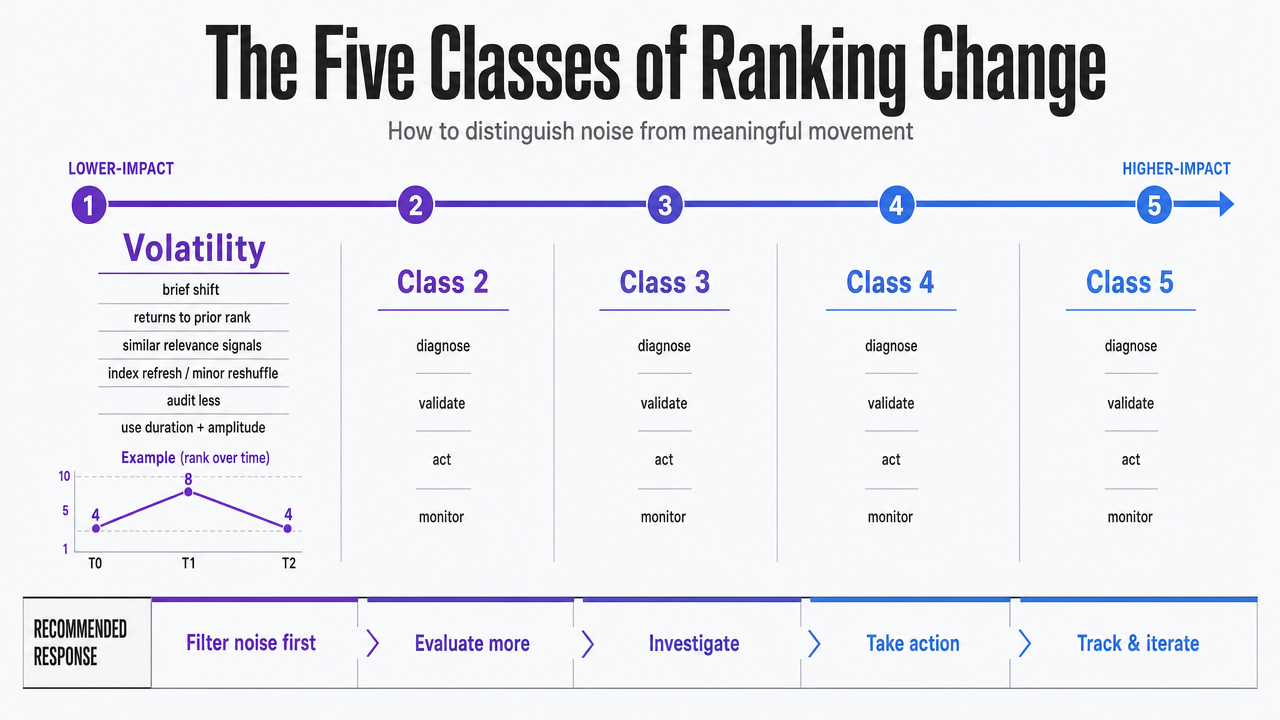 Visualize the five distinct classes of ranking change and their recommended responses, directly supporting the section's framework
Where Position Actually Moves Revenue
The impact of rank movement varies significantly. A comparative click study on Google and Bing revealed that the first result on Google captures 51.3% of clicks, the top five results account for over 86% of all clicks, and 97-99% of clicks occur on the first page 4. This distribution is a steep curve, with traffic diminishing to near-zero beyond position ten.
This click curve is a critical input for triage. A shift from position 2 to 4 on a commercial query can drastically reduce click share, even if the rank change seems minor. Conversely, a drop from position 14 to 22 has minimal revenue impact, as both positions fall within the negligible click share beyond page one.
For agency triage, a practical rule is to prioritize flags within the top five for commercial-intent queries. Movements between positions six and ten warrant weekly batch review, as recoverable click share is meaningful but less urgent. Flags on page two and beyond are reserved for pattern review, where strategists look for clusters of related keywords moving together rather than individual flags.
The pursuit of position one isn't always the most profitable strategy. Research in paid search indicates that while conversion rates are highest at the top, the monetary value of clicks isn't uniform, and middle positions can yield higher profits when bid costs are considered 2. In organic SEO, this translates to production cost. Recovering position 1 from position 3 might require significant content and link investment that could be better spent on a weaker keyword with higher potential ROI. Triage prioritization should consider both potential click share and the efficiency of production cost.
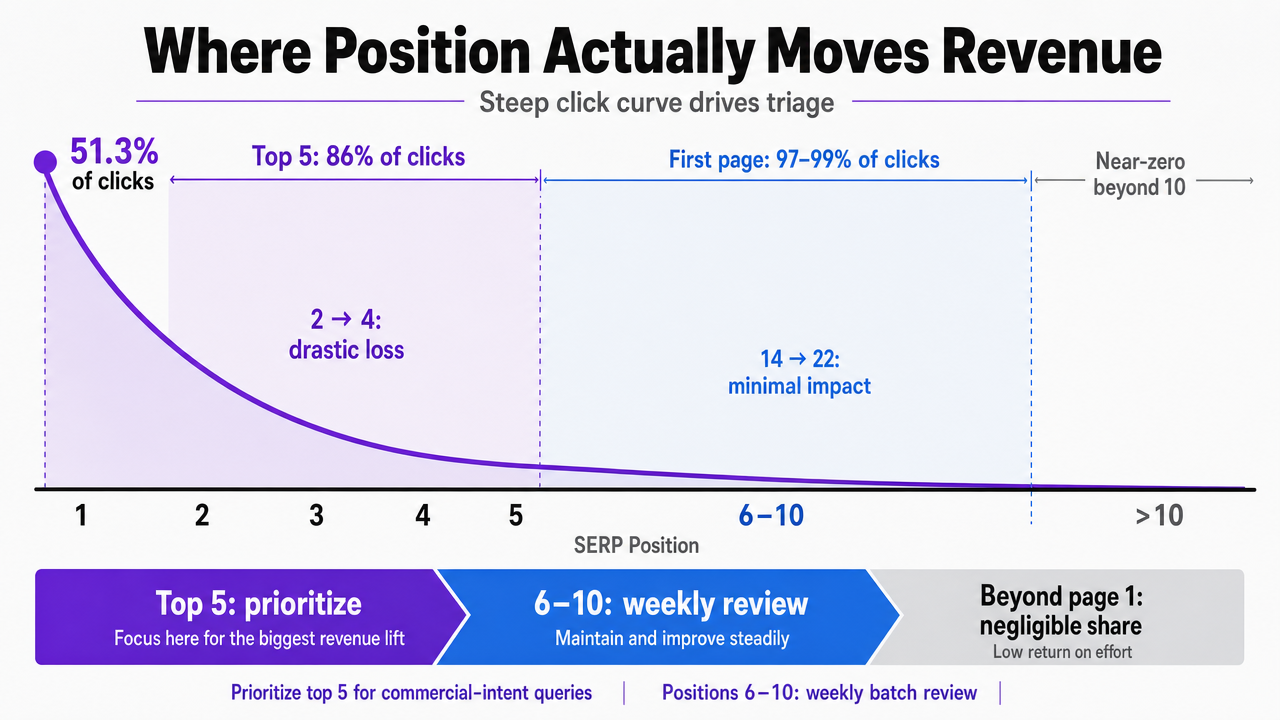 Show the steep click distribution curve across SERP positions, directly supporting the cited 51.3% first-position and 86% top-five click statistics
Monitor SERP Volatility and Validate Adjustments Instantly
Track live ranking shifts and implement data-backed responses on real client projects during your trial.
The Triage Protocol: Routing Flags to Responses
The 48-Hour Rule for High-Velocity Queries
Certain query types inherently feature rotating top results, which is a structural characteristic rather than a signal about individual pages. A study of Google news results during the 2020 U.S. election showed significant turnover in top news positions as events unfolded 6. Agencies that investigate every flag on such queries will waste time auditing self-generated motion.
The 48-hour rule applies to event-driven, seasonal, or news-adjacent queries, such as legal news, health queries during outbreaks, home services after weather events, or financial queries around earnings. For these, rankings are expected to fluctuate. The protocol is to log the flag, tag the query as high-velocity, and defer investigation for two crawl cycles. If the position remains lower after 48 hours and persists into a third day, the query is promoted to standard triage. This saves strategist hours on self-correcting queries, allowing for proper review of persistent issues.
Snippet and Context Checks Before Content Edits
Any flag that passes volatility and velocity filters undergoes two preliminary checks before any production work is scoped. These checks are efficient and do not require modifying the page.
The first is the snippet check. Review the current Google-generated snippet for the query as if you were a cold searcher. Eye-tracking research on Google SERPs highlights that snippet relevance, not position, is the critical factor for clicks 9. If the snippet no longer accurately reflects the query, click share will decline regardless of position. This can often be resolved with a meta description revision or a targeted edit to the on-page section Google is sourcing, without a full content rewrite.
The second is the context check. Contextual click models show that click rates are influenced by surrounding results, not just the flagged listing 7. Screenshot the live SERP and note any changes to adjacent results: a new competitor, a reformatted snippet, an expanded feature module, or a video result pushing content below the fold. The appropriate response depends on these neighboring changes. Skipping these checks can lead to unnecessary content rewrites for problems that don't originate on the page itself.
High-Stakes Verticals Get a Shorter Fuse
Triage thresholds should not be uniform across all clients. Verticals like law firms, healthcare providers, and financial services often have queries where a single ranking slot significantly influences high-impact, infrequent user decisions. Research on the search engine manipulation effect demonstrates that biased search rankings can shift undecided users' voting preferences by 20% or more, illustrating how profoundly position can affect behavior in high-stakes contexts 3.
For high-stakes verticals, the operational adjustment is direct: top-five commercial-intent flags bypass the 48-hour deferral and receive same-day review. Snippet and context checks are performed immediately, rather than waiting for the weekly queue. Page-two keywords, typically batched weekly for lower-stakes clients, are scanned twice a week for these accounts. The classification framework remains consistent, but the response timeline for each class is accelerated. Agencies can leverage this differential in client SLAs, creating pricing tiers and providing a clear rationale for varied response times based on research-backed findings.
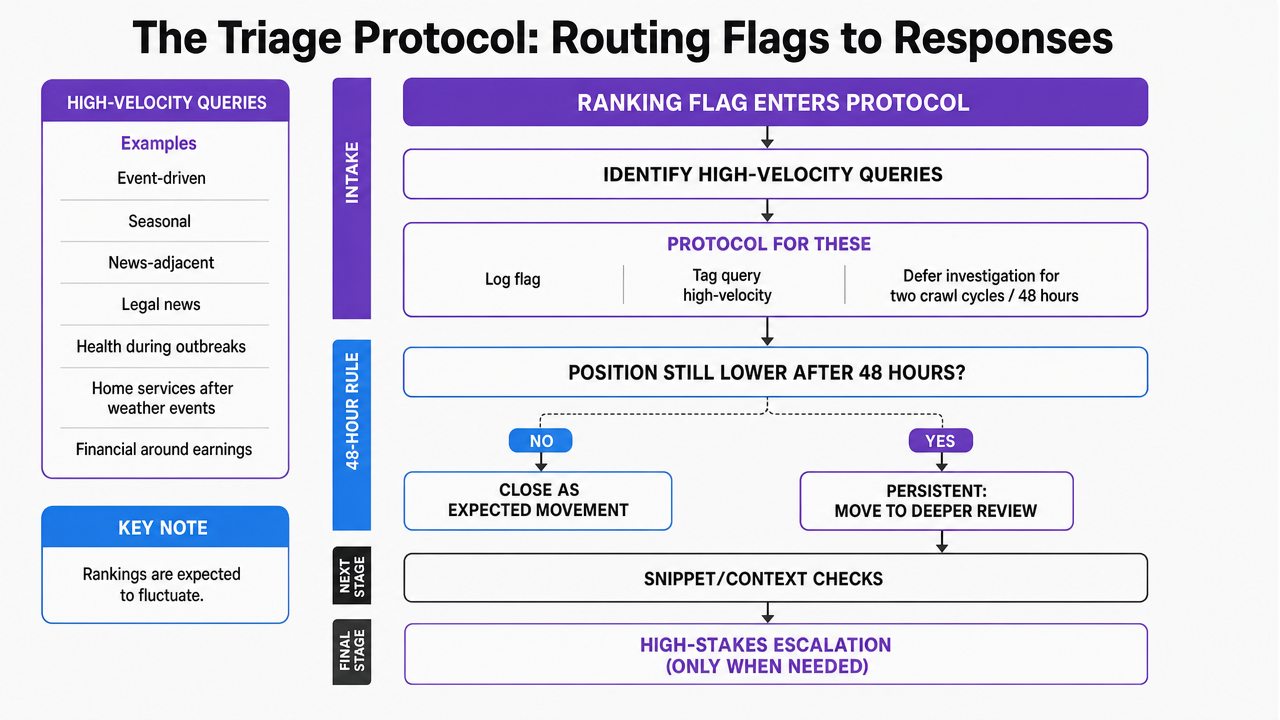 Diagram the decision flow from ranking flag to response, supporting the triage protocol subsections (48-hour rule, snippet/context checks, high-stakes escalation)
Portfolio Economics of Triage-First Tracking
This section examines SERP tracking from a portfolio perspective, focusing on optimizing strategist time across multiple client domains. The goal is to manage weekly workload for a fixed team, not just individual client responses.
Key variables influencing weekly load are consistent across agencies:
K : tracked keywords per client
F : weekly keyword flag rate
M : strategist minutes per flag
C : loaded strategist hourly cost
The weekly cost per client is calculated as (K × F × M ÷ 60) × C. The most impactful lever is 'M' (strategist minutes per flag), as it's directly controlled by the interpretation layer.
| Input | Manual review of every flag | Classification-first triage |
|---|---|---|
| Tracked keywords per client (K) | 500 | 500 |
| Weekly flag rate (F) | 8% | 8% |
| Strategist minutes per flag (M) | 12 | 3 |
| Flags routed to zero-action classes | 0% | ~70% |
| Weekly strategist hours per client | 8.0 | 2.0 |
The reduction in time comes from the classification framework's initial pass. Volatility flags are filtered by duration. Layout shifts are resolved quickly via Search Console impressions-versus-clicks analysis 5. Intent drift is caught by snippet checks before page access 9. High-velocity queries are deferred for 48 hours 6. Only the remaining 10-15% of flags, primarily top-five commercial-intent movements that impact revenue, require full strategist review 4.
At a portfolio scale, this arithmetic impacts hiring. For example, 40 clients with 500 tracked keywords each generate approximately 1,600 weekly flags at an 8% rate. Manual review would require 320 strategist hours weekly, a significant payroll burden. Classification-first triage reduces this to around 80 hours, freeing up time for human-exclusive tasks like competitive teardowns and structural responses to algorithmic reweighting patterns that dashboards cannot identify.
See How Real-Time SERP Tracking Can Stabilize Your Client Rankings
Get a tailored walkthrough of unified SERP monitoring, anomaly detection, and automated reporting workflows designed for agencies managing high-volume keyword portfolios.
Client Communication When a Drop Does Not Matter
When a client notices a ranking drop (e.g., from position 6 to 9) and inquires about agency action, the strategist might know it's outside the top five, recent, and due to a SERP feature expansion. While no content action is warranted, communicating this effectively is key.
A robust reply should have three verifiable components:
- Clearly state the class of change. If a SERP feature caused the drop, identify it as a layout shift and cite research showing how information boxes redirect attention from organic listings even when positions are stable 5.
- Reference the click curve: explain that recoverable click share for movements outside the top five is significantly less than for positions two through four 4.
- Define the specific triggers for action, such as a position threshold, a snippet check outcome, or a persistent drop over a set number of crawls.
Clients are more receptive to transparent, protocol-driven explanations than to silence.
Building the Interpretation Layer Above the Tracker
Rank trackers are standard tools; simply switching vendors does little to reduce the strategist time spent per flag. The real bottleneck is the classification logic that determines which flags warrant human attention.
This interpretation layer consists of three core components:
- a duration-and-amplitude filter to suppress volatility
- a Search Console analysis to distinguish layout shifts from true position loss based on impressions vs. clicks 5
- a snippet-and-context check to identify intent drift and competitive pressure before any page is opened 9
These do not require new tools but rather the discipline to apply them systematically before allocating production hours.
Agencies scaling SEO without increasing specialist headcount build this layer once and apply it across all accounts. Strategists then focus on the residual flags that the classification framework cannot resolve. This is where human judgment is most valuable, and where AI-assisted workflows, such as those offered by platforms like Vectoron, streamline routine classification, allowing human expertise to concentrate on competitive analysis and structural responses.
Frequently Asked Questions
References
- 1.Search Results Pages and Competition for Attention Theory.
- 2.An Empirical Analysis of Search Engine Advertising.
- 3.The search engine manipulation effect (SEME) and its possible influence on user click behavior.
- 4.You are how (and where) you search? Comparative analysis of search engine user behavior across Google and Bing.
- 5.The Role of Information Boxes in Search Engine Results for Patient Searches.
- 6.Novelty in News Search: A Longitudinal Study of the 2020 US Election.
- 7.Modeling Contextual Factors of Click Rates.
- 8.Eye-Tracking Analysis of User Behavior in WWW Search.
- 9.We still trust in Google, but less than 10 years ago: an eye-tracking study.
- 10.Modeling Contextual Factors of Click Rates.