
Key Takeaways
- Rendered-DOM crawl and index diagnostics catch defects that raw-HTML scanners miss, since canonicals, structured data, and primary content often load through JavaScript frameworks and tag managers.
- Content and readability analysis must grade pages against a declared audience reading level per template, not report a single content score that gives specialists nowhere to start.
- Structured-data validation should flag syntax errors, missing required properties, and schema-vs-content mismatches, turning SERP-feature eligibility into a ranked work queue rather than a compliance checkbox.
- Performance and mobile diagnostics belong inside the same integrated audit as SEO and broken-link checks, so one template defect surfaces as one remediation task instead of three parallel tickets.
- Accessibility checks must tag every finding as machine-detectable, suggested-for-review, or manual-only, since roughly 65.25% of WCAG Level A criteria are automatable and AA/AAA require expert testing 4.
- Outcome measurement wired to Search Console and analytics proves template fixes moved impressions and engagement, with mobile and desktop segmented separately and no AI-generated relevance verdicts 3, 9.
- A prioritization layer routes findings into automated-remediation, human-review, and strategist-escalation queues with impact estimates and approval steps, converting 40,000 raw defects into 60 shippable tasks.
What separates production-grade analyzers from reporting dashboards
A production-grade on-page analyzer behaves like a factory line, not a report card. It ingests a page, isolates defects the crawler can prove, flags defects a human must judge, and routes both into a queue that specialists and approvers can actually work through. A reporting dashboard, by contrast, compresses dozens of checks into one number and leaves the hard decisions to whoever opens the PDF.
The distinction matters because single-score models have a known reliability problem. NIST tested a numerical scoring methodology for WCAG 2.0 conformance and found it feasible in theory but too cumbersome, subjective, and unreliable for real-world use, noting that accessibility depends on context of use and the user's environment 10. The same critique applies to composite SEO health scores: a 78 out of 100 tells a Head of SEO nothing about which template to fix first across forty client sites.
Seven feature categories separate analyzers built for portfolio delivery from those built for screenshots in a monthly deck:
- rendered-DOM crawl and index diagnostics,
- content and readability analysis graded against audience,
- structured-data validation,
- performance and mobile diagnostics inside an integrated audit,
- accessibility checks with transparent automated-versus-manual coverage,
- outcome measurement wired to Search Console and analytics, and
- a prioritization layer that routes findings into approval workflows.
Each is evaluated below against a concrete criterion a Head of SEO can put to a vendor.
Rendered-DOM crawl and index diagnostics
The first question a Head of SEO should ask any analyzer vendor is simple: does the crawler evaluate the rendered DOM, or does it stop at raw HTML? Section508.gov is explicit on the equivalent accessibility question, instructing that tools should evaluate HTML as it appears in the rendered page DOM rather than the pre-execution source 6. The same logic governs SEO diagnostics. Modern client sites ship headers, canonical tags, hreflang, structured data, internal links, and primary content through JavaScript frameworks, tag managers, personalization layers, and consent gates. A crawler that reads only the initial response will report a clean page while the rendered version is missing its H1, its canonical, or half its internal links.
Production-grade analyzers resolve this by running a headless browser pass and diffing the pre-render HTML against the post-render DOM. That diff is where the useful findings live:
- canonical URLs rewritten by client-side scripts,
- meta robots directives injected after load,
- lazy-loaded content that never fires for the crawler, and
- internal links generated by framework routers that search engines may or may not follow.
For a portfolio of 10 to 100+ sites, those diffs also surface template-level defects fast—one framework misconfiguration repeats across every page built from the same component.
Index diagnostics then layer on top. The analyzer should reconcile what it crawled against what is actually indexed, flagging orphaned URLs, canonical conflicts, duplicate clusters, and pages that return 200s but carry noindex. Without that reconciliation, a specialist is auditing a theoretical site map, not the one appearing in results.
Vendor evaluation criterion: require a side-by-side rendered-vs-raw report on a sample client URL, plus an indexation reconciliation feed tied to Search Console. If the vendor cannot produce both in a demo, the tool is a source-view scanner with a dashboard.
Content and readability analysis tied to audience
Word count and keyword density are the wrong primary signals for a client-facing analyzer. A better one is whether the page meets its audience at a reading level they can actually process. In a peer-reviewed study of 71 diabetic-retinopathy websites, the average reading level was grade 10.5, and only two of the 71 sites met the sixth-grade reading recommendation commonly used for patient-facing health content; the authors also found that better readability was associated with better SEO metrics, while noting that causality could not be established from a cross-sectional design 1. The scope matters: this is one health topic, one sample, and one point in time. The operational takeaway for a Head of SEO managing legal, healthcare, dental, or senior-living portfolios is more durable. If the analyzer cannot grade a page against a declared audience reading level, it is measuring the wrong thing.
A production-grade content check runs several passes against the rendered main content, not the full DOM including navigation and boilerplate. It extracts the primary content block, scores readability against a configurable target per client or per template, and flags passages that pull the score above threshold. It evaluates heading hierarchy as a reader would use it, not merely whether an H1 exists. It inspects alt text for presence and for whether a human reviewer should confirm the description is meaningful, since automated tools cannot judge whether alternative text is understandable 8. And it checks internal anchor text for descriptive language rather than counting instances of a target phrase.
At portfolio scale, this becomes a template problem. One underperforming service-page template repeated across 40 locations yields 40 readability failures with one root cause. The analyzer should surface that pattern directly, assign the template to a single rewrite task, and propagate the fix on approval.
Vendor evaluation criterion: require per-template readability scoring against a configurable target grade level, a main-content extraction preview, and alt-text findings split into automated detections and human-review items. A single "content score" per URL is a reporting artifact, not a work queue.
Structured-data validation and SERP-feature eligibility
Structured data is where client sites quietly lose eligibility for the SERP features that drive click-through. A page can be perfectly written, correctly indexed, and still fail to appear as a review snippet, FAQ result, local business panel, or product card because its schema is malformed, incomplete, or contradicts the visible content. A production-grade analyzer treats structured-data validation as a first-class check, not a tab buried under "advanced."
The analyzer should parse every schema block on the rendered page, validate it against the current Schema.org vocabulary and Google's documented required and recommended properties for each type, and report three distinct findings:
- syntactic errors that break parsing,
- missing required properties that disqualify the entity from a feature, and
- mismatches between schema values and the rendered content.
The third category is the one most tools skip. A LocalBusiness block that lists hours the on-page content contradicts, a Review schema whose aggregateRating does not match the visible star count, or a MedicalCondition entity attached to a marketing page are all technically valid JSON-LD and all operationally wrong.
For portfolios in legal, dental, home services, and healthcare, the analyzer should ship with vertical-aware templates. A multi-location dental group needs Dentist, LocalBusiness, and Service schema reconciled against NAP data from the client's source of truth. A law firm needs Attorney and LegalService types with jurisdiction fields populated. If the analyzer cannot distinguish a Dentist from a generic LocalBusiness, specialists spend audit hours rewriting what should have been a template fix.
SERP-feature eligibility reporting then ties validation to opportunity. The analyzer should flag which features each URL currently qualifies for, which it is close to qualifying for with one or two property additions, and which it has lost eligibility for after a recent change. That turns schema from a compliance checkbox into a ranked work queue.
Vendor evaluation criterion: require a demo report that shows a rendered-page schema parse, a required-vs-recommended property gap list per Google feature type, and a content-vs-schema mismatch flag. A validator that only confirms JSON-LD parses is a syntax checker, not an SEO tool.
Trial Onpage Analysis That Impacts Live Results
Run real-time onpage audits and optimize published content during your trial—see measurable improvements before you commit.
Performance and mobile diagnostics inside an integrated audit
Performance, mobile usability, and SEO are usually scanned by separate tools, which is exactly how defects compound. A page can pass a Core Web Vitals check on desktop, fail on throttled mobile, carry three broken internal links to deprecated location pages, and still appear green in a per-channel dashboard. The analyzer that scales client results runs these checks against the same rendered DOM, in the same crawl pass, and reconciles the findings against each other.
The evidence for integration comes from the regulated verticals where fragmented audits do the most damage. A peer-reviewed assessment of 58 university hospital websites in Turkey used accessibility, performance, SEO, and mobile tools in combination and found low WCAG compliance alongside frequent broken links and mobile-access problems; the authors concluded that performance and SEO issues were often neglected on sites that otherwise invested heavily in content 2. The sample is one country, one sector, and one point in time, but the operational pattern repeats across any portfolio where accessibility, speed, and discoverability sit in different vendor contracts.
A production-grade performance check captures Core Web Vitals at the URL and template level, separates mobile from desktop rather than averaging them, flags render-blocking resources introduced by tag managers and third-party scripts, and ties each regression to the deploy or template change that caused it. Mobile diagnostics then go beyond a responsive-layout screenshot: tap-target spacing, viewport configuration, intrusive interstitials on landing pages, and font legibility at common handset resolutions. Broken-link scanning runs across internal navigation, canonicals, hreflang targets, sitemap entries, and schema URL properties in the same pass, so a decommissioned service page does not quietly rot into a cluster of 404s referenced by six other templates.
Integration also changes what a specialist does with the output. When a template produces a 2.4-second LCP on mobile, 11 broken internal links, and a missing H1 after a JavaScript rewrite, those are not three tickets in three systems. They are one template defect with three symptoms, and the analyzer should present them that way. Agencies running 10 to 100+ client sites recover meaningful specialist hours when a single remediation task replaces three parallel audit threads.
Vendor evaluation criterion: require a crawl report that lists performance, mobile, broken-link, and on-page SEO findings grouped by URL and by template in the same view, with mobile and desktop metrics reported separately rather than blended. If the vendor demos performance in one tab, broken links in another, and mobile in a third, the integration is marketing copy, not engineering.
Accessibility checks with explicit automated-vs-manual coverage
Accessibility is the feature category where vendor marketing collides hardest with reality. Most analyzers advertise "WCAG compliance scanning" as if automation can produce a conformance verdict. It cannot, and a Head of SEO who treats it as if it can inherits legal and reputational risk on behalf of every client in the portfolio.
The measurable ceiling is now well documented. A 2025 study in Scientific Reports evaluating automated accessibility assessment found that roughly 65.25% of WCAG Level A criteria could be automatically assessed, while significant portions of Level AA and AAA criteria required further investigation or expert testing; the authors also noted that tools frequently failed to flag which criteria required manual review at all 4. The scope is specific: this is one tool evaluation, measured against the WCAG criteria catalog, not a market-wide claim about every scanner. The ceiling is still the right one to plan against, because the pattern repeats across other peer-reviewed assessments and government guidance. A 2021 exploratory study of public-health websites concluded that automatic and manual evaluation have different strengths and limitations and should be combined, and that most sites studied did not conform to WCAG 2.0 Level AA under either method alone 5.
Section508.gov puts the operational rule plainly: automated tools reduce but rarely eliminate the need for manual testing, and the recommended model is automated scanning for obvious errors augmented by manual testing on high-priority templates and published content 6, 7. That is a two-queue system, not a single score.
A production-grade analyzer makes the split explicit in its output. Each finding is tagged as machine-detectable, machine-suggested-for-human-review, or machine-cannot-evaluate. Color contrast, missing form labels, empty links, and ARIA role misuse land in the first bucket. Alt text presence lands in the first; whether that alt text is understandable lands in the second, since automated tools cannot judge semantic meaningfulness 8. Focus order through a multi-step form, keyboard trap detection on custom widgets, and whether an error message actually tells a screen-reader user what to fix land in the third. The analyzer should route the first bucket to developer tickets, the second to a human-review queue sized against specialist capacity, and the third to a scheduled manual audit on high-traffic templates.
Transparent coverage reporting matters as much as the findings. A client-facing audit that claims "WCAG 2.1 AA compliant" based on a scanner pass is making a representation the scanner cannot support, and NIST documented years ago that single numerical accessibility scores are too subjective and context-dependent to serve as reliable conformance verdicts 10. The analyzer should report what percentage of applicable criteria were automatically evaluated on each page, which were deferred, and when the last human review ran.
Vendor evaluation criterion: require the analyzer to label every accessibility finding by evaluation method, publish its automated coverage against the WCAG criteria catalog by conformance level, and refuse to emit a single "accessibility score" as a conformance claim. If the tool produces one number and calls it compliance, it is manufacturing liability for the agency and every client whose logo appears on the report.
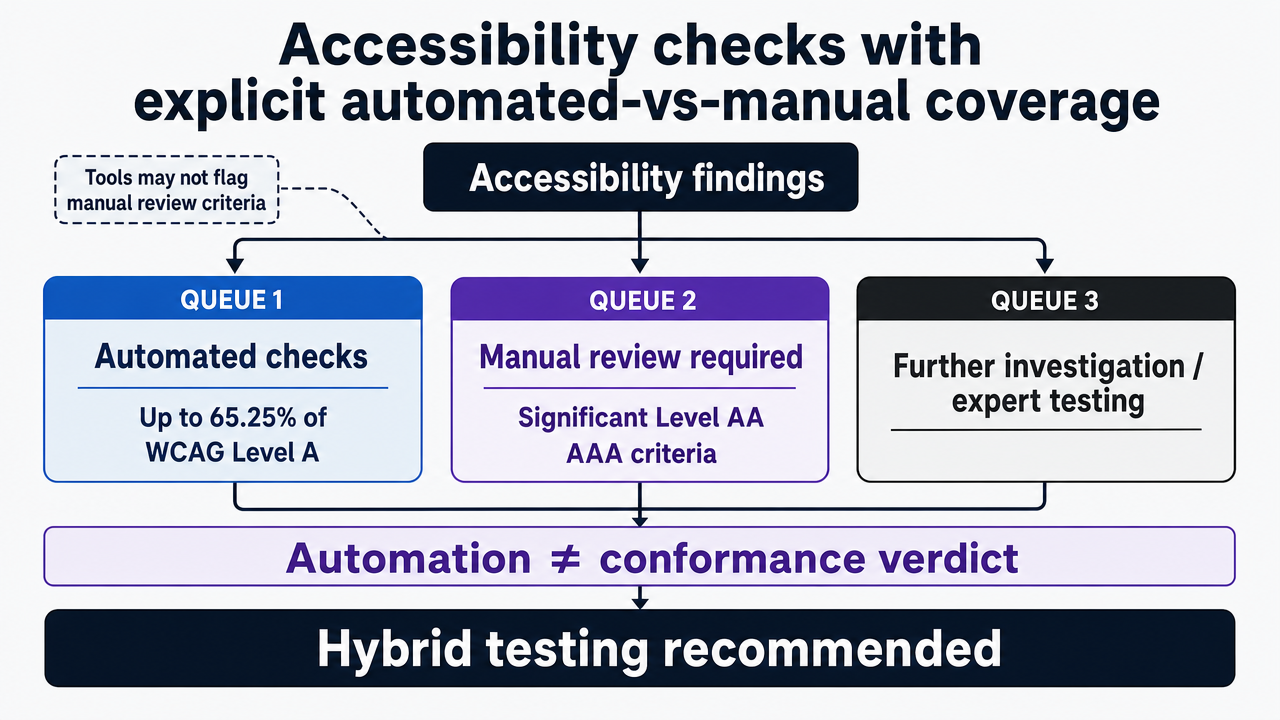 Visualize the three-queue routing model for accessibility findings described in this section, grounded in the cited 65.25% automation ceiling and the Section508.gov hybrid testing recommendation
Outcome measurement wired to Search Console and analytics
An analyzer that cannot connect its recommendations to downstream traffic, device segmentation, and engagement data is a diagnostic tool stuck at the input stage. The outcome layer is where a Head of SEO proves that a template fix moved impressions, that a schema correction captured a SERP feature, and that a readability rewrite changed time on page for mobile users. Digital.gov's metrics guidance identifies page tagging as the standard method for collecting detailed page-level performance data and emphasizes consistent baseline metrics plus mobile segmentation as the foundation for comparing many sites and prioritizing remediation 3. For a portfolio operator, that is the measurement contract: every recommendation the analyzer emits should carry a before-and-after view pulled from Search Console query data, analytics engagement, and device-split performance, scoped to the URL or template the fix touched.
The trap is treating the measurement layer as a vanity dashboard. Impressions and clicks confirm reach; they do not confirm that a page satisfied the query. Automated relevance judgments are the wrong tool for that gap. NIST's February 2025 guidance on information-retrieval evaluation is explicit that LLMs should not be used to create relevance judgments for benchmark evaluation, and that trained human assessors remain required for defensible topicality labels 9. The practical consequence for analyzer design is narrow: the tool can show that a URL now ranks for a cluster of queries, but a specialist still has to judge whether the page actually answers them.
Vendor evaluation criterion: require tagged, template-level before-and-after views from Search Console and analytics on every emitted recommendation, with mobile and desktop reported separately, and no AI-generated relevance verdicts presented as outcome data.
See How Leading Agencies Automate Onpage SEO Analysis at Scale
Request a walkthrough of AI-driven workflows that cut manual onpage audits and accelerate multi-site optimization, with measurable impact on client performance and oversight.
A prioritization layer that routes findings into approval workflows
The six features above produce findings. The seventh decides what happens to them. Without a prioritization layer, a single crawl of a 2,000-URL client site can emit 40,000 individual defects, and the specialist who opens the export spends the week deciding what matters instead of fixing anything. The analyzers that scale client results treat prioritization as the primary deliverable and the raw findings as evidence attached to it.
Section508.gov's testing-methods guidance describes the operating model that actually works at volume: automated scanning identifies obvious errors, manual testing augments it, and manual review is periodically focused on high-priority published content and templates 7. The same split applies to SEO delivery:
- Rendered-DOM crawl findings, broken links, and schema syntax errors should flow directly to developer tickets without a specialist touching them.
- Readability flags, alt-text meaningfulness, and schema-vs-content mismatches should land in a human-review queue sized against the specialist capacity available that week.
- Template-level defects affecting multiple clients should escalate to a strategist for a single remediation decision that propagates on approval.
Three properties separate a real prioritization layer from a sorted list:
- Each finding carries an impact estimate tied to the outcome layer—projected impressions recovered, SERP feature regained, template coverage improved—not a generic severity label.
- Each finding carries an evaluation-method tag so reviewers know whether they are confirming an automated result or making a judgment the machine could not make 6.
- Every action routes through an approval step before execution, because the agency, not the analyzer, carries the consequence when a canonical change or a schema rewrite ships to a client site.
That approval-first routing is what converts a technical scanner into production infrastructure. Vectoron and similar platforms built around specialist-plus-approval workflows treat the analyzer output as a ranked work queue with human sign-off, not a dashboard to be interpreted later. For a Head of SEO running 10 to 100+ client sites, that routing is the difference between an audit that generates 40,000 line items and an audit that generates 60 approved tasks the team can actually ship this sprint.
Vendor evaluation criterion: require the analyzer to output findings grouped into automated-remediation, human-review, and strategist-escalation queues, each item carrying an impact estimate tied to Search Console or analytics data and routed through an explicit approval step. If the deliverable is a CSV export sorted by severity, the prioritization layer does not exist.
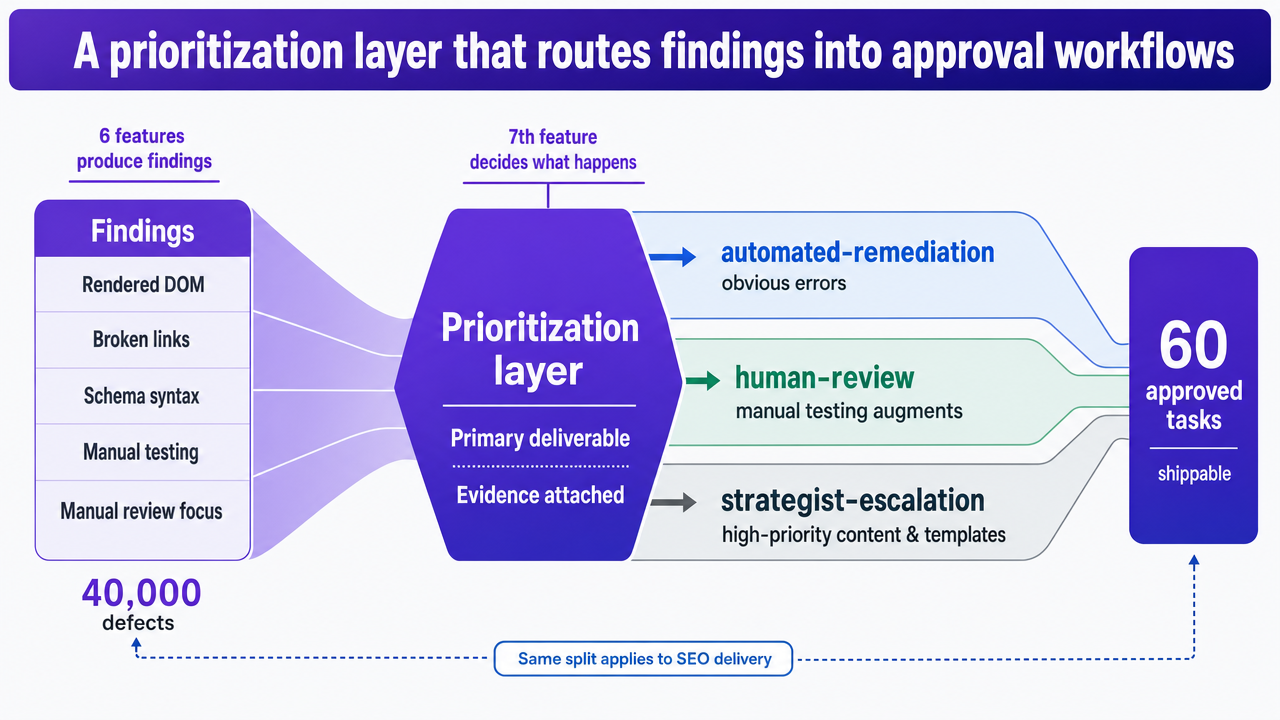 Illustrate the funnel from raw crawl findings to shippable approved tasks described in this section, showing the three-queue routing (automated-remediation, human-review, strategist-escalation) with the article's cited 40,000 defects to 60 approved tasks reduction
If you manage multiple locations: portfolio economics of audited pages
Audience shift: the math above assumes a single site. For agencies and in-house teams running 10 to 100+ client or location-level properties, the operative unit is not the page but the audited page per quarter across the portfolio. That number is what determines whether the analyzer is affordable, whether the specialist bench is sized correctly, and whether QA throughput keeps pace with publishing.
The variables are straightforward: pages per client × clients (or locations) per portfolio × audit frequency = total audited pages per quarter. A 40-location dental group with 180 pages per site audited monthly produces 21,600 audited pages a quarter. The same portfolio audited weekly produces more than 93,000. Specialist hours required to triage that volume depend on which operating model the agency runs.
Under a manual-only model, every finding routes to a human, and throughput caps at whatever the bench can review. Under an automated-only model, the tool emits a verdict the agency cannot defend—NIST documented that numerical conformance scoring was too subjective and context-dependent to be reliable 10, and the same critique applies to a composite SEO score shipped to a client. A hybrid model is the only defensible split. Section508.gov's testing-methods guidance recommends automated scanning for obvious errors augmented by manual testing on high-priority templates and published content 7, and the automated share has a documented ceiling in the adjacent accessibility work: roughly 65.25% of WCAG Level A criteria were automatable in one 2025 tool evaluation, with AA and AAA requiring expert testing 4.
For portfolio planning, that means budgeting specialist hours against the share of findings the tool cannot resolve on its own, and sizing the approval queue against template-level fixes rather than per-URL tickets. Vendor evaluation criterion: require the analyzer to report findings per audited page, per template, and per client, with specialist-hour estimates attached to the human-review queue.
What analyzers still cannot judge
Every feature category above has a ceiling. The honest limit of an on-page analyzer is relevance: whether a page actually answers the query it ranks for. NIST's February 2025 guidance states directly that LLMs should not be used to create relevance judgments for TREC-style information-retrieval evaluation, and that trained human assessors working under monitored procedures remain the defensible source of topicality labels 9. An analyzer can confirm a URL ranks, that its schema parses, that its rendered DOM contains the target entity, and that its readability sits at the configured grade level. It cannot certify that the page satisfies the intent behind the query.
Two adjacent judgments sit in the same unsolved category. Whether alt text is understandable to a screen-reader user is a semantic question automated tools cannot resolve 8. Whether a page's argument, evidence, and recommendations match what a specific client audience needs is a strategic question no scanner should pretend to answer. Heads of SEO should treat these as permanent human-review items, staffed and scheduled, not as gaps a future tool release will close.
Frequently Asked Questions
References
- 1.Search engine optimization and its association with readability and accessibility of diabetic retinopathy websites.
- 2.Accessibility evaluation of university hospital websites in Turkey.
- 3.DAP: Digital Metrics Guidance and Best Practices.
- 4.Automated evaluation of accessibility issues of webpage content: tool and evaluation.
- 5.Evaluating the accessibility of public health websites - PMC.
- 6.Testing for Developers | Section508.gov.
- 7.Overview of Testing Methods for 508 Conformance.
- 8.Does the law matter? An empirical study on the accessibility of websites of public administrations.
- 9.Don't Use LLMs to Make Relevance Judgments.
- 10.Challenges and Benefits of a Methodology for Scoring Web Content Accessibility Guidelines (WCAG) 2.0 Conformance.