
Key Takeaways
- SerpBear retires per-seat rank tracker licenses by self-hosting on agency infrastructure, with documentation citing hundreds of dollars per month in avoided fees per seat 11.
- Serposcope keeps historical rank data on infrastructure the agency controls, protecting an accumulated client asset from churned subscriptions or mid-contract vendor price hikes 9.
- Matomo delivers 100% data ownership from a single deployment that covers the entire client portfolio, turning analytics from a scaling cost into an agency-held asset 7.
- Plausible is cookie-free and self-hostable, removing consent banners and cookie policies from every new site launch and shrinking the compliance surface 6.
- SEO Panel bundles rank checks, backlink monitoring, and audits under GNU GPL v2, giving analysts one shared console instead of six per-seat audit subscriptions 8.
- Google Search Console remains the free primary-source report on crawling, indexation, and query attribution that no self-hosted rank tracker or scraper can reproduce 17.
- PageSpeed Insights supplies authoritative Core Web Vitals thresholds, including the INP metric that replaced First Input Delay on March 12, 2024 and breaks older audit rubrics 19.
- Pipulate treats audits as scriptable code, producing repeatable, diffable crawl and indexing checks across a client portfolio without a mid-tier crawler seat per analyst 1.
- OpenSEO validates titles, descriptions, canonicals, and hreflang across thousands of URLs, absorbing the checklist-style metadata QA that agencies typically bill hourly 1.
- Grafana visualizes rank, analytics, and Core Web Vitals data from the open source backbone on one screen, replacing the per-seat dashboards commercial suites charge for 5.
- Vectoron sits above the open source stack as an AI execution layer, turning signals into approval-gated recommendations and closing the strategy-to-publish gap commercial suites never automated 14.
Where SaaS licenses quietly eat agency gross margin
Every new client an agency signs adds a familiar line to the cost side of the ledger: another rank tracker seat, another analytics profile, another audit tool user. These fees scale with headcount and client count, and they compound faster than retainers can be repriced. The result is a slow compression of gross margin that rarely shows up in a single invoice but becomes visible when a delivery team of ten is quietly carrying six recurring subscriptions per person.
Open source SEO tools address one specific part of that math. They are not a cheaper Semrush clone, and treating them that way leads to disappointment. The honest framing is narrower: self-hosted rank tracking, privacy-first analytics, and technical audit tooling can retire specific commercial line items while leaving keyword databases and backlink indexes untouched 14. The trade is engineering time for licensing spend, and the value depends on how many client accounts absorb the fixed cost of hosting and maintenance 5.
The 11 tools that follow are ranked by that trade, not by feature parity.
What counts as open source for procurement purposes
Before an agency swaps a paid tool for a free one, procurement should confirm the replacement actually meets the Open Source Initiative's definition. Federal guidance defines open source software as code that is freely licensed to the public to use, copy, modify, and distribute, with source availability and non-discrimination in licensing 16. A tool that is merely free to download, or that gates its source behind a commercial tier, does not qualify and cannot be redeployed inside client environments without risk.
Two license families cover most of the tools in this list: GNU GPL v2, which governs SEO Panel 8, and permissive licenses attached to projects like Plausible 6. Both allow self-hosting on agency infrastructure. Verify the license text before deployment, not the marketing page.
How the 11 tools are ranked: margin impact, not popularity
The ordering below follows one rule: how much recurring SaaS spend the tool can retire per client, minus the engineering time required to run it. Rank tracking sits at the top because per-seat rank tracker licenses scale linearly with clients and analysts, and self-hosted alternatives cite "hundreds of dollars per month" in avoided fees per seat 11. Analytics ownership follows, since a single Matomo or Plausible deployment can cover an entire client portfolio 6, 7. Technical audit tooling ranks next. Supporting utilities and Google's own free diagnostics close the list 12.
Stack replacement math: a sourcing worksheet
A sourcing decision needs a worksheet, not a savings claim. The table below maps three commercial SaaS categories that most agencies pay for monthly to their open source counterparts, along with the offsetting cost line the agency absorbs when it self-hosts. Dollar values for commercial spend are left as variables because they depend on seat counts, client counts, and contract tier.
| Commercial SaaS category | Open source counterpart | Documented cost avoidance | Offsetting cost line |
|---|---|---|---|
| Rank tracking (per-seat licenses) | SerpBear or Serposcope, self-hosted 9, 11 | "Hundreds of dollars per month" avoided per seat, per SerpBear documentation 11 | Hosting fees plus engineering hours to maintain the scraper |
| Web analytics (per-hit or per-property fees) | Matomo or Plausible, self-hosted 6, 7 | Freemium tier fees retired across the client portfolio | Database hosting, upgrades, privacy configuration |
| Basic technical audits (crawl and metadata checks) | SEO Panel under GNU GPL v2 8 | Retires low-tier audit subscriptions per analyst | Server capacity and periodic tuning |
Two variables drive whether the trade works. The first is client count: a hosting bill for a self-hosted rank tracker is roughly flat, while per-seat SaaS scales linearly with analysts and clients 5. The second is engineering availability. Open source tools require setup and maintenance, and agencies without in-house technical staff will pay for that time in one form or another 2. Fill in the seat counts and hourly rates specific to the agency before signing off on any swap.
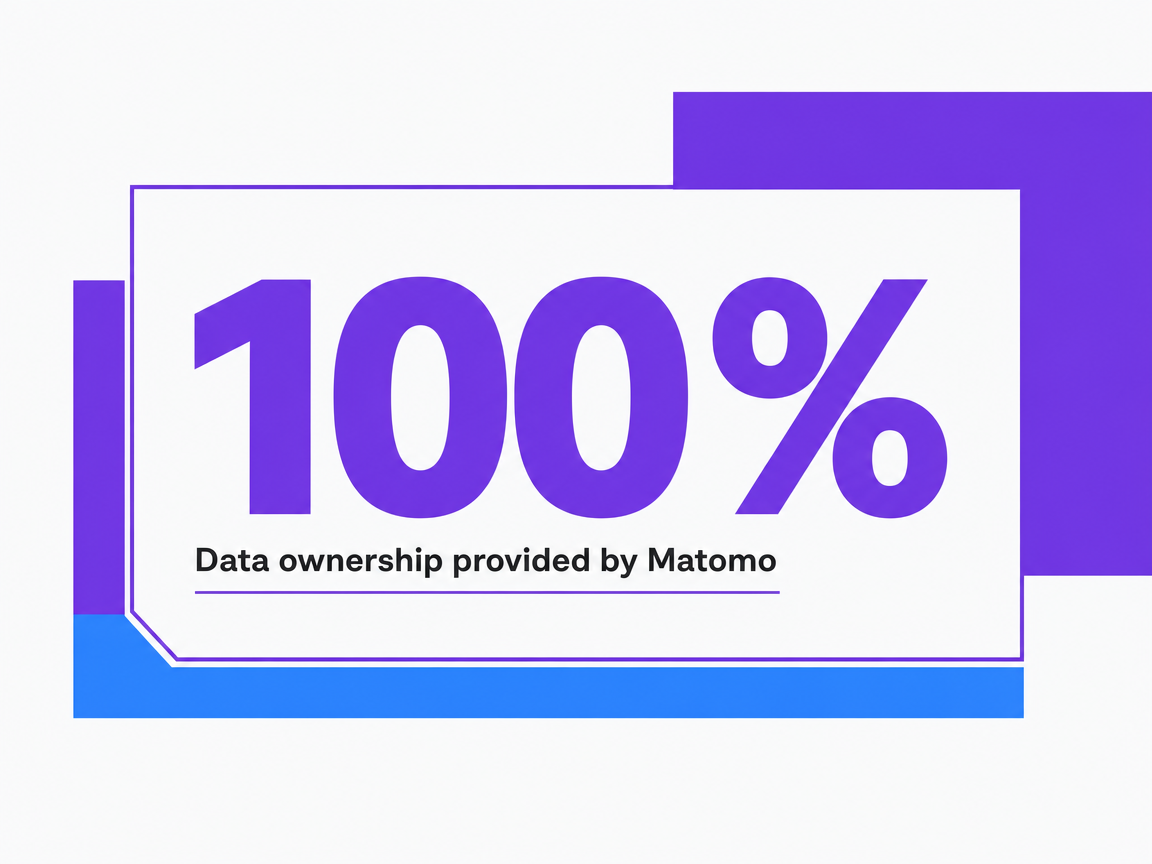 Data ownership provided by Matomo
Data ownership provided by Matomo
SerpBear: self-hosted rank tracking that retires per-seat licenses
SerpBear is a free, open source rank tracker that agencies deploy on their own infrastructure. Its documentation cites "hundreds of dollars per month" in avoided subscription fees per seat, which is the strongest concrete cost-avoidance signal in the open source SEO ecosystem 11. That figure matters because per-seat rank tracker licenses are one of the few line items that scale directly with both analyst count and client count, and they compound faster than most retainer repricing cycles.
The tool tracks keyword positions across Google, records historical rank data, and exposes an API for pulling results into reporting pipelines. Because the code is publicly available with no hidden tracking, agencies can audit scraper behavior before pointing it at client domains 11. That transparency is what makes the tool usable inside client environments where data handling has to be documented.
The trade-off is operational. Rank scraping requires proxy rotation, cadence tuning, and periodic patches as SERP layouts change. Agencies without a dedicated engineer will either absorb that time internally or contract it out, and both options need to be priced into the swap before a per-seat license is cancelled.
Serposcope: rank data kept on infrastructure the agency controls
Serposcope is an open source search engine rank checker whose source code is publicly hosted, which lets agencies verify scraper behavior before pointing it at client domains 9. It ships as a self-hostable application, and hosting providers now offer one-click deployments that keep SEO data on infrastructure the agency manages rather than a vendor's multi-tenant database 10.
The practical draw is data control. Historical rank data is one of the few assets an agency accumulates over the life of a client engagement, and losing it to a churned SaaS subscription or a mid-contract price hike is a recurring failure mode. A self-hosted Serposcope instance keeps that history inside the agency's environment, where it can be queried, exported, or piped into custom reporting without a vendor API rate limit in the way 9.
Serposcope suits agencies that already run Serposcope-adjacent infrastructure or have engineering capacity to maintain a JVM-based service. Teams without that capacity should compare it against SerpBear before committing, since the operational shape of the two tools differs even when the output looks similar.
Test AI-powered SEO workflows on real campaigns
Validate open source alternatives by running live SEO projects before committing to a new production model.
Matomo: analytics ownership as a margin lever
Matomo is an open source web analytics platform that gives operators "100% data control and full ownership" of the traffic data it collects, which is the language its comparison peers use to distinguish it from freemium tools that retain rights over collected data 7. For an agency, that ownership line is where analytics stops being a recurring cost and starts becoming an asset the delivery team actually holds.
| Analytics posture | Data ownership | Vendor rights over collected data |
|---|---|---|
| Freemium SaaS analytics | Shared with vendor under terms of service | Retained for product, sampling, and aggregate use |
| Self-hosted Matomo | 100% agency-controlled 7 | None; data stays on agency infrastructure |
A single Matomo deployment can serve an entire client portfolio, so the hosting bill stays close to flat while the SaaS alternative scales with hits, properties, or seats 5. The engineering trade is a database to maintain and an upgrade cadence to keep, both of which are manageable if there is technical capacity on the team 2. Where Matomo pays for itself is in client conversations about data residency and retention, since the agency can answer those questions in first person rather than pointing at a vendor's policy page.
Plausible: cookie-free analytics that reduces client compliance load
Plausible is an open source, privacy-first web analytics tool positioned as a cookie-free Google Analytics alternative 6. The cookie-free part is the operational hook: without cookies, there is no consent banner to negotiate, no cookie policy to draft, and no downstream request from a client's legal team asking how tracking scripts map to their privacy notice. That is time an agency stops spending on every new site launch.
The script is lightweight, which matters for the same pages an audit tool is trying to keep under Core Web Vitals thresholds. Plausible is self-hostable, so traffic data stays on infrastructure the agency controls rather than a vendor's tenancy 6. For clients who need basic acquisition and content reporting rather than deep event modeling, one Plausible instance covers the portfolio without adding a per-site fee.
Where Plausible falls short is depth. Session-level funnels and custom event schemas belong in Matomo or a paid product. Pair Plausible with Search Console for query data and keep the compliance surface small.
SEO Panel: a GNU GPL v2 control panel for centralized SEO ops
SEO Panel is licensed under the GNU General Public License v2 and describes itself as "a complete open source seo control panel" for managing website optimization across multiple sites 8. That licensing detail matters: GPL v2 lets an agency deploy the software inside client environments, modify it, and redistribute the changes without renegotiating terms per account 16.
The toolkit approach is what makes it useful as a hub rather than a point solution. A single instance bundles rank checking, backlink monitoring, site auditor modules, keyword position reports, and a plugin architecture that lets teams extend the panel with custom checks 1, 8. Junior analysts get one login instead of six, and account leads pull scheduled reports out of one database rather than reconciling exports from separate SaaS dashboards.
SEO Panel replaces the low- and mid-tier audit subscriptions most agencies renew per analyst. It does not replace deep keyword databases or backlink indexes. Budget a server, a PHP/MySQL admin, and a quarterly tuning window; the payoff is a centralized console the delivery team actually shares.
Google Search Console: the free primary source open source can't replicate
No self-hosted rank tracker sees what Google Search Console sees. Search Console is Google's own report on how the crawler discovered a site, which URLs entered the index, which queries impressed and clicked, and where structured data or Core Web Vitals fields failed validation. That is primary-source data from the serving pipeline itself, not a scrape of the SERP 17. An open source stack cannot reproduce it, and treating third-party rank data as a substitute for indexation truth is how audit conclusions go wrong.
Search Console sits alongside open source tools as a free complement, not a competitor 12. Agencies should wire its query and coverage exports into the same reporting layer that consumes Serposcope or SerpBear output. The rank tracker answers where a URL sits for a keyword the analyst chose. Search Console answers which queries Google actually attributed to the URL, and whether the URL is eligible to rank at all.
PageSpeed Insights against Core Web Vitals thresholds
PageSpeed Insights is free, and it reports the same field data Google uses to judge page experience. For an audit workflow built on open source primitives, it fills the one gap those tools cannot fill on their own: authoritative thresholds for what "fast enough" means in Google's own terms 12.
The current targets are specific. A page is considered good when Largest Contentful Paint stays under 2.5 seconds, Interaction to Next Paint stays under 200 milliseconds, and Cumulative Layout Shift stays under 0.1 18. Anything worse than the good band puts a URL into "needs improvement" or "poor," and those states are what audit reporting should flag first.
| Metric | Good | Needs improvement | Poor |
|---|---|---|---|
| LCP | < 2.5s | 2.5s – 4.0s | > 4.0s |
| INP | < 200ms | 200ms – 500ms | > 500ms |
| CLS | < 0.1 | 0.1 – 0.25 | > 0.25 |
Core Web Vitals thresholds per Google 18.
One detail catches older audit configurations off guard: INP replaced First Input Delay as a Core Web Vitals metric on March 12, 2024 19. Any checklist, scoring template, or client dashboard still measuring FID is reporting on a metric Google no longer uses. Audit tooling and internal rubrics should be updated to pull INP from the CrUX field data PageSpeed Insights exposes, then wired into the same reporting layer that consumes rank and index data. That gives account leads one screen where thresholds, trends, and remediation priorities line up against Google's current definitions rather than last year's.
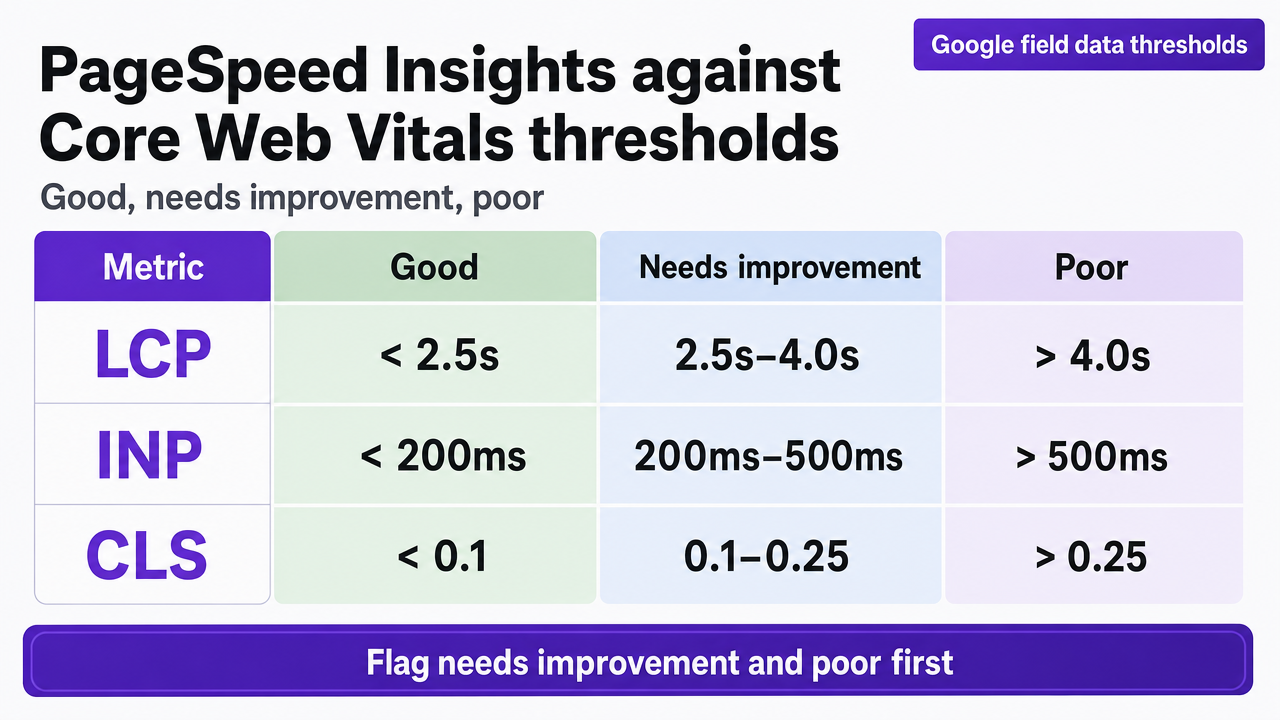 Reinforce the exact Core Web Vitals thresholds (LCP < 2.5s, INP < 200ms, CLS < 0.1) cited in the section prose, showing the good/needs improvement/poor bands per Google
Pipulate: scriptable audits for crawlability and indexing signals
Pipulate is a scriptable, open source SEO toolkit that treats audits as code rather than as a fixed dashboard 1. That framing matters when the audit target is Google's own pipeline. Crawling, indexing, and serving each produce different failure modes, and "the vast majority of pages listed in our results aren't manually submitted for inclusion"—they are discovered by the crawler, which means a URL either becomes reachable or it does not exist to rank 17. A scripted audit lets analysts encode the exact checks that map to that pipeline: robots directives, canonical resolution, internal link depth, status code drift, and index coverage against expected templates.
The practical draw is repeatability. Once an analyst writes an audit script for a site architecture, it runs the same way across the client portfolio and produces diffable output between crawls. That collapses the manual click-through that eats delivery hours, and it keeps audit conclusions defensible when a client asks why a URL is missing from Search Console coverage. Pipulate replaces the mid-tier crawler subscription per analyst; it does not replace the deep enterprise crawler for sites running into the millions of URLs.
Streamline Multi-Client SEO Delivery With Data-Driven Automation
Connect with our team to see how leading agencies use AI-powered workflows to reduce production overhead, synchronize approvals, and maintain control across all SEO projects—without sacrificing quality or client trust.
OpenSEO: metadata validation at scale
Titles, meta descriptions, canonical tags, and structured data all live in the HTML head, invisible to users but weighted by every crawler that touches the page 20. OpenSEO is an open source auditor built to validate that head at portfolio scale: parsing templates for missing or truncated titles, duplicate descriptions, broken canonical chains, and hreflang mismatches across thousands of URLs in one pass 1.
The margin case is straightforward. Metadata QA is the work most agencies bill hourly but structure like a checklist, which means it is the first task an automated audit should absorb. OpenSEO returns diffable reports that account leads can hand to writers or developers without opening a paid crawler seat per analyst.
It does not replace enterprise crawlers on eight-figure URL counts, and it does not rewrite the metadata it flags. Pair it with a template governance process so the same errors stop reappearing in the next crawl.
Grafana with a scraper backend: custom dashboards over the SEO data backbone
Grafana is the visualization layer that ties an open source SEO stack together. Once rank data lives in a SerpBear or Serposcope database, Matomo holds session data, and PageSpeed Insights output lands in a scheduled export, none of it is useful to an account lead until it renders on one screen. Grafana connects to those backends and produces the client-facing dashboards that commercial suites charge per seat to display 5.
The pattern is well documented in the monitoring world. Open source stacks pair a scraper or collector with Grafana to build custom views that flex with the underlying data, trading commercial convenience for flexibility and control 5. Applied to SEO, that means one panel for rank trends by keyword cluster, one for indexation coverage pulled from Search Console exports, and one for Core Web Vitals field data against the current thresholds. Each client gets a scoped dashboard from the same source of truth.
The offsetting cost is real: someone writes the queries, maintains the exporters, and updates panels when a data schema changes 2. Agencies without that engineering time should stop at SEO Panel's built-in reporting. Those that have it get a reporting layer no per-seat contract can match.
Vectoron: the AI execution layer commercial suites never built
Every tool above audits, tracks, or measures. None of them decide what to do next, brief the writer, publish the page, or check whether the fix moved the metric. That work has always sat with the delivery team, and it is the layer where agency margin actually erodes—hours spent turning rank data into recommendations, recommendations into briefs, briefs into published pages, and published pages back into measured outcomes. Commercial SEO suites never automated it; they sold the dashboards on either side of it 14.
Vectoron sits in that gap as an AI execution platform. Specialist strategists read the same signals an open source stack produces—rank movement, indexation coverage, Core Web Vitals field data, session behavior—and surface ranked recommendations through an approval workflow, then execute the work that gets signed off. The design point is approval-first: nothing ships without a human decision, and every recommendation carries the reasoning behind it.
Placed on top of a Serposcope, Matomo, and SEO Panel backbone, it retires the strategy-to-publish hours that per-seat licenses never touched. That is where the margin math closes.
What open source will not replace, and what to keep paying for
The honest scope of an open source SEO stack is auditing, analytics, and ownership—not a full clone of a commercial suite 14. Three categories stay on the paid side of the ledger, and pretending otherwise leads to reporting gaps that clients notice before the agency does.
Deep backlink indexes are the first. Crawling and storing the link graph at web scale is expensive infrastructure work, and no self-hosted tool reproduces the coverage or freshness of a commercial link database. Large-scale keyword databases sit in the same category: query volume estimates, difficulty scoring, and SERP feature history depend on continuous data collection that a single agency deployment cannot match. Enterprise crawlers for sites with millions of URLs are the third—open source auditors handle mid-sized architectures, but the ingestion, diff, and rendering budget for very large sites still favors paid tools 15.
Keep those subscriptions. Cancel the per-seat rank trackers, freemium analytics tiers, and basic audit licenses that the stack above already covers.
If you manage multiple client portfolios: deployment patterns that scale
The economics of an open source SEO stack change when the agency runs more than one delivery pod or holds a mix of white-label and direct-client work. A single Serposcope instance is fine for one team; ten analysts hitting the same scraper queue is a different problem.
Three deployment patterns hold up in practice. The first is a shared backbone with per-client scoping: one Matomo database, one Serposcope or SerpBear cluster, and one SEO Panel install, with row-level or site-level access controls partitioning what each account team sees 1, 8. The second is per-pod deployment, where each delivery team runs its own instance of the stack. That trades hosting cost for isolation and is common where compliance postures differ between clients. The third is a tiered approach: shared analytics and audit tooling, isolated rank scrapers to avoid proxy contention as SERP scraping cadence scales 5.
Cost isolation dictates the choice. As instances multiply, so does the engineering time to patch, monitor, and back them up 2. Pick the pattern that keeps that overhead flat as new clients onboard.
Frequently Asked Questions
References
- 1.The 6 Best Free and Open Source SEO Software Solutions.
- 2.Top Open Source SEO Software to Enhance Your Website's Performance.
- 3.Which Open-Source Tools Are Viable for Data Analysis?.
- 4.A Guide to Open Source Analytics Tools for Data-Driven Decisions.
- 5.Comparison of Open Source API Analytics and Monitoring Tools.
- 6.Plausible Analytics.
- 7.11 Best Web Analytics Tools for Data Driven Success.
- 8.SEO Panel - A control panel for SEO.
- 9.serphacker/serposcope: Rank tracker for SEO.
- 10.Serposcope Hosting - Install and deploy with one click on Appbox.
- 11.SerpBear; The free open-source Rank Tracker.
- 12.The 10 Best Free and Open-Source SEO Software Solutions.
- 13.A Framework for Bridging the Gap Between Open Source Search Engines and Information Retrieval Research.
- 14.The Open Source SEO Stack That's Honest About What It Replaces.
- 15.10 Open Source SEO Tools for 2026.
- 16.Open Source Software - CMS.
- 17.In-Depth Guide to How Google Search Works | Documentation.
- 18.Understanding Core Web Vitals and Google search results.
- 19.Introducing INP to Core Web Vitals | Google Search Central Blog.
- 20.What's in the head? Web page metadata - Learn web development.
- 21.Web Analytics Playbook | Digital.gov.
- 22.Website analytics, SEO, and performance optimization.