
Key Takeaways
- Publishing volume no longer predicts pipeline because modern buyers research independently through peers, communities, and AI tools, with 73% of B2B purchases involving three or more departments 3.
- A pipeline-predictive content system runs on four layers: buyer-group coverage for every committee role, semantic depth for human and AI discovery, governance and provenance for defensibility, and progression metrics that track account movement.
- Assign AI to bounded tasks like role-specific variants and draft research where capacity is the bottleneck, but keep humans accountable for distinctive claims, evidence, and sign-off where credibility is the bottleneck.
- Begin with a 90-day sequence: audit the library against committee roles, rewrite 15 high-influence assets for semantic depth with a provenance log, then replace MQL reporting with account progression data.
Why Publishing Volume Stopped Predicting Pipeline
Most content calendars still measure the wrong thing. Published assets, keyword positions, and session counts move independently of pipeline, because the buyer no longer behaves the way those metrics assume. Forrester's 2025 buyer research found that 64% of business buyers at manager level or above are Millennials or Gen Z, a group that researches independently and forms opinions before any seller conversation 1. By the time a form fill arrives, most of the decision work has already happened somewhere the content team cannot see.
That shift breaks the old equation. More posts do not create more opportunities when buyers consult peers, communities, and AI tools before engaging a vendor. Forrester's 2025 analysis reports that 73% of B2B purchases involve three or more departments, with an average of 13 internal stakeholders and nine external influencers participating in a single decision 3. An article written for a single persona rarely survives that review.
Production capacity has also stopped being the constraint. Stanford HAI reports regular generative-AI use in at least one business function jumped from 33% in 2023 to 71% in 2024 5. Volume is cheap. Predictability is not.
The rest of this article lays out a four-layer framework content managers can present internally: buyer-group coverage, semantic depth for human and AI-assisted discovery, governance and provenance, and progression metrics that trace qualified engagement into pipeline. Each layer answers a specific question volume alone cannot: who the content serves, where it gets found, whether its claims hold up, and what happens after someone reads it.
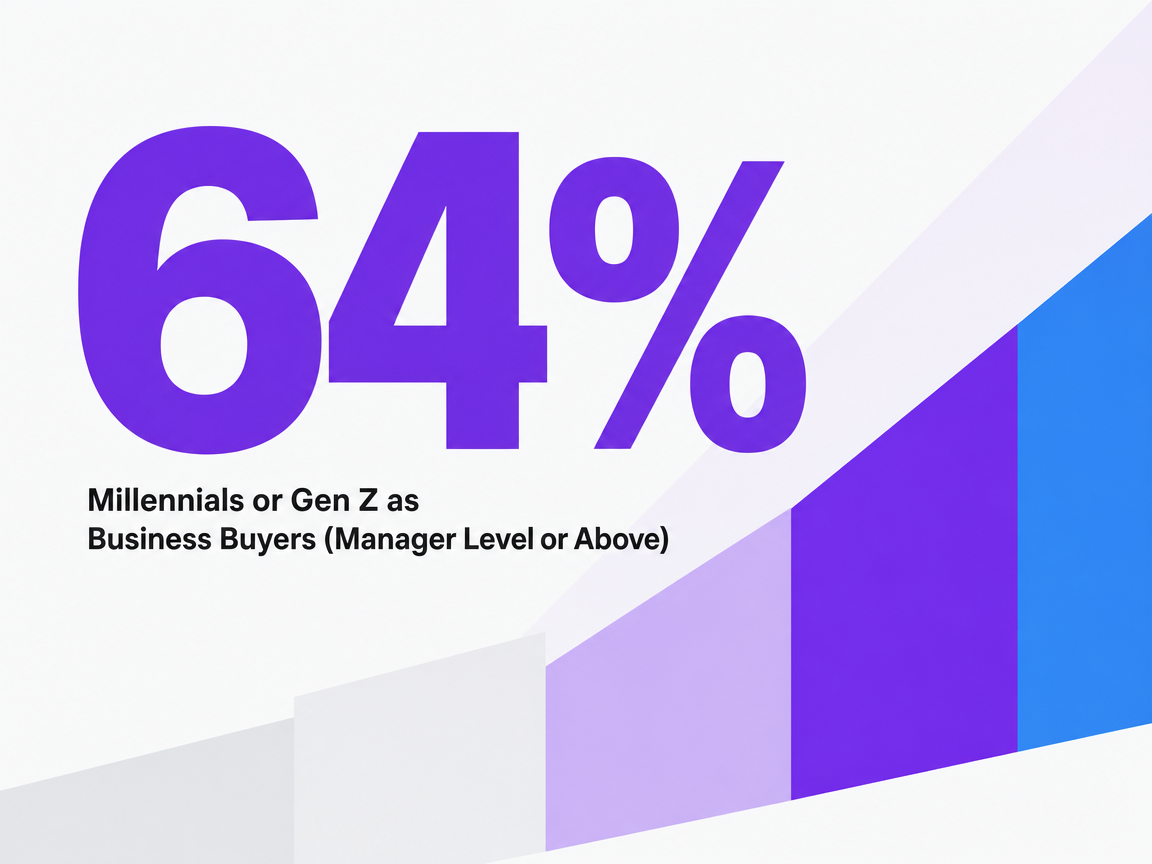 Millennials or Gen Z as Business Buyers (Manager Level or Above)
Millennials or Gen Z as Business Buyers (Manager Level or Above)
The Four Layers of a Pipeline-Predictive Content System
Layer One: Buyer-Group Coverage That Earns Shortlist Position
A content library that speaks to one persona cannot survive a modern purchase decision. Forrester's 2025 analysis of B2B buying networks reports that 73% of purchases involve three or more departments, with an average of 13 people inside the buyer organization and nine outside participating in the decision 3. Each of those stakeholders brings a different question, and most of the forwarding, screenshotting, and Slack-pasting happens without the content team's visibility.
Buyer-group coverage means auditing the content library against the actual composition of a purchase committee rather than against a keyword map. A behavioral health group evaluating a new intake platform will route the same vendor conversation through clinical directors, compliance, IT, billing, and executive sponsors. If the library has one explainer article and three product pages, four of those five readers get nothing useful. The seller then carries the entire burden of translation, which happens too late to influence shortlist formation.
Practical coverage looks like a short inventory of asset types tied to committee roles:
- a technical evaluator document for IT,
- a workflow walkthrough for operations,
- a validation summary for clinical or legal reviewers,
- an implementation and change-management piece for the executive sponsor,
- and a cost-and-value page the economic buyer can forward without edits.
The test is whether each asset can stand alone when pasted into an internal thread. If a reader has to click back to a hub to understand the point, the asset is not forwardable.
External influencers deserve the same treatment. Forrester's data on nine outside participants per decision includes consultants, peer advisors, implementation partners, and industry community members 3. Content aimed at these readers is rarely gated and rarely branded with lead-capture scaffolding. It is written to be cited, quoted, and referenced inside private communities the content team will never see.
Coverage is measured by role fit, not by publishing cadence. A library of 40 role-specific, forwardable assets outperforms a library of 400 generic posts because each piece lands with the person who shapes the shortlist. The internal narrative shifts from "how many articles did we publish this quarter" to "which committee roles can we now serve end-to-end, and which ones still rely on the sales team to explain." That reframing is what moves a content function from a traffic engine to a shortlist-formation function.
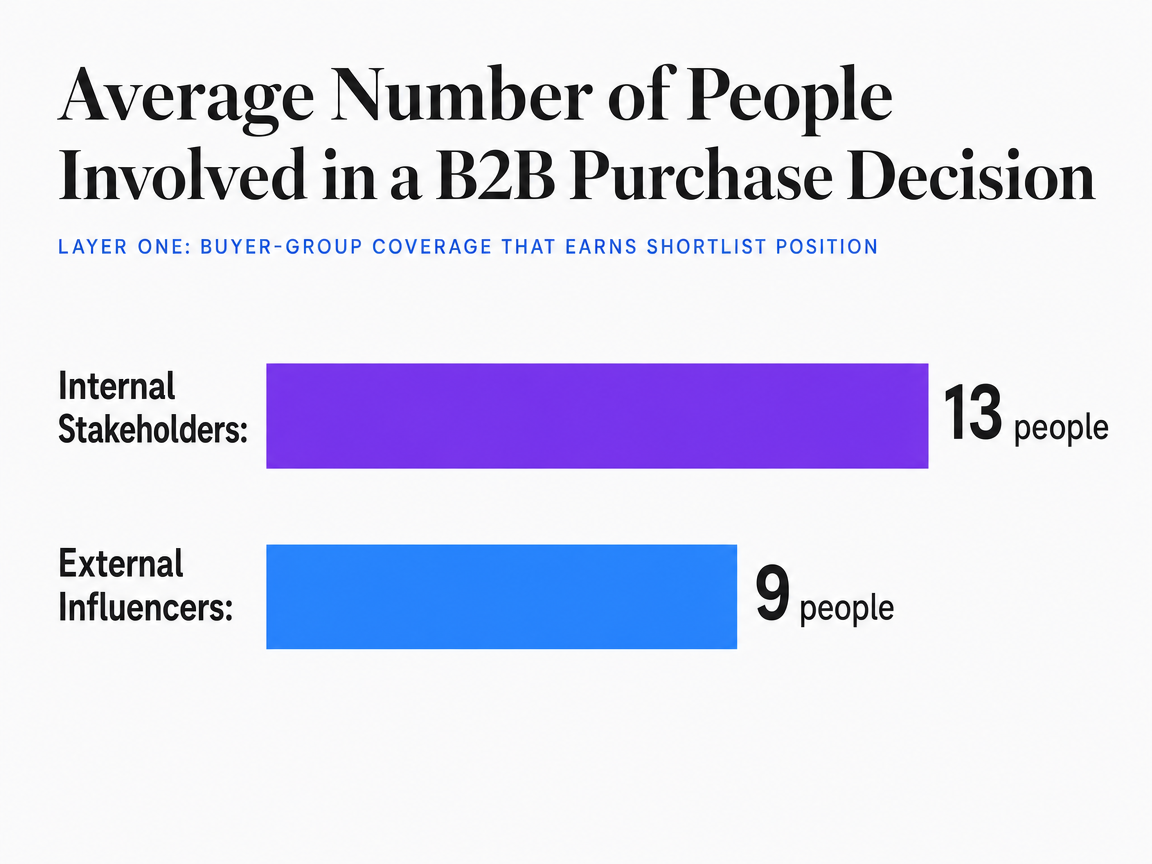 Average Number of People Involved in a B2B Purchase Decision
Details the complexity of B2B buying committees, showing the need for content that serves multiple roles.
Layer Two: Semantic Depth for Human Readers and AI-Assisted Discovery
Keyword targeting still matters, but it no longer defines where optimization ends. Forrester's 2025 preference research found that 68% of B2B buyers already had a front-runner vendor at the beginning of the purchase process, and that front-runner won the deal 80% of the time 2. The study measured active B2B buyers at the start of a tracked purchase journey, so the finding describes which vendor enters the race ahead, not whether any single content format caused that preference. The implication for content strategy is still direct: the work that creates preference happens before the buyer ever types a bottom-funnel query.
Preference forms where buyers do their quiet research, and that increasingly includes AI-assisted tools. Forrester reports that 95% of B2B buyers plan to use generative AI in at least one area of a future purchase, and more than half say it helped them consider more or different vendors while saving time 4. The same body of work argues that AI-assisted discovery rewards semantic depth, clear entities, and evidence rather than keyword density. A page that reads like a thin SEO brief performs poorly as a source for an AI summary because it offers no distinctive claim worth citing.
Semantic depth has concrete components. The page should:
- define the entity it describes,
- state the mechanism by which it works,
- enumerate the specific inputs and outputs,
- name the conditions under which it fails,
- and attach evidence to any numeric claim.
Reviewers can test depth by asking whether an informed outsider could reconstruct the argument from the page alone. If the page relies on the reader already agreeing with the premise, it will not survive either a careful human skim or an AI synthesis.
Depth also means covering the questions buyers actually research before engagement: implementation timelines, pricing structure, integration requirements, change-management load, failure modes, and total cost over a realistic horizon. Forrester's work on self-directed buyers shows that pricing, implementation, and value-realization information published early influences shortlist formation 1. Hiding those answers behind a sales conversation signals to both the reader and the AI system that the page is a landing page, not a reference.
Optimization at this layer is a durability test, not a checklist. The question is whether a given page will still be cited, forwarded, and summarized accurately 18 months from now when the buying committee returns to it. Pages that pass that test tend to be the ones that put a brand into the front-runner position before any form is filled.
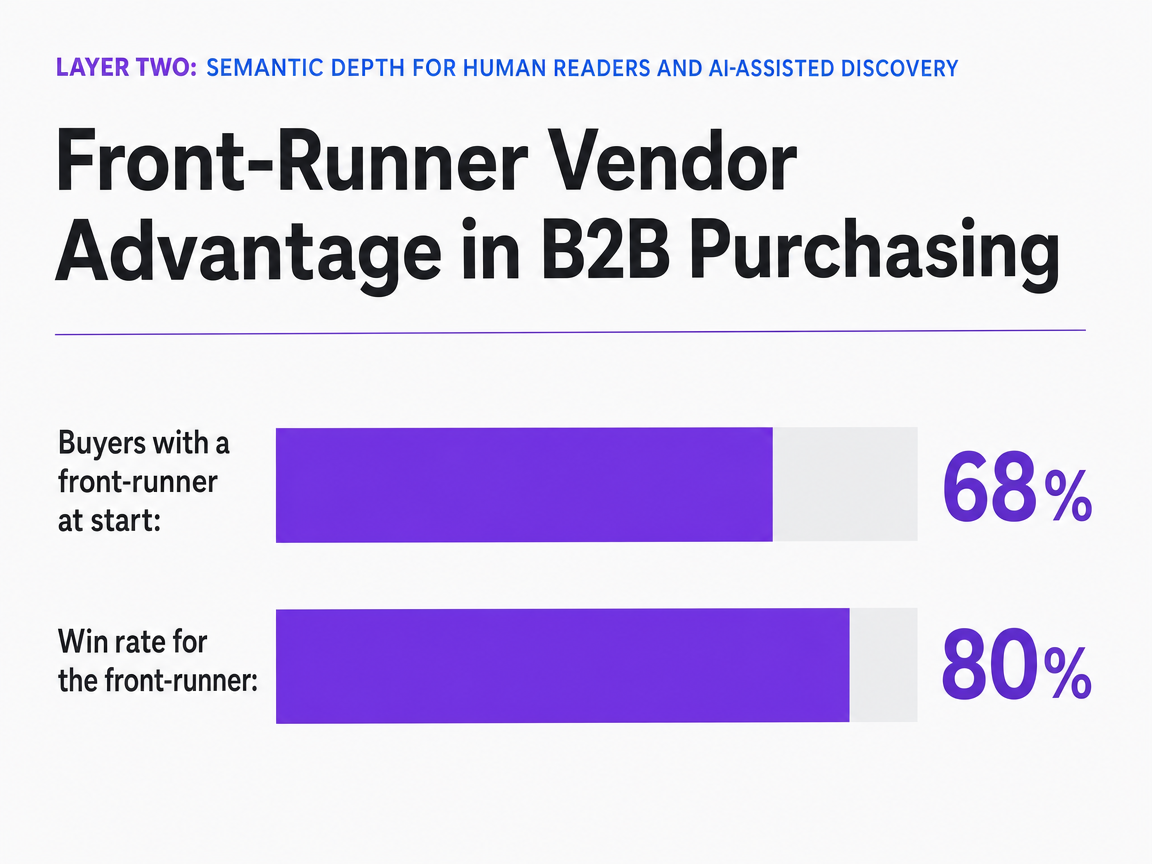 Front-Runner Vendor Advantage in B2B Purchasing
Illustrates the high importance of being the preferred vendor early in the buying process.
Layer Three: Governance and Provenance That Keep Claims Defensible
Governance is the layer most content calendars skip until something goes wrong. For teams serving healthcare, behavioral health, legal, dental, senior living, or home services, the cost of a defensibility failure is not a traffic dip. It is a regulator letter, a platform suspension, or a clinical review that pulls an entire campaign offline. The governance layer exists to prevent those outcomes while still allowing the content function to move at pace.
NIST's Generative AI Profile, published in July 2024, offers a usable baseline. The profile identifies 13 risks and more than 400 actions organizations can consider when managing generative-AI systems across validity and reliability, safety, security, accountability, transparency, explainability, privacy, and fairness 9. Content teams do not need to adopt all 400 actions. They do need to map which risks apply to research, drafting, personalization, QA, and distribution, and assign a named owner to each. The exercise usually surfaces three or four unassigned risk areas that have been sitting with no reviewer.
Provenance is the companion discipline. NIST's separate report on digital-content transparency explains that provenance data can help establish the authenticity, integrity, and credibility of digital content by recording information about its origins and history 6. For content operations, that translates to a lightweight record of how each asset was produced: which drafting tool was used, which source documents informed the claims, who reviewed the draft, and which images or quotes came from third-party sources. The record does not have to be public, but it has to be retrievable when a claim is challenged.
Substantiation and disclosure sit alongside provenance. The FTC states that advertisers must have a reasonable basis for product claims before dissemination and that health-related claims generally require competent and reliable scientific evidence 10. The agency's native advertising guidance adds that disclosures must be clear and prominent when needed to prevent deception, placed close to the content and readable on the device where it appears 7. These are not two separate workflows. They are a single pre-publication review: can every objective claim be sourced, and is any sponsored or AI-assisted element labeled where the reader will see it.
Healthcare operators carry an additional layer. HHS defines marketing under HIPAA as a communication about a product or service that encourages recipients to purchase or use it, and generally requires individual authorization for marketing uses or disclosures of protected health information, subject to specified exceptions 8. The same guidance applies when CRM data, call tracking, and advertising platforms are stitched together for content targeting 11. Authorization status should be recorded in the same provenance log as drafting and review, so a reader-level audit can reconstruct whether consent covered the use.
Governance does not slow a functional content system. It replaces the ad-hoc email chains, screenshot approvals, and verbal sign-offs that break down the moment the team adds a second channel or a third location. A documented review path, a provenance record, and a substantiation file turn defensibility from a scramble into a retrieval.
Layer Four: Progression Metrics That Replace Form-Fill Theater
Form fills measure a willingness to trade an email address for a document. They do not measure whether the buyer is moving toward a purchase decision, and in self-directed buying journeys most progression happens without any form interaction at all. Forrester's research on younger B2B buyers notes that 64% of business buyers at manager level or above are Millennials or Gen Z, a group that researches independently and forms opinions before engaging sellers 1. A measurement model built on form fills systematically underweights the work that actually produces pipeline.
Progression metrics track movement rather than capture. The useful signals cluster into three groups:
- Depth-of-engagement signals: scroll completion on long-form evidence pages, repeat visits from the same account, time on implementation and pricing pages, and multi-asset sessions that touch role-specific content.
- Buyer-group signals: the number of distinct roles from one account that reach the library in a quarter, the pattern of internal forwards visible in email-to-session referrers, and the growth of named-account sessions on committee-oriented assets.
- Outcome signals: the proportion of closed-won deals whose primary contacts touched three or more library assets before the first sales conversation, and the shift in the percentage of inbound conversations that begin with a specific product question rather than a generic discovery request.
None of these metrics require new infrastructure. They require pulling existing analytics, CRM, and call-tracking data into one view and reporting on the account rather than the session. The reporting change is the point. A library serving a buying committee cannot be judged by individual lead counts, because any single lead represents one voice in a 13-person internal discussion 3.
The internal narrative becomes easier to defend. Instead of reporting published posts and MQLs, the content function reports which accounts progressed, which committee roles engaged, and which assets appeared in closed-won deal histories. That is the measurement model a pipeline-predictive system runs on, and it is the one that justifies continued investment when the next budget cycle begins.
Test Predictable Content Impact in Real-Time
Experience measurable pipeline growth by publishing and tracking live content performance during your trial.
Where AI Fits Inside the System (and Where It Does Not)
AI belongs inside the content system as a capacity multiplier, not as a replacement for the four layers that make the system predictable. Stanford HAI's 2025 AI Index reports that organizational AI use rose from 55% in 2023 to 78% in 2024, and regular generative-AI use in at least one business function climbed from 33% to 71% over the same period 5. Marketing and sales were among the functions most commonly reporting revenue gains, though the report notes those gains come from survey self-reports rather than independently measured causal effects.
That gap matters. A production surge of this scale answers the question of how much content a team can draft, not whether any of it earns shortlist position or progresses an account. Content managers who read the adoption curve as proof of outcome risk doubling output while the pipeline signal flatlines. The useful read is narrower: AI collapses the cost of first drafts, outline research, variant generation, role-specific rewrites, and summarization of long source material. Each of those tasks sits upstream of the decisions that still require human judgment.
AI fits well where the work is bounded and reviewable: generating a technical evaluator version of an existing explainer, extracting the three questions a compliance reviewer will ask of a draft, drafting an internal-forwardable summary of a longer piece, or clustering months of call transcripts into recurring buyer objections. It fits poorly where the work defines preference or defensibility: the distinctive claim, the evidence that supports it, the editorial judgment on what to publish, and the final sign-off on anything regulated.
The practical rule is to assign AI to the layers where capacity is the bottleneck and keep humans accountable for the layers where credibility is the bottleneck. Buyer-group coverage can absorb substantial AI leverage because the asset types are known. Semantic depth benefits from AI research assistance but depends on a human subject-matter reviewer to confirm the distinctive argument. Governance stays human by design. Progression metrics stay human because the reporting narrative is what the content function defends in budget meetings. Adoption is not the outcome. A measurable shift in shortlist position and account progression is.
If You Manage Multiple Locations: A Consolidation Worksheet
The audience shifts here. The next few paragraphs are written for content managers at multi-location service brands — dental groups, behavioral health networks, home services franchises, senior living portfolios, legal practice networks — where the same content function has to serve 10, 50, or 300 locations without a proportional increase in headcount. The four-layer framework still applies, but the operating math is different.
Distributed content programs usually fail at the seams. Each location requests slightly different pages, review cycles multiply across clinical, legal, and marketing reviewers, and the same substantiation work gets repeated by different people who do not know it has already been done. Governance debt compounds faster than publishing output, which is why HIPAA marketing authorizations and FTC substantiation files 10, 11belong in a central provenance log rather than in each location's shared drive.
The worksheet below is a planning tool, not a benchmark. Populate the current-state column with the team's actual numbers and model the consolidated-state column against a governed workflow that reuses evidence, templates, and approvals across the portfolio.
| Variable | Current State (populate) | Consolidated State (model) |
|---|---|---|
| Number of locations | L | L (unchanged) |
| Assets per location per quarter | A | A (unchanged) |
| Total quarterly assets | L × A | L × A |
| Fully loaded cost per asset | C | C adjusted for shared drafting and templates |
| Review and approval cycles per asset | R | R reduced by single-path review |
| Compliance review hours per asset | H | H reduced by reused substantiation files |
| Reviewer roles touching each asset | N | N held flat; sequencing changed |
| Rework rate (% returned after review) | W | W reduced by pre-publication provenance check |
Two levers move the math:
- Consolidate review paths so clinical, legal, and brand sign-offs run against a shared substantiation file instead of per-asset email chains.
- Treat location-specific content as variants of a central master, not as independent assets, so Layer Three provenance records 6cover the whole set.
The 90-day rollout in the next section describes how to sequence that work without stalling the editorial calendar.
See How AI-Driven Content Operations Deliver Predictable Pipeline Impact
Connect with an expert to benchmark your current content workflows and discover data-backed methods to accelerate production velocity, improve SEO outcomes, and align content to pipeline metrics—without increasing team size.
A 90-Day Rollout for Teams Already Running an Editorial Calendar
The rollout assumes the editorial calendar keeps shipping. Nothing below asks the team to pause publishing while the framework is installed. The work is sequenced so each 30-day block produces an artifact the content manager can present internally, and so the four layers come online in the order that compounds fastest.
- Days 1–30: Buyer-group audit and progression baseline. Inventory the existing library against the committee roles the sales team actually encounters on live deals. Tag each asset by the role it serves and flag the gaps where the seller is still carrying the translation work. In parallel, pull 90 days of analytics, CRM, and call data into one account-level view and record the current baseline for multi-asset sessions, distinct roles per account, and library touches in closed-won deal histories. The deliverable is a one-page coverage map and a baseline progression report.
- Days 31–60: Semantic depth pass and governance log. Select the top 15 assets by account influence and rewrite each one for depth: distinctive claim, mechanism, inputs and outputs, failure modes, and sourced evidence. Stand up a lightweight provenance log that records drafting tool, source documents, reviewer names, and substantiation files per asset, consistent with NIST's guidance on recording origins and history 6. For regulated verticals, add the authorization status field alongside each entry 11. The deliverable is 15 upgraded assets and an active log.
- Days 61–90: Progression reporting and AI leverage. Replace the monthly MQL slide with an account progression report showing distinct roles engaged, multi-asset accounts, and library presence in closed-won histories. Assign AI to the bounded tasks identified earlier—role-specific variants, draft research, transcript clustering—while human reviewers hold the distinctive claims and the sign-off. The deliverable is a reporting template the content function will defend at the next budget review.
Platforms like Vectoron can compress the governance and reporting work when the team is ready to consolidate tooling, but the sequence above runs on whatever stack is already in place.
Frequently Asked Questions
References
- 1.Digital Natives Are Rewriting B2B Buying.
- 2.Building Preference Is The Key To Winning B2B Buyers.
- 3.Three Realities About B2B Buying Networks.
- 4.From Keywords To Context: Impact And Opportunity For AI-Powered Search In B2B Marketing.
- 5.Economy | The 2025 AI Index Report | Stanford HAI.
- 6.Reducing Risks Posed by Synthetic Content: An Overview of Technical Approaches to Digital Content Transparency.
- 7.Native Advertising: A Guide for Businesses.
- 8.Standards for Privacy of Individually Identifiable Health Information.
- 9.Artificial Intelligence Risk Management Framework: Generative Artificial Intelligence Profile.
- 10.Health Products Compliance Guidance.
- 11.Marketing.
- 12.B2B Buyer Vendor Preferences Are Durable Across All Purchase Types.