
Key Takeaways
- Position tracking loses retainers when rankings climb but qualified intake stays flat; agencies need a four-layer stack tying visibility to qualified sessions, assisted actions, and booked revenue.
- Filter sessions against the client's actual buyer using geography, page type, and intent, and diagnose conversion drops with NIST's task time, errors, completion, and satisfaction measures 3.
- Treat YMYL editorial governance, HIPAA tracking rules, ADA acceptance criteria, and the FTC Reviews Rule as production inputs upstream, not compliance escalations after publication 9, 7, 5.
- Focus next on the 90-day sequence: define qualified sessions and negotiate PMS or CRM exports first, then build the diagnostic layer, then reconcile booked revenue against assisted actions.
The Retention Gap Behind Every Ranking Report
Position tracking sells retainers. It rarely saves them. Agency SEO leads know the pattern: a client hits page-one targets for the agreed keyword set, monthly reports look defensible, and the account still churns at renewal because the practice manager cannot point to more booked consultations, more qualified case intakes, or more scheduled service calls than the prior quarter.
The gap is not effort. It is instrumentation. Most delivery teams optimize against pre-click signals — impressions, positions, click-through — and hand off responsibility for what happens after the session begins. When a healthcare client's traffic doubles but the front desk logs the same volume of qualified new-patient calls, the ranking report becomes an argument the agency cannot win.
Rebuilding the engagement around client outcomes requires a defensible chain: visibility, qualified sessions, assisted client actions, and booked revenue read from the client's own service data. Each layer has its own evidence source, its own diagnostic, and its own regulatory constraint in verticals bound by FTC, HIPAA, and ADA guidance 7, 9, 5. The sections that follow build that chain and stress-test it against the delivery load of a full book of business.
A Four-Layer Outcome Stack for Agency SEO Delivery
Visibility Is a Leading Indicator, Not a Deliverable
Visibility metrics — impressions, average position, share of voice — describe surface area, not commercial performance. They belong at the base of the stack because they precede every downstream event, but they cannot be the unit a client pays to see improve.
The operational discipline for delivery leads is to treat Search Console data as diagnostic input for the next three layers rather than as the report itself. Impressions on a service page that never converts identify a targeting mismatch. Position gains on informational queries with no downstream engagement flag an intent gap the content team owns. Query-level movement on a booking page tied to a stalled form completion rate points to a UX or trust failure, not a ranking problem.
The reframe for account managers is direct: visibility reporting is internal telemetry that explains why the outcome layers moved. It should appear in the client review only when a change at the base predicts or explains a change further up. A ranking gain that produced no assisted action gets reported as a diagnostic, not a win. A ranking loss on a page that continued to convert gets reported as a signal to protect intent, not to chase position. Position tracking, in this configuration, stops being the product.
Qualified Sessions: Filtering Traffic Against the Client's Buyer
Session counts are the first layer where an agency can lie to itself without noticing. A behavioral health client's traffic can climb 40 percent on informational queries about symptoms while its intake volume stays flat, because the sessions arriving never matched the buyer the practice actually serves.
Qualification is a filter, not a metric. The delivery team defines it per client with the practice manager, the intake lead, or the service coordinator — whoever owns the definition of a real prospect. For a multi-location dental client, qualified sessions are those hitting service, location, insurance, or booking pages from geographies inside the catchment radius. For a plaintiff-side law firm, qualified sessions arrive on case-type pages with dwell patterns consistent with intake research, not competitor comparison browsing.
The measurement build is unglamorous. Segment GA4 explorations by landing-page cluster, geography, device, and referring query pattern from Search Console. Exclude branded traffic from the qualified count so improvements are attributable to SEO work rather than existing demand. Report qualified sessions alongside total sessions each month, and treat any month where total grows but qualified does not as an alert. That divergence is the earliest warning that the content roadmap is drifting from the client's actual book.
Assisted Client Actions: The NIST Diagnostic Bridge
The middle of the stack is where most delivery teams lose the thread. Qualified sessions arrive, and something goes wrong between the landing page and the confirmed action — a form submission, a scheduled call, a booked consultation, a completed intake questionnaire. Without a diagnostic layer, the failure gets attributed to "conversion rate" as if that were a cause.
NIST's usability framework supplies the missing vocabulary. Usability is defined as effectiveness, efficiency, and satisfaction in a specified context, measured through task time, errors, successful completion, and satisfaction 3. Applied to a client's booking flow or intake form, those four measures become the diagnostic instruments an agency can actually run: how long a representative prospect takes to complete the action, how many errors interrupt them, what percentage finish, and how the experience registers when they do.
NIST's broader UX-evaluation process — scope, users and context, scenarios and tasks, applicable usability metrics, measures for selected metrics — gives delivery teams a repeatable structure for turning "the form isn't converting" into a specific, testable hypothesis 4. A five-user task test on a dental appointment flow will surface friction that no heatmap tool will explain and no A/B test will isolate quickly enough to matter to the current quarter.
The stack looks like this: visibility feeds qualified sessions, qualified sessions feed assisted client actions, and NIST's measures explain the drop between the second and third layers. Delivery leads who instrument the middle layer stop losing arguments about why traffic did not convert, because they can point to task-completion rates and error events on the specific page in question rather than defending an aggregate number.
Booked Revenue and Retention: Reading the Client's Service Data
The top layer is the one the client already tracks — and the one most agencies never see. Booked consultations, scheduled procedures, signed retainers, contracted service jobs, admitted residents. That data lives in the practice management system, the case intake platform, the field service dispatcher, or the CRM. It rarely lives in the analytics stack the agency built.
Closing the loop requires a data-exchange arrangement, not a new dashboard. The delivery team negotiates a monthly export from the client's system — appointment counts by source, retainer signings by intake channel, service jobs by lead origin — and reconciles it against the assisted-action data captured on the site. Attribution is imperfect at this layer, and the honest report says so. Multi-touch journeys, offline referrals, and returning visitors blur any single-touch model.
What matters for the retainer conversation is directional coherence across the stack: qualified sessions rose, assisted actions rose, and the client's own booked-revenue number rose in the same window. When those three move together, the agency has an argument no ranking report produces. When they diverge, the delivery team has a specific place to look before the client asks.
Retention data belongs here as well. In behavioral health, dental, and senior living, a booked appointment that does not convert to a completed service is not a business outcome. Reporting SEO influence on show rates, second-appointment conversion, and lifetime service value — where the client will share it — moves the engagement from acquisition vendor to revenue partner.
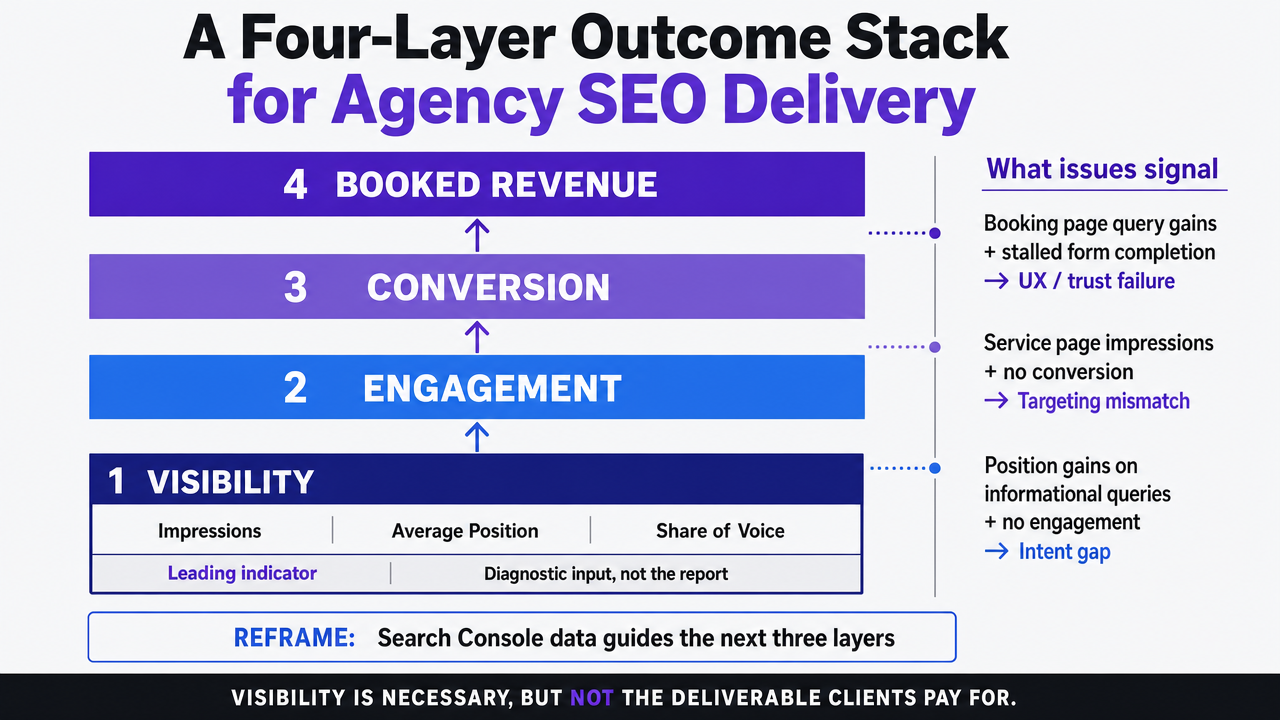 Visualize the four-layer outcome stack described across the subsections, giving readers a single reference for how visibility flows up to booked revenue
YMYL Content Quality as an SEO Performance Input
Ranking a page that a qualified visitor does not trust produces the exact pattern the outcome stack was built to expose: visibility without assisted action. In YMYL verticals — behavioral health, medical, legal, senior living — the trust signal is not a schema tag or an author byline template. It is whether the content survives the scrutiny of a prospect making a health, financial, or legal decision on behalf of themselves or a family member.
The baseline in healthcare is weaker than most delivery teams assume. A systematic review of 153 cross-sectional studies covering 11,785 health websites found that only 18 percent carried HON Code certification, one common third-party trust proxy 1. The review also reported that no site earned an excellent rating across the full evidence base, with 37 to 79 percent judged good depending on the assessment scale used. HON Code is one proxy among several and the underlying tools varied study to study, so the 18 percent figure describes the reviewed corpus rather than a universal quality score for the health web. It still frames the operating environment: the ceiling for editorial credibility in the category the reader serves is low, and rankings distribute against that low ceiling.
The implication for delivery is procedural, not philosophical. Editorial governance becomes an SEO input the agency instruments alongside crawl coverage and internal linking.
- Named clinical or legal reviewers on every YMYL page
- Dated last-reviewed timestamps tied to a real review cadence
- Citations to primary sources rather than commercial secondary summaries
- Removal of unsubstantiated outcome language on service pages
Each of those controls is measurable at the page level and reportable in the same review where qualified sessions and assisted actions get discussed.
Delivery leads who treat quality governance as a production standard rather than a compliance checkbox close a specific leak in the stack: qualified sessions that arrive, read the page, and leave because the page did not earn the next click. That leak does not show up in position tracking. It shows up in the assisted-action layer as a completion-rate depression the content team can fix.
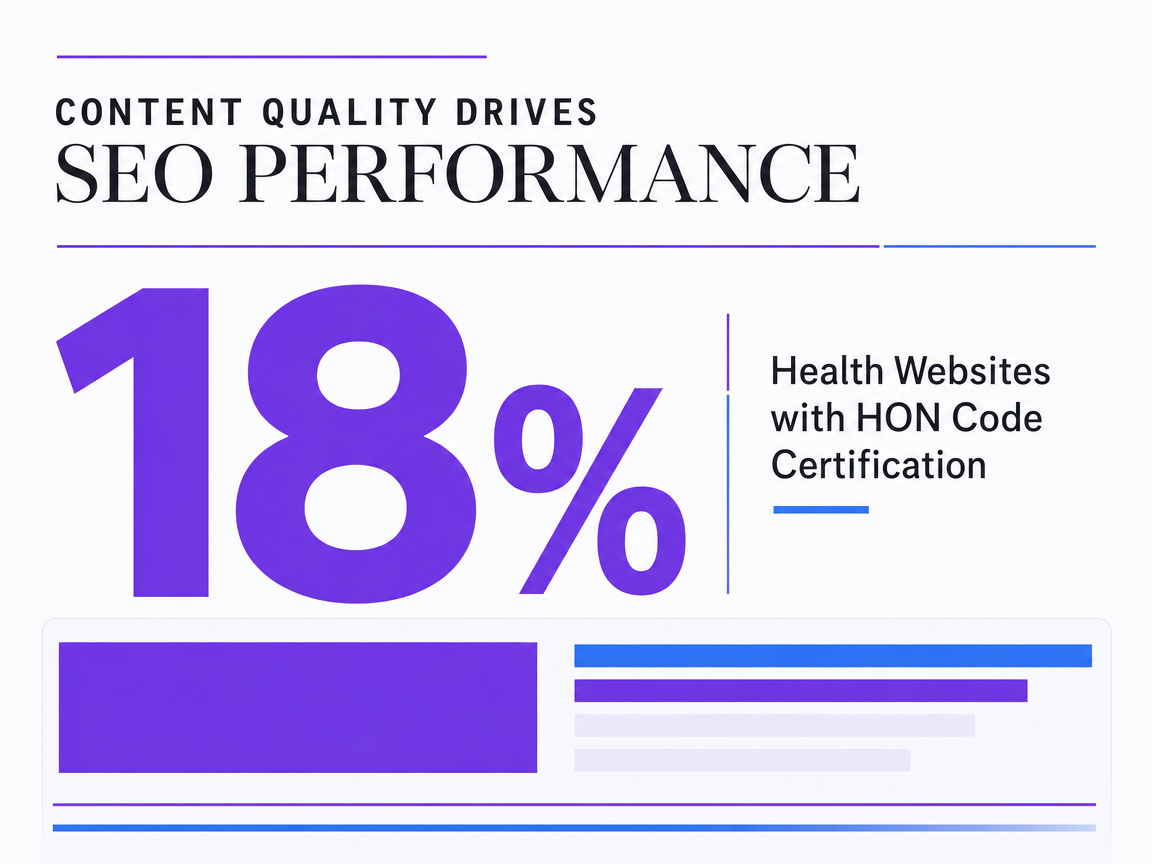 Health Websites with HON Code Certification
Health Websites with HON Code Certification
Test AI-powered SEO execution in real time
Validate results-focused SEO workflows by publishing live content and measuring client impact during your trial.
Compliance as a First-Class SEO Input
The FTC Reviews Rule and Reputation Assets
Review generation is an SEO deliverable in every local vertical the reader serves. It became a regulated activity on October 21, 2024, when the FTC's final rule on consumer reviews and testimonials took effect 7. Delivery teams that still run review workflows the way they did in 2023 are exposing clients to civil penalties in the same motion that lifts their local pack visibility.
The rule prohibits the sale, purchase, creation, or dissemination of fake or false reviews and testimonials, including certain AI-generated reviews that misrepresent the reviewer or the experience 8. It also reaches sentiment-conditioned incentives, undisclosed insider testimonials, review suppression, and misleading claims of independence 6. Each of those categories maps to a tactic that has appeared in agency reputation playbooks: incentives paid only for positive reviews, staff or family testimonials posted without disclosure, filtering flows that route unhappy customers to private channels, and third-party reputation widgets presented as neutral.
The economic stakes are not abstract. Research cited in the Federal Register notice estimates consumer welfare losses from certain review manipulation practices at $0.12 for every dollar spent in an experimental setting, with the caveat that the estimate covers limited manipulation types and excludes broader effects such as suppression 2. The figure is narrow by design and should not be extrapolated to the full local-search economy, but it establishes the regulator's evidentiary posture: review manipulation is treated as measurable consumer harm, not a gray-area marketing tactic.
The delivery adjustment is procedural. Audit every client's review-generation flow against the rule's prohibited practices before the next campaign cycle. Document the request language, the incentive structure, the disclosure treatment for employee or family reviews, and the response protocol for negative reviews. Reputation assets that survive that audit continue to compound local visibility. Assets that do not become liabilities the agency is now on record having built.
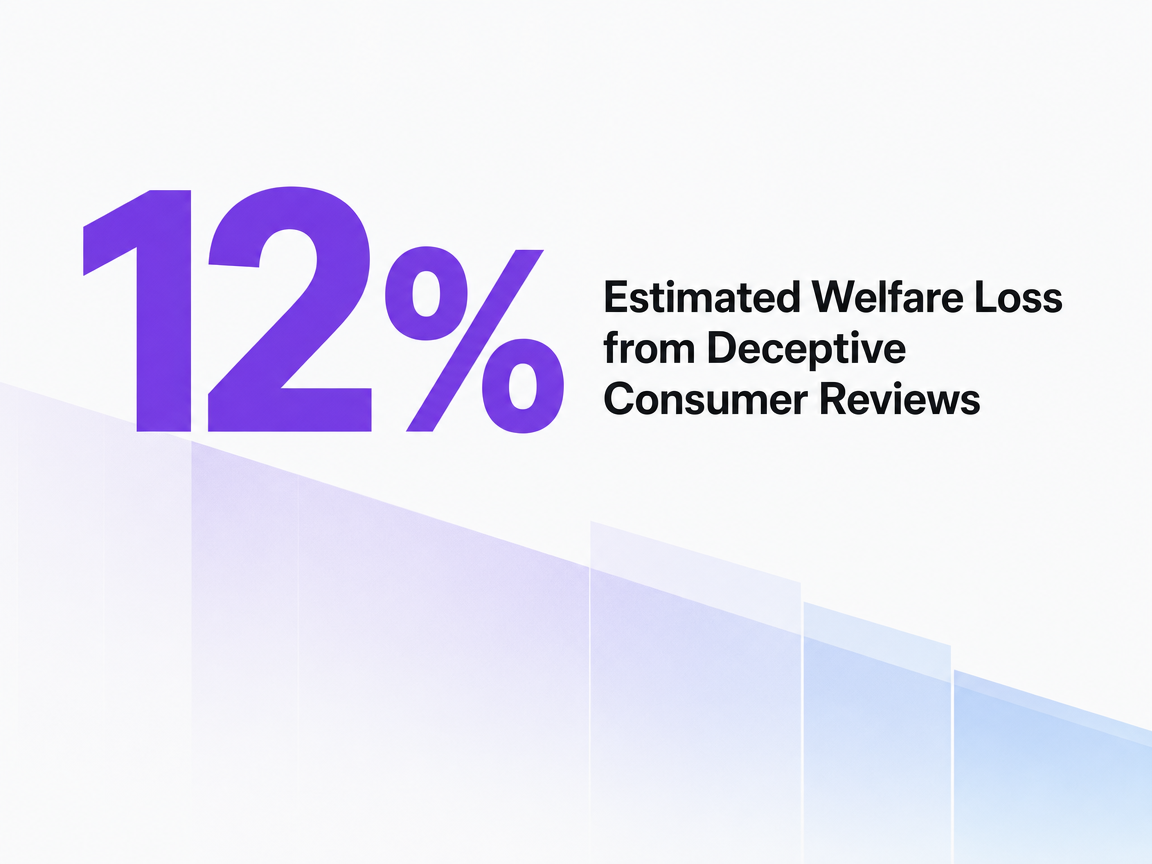 Estimated Welfare Loss from Deceptive Consumer Reviews
Estimated Welfare Loss from Deceptive Consumer Reviews
HIPAA Tracking, ADA Access, and Substantiated Landing-Page Claims
Three regulatory inputs shape what an agency is allowed to instrument, ship, and claim on a client's site. Each one has a specific point of failure in a standard SEO delivery workflow.
The first is HIPAA. HHS guidance on tracking technologies is explicit: obligations apply when information collected through analytics, pixels, session tools, or call intelligence, or disclosed to vendors, includes protected health information 9. That covers appointment-request forms, symptom-oriented landing pages viewed by authenticated patients, and call recordings that surface treatment context. The compliance question is not whether the page is authenticated. It is whether the data flowing to the vendor could reveal that an identifiable individual sought care for a specific condition. Delivery teams deploying GA4, Meta pixels, or call tracking on healthcare clients without a signed business associate agreement and a configured data suppression layer are creating the client's next breach report, not their next conversion dashboard.
The second is ADA. DOJ guidance issued in March 2022 addresses web accessibility for state and local governments under Title II and public-facing businesses under Title III 5. Every SEO change that touches an appointment flow, an intake form, a navigation restructure, or a service-page template is an accessibility change. Screen-reader compatibility on booking flows, keyboard operability on multi-step intake forms, and color contrast on call-to-action elements belong in the SEO acceptance criteria, not in a separate accessibility audit that runs on a different quarter.
The third is substantiation. FTC digital-disclosure guidance requires that online claims be truthful, nonmisleading, substantiated, and accompanied by clear and conspicuous disclosures placed as close as possible to the triggering claim 10. That applies directly to the outcome language SEO teams write into service pages, comparison pages, and location pages: success rates, recovery timelines, savings figures, credential claims. A disclosure cannot rescue an unsupported claim. The operational rule for content production is to require a citation to a primary source at the point any performance or outcome claim is drafted, or to remove the claim before publication.
These three inputs share a delivery consequence. Compliance review has to move upstream into the content brief and the technical ticket, not downstream into a legal escalation after publication. Agencies that build it into the production step protect the retainer. Agencies that do not, discover the exposure the same week the client's counsel does.
Scaling Delivery Without Scaling Headcount
The Cost Shape of Specialist-per-Function Delivery
The delivery model most agencies inherited was built for a smaller book. One SEO strategist, one content lead, one technical specialist, one reporting analyst, and an account manager coordinating between them. That shape works at 8 clients. It breaks predictably somewhere between 20 and 30, and the break shows up as margin compression before it shows up as quality failure.
The reason is coordination overhead, not production capacity. Every additional specialist adds a briefing surface, a revision loop, and a handoff that has to be resolved before work ships. A technical recommendation waits on the content team's calendar. A content brief waits on the strategist's approval. A reporting refresh waits on the analyst's queue. The billable hour count on the timesheet undercounts the actual delivery cost because the coordination time between specialists rarely gets logged against the client it belongs to.
The second cost is compliance drag. In verticals bound by HIPAA tracking rules, ADA acceptance criteria, and FTC substantiation for outcome claims, every ticket that touches a form, a pixel, or a service page has to be reviewed against a standard no single specialist owns end to end. When review is a separate stage rather than a production input, it becomes the queue everything else waits behind. Scaling the book means scaling that queue.
A Per-Client Delivery Worksheet You Fill In
The worksheet below is a variable model, not a benchmark. Delivery leads plug in their own rates, hours, and overhead assumptions and compare the specialist-per-function shape against a unified approval workflow where a single reviewer signs off on ranked, pre-assembled recommendations across SEO, content, technical, and reporting.
| Per-client monthly delivery input | Specialist-per-function | Unified approval workflow |
|---|---|---|
| SEO strategist hours | Fill in: hours × blended rate | Fill in: reduced hours × blended rate |
| Content production hours | Fill in: hours × blended rate | Fill in: reduced hours × blended rate |
| Technical implementation hours | Fill in: hours × blended rate | Fill in: reduced hours × blended rate |
| Reporting and QA hours | Fill in: hours × blended rate | Fill in: reduced hours × blended rate |
| Tool stack allocation per client | Fill in: monthly cost / active clients | Fill in: consolidated platform cost / active clients |
| Coordination overhead uplift | Fill in: % applied to labor subtotal (status meetings, briefing cycles, revision loops) | Fill in: reduced % applied to labor subtotal |
| Compliance review time (HIPAA, ADA, FTC) | Fill in: hours as separate stage | Fill in: hours embedded in approval step |
| Per-client monthly delivery cost | Sum of above | Sum of above |
Two rows carry most of the difference. The coordination uplift is the number most agencies never measure and always pay. The compliance row is the one that decides whether the model survives an audit, given the HHS tracking guidance and FTC substantiation standard already covered in Section 4 9, 10. Delivery leads who fill in the worksheet honestly usually find that headcount is not the constraint. The number of handoffs per approved change is.
Scale SEO Impact Across Clients With Data-Driven Automation
See how leading agencies leverage unified AI workflows to deliver measurable SEO outcomes at scale—without increasing headcount or losing strategic oversight.
If You Manage a Multi-Location Portfolio: Reading Outcomes Across Branches
The scope shifts here. The framework above assumes a single client with a single service journey. Delivery leads running SEO for multi-location operators — DSOs with 40 practices, home-services franchises with 60 territories, senior-living portfolios with 25 communities — face a different measurement problem: the outcome stack has to resolve at the branch level or it hides the accounts that are actually failing.
Portfolio reporting that averages qualified sessions, assisted actions, and booked revenue across locations produces a number the regional director cannot act on. Two practices at 130 percent of target mask three practices at 60 percent. The delivery discipline is to render the four layers per branch, then flag the branches where the layers diverge from the portfolio median rather than from an absolute target. A location whose qualified sessions climbed while booked appointments stalled is a service-delivery question — front-desk capacity, insurance verification, appointment availability — that the agency surfaces to the operator rather than tries to solve with more content.
Attribution mechanics get harder. HIPAA constraints already covered in Section 4 mean the healthcare portfolios cannot rely on user-level joins between site behavior and PMS bookings 9. The workable substitute is location-scoped reconciliation: qualified sessions to a specific location page, form or call events tagged to that location, and a monthly appointment export from the operator's system filtered to the same location. Directional coherence at the branch level is the reportable outcome. Divergence is the escalation.
Instrumenting the Stack in the First 90 Days
A 90-day build sequences the four layers in the order the client will ask about them. Skipping ahead to booked revenue reconciliation before qualified sessions are defined produces a report the delivery team cannot defend when the numbers move.
Days 1 to 30 belong to definition and access. The delivery lead sits with the client's intake owner, front-desk manager, or service coordinator to write down what qualifies a session — geography, page type, buyer intent — and negotiates the monthly export from the practice management system, CRM, or dispatch platform that will feed the top layer. Search Console and GA4 access get audited, branded traffic gets segmented out, and any healthcare client's tracking stack gets reviewed against HHS guidance before a new pixel or call-intelligence deployment ships 9. Business associate agreements and data suppression rules get resolved in this window, not after.
Days 31 to 60 build the diagnostic layer. A five-user task test on the primary booking or intake flow, scored on task time, errors, successful completion, and satisfaction, produces the first friction map 3. Editorial governance controls — named reviewers, review dates, primary-source citations — get applied to the highest-traffic YMYL pages first, and any outcome language on service pages gets pulled back to what the client can substantiate under FTC standards 10. Review-generation workflows get audited against the FTC rule before any new campaign runs.
Days 61 to 90 close the loop. The monthly export from the client's system arrives, gets reconciled against assisted-action data, and the first outcome report replaces the position tracker in the client review. The report shows directional coherence across the four layers or names the specific layer where coherence broke and what the next 30 days will test.
Frequently Asked Questions
References
- 1.Can Patients Trust Online Health Information? A Meta-narrative Systematic Review Addressing the Quality of Health Information on the Internet.
- 2.Use of Consumer Reviews and Testimonials: Final Rule.
- 3.Usability Testing - NIST.
- 4.User Interface/ User Experience Publications.
- 5.Justice Department Issues Web Accessibility Guidance Under the Americans with Disabilities Act.
- 6.16 CFR Part 465: Trade Regulation Rule on the Use of Consumer Reviews and Testimonials (Final Rule).
- 7.The Consumer Reviews and Testimonials Rule: Questions and Answers.
- 8.Federal Trade Commission Announces Final Rule Banning Fake Reviews and Testimonials.
- 9.Use of Online Tracking Technologies by HIPAA Covered Entities and Business Associates.
- 10.How to Make Effective Disclosures in Digital Advertising.