
Key Takeaways
- Stalled organic programs rarely lack writing capacity—they lack a governed loop connecting strategy, production, distribution, and measurement through named approval gates rather than parallel channel calendars.
- Structure the team by function—strategy, SEO, production, distribution, measurement—rather than by channel, because buyers move across search, feeds, video, and aggregators in a loop, not a funnel 8.
- Automate the middle of the workflow (drafting, formatting, metadata, scheduling) while keeping topic prioritization, angle selection, evidence, and final approval with humans against a people-first editorial standard 6.
- Report four pipeline numbers per cluster—qualified conversations, booked meetings, cost per opportunity, and time to first pipeline event—and retire any cluster or surface that fails two full cycles.
The Coordination Problem Behind Stalled Organic Growth
Most in-house marketing teams are not stuck because they cannot produce enough content. They are stuck because five parallel workstreams—SEO briefs, blog drafts, social posts, video edits, and reporting decks—move on separate calendars, get reviewed by different people, and rarely feed each other. Volume rises. Pipeline contribution flatlines.
Peer-reviewed research on content marketing effectiveness points to the same conclusion. Strategic alignment, audience insight, and content quality predict business outcomes far more reliably than output volume 1. When a VP audits a stalled organic program, the missing ingredient is almost never writing capacity. It is a decision-making loop that connects what the team learns about the audience to what actually gets published and measured.
The operating reality has also changed underneath most team structures. Discovery now runs across search, social feeds, video, and AI-assisted answers at the same time, and the buyer journey behaves less like a funnel and more like a loop of exploration and evaluation across many touchpoints 8. A channel-by-channel org chart cannot orchestrate that.
The sections that follow lay out a different operating model: one governed loop with clear passes for strategy, production, distribution, and measurement, staffed by specialist functions rather than channel owners.
Why Discovery Is No Longer a Single-Channel Problem
The Fragmented Surface Marketing Leaders Must Plan For
Organic reach is not distributed evenly across platforms, and it is not distributed the way most marketing plans still assume. Recent Pew data shows 84% of U.S. adults ever use YouTube, 71% ever use Facebook, and 50% ever use Instagram 4. Those numbers describe a discovery surface where video, feed, and image-first environments each hold a meaningful share of adult attention at the same time.
For a VP allocating a fixed content team against those platforms, that changes the math. A team of four cannot maintain original-format presence on every surface without either producing lower-quality work everywhere or defaulting to cross-posted duplicates that underperform on each platform's ranking signals. The choice is not which channel to prefer. It is which two or three channels to staff for native production and which to treat as syndication targets.
The peer-reviewed content-marketing literature reinforces the point. Effectiveness tracks strategic alignment, audience insight, and content quality far more closely than raw output volume 1. A team producing three formats well on two high-reach platforms will typically outperform the same team producing seven formats poorly across five.
Channel selection, in that framing, is a capacity-allocation decision. It should be made once per planning cycle, tied to audience data, and revisited only when reach or conversion evidence forces the question—not every time a new platform trends.
Search, Social, and Creator-Adjacent Distribution
Even inside digital, no single surface dominates. Pew's platform data on U.S. adults reports 21% prefer news websites or apps, 14% prefer social media, and 10% prefer search as their digital source 3. Preference splits like that make a search-only or a social-only organic program a structural bet against most of the audience.
Buyer behavior mirrors the fragmentation. Google's consumer research describes discovery and evaluation as a loop across search, social feeds, aggregators, review sites, and video, with buyers moving between exploration and comparison many times before deciding 8. A single-channel program can win a moment inside that loop but rarely the sequence.
Creator-adjacent distribution has become part of the same picture. About one in five U.S. adults regularly get news from influencers on social media, meaning organic content increasingly competes with, and sometimes benefits from being carried by, creators who already have audience trust on a given platform 5. For in-house teams without the bandwidth to build native audiences on every surface, partnerships with a small set of vetted creators can extend reach without adding headcount.
The operational takeaway is narrower than it looks. Marketing leaders should map two or three primary surfaces where the team produces native work, one or two secondary surfaces served by adapted content, and a short list of creator relationships that carry the brand into contexts an internal team cannot staff.
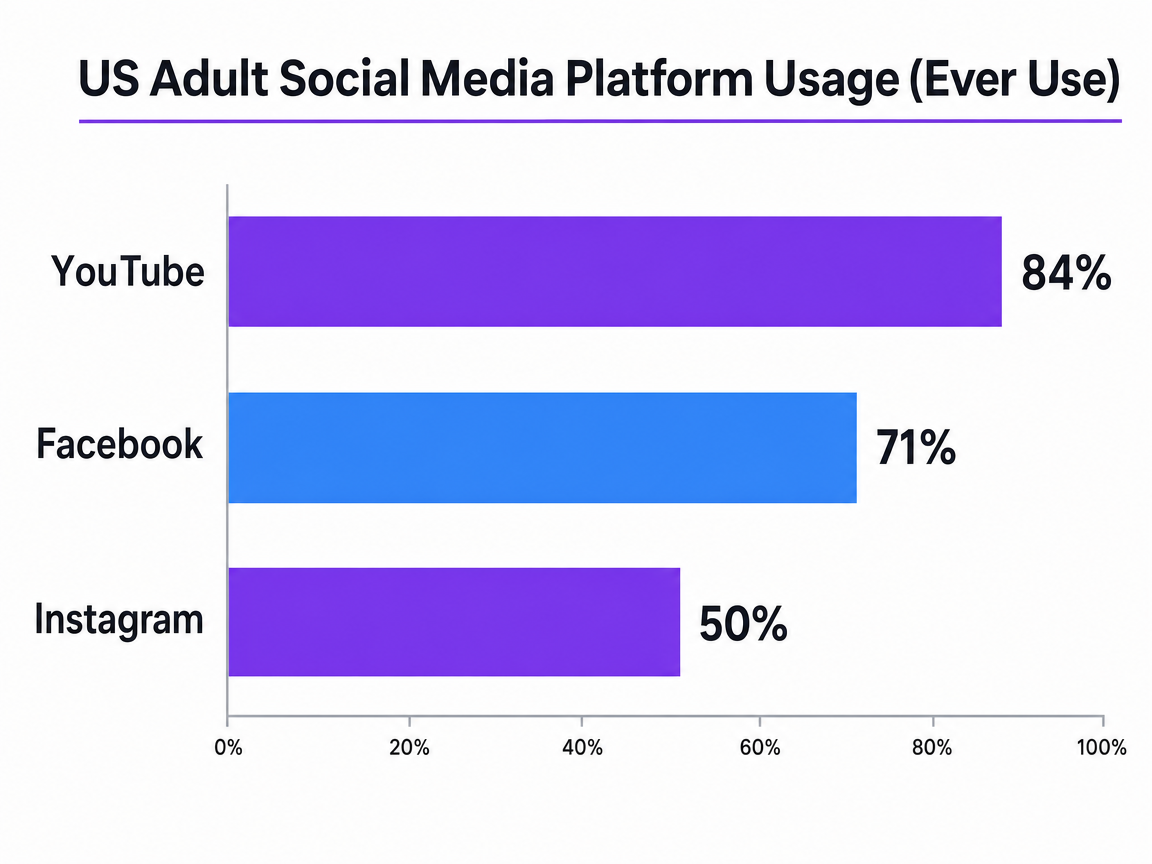 US Adult Social Media Platform Usage (Ever Use)
The percentage of U.S. adults who report ever using YouTube, Facebook, or Instagram, indicating platform reach.
The Governed Loop: One System Instead of Four Departments
Strategy Pass — Inputs, Prioritization, and Decision Points
The strategy pass is where a small team decides what not to do. It runs on a fixed cadence—monthly for most in-house groups, quarterly for planning resets—and takes three inputs: audience research from prior-quarter engagement and sales conversations, a pipeline view showing which topics produced qualified opportunities, and a competitive read on what is ranking or getting shared in the category.
Prioritization then happens against a single question: which topics, formats, and surfaces are most likely to move pipeline given the current team's capacity? The peer-reviewed content-marketing literature is direct on this point—strategic alignment and audience insight predict effectiveness more reliably than production volume 1. A strategy pass that produces a ranked list of ten topics is more valuable than one that produces sixty.
The decision point at the end of the pass is explicit. A named owner approves the topic list, the target surfaces, and the success metric for each item before anything enters production. That approval becomes the brief. If the strategy pass ends without a signed list, the production pass does not start. This single gate prevents the most common failure mode in stalled organic programs: production running on inertia rather than on current intent data.
Production Pass — Approval-First, Not Automation-First
Production is where automation tempts teams into the wrong sequence. The instinct is to generate first and edit later. The governed loop reverses that order. Human judgment sets the outline, the angle, and the evidence requirements before drafting begins, and human approval closes the gate before publishing.
Between those two decision points, repetitive execution can be systematized: draft generation, formatting, metadata, image selection, internal linking, and scheduling. McKinsey's operating-model work on generative AI in marketing recommends a three-layer team structure with explicit measurement, change management, and scaling stages rather than ad hoc tool adoption 10. The practical translation is that automation belongs in the middle of the production pass, not at either end.
Google's guidance on organic search reinforces the emphasis on judgment at the edges. The recommendation is helpful, reliable, people-first content—an editorial standard, not an output volume target 6. A production pass built around that standard treats the AI-assisted draft as raw material that a specialist edits against the approved brief.
The output of the pass is a scheduled asset with a named reviewer, a target surface, and a measurement tag already in place. No asset moves to distribution without those three fields populated.
Distribution Pass — Orchestrating the Messy Middle
Publishing an asset is not distribution. It is the first step of it. The distribution pass treats each approved asset as a source that gets adapted for the two or three primary surfaces the strategy pass selected, plus syndication and creator handoffs where those exist.
The buyer behavior underneath this is well documented. Google's consumer research describes discovery and evaluation as a loop across search, social feeds, aggregators, review sites, and video, with buyers moving between exploration and comparison many times before deciding 8. A separate Google framing points to what it calls 4S behaviors—streaming, scrolling, searching, and shopping—reshaping how people discover and engage with brands 9. Neither model rewards single-surface publishing.
The pass has three operational steps:
- Adapt the asset for each primary surface using formats native to that surface, not cross-posted duplicates.
- Schedule the sequence so search, social, and any creator or newsletter carry hit within a defined window rather than drifting over weeks.
- Log the surface, format, and timing against the asset's measurement tag so the next pass can read what actually moved.
The decision point here is a stop rule. If a surface produces no measurable pipeline contribution across two full cycles, it drops from the primary list.
Measurement Pass — Pipeline Metrics That Force Decisions
Traffic and rankings do not force decisions. Pipeline metrics do. The measurement pass reports against four numbers per topic cluster: qualified conversations generated, booked meetings, cost per opportunity, and time to first pipeline event. Vanity metrics can appear in the appendix; they do not appear in the review.
The rubric matters because organic discovery is fragmented in ways that reward a pipeline-level read. Pew reports that 53% of U.S. adults say they at least sometimes get news from social media, with regular news consumption concentrated on Facebook at 38% and YouTube at 35% 2. A team looking only at search-console data will miss the share of demand that formed on those surfaces before landing on the site.
The pass produces two decisions. First, which topic clusters continue, expand, or retire based on their contribution to the four numbers. Second, which surfaces earn more capacity next cycle and which drop. Both decisions feed directly back into the next strategy pass as inputs.
Handled this way, measurement stops being a monthly reporting ritual and becomes the mechanism that keeps the loop honest. A cluster that cannot show pipeline contribution after two full cycles is not underperforming—it is finished.
 US Adults Who Sometimes Get News from Social Media
US Adults Who Sometimes Get News from Social Media
Test Predictable Organic Pipeline at Full Scale
Validate scalable, end-to-end organic execution using your real campaigns and live content publishing for seven days.
Specialist Functions Beat Channel-Based Teams
Most in-house marketing orgs are drawn on the wrong axis. Boxes on the chart read Blog, Social, SEO, Video, Email—one person or contractor per channel, each running a private calendar. That structure optimizes for output per channel and penalizes coordination across them. When the buyer journey behaves as a loop across search, feeds, aggregators, and video 8, parallel channel owners produce parallel plans that rarely reinforce each other.
A specialist-function model reorganizes the same headcount around what the work actually requires. Five functions cover a mature organic program:
- Strategy and prioritization
- SEO and technical distribution
- Content production and editing
- Multi-surface distribution
- Measurement
Each function serves every channel. The SEO specialist informs YouTube titles and blog architecture. The distribution specialist adapts one approved asset for search, social, and newsletter within a single publishing window. The measurement specialist reports pipeline contribution across surfaces, not rankings by channel.
McKinsey's operating-model work on generative AI in marketing points in the same direction, recommending a three-layer team structure with explicit measurement, change management, and scaling stages rather than tool-by-tool adoption 10. The layers map cleanly onto the specialist functions above: leadership setting direction, a core team owning execution and standards, and embedded users applying the outputs.
The staffing implication is narrower than most VPs expect. A team of four to six can run the full loop when each seat owns a function and the loop's gates enforce sequence. Adding a sixth channel manager to that same team usually slows it down.
Where Automation Earns Its Keep — And Where It Doesn't
Automation pays inside the production and distribution passes, where the work is repetitive and the quality bar is set upstream by a human brief. It stops paying at the two ends of the loop: setting direction and judging whether the output actually serves the audience.
The paid-search side of the industry offers a useful directional signal on how much lift automation adds when it is scoped tightly. Google reports that advertisers activating AI Max in Search campaigns typically see a 14% increase in conversions or conversion value at a similar CPA and ROAS 7. That figure comes from paid Search campaigns and is advertiser-reported, not an organic benchmark—but it points to the same pattern in-house teams see when they automate the middle of a governed loop: constrained, well-instrumented tasks respond to automation faster than open-ended creative work.
Inside an organic program, the tasks that earn automation are draft generation against an approved outline, format adaptation across surfaces, metadata and internal linking, image selection, and scheduling. Google's own guidance for organic search sets the ceiling on that automation: the standard is helpful, reliable, people-first content, which is an editorial judgment a machine cannot make on its own 6. The specialist edits the draft against that standard before it publishes.
The tasks that should stay with humans are narrower and more valuable. Topic prioritization, angle selection, evidence sourcing, and the final approval gate all require judgment about what the audience will find useful and what the business needs to say. A team that automates those decisions loses the quality signal that makes the rest of the loop worth running.
Where Headcount Actually Belongs
The argument that a governed loop reduces headcount pressure is not an argument that people do not matter. It is an argument about which roles compound and which ones burn out. Two seats consistently earn more investment than most in-house orgs give them, and both sit at the judgment ends of the loop rather than in the middle.
The first is a senior editorial owner who sets the quality bar. Google's guidance on organic search puts the standard at helpful, reliable, people-first content, which is an editorial call, not a template 6. A team without a named owner for that judgment tends to publish more and convert less, regardless of how many drafters or contractors it adds.
The second is a measurement lead who reports pipeline contribution across surfaces. Discovery now spans search, feeds, video, aggregators, and review sites in a loop rather than a funnel 8, and a team that cannot attribute demand across those surfaces will keep funding the wrong clusters. This role is often merged into analytics or ops; it should be a dedicated seat once organic contributes a meaningful share of pipeline.
Everything else—drafting, formatting, scheduling, syndication—can be shared, systematized, or vendored. Headcount belongs where judgment compounds.
See How Leading Teams Scale Organic Pipeline—Without More Hires
Connect for a walkthrough of unified AI-powered marketing execution, enabling your team to grow organic channels with measurable efficiency—no additional headcount or vendor management required.
For Operators Running Multiple Locations: Modeling the Consolidation Tradeoff
For VPs running marketing across ten, thirty, or a hundred locations, the operating model question compounds. A channel-based structure that strains a single-brand team collapses at portfolio scale: five vendors times three regions times two service lines produces a coordination load no in-house team can absorb. The consolidation question is not whether to centralize—it is how to model the tradeoff before committing.
The comparison below is a modeling frame, not a price sheet. It uses variables so a VP can drop in current retainer ranges, headcount costs, and review hours from the actual org.
| Cost Line | Traditional Stack | Consolidated Platform + In-House Oversight |
|---|---|---|
| SEO agency retainer | retainer_low – retainer_high | Absorbed into platform fee |
| Content agency retainer | retainer_low – retainer_high | Absorbed into platform fee |
| Social contractor | retainer_low – retainer_high | Absorbed into platform fee |
| PPC agency | retainer_low – retainer_high | Absorbed into platform fee |
| Analytics contractor | retainer_low – retainer_high | Absorbed into platform fee |
| In-house oversight | headcount_FTE (coordination-heavy) | headcount_FTE (judgment-heavy) |
| Weekly review load | review_hours_per_week across vendors | review_hours_per_week in one queue |
The variables that move the model are not the line items. They are review hours and coordination load. A stack of five vendors typically produces five status calls, five reporting formats, and five briefing cycles per location group. A consolidated model collapses those into a single approval queue, which is where McKinsey's three-layer operating recommendation earns its keep at scale 10.
The stop rule for operators is the same as the stop rule inside a single loop. If a surface or a location cluster produces no measurable pipeline contribution across two full cycles, capacity moves. Portfolio scale makes that discipline cheaper to enforce, not harder.
A 90-Day Path to a Working Loop
A working loop is not a rebuild. It is a sequenced install. Ninety days is enough for most in-house teams of four to six to move from parallel channel workstreams to a governed loop with one approval queue.
- Days 1–30: Install the strategy and measurement passes. Name one owner for topic prioritization and one for pipeline reporting. Cut the active topic list to ten items ranked by pipeline potential rather than search volume, using the audience-insight and strategic-alignment criteria the content-marketing literature ties to effectiveness 1. Instrument four numbers per cluster: qualified conversations, booked meetings, cost per opportunity, and time to first pipeline event.
- Days 31–60: Install the production pass. Move automation into the middle of the workflow—drafting, formatting, metadata, scheduling—while keeping outlines, evidence, and final approval with named humans. Google's organic guidance sets the editorial ceiling: helpful, reliable, people-first content 6.
- Days 61–90: Install the distribution pass and enforce stop rules. Adapt each approved asset for two primary surfaces and one secondary. Retire any cluster or surface that has not produced measurable pipeline contribution across two cycles. The loop is working when retirement decisions happen on schedule.
 US Adults Getting News from Digital Devices
US Adults Getting News from Digital Devices
Frequently Asked Questions
References
- 1.Determinants of content marketing effectiveness: Conceptual framework and empirical validation.
- 2.Social Media and News Fact Sheet.
- 3.News Platform Fact Sheet.
- 4.Americans' Social Media Use 2025.
- 5.America's News Influencers.
- 6.Search innovations transform user behavior.
- 7.How AI is changing consumer search behavior.
- 8.Navigating purchase behavior & decision-making.
- 9.The new consumer decision-making process.
- 10.How generative AI can boost consumer marketing.