
Key Takeaways
- Treat rank as a diagnostic input feeding decisions, not a client deliverable, since position shifts rarely explain what happened to a page or to pipeline 3.
- Anchor reporting on Search Console as first-party ground truth and use third-party trackers only as directional overlays for competitor and SERP feature movement 1.
- Reorganize sprawling keyword lists into cohorts bounded by commercial intent, geography, and page cluster so position movement ladders directly to qualified-lead outcomes.
- When anomalies surface, run Google's segmentation sequence across query, URL, country, device, and search appearance before drafting any client explanation 2.
Rank Is a Leading Indicator, Not a Deliverable
Rank is a signal about where a page sits in a specific result set at a specific moment for a specific user context. It is not a booking, a qualified call, or a signed engagement. Agencies that organize client reporting around position movement as the headline metric end up defending noise instead of defending strategy.
Google's own ranking documentation describes Search as the output of many automated systems weighing hundreds of signals across hundreds of billions of pages, with evaluation happening at the page level rather than against a single query slot 3. That design has a direct consequence for client reporting: a position change for one keyword rarely explains what happened to a page, let alone what happened to pipeline. Treating rank as a deliverable collapses a multi-signal system into a single number that clients then anchor to.
The more useful framing for a Head of SEO managing a book of accounts is this: rank data is a diagnostic input that feeds a decision, not the decision itself. Search Console provides the first-party query, page, country, device, and search-appearance breakdowns needed to turn position shifts into interpretable movement 1. The agency's job is to pair those segmented signals with qualified-lead data and surface approval-ready recommendations. The sections that follow build that operating system, starting with what breaks when rank reports are taken at face value.
What Breaks Legacy Rank Reports
Personalization, Location, and Device Noise
The screenshot a client sends on a Tuesday morning showing their competitor at position two does not describe the SERP the agency's tracker queried on Monday night. Both can be accurate. Both can also be irrelevant to the page's actual performance.
A historical academic study of 200 users measured Google Web Search personalization and found that an average of 11.7% of results differed between users, with top ranks tending to be less personalized than lower positions 10. The scope matters: this is historical causal research, not a current universal personalization rate. The operational takeaway holds anyway. Any result page an agency captures is a snapshot conditioned on location, device, language, logged-in state, search history, and collection timestamp. A tracker reporting "position 4" without declaring those conditions is reporting a measurement without a unit.
Three controls close most of the gap between what the tracker says and what the client sees:
- First, pin geography to the market the client actually serves, down to the metro or postal code for local-intent queries, and record it in the report.
- Second, split mobile and desktop into separate cohorts rather than averaging them; device-level CTR curves and SERP layouts diverge enough that a blended position obscures both.
- Third, timestamp every collection run and hold the collection window constant week over week.
Reports built on these controls stop generating the "but I see something different" conversation that burns senior-strategist hours every reporting cycle. The tracker becomes a defensible instrument instead of a debate prompt.
AI Overviews and the Displacement of Blue-Link Position
A page can hold position three for a commercial query and still lose impressions, clicks, and qualified calls over a quarter. The traditional rank-tracker view will not explain it, because the position itself did not move.
Google's own documentation describes AI Overviews and AI Mode as features that help users get to the gist of a topic and provide a jumping-off point to explore links 4. When those surfaces appear above the first blue link, they compress the attention available to conventional organic results, redistribute clicks toward cited sources inside the AI surface, and sometimes answer the query outright. A rank report that only measures blue-link position reports the one layer of the SERP that may no longer sit at the top of the page.
Two adjustments keep client reporting honest. The first is cross-referencing Search Console's search-appearance dimension against tracked positions, so impressions lost to AI surfaces show up as a separate line rather than disappearing into a "rank stable, clicks down" anomaly. The second is annotating cohorts where AI Overviews appear frequently, which converts a reporting blind spot into a documented segment the agency can discuss with evidence. Position becomes one layer of visibility, not the entire visibility story.
Why Single-Keyword Position Misrepresents Page Performance
Google's ranking documentation is explicit that Search uses many automated systems weighing many signals, and that ranking is designed to work at the page level across hundreds of billions of pages 3. A single tracked keyword is one query out of the dozens or hundreds a well-optimized page may rank for. Treating that one position as the page's grade misreads the system.
A service page targeting a primary head term typically earns impressions across long-tail variants, question modifiers, geo-modified phrases, and feature-triggered queries. The head term can slip from position three to five while total impressions, clicks, and conversions on that URL rise, because the page gained ground on twelve adjacent queries that collectively drive more qualified traffic. The inverse is also common: the head term holds steady while the page quietly loses visibility across the long tail that was actually feeding the pipeline.
Measurement at the URL and query-cluster level, not the single-keyword level, is the only view that matches how the system evaluates pages. Rank cohorts, developed in the next section, operationalize that view for client reporting without multiplying the number of rows a strategist has to read.
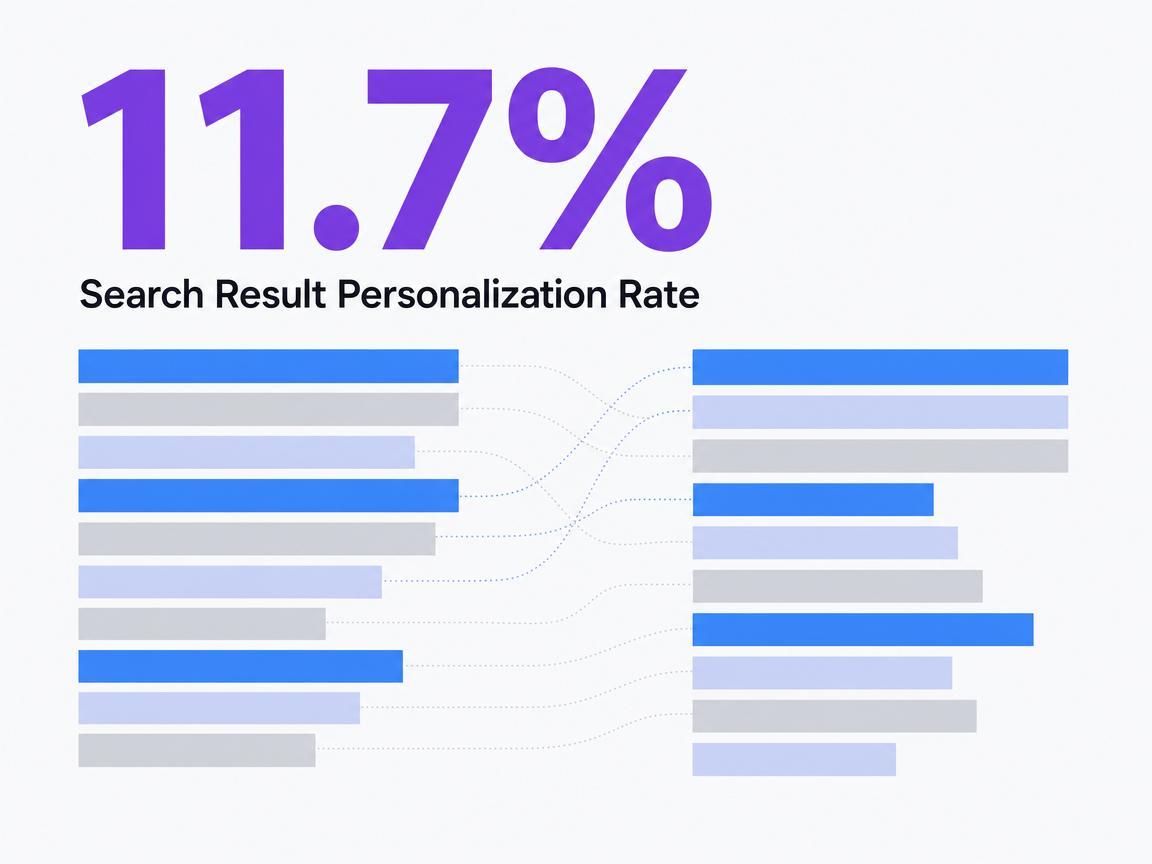 Search Result Personalization Rate
Search Result Personalization Rate
The First-Party Foundation: Search Console as Ground Truth
What the Search Analytics API Actually Delivers
Search Console is the only data source that reports what Google actually served to users of a client's site. Third-party trackers simulate; Search Console records. That distinction is the entire reason it belongs at the base of the stack.
The Search Console API exposes four services: Search Analytics, Sitemaps, Sites, and URL Inspection 7. For rank-checker strategy, Search Analytics does the heavy lifting. It returns impressions, clicks, CTR, and average position filtered by query, page, country, device, search appearance, and date, which is the exact segmentation Google itself recommends for diagnosing performance 1. Average position is an averaged topmost-position metric across the impressions a page earned, not a universal rank reading, and reports should label it that way.
Pulling this through the API rather than the UI changes the operating model. A single scheduled job can retrieve segmented performance for every client property on the same cadence, normalize it into a shared schema, and feed cohort dashboards without a strategist opening the Search Console interface. URL Inspection and Sitemaps services close the loop by surfacing indexing state and submission health alongside the performance pull, so a position anomaly can be checked against index coverage in the same workflow instead of a second tab.
Third-Party Trackers as Directional Overlays
Third-party rank trackers earn a role, but not the headline role. They query SERPs on a defined schedule from a declared location and device, which gives agencies a controlled view of competitor positions, SERP feature presence, and local-pack composition that Search Console does not expose. That is their job.
Where they underperform is in representing what the client's own users encountered. A tracker reports the SERP its infrastructure saw; Search Console reports the impressions real users were served. When the two disagree, Search Console wins the client conversation because it is first-party data from Google about the client's own property.
The operating rule is to pin the tracker as a directional overlay on top of the Search Console baseline. Positions from the tracker annotate competitor movement and SERP feature changes inside a cohort view. Impressions, clicks, and average position from Search Console drive the trend lines the client sees. Reports built this way stop treating two different measurement systems as interchangeable and give the strategist a defensible answer when a position number is disputed.
Test Automated Rank Tracking on Live Campaigns
Evaluate real-time keyword ranking data and workflow efficiency across actual client accounts during your trial period.
Building Rank Cohorts That Ladder Up to Revenue
A tracked keyword list grows by accretion. A new campaign adds thirty terms, a competitor analysis adds twenty more, and within a year the client property has an 847-row keyword sheet that no strategist reads line by line. The fix is not pruning the list; it is reorganizing it into cohorts that map to how the business actually earns revenue.
A rank cohort is a bounded group of tracked queries that share three attributes: commercial intent tier, geographic scope, and the page cluster they resolve to. A cohort for a personal-injury firm's practice-area pages in a single metro behaves differently from a cohort of informational blog queries targeting the same market, and both behave differently from branded-defense terms. Reporting at the cohort level compresses hundreds of rows into five or six narrative lines a client can act on, and it exposes directional movement that a sorted keyword list hides.
Cohort-level movement matters because position shifts near the top of the SERP produce outsized click effects. A historical peer-reviewed study of result ordering found that moving a result from rank one to rank two reduced click odds by between one-third and two-thirds, depending on the query 9. The figure is historical causal evidence, not a current CTR curve, and modern SERPs with AI surfaces, ads, and rich results distribute attention differently. The directional point still holds: when a high-intent commercial cohort slides from an average position of 1.8 to 2.6, the pipeline consequence is not proportional to the position delta. It is larger.
Cohorts also give the agency a clean join to downstream data. Each cohort carries an expected conversion profile—qualified calls for commercial-local terms, form fills for mid-funnel comparison queries, newsletter opt-ins for top-of-funnel content—so cohort trends can be reported alongside the lead volume the cohort was built to produce. When a cohort's position holds but its clicks and qualified calls both decline, the agency has a specific anomaly to diagnose rather than a vague "rankings are mixed" conversation. When positions soften but qualified calls rise, the agency has evidence that the cohort composition needs rebalancing toward the queries actually converting. Rank data stops being a ledger and starts being a view into the revenue line it was always supposed to inform.
The Diagnostic Playbook for Rank Anomalies
Segment Before You Explain
When a client flags a position drop, the strategist's first move is not to open the tracker. It is to open Search Console and segment.
Google's own debugging guidance prescribes a specific sequence: compare the last three months with the previous period or the same period year over year, then check whether the change is limited to specific queries, URLs, countries, devices, or search appearances 2. That sequence exists because an unsegmented traffic line hides which part of the property actually moved. A 14% click decline could be one page losing a featured snippet, one country going dark on a geo-restricted campaign, mobile INP regressing after a template deploy, or a seasonal demand shift the client's category always shows in Q3.
The operating adaptation for an agency is to codify the sequence into a repeatable escalation. Each anomaly ticket opens with five segment pulls in order:
- query
- URL
- country
- device
- search appearance
Each pull either narrows the anomaly to a specific slice or clears that dimension. A cross-check against Google Trends determines whether the pattern is site-specific or market-wide 2. By the time a strategist is drafting the client note, the anomaly has a documented location in the data, not a hypothesis.
This discipline changes the economics of the reporting call. Explanations arrive with evidence attached, and the agency stops burning senior hours on speculative diagnosis every time a tracker line dips.
Core Web Vitals as Diagnostic Inputs, Not Ranking Levers
Core Web Vitals belong in the diagnostic workflow, not at the top of the recommendation stack. Google's own documentation sets the good thresholds at LCP within 2.5 seconds, INP at or below 200 milliseconds, and CLS at or below 0.1, evaluated at the 75th percentile across mobile and desktop 8. Passing those thresholds does not guarantee higher positions. Failing them does not guarantee a drop. The metrics describe experience, and experience is one input among many the ranking systems weigh.
The useful move is to attach CWV field data to the anomaly ticket. When a URL cohort shows softening clicks and the tracker shows stable position, a p75 INP that crossed from 180 ms to 240 ms on mobile after the last template release is a concrete diagnostic lead. When positions and clicks both hold while CWV degrades, the agency has a leading indicator worth queuing for the next sprint without inflating it into a crisis narrative.
Reporting the three metrics against their good, needs-improvement, and poor bands keeps the conversation honest. The client sees where each cohort sits on the reference thresholds, where regressions correlate with query or URL-level anomalies, and where the data cleanly rules CWV out as a cause. That is the role: a documented input the strategist can confirm or dismiss, not a lever to overstate.
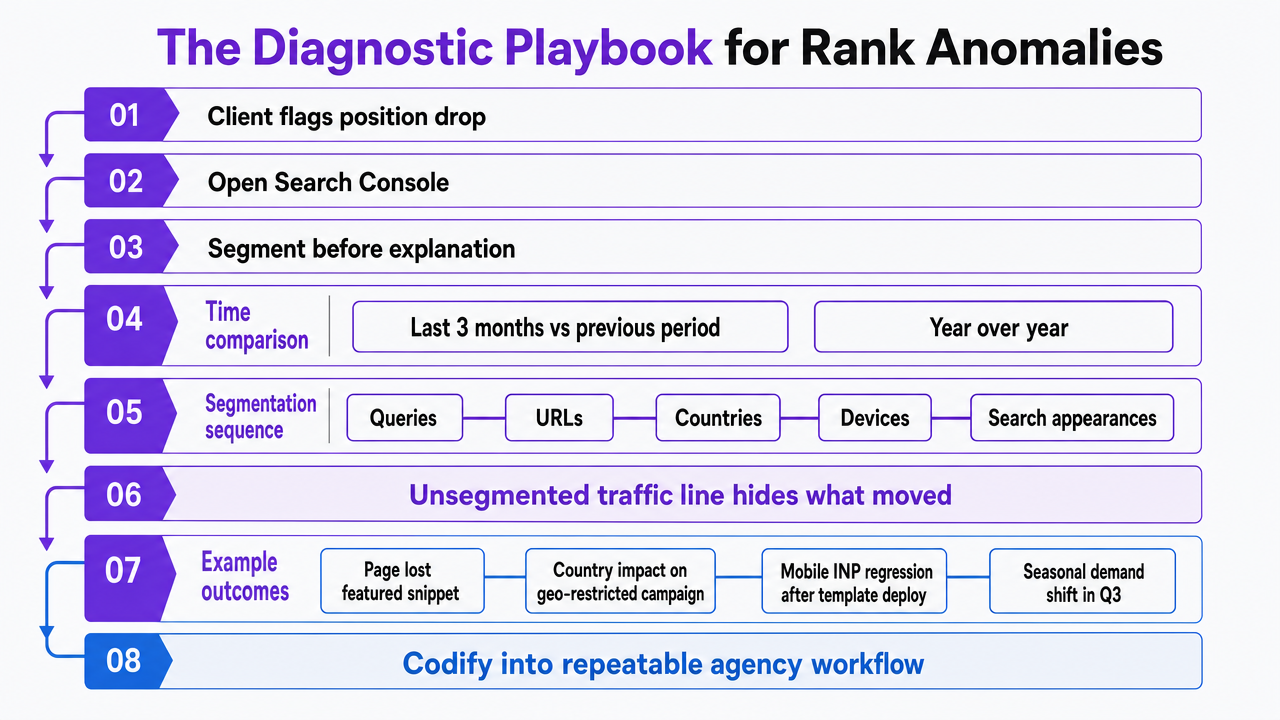 Visualize Google's prescribed segmentation sequence as a repeatable agency escalation workflow, directly supporting the section's cited diagnostic steps
Compliance Guardrails for Automated Collection and AI-Assisted Reporting
Scaling rank collection and AI-assisted reporting across a client portfolio introduces two policy surfaces that agencies cannot defer. Google's spam policies explicitly identify automatically generated traffic as a prohibited practice and classify scaled content abuse as generating pages primarily to manipulate rankings rather than help users 6. Both apply directly to how an agency operates a rank checker and how it uses AI to draft client-facing analysis.
On the collection side, the rule is restraint by design. Pull first-party data through the Search Console API on a controlled cadence rather than scraping live SERPs at volume, and when third-party trackers are used as directional overlays, rely on vendors that respect rate limits and query the SERP through compliant channels. The Search Console API handles multi-client Search Analytics, Sitemaps, and URL Inspection pulls without touching Google's query infrastructure, which keeps the base layer of the stack inside sanctioned access 7.
On the reporting side, Google's AI-optimization guidance accepts AI-assisted production but draws the line at content created primarily to manipulate rankings or generative-AI responses 5. The operational translation is a documented approval workflow: AI drafts cohort narratives and recommendations, a senior strategist reviews for accuracy and client fit, and nothing publishes or ships to the client without that sign-off recorded.
Streamline Multi-Client Organic Rank Tracking With Centralized AI Oversight
Connect with our team to see how agencies use AI-powered rank monitoring and approval workflows to deliver measurable SEO outcomes at scale—without increasing headcount or manual reporting overhead.
If You Manage a Portfolio: Senior Hours Per Client Per Month
The analysis so far addresses rank-checker strategy for a single client property. The economics change when the same methodology has to run across 15 to 80 accounts at once, which is where most Heads of SEO actually live. Senior-strategist hours, not tool licenses, are the constraint.
The workflow has five stages that each consume time per client per month:
- data collection across Search Console API and third-party trackers
- cohort segmentation and normalization
- anomaly review against the diagnostic sequence 2
- client-facing report assembly
- recommendation drafting for approval
In a manual delivery model, a strategist typically touches every stage on every account every cycle. In a partially automated model, collection and segmentation are scripted but anomaly review, reporting, and recommendations remain hand-built. In an approval-workflow model, AI drafts anomaly narratives and recommendations from the segmented cohort data, and the strategist's time concentrates on review and sign-off rather than production.
| Workflow stage | Manual (hrs/client/mo) | Partially automated | Approval-workflow automated |
|---|---|---|---|
| Data collection | Cm | ~0 | ~0 |
| Cohort segmentation | Sm | ~0 | ~0 |
| Anomaly review | Am | Am | 0.3 × Am |
| Report assembly | Rm | 0.4 × Rm | 0.15 × Rm |
| Recommendation drafting | Dm | Dm | 0.4 × Dm |
The variables matter more than any invented hour count. Each agency's baseline differs, but the structure of the compression is consistent: the stages that scripted pulls remove are the lowest-judgment ones, and the stages AI drafting compresses are the highest-volume writing tasks. The strategist's hours shift toward review, which is where their judgment actually produces client value. Multiply the per-client delta across a portfolio of 40 accounts, and the recovered capacity funds either margin, retention work, or the next tranche of accounts without a headcount addition.
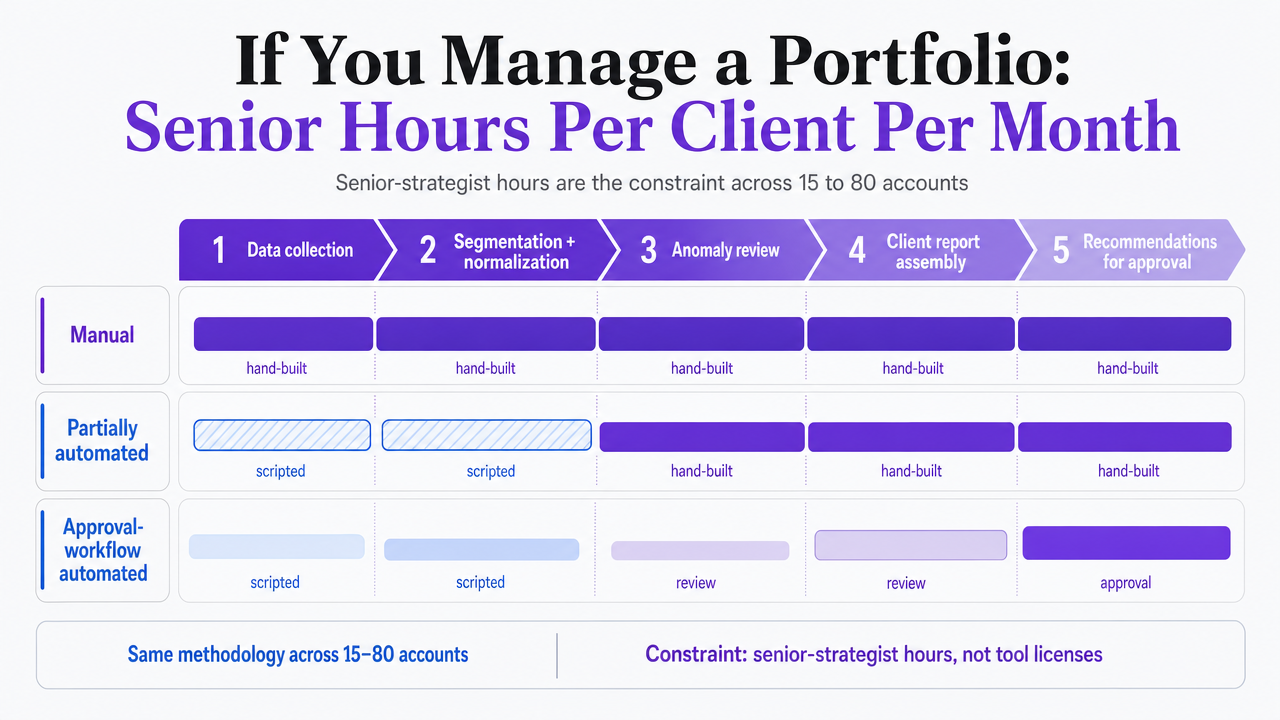 Visualize the comparison table from the section showing how three delivery models (manual, partially automated, approval-workflow automated) compress senior-strategist hours across the five workflow stages
From Rank Data to Approval-Ready Recommendations
The last mile of a rank-checker operating system is the handoff from segmented data to a recommendation a client can approve. Reports that stop at observation generate meetings. Reports that end in a ranked, reasoned recommendation generate decisions.
A recommendation becomes approval-ready when four elements travel together:
- the cohort or URL the recommendation affects
- the segmented evidence behind it drawn from Search Console query, page, country, device, and search-appearance breakdowns 1
- the diagnostic reasoning that links the evidence to the proposed action 2
- the expected outcome stated in a metric the client already tracks
A recommendation to rework a practice-area page because its commercial-local cohort slid from an average position of 1.9 to 2.7 while impressions held flat reads differently than "we noticed rankings dropped." The first is actionable. The second is a prompt for debate.
Routing matters as much as drafting. Recommendations should enter a single queue where a senior strategist reviews, edits, or rejects each one before it reaches the client, with the sign-off recorded against the ticket. That discipline keeps AI-assisted drafting inside the quality boundary Google's guidance draws around useful, human-reviewed output 5 and gives the agency a defensible audit trail for every change shipped on a client's property.
Platforms like Vectoron are built around that approval-first pattern, which is where rank-checker strategy stops being a reporting problem and becomes a delivery system.
Frequently Asked Questions
References
- 1.How To Use Search Console.
- 2.Debugging drops in Google Search traffic.
- 3.A Guide to Google Search Ranking Systems | Documentation.
- 4.AI Features and Your Website | Google Search Central.
- 5.Google's Guide to Optimizing for Generative AI Features on ....
- 6.Spam Policies.
- 7.API Reference | Search Console API - Google for Developers.
- 8.Web Vitals | Articles | web.dev.
- 9.How Does Ranking Affect User Choice in Online Search?.
- 10.Measuring Personalization of Web Search.