
Key Takeaways
- Scaling organic visibility depends on treating SEO as a three-layer system: a quality standard AI must clear, technical eligibility run as a repeatable workflow, and AI-assisted execution with named approval gates.
- Volume tactics fail because industry leaders' generative engine optimization performance can lag classic SEO by 20 to 50 percent, and pages must offer unique, substantive content to be selected 18.
- Every page needs at least one element competitors cannot replicate, such as internal data, proprietary frameworks, or expert judgment, or it becomes production overhead rather than pipeline 1.
- Focus next on measuring elapsed days versus active hours per page, moving structured data into drafting, and assigning single approvers to strategy, editorial, and technical gates.
The Production Bottleneck Behind Stalled Organic Growth
Most in-house marketing teams are not losing organic search visibility because they lack ideas or effort. They are losing it because the production system between an idea and a live, eligible page still runs on briefing cycles, review loops, and vendor handoffs designed for a slower search environment.
The math has changed. Google's 2025 guidance for AI search experiences is explicit that pages must meet technical requirements to be found, crawled, indexed, and considered, and must offer unique, satisfying content on top of that eligibility 2. Volume alone does not clear either bar. Neither does a retainer that produces twelve mediocre posts a quarter.
VPs of marketing feel this as a widening gap between the pipeline number they own and the throughput their current headcount can deliver. Adding a writer or another agency does not close it, because the constraint is coordination cost, not writing capacity. Each brief passes through a strategist, a writer, an editor, a technical reviewer, and a publisher, and each handoff introduces delay and quality drift.
Scaling organic visibility now depends on treating SEO as a linked production system: a content quality standard that AI output must clear 1, a technical eligibility layer that runs as a repeatable workflow 3, and an execution layer where AI does the assembly work while humans keep approval authority. The sections that follow diagnose where that system breaks and how leaner teams are rebuilding it without new hires.
Why Volume Tactics Fail in AI-Era Search
The old logic was straightforward: publish more pages, cover more queries, capture more clicks. That logic breaks when the search result itself is an AI-generated answer that may or may not surface the source page at all.
McKinsey's analysis of AI search puts a number on the exposure. Industry leaders' generative engine optimization (GEO) performance may lag their classic SEO performance by 20 to 50 percent, meaning brands that already win in traditional rankings are underrepresented when AI answers pull from the same content pool 18. The gap is not distributed evenly across the market. It is specifically the leaders, the ones with the deepest content libraries, who are losing ground in AI answer experiences.
Publishing more pages into that gap does not close it. Google's 2025 guidance for AI search experiences is explicit that pages must first meet technical requirements to be found, crawled, indexed, and considered, and then must offer unique, satisfying content on top of that eligibility 2. A high-volume backlog of thin pages fails on both counts. The pages may be crawlable but not distinctive enough to be selected as source material, or distinctive but missing the structured signals that make them legible to AI systems.
The quality standard has also tightened. Google asks whether a page provides original information, reporting, research, or analysis, and whether it offers a substantial description of the topic 1. Volume tactics optimize for the opposite: covering more surface area with less depth per page.
For in-house teams, this reframes the growth problem. The question is not how many more posts can ship this quarter. It is which pages are eligible for both classic ranking and AI answer selection, and how many of those the current production system can actually produce.
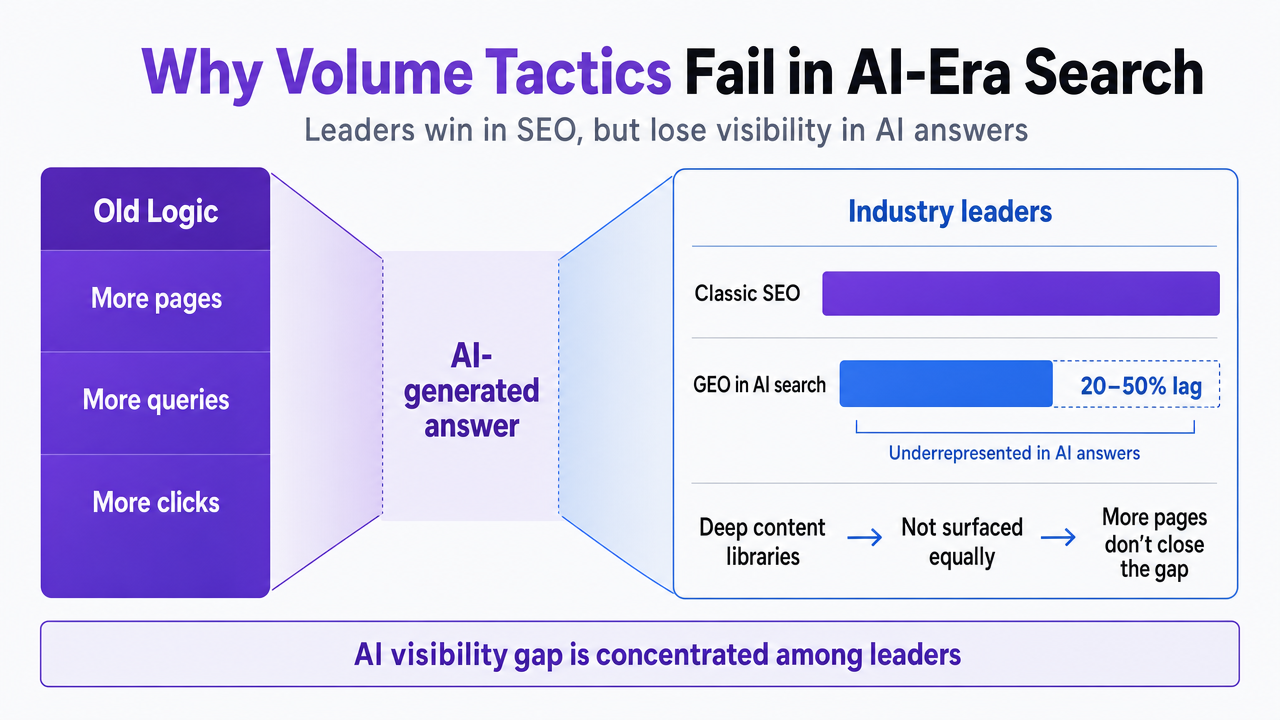 Visualize the McKinsey finding that industry leaders' GEO performance lags SEO by 20-50%, directly supporting the section's core argument about the AI-era visibility gap
The Three-Layer System Replacing Headcount
Layer One: A Quality Standard AI Output Must Clear
The quality bar is not a stylistic preference. It is a documented threshold that determines whether a page is treated as a candidate for ranking and AI answer selection or filtered out as low-value.
Google's helpful-content guidance asks whether a page provides original information, reporting, research, or analysis, and whether it offers a substantial, complete, or comprehensive description of the topic 1. Those two questions do most of the work. A page that summarizes what already exists on the first page of results fails the first test. A page that answers a query in three shallow paragraphs fails the second.
For in-house teams using AI to draft at scale, this reframes what the AI is actually for. It is not for producing finished pages. It is for producing the assembly work, the outlines, the first-pass structure, the summary of source material, so that the human contribution can concentrate on what the guidance rewards: original analysis, proprietary data, expert judgment, and depth that a generic model cannot fabricate.
Google's 2025 AI-search guidance reinforces the same standard from the other direction. Pages must offer unique, satisfying content to be considered in AI experiences, on top of meeting technical requirements to be found and indexed 2. Uniqueness is the operative word. AI-drafted content that reads like every other AI-drafted page on the same topic will not be selected as a source.
The practical rule for lean teams is straightforward. Every page needs at least one element a competitor cannot easily replicate: internal data, a proprietary framework, a named expert's judgment, or original research. Without that element, the page is production overhead, not organic pipeline.
Layer Two: Technical Eligibility as a Repeatable Workflow
Technical eligibility is where lean teams either compound their advantage or bleed it. Google Search Essentials lists the baseline plainly: pages must be crawlable, links must be discoverable, and content must meet helpful-content standards to be considered at all 3. None of that is optional, and none of it is a one-time project.
Structured data is the highest-leverage piece of this layer for in-house teams. It is the mechanism by which a page tells search engines and AI systems what it actually is, rather than leaving that interpretation to inference. Google's documentation is direct that structured data helps search engines understand page content and supports richer search appearances, with JSON-LD recommended as the format that is easiest to implement and maintain at scale 4. Multiple templates can share the same markup pattern, which is what makes the workflow repeatable rather than page-by-page.
The policy side matters as much as the technical side. Google requires that structured data be a true representation of the page content, and misleading or irrelevant markup is not eligible for rich results 5. For teams generating markup programmatically, this means the workflow needs a validation step tied to the actual page content, not just schema-validator syntax checks.
Coverage decisions should follow business templates rather than every supported type. Google's list of supported structured-data types spans articles, FAQs, products, videos, and local business results, and prioritizing the templates that match a site's page types delivers more return than chasing every eligible format 6. For multi-location service brands, local business and product markup on service pages typically produce the largest visibility gains per hour of engineering time.
The evidence that semantic structure changes discoverability is not just anecdotal from SEO practice. Peer-reviewed research on search-engine performance found that applying semantic analysis and optimization techniques improved recall from 72 percent to 89 percent and precision from 78 percent to 92 percent 17. Those gains describe search-engine engineering rather than SEO tactics directly, but the principle transfers: pages that are semantically legible get retrieved more accurately and more often.
Multi-engine coverage is a smaller but real part of the workflow. Bing's webmaster guidelines formalize expectations for acceptable site behavior and search-friendly content across a second major surface 9, and the Bing Webmaster API supports programmatic diagnostics and monitoring that lean teams can automate rather than staff 10. The point is not that Bing traffic rivals Google. It is that the same structured signals feed multiple discovery surfaces, so the marginal cost of coverage is low once the workflow exists.
Documentation drift is the last operational risk. Google's search documentation updates page records changes and removals to structured-data types and other guidance 8. A markup workflow that is not reviewed against those updates on a set cadence will accumulate stale patterns that quietly lose eligibility.
Layer Three: AI-Assisted Execution With Approval Gates
The third layer is where most teams either capture the productivity gain or lose it to rework. AI-assisted execution is not a matter of buying a writing tool and pointing it at a content calendar. It is a governance design question: what does the AI produce, what does a human approve, and where does the approved output go automatically after sign-off.
McKinsey's research on gen AI adoption frames this transition as a shift from isolated employee experimentation to organizational transformation, meaning the productivity gains arrive only when the workflow itself changes, not when tools are layered on top of existing coordination overhead 13. Teams that add AI drafting without redesigning the review and publishing steps typically see slower cycles, not faster ones, because they have added a new artifact to review without removing the artifacts that already existed.
The design principle that works is approval-first automation. AI handles signal detection, ranked recommendations, draft assembly, structured-data generation, and publishing execution. Humans hold the decision authority at named gates:
- Strategy approval before a topic enters production
- Editorial approval before a draft becomes a page
- Technical approval before markup goes live
Everything between those gates runs without a meeting.
Two operational constraints keep this from becoming shadow automation. First, every AI-generated recommendation should carry its reasoning so the human approver can evaluate the logic, not just the output. Second, the substantiation requirement from Layer One does not relax at this layer. Original information, reporting, research, or analysis is still the standard the page must clear 1, and the approval gate is where that standard gets enforced.
The headcount math changes when this layer works as designed. A team of three or four with a governed AI production system can publish, mark up, and monitor at a throughput that previously required a writer, an SEO specialist, a technical resource, and an agency retainer. The staff did not disappear. The coordination between them did.
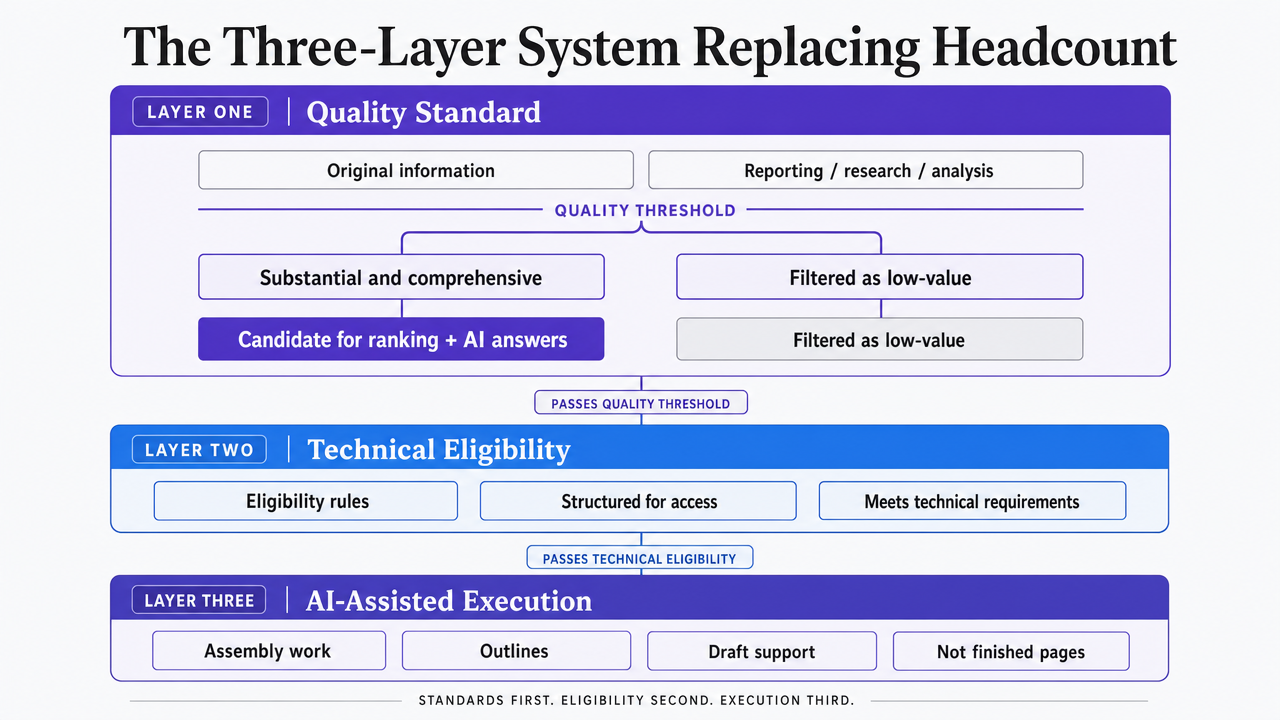 Visualize the three-layer operating model that structures the entire article's central framework, showing how quality standards, technical eligibility, and AI-assisted execution stack together
Experience AI-driven organic pipeline growth firsthand
Test real-time organic search execution and measure outcomes before making a commitment.
Quantifying the Productivity Opportunity
The economic case for redesigning the production system rests on published research, not vendor projections. McKinsey estimates that generative AI could increase the productivity of the marketing function by 5 to 15 percent of total marketing spending, with SEO tasks such as titles, image tags, and content creation named among the supported use cases 11. The range is scoped as a share of total marketing spending, not as a top-line revenue lift or a headcount reduction, and that distinction matters when translating it into a plan.
For a marketing organization spending $4 million annually, the range implies $200,000 to $600,000 in recoverable productivity, roughly the fully loaded cost of two to five specialists. That capacity does not have to come out as layoffs. It typically shows up as reassigned hours: fewer people producing briefs, more people producing original analysis, proprietary data, and the depth that Google's helpful-content guidance rewards 1.
The gains are not automatic. McKinsey's follow-on research on gen AI adoption frames the shift as one from isolated employee experimentation to organizational transformation, meaning the 5 to 15 percent range assumes workflow redesign rather than tool layering on top of existing coordination overhead 13. Teams that add AI drafting without changing review and publishing steps generally capture the low end of the range or less.
The strategic read for VPs of marketing is that the productivity opportunity is real and sized, but it is claimed by whoever redesigns first, not whoever buys tools first.
Diagnosing Where Coordination Cost Hides
Coordination cost is the line item that never appears on a marketing budget but consumes most of the calendar. It is the time between a topic decision and a live page, and for most in-house teams it dwarfs the time spent actually writing.
Four handoffs typically account for the bulk of it:
- Briefing, where a strategist translates a topic into a document a writer can act on.
- Drafting, where a writer or agency produces a first version.
- Review, where an editor, a subject-matter expert, and sometimes a legal or compliance reviewer each mark up the same file in sequence.
- Publishing, where a technical resource adds structured data, checks internal links, and pushes the page live.
Each step is defensible on its own. The problem is the queue time between them, which is where weeks disappear.
A useful diagnostic is to measure two numbers per page: active hours and elapsed days. Active hours are the time humans spent producing or reviewing. Elapsed days are calendar days from brief to publish. When the ratio of elapsed days to active hours exceeds roughly one to one, the constraint is coordination, not capacity. Hiring another writer at that ratio adds queue, not throughput.
The technical eligibility layer hides its own coordination cost. Structured data that must be a true representation of the page content 5 cannot be added as a post-publish afterthought without introducing a second review cycle. Teams that generate markup during drafting, tied to the same source content the writer used, remove that loop entirely. The savings are not glamorous, but they compound across every template on the site.
If You Manage Multiple Locations: Consolidation Economics
The economics shift when the reader owns organic pipeline across ten, fifty, or two hundred locations rather than a single site. Multi-location operators in legal, dental, home services, senior living, and healthcare typically inherit a stack that grew by acquisition: an SEO retainer covering the flagship brand, a separate local SEO vendor for location pages, freelance writers for blog throughput, and an in-house lead who spends most of the week coordinating between them. The organic result is uneven visibility across locations and a coordination bill that grows faster than pipeline.
The consolidation question is not whether to fire vendors. It is whether the same three-layer system, quality standards, technical eligibility, and AI-assisted execution with approval gates, can run once for the parent brand and inherit down to every location page. Google's structured-data documentation supports this pattern directly: local business and product markup are listed among supported types, and a single template can generate valid JSON-LD for every location if the source data is accurate 6. Structured data must remain a true representation of the page content at each location, which is where the approval gate does its work 5.
The productivity math anchors to McKinsey's 5 to 15 percent range on total marketing spending 11, but the leverage compounds with location count because the same workflow serves every unit. The variables that matter are retainer spend, in-house FTE cost, and review-cycle hours per location per month.
| Cost line | Traditional multi-vendor model | Consolidated AI-assisted model |
|---|---|---|
| Brand-level SEO retainer | Monthly retainer, fixed regardless of output | Absorbed into platform + approval workflow |
| Local SEO vendor | Per-location monthly fee × location count | One markup and content workflow inherited by all locations |
| Freelance or agency writing | Per-post fee × publishing cadence | AI drafts + human approval at editorial gate |
| In-house coordination | 0.5 to 1.0 FTE managing vendor handoffs | Reassigned to original analysis and expert review |
| Technical SEO vendor | Project-based, triggered by audits | Continuous, programmatic diagnostics 10 |
The line that moves first is coordination FTE, not vendor spend. Operators who consolidate typically hold headcount flat and redirect the coordinator's hours toward the original analysis and proprietary data that Google's helpful-content standard actually rewards 1. That reassignment is where the productivity range gets captured rather than left on the table.
See How Top Brands Scale Organic Search Without Adding Headcount
Request a walkthrough of the platform that automates multi-channel SEO execution and content production—backed by live performance data—while keeping full control in-house.
Governing AI Output Without Slowing It Down
Governance is where most AI content programs quietly fail. Either the review process becomes so heavy that it erases the productivity gain, or it becomes so light that ineligible pages ship and the site accumulates the kind of unhelpful content that Google's guidance explicitly filters against 1.
The design that holds both together is narrow, high-authority approval at fixed points rather than broad, low-authority review across every artifact. Three gates carry most of the weight:
- A strategy gate confirms that the topic has an original element a competitor cannot easily replicate before drafting begins.
- An editorial gate confirms that the finished page provides original information, reporting, research, or analysis and a substantial description of the topic 1.
- A technical gate confirms that structured data is a true representation of the page content before markup goes live 5.
What sits between the gates should not require meetings. AI drafts, assembles markup, checks internal links, and stages the page. The approver sees the recommendation, the reasoning, and the finished artifact in one view and either signs off or sends it back with a specific reason.
Two disciplines keep this from drifting. Every AI output carries its source material and its logic, so an approver evaluates the reasoning, not just the prose. And the update cadence tracks Google's documentation changes 8, so markup patterns and content standards do not silently fall out of eligibility while the workflow keeps producing at speed.
A 90-Day Path to a Governed Production System
Redesign happens in phases, not in a single sprint. A 90-day sequence gives in-house teams enough time to change the workflow without stalling publishing during the transition.
- Days 1 to 30: baseline and quality standard. Audit the current queue. Measure active hours and elapsed days per page across the last quarter. Identify the templates that carry the most organic traffic and the fewest structured-data signals. Write the editorial standard the team will hold every AI-assisted page to, anchored to Google's helpful-content questions on original information, reporting, research, or analysis and substantial topic coverage 1. Nothing publishes without an identified original element.
- Days 31 to 60: technical eligibility as a workflow. Move structured data into the drafting step rather than a post-publish task. Standardize JSON-LD templates for the two or three page types that matter most, validated against the actual page content each time 5. Set a monthly cadence for reviewing Google's documentation updates so markup patterns do not silently expire 8. Add programmatic diagnostics for a second engine surface where the marginal cost is low 10.
- Days 61 to 90: approval gates and measurement. Name the three gates, strategy, editorial, technical, and assign a single approver to each. Retire the review steps between them. Track elapsed days per page and the ratio of eligible pages published. That ratio, not raw output, is the metric the pipeline number now rides on. Platforms like Vectoron are built around this approval-first pattern for teams making the shift.
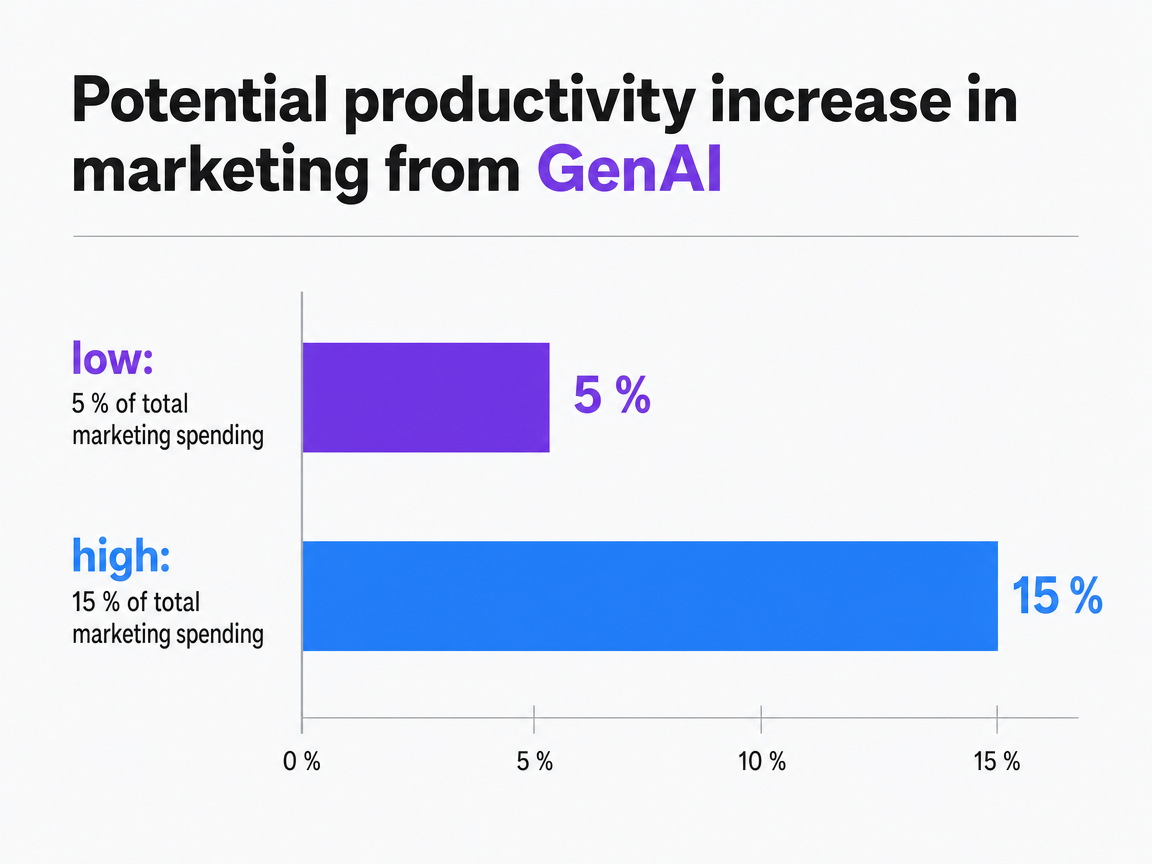 Potential productivity increase in marketing from GenAI
McKinsey estimates that generative AI could increase the productivity of the marketing function by 5% to 15% of total marketing spending. This can be visualized as a range or bar chart showing the low and high estimates.
Frequently Asked Questions
References
- 1.Creating Helpful, Reliable, People-First Content.
- 2.Top ways to ensure your content performs well in Google's AI search experiences.
- 3.Google Search Essentials.
- 4.Intro to How Structured Data Markup Works.
- 5.General Structured Data Guidelines.
- 6.Structured Data Markup that Google Search Supports.
- 7.Intro to Product Structured Data on Google.
- 8.Latest Google Search Documentation Updates.
- 9.Webmaster Guidelines.
- 10.Bing Webmaster API.
- 11.The economic potential of generative AI: The next productivity frontier.
- 12.The economic potential of generative AI.
- 13.Gen AI adoption: The next inflection point.
- 14.Search engine Performance optimization: methods and techniques.
- 15.Google Updates Structured Data Guidance To Clarify Supported Formats.
- 16.Google Updates Guidance On Helpful Content System and Discover.
- 17.Search engine performance optimization: methods and techniques.
- 18.New Front Door to the Internet: Winning in the Age of AI Search.