Key Takeaways
- Search position is the dominant traffic lever, with pages outside the top five losing roughly 90% of clicks and a 1% rank gain within the top five yielding about 1.3% more clicks 14.
- Prioritize the inputs that move rank for commercial-intent queries: intent-matched content by page type, readable copy, descriptive internal linking, technical hygiene, and quarterly refresh cycles 16.
- Pruning redundant, outdated, and trivial pages and rewriting high-traffic, low-engagement URLs often outperforms publishing new content, since consolidation concentrates authority on canonical pages 4.
- Sequence work by scaling efficiency—template-layer technical and linking fixes first, then audit-driven refresh cycles, then page-level tuning for queries closest to monetization 5.
The Impact-Weighted View of Organic SEO
Organic SEO encompasses numerous tactics, but the work that drives qualified traffic focuses on a smaller, high-impact set. Research on retail search behavior indicates that exclusion from the first five pages of results reduces organic clicks by approximately 90%, while a 1% rank improvement within those first five pages can increase clicks by about 1.3% 14. While these specific magnitudes may vary by industry and changes in search engine results page (SERP) design, the fundamental principle remains consistent: search position is the dominant factor 18.
For growth directors managing a portfolio of service-line or location pages with limited resources, this insight reframes prioritization. Efforts that secure top positions for commercial-intent queries yield compounding returns. Conversely, work focused on secondary metrics—such as meta tag adjustments, image alt text, or schema additions—rarely improves rank independently 2. Both types of activities are important, but their impact on ranking is not equal.
This article ranks organic SEO activities by their evidence strength, starting with the primary ranking lever itself and then detailing the inputs that directly influence it: intent-matched content, clear and readable copy, internal linking for authority distribution, technical hygiene, and systematic content refresh cycles 16. The objective is to provide a decision framework for portfolio management, rather than a generic checklist of equally weighted best practices.
Ranking Position: The Dominant Traffic Lever
Among all factors influencing organic traffic, a page's position on the search results page is paramount. An empirical analysis of retail search behavior precisely quantified this elasticity: pages outside the top five results experience a roughly 90% reduction in organic clicks, whereas a 1% rank improvement for pages already within the top five yields about 1.3% more clicks for the same query 14. While this study focused on retail and predates recent SERP changes like AI overviews, the directional finding—that click-through rates are highly sensitive to visible position—is consistent across broader research on organic and paid interactions 17.
The operational implications are significant. A service-line page on page three of search results captures only a fraction of the demand that a page-one position would attract for the identical query, irrespective of content quality. Growth teams that allocate production hours uniformly across a portfolio without considering current rank risk subsidizing pages that cannot effectively convert demand into pipeline. By benchmarking traffic, keyword rankings, and conversion rates before allocating effort, teams can identify pages situated on the steep part of the elasticity curve, where minor position gains lead to disproportionately large increases in clicks 5.
This prioritization logic underpins the activities discussed in subsequent sections. Intent-matched content, internal linking, technical hygiene, and content refresh cycles are not coequal tasks; they are inputs evaluated by their reliability in improving rank for monetizable queries 18. Activities that enhance user experience without directly impacting rank are still valuable but should be sequenced after those that influence position for commercial-intent terms.
Content Built for Search Intent and Reader Comprehension
Matching Query Intent to Page Type
Rank improvements are driven by content that directly answers the specific question behind a query, rather than merely mentioning keywords. For example, the query "crm integration with hubspot" suggests a need for a comparison or technical setup guide. "What is a crm" indicates a search for a definitional explainer, and "crm pricing" expects transactional details. Creating a single page that attempts to address all three intents will likely fail to rank for any, as search engines deliver distinct result types for each intent 18.
For SaaS growth teams, a practical approach involves inventorying commercial-intent queries by page type—such as comparison, integration, alternative-to, pricing, or use-case—and assigning each query to a single canonical page. This prevents diluting coverage across multiple, overlapping posts. Federal content guidance supports this, noting that a prioritized keyword list, integrated into specific pages, outperforms broad keyword coverage on generic content 3. Keyword research informs these assignments, which then dictate page structure.
An intent mismatch often manifests as high impressions with low click-through rates, or healthy clicks coupled with weak engagement 4. These are diagnostic signals. A page ranking on page two for a query whose intent it doesn't serve will not improve its position, regardless of link equity or freshness. The operational solution is to rewrite the page to align with the intent, or to split it into multiple pages, each addressing a distinct intent 5.
Readability as a Measurable Ranking Lever
Readability, often categorized under user experience, significantly impacts organic performance. A 2024 peer-reviewed analysis of diabetic retinopathy patient education pages revealed that 97% of these pages exceeded the median U.S. health literacy level. The study found that improved readability, measured by a lower Flesch-Kincaid grade level, was significantly associated with higher SEO scores and earlier appearance in search results 15. While this study focused on a specific clinical subset, the directional finding aligns with broader research on health content: much online health information is written above recommended reading levels, creating a disconnect between content creation and user consumption 19.
[CHART: Readability grade level vs. SEO score for diabetic retinopathy patient education pages, showing the inverse relationship documented in the 2024 analysis where 97% of pages exceeded median U.S. health literacy and lower-grade-level pages appeared earlier in results — ref_15]
The mechanism is indirect but observable. Pages written above the audience's reading level typically result in higher bounce rates and shorter dwell times. Search engines interpret reduced bounce rates as a positive signal 8. For instance, a condition-symptom page written at a twelfth-grade reading level will lose readers who initiated a query phrased at a seventh-grade level, leading to an engagement gap that eventually becomes a ranking gap. This dynamic is also evident in non-clinical content evaluated against general-audience reading levels 20.
For multi-location healthcare operators, this has concrete implications: condition pages, procedure explainers, and intake content should be drafted and measured against a target grade level. Plain-language revisions are not merely a stylistic choice; they alter the engagement signals that search engines weigh, and evidence from healthcare content links this change to measurable SERP movement 15. SaaS teams creating technical content face a similar challenge, where documentation and feature pages requiring high domain fluency will underperform comparison and use-case pages that meet readers at their specific intent.
Internal Linking and Site Architecture as Authority Distribution
Once a portfolio of pages acquires external links, the internal architecture determines how that authority is distributed. Search engines consider link popularity and the diversity of link sources when assessing page authority. However, the internal structure connecting pages on the same domain dictates how this authority flows to the URLs that generate business value 6. A homepage with strong external signals provides little benefit to a deeply buried integration page if no clear internal path with descriptive anchor text connects them.
The mechanics are straightforward. Anchor text containing relevant keywords improves both crawl interpretation and user navigation, while generic phrases like "click here" are inefficient 1. Descriptive anchors that clearly name the destination—for example, "HIPAA-compliant intake workflow" instead of "learn more"—provide search engines with explicit signals about the target page's topic, aligning it with relevant queries 7. Anchor link patterns within long pages, accordion structures, and back-to-top navigation also aid reader scanning and help crawlers map content hierarchy 1.
For multi-location healthcare operators and SaaS teams managing multiple service-line pages, internal linking acts as a portfolio-level lever. A condition page linking laterally to related procedure pages, then upward to a service-line hub, and then outward to location pages effectively distributes authority along the path a researching patient or buyer would naturally follow. Pages isolated from this internal link graph will rank below what their content quality might suggest, because no internal signal informs the index of their relevance within the site's topical cluster.
The combination of keyword-focused link text, diverse external links, and a coherent on-page hierarchy determines whether authority concentrates on high-intent pages or disperses across the site 6. Auditing the existing internal link graph—identifying which pages link to others, with what anchor text, and whether commercial-intent pages are within three clicks of the homepage—reveals structural fixes that can yield compounded benefits across the entire portfolio without requiring new content production 16.
Test organic SEO execution with real campaigns
Validate which SEO activities move the needle using your actual data and live content before committing.
Technical Hygiene: Speed, Crawlability, and On-Page Execution
Technical SEO primarily removes barriers to ranking rather than directly boosting it. A fast, crawlable page with clean on-page markup won't necessarily outrank a slower one solely due to technical superiority. However, a slow or poorly structured page will limit the potential rank its content can achieve. Federal accessibility reviews highlight desktop and mobile page speed as a fundamental check, precisely because performance dictates whether arriving traffic stays on the site 10. Peer-reviewed research on search performance optimization broadly states that relevance, speed, and user experience are interconnected inputs, and weakness in one area degrades the others 12.
The on-page execution layer is where many teams over-allocate attention. While title tags with target keywords, descriptive image filenames and alt text, schema markup for eligible content types, and short, readable URLs are all part of the implementation checklist 2, none of these individually will elevate a page from position fifteen to position three. Their significance emerges when applied consistently across an entire portfolio, ensuring crawlers accurately interpret hundreds of pages without ambiguity 13. A Lighthouse audit conducted on representative templates can identify basic implementation gaps—such as missing meta descriptions, render-blocking resources, or unlabeled images—that become significant when multiplied across a multi-location footprint 9.
For growth directors, the sequencing of technical work is more critical than the inventory of tasks. Speed and crawlability fixes should be prioritized because they impact every page on the domain. On-page markup follows, as it scales efficiently through templates rather than requiring individual page edits. Page-level tuning should only occur after the foundational structural work is stable. Treating these items as isolated tasks rather than a coordinated technical baseline is a common pitfall that prevents high-quality content from ranking as its intent match would predict 5.
Content Refresh and ROT Pruning
Effective content audits often involve removing pages rather than just adding them. Federal content strategy guidance explicitly identifies ROT (redundant, outdated, trivial) analysis as a primary method for improving organic search performance, alongside a separate diagnostic for pages with high traffic but low engagement 4. Both categories are prevalent in established SaaS knowledge bases and healthcare websites that have accumulated years of condition pages, press releases, and superseded service descriptions.
[INFOGRAPHIC: Content audit triage quadrant based on the USDA framework — redundant, outdated, trivial, and high-traffic / low-engagement — used to classify each URL in a portfolio for refresh, consolidate, or remove decisions, per ref_4]
These four categories dictate different actions. Redundant pages—multiple URLs covering essentially the same intent—should be consolidated into a single canonical page, with weaker URLs redirected to transfer accumulated link signals to the survivor. Outdated pages with enduring intent should be rewritten with current data and republished. Outdated pages whose intent is no longer relevant should be removed entirely. Trivial pages that never attracted traffic and lack an internal linking role should also be de-indexed. The high-traffic / low-engagement quadrant is particularly diagnostic 4: these pages already attract clicks but fail to match user intent, making them prime candidates for high-leverage rewrites rather than new content.
Freshness is a parallel input. Search engines interpret reduced bounce rates as a positive signal 8, and pages that no longer reflect current product capabilities, pricing, or clinical guidelines quickly lose readers. For a multi-location healthcare operator, this might mean location pages referencing departed providers, changed service lines, or renegotiated insurance networks. For SaaS teams, it could involve comparison pages benchmarking against competitor versions that are two releases behind. Implementing a quarterly refresh cycle focused on commercial-intent pages—rather than the entire site—captures most of the ranking benefits without causing audit fatigue 5.
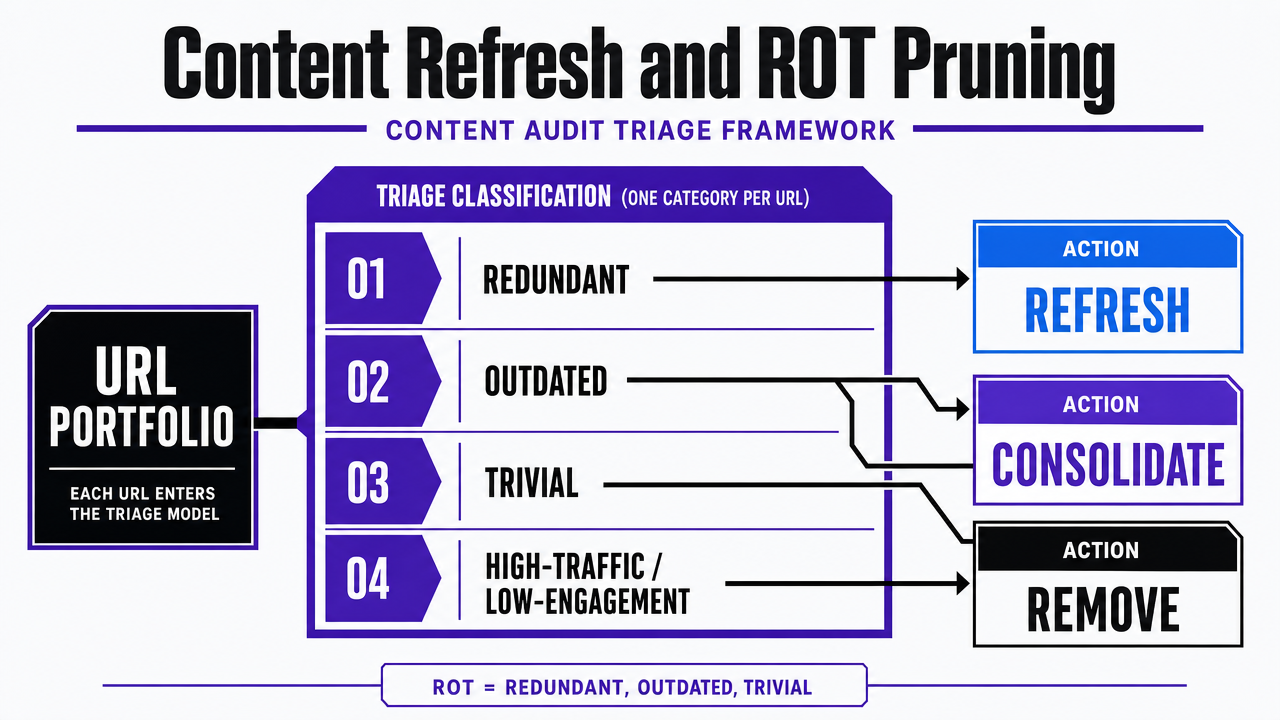 Visualize the four-category content audit triage framework cited from USDA guidance, which the section explicitly walks through as the operational decision model
Folklore vs. Durable Levers: What to Stop Doing
Several practices commonly found in agency deliverables lack strong empirical support as independent ranking factors. Academic research distinguishes between evidence-based strategies and myths, identifying a core set of durable inputs—such as link popularity from diverse sources, keyword presence in title tags and visible content, and a crawlable site structure. This research also highlights that many granular tactics promoted as "ranking hacks" do not withstand controlled study 11. Examples include:
- rigid keyword density targets
- excessive exact-match anchor text stuffing
- meta keywords tags
- shallow link exchanges
A more costly misconception in operational settings is the pursuit of content volume for its own sake. Simply producing more pages does not improve rank if the new content duplicates existing intent or falls outside the internal linking graph that distributes authority 6. Federal content guidance reinforces this point: high-traffic pages with low engagement and redundant URLs indicate an over-published portfolio that requires consolidation, not expansion 4. Growth teams that actively prune ROT often observe rank improvements on their surviving canonical pages within a single quarter 4. Knowing what to stop doing is as crucial as knowing what to start.
See How Top SaaS Teams Automate High-Impact SEO Activities
Request a walkthrough of automated workflows for keyword gap analysis, technical audits, and content optimization—backed by benchmark data from high-growth SaaS and enterprise campaigns.
Portfolio Execution: When Activities Compound
If a Team Manages Multiple Service Lines or Locations
The SEO activities discussed behave differently when applied across an entire portfolio compared to a single page. For a multi-location healthcare operator managing condition pages, procedure pages, provider bios, and location landing pages across thirty or more sites, each activity becomes a template-level decision rather than a per-page edit. A title tag convention that performs well on one location page can be applied to all. An internal linking pattern that routes authority from a service-line hub to its underlying procedure pages can be replicated across every service line on the domain. This approach allows work to scale through structural implementation, not through increased labor 16.
SaaS teams managing comparison, integration, and use-case pages across multiple product lines face the same template logic. A readability standard set at a seventh-grade target for use-case content can be applied consistently across the entire portfolio. A schema implementation rolled out at the template layer will cover all future pages built from that template 2. The pages that benefit most are those already positioned on the steep part of the rank elasticity curve—close enough to page-one visibility that template-level improvements can push them across the threshold 5.
The primary failure mode in portfolio execution is inconsistent application. A portfolio where half the location pages use descriptive anchor text and the other half use generic phrases sends fragmented signals to crawlers, leading to underperformance compared to a smaller, consistently executed portfolio 7.
Activity Prioritization Across a Page Portfolio
Allocating finite production hours across a portfolio requires prioritizing activities based on their impact mechanism, evidence strength, and how efficiently that impact scales across multiple pages. The table below summarizes the major levers discussed, evaluated against these three dimensions.
| Activity | Impact mechanism | Evidence | Portfolio scaling ||---|---|---|---|| Rank-position improvement on commercial-intent queries | Direct click capture; position dominates organic traffic | 14, 18 | Concentrates on pages near page-one threshold || Intent-matched content by page type | Aligns page with the result type the query expects | 3, 18 | Scales through page-type templates || Readability against audience grade level | Reduces bounce; engagement signals feed rank | 15, 8 | Scales through editorial standard across templates || Internal linking with descriptive anchors | Distributes external authority to commercial pages | 1, 6, 7 | Scales through site architecture, not per-page work || Technical hygiene (speed, crawlability, schema) | Removes ranking ceilings; gates traffic retention | 10, 2, 9 | Scales through template and infrastructure fixes || Content refresh and ROT pruning | Consolidates authority; removes engagement drag | 4, 8 | Scales through quarterly audit cycles |
Directors should sequence work by scaling efficiency: template-layer fixes first, followed by audit-driven refresh cycles, and then page-by-page rank optimization for queries closest to monetization 5.
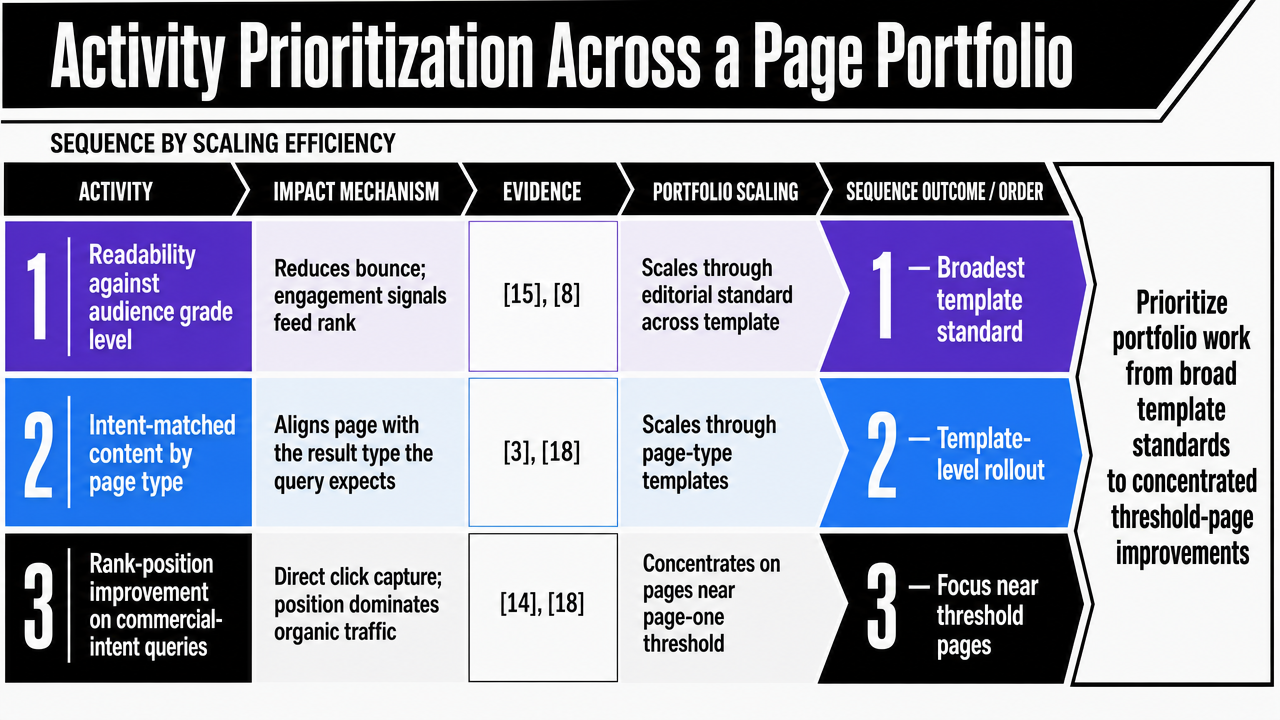 Convert the article's prioritization table into a scannable process visual showing how to sequence SEO activities by scaling efficiency, which the section explicitly recommends
Organic and Paid as Channel Interactions, Not Substitutes
Growth directors often view the decision to shift budget from paid search to organic work as a simple substitution. However, field experiments on the interaction between organic and sponsored listings refute this framing. The position and visibility of organic results significantly influence click-through rates on both types of listings. The two channels can behave as complements or substitutes depending on the query type, brand recognition, and SERP layout 17. For example, a branded query with a strong organic position might render a paid impression redundant, while a high-intent commercial query with weak organic visibility will lose traffic to competitors regardless of paid spend.
For portfolio owners, the operational takeaway is that organic investment should be evaluated based on queries where rank gains either reduce reliance on paid bids or expand coverage on terms that paid channels cannot economically sustain. Treating SEO as a cost-effective complement to paid media, rather than a direct replacement, aligns with both experimental evidence and the integrated channel model that consistently outperforms isolated tactics 18.
Where Execution Capacity Becomes the Real Constraint
The activities that drive organic growth are well-known. Intent-matched content, internal linking, technical hygiene, readable copy, and disciplined refresh cycles are consistently identified in credible analyses as key drivers of rank 16. The primary challenge for most growth directors is not identifying these activities, but rather sustaining coordinated execution across a portfolio of service-line or location pages without production capacity issues leading to inconsistent coverage 5. Template-level fixes, quarterly ROT audits, and rank-tracked refresh cycles all demand a consistent delivery cadence that traditional retainer-and-handoff models often struggle to maintain across dozens or hundreds of URLs.
This is where the operating model becomes more critical than the tactic list. AI-driven execution platforms like Vectoron reduce the coordination overhead that often hinders portfolio SEO programs. They manage content, technical, and authority work against a single account-level plan, offering a unit-economic profile (e.g., a $599 monthly trial price) that allows directors to test sustained execution against the activity priorities outlined here without the variability of agency retainers.
Frequently Asked Questions
References
- 1.Links and Within Page Navigation.
- 2.SEO-Best-Practices - CT.gov.
- 3.Assessing State UOCAVA Web Pages.
- 4.Content Plays | USDA.
- 5.Six Ways to Improve Your Site's Ranking (SEO).
- 6.Search Engine Optimization (SEO) | University of Puget Sound.
- 7.Search Engine Optimization (SEO) - SMU.
- 8.Overview of SEO and How to Improve Google Rankings.
- 9.Overview - Digital.gov.
- 10.Access Findings Overview | LSC - Legal Services Corporation.
- 11.How to Improve Your Google Ranking: Myths and Reality.
- 12.Search engine Performance optimization: methods and techniques.
- 13.Visibility of Moodle applications in Central Asia: analysis of SEO.
- 14.Search Engine Optimization: What Drives Organic Traffic to Retail Sites.
- 15.Search engine optimization and its association with readability and information quality of online patient resources on diabetic retinopathy.
- 16.Search Engine Optimisation (SEO) strategy as determinants to viral marketing.
- 17.Analyzing the Relationship Between Organic and Sponsored Search Advertising: A Field Experiment.
- 18.The Significant Role of SEO in Effective Web Marketing.
- 19.Health Information on the Internet: Accessibility, Quality, and Readability in English, Spanish, and Korean.
- 20.Readability and Suitability of Information Presented on a University Health Center Public Website.