
Key Takeaways
- Publishing high volumes of thin or templated pages triggers Google's scaled content abuse policy and drags down the whole domain 1; consolidate near-duplicates, cull low-effort URLs, and measure content teams on effort per page instead of publish count.
- Parameter variants, inconsistent canonicals, orphaned pages, and generic anchor text split authority across duplicate URLs 12; audit canonical selection with URL Inspection, rebuild a hub-and-spoke internal link graph, and enforce descriptive anchors in the CMS 13.
- Ranked pages that miss Core Web Vitals thresholds at the 75th percentile of field data quietly lose conversions 4; hold every commercial template to LCP under 2.5s, INP under 200ms, and CLS under 0.1, and recheck field data after every deploy 14.
- AI Overviews cut traditional clicks to 8% of searches versus 15% without a summary 9, so rankings no longer equal traffic; implement schema that mirrors visible content to earn rich results and expand SERP footprint on queries that still click 5.
- When SEO, content, web performance, and pipeline sit in separate teams with separate scorecards, the other four mistakes keep resurfacing 17; assign one brief, one owner accountable from query to booked meeting, and one monthly feedback loop reading Search Console alongside the CRM.
Why Ranked Pages Stopped Producing Qualified Demand
Rankings and pipeline have quietly decoupled. Marketing teams with strong keyword footprints are watching sessions plateau and demo requests slide, and the diagnostic answer is no longer buried inside the algorithm. It sits in Google's own documentation and in recent user-behavior research that most SEO retainers have not adjusted for.
Pew Research found that when Google displays an AI summary, users click a traditional result in just 8% of searches, compared with 15% when no summary appears 9. Page-one visibility is now a smaller share of a shrinking click pool. At the same time, Google's spam policies, helpful-content framework, and Core Web Vitals thresholds have tightened what actually earns visibility in the first place 1, 2, 4.
Five execution mistakes explain most of the gap between ranked pages and qualified demand:
- Scaled content that trips Google's spam policy
- Canonical fragmentation
- Page-experience regressions
- Neglected structured data and SERP clickability
- Treating SEO as a siloed channel rather than a coordinated growth system 8, 17
Each has a diagnosable cause and a specific fix a VP can assign this quarter.
Mistake 1: Scaled Content That Trips Google's Own Spam Policy
What 'Scaled Content Abuse' Actually Covers
Google's spam policy names this directly:
"Scaled content abuse is when many pages are generated for the primary purpose of manipulating search rankings and not helping users" 1.
The policy is intent-based, not tool-based. Human writers churning out 400 near-duplicate location pages fall inside it. So does an AI pipeline pushing 200 templated blog posts a month with rotated intros and stock statistics.The distinction matters because most in-house SEO programs still measure content teams on published-page volume. That KPI conflicts with the policy language. Google's AI-content guidance draws the same line from a different angle:
"Using automation—including AI—to generate content with the primary purpose of manipulating ranking in search results is a violation of our spam policies" 3.
Method is irrelevant. Purpose and quality are what trigger suppression.
What triggers the policy in practice is a pattern: pages that exist because a keyword exists, not because a reader question exists. Landing pages built from a spreadsheet of cities. Glossary entries padded to hit a word count. Comparison posts that recycle vendor descriptions 2.
The Site-Wide Drag From Mediocre Volume
The pipeline consequence is not a per-page penalty. It is domain-level suppression. Google's August 2022 helpful content update introduced a site-wide signal designed to reward sites where visitors report a satisfying experience—and, by inversion, to demote domains carrying large volumes of unhelpful pages 15. That signal has since been folded into broader ranking systems, but the mechanic remains: mediocre pages published under the same domain pull down the pages a marketing team actually cares about.
Search Quality Rater Guidelines describe high-quality main content as work that
"takes significant effort, originality, and skill" 16.
Raters do not set rankings directly, but the framework describes what Google's systems are trained to approximate. A 900-word post assembled from three competitor articles fails that bar even when it ranks briefly.
For a VP inheriting an SEO retainer, the diagnostic question is not "is our content ranking?" It is "what percentage of our indexed URLs would a rater score as taking significant effort?" If the answer is under half, the ranked pages are subsidizing the ones dragging the domain. Rankings on the money pages are borrowed, not earned, and the next algorithm refresh reclaims them.
The Fix: Consolidate, Cull, Rewrite for Effort
Three actions, in order.
- Inventory every indexable URL and score it against Google's people-first questions: original information, substantial value, satisfying experience 2. Pages that fail on all three should be noindexed or 301'd into a stronger parent page, not left to age.
- Consolidate topical near-duplicates into single deeper pages. Ten thin posts on adjacent long-tail queries almost always underperform one comprehensive page with genuine expertise, examples, and primary sourcing. Consolidation also frees crawl budget for the URLs that matter.
- Reset the content team's KPI. Published-page count rewards the exact behavior Google's spam policy targets. Effort-per-page—measured in original research, expert input, or primary sourcing—produces the artifacts that survive updates. The volume drops. The pipeline contribution per page rises. Both outcomes are the point.
Mistake 2: Canonical and Internal-Link Fragmentation That Splits Authority
Parameterized URLs, Duplicate Templates, and Signal Conflicts
Google's canonicalization documentation describes the canonical URL as
"the most representative version from a set of duplicate pages,"
and notes that duplicates are crawled less frequently to reduce crawl load 12. That single sentence explains why so many well-optimized service pages underperform: the version a marketing team wants indexed is not always the version Google selects as representative.
The fragmentation usually starts quietly. Common sources include:
- A CMS appending tracking parameters to campaign URLs
- A filtered category page generating a dozen sort variants
- A staging subdomain left indexable
- A print-friendly template mirroring the canonical copy at a second URL
Each variant carries a fraction of the internal links, external links, and engagement signals that should have consolidated on one page.
Signal conflicts compound the problem. Google treats 301 redirects as a strong canonical signal, rel=canonical as strong, and sitemap inclusion as a weaker signal 6. When those signals disagree—say, a rel=canonical points to URL A while internal links and the sitemap point to URL B—Google picks its own representative and may override the declared preference 13. The pipeline consequence is a page that ranks intermittently, cannibalizes its own variants, and never accumulates the authority its content deserves. Crawl budget gets spent revisiting duplicates instead of discovering new commercial pages.
Orphaned Service Pages and Weak Anchor Text
Google's link guidance is unambiguous:
"every page you care about should have a link from at least one other page on your site" 7.
Yet audits of mid-market sites routinely surface money pages—industry vertical landers, secondary service pages, case studies gated behind form pages—that no internal link points to. They exist in the sitemap and nowhere else.
Orphaned pages are only half the problem. Weak anchor text is the other half. "Learn more," "click here," and "read this" strip Google of the contextual signal that internal links are supposed to carry. Google's own guidance calls for descriptive, concise anchor text that describes the destination 7. A CTA button labeled "Learn more" pointing to a workers' compensation page tells Google nothing about the destination's topic; a text link reading "workers' compensation claim process" tells it everything.
The compounding effect matters. A ranked blog post that links to three service pages with descriptive anchors passes topical relevance downward. The same post linking with generic anchors passes only crawlability.
The Fix: Audit With URL Inspection, Then Rebuild the Hub-and-Spoke
- Start with Search Console's URL Inspection tool. Google's troubleshooting documentation recommends it specifically for identifying which page it considers canonical versus what a team declared 13. Sample the top 50 commercial URLs. For every mismatch, trace the conflicting signal—usually a stray parameter, an inconsistent sitemap entry, or a rel=canonical set by a plugin.
- Map the internal-link graph. Every commercial page should sit inside a hub-and-spoke: a pillar page linking down to service or sub-topic pages, and those pages linking back with descriptive anchors. Orphaned pages either get integrated into the graph or get consolidated into a stronger parent 11.
- Standardize anchor text conventions in the CMS. Contributors should not be able to publish an internal link reading "click here." A brief style rule enforced at the editor level fixes 80% of anchor-text drift in a quarter.
Test automated SEO workflow on live content
Experience real-time content publishing and measurable organic pipeline impact during your trial period.
Mistake 3: Page Experience Gaps That Kill Conversion on Ranked Pages
The Thresholds VPs Should Be Enforcing
A ranked page that loads slowly, jitters during layout, or lags on interaction converts at a fraction of its potential. Google's Core Web Vitals guidance sets three thresholds that a marketing VP can hand directly to a vendor or engineering lead:
- Largest Contentful Paint under 2.5 seconds
- Interaction to Next Paint under 200 milliseconds
- Cumulative Layout Shift under 0.1 4
These are not aspirational targets. They are the field-data cutoffs Google uses to classify a URL as delivering a good experience.
The measurement rule matters as much as the numbers. Search Console's Core Web Vitals report groups URLs by similar page templates and assigns group status based on the 75th percentile of real user visits 14. A pricing page that loads in 1.8 seconds for the marketing team's laptop can still fail the threshold if three-quarters of mobile visitors experience LCP above 2.5 seconds on a mid-tier Android device. Lab data from a staging environment is not the metric being scored.
The operational shift is simple. Move performance conversations from average load time to 75th-percentile field data, and hold every commercial template—service pages, comparison pages, case studies—to the three thresholds by template group, not by individual URL.
INP Regressions Are the Silent Pipeline Killer
Interaction to Next Paint replaced First Input Delay as a Core Web Vital in 2024, and it is the metric most likely to be quietly failing on high-intent pages. INP measures the delay between a user's tap, click, or keystroke and the next visual response from the page 4. A demo-request form that takes 340 milliseconds to react to the first field click feels broken even when the page loads quickly.
The common culprits are predictable:
- Third-party tags loaded synchronously
- Oversized JavaScript bundles on service pages
- Chat widgets that block the main thread during hydration
Each ships without ceremony. A marketing ops team adds a heatmap script on Tuesday, and by Friday the INP for the highest-converting template has drifted past 200 milliseconds at the 75th percentile.
The diagnostic cadence should match the deploy cadence. Any change that adds a tag, swaps a hero image, or modifies a form component gets a Search Console field-data check the following week 14. Rankings on a laggy page hold longer than conversions do, so pipeline damage shows up in the CRM before it shows up in the rankings report.
Mistake 4: Ignoring Structured Data and SERP Clickability in the AI-Summary Era
Page-One Visibility No Longer Equals Traffic
The definition of an organic SEO win has quietly changed, and most retainers have not caught up. A page ranking in position three on a query that now triggers an AI Overview is not the same asset it was two years ago. It sits below a synthesized answer that resolves the query before the user scrolls.
Pew Research analyzed 68,879 Google searches from 900 U.S. adults in March 2025 and found that users clicked a traditional search result in 8% of searches when an AI summary appeared, compared with 15% when no summary appeared 9. The source links embedded inside the AI summary itself fared worse—clicked in just 1% of visits 9. The click pool for informational and mid-funnel queries is nearly half the size it was in the pre-summary SERP, and the citations Google offers as consolation traffic barely register.
The pipeline implication is direct. Reporting that tracks average position or impressions in isolation now systematically overstates the demand a ranked page captures. A VP looking at a rankings dashboard showing green arrows can be looking at a session count sliding in the opposite direction on the same URLs. The two metrics have decoupled, and the reporting cadence most SEO services still use was designed for a SERP that no longer exists.
The corrective is not to abandon ranking work. It is to weight the SERPs that still produce clicks—commercial-intent queries, comparison queries, and branded queries where AI summaries appear less often—and to treat the snippet itself as a conversion surface.
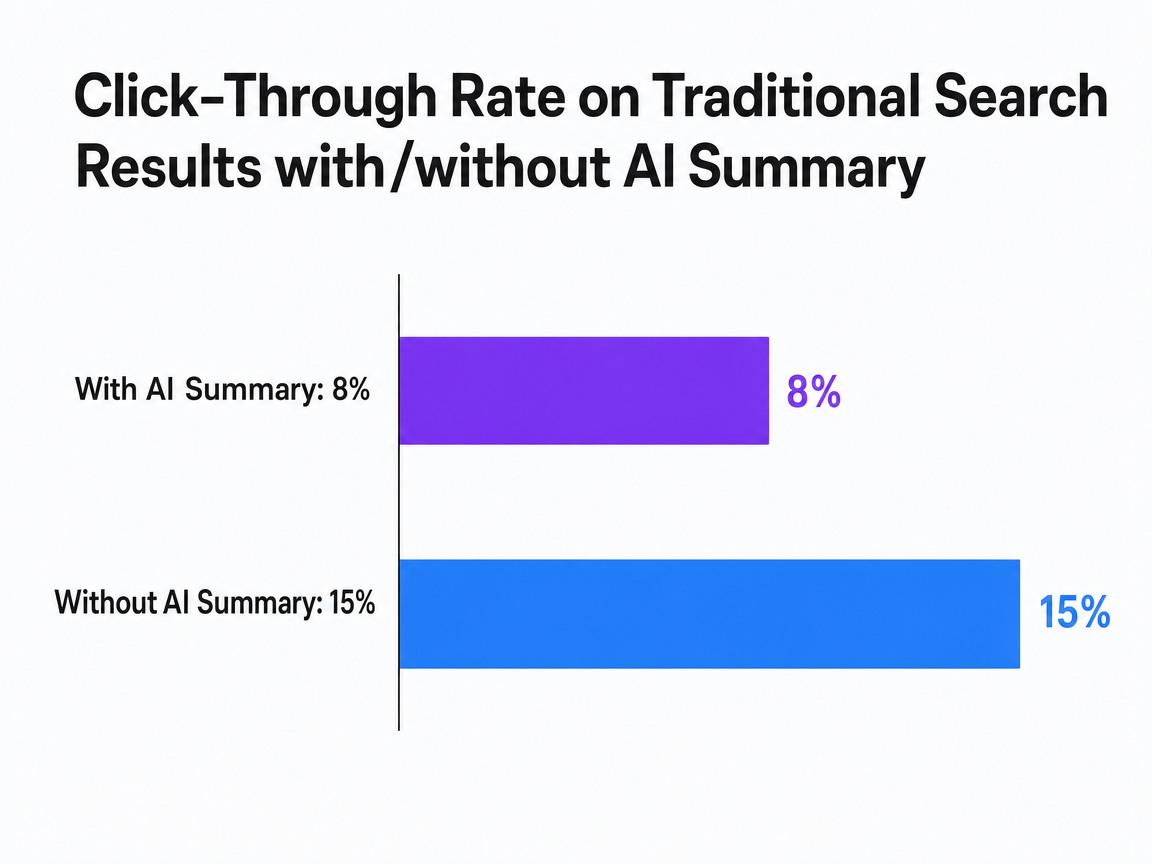 Click-Through Rate on Traditional Search Results with/without AI Summary
Comparison of user click-through rates on traditional search links when Google's AI summary is present versus when it is not. Data is from a Pew Research study.
Where Attention Actually Concentrates on Modern SERPs
The click compression is not new; AI summaries accelerated a trend that was already well documented. Nielsen Norman Group's eye-tracking work found the #1 organic position received 28% of clicks in its 2019 study, down from 51% in a comparable 2006 measurement, and that 59% of total clicks concentrated in the top three organic positions 10. Position four and beyond split what remained.
Two operational conclusions follow. First, ranking fifth on a high-volume term now returns a fraction of what ranking fifth returned a decade ago, and the gap between position three and position one is wider than most forecasting models assume. Second, everything visible above the fold—rich results, site links, review stars, FAQ expansions—competes for the same shrinking attention window. Snippet quality and SERP feature eligibility are no longer cosmetic. They determine whether a ranked page gets clicked at all.
Structured Data as a Clickability Lever, Not a Ranking Trick
Structured data does not raise rankings. Google is explicit on this point, and any vendor selling schema as a ranking tactic is selling the wrong outcome. What structured data does is make a page eligible for rich results—the review stars, product prices, FAQ dropdowns, event details, and how-to steps that expand a listing's footprint on the SERP 5.
Google's own documentation cites two case examples for the impact: Rotten Tomatoes saw a 25% higher CTR on pages with structured data enabled, and Nestlé measured an 82% higher CTR on pages that appeared as rich results 5. Those are Google-selected examples, not universal benchmarks, but the mechanic is consistent. When a listing occupies more visual real estate and carries more information before the click, more users click.
The common implementation failure is schema that describes information not visible on the page. Google warns against this directly and can suppress rich-result eligibility when the markup and the rendered content diverge 5. A FAQ schema block declaring five questions that appear nowhere in the page body is worse than no schema at all—it signals manipulation and forfeits the eligibility the markup was supposed to earn.
The operational fix is straightforward. Audit which templates qualify for rich-result types Google actually supports, implement schema that mirrors visible content, and validate every deploy with the Rich Results Test. On commercial pages where the SERP still produces clicks, schema is one of the highest-leverage changes a marketing team can ship in a quarter.
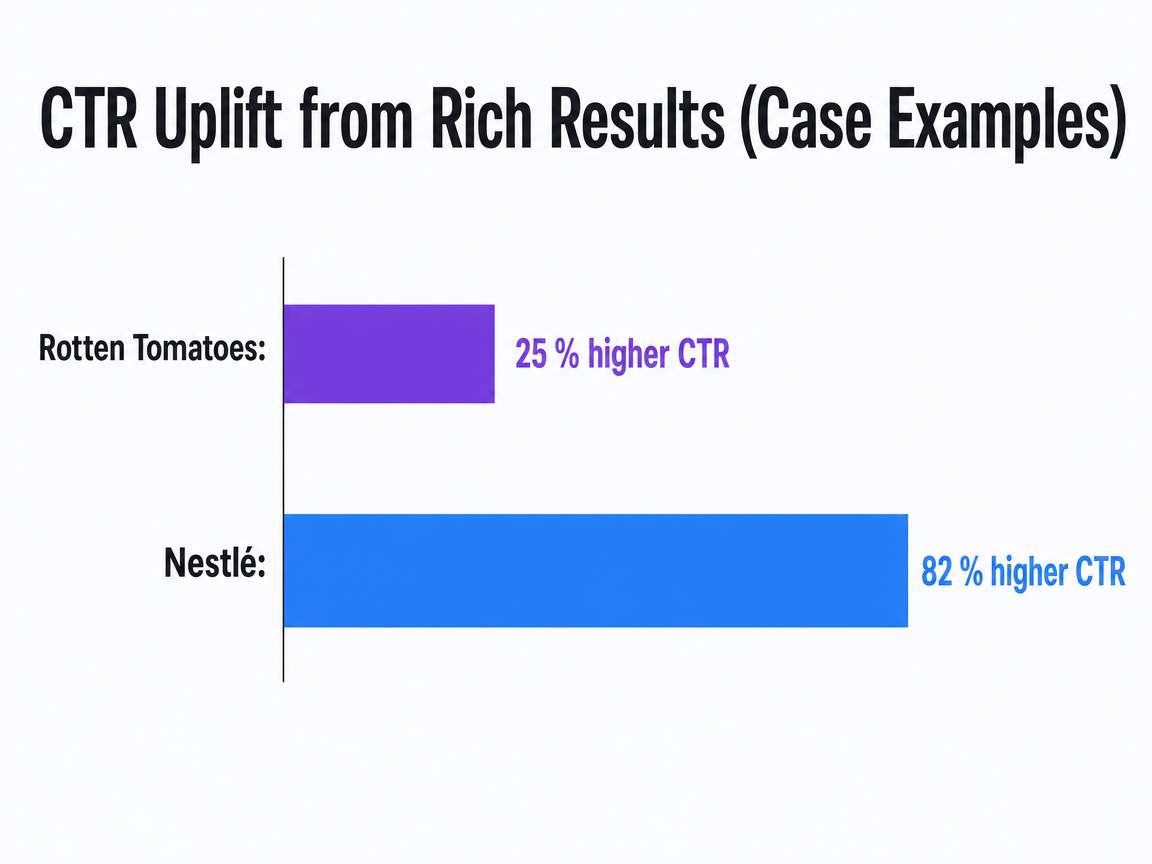 CTR Uplift from Rich Results (Case Examples)
Case study examples cited by Google showing the percentage increase in click-through rate (CTR) for pages with rich results enabled by structured data.
Address Pipeline Stalls from Common SEO Execution Gaps
Request a data-driven assessment of your organic SEO process and see how unified, AI-powered workflows can reduce operational drag and accelerate high-intent lead generation across your portfolio.
Mistake 5: Running SEO as a Channel Silo Instead of a Coordinated Growth System
The Meta-Mistake: Rankings Owned by One Team, Pipeline Owned by Another
The first four mistakes are executional. This one is structural, and it explains why the other four keep recurring even after they get fixed. In most mid-market organizations, SEO sits inside a content or demand-gen sub-team with a keyword-and-traffic scorecard. Pipeline sits inside sales ops with a revenue scorecard. Web performance sits inside engineering. Schema sits nowhere in particular. Each function optimizes its own metric, and no one owns the handoff between a ranked page and a qualified lead.
McKinsey's research on B2B growth found that the companies outperforming their peers
"orchestrate experiences across channels"
and use shared data to continuously tune growth levers, rather than running each channel as a discrete tactic 17. The pattern in underperforming programs is the inverse: an SEO vendor delivers a monthly rankings report, a content agency delivers a monthly publishing calendar, and a web team ships template changes on its own sprint cadence. None of them see the CRM. None of them know which ranked pages produced booked meetings last quarter.
Google's own framing reinforces the point. Search Essentials organizes SEO into technical requirements, content quality, and spam risk—three domains that touch different internal teams in most companies 8. Without a single owner reading the CRM back into all three, execution drifts toward whichever metric each team already reports on.
If You Manage Multiple Locations: The Fragmentation Tax
This section is for VPs at multi-location brands—law firms with regional offices, DSOs, home-services franchises, senior living portfolios, behavioral health networks. The silo problem compounds differently at scale, and the cost is measurable in both crawl budget and production hours.
Consider the arithmetic. A portfolio with L locations, each maintaining P core service pages, generates L × P canonical URLs before any blog content, FAQ, or landing page variants. Add typical review cycles—R rounds of legal, clinical, or brand approval per page—and the annual production load becomes L × P × R editorial cycles. A 40-location dental group with 12 service pages and 3 review rounds carries 1,440 review cycles a year on service pages alone, before campaign landers.
The SEO fragmentation tax hits on top of that. When each location publishes near-duplicate service descriptions with only the city name swapped, Google's canonicalization model treats them as a duplicate set and picks one representative URL to crawl and rank 12. The duplicates are crawled less frequently and accumulate a fraction of the authority they would carry as genuinely differentiated pages 12. Multi-location brands often discover this only when they audit which of their location pages Google actually considers canonical—and find that half the portfolio is being represented by a different city's page than intended 13.
The tax has two components: production hours spent creating pages that consolidate anyway, and lost visibility on pages that never accumulate enough signal to compete. Both compound quarterly.
The Fix: One Brief, One Owner, One Feedback Loop
Three structural changes collapse the silo.
- One brief. Every commercial page—service lander, comparison, case study, location page—gets a single brief that specifies the target query, the conversion action, the schema type, the internal-link parents, and the Core Web Vitals template it inherits. Content, SEO, and web performance work from the same document, not three parallel ones.
- One owner. Assign a single role—usually a senior manager reporting to the VP—accountable for the full path from ranked query to booked meeting. That owner reads Search Console, the CRM, and the Core Web Vitals report on the same weekly cadence. Vendors report into that role, not into three separate functions.
- One feedback loop. Ranked pages that produce no pipeline get flagged within 60 days for either intent mismatch, conversion friction, or a SERP that no longer clicks through. Pages that produce pipeline get reinforced with additional internal links, deeper content, and schema expansion 7, 11. The loop runs monthly, not annually. Coordinated execution is the point; the specific tooling used to coordinate it is a downstream decision.
The Quarterly Reallocation Decision
The five mistakes are not equally expensive to fix, and a VP inheriting a stalled program does not have four quarters to fix them all. The reallocation question is which mistake is bleeding pipeline fastest right now.
For most mid-market programs, canonical fragmentation and page experience regressions produce faster pipeline recovery than content rewrites, because the underlying pages already rank—they just fail to consolidate authority or convert clicks 12, 4. Content culls take two quarters to show up in domain-level signals 15. Structured data ships in weeks and compounds on the SERPs that still produce clicks 5. Silo collapse—one brief, one owner, one loop—is the change that keeps the other four fixed.
Vectoron was built for this reallocation: specialist AI strategists ranking priorities against live pipeline data, with human approval before anything ships. A two-week trial at $599/month lets a VP test the diagnosis against a real portfolio.
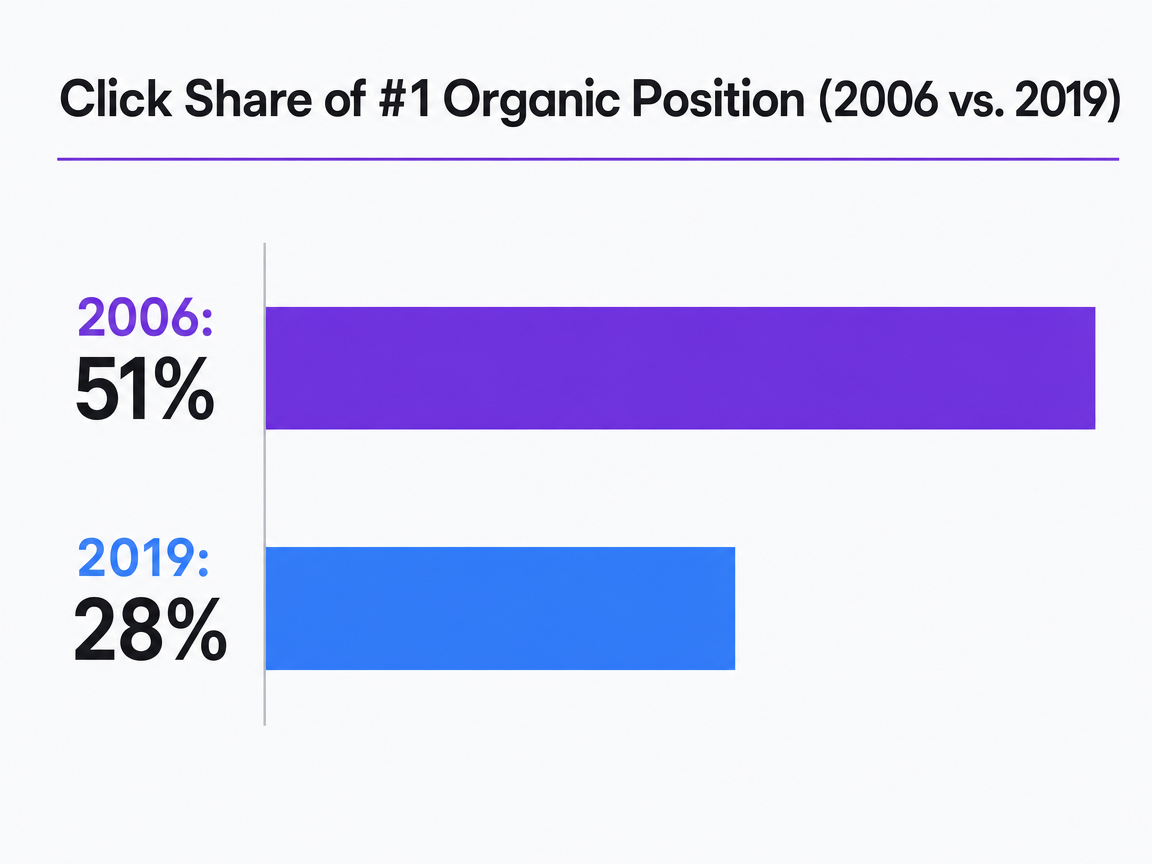 Click Share of #1 Organic Position (2006 vs. 2019)
Comparison of the percentage of clicks received by the first organic search result, showing a decline from 51% in 2006 to 28% in a 2019 study, indicating attention is more distributed on modern search pages.
Frequently Asked Questions
References
- 1.Spam Policies for Google Web Search | Google Search Central | Documentation | Google for Developers.
- 2.Creating Helpful, Reliable, People-First Content.
- 3.Google Search's guidance about AI-generated content.
- 4.Understanding Core Web Vitals and Google search results.
- 5.Introduction to structured data markup in Google Search.
- 6.How to specify a canonical URL with rel="canonical" and other methods.
- 7.SEO Link Best Practices for Google | Google Search Central.
- 8.Google Search Essentials (formerly Webmaster Guidelines).
- 9.Google users are less likely to click on links when an AI summary appears in the results.
- 10.Complex Search-Results Pages Change Search Behavior.
- 11.Search Engine Optimization (SEO) Starter Guide.
- 12.What is URL Canonicalization | Google Search Central.
- 13.Fix Canonicalization Issues | Google Search Central | Documentation.
- 14.Core Web Vitals report - Search Console Help.
- 15.What creators should know about Google's August 2022 helpful content update.
- 16.Search Quality Rater Guidelines: An Overview.
- 17.The new B2B growth equation.