Key Takeaways
- PAA functions as Google's query refinement layer, exposing a live intent map that should drive page structure and internal routing rather than serve as a snippet trophy 11.
- Direct PAA click yield sits near 3% on average, so the real payback comes from ranking correlation on commercial queries and defending CTR on SERPs where competitors own the answer 6, 2, 3.
- PAA and AI Overviews are converging, with generative content populating roughly half of PAA answer slots, so optimizing for one increasingly earns eligibility for the other 5.
- Portfolio leads should concentrate answer-block templating on transactional service, category, and comparison pages, where question coverage correlates most strongly with rankings rather than on blog or glossary inventory 3.
The Intent Layer Hiding in Plain Sight
The People Also Ask (PAA) box has become a significant feature on Google's Search Engine Results Pages (SERPs). Google uses PAA as a query refinement mechanism, indicating that the questions within are not merely decorative but represent Google's live model of how searchers narrow, expand, or reframe their original queries 11. Each question in a PAA box signals the intent Google believes is adjacent to the user's initial search.
For agency Heads of SEO managing numerous client sites, this reframing is crucial. PAA transforms from a simple snippet trophy into an intent operating system, offering a question map that dictates page structure, internal linking for topical depth, and where snippet eligibility truly resides. A 2026 correlation study found that pages comprehensively answering PAA questions consistently achieved higher rankings, particularly for transactional and commercial queries, which directly impact pipeline rather than just impressions 3.
This article will distinguish between two economic realities often conflated in PAA discussions: the low direct-click yield of PAA capture and the substantial ranking and eligibility gains derived from treating PAA question sets as an intent architecture. This distinction is vital for portfolio-scale agencies to gain or lose market share.
Understanding the PAA Box in 2026
Mechanics: Query Refinement, Not Decoration
The PAA box is an interactive accordion feature on the SERP, presenting a set of related questions. Each question expands to display a concise extracted answer and a source link. Clicking on a question reveals additional questions, generated in response to the user's chosen branch. This list is dynamic and is not ranked by traditional link authority.
Google explicitly states that PAA functions as a query refinement mechanism 11. This means the feature actively guides the searcher's session. Each question represents a hypothesis about the user's next potential query, derived from co-occurring queries, entity relationships, and historical follow-ups that resolve original intent. User clicks on PAA questions provide Google with feedback on which hypotheses are correct.
Consequently, PAA questions are algorithmically generated based on query and content relevance, not driven by markup, as Google's documentation on search appearance confirms 13. Therefore, FAQPage schema alone does not guarantee a page's inclusion in the PAA box. Furthermore, because PAA reflects live intent branching, its question sets offer a public insight into how Google models a topic, which can be harvested and clustered by SEO teams.
Prevalence After AI Overviews
PAA was already widespread before the introduction of AI Overviews. A Semrush study indicated PAA appeared in 51.85% of measured searches, a footprint comparable to standard organic blocks on many commercial queries 4. The expectation that PAA would diminish with the rise of generative answers has not been supported by recent data.
A 2026 analysis using Semrush Sensor data from the Italian market observed PAA appearing in nearly 80% of SERPs after the AI Overview rollout, indicating an increase in its incidence 5. While this is a single market sample, the trend suggests PAA is expanding its presence on the SERP. This is significant for planning, as many agency teams had anticipated its deprecation in favor of AI-generated summaries.
For SEO professionals managing multiple client sites, the practical implication is that PAA is not a declining feature. It is a persistent and growing layer of the SERP, present on the majority of queries relevant to clients. Content strategies designed to systematically answer PAA questions are not targeting a fading format but are building against a surface that Google is increasingly relying on as its primary query refinement mechanism, even as generative answers integrate with the same infrastructure.
Realistic Assessment of PAA CTR
The direct-click yield from PAA is generally low. Any agency strategy relying solely on PAA capture to significantly boost client traffic will likely fall short. Backlinko's 2025 click-stream study found that only about 3% of searchers interact with a PAA box on average 7. Keystar's 2026 CTR benchmark corroborates this, listing PAA with an approximate 3.0% average CTR for informational and question-format queries 6. This stable, low ceiling for direct clicks is a consistent finding across benchmark studies.
However, there are exceptions. The same Backlinko research noted that for one specific query category, "supplements for back pain," PAA interaction climbed to nearly 15% 8. A related SearchOS synthesis cited a 13.6% peak in a comparable vertical 1. These higher figures, if misinterpreted, might suggest a broad investment in PAA capture is warranted. This is not the case. Such peaks occur in specific verticals characterized by high-consideration, low-branded-trust, symptom-driven queries where users actively explore alternatives before committing. Verticals like legal intake, dental new-patient acquisition, or senior living inquiries do not exhibit the same behavior.
For a portfolio lead, the honest assessment is that direct PAA click yield typically remains in the low single digits for most client queries, with double-digit figures appearing only in narrow verticals under specific intent conditions. Compared to standard position 1-3 CTRs, which Keystar's benchmark tracks in the double digits, PAA is not a primary traffic channel 6. Instead, it serves as a positioning surface. Business cases built solely on PAA clicks are mathematically unsound. The true value of PAA work lies in its impact on cannibalization dynamics and ranking correlation, which will be discussed in subsequent sections.
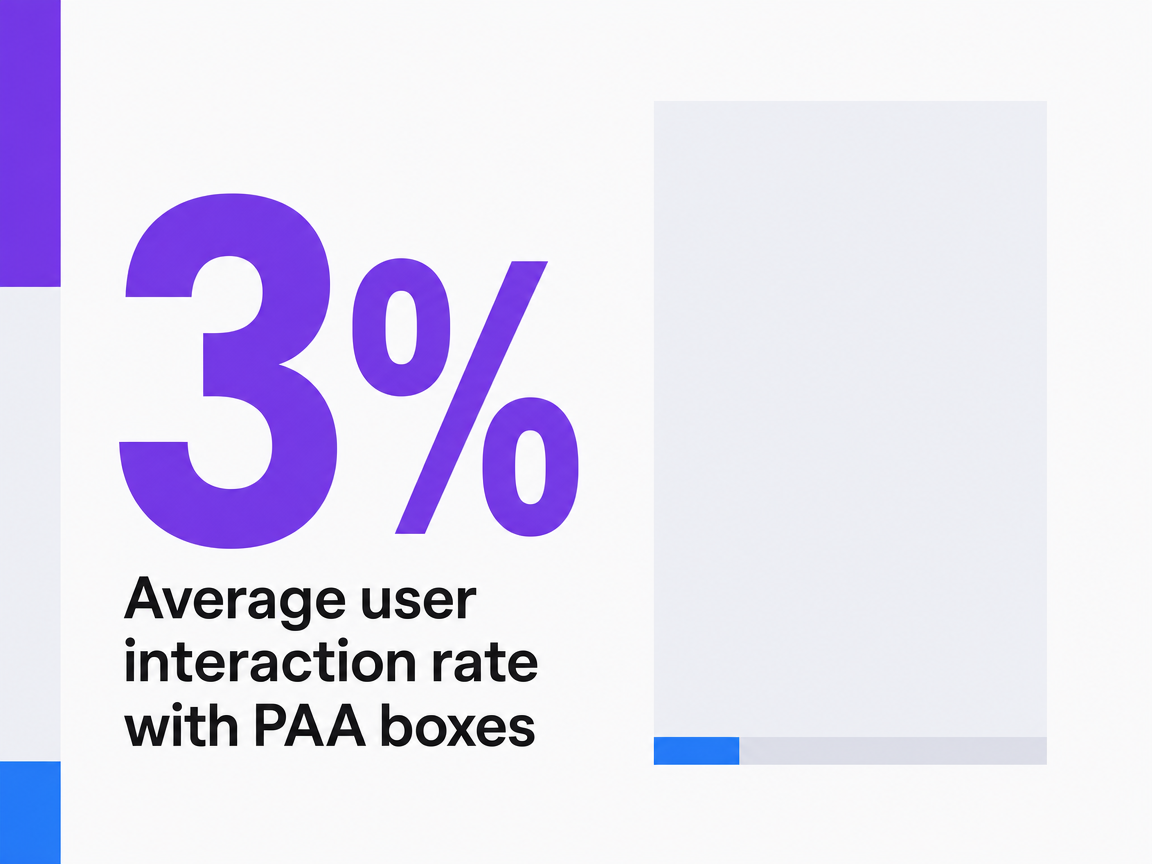 Average user interaction rate with PAA boxes
Average user interaction rate with PAA boxes
Test PAA box strategies on live client sites now
Validate PAA optimization impact with published content and real-time ranking data during your trial period.
The Cannibalization Hinge Most PAA Articles Overlook
The strategic rationale for pursuing PAA capture extends beyond the modest 3% direct click-through rate. It concerns the impact on other SERP listings when a competitor becomes the PAA source. A 2023 study, co-authored with Nova School of Business and Economics, investigated how SERP features influence organic CTR across positions. It found that PAA increases CTR for the sites cited within the box while depressing CTR for other organic results on the same SERP that are not featured 2. This indicates that the PAA box is not neutral; it actively redistributes clicks.
This finding alters the economic perspective. A page that secures the PAA answer gains direct PAA interactions and a lift in its underlying blue link's CTR. Conversely, a page ranking in the top 10 but not featured in PAA experiences a loss, receiving fewer clicks than its position would historically predict for the same query in the same session. On a SERP where PAA is present—which Semrush data indicates is over half of measured searches—an organically ranked page not serving as the PAA source is in a less advantageous position than its ranking alone suggests 4.
For a portfolio lead, this redefines what "good" looks like in client reporting. A #3 ranking on a commercial query where a competitor owns the PAA answer is consistently losing CTR, a leak that doesn't manifest as a ranking drop. MediaPost's synthesis of SERP-feature research confirms this, noting that PAA and related-search elements divert click paths away from traditional listings 9. The clicks haven't vanished from the SERP; they've shifted to the PAA source.
Operationally, PAA work offers two payoffs:
- The direct click on the accordion.
- The more significant payoff — defending the CTR that a client's other rankings should already be earning.
Any account where the client ranks in the top 10 for a commercial query but a competitor holds the PAA answers on that SERP represents a defensive priority. This is not because PAA will generate substantial direct traffic, but because losing the PAA source position imposes a compounding CTR tax on the rankings the client has already worked to achieve.
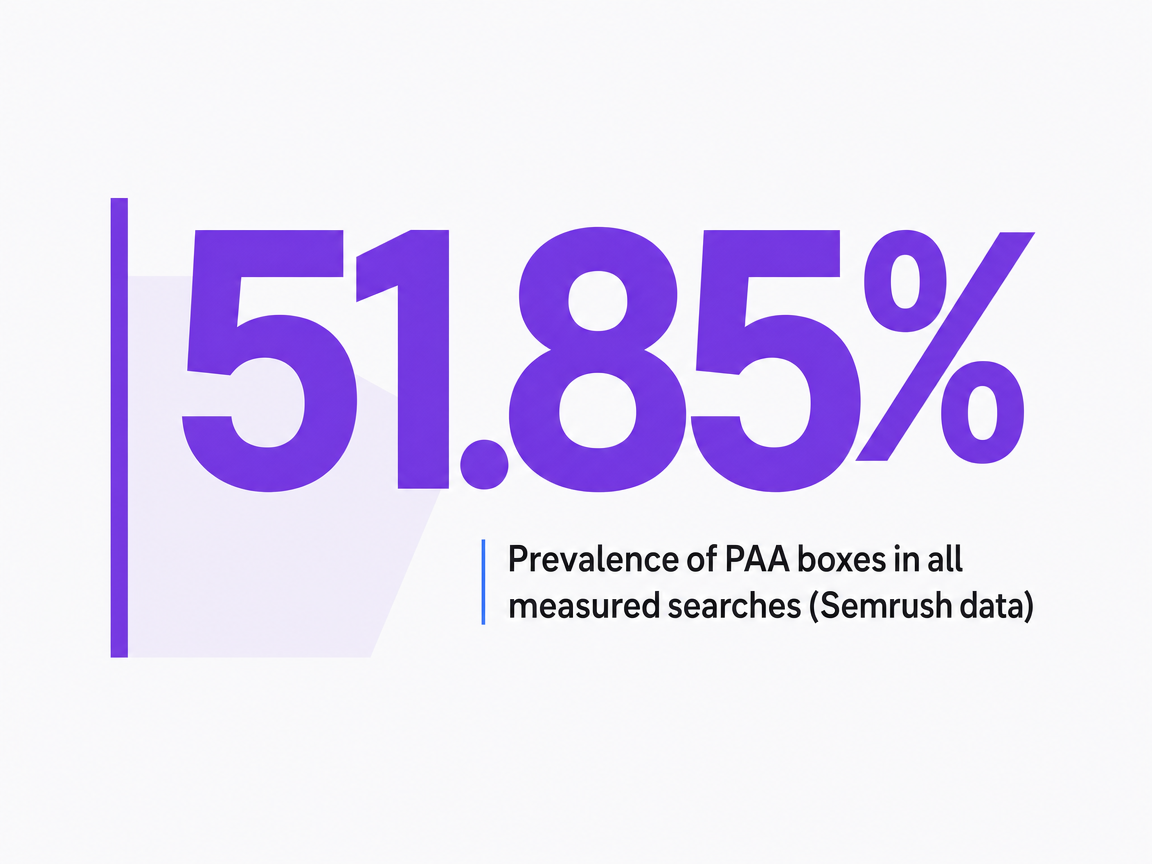 Prevalence of PAA boxes in all measured searches (Semrush data)
Prevalence of PAA boxes in all measured searches (Semrush data)
PAA Coverage and Ranking Correlation
The case for PAA work's impact on rankings is stronger than its direct click potential, and it is intent-specific. A 2026 correlation study across various query types revealed that pages comprehensively answering PAA questions consistently ranked higher than those that did not 3. This relationship was strongest for transactional and commercial queries, weaker for informational, and weakest for navigational queries. This gradient is crucial for portfolio leads to allocate production hours effectively.
For transactional and commercial queries, PAA question coverage acts as a ranking input rather than mere content padding. Pages designed to sell a service, compare providers, or capture bottom-funnel demand often appear on SERPs where Google actively refines user intent—e.g., is it a price question, a qualification question, an alternatives question, or a location question? Pages that address the full branch of PAA-modeled follow-ups align more closely with the intent Google aims to resolve for that query. The correlation study frames this as coverage of the question set, distinct from keyword density 3.
Two limitations should be noted:
- Correlation does not imply causation. Pages that thoroughly answer PAA questions also tend to be longer, better-structured, and more topically complete, any of which could independently contribute to ranking improvements. The study reports co-occurrence, not a controlled mechanism 3.
- The effect diminishes for informational queries, which have historically been the focus of much agency PAA effort. A portfolio that prioritizes PAA capture for blog posts and glossary pages is optimizing against the weakest correlation. Greater yield is found on service pages, category pages, and comparison pages—templates that directly contribute to client revenue.
The AI Overview Convergence
The notion that AI Overviews would cannibalize PAA has not been supported by data; instead, the two features are converging. A 2026 analysis using Semrush Sensor data from Italy revealed that approximately half of the PAA answers examined already incorporated AI Overview content 5. This indicates that the answer slot within the accordion is increasingly populated by generative summaries rather than direct extractions from a single source page. The PAA box has not shrunk to accommodate AI; it has become a distribution surface for it.
This convergence changes the operational meaning of "winning" a PAA answer. When the answer text is AI-generated, the citation logic shifts from a single-source snippet extraction to a synthesized response drawing from multiple pages Google deems authoritative on the sub-question. Being the source of a PAA answer now more closely resembles being one of several sources feeding an AI Overview: the page still receives attribution and a link, but the answer text itself is composed, not directly lifted. The same 2026 analysis noted that PAA incidence in Italian SERPs remained at nearly 80% after the AI Overview rollout, confirming that the surface area for this fused format is expanding 5.
For a Head of SEO planning content operations across a client portfolio, the strategic implication is that optimizing for PAA and optimizing for AI Overview eligibility are becoming a unified objective. Pages cited within PAA answers for transactional queries today are increasingly the same pages Google will draw from to compose AI Overview responses for those queries tomorrow. Treating these as separate workstreams doubles production costs without doubling the yield.
See How High-Volume PAA Box Wins Are Engineered—at Scale
Request a walkthrough of data-driven workflows purpose-built for agencies to systematically capture PAA box visibility across multiple clients—without increasing headcount or sacrificing oversight.
PAA as an Intent Operating System
Harvesting Question Sets as a Live Intent Map
Treating PAA as an intent map begins with harvesting existing questions, not generating new content. For every seed query a client targets, Google provides a stack of PAA questions, which it has identified as the most probable next steps in a searcher's session—confirming its function as a query refinement layer 11. Systematically collecting these questions across a client's priority keyword set offers a public, Google-modeled view of the topic that no keyword tool can replicate.
The operational process is straightforward:
- Identify the top 50 to 200 revenue-relevant queries for each client.
- For each seed query, capture the initial PAA questions, then click into two or three to reveal the second-tier questions Google appends.
- Deduplicate and then cluster the resulting question pool by sub-intent, such as price, qualification, comparison, timing, location, or risk.
This process yields a branching map of expected follow-ups, weighted by the order in which Google surfaces them.
This map informs critical decisions for a Head of SEO: which pages require new answer blocks, how internal links should guide searchers deeper into an intent branch, and which sub-topics warrant their own dedicated URLs rather than just sections within existing pages. An eye-tracking study on related-question interfaces showed they encourage broader exploration of presented options 10. Portfolio-scale agencies can harvest this exploration path once and apply it across all clients whose SERPs share similar intent branches.
Answer-Block Templating Without the FAQ Dump
Once the question map is established, the common pitfall is to simply add a generic FAQ section to every page. This approach misunderstands how PAA sources content. Google's documentation explicitly states that PAA answers are algorithmically generated based on query and content relevance, not through FAQPage markup 13. A generic FAQ dump fails to satisfy searchers, ranking models, or extraction algorithms.
Answer-block templating replaces the generic FAQ dump with structured, in-context passages placed within sections of the page that already carry topical weight. Each block follows a consistent format: the question stated as a heading, followed by a direct 40 to 60-word answer as the first paragraph, and then supporting details, comparisons, or qualifications. The direct answer is placed first for clean extraction by algorithms. The supporting detail below it convinces the ranking model that the page thoroughly covers the sub-intent, a factor linked to higher rankings for transactional and commercial queries in the 2026 correlation study 3.
Applying this templating at a portfolio scale offers significant operational leverage. A single, consistent answer-block schema, used across service pages and comparison templates within a client book, ensures predictable eligibility for both PAA sourcing and the AI Overview citations that now populate roughly half of PAA answer slots 5. The directive shifts from "write more FAQs" to "answer these specific sub-intents using this specific structure within these specific templates."
PAA Payback for Agencies Managing Portfolios
This section is specifically for Heads of SEO managing 20 to 200 client sites, not single-site operators. The economics of PAA work change significantly when applied across a portfolio, as the fixed cost of building a harvesting and templating system is amortized across all clients whose SERPs share similar intent branches.
The payback patterns fall into three categories, with varying weights:
- Client portfolios heavily focused on informational content—such as publishers, glossary-driven SaaS, or top-of-funnel blog inventory—will see the weakest returns. PAA CTR for such content hovers around the 3% average, and the ranking correlation for informational queries is the softest among the four intent types measured 7, 3.
- A portfolio weighted towards transactional and commercial pages—like legal service pages, dental new-patient templates, home services location pages, or senior living inquiry funnels—will experience the strongest ranking lift from comprehensive question coverage and the greatest defensive CTR gain by preventing competitors from securing the PAA source position on those SERPs 3, 2.
| Client Mix in a 25-Account Book | Primary Payback Driver | Expected Direct PAA CTR Range | Where the Real Yield Sits |
|---|---|---|---|
| Informational-heavy | Topical authority, snippet eligibility | ~3% average 7, 6 | Long-tail impression growth, not clicks |
| Mixed intent | Ranking correlation on commercial pages | 3% baseline, higher on select verticals 1 | Ranking lift on comparison and category pages 3 |
| Transactional-heavy | CTR defense + ranking correlation | 3% baseline, up to 13.6% in narrow verticals 1 | Preventing competitor PAA capture from taxing existing rankings 2 |
The operational takeaway for a portfolio lead is to prioritize accounts based on their intent mix, rather than solely on traffic volume. A mid-sized transactional client with 40 revenue-relevant queries will yield more from PAA work than a large informational client with 4,000 blog URLs. This is because both the ranking correlation and the cannibalization defense are concentrated on commercial intent 3, 2. Therefore, build the harvesting and answer-block system first for the transactional segment, then extend the same templates across the rest of the portfolio once the initial production cost has been absorbed.
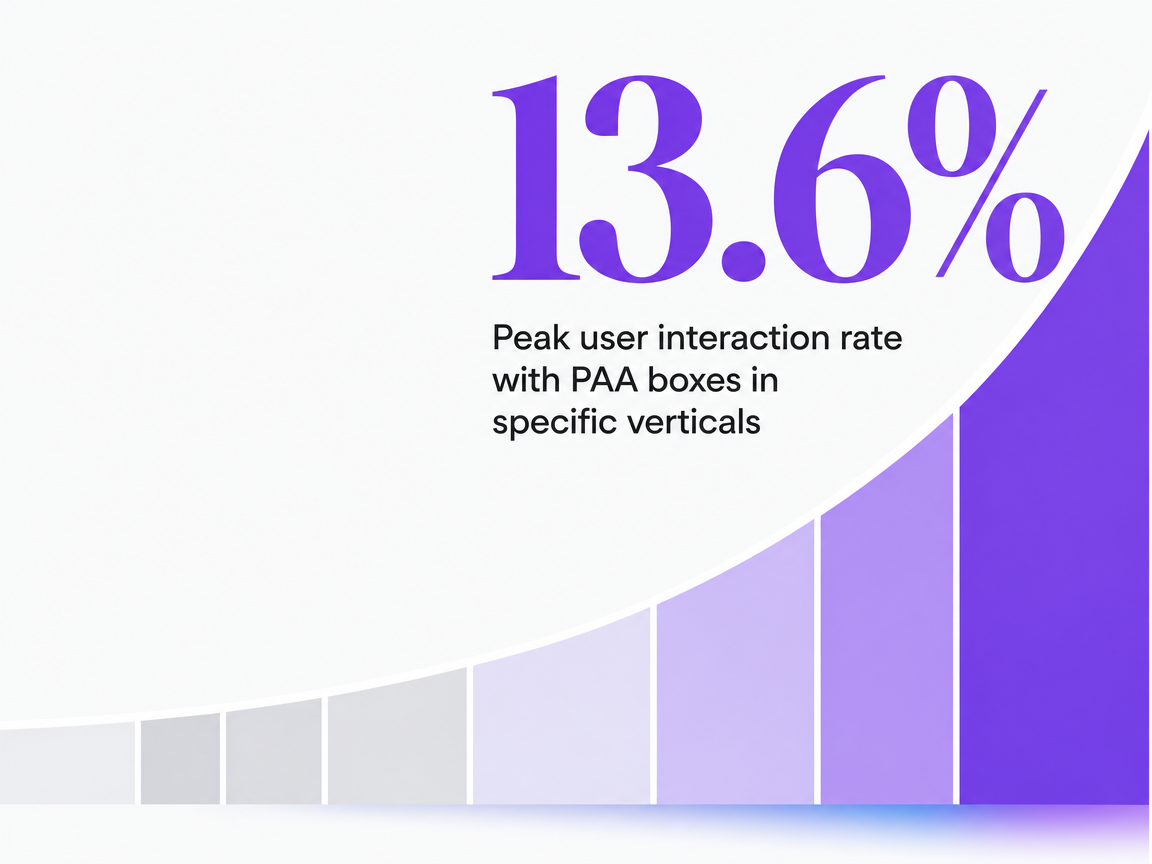 Peak user interaction rate with PAA boxes in specific verticals
Peak user interaction rate with PAA boxes in specific verticals
Common Agency Misconceptions About PAA
Three recurring failure patterns in agency PAA strategies stem from treating the PAA box as a snippet trophy rather than an intent surface.
- The first is the belief that simply adding a generic FAQ block to every template will guarantee eligibility. PAA answers are algorithmically generated based on query and content relevance, not through markup 13. A bottom-of-page FAQ dump provides extraction models with no suitable content to lift and offers no additional intent coverage to the ranking model.
- The second mistake is focusing PAA efforts on blog and glossary inventory, where the ranking correlation is weakest and the direct CTR ceiling remains near 3% 3, 6. The transactional and commercial templates, which are directly tied to pipeline accountability, are where comprehensive question coverage significantly impacts rankings. These templates often receive the least PAA attention.
- The third, and most costly, error is measuring PAA work solely by whether the client "won the box," while ignoring the CTR tax imposed on all other rankings on a SERP where a competitor is the PAA source 2. A portfolio audit that identifies non-source rankings on PAA-present commercial SERPs reveals defensive priorities that would not appear in a standard ranking report.
Frequently Asked Questions
References
- 1.What is People Also Ask (PAA)? Google SERP Feature Guide.
- 2.SERP features' impact on CTR quantified - Grips Intelligence.
- 3.People Also Ask SEO Study 2026: Ranking Insights.
- 4.What is Google's 'People Also Ask' and how does it work?.
- 5.The impact of AI Overview on People Also Ask answers.
- 6.Google Click-Through Rates by Ranking Position: 2026–2025.
- 7.How People Use Google Search (New User Behavior Study).
- 8.0.2 Overview Of The User Research Study (Backlinko).
- 9.Google Search Features Impact Organic Search CTRs.
- 10.How does this tool affect exploration-exploitation strategies with regard to prior domain knowledge and search context? An eye-tracking study.
- 11.Google People Also Ask Used For Query Refinement.
- 12.Search Engine Optimization (SEO) Starter Guide.
- 13.Search appearance and SERP features.