
Key Takeaways
- Leading renewal reports with position screenshots contradicts Google's own guidance, which treats impressions and clicks as the real measures of search success 1.
- Replace single-keyword position tracking with a Page Value Record: eight fields per URL covering query cluster, Search Console metrics, search appearance, business outcome, and a change log of shipped work.
- Separate ranking, search appearance, and business outcome into distinct lanes so schema deployments are not reported as ranking wins and position gains are not reported as revenue.
- When a client panics, follow Google's documented order: read impressions and clicks first, review average position third, then segment by search type, query, and page 1.
- Run weekly recent-data checks as an internal trigger log only, since the seven-day window carries latency and cannot distinguish a blip from a durable change 4.
- Build the monthly client narrative on Search Console Insights, pairing trending-up and trending-down pages with the change log, weekly flags, and next month's refresh queue 3.
- Document Core Web Vitals and schema work as technical deliverables with before-and-after metrics, never as the cause of a ranking gain, since good scores do not guarantee top rankings 7.
- Standardize extracts across 30+ accounts with the Search Analytics API to reclaim senior-strategist hours, while disclosing that API output is a sample rather than a complete census 5.
Why Position Alone Stopped Selling Renewals
The "you moved from #7 to #4" screenshot is a renewal risk, not a renewal argument. It overclaims what a position change proves, and it understates the work the agency actually shipped. Google's own debugging guidance tells site owners not to focus too much on absolute position and identifies impressions and clicks as the ultimate measures of search success 1. An agency leading its monthly report with a rank-tracker delta is contradicting the platform it depends on.
The problem compounds at the book-of-business level. A Head of SEO overseeing dozens of accounts cannot defend renewals when every report answers a different question than the client is asking. Clients ask whether the investment produced qualified demand. A position screenshot answers whether a keyword moved. Those are not the same answer, and finance teams reviewing retainers notice the gap.
Google also describes ranking as a page-level system drawing on multiple signals to decide which pages are most helpful for a query 8. That framing kills single-cause narratives. A page's movement reflects content changes, competing results, query intent shifts, and search appearance updates working together. Attributing the move to one tactic is a credibility leak.
The fix is structural. Reframe the page ranking check as a page-level diagnostic that ties target-query movement to impressions, clicks, qualified sessions, and documented work shipped. The sections that follow build that reporting unit, name its fields, and standardize it across the book.
The Page Value Record: One Reporting Unit for Every Account
The Eight Fields That Replace a Position Screenshot
A page ranking check becomes defensible when it stops being a number and starts being a record. The Page Value Record is that artifact: a single-row entry per target page, repeated across the book, that captures what the page is doing in search and what the agency did to the page during the reporting window. Eight fields do the work.
- Field one is the target URL.
- Field two is the query cluster the page is built to serve, not a single head term.
- Fields three through six are the Search Console performance metrics for that URL and cluster: impressions, clicks, CTR, and average position.
- Field seven is search appearance, meaning the SERP features the URL is eligible for or showing in.
- Field eight is the business outcome tied to qualified organic sessions reaching the page, paired with a change log of what shipped: content edits, internal links added, schema deployed, speed work merged.
This structure aligns with how Google describes its own ranking systems: page-level systems that draw on multiple signals to determine what a page is about and which pages are most helpful for a query 8. A record built around the URL and its query cluster matches the unit of analysis Google uses. A record built around a single keyword position does not.
The operational payoff is that every account in the book speaks the same schema. A junior strategist filling out the record cannot default to a position screenshot, because position is one of eight required fields. A senior strategist reviewing thirty accounts can scan the same columns in the same order and spot which pages need investigation before the client email arrives.
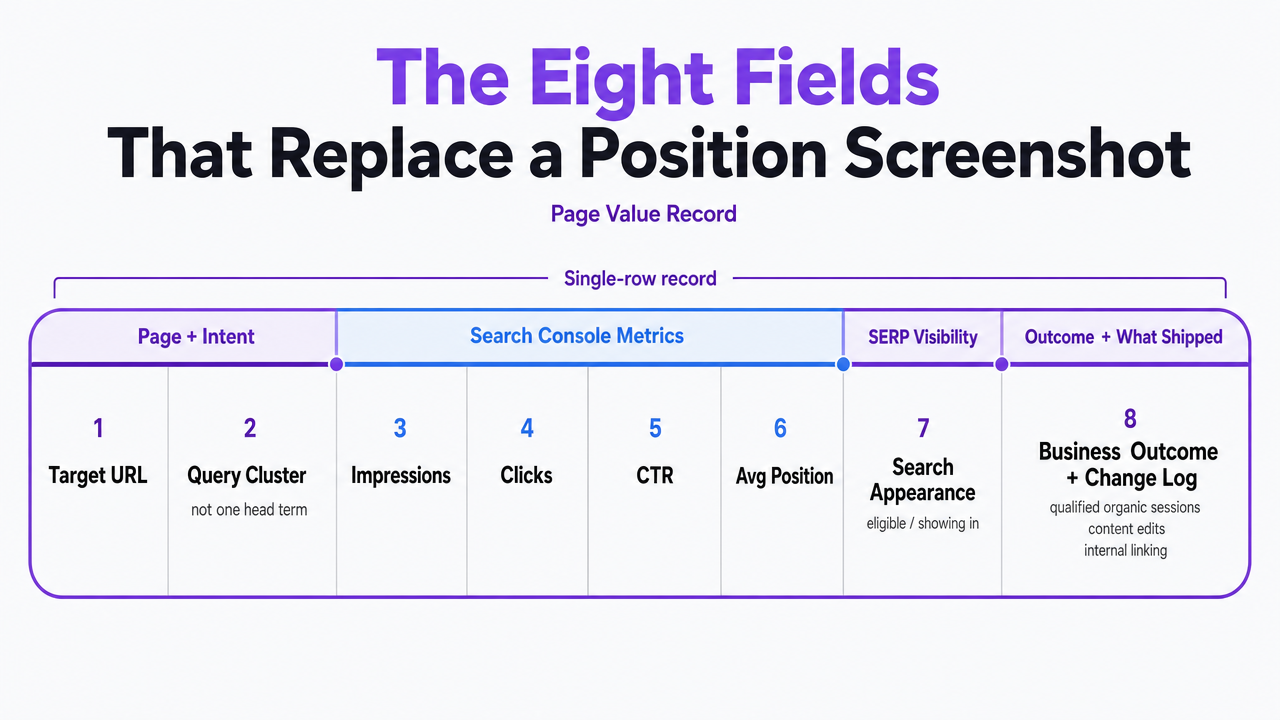 Visualize the eight fields of the Page Value Record as a single reporting unit referenced throughout the article
Separating Ranking, Search Appearance, and Business Outcome
Most agency reports collapse three distinct lanes into one narrative, and clients notice the sleight of hand even when they cannot name it. The Page Value Record forces the lanes apart.
Lane one is ranking change. This is the page-level movement of the target URL for its query cluster, driven by the full set of signals Google's ranking systems weigh together 8. A page moving from position 7 to position 4 belongs here, and so does the explicit caveat that no single tactic produced the move.
Lane two is search appearance change. This covers whether the URL became eligible for, or started displaying in, richer SERP treatments: FAQ results, product snippets, review stars, breadcrumbs, and similar features governed by structured data. Google's guidance is direct: structured data can make content eligible for a richer appearance in Search, but actual appearance may differ, and eligibility is not display 10. Reporting a successful schema deployment as a ranking win confuses the lanes and invites the client to ask the one question the report cannot answer. Reporting it as a search appearance deliverable, with impressions and CTR tracked for before-and-after context, is accurate and defensible.
Lane three is business outcome change. This is where impressions, clicks, qualified sessions, and the downstream key events live. Google's own debugging guidance identifies impressions and clicks as the ultimate measures of search success and advises against focusing too much on absolute position 1. The business outcome lane is where the client's investment question actually gets answered, and it is the lane that should carry the most weight in the monthly narrative.
Keeping the lanes separate protects the agency from two symmetrical mistakes: claiming a rich-result deployment caused a ranking gain, and claiming a position gain produced revenue it did not produce. Each lane has its own evidence standard, its own source, and its own place in the record. The report tells the client which lane moved, by how much, and what the agency shipped against it.
The Diagnostic Sequence When a Client Panics
The panic email arrives on a Tuesday morning: traffic is down, rankings look bad, what happened. The agency that answers with a rank-tracker screenshot has already lost the exchange. The agency that runs Google's documented diagnostic sequence keeps control of the narrative and the account.
Google publishes a specific order of operations for traffic declines, and it is the correct order for a client-panic response too:
- Start with the Search Console performance chart.
- Compare impressions and clicks against the prior period.
- Review average position only after the volume metrics have been read.
- Then segment by search type, and finally by query and page 1.
The sequence is diagnostic, not decorative. Each step eliminates a class of explanation before the next step runs.
The volume read comes first because it answers the client's actual question: did fewer people see us, did fewer people click, or both.
- Impressions down with clicks flat points to a visibility change.
- Clicks down with impressions flat points to a CTR change, often tied to a search appearance shift or a new SERP competitor.
- Both down together points to a larger relevance or indexing issue, which is where URL Inspection earns its place in the workflow by confirming whether the affected URLs are still indexed and crawlable 2.
Average position enters the conversation third, not first. A position shift without an impressions shift is often a reporting artifact rather than a demand event. A position shift paired with an impressions drop is a signal worth investigating against the search-type and query-segment views.
The output of this sequence is not an answer in the first hour. It is a defensible written response that names what moved, what did not, and which hypothesis the agency is testing next. That response is the artifact that converts panic into a scheduled follow-up and keeps the renewal conversation on evidence rather than vibes.
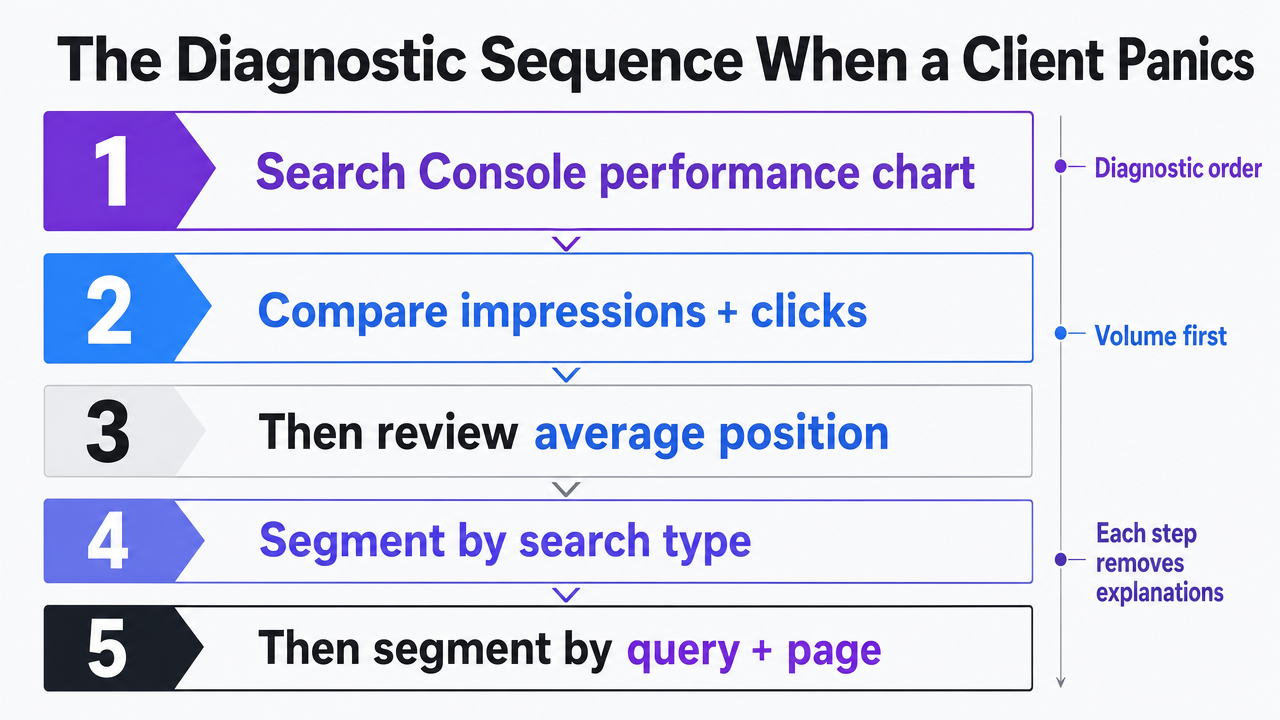 Visualize Google's documented diagnostic order of operations cited from ref_1 and ref_2
Run Live Page Ranking Checks in One Week
Test real-time ranking data and publish actionable reports for your clients in your first week.
Two-Tier Cadence: Weekly Monitoring, Monthly Narrative
Weekly Recent-Data Checks Without Overclaiming
Weekly checks exist to catch movement, not to generate client-facing claims. Google's December 2024 recent-performance view surfaces clicks, impressions, CTR, and average position with breakdowns by query, page, country, and device, which compresses the detection window for a visibility change from weeks to days 4. That shortened window is operationally valuable to a senior strategist running a book of accounts. It is also easy to misuse.
The discipline is to treat the weekly check as an internal trigger log, not a report. A junior strategist scans the recent-data view across every Page Value Record in the account, flags any URL whose impressions or clicks shifted beyond a defined threshold, and files the flag with a one-line hypothesis. No client email leaves the office on the strength of a seven-day view alone, because recent data carries reporting latency and the comparison window is too short to separate a demand blip from a durable change 4.
The weekly cadence earns its keep in two ways. It gives the agency a head start on diagnosis before the client notices a change, and it builds a dated flag history that the monthly narrative can reference as evidence of active monitoring. The flag log is the artifact, not the screenshot.
Monthly Insights Review as the Client-Facing Story
The monthly review is where the Page Value Record becomes a narrative. Google's Search Console Insights, relaunched June 30, 2025 and integrated into Search Console, converts raw performance data into prioritized signals: total clicks and impressions against the previous period, pages with the largest increase in clicks, and pages that may need a refresh or further investigation 3. That prioritization is the backbone of a defensible monthly story.
The sequence runs top-down:
- Start with the period-over-period volume read for the account, then pull the trending-up pages and attach the change-log entries that shipped against them during the window.
- Pull the trending-down pages next and attach the weekly flags filed earlier in the month, which prove the agency saw the movement in real time rather than discovering it in the report.
- End with the pages Insights identifies as candidates for refresh, which seeds the next month's production queue and makes the report a planning document rather than a backward-looking recap.
Insights labels trends; it does not establish why a page changed or whether the traffic produced business value 3. The monthly narrative closes that gap by pairing each trending page with its business-outcome field from the Page Value Record. The client reads one document that names what moved, what the agency shipped, what the agency flagged, and what ships next.
Technical Evidence Without the Causal Overclaim
Technical work belongs in a client report. It just doesn't belong under the heading "why your rankings went up." The Page Value Record carries a change-log field precisely so completed technical deliverables can be documented as shipped work with measurable before-and-after context, not as the cause of a ranking shift.
Core Web Vitals are the cleanest example. Google's thresholds for a good user experience are specific and measurable: Largest Contentful Paint within 2.5 seconds, Interaction to Next Paint below 200 milliseconds, and Cumulative Layout Shift below 0.1 6. A speed engagement that moves a page from poor to good on all three is a legitimate deliverable. It warrants documentation with the before-and-after field data, the deployment date, and the affected URLs. What it does not warrant is a causal claim about ranking. Google states directly that good results in the Core Web Vitals report, or in third-party tools, do not guarantee that pages will rank at the top of Search 7. A monthly report that pairs a CWV improvement with a position gain and implies the first produced the second is making a claim the platform's own documentation refutes.
The same discipline applies to structured data. A schema deployment that makes a page eligible for a richer SERP treatment is a search appearance deliverable, logged in the search appearance field and tracked through impressions and CTR before and after. Google is explicit that structured data can make content eligible for a richer appearance in Search, but actual appearance may differ 10. Eligibility is the deliverable. Display is a downstream outcome. Ranking is a separate lane entirely.
The practical rule for the report writer is one sentence long. Describe the technical work, name the measurable change in the technical metric, and stop. Let the business-outcome field carry the demand story. A client who sees an honest technical section learns that the agency ships work and measures it against the right benchmark. A client who sees a CWV score fused to a position chart learns that the agency is reaching for a narrative, and that lesson is harder to unlearn than any single ranking drop.
If You Run a Book of 30+ Accounts: Senior-Strategist Economics
Scope shift: this section is for the Head of SEO running a book large enough that senior-strategist hours are the binding constraint, not the number of keywords tracked. At 30 accounts and up, the ranking check stops being an analyst exercise and starts being a staffing model.
The manual version of the workflow is familiar. A strategist opens Search Console per account, pulls the performance view, filters by target URL, exports to a sheet, and reconciles against the change log by hand. Across a book, the arithmetic is unforgiving. The Search Analytics API changes the arithmetic by letting the agency query performance data programmatically, grouped by page, query, country, and device, and feed the results into a single standardized record for every account in the book 5. The Page Value Record stops being a document a strategist writes and becomes a row a system populates.
The table below uses variables, not benchmarks, to show where the hours go.
| Workflow | Hours per account per month | Senior-strategist capacity | Senior time reallocated to strategy ||---|---|---|---|| Manual per-account ranking check | ~4 hrs | Lower | Minimal || API-standardized check with Page Value Record | ~1 hr | Higher | Majority of reclaimed hours |
The ratios matter more than the absolute numbers. Compressing the mechanical portion of the check frees senior hours for the work that actually defends renewals: diagnosing why trending-down pages moved, approving the next refresh queue, and writing the narrative that pairs each flagged URL with its business-outcome field.
Two disclosures protect the model from its own leverage. API output is not guaranteed to include every row because of internal data-return limits, so an API extract should be described as a standardized sample, not a complete census of client search activity 5. And standardization is not autopilot. Google's people-first guidance is explicit that content and workflows built primarily to manipulate rankings, including automated ones, violate its spam policies 9. The senior strategist's judgment is what the reclaimed hours are for, not what they replace.
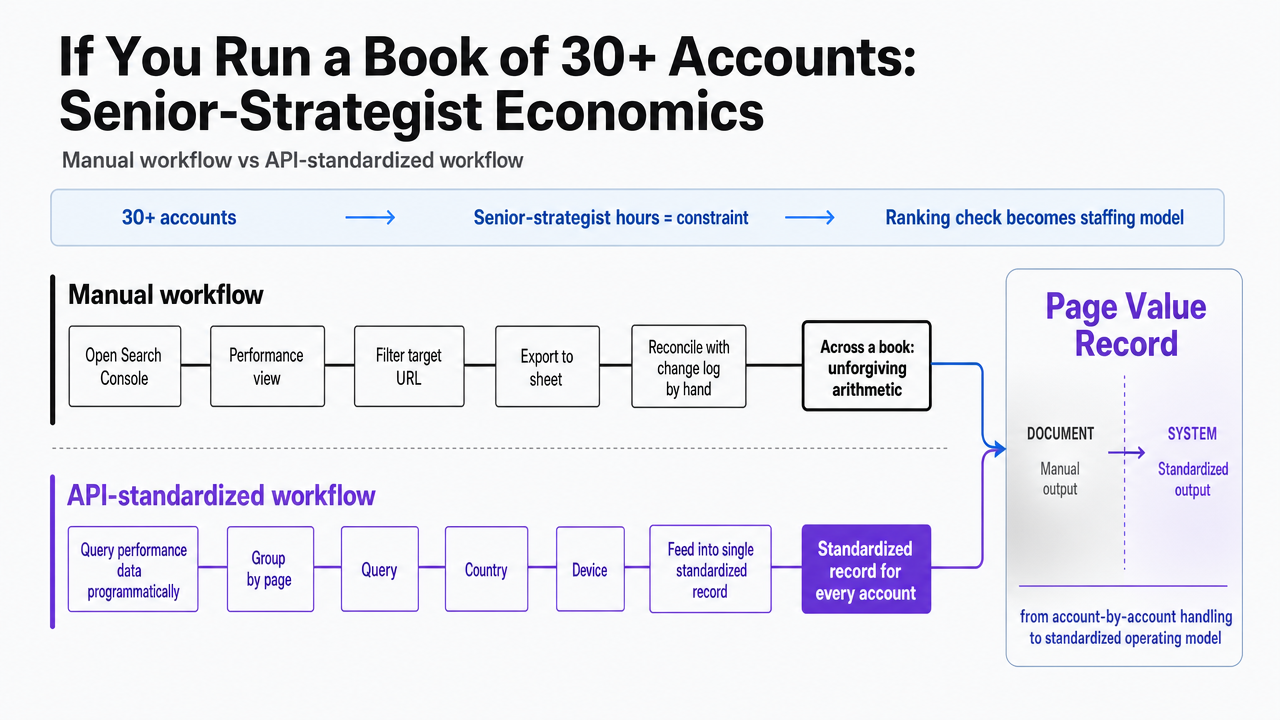 Visualize the comparison table of manual vs API-standardized workflow contained in the section
Quantify SEO Impact: Validate Client Value with Real-Time Page Ranking Checks
See how unified, data-driven page ranking checks make it easy to demonstrate measurable SEO gains across multiple client accounts—without increasing team workload or sacrificing accuracy.
What Not to Claim in a Ranking Report
Credibility in a client report is lost one overclaim at a time. Three claims recur in agency decks often enough to warrant a standing rule against them.
- Treating average position as a proxy for value. A position shift read in isolation does not prove demand changed, and Google's own guidance tells site owners not to focus too much on absolute position 1. A report that leads with a position number is answering a question the client did not ask.
- Implying that Core Web Vitals or page-experience work caused a ranking gain. Good scores do not guarantee top rankings, and Google states this directly 7. Technical wins belong in the change log with before-and-after metrics, not in a causal sentence about position.
- Presenting a Search Analytics API extract as a complete census of client search activity. The API may prioritize top results because of internal data-return limitations, so extracts should be labeled as standardized samples 5. A dashboard that quietly treats sampled rows as the full picture will eventually be audited by a client who notices the gap.
One additional discipline protects the whole report. Structured-data deployments produce eligibility, not guaranteed display, and a manual action against markup removes rich-result eligibility without affecting ordinary web ranking 11. Report schema work in the search appearance lane, with impressions and CTR as the evidence, and the renewal conversation stays on terrain the agency can defend.
Standardizing the Check Across the Book of Business
A reporting unit only earns its keep when every account in the book uses it the same way. That means a shared schema for the Page Value Record, a shared cadence for weekly flags and monthly narratives, and a shared disclosure language for what the data does and does not prove. Without those three, the standard dissolves into whatever each strategist decides to show.
The shared schema is enforced at the extract layer. A Search Analytics API query grouped by page, query, country, and device populates the same six performance fields for every account, which removes the per-strategist variance in what gets pulled and how it is framed 5. The remaining two fields, search appearance and change log, stay in human hands because they require judgment about what shipped and which SERP features matter for the target cluster.
The shared disclosure language is the quiet discipline that protects the whole system. Every report notes that extracts are standardized samples rather than a complete census 5, and every automated step in the production pipeline is governed by human approval before it reaches the client, which is the editorial posture Google's people-first guidance requires of any AI-assisted workflow 9. Platforms like Vectoron are built around that approval-first loop so the standard scales without surrendering the judgment the standard depends on.
Frequently Asked Questions
References
- 1.Debugging drops in Google Search traffic.
- 2.How To Use Search Console.
- 3.The new Search Console Insights report is here.
- 4.An improved way to view your recent performance data in Search Console.
- 5.Search Analytics | Search Console API.
- 6.Understanding Core Web Vitals and Google search results.
- 7.Understanding page experience in Google Search results.
- 8.A Guide to Google Search Ranking Systems.
- 9.Ask ``who, How, And Why''....
- 10.Structured Data Markup that Google Search Supports.
- 11.Completeness.