
Key Takeaways
- Semrush Position Tracking consolidates per-client spreadsheets into one portfolio view, adding SERP-feature tracking, cannibalization detection, and Search Console reconciliation across large account books.
- Ahrefs Rank Tracker pairs positions with its backlink index, letting analysts pivot from a rank drop to referring-domain changes without switching tools 1.
- AccuRanker delivers on-demand refreshes, per-tag grouping, and Search Console reconciliation, replacing constant account-manager requests for fresh data but stopping short of cause diagnosis.
- SE Ranking bundles rank tracking, site audits, backlink monitoring, and white-label portals in one login, making it the practical consolidation pick for agencies under thirty accounts.
- Sistrix anchors European reporting through its Visibility Index across German, UK, Spanish, Italian, and French markets, correlating movements with known Google algorithm updates.
- Nozzle captures full SERP, feature, and pixel-position data into BigQuery, replacing custom scraper pipelines for SQL-fluent teams that need deep SERP analysis.
- Search Console plus Looker Studio supplies the free first-party foundation for impressions, clicks, indexing, and Core Web Vitals, essential for reconciling any third-party rank data 2.
- Profound monitors brand mentions, citations, and answer composition across AI Overviews, ChatGPT, Perplexity, and Gemini, exposing generative-AI visibility gaps a classic rank report misses 4.
- Vectoron adds an approval-workflow execution layer that routes briefs, production, and publishing through human sign-off, closing the gap between rank signals and shipped work.
Why single-number rank tools fail agency workflows
A daily position number is an outcome, not a diagnosis. Google's documentation states that ranking is produced by numerous automated systems working at the page level and reinforced by site-wide signals, including link analysis, freshness, neural matching, and the helpful-content signal 1. A rank tracker that reports "position 7 → position 9" without exposing which of those systems moved forces an agency analyst to guess the cause.
This diagnostic challenge compounds across a client portfolio. An account manager reviewing thirty clients needs to differentiate noise from algorithmic shifts and identify specific page-level causes a strategist can address. Search Console provides the first-party data—impressions, clicks, query breakdowns, indexing status, and Core Web Vitals—necessary for this triage, complementing any third-party ranking view 2.
Agency-grade page ranking software must perform three critical functions beyond what a spreadsheet can offer:
- reconcile modeled position data against Search Console,
- segment movements by cause, and
- integrate the resulting insights into a repeatable multi-client workflow.
The tools reviewed in this article are evaluated based on these criteria.
The agency rubric: six capabilities that separate rank trackers from ranking intelligence
To objectively evaluate page ranking software, a fixed rubric is essential. Six capabilities determine a platform's suitability for an agency's delivery stack:
Portfolio scale. : The system must handle hundreds of projects, thousands of tracked keywords per project, and per-client tag hierarchies without performance degradation. Efficiency gains occur when a single view can rank movements across the entire client book.
Search Console integration depth. : Modeled position data can deviate from reality. First-party impressions, clicks, queries, and page-level reports from Google Search Console are crucial for reconciliation, as Google frames GSC as the source of truth for crawling, indexing, and Search performance 2. A tool lacking property-level GSC integration and keyword joining creates a reporting silo.
SERP-feature coverage, including AI Overviews. : Google's ranking systems consider various page-level factors, with helpful content integrated into core ranking in March 2024 1. A position 3 result next to an AI Overview and six sitelinks differs significantly from a position 3 in a ten-blue-link SERP. The platform must record feature presence, ownership, and pixel depth.
Anomaly detection. : Portfolio-scale monitoring requires triggered alerts for statistically meaningful movement, indexing loss, or feature drops. Threshold rules are more efficient than daily manual review.
White-label reporting. : QBR-ready output, per-client branding, scheduled delivery, and commentary fields are essential for tools to save analyst time rather than add to it.
API access. : Programmatic data pulls into a data warehouse or Looker Studio allow agencies to standardize KPIs across clients, eliminating the need to re-template dashboards for each account.
Each of the nine tools discussed is graded against these six criteria, providing a framework for evaluating vendor demonstrations.
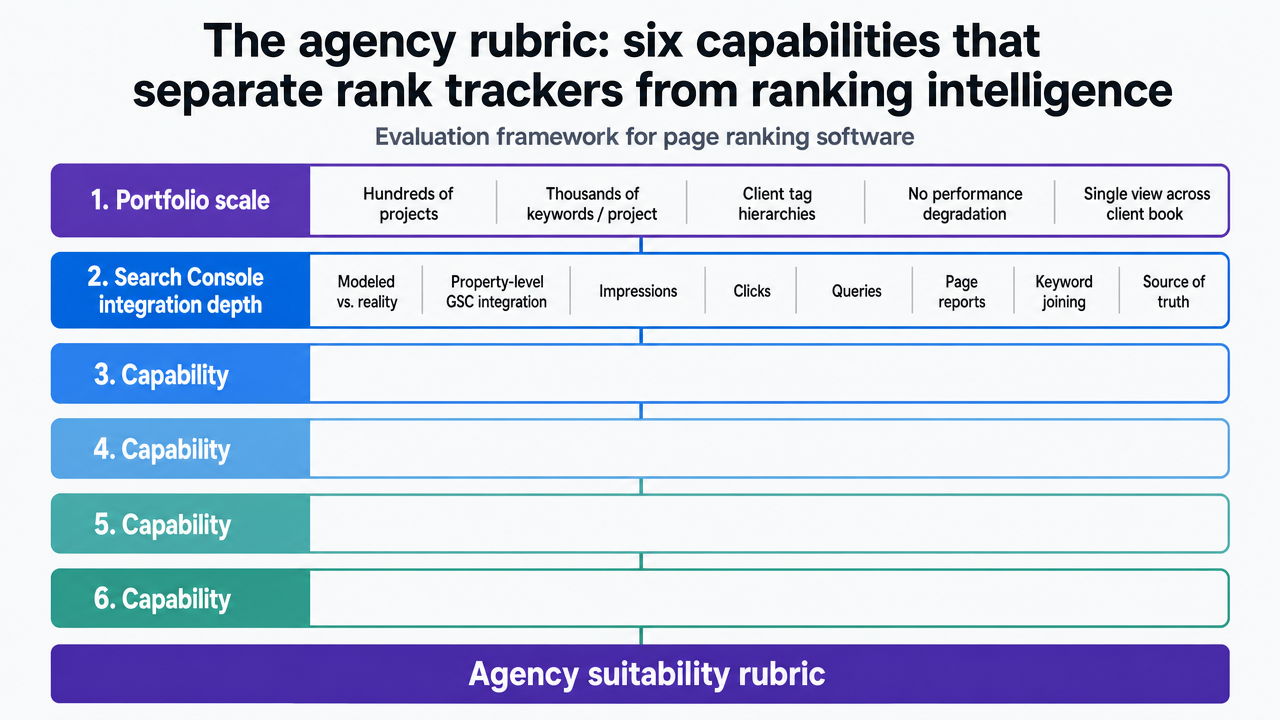 Visualize the six-capability evaluation rubric that structures the entire tool review, giving readers a scannable reference framework
Rank tracker vs. ranking intelligence platform
The term "page ranking software" encompasses two distinct product types: a rank tracker and a ranking intelligence platform. A rank tracker's function is limited to reporting position. A ranking intelligence platform, however, connects position to its underlying causes. Misunderstanding this distinction often leads agencies to acquire multiple tools that provide similar line charts but no diagnostic insights.
A rank tracker provides daily crawl data: keyword, location, device, SERP feature, position, and delta. This is valuable, especially for smaller portfolios. A ranking intelligence platform extends beyond this by:
- integrating position data with Search Console impressions, clicks, and query trends 2,
- incorporating technical signals like indexing status and Core Web Vitals field data 5,
- flagging SERP-feature changes and AI Overview inclusion 4, and
- correlating movement with Google's described page-level ranking systems 1.
The practical difference is evident during a Monday-morning triage: when a client's target keyword drops, does the tool explain why, or does it merely present a chart? Trackers produce charts; intelligence platforms identify pages requiring immediate attention. Agencies managing over thirty accounts typically need both types of solutions.
Test AI-Driven SEO Execution on Live Pages
Validate page ranking impact with real-time content deployments during your trial, measuring outcomes from live data.
The nine tools worth an agency's time
Semrush Position Tracking — replaces the multi-project rank spreadsheet
Semrush Position Tracking consolidates per-client spreadsheets into a single portfolio view, offering daily updates, device and location granularity, and per-project tag hierarchies. For agencies managing fifty accounts, this streamlines campaign setup, competitor selection, and share-of-voice analysis within one platform.
The platform tracks ownership across approximately thirty SERP feature types, identifies URL cannibalization, and sends movement alerts via email or Slack. Its Search Console connector links property-level impressions and clicks to tracked keywords, providing the reconciliation layer Google identifies as crucial for understanding first-party data 2.
While strong in portfolio scale, reporting, and API capabilities, Semrush Position Tracking's AI Overview inclusion tracking is still evolving compared to specialized tools. Its per-keyword pricing can also be a drawback for agencies with extensive long-tail keyword portfolios.
Ahrefs Rank Tracker — replaces manual competitor visibility pulls
Ahrefs integrates rank tracking with its backlink index, which is significant because Google's ranking documentation includes link analysis and PageRank among its page-level evaluation systems 1. This integration allows analysts to pivot from a rank drop to referring domain changes and lost backlink reports without switching tools, directly addressing potential causes.
Features like Traffic Share by Domain and Pages reports enable strategists to demonstrate competitive movement in QBRs, illustrating not just position but also market share gains. Keyword SERP history is retained, which is useful for addressing client disputes regarding position changes.
Ahrefs' rank refresh cadence is slower than dedicated trackers, and its white-label branding options are less comprehensive than agency-native platforms. It excels in competitive intelligence and content-cause diagnosis but is average in white-label reporting.
AccuRanker — replaces ad-hoc daily refresh requests from account managers
AccuRanker focuses solely on rank tracking, offering on-demand refresh capabilities to eliminate frequent requests from account managers. Its features, including fresh-position calls, per-tag grouping, and unlimited users, align well with agency team structures.
The Search Console integration reconciles modeled position data with first-party queries and clicks, which Google considers the operational source of truth for Search performance 2. Segment filters by landing page, tag, search intent, or SERP feature transform large keyword projects into manageable, triageable lists.
AccuRanker reports position and SERP context effectively but does not diagnose cause. It is best paired with a content or link analysis tool. It offers best-in-class refresh cadence and reporting but has a deliberately narrow scope.
SE Ranking — replaces the small-agency stack of three separate SEO tools
SE Ranking combines rank tracking, site auditing, backlink monitoring, and white-label client portals at a price point suitable for agencies with fewer than thirty accounts. Its primary value lies in consolidation: a single login, billing line, and export format across all clients.
Rank tracking supports major search engines, mobile and desktop segmentation, and local search grids. The site audit identifies crawl, indexing, and structured-data issues, which are important because Google uses structured data to classify content and enable enhanced appearances 7. Client dashboards are white-label ready with custom branding and scheduled email delivery.
SE Ranking's portfolio views can become cumbersome beyond approximately one hundred active projects, and its API depth is less robust than Semrush or Ahrefs. It is a strong consolidation option for growing agencies but may not scale effectively for enterprise-level client books.
Sistrix — replaces guesswork about visibility index movements in EU markets
Sistrix's Visibility Index is a standard reference for German, UK, Spanish, Italian, and French search markets. Agencies with European clients use it as a common metric for reporting site performance, similar to how US-centric agencies use Ahrefs.
Beyond the index, Sistrix tracks SERP-feature history, cannibalization, and directory-level performance for large sites, beneficial for multi-location and multi-language accounts. The tool correlates movements with known Google algorithm updates, providing a clear narrative for traffic shifts.
For US-centric agencies, North American data depth is less comprehensive than domestic competitors, and the interface prioritizes analyst use over client-facing reporting. It is essential for European portfolios but supplementary in US-only stacks.
Nozzle — replaces custom BigQuery pipelines for SERP-feature analysis
Nozzle is designed for agencies proficient in SQL. It captures the entire SERP—including every feature, pixel position, and result-type ownership—and pipes this data into BigQuery for custom analysis. For teams previously developing their own scrapers and cleaning JSON data, Nozzle offers a compelling buy-vs-build solution.
Granular position and feature data are critical because click concentration on Google is heavily skewed towards the top of page one. A 2021 study indicated that position 1 received 51.3% of clicks, position 2 received 15.68%, and position 3 received 9.23% of clicks, with 97.11% of clicks on the first page 10. While this baseline predates AI Overviews, it highlights the economic impact of even small position changes.
Nozzle offers the highest ceiling for SERP-data depth but requires analysts to be proficient in SQL.
Search Console + Looker Studio — replaces third-party reporting on first-party truth
Google Search Console serves as the foundational, free layer for understanding a site's performance, providing first-party data on impressions, clicks, queries, pages, indexing status, structured-data eligibility, and Core Web Vitals 2. Looker Studio transforms this data into customizable, per-client dashboards with scheduled delivery, filters, and blended data from Analytics and Ads.
For agencies, this combination is crucial for reconciliation. If a rank tracker shows position 5 but Search Console indicates an average position of 8.2 with declining impressions, the Search Console data is more reliable for client QBRs. Google's Core Web Vitals field data—LCP under 2.5 seconds, INP under 200 milliseconds, CLS under 0.1—is also available, allowing analysts to link position drift to page experience issues 5.
Limitations include the lack of a cross-property portfolio view without custom engineering and no competitor data. While a mandatory foundation, it is insufficient as a standalone rank solution.
Profound — replaces manual prompt-testing for AI Overview and chatbot visibility
Monitoring generative-AI visibility is essential for any current SEO strategy. Google's optimization guide states that generative-AI models draw from publicly accessible, crawlable content, and visibility in AI features relies on the same technical fundamentals as traditional search 4. Profound monitors brand mentions, citation frequency, and answer composition across AI Overviews, ChatGPT, Perplexity, and Gemini.
The agency use case is both defensive and diagnostic. If a client's category-defining query yields an AI Overview citing competitors but not them, Profound logs the exposure gap, cited sources, and trend over time. Reusable prompt libraries across client accounts reduce setup time for AI-visibility tracking.
AI answer results can vary by user, location, and time, making trend data more important than single snapshots. Profound is the best purpose-built option for AI-search monitoring within a still-maturing category.
Vectoron — replaces the client-approval and execution bottleneck around ranking work
Vectoron is not a rank tracker but an approval-workflow execution layer that complements the tools mentioned above. It addresses the post-rank-signal process: briefing, approval routing, production, publishing, and KPI attribution back to the position change.
Specialist strategist modules for content, SEO, PPC, backlinks, social, and call intelligence analyze live account signals and prioritize recommended work through a Command Center. This system routes every decision for human sign-off before execution. For agency heads managing thirty to two hundred accounts, Vectoron reduces coordination overhead by consolidating briefing cycles, status meetings, and vendor handoffs into an approve/decline queue with strategic reasoning attached to each recommendation.
Vectoron is not evaluated on rank-tracker axes but is strong in providing a workflow layer that translates rank intelligence into governed, shipped work.
If you manage a portfolio: the consolidation math on manual rank review
This section targets heads of SEO managing multi-client portfolios, not single-brand in-house teams, as the economics shift significantly with scale.
The market pressure is quantifiable. U.S. search advertising revenue reached $114.2 billion in 2025, an 11% year-over-year increase, representing 38.8% of digital advertising revenue 9. Client CFOs expect retainers to reflect this growth, necessitating a reduction in agency delivery cost per client while increasing reporting depth. Manual rank review works against this goal.
Using a blended analyst rate of $85 per hour, the following table illustrates the cost implications of manual rank review across different portfolio sizes:
| Portfolio Size | Keywords / Client | Reporting Cadence | Analyst Hrs / Client / Mo | Effective Cost / Client |
|---|---|---|---|---|
| 10 clients | 150 | Monthly | 4.0 | $340 |
| 25 clients | 250 | Bi-weekly | 3.2 | $272 |
| 50 clients | 400 | Weekly | 2.6 | $221 |
| 100 clients | 500 | Weekly + alerts | 2.1 | $179 |
| 200 clients | 500 | Weekly + alerts | 1.7 | $145 |
The cost curve demonstrates a critical inflection point around forty accounts. Below this threshold, a skilled analyst with a spreadsheet and Search Console access can manage the workload 2. Beyond it, efficiency gains in hours per client only occur when portfolio views, anomaly alerts, and API-driven reporting replace manual triage. The marginal cost of manual rank review quickly surpasses the cost of tool automation and workflow software, with the gap widening as more clients are added.
Agencies should model their own client books before renewals. If the effective cost per client remains flat while the portfolio grows, consolidation and automation are overdue.
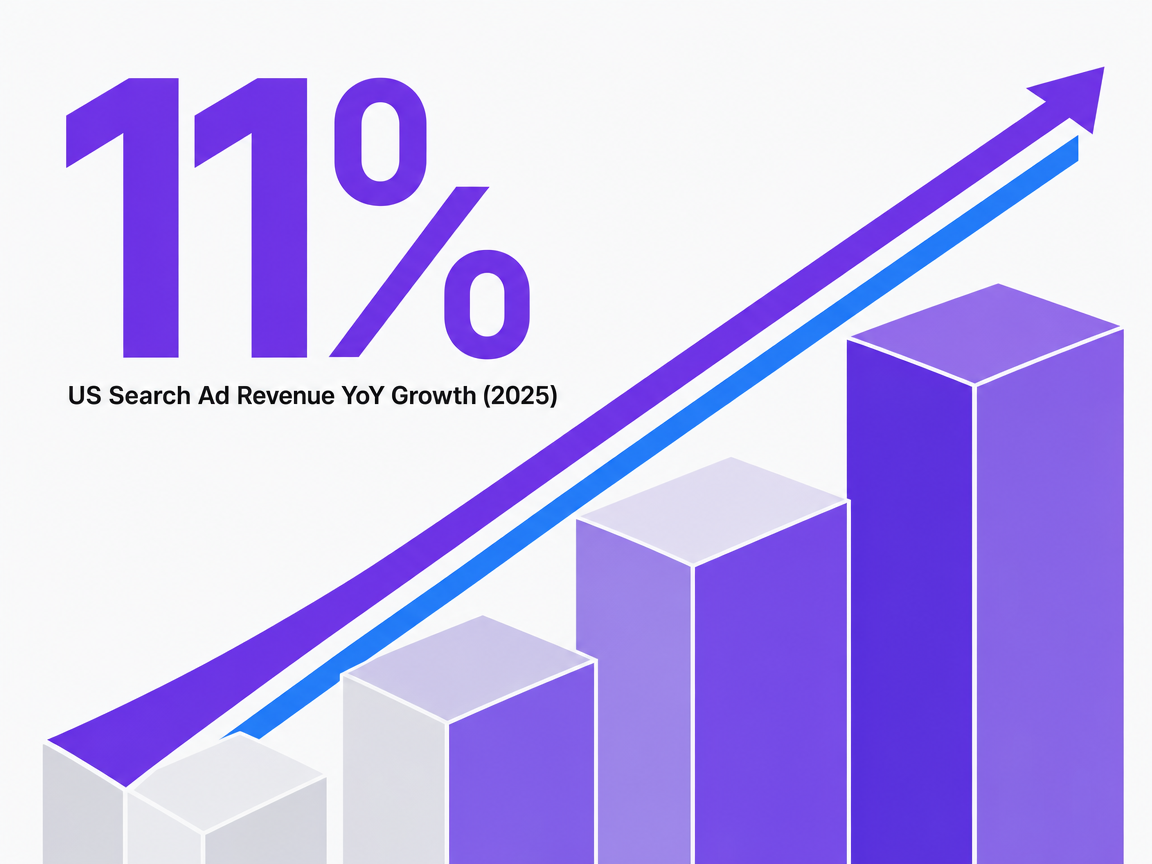 US Search Ad Revenue YoY Growth (2025)
US Search Ad Revenue YoY Growth (2025)
Connecting position to cause: technical, content, and behavior signals
Position is a symptom; the underlying cause resides in three data layers that a page ranking platform must integrate or reconcile: technical, content, and behavior. Neglecting any of these layers leads to guesswork.
Technical factors are the first area to investigate when a page's ranking drops without corresponding content or link changes. Google defines page experience as a page-level assessment encompassing Core Web Vitals, HTTPS, mobile usability, and the ability to distinguish primary content 6. A rank drop coinciding with LCP exceeding 2.5 seconds or INP crossing 200 milliseconds indicates a technical diagnosis 5. Indexing status and sitemap discovery are also crucial, as Google treats sitemap submission as a hint, not a guarantee of crawl or indexing 8.
Content-related causes manifest in query drift and structured-data eligibility. If a tracked keyword declines and Search Console shows the page now ranking for a different query cluster, it indicates a shift in intent requiring an editorial fix. Structured data changes eligibility for enhanced appearances, which can alter click share even if position remains stable 7.
Behavioral signals complete the diagnostic loop. Prior click rank, query reformulation, and search duration correlate with future click-through rates. A stable position with decaying clicks is a significant signal, not a minor fluctuation 14. Any platform that reports rank without considering behavioral data provides an incomplete picture.
See How Leading Agencies Standardize Page Ranking Insights at Scale
Request a walkthrough of AI-powered workflows that centralize rank tracking, approval, and reporting—no extra headcount required. Designed for agencies managing complex, multi-client SEO portfolios.
AI-search visibility and the governance line around automation
Two opposing trends are shaping agency rank operations. Generative-AI features have shifted discovery away from the traditional ten-blue-link SERP, meaning tools reporting only classic positions are measuring a diminishing surface. Simultaneously, Google's spam policy has tightened around automation, including automated querying of Search results and scaled content abuse, defined by intent to manipulate rankings rather than production method 3. This raises critical governance questions.
Regarding visibility, Google's guide to AI features explicitly states that generative models draw from publicly accessible, crawlable content, and inclusion depends on the same fundamentals as traditional Search 4. Rank software must log AI Overview presence, cited sources, and changes over time. A client cited in three AI answers one month and none the next has lost visibility that a classic position report will not capture.
On the automation front, the operational rule is clear: use vendor-approved SERP APIs, not scraped ones, and ensure AI-assisted content undergoes editorial judgment and approval before publication. McKinsey's 2025 State of AI report highlights that organizations deriving value from AI are those re-engineering workflows and governance, not merely integrating models into existing pipelines 13. For agency page ranking software, this translates to a mandatory approval layer between machine-generated insights and published work.
Buying decision: matching the nine tools to three agency shapes
Agency structure is a primary determinant of the optimal tech stack. Three common profiles cover most of the market:
Under 40 accounts, generalist bench. : Focus on consolidation. SE Ranking or Semrush Position Tracking, combined with Search Console and Looker Studio, provides rank tracking, auditing, and reporting on a single bill 2. Profound should be added if clients specifically inquire about AI Overview presence.
40 to 150 accounts, specialist pods. : Separate rank tracking from intelligence. AccuRanker for refresh cadence and alerts, Ahrefs for competitive analysis and link-cause diagnosis, Search Console as the reconciliation layer, and Profound for AI-visibility monitoring 4. Integrate Vectoron to streamline the process of turning approved recommendations into implemented work without lengthy briefing cycles.
150+ accounts or European-heavy books. : Supplement with Nozzle for deep SERP-data analysis and Sistrix for EU visibility benchmarks. At this scale, API access and data warehouse pipelines become essential, not optional.
Agencies should evaluate every vendor against the six-axis rubric before renewal, recognizing that a stack suitable for 30 accounts will likely be inadequate for 100.
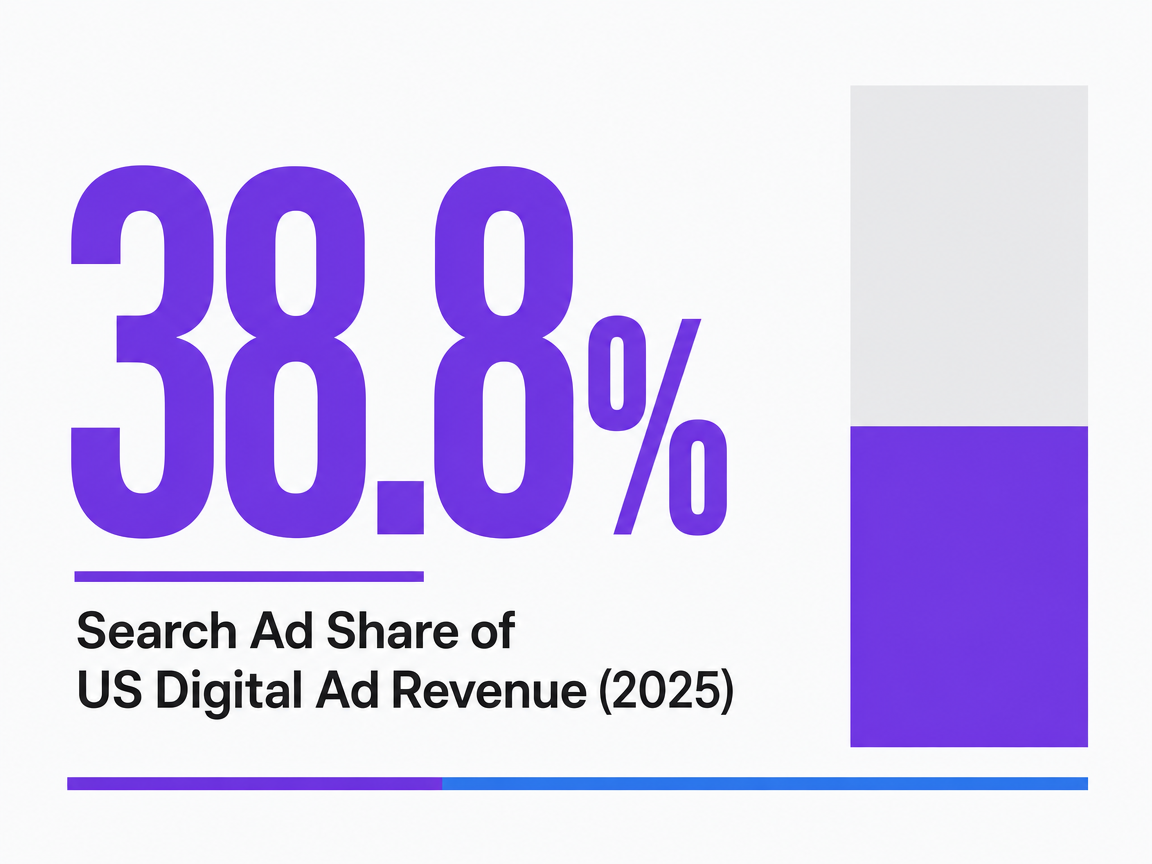 Search Ad Share of US Digital Ad Revenue (2025)
Search Ad Share of US Digital Ad Revenue (2025)
Frequently Asked Questions
References
- 1.A guide to Google Search ranking systems.
- 2.Get started with Search Console.
- 3.Spam policies for Google web search.
- 4.Google's Guide to Optimizing for Generative AI Features on Search.
- 5.Understanding Core Web Vitals and Google search results.
- 6.Understanding page experience in Google Search results.
- 7.Intro to How Structured Data Markup Works.
- 8.Build and Submit a Sitemap.
- 9.Internet Advertising Revenue Report: Full Year 2025.
- 10.Search Engine Results Page Click Behavior: An Analysis of User Interaction with Google and Bing.
- 11.CHAPTER 4: Economy.
- 12.AI in the workplace: A report for 2025.
- 13.The state of AI.
- 14.Identification of Factors Predicting ClickThrough in Web Searching.