
Key Takeaways
- Treat PAA as a content operations program rather than a page-level tactic, since scaling across clients and writers demands templates, review gates, and portfolio-level filters.
- Qualify queries using four attributes—task type, audience fluency, PAA stability, and competitive answer quality—so production effort concentrates on exploratory, novice-facing questions where PAA engagement is highest 1.
- Structure answer blocks with a direct answer, scope sentence, and follow-up hook under a full interrogative header, mirroring PAA's clarifying-question patterns to improve extraction odds 3.
- Forecast against a CTR band of 3.0% to 7.4%, using the lower benchmark for budget defense and the survey ceiling as observed upper bound, rather than a single fragile number 6, 4.
- Run a four-station workflow—intake scoring, templated drafting, tiered review, and batch approval—to keep strategist involvement off the critical path while protecting quality.
- Report share-of-SERP and PAA impression share as headline metrics, relegating sessions to a diagnostic against the modeled CTR band, since PAA answers on-SERP by design 10.
- Acknowledge the decoupling of content from clicks caused by answer boxes and AI Overviews, and reposition PAA as a topical-authority play with capped budget and limited traffic upside 11, 8.
Why PAA Belongs in Content Operations, Not the Ranking Checklist
People Also Ask (PAA) capture at agency scale is a content operations challenge, not merely a page-level tactic. While optimizing a single answer block for one query is straightforward, replicating that success across numerous client sites, diverse verticals, and a rotating team of writers demands a systemic approach. Tactics effective for individual optimizations often fail without a robust operational framework.
The shift in user attention on Search Engine Results Pages (SERPs) justifies this operational reframe. Rich SERP features, including PAA, divert user fixation from traditional blue links. Users engaging with question-oriented modules frequently expand multiple entries but click through to only a fraction of the underlying pages 2, 10. This behavior rewards agencies capable of consistently delivering well-structured answer blocks across their client portfolios, while penalizing those that treat PAA as an ad-hoc optimization request.
Furthermore, traditional position-based click models often misrepresent traffic potential on SERPs featuring answer modules, leading to inaccurate traffic projections 9. For PAA to be a viable component of a delivery plan, its value must be honestly assessed: modest incremental sessions, significant on-SERP visibility, and the accumulation of topical authority signals across a domain.
The following sections detail how to manage PAA as a repeatable output, covering query qualification, templated answer patterns, review processes, forecasting, and reporting that accurately reflects its value without overpromising traffic.
Qualifying Which Client Queries Deserve PAA Investment
Task Type and Knowledge Level Influence PAA Engagement
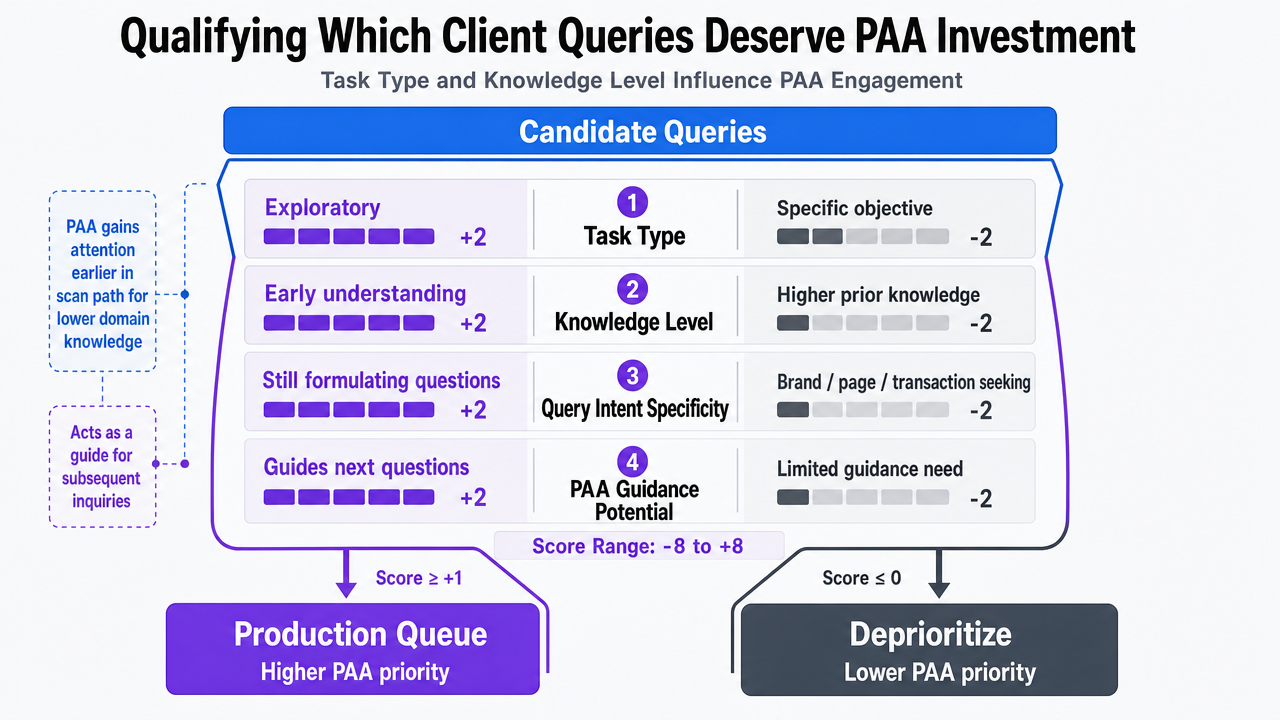
A key insight for PAA prioritization is that user interaction with the box varies based on task type and prior knowledge. A 2024 eye-tracking study revealed that searchers with less domain knowledge processed PAA content earlier in their scan path, and exploratory tasks led to increased fixation on the PAA box 1. While a small lab study, its directional findings are stable enough for practical application.
From an agency perspective, this means PAA gains more attention for queries where the searcher is early in their understanding of a topic and still formulating their questions. In these scenarios, the PAA box acts as a guide for subsequent inquiries. Conversely, queries where users have a clear objective—seeking a specific brand, page, or transaction—yield less engagement with PAA, as users tend to bypass it for their known destination.
This pattern should influence how SEOs evaluate client keyword lists. High-value PAA opportunities are concentrated in the informational and comparative stages of the funnel—queries about how things work, comparisons between options, or expectations from a service. These typically involve exploratory tasks and audiences unfamiliar with the subject matter. Branded queries, transactional intents, and highly technical queries for specialists are lower-priority PAA targets, even if the box appears, because the users most likely to engage with PAA are not the client's target converters.
A Portfolio-Wide Query Selection Filter
To translate behavioral insights into a scalable portfolio filter, queries should be scored on four attributes before content creation begins:
- Task type: is it exploratory or directed?
- Audience fluency: is the searcher a novice or a specialist?
- PAA presence and stability: does the box consistently appear, and do its questions align with topics the client can credibly address?
- Competitive answer quality: are existing PAA sources weak enough for a well-structured answer to compete effectively?
Queries that meet all four criteria proceed to the PAA production queue. Those that only show PAA presence—but target a directed and fluent audience—are tiered lower, where an answer block might be added opportunistically but a dedicated page won't be built around it. This selective approach is crucial for portfolio-scale PAA work, distinguishing it from per-page optimization. Many SERPs with PAA boxes are not worth targeting, making the decision to decline a high-leverage strategic choice.
This filtering process also safeguards profit margins. An SEO managing numerous accounts cannot afford to have writers crafting bespoke answer blocks for every PAA suggestion. A shared rubric directs production efforts towards exploratory, novice-facing, and weakly-answered questions where PAA inclusion is both feasible and impactful, leading to the templated answer blocks discussed next.
 Visualize the four-attribute query qualification filter described in the section, showing how candidate queries are scored and routed into or out of the production queue
Engineering Answer Blocks That Match Clarifying-Question Patterns
The Anatomy Google Rewards
Effective answer-block design draws from research treating PAA entries as clarifying questions—the type a search system might ask to refine user intent. Researchers developing clarifying-question systems have utilized Google's PAA feature as a source of real-world information needs, recognizing that these questions reflect what searchers genuinely want to resolve next 3. This perspective fundamentally shapes what constitutes a good answer block.
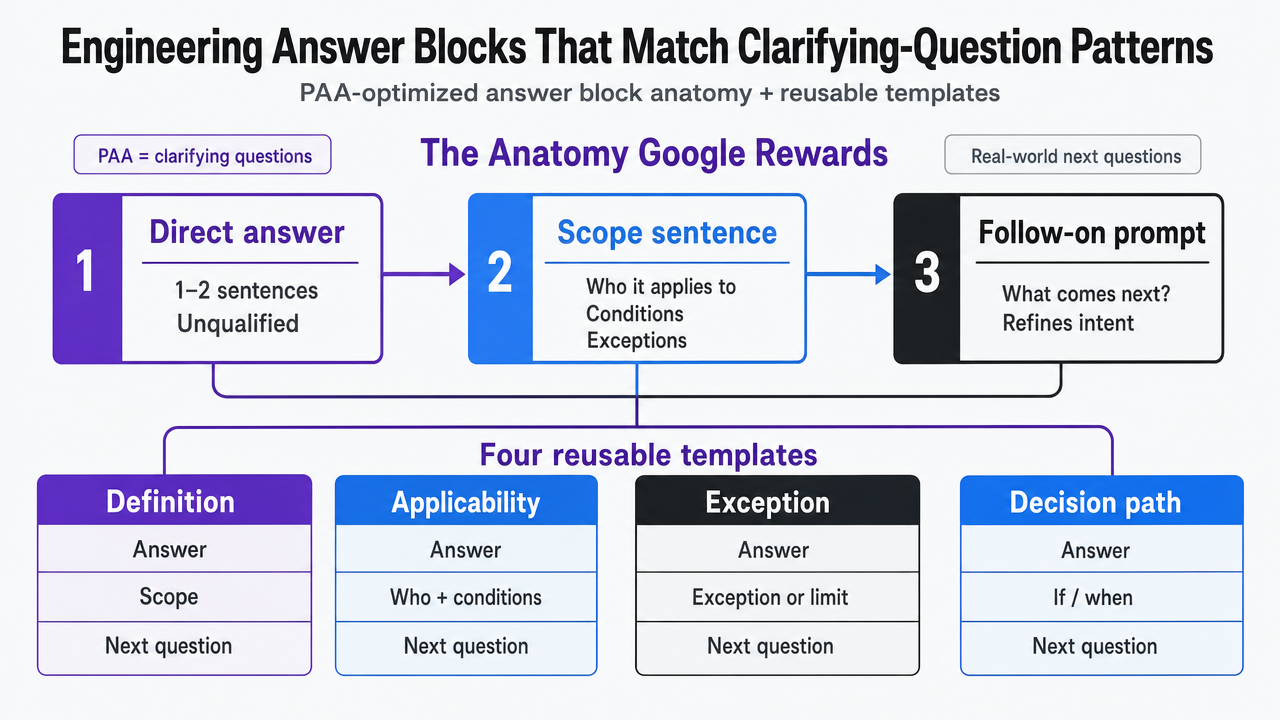
A PAA-optimized answer block consists of three sequential parts:
- A direct, unqualified answer to the surface question, ideally in one or two sentences.
- A supporting sentence that defines the scope—who it applies to, under what conditions, or with specific exceptions—ensuring the answer remains coherent when extracted by Google.
- A follow-up hook: a sentence or brief list that anticipates the next logical clarifying question, mimicking PAA's own chaining of questions.
The question header is as vital as the content. It should mirror the syntactic structure of PAA entries: full interrogative sentences, natural phrasing, and no keyword stuffing. Extraction models prioritize question form before analyzing the answer. For instance, "How much does X cost?" is always preferable to "X cost" as an H2 or H3.
This structured approach increases the likelihood of PAA inclusion, though it doesn't guarantee it. Production costs typically increase by 10-15 minutes per block compared to a generic paragraph. In reporting, this effort will initially manifest as a gradual increase in PAA impressions before any significant CTR movement, a sequence that should be communicated in the delivery plan to manage client expectations.
Templated Patterns for Scalable Content Production
For SEOs managing multiple client portfolios, the goal is to streamline answer block production by removing strategists from the critical path, thereby preventing bottlenecks. Four primary templates can cover most PAA-eligible questions across service-oriented client work.
- The definition pattern addresses "what is X" queries with a one-sentence definition, a sentence categorizing the concept, and a follow-up line hinting at common comparisons.
- The cost pattern answers "how much does X cost" with a price range, a sentence detailing variables influencing the range, and a line explaining who the low and high ends apply to.
- The process pattern tackles "how does X work" with a 3-5 step sequence, each step a single sentence, followed by a common failure point.
- The comparison pattern resolves "X vs Y" with a one-sentence verdict, a two-sentence contrast on the most critical axis, and a follow-up for a secondary axis.
Each template includes a fill-in brief and two reviewed examples relevant to the client's vertical. Writers apply the templates, while strategists initially review the first five blocks per writer per client, then transition to sampling. This operational model is supported by clarifying-question research, which indicates that PAA-derived questions represent stable, recurring information needs, allowing these four patterns to be reused across numerous queries within a vertical without becoming outdated 3.
This templated approach involves a trade-off: reduced voice variation, which some clients may notice on brand-sensitive pages. A solution is to limit template use to informational subfolders—such as resource hubs, learning sections, or glossaries—and reserve hand-crafted copy for high-value "money pages" where brand voice and conversion are paramount. Portfolio economics dictate that strategist attention is best spent where templates cannot be applied.
 Illustrate the three-part anatomy of a PAA-optimized answer block and the four reusable templates, both directly explained in the section
Test advanced workflows for People Also Ask wins
See how automated content strategies earn PAA box placements for real client sites during your trial.
Forecasting PAA Value Without Overselling the Client
The CTR Range Worth Modeling Against
A defensible PAA forecast should consider a range of click-through rates (CTR). First Page Sage's 2026 benchmark assigns the PAA box a 3.0% CTR, derived from their proprietary dataset 6. Another cross-feature CTR compilation also reports 3.0% for PAA, providing context against other SERP features 7. A higher estimate comes from a survey of over 3,500 internet users, where approximately 6% reported clicking on PAA boxes, with CTRs ranging from 5.4% to 7.4% on SERPs containing the feature 4.
The difference in these figures is methodological: 3.0% is an aggregated benchmark from observed SERPs, while the 5.4%–7.4% range is based on self-reported user behavior, which often overestimates recalled actions. A forecasting band from 3.0% (low end) to 7.4% (high end) encompasses both. The most transparent client conversation involves modeling against the lower end and reporting actual performance based on the client's analytics.
This approach provides strategists with a robust, defensible range rather than a single, fragile number, mitigating the temptation to promise the highest possible outcome. Client-facing forecasts should cite both the 2026 benchmark for the baseline and the user survey for the upper bound, ensuring the forecast remains credible through quarterly reviews.
Sizing the Opportunity Across a Portfolio of Clients
For an SEO managing a large client portfolio, the objective is to determine if a firm-wide PAA program meets internal cost-to-serve thresholds before budget allocation. The calculation involves four variables and one sourced anchor.
The variables are:
- Average monthly queries per client where a PAA box appears (V), which is an agency-measured portfolio observation.
- Capture rate (C), the percentage of targeted queries where a client page achieves PAA inclusion, typically modeled at 10%–25% for qualified programs.
- PAA CTR, using the sourced band of 3.0% (baseline) 6 to 5.4%–7.4% (upper end) 4.
- Incremental sessions per client per month are calculated as V × C × CTR.
The table below illustrates potential session volumes across different query tiers, using the established CTR band. The volume and capture rates are illustrative and should be replaced with actual client data.
| Per-client PAA queries (V) | Capture rate (C) | Sessions at 3.0% CTR | Sessions at 7.4% CTR |
|---|---|---|---|
| 200 | 15% | 9 | 22 |
| 500 | 20% | 30 | 74 |
| 1,000 | 25% | 75 | 185 |
For 50 clients, the middle tier projects approximately 1,500 to 3,700 incremental sessions monthly across the portfolio. This is a modest figure relative to typical agency revenue, highlighting that PAA rarely justifies its cost solely as a session-generation program at the lower end of the band. Its value emerges when the same production investment also enhances featured snippet candidacy, boosts topical authority, and increases share-of-SERP within informational content areas where templated answer blocks reside. Funding decisions should consider this composite outcome, not just session growth.
Building the Delivery Workflow: Templates, Review Gates, Approval
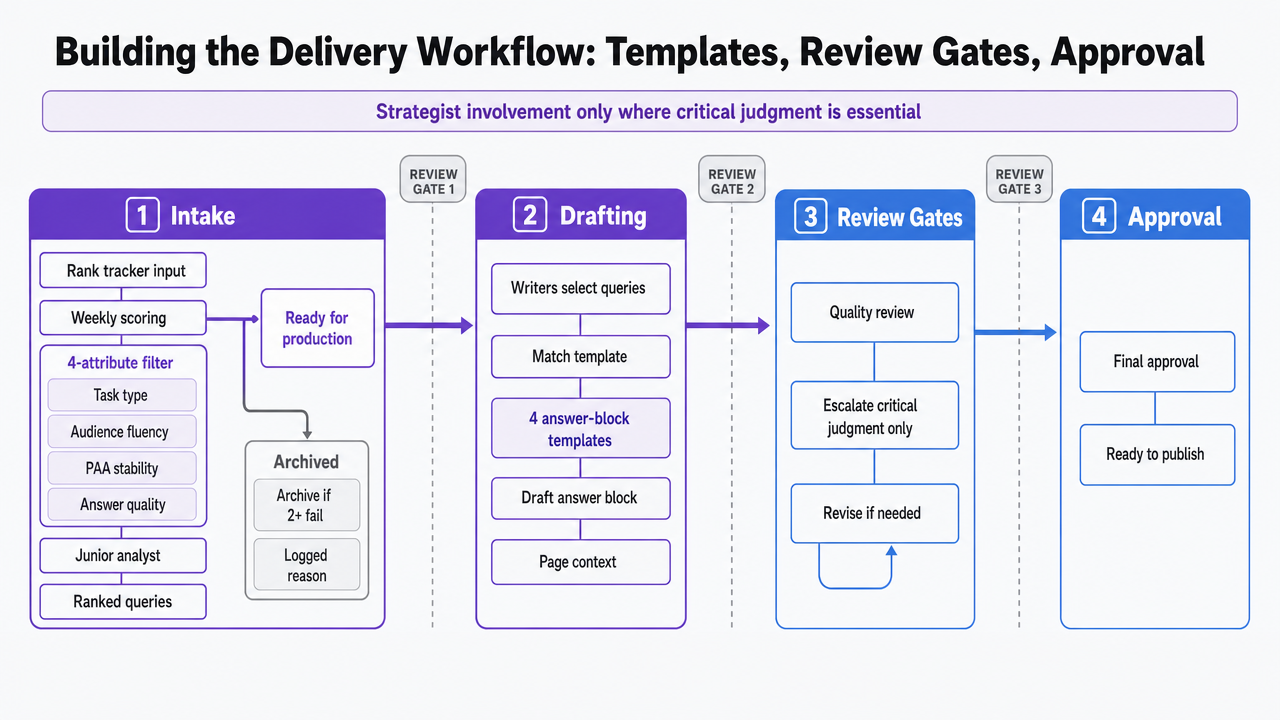
A sustainable workflow for portfolio-scale PAA involves four distinct stages, each designed to minimize strategist involvement except where critical judgment is essential.
- Station One: Intake. A rank tracker feeds candidate queries into a weekly scoring process using the four-attribute filter: task type, audience fluency, PAA presence stability, and competitive answer quality. This scoring is rubric-based, allowing a trained junior analyst to execute it. The output is a ranked list of queries ready for production. Queries failing two or more attributes are archived with a logged reason, which is useful when clients inquire about specific keywords.
- Station Two: Drafting. Writers select queries from the ranked list, match them to one of the four answer-block templates, and draft the block along with surrounding page context using a fill-in brief. Because templates are based on PAA's clarifying-question patterns 3, drafts typically require editing rather than extensive rewriting.
- Station Three: Review. The first five blocks from each writer per client undergo a full strategist review. Subsequently, review shifts to a 20% sample, supplemented by automated checks for elements like question header syntax, answer length, and the presence of scope and follow-up sentences. This gate maintains quality without requiring senior staff time to scale linearly with output.
- Station Four: Approval and Publish. Client-side approvers sign off on batches of content rather than individual pages. Publishing occurs on a fixed schedule to ensure clean measurement windows. Each approved block is tagged in the CMS as PAA-eligible, feeding into the reporting layer. This workflow ensures high throughput with defensible quality, provided the discipline to reject weak candidates at station one is maintained.
 Visualize the four-station operational workflow described in the section, which is a pure process with no chartable data but clear sequential stages
Scale 'People Also Ask' Wins Across Client Portfolios—Without Adding Overhead
Connect with our team to see real-world frameworks for capturing and reporting on PAA box placements at scale, leveraging AI-driven workflows tailored for multi-client agency environments.
Reporting PAA as Share-of-SERP, Not Session Growth
Client reports that prioritize session counts for PAA will consistently face challenges. PAA is designed to answer questions directly on the SERP, and behavioral research indicates users often expand multiple entries but click through to only a fraction of the underlying pages 10. This is an inherent characteristic of the feature, not a failure. Reporting must clearly articulate this reality to avoid constant renegotiation of delivery plans.
The most robust metrics for PAA reporting are visibility-based. The primary metric is "Share-of-SERP" for the client's target question set—the percentage of tracked PAA-eligible queries where a client page appears within the accordion. A secondary metric is PAA impression share from Search Console, filtered to URLs containing templated answer blocks. Both metrics typically show movement within weeks and correlate with gains in topical authority that can benefit adjacent informational queries in subsequent quarters.
While sessions should still be included in reports, they should be presented as a bounded diagnostic rather than the headline. A "clicks-from-PAA-eligible-URLs" line, compared against the forecasted 3.0%–7.4% CTR band, informs the client whether their SERPs are performing within, above, or below the modeled range. If a client is at the lower end of CTR but share-of-SERP is increasing, it indicates a healthy program that is effectively earning attention within the established economics of answer boxes 11.
Operationally, the dashboard should prominently display and defend two numbers: share-of-SERP for the targeted question set and PAA impression share on tagged URLs. Session counts serve as a diagnostic tool, not the primary performance scorecard.
The Second-Order Risk: Answer Boxes, AI Overviews, and Decoupled Traffic
A significant strategic risk to acknowledge in the delivery plan is that answer boxes can weaken the direct link between content creation and website traffic. Publishers provide the content that fuels PAA, yet users increasingly find answers directly within the SERP accordion without clicking through to the source. Policy researchers have termed this the "decoupling of content provision from user traffic" 11. Agencies pursuing PAA at scale are knowingly participating in this dynamic, which may differ from the assumptions in many client contracts.
The advent of AI Overviews further intensifies this dynamic. UX research on AIO deployments shows that expandable answer modules, including PAA, now compete with generative summaries for user attention. Early observations indicate that participants who previously saw only external results sometimes showed no clicks on new AIO right-rail links 8. Practically, this means engineering for PAA candidacy remains valuable, but the potential for outbound clicks from any single answer feature is becoming more constrained.
The strategic repositioning is clear: market PAA to clients as a program focused on topical authority and share-of-SERP, with a limited traffic upside. Price production accordingly, and cap the portion of any content budget dedicated to PAA against investments in money pages and off-SERP demand channels. SEO leaders who proactively address the decoupling risk in their delivery plans will maintain program defensibility when future SERP layout changes impact performance metrics.
Frequently Asked Questions
References
- 1.People also ask: How does this tool affect exploration-exploitation strategies with regard to prior domain knowledge and search context? An eye-tracking study.
- 2.Competing for Users' Attention: On the Interplay between Organic and Sponsored Search Results.
- 3.From "people also ask" to clarifying questions for enhancing web search experiences.
- 4.Featured Snippets Study: Results From 3,500+ Internet Users.
- 5.Google Search Features Impact Organic Search CTRs.
- 6.Google Click-Through Rates (CTRs) by Ranking Position in 2026.
- 7.Average CTR by Ranking Position on Google SERP.
- 8.Other Studies And Research (Google AI Overviews UX Study Methodology).
- 9.Modeling User Click Behavior on Search Engine Results Pages with Rich Features.
- 10.Behavioral Analysis of Users' Interactions with Question-Oriented SERP Features.
- 11.Policy Implications of Search Engine Answer Boxes.