
Key Takeaways
- Treat pillar pages as a six-stage production line—topic selection, cluster mapping, drafting, internal linking, structured data, and maintenance—so quality standards hold across every client account.
- Screen topics with a three-part test: the client must offer original evidence, the topic must anchor a defensible cluster of six to ten subtopics, and it must match a real audience decision 1.
- Enforce linking and schema as rules rather than judgment calls—cluster pages link up within the first 150 words, pillars link down from a dedicated section, and JSON-LD markup must mirror visible content 2, 6.
- Shift human effort upstream to approval and governance: signal-based Search Console triggers replace calendar reviews, and reviewers verify original evidence, cluster overlap, and schema accuracy before publication 1.
Why pillar pages stall at agency scale
Most agency SEO teams understand the pillar-and-cluster model. The challenge isn't a lack of knowledge, but rather that pillar pages are often treated as isolated projects, built once and then neglected. A typical process involves a senior strategist defining the topic, a writer drafting extensive content, an editor refining it, and a developer manually adding FAQ schema before publication. Months later, critical elements like internal linking strategy, deferred subtopics, or necessary content refreshes are forgotten. This leads to a repetitive cycle where each new client project starts from scratch.
This approach doesn't scale across a portfolio of clients. Google continuously raises the bar for content quality, emphasizing comprehensiveness, originality, and a people-first approach 1, while also highlighting internal links as a key discovery mechanism 2. Research on topic clusters further supports this, indicating that authority is signaled by content hierarchy and cross-linking, not by individual assets 10, 11. Neither Google's guidelines nor practitioner research rewards a bespoke, single-page effort.
The solution is to shift from viewing pillar pages as static documents to a structured production line with defined stages, clear rules, and a regular maintenance schedule. The following outlines a six-stage process that an SEO lead can implement with their team.
The six-stage production line
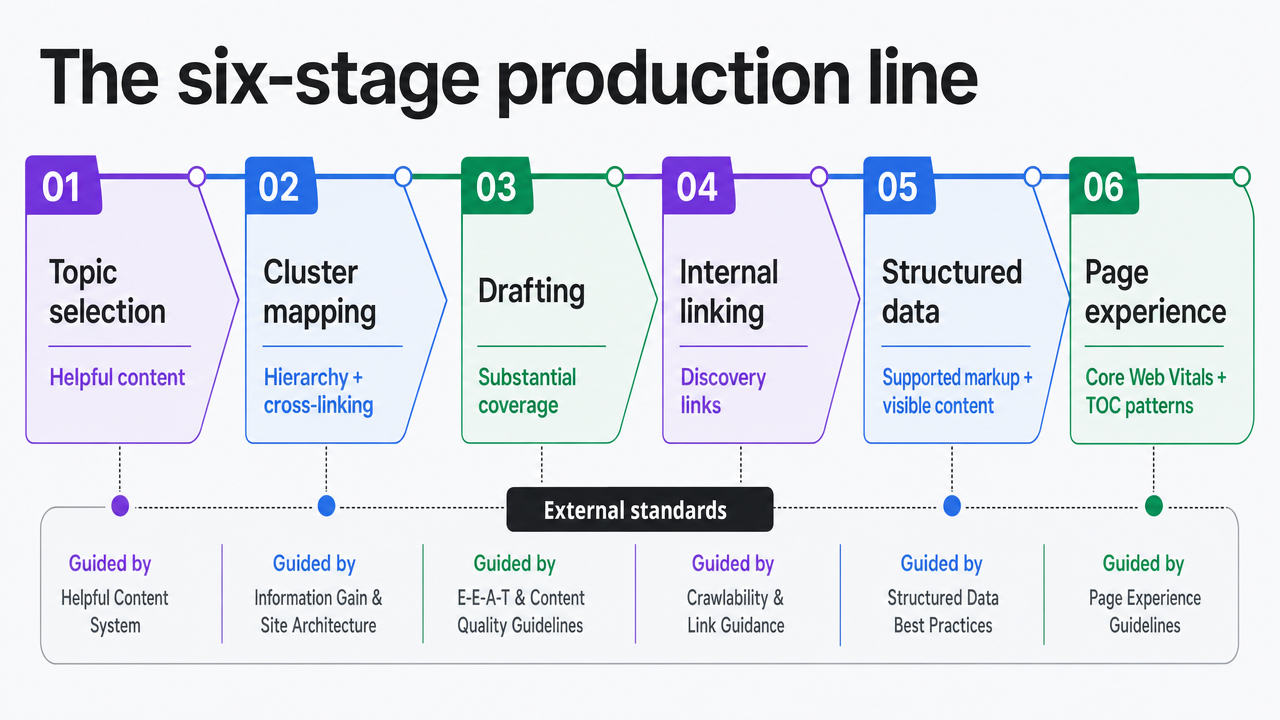
Any pillar program designed for scale beyond a few accounts relies on these six stages, each guided by specific external standards:
- Topic selection adheres to the helpful-content standard, prioritizing originality and comprehensiveness 1.
- Cluster mapping is informed by the consensus that hierarchy and cross-linking are crucial for signaling authority 10.
- Drafting focuses on substantial coverage rather than arbitrary word counts, aligning with Google's guidance 2.
- Internal linking follows the SEO Starter Guide's emphasis on links as a discovery mechanism 2.
- Structured data implementation is governed by Google's supported-markup gallery and the policy that markup must reflect visible content 4.
- Page experience and in-page navigation are guided by Core Web Vitals 3 and research on table-of-contents patterns for long-form content 8.
By grounding each stage in verifiable sources, subjective debates about content strategy are minimized.
Stage 1: Topic selection that survives portfolio review
Topic selection is a common point of failure for pillar programs. A strategist might choose a high-volume keyword, but if the site lacks genuine authority on that topic, the page will fail to rank. This issue is amplified across multiple accounts until a standardized rule is enforced.
This rule is a three-part test applied before a topic enters production:
- The client must be able to cover the topic with original information, reporting, or analysis, not just a rehash of existing content. Google's helpful-content standard explicitly asks whether a page offers original insights and comprehensive coverage 1. If the client cannot provide unique case data, expert interviews, or proprietary operational details, the topic is rejected, regardless of search volume.
- The chosen topic must anchor a defensible cluster. Practitioner advice for core-topic selection emphasizes balancing relevance, search volume, and keyword difficulty, rather than solely focusing on volume 13. For instance, a DUI defense firm can effectively build a pillar around "DUI penalties by state" because subtopics like "first offense," "refusal," "CDL holders," and "expungement" fall within their expertise. Conversely, "Criminal law" would be too broad for the same firm.
- The topic must align with a real audience decision, not an abstract category. Google's quality guidelines are clear: content created primarily to attract search traffic, rather than to genuinely help users, is considered low-value 1.
An SEO lead applying this three-part test across multiple accounts will likely eliminate a significant portion of proposed pillars before drafting begins. This rigorous review process is designed to prevent the recurrence of the artisanal, one-off content creation pipeline for each client.
Stage 2: Cluster mapping as a reusable artifact
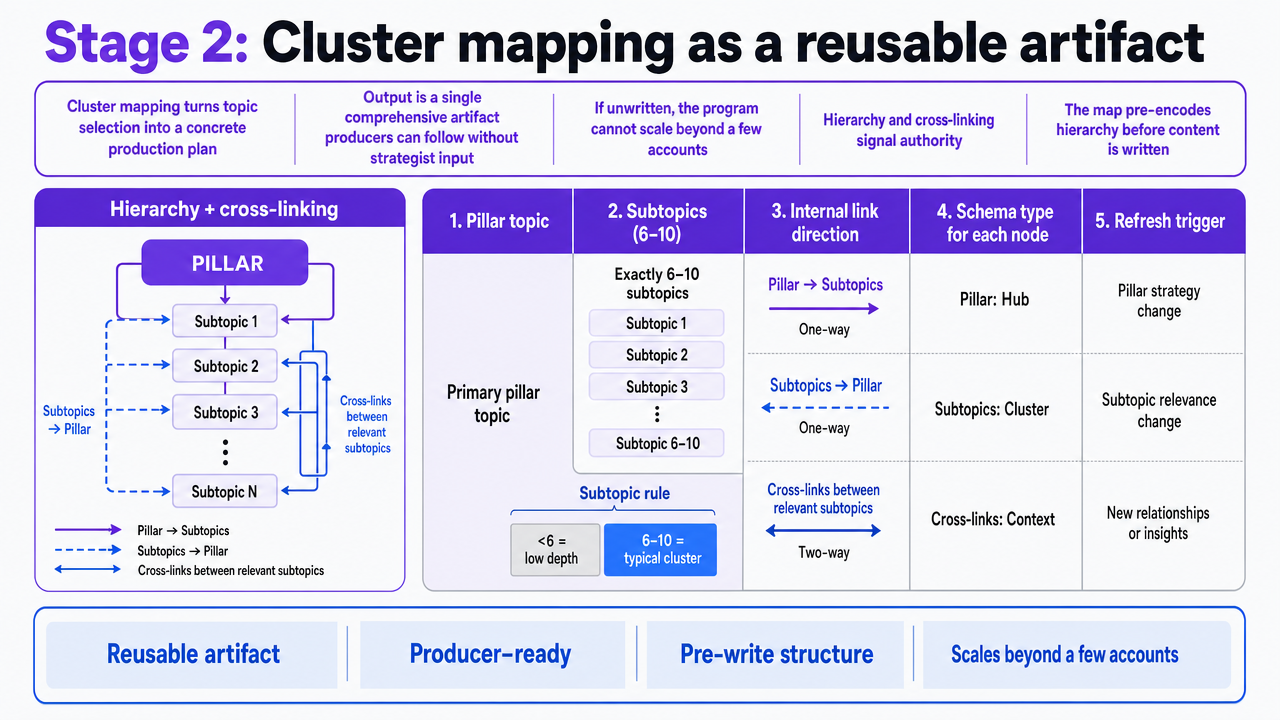
Cluster mapping transforms topic selection into a concrete production plan. The output of this stage is a single, comprehensive artifact that a producer can follow without needing further input from the strategist. If this map remains an unwritten concept, the program cannot scale beyond a few accounts.
This artifact is a table with five columns: pillar topic, subtopics (typically six to ten), internal link direction, schema type for each node, and a refresh trigger. Practitioner guidance on topic clusters explicitly states that hierarchy and cross-linking are what signal authority to Google, not any single asset 10. The map pre-encodes this hierarchy before any content is written.
The number of subtopics is critical. Fewer than six subtopics often don't provide enough depth for Google to recognize the cluster as an authoritative resource. More than ten can lead to overlap, causing the cluster to become self-cannibalizing. CMI's rule is clear: cluster pages should not redundantly cover the pillar's details, and each cluster page must link back to the pillar 12. This becomes a hard constraint within the map. If two proposed subtopics require 40% or more of the same source material, one is either cut or merged before drafting.
Link direction is a frequently overlooked column. Every cluster page must link upwards to the pillar. The pillar, in turn, links downwards to every cluster page from a dedicated section, not from scattered inline mentions. Sibling links between cluster pages are only permitted when the subtopics have a genuine, logical relationship, such as "first-offense DUI" linking to "license reinstatement." Random sibling links can dilute the intended hierarchy.
Schema type is assigned per node during the mapping stage, not as a post-publication task. A pillar designed as an editorial guide receives Article schema. A subtopic structured as a question-and-answer set gets FAQPage. A subtopic detailing a procedure, such as "how to request a dental records transfer," uses HowTo schema. Pre-determining schema types avoids last-minute development rushes.
The refresh trigger column ensures the cluster remains current. Each node is assigned a specific trigger: a statutory change for legal topics, a CPT code update for medical content, a Google algorithm-related quality signal in Search Console, or a fixed 180-day review. Without these triggers, the map becomes a static launch document rather than a living maintenance plan.
This artifact, when provided to a producer, eliminates approximately a week of scoping discussions per pillar. Across a portfolio of twenty producers, it removes the need for those recurring conversations entirely.
Test Data-Driven Pillar Page Execution Now
Experience end-to-end pillar page creation and publication with measurable SEO impact during your trial period.
Stage 3: Drafting for comprehensiveness, not word count
Drafting is where two persistent SEO myths—the magic word count and keyword density targets—continue to consume agency resources. Neither is supported by Google's own documentation. The SEO Starter Guide explicitly states that a specific word count does not improve rankings 2. Google's helpful-content guidance replaces these myths with a different standard: does the page offer original information, reporting, or analysis, and is its coverage substantial, complete, or comprehensive for the topic 1?
Drafting myths to retire
- A pillar page needs 3,000+ words to rank.
- Keyword density between 1% and 2% signals relevance.
What Google actually asks
- Does the page provide original information, reporting, or analysis? Is coverage substantial and comprehensive 1?
- Is the page written for people first, not to attract search traffic 1?
- If automation was used in production, is that use disclosed and useful to the reader 1?
- The Starter Guide is explicit that there is no magic word count 2.
Draft against Google's stated quality criteria, not word-count or density heuristics.
Operationally, this translates to a coverage brief rather than a word count target. Before a producer begins writing, the brief outlines every subtopic the pillar must address, every question a knowledgeable reader might have, and all first-party evidence the client can provide. For a DUI pillar for a defense firm, this would include penalties by offense level, license consequences, refusal and implied consent laws, commercial driver's license impact, expungement eligibility, and the firm's own case outcomes. If the draft comprehensively answers these points in 1,900 words, it ships at that length. If 3,400 words are needed for comprehensiveness, then that is the length.
Two drafting rules directly stem from the helpful-content standard. Original information is mandatory, meaning every pillar must offer something unique compared to ranking competitors: an expert explanation, a case study, a proprietary framework, or first-party operational data 1. Additionally, AI-assisted production requires a disclosure that genuinely adds value for the reader, not just a generic footer 1. Producers who internalize these rules shift their focus from page length to whether the content fully resolves the topic.
Stage 4: Internal linking rules enforced across accounts
Internal linking is a critical point for governance. Google's SEO Starter Guide emphasizes links as a primary discovery mechanism 2, implying that any unlinked cluster page is effectively invisible to the crawler's understanding of the site's hierarchy. Practitioner research on site structure further confirms that topic silos only build authority when the linking pattern accurately reflects the hierarchy 11.
Three rules transform linking from a subjective decision into an enforceable checklist:
- Every cluster page must link up to its pillar within the first 150 words, using descriptive anchor text that clearly names the pillar topic. For example, a behavioral health cluster page on "partial hospitalization admission criteria" should link up with the anchor "levels of care for adolescent mental health," avoiding generic phrases like "click here" or "learn more."
- The pillar must link down to every cluster page from a dedicated section, not from scattered inline mentions. CMI's cluster guidance explicitly states that cluster pages should not repeat the pillar's content in depth 12. This strategy works only if the pillar deliberately directs traffic to sub-pages rather than attempting to answer every subtopic itself. A clearly labeled "Related guides" or "In this cluster" section serves this purpose.
- Sibling links between cluster pages are only permitted when the subtopics share a genuine user path. For instance, a dental DSO cluster page on "implant candidacy" can logically link sideways to "bone grafting timelines" because a reader considering implants often needs information about grafting. However, it should not link to "whitening aftercare," as this belongs to a different user journey.
Enforcing these three rules across multiple accounts replaces recurring linking audits with a standardized producer checklist that accompanies every draft.
Stage 5: Structured data as the default, not the polish
Structured data on pillar pages is often treated as a last-minute task for developers just before launch. This sequencing frequently causes pillar programs to miss rich-result eligibility across a significant portion of their portfolio. Structured data should be a core production stage, not an afterthought, and it must be integrated into the cluster map before drafting begins.
Three primary schema types cover most pillar content:
- A pillar designed as an editorial guide should use Article schema, which Google supports as a distinct markup type with its own validation path 5.
- A subtopic node structured as an official question-and-answer set should use FAQPage, eligible for rich results since Google added FAQ and HowTo support to Search 7.
- A subtopic that outlines a defined procedure, such as "how to request a dental records transfer," should use HowTo schema 7.
The full supported gallery also includes breadcrumbs, video, and other formats that should be assigned during the mapping stage 4.
Two enforcement rules ensure consistent and accurate schema across accounts. First, markup must accurately reflect visible content on the page. Google's structured-data policies explicitly state that hidden, misleading, or irrelevant markup violates spam guidelines and can lead to disqualification 6. A common violation, and one easy to audit, is FAQ schema attached to questions not visible in the FAQ block. Second, every deployment must pass the Rich Results Test before the page goes live 5. JSON-LD is the supported format for all three types 6, allowing producers to use templates rather than hand-coding markup for each pillar.
Stage 6: Maintenance triggers tied to Search Console
Every pillar page will eventually experience decay. The crucial factor is whether this decay is detected early or much later. Google's helpful-content standard considers freshness and ongoing accuracy as integral to content quality, not separate signals 1. This means a pillar that ranked well in March but declined by September is a quality failure, not merely a maintenance oversight.
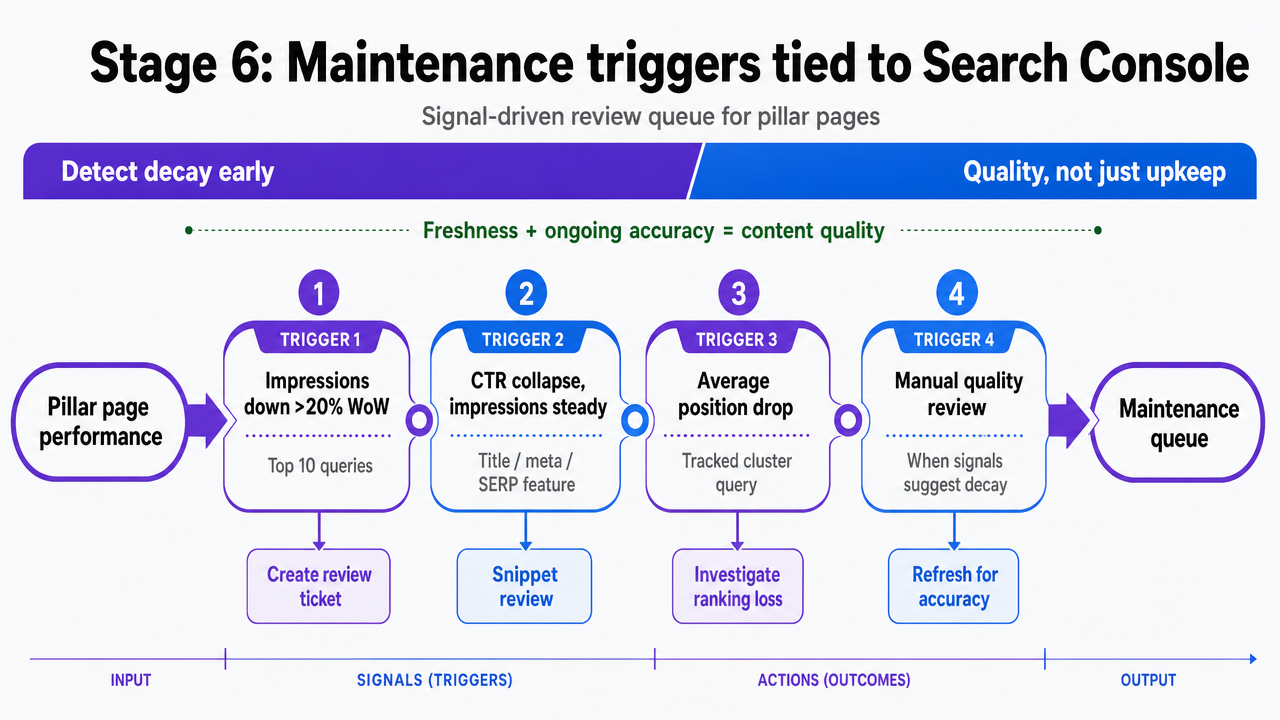
Four triggers transform maintenance from a calendar-based task into a signal-driven queue:
- A week-over-week impression drop exceeding 20% for a pillar's top ten queries in Search Console should generate a review ticket.
- A click-through-rate collapse without an impression drop suggests issues with the title, meta description, or SERP feature displacement, rather than content quality.
- If the average position for any tracked cluster query slides from page one to page two, it should trigger a coverage audit against the original brief.
- A fixed 180-day review is conducted regardless of other signals, as some decay is slow enough to evade weekly detection.
At portfolio scale, named triggers are more effective than named owners. A producer managing six accounts cannot mentally track twenty maintenance calendars, but they can efficiently work through a queue sorted by trigger type. The cluster inventory artifact from Stage 2 is where each trigger is recorded per node, thereby closing the loop between initial planning and ongoing upkeep.
See How Enterprise Teams Scale Pillar Page Impact Without Adding Headcount
Request a walkthrough of AI-driven workflows that automate pillar page creation and optimization at scale, with measurable improvements in topic authority and time-to-rank for multi-site or multi-brand portfolios.
Page experience and in-page navigation on long pillars
A 3,000-word pillar that fails Core Web Vitals will not reach its full ranking potential. Google's page-experience guidance integrates mobile-friendliness, loading performance, and the absence of intrusive interstitials into its quality signals 3. For long pillar pages, common culprits include hero images that block Largest Contentful Paint, embedded videos that cause layout shifts on mobile, and third-party scripts loading before the H1 renders. Producers who publish a pillar without a Lighthouse audit on a mid-tier mobile device are delivering an incomplete page.
In-page navigation is the second lever, and it is only beneficial for sufficiently long pages. Research from NN/g confirms that in-page links function as a table of contents and are particularly effective for lengthy content 8. For a 3,400-word DUI penalties pillar with nine H2 sections, a sticky jump-link menu transforms the page into a scannable reference. However, for an 1,100-word cluster page with only three H2s, the same pattern can create friction because in-page links contradict the user's expectation that a link leads to a new page 8. The rule for producers is to prioritize content structure first, then select the appropriate navigation pattern 9.
If you manage multiple locations or a client portfolio
The preceding discussion assumes a single account. Portfolio operations significantly alter the dynamics. An SEO head managing pillar programs across fifteen law firms, six DSO groups, and eight behavioral health networks is not executing the six stages once, but potentially ninety times per quarter, each with unique subject-matter constraints and varying first-party evidence availability per client.
The traditional agency setup for a single pillar-and-cluster program is well-established: a strategist for topic scoping, a senior writer for the pillar, one or two junior writers for cluster pages, an editor, an SEO analyst for keyword mapping and internal linking, and a developer for schema deployment. Practitioner guidance on topic clusters and site structure views this coordination as essential for building authority 10, 11. While this coordination overhead is manageable for one account, it becomes a significant bottleneck at twenty accounts.
| Role | Traditional per-pillar effort | Governed AI-assisted model |
|---|---|---|
| Topic strategist | 8–12 hours | 1–2 hours (portfolio review only) |
| Cluster mapper / SEO analyst | 10–16 hours | 2–3 hours (approve generated map) |
| Writers (pillar + clusters) | 40–70 hours | 4–6 hours (edit, add first-party evidence) |
| Editor | 8–12 hours | 2–3 hours |
| Schema developer | 3–6 hours | 0 hours (templated JSON-LD) |
| Project manager | 6–10 hours | 1 hour (queue review) |
The table illustrates that AI doesn't just write faster; a governed production line consolidates multiple approval loops into one. Google's structured-data policies still require markup to reflect visible content 6, the helpful-content standard still demands original information and disclosed AI use 1, and cluster pages must not duplicate the pillar's content in depth 12. These rules do not relax at portfolio scale. What changes is the enforcement mechanism: a single approver working from a governed queue, rather than six specialists coordinating via Slack for each account.
What changes when AI handles production and humans approve
The six stages of pillar page production remain constant. What shifts is the allocation of human judgment. In a traditional pillar program, senior time is heavily invested in scoping, drafting, and coordination. In a governed AI-assisted program, this time is redirected to approval: reviewing the generated cluster map before production, verifying that drafts incorporate the client's first-party evidence, and confirming that schema accurately reflects visible content prior to deployment 6.
Google's helpful-content standard is neutral regarding content production methods. It primarily asks whether the page provides original information and, if automation is used, whether that use is disclosed and beneficial to the reader 1. An SEO head managing fifteen law firm accounts can meet this standard by using AI to draft the foundational content, with a human approver adding practitioner details, case patterns, and appropriate disclosures. However, the approver cannot outsource critical judgment calls: whether a topic passes the three-part portfolio test from Stage 1, whether the cluster map avoids the overlap CMI warns against 12, and whether every cluster page links up with descriptive anchor text 2. Governance moves upstream, execution moves downstream, and the production line finally achieves scale.
Frequently Asked Questions
References
- 1.Creating Helpful, Reliable, People-First Content.
- 2.Search Engine Optimization (SEO) Starter Guide.
- 3.Understanding page experience in Google Search results.
- 4.Structured Data Markup that Google Search Supports.
- 5.Learn About Article Schema Markup.
- 6.General Structured Data Guidelines.
- 7.New in structured data: FAQ and How-to.
- 8.Anchors OK? Re-Assessing In-Page Links.
- 9.In-Page Links for Content Navigation.
- 10.Why (& How) Topic Clusters Are Your Most Powerful SEO ....
- 11.Site Structure & Internal Linking in SEO: Why It's Important.
- 12.How to Get Ranked and Read With a Topic Cluster Model.
- 13.How Core Topics and Content Clusters Lead to Better Google Search Rankings.