
Key Takeaways
- A pillar page owns a head topic with comprehensive overview treatment, a mapped cluster set, and bidirectional internal linking — anything missing one of those four attributes is a long-form article, not a pillar 7, 9.
- The industry conflates hub, pillar, cluster, and tactical hub, so agencies should pick one working definition and enforce it across briefs rather than resolve the terminology debate 1, 4, 11.
- Cluster pages must ship before or alongside the pillar, never after — a pillar launched alone wastes the window and forces the URL to re-earn attention once clusters exist 8, 11.
- Internal linking should follow a three-directional schema — pillar-to-cluster, cluster-to-pillar, and substantive lateral links — enforced as a QA checklist item rather than left to editor judgment 7.
A working definition for agency delivery
A pillar page is a single, comprehensive page that stakes a claim to a head topic and is defended structurally by a set of cluster pages plus disciplined internal linking. It is not a long blog post with a table of contents bolted on. It is a topical contract — one URL an agency commits to keeping authoritative on a specific subject, with supporting pages that both extend its coverage and route link equity back to it 7, 9.
The working vocabulary inside most agencies is inconsistent. Some sources treat "hub" and "pillar" as synonyms 1, 11. Others hold a stricter line, describing a pillar as what results when a hub and its spokes are folded into one page 4. Both usages appear in client decks, briefs, and QA checklists — often on the same account — which leads to delivery teams building different artifacts against the same word.
For a Head of SEO running multi-client delivery, a pillar page, as a delivery standard, has four fixed attributes:
- a defined head topic it owns,
- a comprehensive overview treatment of that topic,
- a mapped set of cluster pages that cover subtopics in depth, and
- a bidirectional internal linking schema between the pillar and its clusters 7, 12.
Anything missing one of those attributes is a long-form article, not a pillar. This distinction makes the format brief-able across writers, editors, and AI-assisted production without quality drift between accounts.
Reconciling the terminology: hub, pillar, cluster, tactical hub
Where the industry conflates hub and pillar
The vocabulary problem is not hypothetical. It shows up in briefs, in QA checklists, and in the awkward moment when an account strategist and a writer realize they have been building against different mental models of the same deliverable.
Foundation treats "hub" and "pillar" as the same idea, explicitly aligning the hub page with HubSpot's pillar page framework and describing both as a central overview linked to narrower spoke pages 1. Web Tonic goes further, stating that "hub and spoke, topic cluster, and pillar-cluster all refer to one central page linking out to supporting sub-topic pages that link back to it" 11. Under that reading, the words are interchangeable.
A third variation describes the pillar page as a "tactical hub" for a specific topic cluster, positioning it as a particular implementation of the broader hub concept 2. This framing, when combined with the synonym treatments, produces four labels — hub, pillar, cluster, tactical hub — for what may or may not be the same artifact.
For a Head of SEO briefing writers and reviewers across accounts, the practical consequence is variance. Two teams reading two credible sources will produce two different pages against the same client keyword. That variance is the problem worth fixing, not the terminology itself.
The stricter distinction: pillar as a single collapsed page
A more rigorous reading draws a hard line between the two structures. Under that reading, hub-and-spoke is a distributed architecture — one overview page plus many linked subtopic pages — while a pillar is a single, comprehensive, long-form page where all the content lives at one URL. The load-bearing formulation from the source: "if you folded a hub and all its spokes into one page, you'd have a pillar" 4.
This distinction resolves the ambiguity by making the two models geometrically distinct. Hub-and-spoke distributes the topic across a network of URLs, each pulling its own weight in the SERP and passing equity through internal links. A strict pillar concentrates the topic onto one URL and accepts the trade-offs that come with that concentration — heavier page weight, longer editorial cycles, and no independent ranking surface for subtopic queries.
Agencies do not have to pick a side of the linguistic debate to standardize their delivery. What matters is choosing one definition and enforcing it across briefs. The working definition already set at the top of this article — a comprehensive overview page defended by cluster pages and bidirectional linking 7 — is the distributed reading, and it is the more scalable choice for a multi-client book because each cluster page becomes an independent ranking asset rather than a section of one monolithic document.
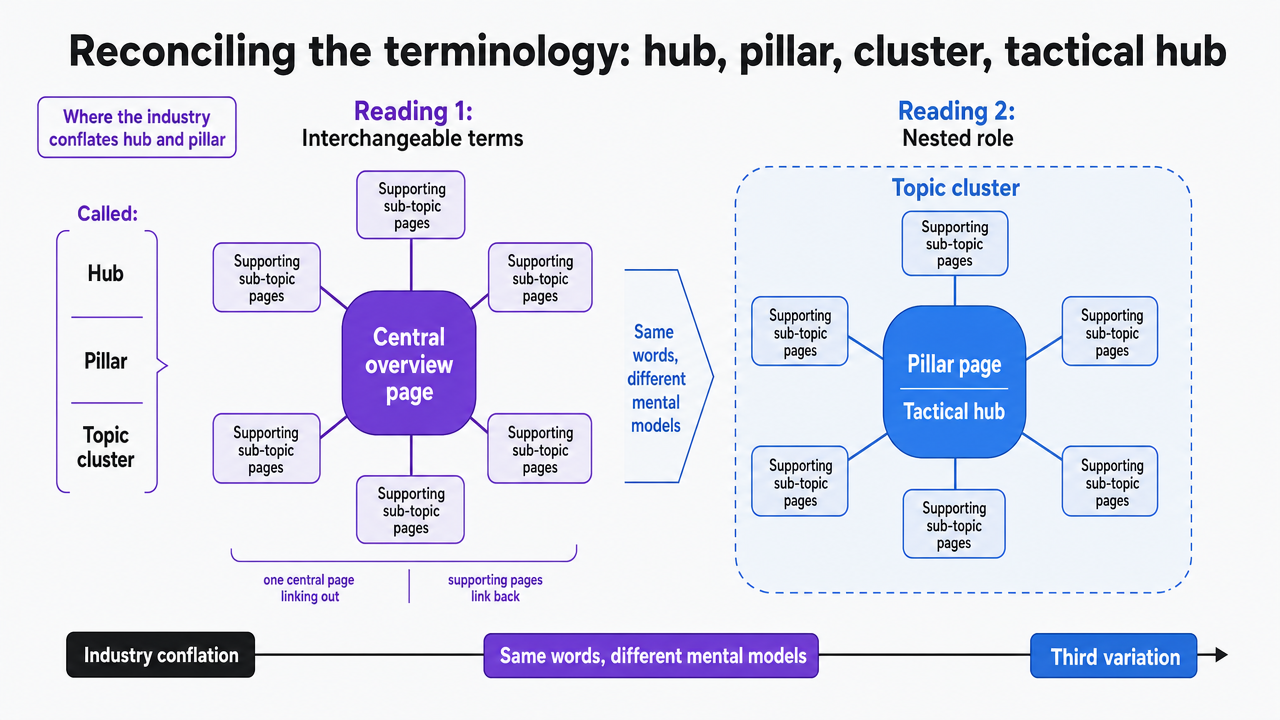 Clarify the terminology comparison the section makes between hub, pillar, cluster, and tactical hub by visualizing the two competing geometric readings
Anatomy of a pillar page an agency can standardize
Scope, depth, and word-count ranges
Scope is where most pillar briefs collapse. A pillar is not defined by length; it is defined by the head topic it commits to owning and the completeness with which it treats that topic at the overview layer. Length is a downstream consequence of that scope, not a target to hit for its own sake.
One widely cited practitioner guide places recommended word counts at 3,000–10,000 words for pillar/hub pages and 1,500–3,000 words for cluster/spoke pages 3. That range is useful as a planning input, but it is guidance from a content-marketing publication, not a Google directive. Google's own guidance stays deliberately generic — build simple, descriptive site structures and pages written for users rather than search engines — and does not endorse specific pillar formats or word counts 6. Agencies that quote the 3,000–10,000 range in client decks should attribute it as a practitioner benchmark, not policy.
What those ranges do provide is a defensible floor for production planning. A 900-word overview cannot credibly carry a head topic against a well-resourced competitor's 6,000-word treatment. Conversely, a 12,000-word pillar without corresponding depth on the covered subtopics wastes editorial hours that would rank better on independent cluster URLs.
For a Head of SEO writing a delivery standard, three scope rules are more effective than any word count:
- The pillar answers the head query at the overview level and links out for depth.
- Every subtopic important enough to earn a section in the pillar earns its own cluster page 9.
- The pillar is treated as an evergreen asset — reviewed on a schedule, not shipped and abandoned — because the topical claim it stakes has to be maintained against competitor moves 10.
These three rules brief cleanly to writers and to AI-assisted production alike, making the format reliable across accounts.
The internal linking schema that defends the claim
The linking pattern is the part of the model that actually does the SEO work, and it is the part most agency briefs underspecify. A pillar page without a disciplined linking schema is merely a long article with a table of contents.
The operational schema is three-directional: pillar-to-cluster, cluster-to-pillar, and lateral cluster-to-cluster where the subtopics genuinely relate 7. Each direction serves a specific purpose:
- Pillar-to-cluster links tell search engines which URLs the pillar delegates depth to on each subtopic, and guide readers from overview to detail.
- Cluster-to-pillar links consolidate topical signal back to the URL that owns the head term and pass equity upward.
- Lateral cluster-to-cluster links model how subtopics inside a domain of expertise reference each other, making the domain appear coherent rather than a stack of isolated posts.
Google's public guidance backs the underlying mechanic without prescribing the schema: descriptive anchor text and clear internal linking help search engines understand how pages relate 6. The schema above operationalizes this principle within a topic cluster.
For QA, three rules provide concrete checks:
- Every cluster page links back to the pillar at least once, using anchor text that reflects the head topic rather than "click here."
- Every section of the pillar that summarizes a subtopic links out to the corresponding cluster page.
- Lateral links are added only where the connection is substantive — cross-linking every cluster to every other cluster dilutes signal rather than strengthening it, and creates cannibalization risk the pillar-and-cluster model is specifically designed to avoid 7.
These rules transform linking from an editor's judgment call into a checklist item that survives handoff between accounts.
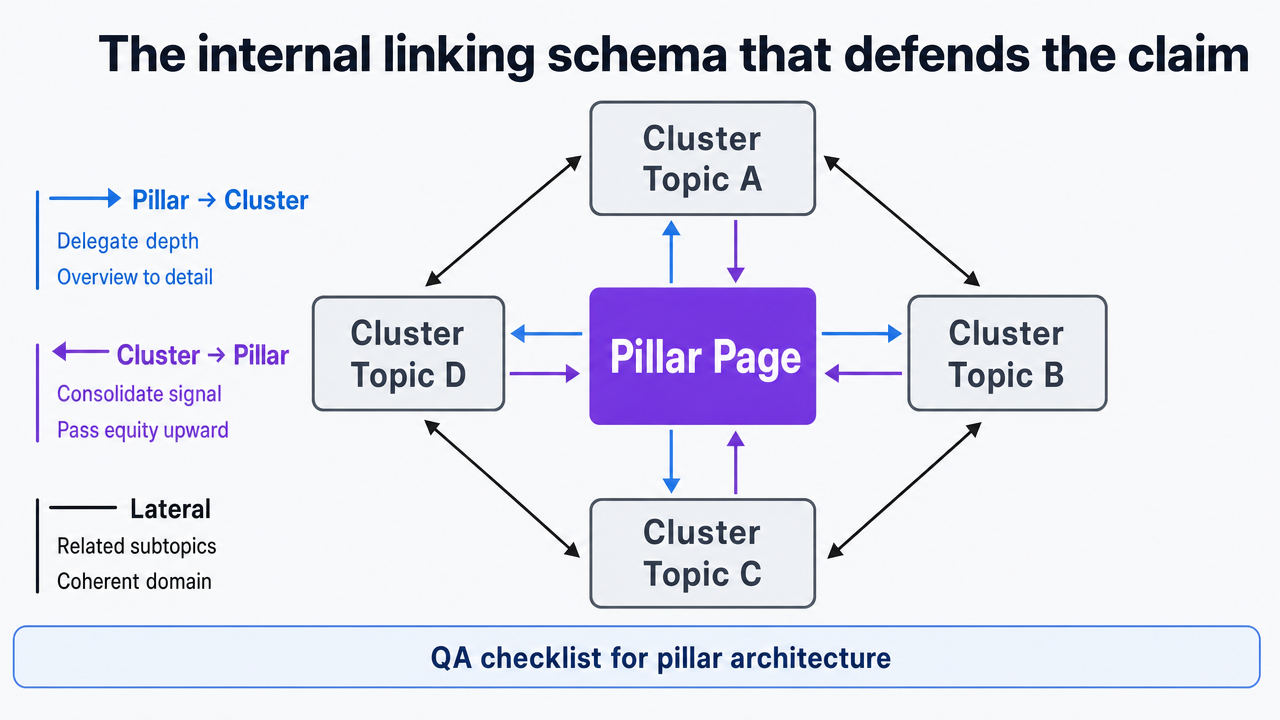 Visualize the three-directional linking schema (pillar-to-cluster, cluster-to-pillar, lateral) that this section defines as the QA checklist for pillar architecture
Launch sequencing: do not ship a pillar without spokes
Sequencing is where good architecture gets undone by production convenience. A pillar published alone — with promised cluster pages queued for later sprints — is a pillar that ranks against its own gaps. Every subtopic section reads as a summary pointing to nothing, and the internal linking schema that gives the architecture its lift does not exist yet.
The operational rule from practitioners who have run this play at scale is direct: do not launch the hub empty 11. Cluster pages should ship before or alongside the pillar, not months after it. One hub-and-spoke walkthrough treats this as a hard prerequisite, arguing that publishing the pillar without its supporting spokes wastes the launch window and forces the URL to re-earn attention on the second pass once clusters finally exist 8.
For delivery planning, this pushes work upstream. The pillar cannot be the first artifact in the sprint. Subtopic mapping, cluster outlines, and at least the first tranche of cluster drafts have to be in production before the pillar's build begins, so that internal links resolve to live URLs on the day the pillar publishes. Agencies that treat the cluster set as a follow-on release consistently see the pillar underperform its potential and blame the format rather than the sequence.
The planning consequence is simple. A pillar+cluster set is one deliverable with many URLs, not a pillar plus optional supporting content — and it gets scheduled that way.
Test pillar page strategies on live campaigns now
Validate your pillar page approach by publishing and measuring real content performance during your trial.
Pillar vs. hub-and-spoke vs. topic cluster: a decision model
Three architectures often appear in the same conversations, sometimes using the same words. Sorting them by geometry — not vocabulary — provides a Head of SEO with a defensible decision model to brief against.
Standalone long-form pillar : Concentrates the entire topic onto one URL. All coverage, all subtopic depth, and all internal navigation live inside one document. This is the strict reading where a pillar is what you get when a hub and its spokes are folded into a single page 4. It maximizes on-page depth signal for one URL and gives up independent ranking surface for every subtopic query.
Hub-and-spoke : Distributes the topic across a network. An overview page sits at the center; dedicated subtopic pages orbit it, with links flowing in both directions 2, 11. Each spoke becomes its own ranking asset, and the hub earns authority from the density of the network pointing at it. Some sources treat this as the same thing as a pillar-cluster setup with different labels 11; others hold the strict distinction described above 4.
Topic cluster : The operational middle ground most agencies actually ship: a comprehensive overview pillar plus a set of in-depth cluster pages, all bound by disciplined internal linking 7, 9. Geometrically it matches hub-and-spoke. What separates it in practice is the framing — clusters are planned as a coordinated release around one head topic, not as a hub that later accumulates related posts.
The decision, then, reduces to three questions:
- Does the head topic have enough distinct, independently searchable subtopics to justify separate URLs? If yes, the distributed model wins — call it hub-and-spoke or topic cluster, but do not concentrate everything on one page.
- Is the topic narrow enough that fragmenting it would produce thin cluster pages competing with each other? If yes, a single collapsed pillar is the honest choice 4.
- Is the plan to publish incrementally with no committed subtopic set? If yes, none of these architectures apply yet — build the subtopic map first, or ship standalone articles until one earns the right to become a pillar.
For multi-client delivery, the topic cluster geometry is the standard worth adopting. Cluster URLs give each account independent ranking assets, the linking schema is briefable, and the model survives handoff between writers and reviewers without collapsing into a monolithic page no one wants to update.
When pillar+cluster is the wrong architecture
Most competing guides treat pillar and cluster as the default answer for any content program. However, three scenarios argue against it, and a Head of SEO who can name them defends the architecture better than one who applies it universally.
The first is topic thinness. If the head topic does not have enough distinct, independently searchable subtopics to justify separate URLs, fragmenting it produces cluster pages that cannibalize each other and dilute the pillar rather than reinforcing it — a documented failure mode of the model when keyword planning is loose 7. In that case, a single well-scoped long-form article or a strict collapsed pillar covering the topic in one URL is the honest choice 4.
The second is a legacy content estate with no committed subtopic map. Publishing a pillar into a site that will accumulate related posts opportunistically over the next year is not a topic cluster — it is a hub waiting to be built. Google's guidance rewards logically grouped content and clear internal linking 6, but neither exists until the cluster set is planned as a coordinated release rather than a backlog.
The third is transactional or faceted intent. Product listings, location pages, and comparison-driven queries are served better by category and faceted structures than by an overview page delegating depth to clusters. Content Marketing Institute's treatment of the pillar model does not address these alternatives 5, which is where agencies applying the format universally lose ranking ground to competitors using the right structure for the intent.
The defensible rule for delivery: pillar+cluster is the standard for informational head topics with a mapped subtopic set. Everything else gets a different architecture, briefed under a different template.
See How Leading Agencies Streamline Pillar Page Production with AI-Driven Workflows
Connect with our team to learn how AI-powered frameworks enable faster creation, approval, and optimization of high-impact pillar pages—ensuring content quality and strategic oversight at scale.
If you manage multiple client accounts: scaling pillar production
The traditional production stack per pillar+cluster set
This section addresses Heads of SEO running delivery across a portfolio of client accounts, not a single in-house program.
One pillar plus a mapped cluster set is not one deliverable. It is a coordinated release of roughly six to twelve URLs — the pillar itself and the cluster pages that the linking schema depends on to function 7, 11. The traditional production stack absorbs that scope across five roles:
- a strategist to define the head topic and subtopic map,
- a writer (often more than one) to draft the pillar and clusters,
- an editor to enforce voice and structural consistency across the set,
- an SEO specialist to run keyword mapping and link QA against the schema, and
- a project manager to hold the sequence together so clusters ship before or alongside the pillar rather than in a later sprint 8, 11.
For a single client, the stack is workable. Across a book of fifteen or twenty accounts, each expecting one to two pillar sets a quarter, the math turns against the agency. Every account needs its own strategist attention, editorial pass, and QA cycle. Hiring more specialists to keep pace is how margin evaporates — and how quality drifts as the newest hires take the newest accounts.
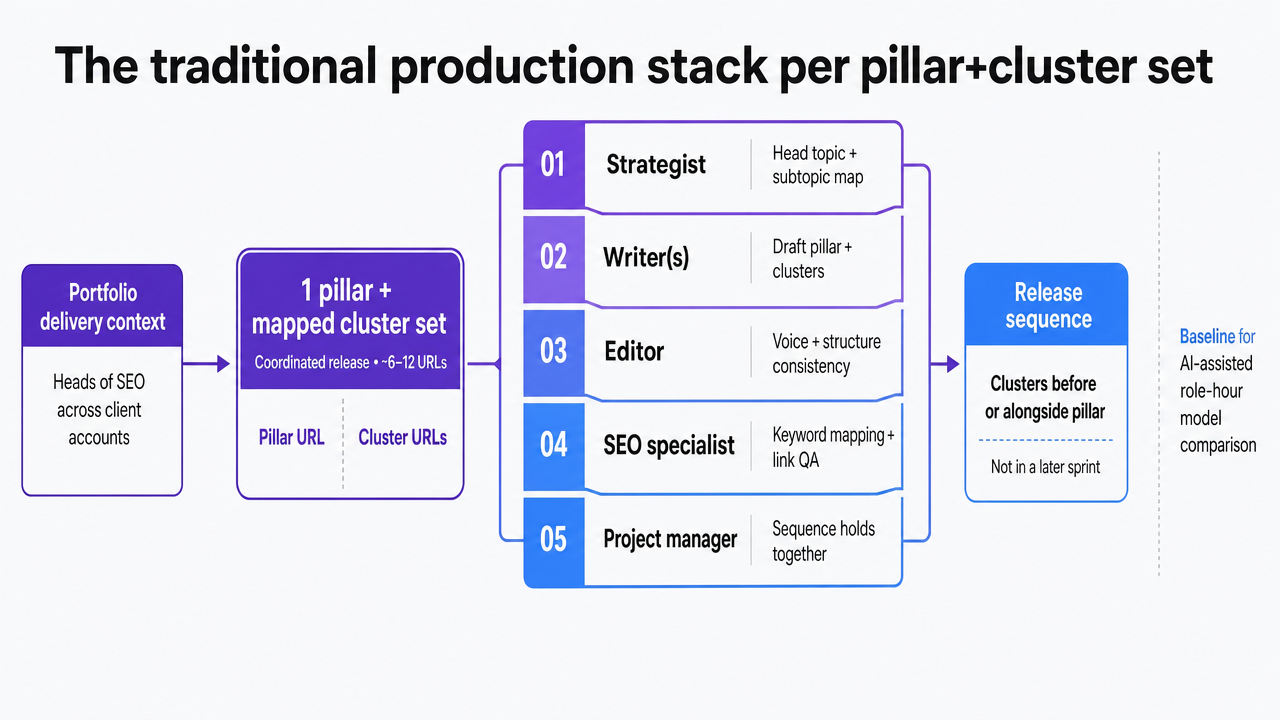 Compare the traditional five-role production stack to the AI-assisted role-hour model described in the following subsection, which is a framework/operating model directly explained in the article
A coordinated AI-assisted model using role-hour variables
The alternative is not fewer humans; it is fewer human hours spent on the parts of the workflow that do not require judgment. Subtopic mapping, keyword grouping, first-draft cluster production, link-schema auditing against the pillar-to-cluster / cluster-to-pillar / lateral cluster rules 7, and consistency checks across a set of URLs are all tasks where an AI-assisted production layer can carry the load and route finished work to a human reviewer for approval.
The consolidation is visible when the two models are laid out as role-hour variables against a single pillar+cluster set. The table below uses hours per role (H) and a blended agency rate (R) rather than invented dollar figures.
| Role | Traditional hours | AI-assisted hours | Human role in AI-assisted model ||---|---|---|---|| Strategist | H_s | ~0.4 × H_s | Approves subtopic map and topic scope || Writer | H_w | ~0.3 × H_w | Edits drafts, adds first-party insight || Editor | H_e | ~0.6 × H_e | Enforces voice; QA against structural checklist || SEO specialist | H_seo | ~0.4 × H_seo | Approves keyword map and link schema || Project manager | H_pm | ~0.5 × H_pm | Owns launch sequence and client sign-off |
Blended cost per pillar set is the sum of (hours × R) across roles. As the multipliers compress on the AI-assisted side, the same delivery standard — the four fixed attributes established at the top of this article — ships across more accounts without adding specialists to the roster 9, 12.
The operational point is not that AI replaces the strategist or the editor. It is that the strategist stops writing subtopic outlines from scratch for every account, and the editor stops re-teaching structural rules to every new writer. Judgment stays with the humans. The repeatable parts of the production stack move underneath them. That is what makes a defensible pillar standard survive across a full client book — and it is the model Vectoron was built to operate.
Adopting a defensible pillar standard across the book
The path from surface-level familiarity to a delivery standard is short, and it does not require solving the industry's terminology fight. It requires picking one working definition and enforcing it. A pillar page owns a head topic, treats it comprehensively at the overview layer, is defended by a mapped cluster set, and is bound to those clusters by a three-directional linking schema 7, 9. Anything missing one of those attributes gets briefed under a different template.
The four rules that make the standard portable across accounts:
- Name the head topic and its subtopic map before drafting begins.
- Ship cluster pages before or alongside the pillar, never after 8, 11.
- Enforce pillar-to-cluster, cluster-to-pillar, and substantive lateral links as a QA checklist item, not an editor's judgment call 7.
- Treat the pillar as an evergreen asset with a scheduled review cadence 10.
What separates agencies that scale this format from agencies that stall on it is where the repeatable production hours live. Vectoron was built to carry those hours underneath a human approval layer, so the standard survives the sixteenth account as cleanly as the first.
Frequently Asked Questions
References
- 1.What Is a Hub in Marketing?.
- 2.Hub-and-Spoke SEO Model: Build Topical Authority with Hub & Spoke.
- 3.Hub-and-Spoke Content Model: Complete Guide for 2026.
- 4.Hub-and-spoke vs pillar content architecture for SEO | Buron Skills.
- 5.How to Build Pillar Pages and Topic Clusters for Content Marketing.
- 6.Search Engine Optimization (SEO) Starter Guide.
- 7.Topic Clusters and Pillar Pages | The SEO Handbook.
- 8.What Is Hub and Spoke in Content Marketing? The Pillar ....
- 9.What Are Pillar Pages and Topic Clusters? (And Why You ....
- 10.The Benefits Of Pillar Pages & Topic Clusters - Blue Compass.
- 11.Hub and Spoke SEO: The 2026 Marketer's Guide | Web Tonic™.
- 12.Your Guide to Pillar Pages and Topic Clusters.