
Key Takeaways
- Treat the pillar page as a governance artifact that defines cluster scope, canonical authority, internal-link contracts, and the editorial floor rather than as a long essay.
- Qualify topics for pillar treatment against four criteria: mental-model fit, parent-child depth of five to fifteen subtopics, commercial relevance, and maintainable depth 1.
- Enforce a hub-to-child linking contract with descriptive anchors and zero orphans, backed by a per-client canonical map that resolves service, location, and legacy page collisions 4, 7.
- Place the approval gate before publish so a named human signs off on added value, and measure clusters through assisted conversions and information-lookup proxies instead of rankings 5, 3.
The Governance Layer Hiding Inside a Pillar Page
Most pillar pages fail because they are built as essays. Agency SEO leaders who scale cluster programs across a client portfolio treat the pillar page as something different: a governance artifact. It is the hub that defines which supporting pages exist, how they link to each other, which URL carries canonical authority, and what the editorial floor looks like for every page in the system.
That reframing matters because the operational pressure on Heads of SEO is portfolio-wide, not page-level. Content Marketing Institute's 2025 benchmark research, based on self-reported data from B2B marketers, found that 58% rate their content strategy only moderately effective and 35% identify SEO optimization as a top challenge 8. The capacity gap is real, and it will not close by assigning more writers to longer articles.
Google's own guidance reinforces the governance framing. Search Essentials ties eligibility to people-first usefulness, descriptive language, and crawlable structure rather than word count 2. A pillar page that cannot enforce those standards across its cluster is decoration. One that can becomes the control surface for everything downstream: scoping decisions, internal-link contracts, canonical maps, technical thresholds, and the approval gates that keep AI-assisted production inside Google's rules. The remainder of this piece unpacks each control.
Scoping Clusters Before Writing a Single Hub
Four Criteria That Qualify a Topic for Pillar Treatment
The scoping error that sinks most cluster programs happens before a brief is written: a strategist green-lights a pillar on a topic that cannot support a parent-child structure or does not match how buyers actually search. Yale's information architecture guidance frames the question correctly, recommending that content be organized around user mental models with clear parent-child relationships, grouped related information, and a deliberate audit for gaps and redundancies 1.
Translated into a go/no-go filter a strategist can run during cluster planning, four criteria qualify a topic for pillar treatment:
- Mental-model fit. The topic reflects how the client's buyers group the problem in their own language, not how the client's service lines are organized internally 1. A pillar built around an internal product taxonomy will not match search behavior.
- Parent-child depth. The topic breaks cleanly into five to fifteen supporting subtopics that each deserve their own URL and each answer a distinct query. Topics that collapse into two or three supporting pieces belong inside a single article, not a hub.
- Commercial relevance. The topic sits on a path to a revenue-generating action for the client. Pillars built on peripheral curiosity queries consume production capacity without contributing to pipeline.
- Maintainable depth. The agency can staff ongoing updates, gap audits, and redundancy checks across the cluster 1. A pillar that cannot be maintained for twelve months becomes a liability.
A topic that fails any one of the four should be absorbed into an existing cluster, consolidated with an adjacent hub, or demoted to a single supporting page. Scoping discipline at this stage prevents the downstream problems that technical fixes cannot repair.
Mapping Parent-Child Relationships Across a Client Portfolio
Cluster scoping at the single-site level is tractable. Doing it across twenty or forty client sites is where agency throughput collapses. A Head of SEO managing a portfolio has to standardize the mapping exercise so that any strategist on the bench can produce a defensible cluster plan in hours rather than weeks.
The portfolio-level artifact is a cluster map per client: one row per proposed pillar, columns for the parent topic, the five-to-fifteen child subtopics, the existing URLs on the client's site that already address those subtopics, and the gaps that justify new production. Yale's guidance to audit for gaps, redundancies, and consolidation opportunities belongs at the top of this template 1. Without that audit, agencies ship net-new pillars on top of forgotten legacy content, which fragments signals and creates the near-duplicate problem canonicalization is meant to solve.
Three operating rules keep the mapping exercise repeatable:
- No pillar enters the production queue until its cluster map lists every existing client URL that touches the topic and marks each as keep, consolidate, redirect, or retire.
- Each child subtopic is assigned a search intent label (informational, comparative, transactional) so the hub-to-child linking contract downstream knows which anchors to use.
- Mapping is reviewed by a second strategist before client approval. Peer review catches mental-model mismatches that the originating strategist is too close to see.
Standardizing the artifact is what makes the cluster-planning cycle time predictable. It also gives client-facing leads a single document to defend scope against the common client request to add a pillar on a topic that fails the four criteria above.
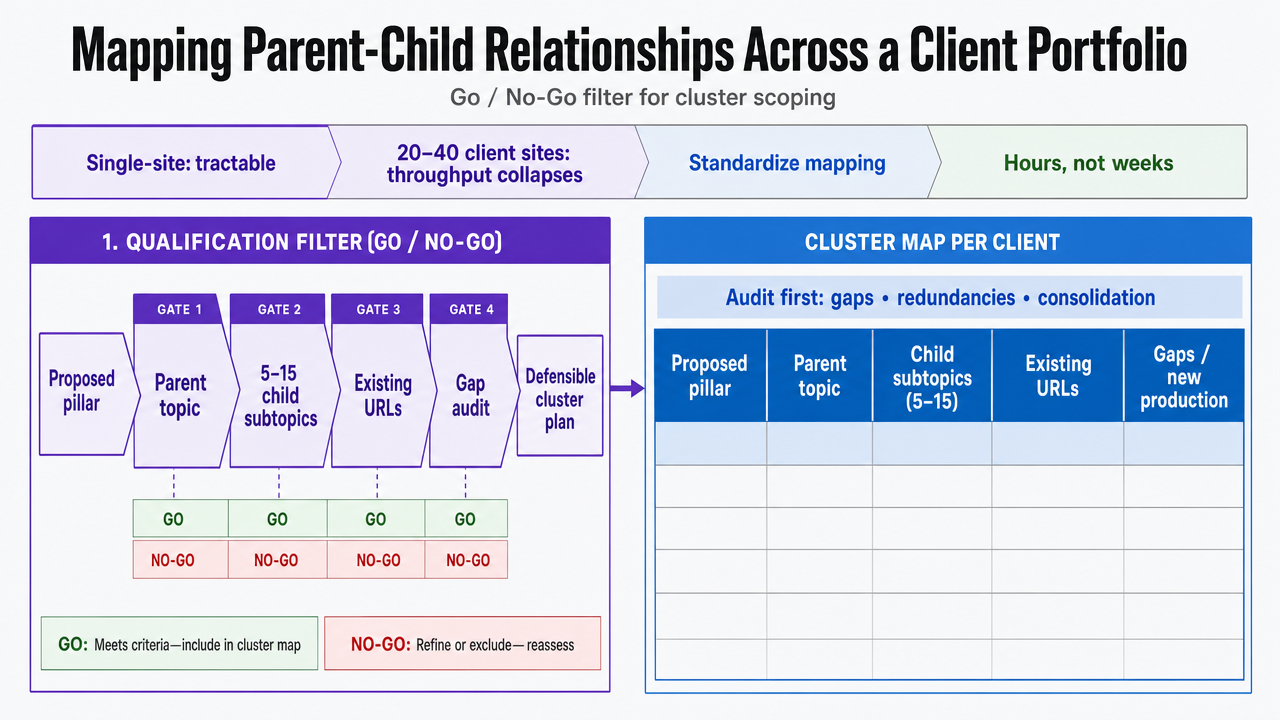 Visualize the four qualification criteria as a go/no-go filter strategists apply during cluster scoping, directly supporting the section's framework
An Internal-Linking and Canonical Standard an Agency Can Adopt As-Is
Descriptive Anchors, Hub Links, and Zero Orphans
The pillar page earns its name only when it functions as a navigational hub. Google's link documentation is direct about the mechanism: every page that matters should receive a link from at least one other page, and anchor text should be descriptive, concise, and relevant to the destination 4. Agency SEO leaders can translate those two sentences into a linking contract that every cluster in the portfolio follows without strategist-by-strategist interpretation.
The contract has three enforceable rules:
- Hub-to-child, child-to-hub, child-to-sibling. The pillar links out to every supporting page in its cluster using anchors that name the subtopic. Each supporting page links back to the pillar and to at least two sibling pages that address adjacent subtopics. This closes the orphan risk that Google's documentation flags 4 and makes the cluster traversable in either direction.
- Descriptive anchors, no generic phrases. Anchors read as the subtopic itself, not as "click here," "learn more," or the raw URL. The anchor is also the primary query the destination page targets, which gives both users and crawlers an accurate preview 4.
- No orphans at publish. A supporting page cannot enter the index without an inbound link from the pillar and at least one sibling. The pre-publish QA checklist blocks the URL otherwise.
Enforced at the template and QA layer rather than left to writer discretion, the contract turns internal linking from a frequent QA miss into a deterministic step.
Canonical Hygiene When Service and Location Pages Collide
Agencies serving multi-location clients, DSOs, home-services franchisors, and regional law firms hit the same failure mode: dozens of near-duplicate service pages across locations, each targeting a city-level variant of the same core offering. Without canonical discipline, those pages fragment the ranking signals the pillar page is supposed to consolidate. Google selects a canonical based on which URL it considers most representative, complete, and useful, and its selection is a signal interpretation rather than an absolute instruction 7.
The portfolio-level canonical map sits alongside the cluster map and resolves four recurring collisions:
- Service page versus location-specific service page. The location page is canonical when it carries unique local proof (team, licensing, pricing, reviews). The generic service page is canonical when the location variants are templated with minimal differentiation; the thin variants redirect or carry a canonical pointing to the hub 7.
- Pillar versus legacy long-form article on the same topic. The pillar is canonical. The legacy article is consolidated into the pillar or redirected, with its backlinks pointed to the new URL.
- Category hub versus pillar page. If a client's CMS auto-generates a category index that overlaps the pillar, the pillar takes canonical priority and the index is set to noindex.
- Printable, AMP, or syndicated variants. The main pillar URL is the declared canonical on every variant 7.
Documented once per client and reviewed at each cluster launch, the map prevents the signal fragmentation that silently caps pillar performance.
Test Pillar Page SEO Execution at Scale
Validate pillar strategies by publishing live content and measuring real ranking impact in your own workflow.
The Technical Quality Floor for Every Pillar Page
Headings, Hierarchy, and Scannability as Non-Negotiables
A pillar page that cannot be scanned fails before its content is ever judged. The UK Home Office user-centred design guidance sets the baseline: one main H1, logically sequenced subheadings, and heading text that is short, clear, and relevant to the content below it 9. Agency SEO leaders should codify that pattern into the pillar template itself so writer-level variance disappears from QA.
The template-enforced standard that holds up across a client portfolio has four components:
- One H1 that names the pillar topic in the buyer's language. Not the client's internal product name, not a cleverness play. The H1 is also the page's primary query target.
- H2s that map to the child subtopics defined in the cluster map. Each H2 corresponds to a supporting page or a section that would otherwise justify one. This creates a visible table of contents without a separate widget and keeps the hub structure legible to screen readers 9.
- H3s reserved for genuine sub-structure, never for visual emphasis. Skipping heading levels or using H3 as styled bold text breaks assistive-technology navigation and signals sloppiness to any editor reviewing the page.
- Topic sentences that stand alone. Each paragraph's first sentence carries the point so a scanning reader absorbs the argument without reading the full paragraph.
Nielsen Norman Group's foundational web-reading research, though dated to 1997 and measured on a small usability sample rather than modern search behavior, remains the clearest demonstration of why these choices matter: concise, scannable, objective writing improved measured usability well beyond control conditions 10. The historical scope limits its use as a ranking argument, but it supports the editorial standard directly. QA that enforces heading hierarchy and topic-sentence discipline at publish time removes an entire category of rework.
Core Web Vitals Thresholds on Media-Heavy Hubs
Pillar pages carry weight that ordinary posts do not: embedded diagrams, data tables, interactive comparisons, sticky navigation, and sometimes video. Each addition pushes the page closer to failing the thresholds Google uses to measure real-world experience. The targets are specific and non-negotiable as a floor: Largest Contentful Paint within 2.5 seconds, Interaction to Next Paint below 200 milliseconds, and Cumulative Layout Shift below 0.1 6.
Three failure modes recur on agency-built hubs:
- LCP regressions from hero media. A full-width hero image or autoplay video on a pillar page is the most common cause of LCP breaching 2.5 seconds. The fix is deterministic: preload the hero asset, serve responsive formats, and defer anything below the fold 6.
- INP spikes from interactive widgets. Table-of-contents scrollspy, accordion FAQs, and filterable comparisons add JavaScript that blocks the main thread. Any widget that cannot respond within 200 milliseconds either gets optimized or removed before launch 6.
- CLS from late-loading embeds. Chart iframes, social embeds, and ad slots that reserve no dimensions push content down after render. Reserving explicit height and width on every embedded element prevents the shift 6.
Passing the three thresholds does not guarantee ranking; Google treats page experience as one input among many 6. Failing them, however, caps the pillar's ceiling and undermines every editorial decision made upstream. The pre-publish checklist should block any pillar URL whose field data misses the thresholds, with a documented remediation owner before the page re-enters the queue.
Approval-First Production: Where AI Belongs in the Pipeline
What Google's Scaled-Content-Abuse Policy Actually Disqualifies
The policy question is not whether AI touched the draft. Google's spam policies define scaled content abuse as creating large amounts of unoriginal content that provide little or no value, including pages generated with generative AI without added user value, when the primary purpose is to manipulate rankings 5. The criterion is user value, not authorship.
That distinction has three operational consequences for an agency scaling pillar clusters:
- Volume alone is not the trigger. Shipping thirty supporting pages across a cluster is not abuse if each page addresses a distinct intent identified in the cluster map and carries original analysis, examples, or data the client's buyers cannot find elsewhere. Shipping thirty pages that paraphrase the same source material is abuse regardless of whether a human or a model produced the first draft 5.
- Added value is the audit question. Every page in the queue has to answer: what does this URL contribute that the top ten results do not? If the strategist cannot name the delta in a sentence, the page is a liability. The approval gate is where that question gets asked, not after publish.
- Model-assisted drafting is explicitly permitted. Google's position is that generative AI used to improve structure, research synthesis, or editorial efficiency is acceptable when the output remains useful and original 5. The policy targets intent and outcome, not tooling.
Translating the policy into production rules yields a single gate: no AI-drafted page enters the index without a named human approver who signs off on the added-value claim. The approver is accountable for the publish decision, which is what keeps the volume defensible when a client's cluster scales from five pages to fifty.
Portfolio Economics: Comparing Three Production Models
Agency SEO leaders choosing a production model for a portfolio pillar program are solving for four variables at once: how many clusters each strategist can ship per quarter, how many QA hours each cluster absorbs, how many approval-cycle touchpoints the model requires, and how much risk the model carries under Google's scaled-content-abuse policy 5. The three dominant models trade those variables differently.
The traditional brief-to-writer-to-editor pipeline optimizes for editorial depth and carries the lowest policy risk, because every page passes through a named strategist, writer, and editor who each add judgment. It also constrains throughput severely: the same senior strategist who scopes the cluster map also reviews the drafts, and the approval loop with the client typically adds two to three touchpoints per cluster. Capacity is bounded by the number of experienced strategists on the bench.
The outsourced freelance network expands throughput by distributing drafting across contractors but shifts the QA burden back to the agency's editors. Freelance variance in source handling, anchor discipline, and claim accuracy means QA hours per cluster tend to rise, not fall. Policy risk sits in the middle: contractors who meet deadlines by paraphrasing competing content create exactly the unoriginal-at-scale pattern Google's spam policies describe 5.
The AI-drafted with human approval workflow inverts the ratios. Drafting time compresses, freeing strategist hours for cluster-map scoping, source validation, and the added-value audit at the approval gate. QA hours per cluster depend on how early in the workflow the human reviewer intervenes: approval-first systems that gate every page before publish keep policy exposure low because the compliance control sits inside the production loop rather than at the edge 5.
| Production Model | Clusters shipped per strategist per quarter | QA hours per cluster | Approval-cycle touchpoints | Risk under scaled-content-abuse policy |
|---|---|---|---|---|
| Traditional brief-to-writer-to-editor | Low | Moderate | 2–3 per cluster | Low (named human judgment at every stage) |
| Outsourced freelance network | Moderate | High (variance correction) | 3–4 per cluster | Moderate (paraphrase risk at scale) 5 |
| AI-drafted with human approval workflow | High | Low to moderate (if gated early) | 1–2 per cluster | Low when approval gate enforces added-value audit 5 |
The choice is not between human and machine. It is between production models that place the approval gate before publish and models that discover quality problems after the URL is live. The approval-first workflow is the only one of the three that expands throughput without transferring the compliance burden to post-publish cleanup.
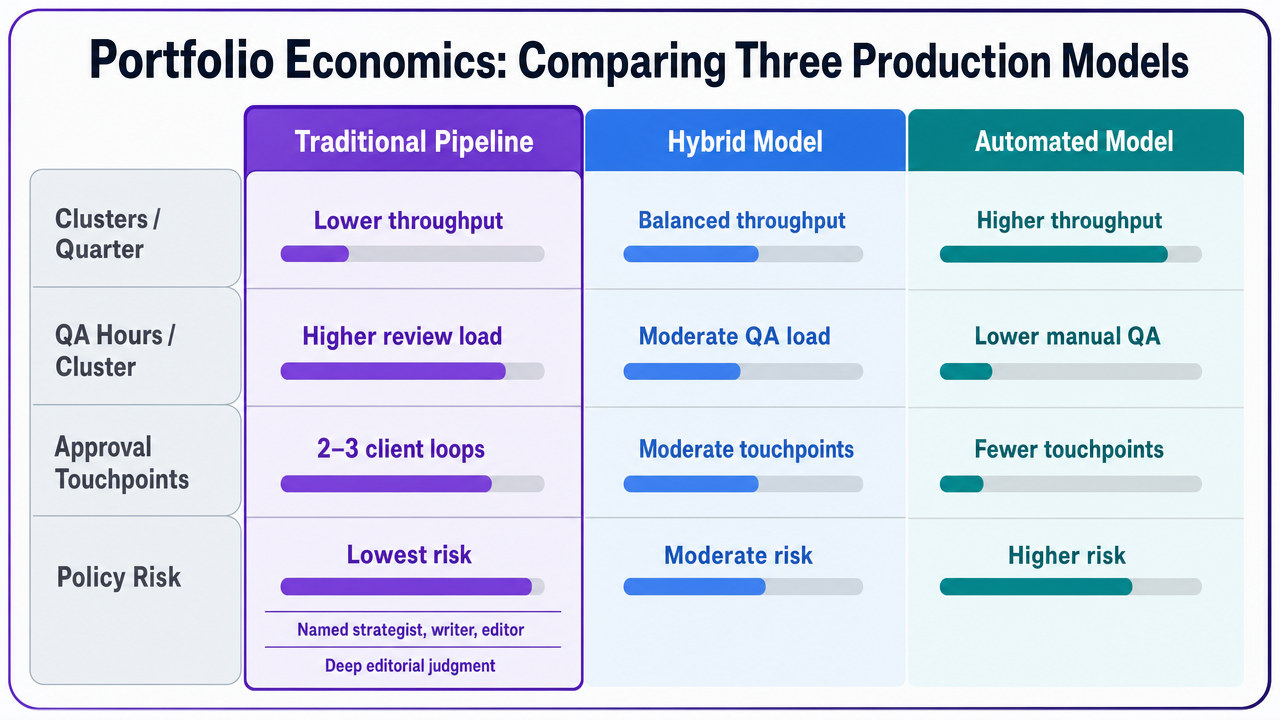 Render the comparison table from the section as a scannable visual comparison of three production models across four operational variables
See How Top Agencies Systematize Pillar Page SEO for Scalable Results
Connect with our team for a data-driven walkthrough of AI-powered workflows that streamline pillar content creation, approval, and reporting—eliminating bottlenecks for agencies managing multi-client SEO at scale.
Measuring the Cluster, Not the Click
Pillar-page performance measured in keyword rankings or sessions tells a Head of SEO almost nothing about whether the cluster earns its production cost. Google's own guidance for AI-driven search surfaces advises creators to evaluate conversions, signups, engagement, and information lookups rather than optimizing to click volume alone, because AI Overviews and AI Mode change what a visit looks like before the user ever reaches the page 3. The measurement model for the cluster has to reflect that shift.
Three reporting layers hold up across a client portfolio and give the Head of SEO a defensible answer when a client asks what the pillar is doing.
- Cluster-level demand capture. Report impressions, clicks, and query coverage for the pillar and every supporting URL as a single unit. A pillar that loses clicks to AI Overviews while its supporting pages pick up long-tail queries is working; a pillar that loses both is not 3.
- Assisted conversions, not last-click. Attribute signups, qualified calls, and form submissions to any cluster URL that appeared in the path. The pillar's job is to enter the consideration set early, which rarely shows up in last-click reports.
- Information-lookup proxies. Scroll depth on the pillar, click-through from pillar to supporting pages, and return visits to the cluster indicate the hub is doing navigational work even when the session does not convert 3.
Reported quarterly against the cluster map, these three layers replace the ranking screenshot with evidence a client's finance team can read.
A Repeatable Operating Rhythm for Heads of SEO
The controls described above hold up only when they run on a cadence. A Head of SEO scaling pillar programs across a client portfolio needs an operating rhythm that assigns each control to a recurring slot, with a named owner and a hand-off into the next stage.
A workable quarterly rhythm has four fixed slots:
- Week one: cluster-map review per client, with the gap-and-redundancy audit refreshed against current site inventory 1.
- Weeks two through ten: production against the approved map, with the approval gate enforcing the added-value audit before any URL enters the index 5.
- Week eleven: technical sweep of every live pillar against LCP, INP, and CLS field data, plus the internal-link and canonical map check 6.
- Week twelve: cluster-level performance review covering query coverage, assisted conversions, and information-lookup proxies for AI-surfaced traffic 3.
Agencies that codify this rhythm shift the Head of SEO's role from firefighting to portfolio stewardship. The strategists scope, the approval gate protects quality, the technical floor holds, and the measurement model answers client questions in evidence rather than screenshots. Vectoron's approval-first production platform exists to run that rhythm without expanding the strategist bench.
Frequently Asked Questions
References
- 1.Site Mapping and Information Architecture | Usability & Digital ....
- 2.Google Search Essentials (formerly Webmaster Guidelines).
- 3.Top ways to ensure your content performs well in Google's AI experiences on Search.
- 4.SEO Link Best Practices for Google.
- 5.Spam Policies.
- 6.Understanding Core Web Vitals and Google search results.
- 7.What is URL Canonicalization.
- 8.B2B Content Marketing: 2025 Benchmarks & Trends.
- 9.Headings - Home Office User-Centred Design Manual.
- 10.Method.