
Key Takeaways
- Google's guidance defines pillar quality through helpful, people-first content with descriptive internal links and clear organization, not word counts, cluster size, or template rules 1, 2, 4.
- Cluster architecture works when each subpage resolves a distinct sub-task and is linked contextually from the pillar section that discusses it, using anchor text that names the destination 2, 7.
- Five single-signature review gates—strategy, SEO, editorial, subject-matter, and technical QA—translate Google's helpful-content questions into a repeatable rubric that keeps AI-assisted production defensible 4, 6.
- Portfolio-scale pillar programs should report on impression share, AI Overview citation presence, and sub-task completion rather than raw sessions, since AI features fold visibility into Web search reporting 8, 11.
What Google's Current Guidance Actually Requires of a Pillar Page
A pillar page in 2025 is not defined by word count, hub-and-spoke diagrams, or the number of H2s it contains. Google's Search Essentials frames the requirement in different terms: helpful, reliable, people-first content, presented with clear organization and crawlable links to related material 1. Nothing in the documentation prescribes a page length, a minimum cluster size, or a specific template. That absence is the point. Agencies that still spec pillars by word count are optimizing against a rubric Google never wrote.
The functional definition that survives current guidance is narrower and more useful: a pillar page is the authoritative, well-structured entry point for a topic that a client's business can credibly own, connected to focused supporting pages through descriptive internal links 1, 2. It exists to satisfy a reader's task, not to warehouse keyword variants. Google's AI-features guide reinforces this by warning against producing separate pages for every query variation when the underlying intent is manipulating rankings or generative-AI responses 7.
Four requirements do the real work:
- The content must be original, current, and produced for people rather than search engines, per the SEO Starter Guide 3.
- The page must be readable and organized so a scanner can locate the answer to a specific sub-question without reading the whole document 3.
- Every important supporting page must be linked from at least one other page, with descriptive anchor text that tells users and Google what they will find 2.
- The page must pass Google's helpful-content self-assessment: first-hand expertise, a clear site purpose, and enough information for a reader to complete the task they arrived with 4.
The operational implication for a Head of SEO managing a client portfolio is that pillar quality can be defined without a house style guide arguing about section counts. If a strategist can answer yes to Google's self-assessment questions and can point to descriptive internal links leading to focused subpages, the page meets the bar. If they cannot, no amount of length, schema, or keyword density will compensate. That standard is portable across verticals, which is what makes it scalable.
Architecture: Cluster Design, Anchor Text, and Internal Link Density
The architecture of a pillar-and-cluster system is a linking problem before it is a content problem. Google's crawlable links documentation states that every page an owner cares about should have a link from at least one other page, and that descriptive, relevant anchor text helps both users and Google understand what a destination page covers 2. That single rule, applied rigorously, does most of the architectural work. If a subpage cannot be reached through a descriptive contextual link from the pillar, it is not part of the cluster; it is an orphan the pillar happens to share a topic with.
Cluster design starts by defining the pillar's task boundary, not its keyword list. The pillar answers the top-level question a reader arrives with. Subpages answer the sub-tasks that reader encounters once they commit to the topic. Google's AI-features guide is explicit that producing separate pages for every query variation, when the underlying intent is the same, works against both users and generative-AI representation of the site 7. The operational rule: a subpage exists only when it resolves a distinct sub-task that would clutter the pillar if inlined, and it earns its place by being linked contextually from the section of the pillar where a reader would naturally want it.
Anchor text is where most agency pillar programs leak authority. Nielsen Norman Group's information-scent research shows that users judge whether to click based on the link label, the surrounding context, and prior experience with similar labels 12. Generic labels such as "learn more," "read our guide," or "click here" strip scent from the link and force the reader to reconstruct intent from the paragraph around it. Descriptive labels do the opposite: they preview the destination and let the reader forage efficiently, which is what information-foraging theory predicts users are optimizing for in the first place 11.
Weak versus strong internal link labels on a pillar page. Descriptive anchor text tells the reader what they will find; generic anchors force them to guess. Grounded in Google's crawlable links guidance 2.
Internal link density on a pillar page is not a number to optimize; it is a consequence of covering the topic well. Google does not publish a target link count, and forced linking degrades clarity 2. The working standard is that each cluster subpage is linked from the pillar section that discusses its sub-task, using anchor text that names the sub-task, and that the subpage links back to the pillar with an anchor that names the parent topic. Cross-links between sibling subpages are added only when a reader on one subpage would plausibly need the other to complete their task.
Two structural mistakes recur across client audits:
- Stacking every cluster link into a footer or sidebar list on the pillar, which satisfies the crawlability requirement but destroys contextual scent because the links appear divorced from the reader's current sub-task.
- Duplicating the same descriptive anchor across many placements on the pillar, which flattens the differentiation Google's guidance is asking for.
Both errors are visible in a five-minute review: open the pillar, scroll, and ask whether each internal link would tell a first-time reader something specific about where it leads. If the answer is no, the architecture is decorative rather than functional.
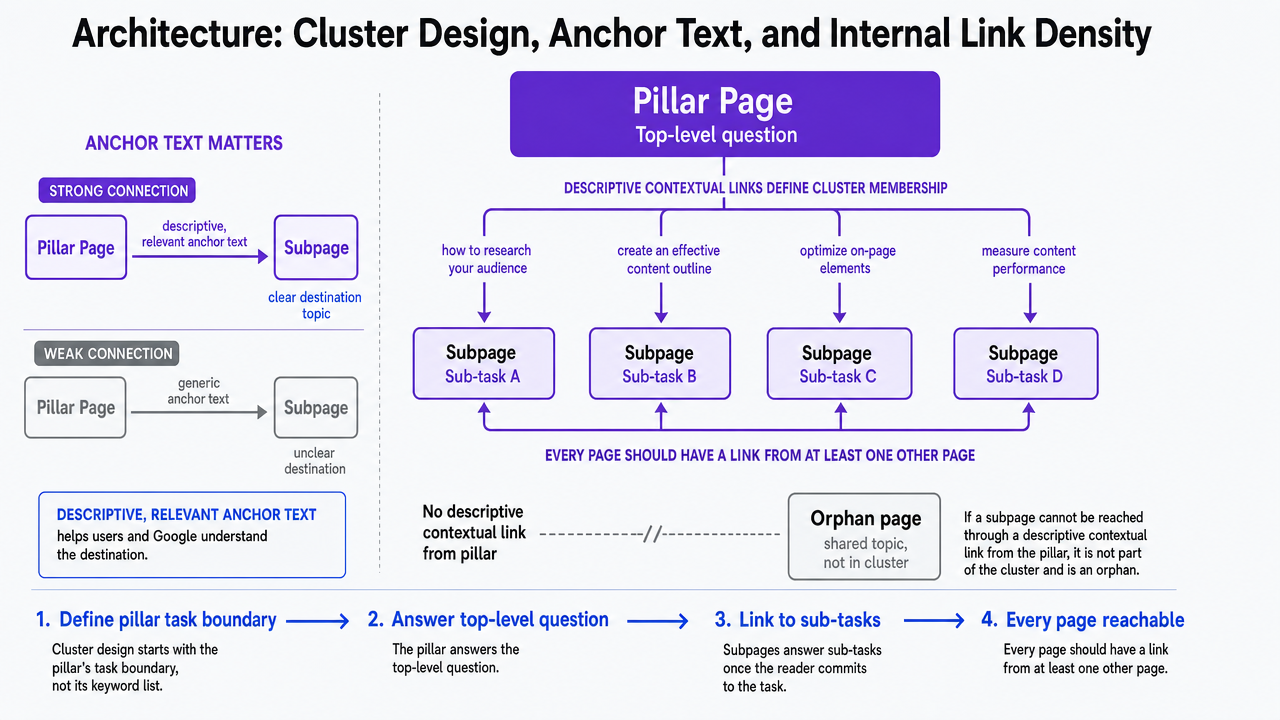 Visualize the article's specific guidance on descriptive versus generic anchor text, reinforcing the information-scent principle discussed in this section
Governance Gates: Turning Helpful-Content Questions into a Review Rubric
Pillar quality at portfolio scale is a governance problem. Google's helpful-content framework is qualitative by design: it asks whether a page demonstrates first-hand expertise, whether the site has a clear primary purpose, and whether a reader will leave having learned enough to accomplish their goal 4. Those questions do not answer themselves inside a Trello card. They need owners, criteria, and a sequence, or the answer defaults to whichever strategist happens to review the draft that week.
The move that separates repeatable pillar programs from bespoke ones is translating those self-assessment questions into named review gates with a specialist accountable at each step. The gates below are the working structure; the two subsections that follow explain how to staff them and how to keep AI-assisted production inside Google's spam-policy line 6.
The Five-Gate Production Model for Portfolio Delivery
Five review gates, in order, map cleanly to the helpful-content questions Google publishes 4:
- Strategy owns the topic decision and the task boundary: does the client have a credible reason to own this pillar, and what job is the reader trying to finish.
- SEO owns architecture: cluster scope, descriptive anchor text, and whether every supporting page is reachable from the pillar 2.
- Editorial owns readability, uniqueness, and whether the draft is organized so a scanner can locate a sub-answer without reading the whole page 3.
- Subject-matter owns first-hand expertise: named reviewer, source quality, and whether the claims reflect operating knowledge rather than paraphrased competitors 4.
- Technical QA owns the shipped page: crawlability, canonical, and the performance floor covered later in this article.
Five specialist review gates for a pillar page, each tied to a Google helpful-content self-assessment question about first-hand expertise, site purpose, and whether the reader leaves having learned enough 4.
Two operating rules keep the gates from collapsing into a single overworked reviewer. Each gate has a written pass criterion the specialist can defend in one sentence, and each gate is single-signature: one owner approves or rejects, no committees. That structure lets a Head of SEO stop being the last read on every pillar and start auditing the gates themselves, which is what scales across 15 to 60 accounts.
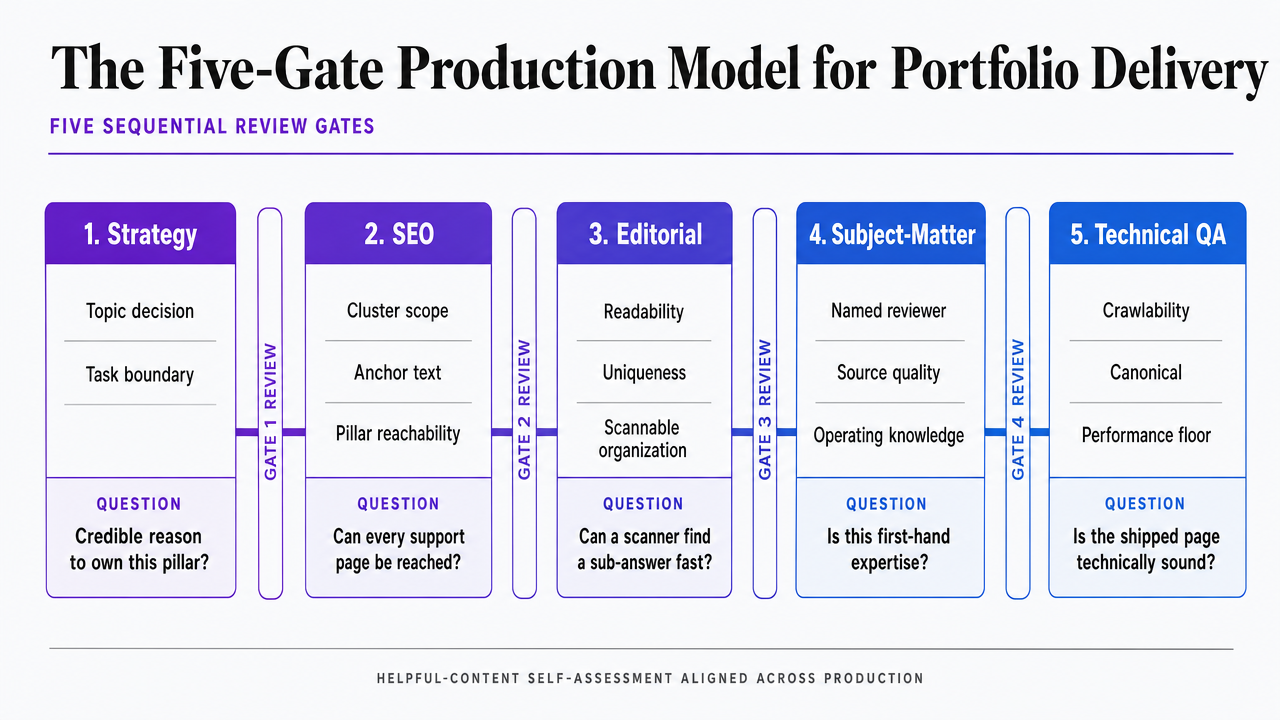 Visualize the five sequential specialist review gates described in the section, each tied to a helpful-content self-assessment question
AI-Assisted Production Inside the Scaled-Content-Abuse Line
Google's guidance on generative AI content is deliberately purpose-based rather than method-based. Automatically generated content must meet Search Essentials and spam-policy standards, and producing many pages without adding value can be classified as scaled content abuse regardless of whether a human or a model wrote the words 5, 6. There is no numeric threshold in the policy; intent, originality, usefulness, and demonstrable review carry the decision 6.
For a pillar program, that reframes AI from a drafting question into a review-evidence question. The safe pattern is to use AI for research synthesis, outline pressure-testing, section drafting, and internal-link auditing, then run every draft through the five gates with the subject-matter and editorial signatures logged. What agencies cannot defend is publishing model output at volume without the specialist review that Google's helpful-content assessment presumes 4.
Three operational rules keep AI-assisted pillars on the right side of the line:
- No pillar ships without a named subject-matter reviewer whose expertise is defensible to the client and traceable in the draft.
- Sourced claims cite the actual document, not a paraphrase, so the editorial gate can verify without a second research pass.
- Cluster expansion is capped by task boundary, not by keyword inventory: if a proposed subpage does not resolve a distinct sub-task a real reader would encounter, it does not enter the queue 7.
Those three rules, enforced at the gate rather than in a style guide, are what let AI-assisted production scale without drifting into the pattern Google's spam policy targets 6.
Test pillar page strategies with live content
Validate your topic authority framework using real client-ready pillar pages during a full-access trial.
Where Agency Budgets Are Moving and What That Means for Pillar Programs
Content Marketing Institute's 2025 B2B benchmark research puts a number on where marketing budgets are shifting: 40% of surveyed B2B marketers expected to increase investment in AI for content optimization and performance, and 39% expected to increase investment in AI for content creation 10. The two figures are close enough to read as a single signal. Buyers are funding both sides of the production line, not choosing between them.
CMI's 2025 B2B benchmark shows 40% of respondents planning to increase AI investment in content optimization and performance, and 39% planning to increase investment in AI for content creation 10. The figures reflect marketer-reported intent, not causal outcomes.
For an agency Head of SEO, the operational reading is more useful than the headline. Clients are budgeting for AI-assisted production regardless of whether the agency offers it, which means the differentiation shifts to what happens around the model output: strategy, review, and measurement. Pillar programs are where that difference is easiest to demonstrate, because the artifact is visible, the architecture is auditable, and the review trail is defensible under Google's helpful-content and spam-policy standards 4, 6.
Two budget consequences follow. Retainers that were structured around drafting hours lose margin as AI compresses that step, so the profitable work moves upstream into strategy gates and downstream into subject-matter review and measurement. Agencies that keep pricing tied to word volume rather than governance are competing against every client's in-house AI stack on the one dimension the client can now replicate internally.
The pillar page is the natural unit for repricing this work. It carries enough scope to justify five specialist gates, enough architectural complexity to warrant an SEO sign-off on cluster design 2, and enough client visibility that the review trail becomes part of what the retainer is buying. Programs that surface those gates in the statement of work convert AI-driven cost compression into margin instead of ceding it back to procurement.
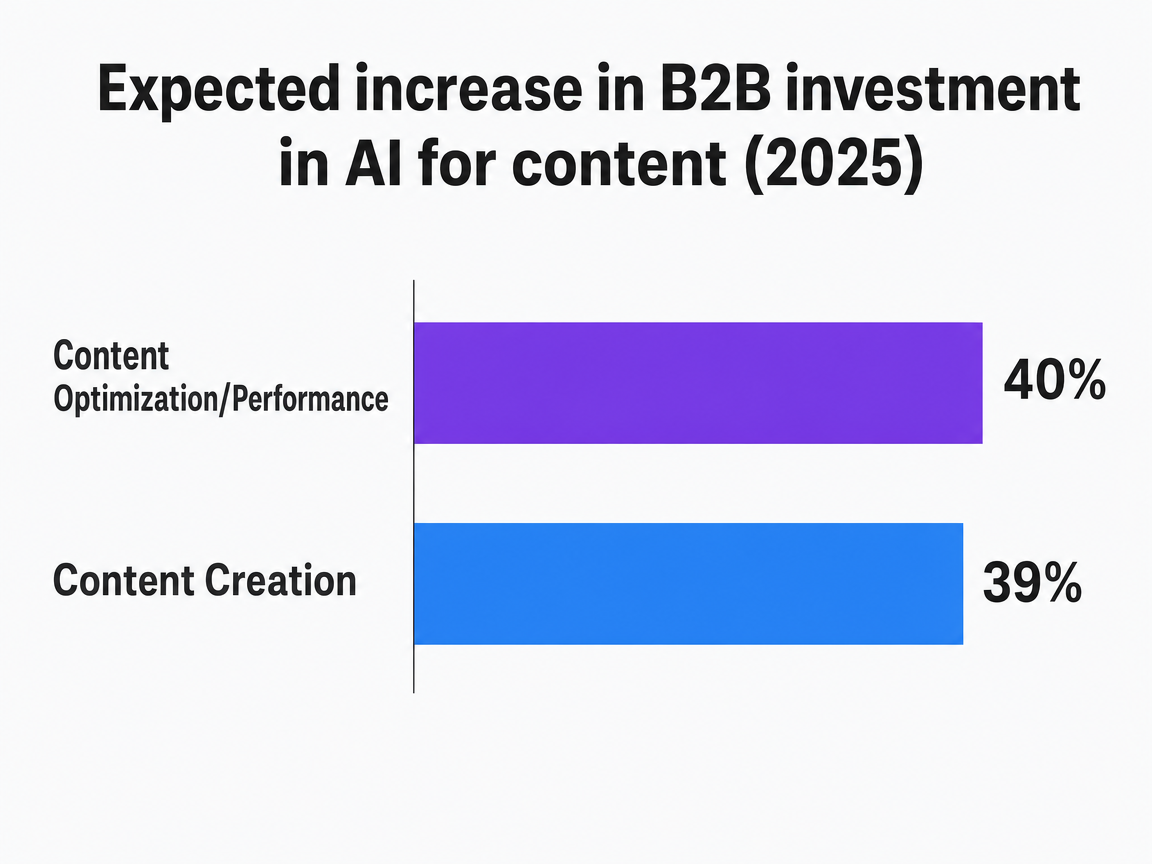 Expected increase in B2B investment in AI for content (2025)
From CMI's 2025 B2B Content Marketing report, showing the percentage of respondents who plan to increase investment in different AI applications for content.
Technical Floor: Core Web Vitals for Long, Media-Heavy Pillars
Pillar pages fail Core Web Vitals more often than shorter content because they carry the load that makes them useful: hero images, comparison tables, embedded video, cluster navigation, and the scripts that power on-page anchors. Google's targets for a good experience are unambiguous:
- Largest Contentful Paint within 2.5 seconds
- Interaction to Next Paint below 200 milliseconds
- Cumulative Layout Shift below 0.1
Those thresholds are the technical floor a pillar must clear before its architecture and content quality get a fair read 9.
LCP is where most pillars break first. The largest element above the fold is usually a hero image or a diagram illustrating the cluster, and unoptimized versions push the metric past 2.5 seconds on mid-tier mobile devices 9. The operational fix is boring and durable: compress and correctly size the hero, defer below-the-fold media, and preload the LCP asset. Agencies that ship pillars without a rendered-size audit are conceding the metric before the first reader arrives.
INP is the responsiveness metric that penalizes the interactive elements pillars increasingly rely on, including sticky navigation, accordion clusters, and in-page tab systems. Every one of those patterns runs JavaScript on user input, and stacked handlers push INP above the 200 millisecond threshold on slower devices 9. The rule for pillar templates is that any interactive element earns its place by resolving a distinct navigation task, not by decorating the page.
CLS punishes late-loading images without dimensions, injected ad units, and web fonts that reflow the layout after paint. On a pillar page, the visible symptom is a reader losing their place in a long section because a mid-page image finally arrives. Reserving space with explicit width and height attributes keeps CLS under 0.1 and preserves scroll position 9.
Passing Core Web Vitals is not a ranking guarantee; Google is explicit that it is one part of page experience alongside relevance, quality, and intent satisfaction 9. The reason it belongs in a governance rubric anyway is that a pillar that fails the thresholds undermines the helpful-content assessment it is trying to satisfy 4. The technical QA gate exists to catch that failure before publish, not after a Search Console alert.
See How Leading Agencies Streamline Pillar Page Production at Scale
Connect with our team to discuss data-driven workflows for building topic authority through pillar pages—without increasing headcount or compromising content quality.
Measurement When AI Overviews Absorb the Click
Pillar-page reporting built around organic sessions and keyword rankings understates performance in the AI Overviews era, and it does so in a way that is hard to defend to a client staring at a flat traffic chart. Google's own documentation is direct about the mechanic: pages appearing in AI features are included in overall Search traffic and reported in Search Console under the Web search type, not broken out as a separate channel 8. The impressions are counted; the click behavior sits inside the same buckets that traditional blue-link results occupy. Agencies that keep reporting only on sessions and position lose credit for visibility they actually earned.
The reporting frame that survives this shift has three layers:
- Impression share and average position in Search Console remain the leading indicators for pillar coverage, because those metrics register when a pillar is being surfaced to a query set regardless of whether the AI feature summarizes it or the user clicks through 8.
- Query-level presence in AI Overviews, sampled manually or through a monitoring tool, becomes the qualitative overlay: which sub-tasks on the pillar are being cited, which cluster subpages are appearing as supporting links, and which competitors are being pulled in alongside.
- Downstream engagement on the pillar itself, including scroll depth on the sections that answer the pillar's task, indicates whether the readers who do click are finishing the job the page was built to satisfy 11.
The account-management defense that holds up in a client review starts with the impression trend, names the queries where AI features are compressing clicks, and shows the pillar being cited within those features as the source of the compression. That framing is honest about the click loss and takes credit for the visibility, which is the position Google's own documentation supports 8. It also redirects the conversation from raw traffic to task completion: the pillar's job is to be the reference a reader lands on when the summary is not enough, and to be the source the summary itself is built from.
Two measurement mistakes recur:
- Treating an impressions-up, clicks-down pattern as a ranking loss when it is often the signature of AI Overview inclusion 8.
- Over-instrumenting the pillar with engagement events that measure time on page rather than sub-task resolution; information-foraging research is clear that a shorter session ending in a completed task is a success, not a failure 11.
The reporting rubric a Head of SEO can hand to account managers is narrow on purpose: impression trend, AI-feature citation presence, and sub-task completion on the pillar. Everything else is diagnostic.
Running Pillar Programs Across a Client Portfolio
Scope shift: this section addresses the Head of SEO overseeing pillar work across 15 to 60 accounts, not the strategist producing a single page. The operational question changes at that scale. It stops being how to build a good pillar and becomes how to make the median pillar across the portfolio hit a defensible bar without every project routing through the same senior reviewer.
Three portfolio-level mechanics do most of that work.
- A shared topic-decision standard applied at intake, before any drafting begins. A client's pillar candidate list is filtered against Google's helpful-content questions about site purpose and first-hand expertise 4: does the account have a credible reason to own the topic, and can the team point to a named subject-matter reviewer on the client side or a documented equivalent. Topics that fail either test do not enter the production queue regardless of search volume. That single filter, enforced at intake, prevents the pattern Google's spam policy targets when many pages are produced primarily to chase rankings rather than help users 6.
- A standardized cluster architecture that travels across accounts. The rule is portable because it is Google's, not the agency's: every subpage reachable through a descriptive contextual link from the pillar section that discusses its sub-task, and every important page linked from at least one other page 2. Account managers do not need to relitigate architecture per client; they inherit the pattern and adapt the topic. That is what lets a junior strategist ship a defensible cluster map without waiting for senior review.
- A portfolio-wide reporting rubric that account managers can defend without escalation. Impression trend and average position from Search Console cover pillar visibility, including AI-feature exposure that lands in the Web search type 8. Sampled query-level presence in AI Overviews covers qualitative citation. Sub-task completion on the pillar covers whether readers who arrive finish the job the page was built to satisfy 11. Three metrics, same shape across every account, reviewed on the same cadence.
What this produces at the portfolio level is not uniformity of output but uniformity of standard. The pillars themselves vary by vertical and client voice; the intake filter, cluster rule, and reporting rubric do not. That is the structural condition for scaling pillar delivery without the Head of SEO becoming the last read on every draft, and it is where AI-assisted production earns its margin: on the governed steps, not on the drafting step every competitor can now automate.
Frequently Asked Questions
References
- 1.Google Search Essentials (formerly Webmaster Guidelines).
- 2.SEO Link Best Practices for Google.
- 3.SEO Starter Guide: The Basics.
- 4.Creating Helpful, Reliable, People-First Content.
- 5.Google Search’s guidance on using generative AI content.
- 6.Spam Policies for Google Web Search.
- 7.Google’s Guide to Optimizing for Generative AI Features on Google Search.
- 8.AI Features and Your Website.
- 9.Understanding Core Web Vitals and Google search results.
- 10.B2B Content Marketing: 2025 Benchmarks & Trends.
- 11.Information Foraging: A Theory of How People Navigate on the Web.
- 12.Information Scent: How Users Decide Where to Go Next.