
Key Takeaways
- BrightEdge consolidates keyword universes, ranking data, and workflow across dozens of client domains, absorbing the senior specialist coordination that would otherwise sit outside a governed workspace 2.
- Semrush spans keyword research, backlinks, on-page auditing, and AI visibility tracking, closing the gap left when teams default to general-purpose LLMs without ranking context 1.
- Surfer SEO compresses the brief-to-draft cycle through its Content Editor and extends into GEO via its AI Tracker, letting junior writers hit senior-quality output 3.
- Screaming Frog absorbs the manual technical audit, crawling millions of URLs and surfacing redirect chains, canonical conflicts, and structured data errors in minutes 7.
- Ahrefs anchors backlink intelligence, condensing referring domain reconciliation and lost-link recovery into filtered lists an outreach coordinator can action the same day 7.
- Frase differentiates from Surfer on question mining and outline density, making it the stronger fit for long-form editorial where structural completeness drives ranking 3.
- Whatagraph pulls Search Console, Analytics, Ahrefs, and Semrush data into templated dashboards, reclaiming a full reporting analyst seat for agencies running 30+ monthly reports 4.
- Rankscale monitors prompt-level mentions, competitor share of AI answers, and citation sources across ChatGPT, Perplexity, and Google's AI Overviews — a role that did not exist two years ago 4.
- Vectoron addresses the coordination gap Forrester flags in agency genAI adoption, routing every recommendation through a Command Center for human approval before execution 9.
Why Stack Composition Now Decides Agency SEO Margin
The economics of agency SEO delivery have shifted faster than most tooling budgets. A 2024 benchmark survey of businesses actively running SEO programs found that 49.4% allocate less than 10% of their SEO budget to AI-related tools, 31.2% allocate between 10% and 20%, and only 6.5% commit more than half of their SEO spend to AI 1. Read against workload, that allocation is out of step with what AI-assisted platforms can now absorb across content briefs, technical audits, reporting, and generative engine visibility.
The context around that number matters. McKinsey's early-2024 survey put regular organizational use of generative AI at 65% 10, and Forrester's 2025 review of US marketing agencies describes genAI as accelerating inside agency operations while still functioning as a cost center rather than a revenue line 9. Agencies are spending on AI. Most are not composing it into a stack that reduces cost-to-serve.
Forrester's 2025 prediction sharpens the stakes: AI-powered content production is expected to shift work back toward external providers that can deliver at lower unit cost 11. For agency SEO leads managing 10 to 100 client domains, margin depends on which layers of the workflow the stack actually absorbs. Picking one enterprise platform is no longer the decision. Composing six coordinated layers is.
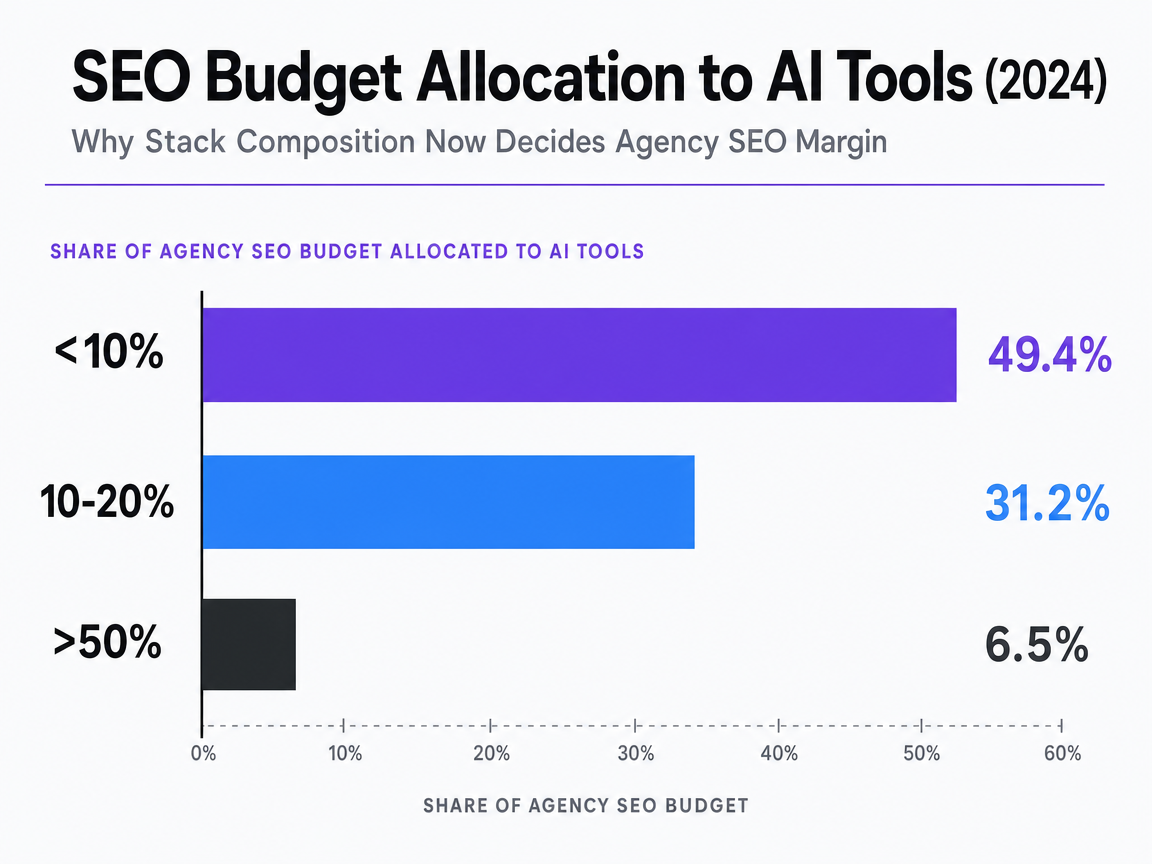 SEO Budget Allocation to AI Tools (2024)
A 2024 survey breakdown of how businesses allocate their SEO budgets to AI-related services and tools. The categories are '<10%', '10-20%', and '>50%' of total SEO budget.
The Six-Layer Model Behind a Pro SEO Stack
Forrester's enterprise SEO evaluation featured seven vendors — BrightEdge, Conductor, Moz, Searchmetrics, SEMrush, seoClarity, and Siteimprove — as the platforms large organizations use to run SEO at scale 2. That vendor list defines one layer of an agency stack. It does not define the stack.
A pro SEO stack in 2025 breaks into six functional layers, each absorbing a task that used to sit with a dedicated specialist:
- The first is enterprise SEO management, where platforms like BrightEdge or seoClarity hold keyword universes, ranking data, and workflow across client domains 2.
- The second is AI content and on-page optimization, where tools such as Surfer SEO and Frase compress the brief-to-draft cycle that consumed content writer hours 3.
- The third is technical crawl, still anchored by Screaming Frog for site architecture audits that a technical SEO would run manually 7.
- The fourth layer is backlink intelligence and outreach, where Ahrefs remains the reference dataset for competitive link research 7.
- The fifth is reporting and attribution, where automation platforms like Whatagraph collapse the reporting analyst function across dozens of client portfolios 4.
- The sixth — and newest — is AI visibility, or generative engine optimization, tracking how brands surface inside ChatGPT, Perplexity, and Google's AI Overviews through tools like Rankscale and Surfer's AI Tracker 4.
Each layer maps to an FTE role the tool absorbs: specialist SEO, content writer, technical auditor, link researcher, reporting analyst, GEO analyst. The composition question is which of those six roles an agency still pays for in full, and which the stack now covers at the margin.
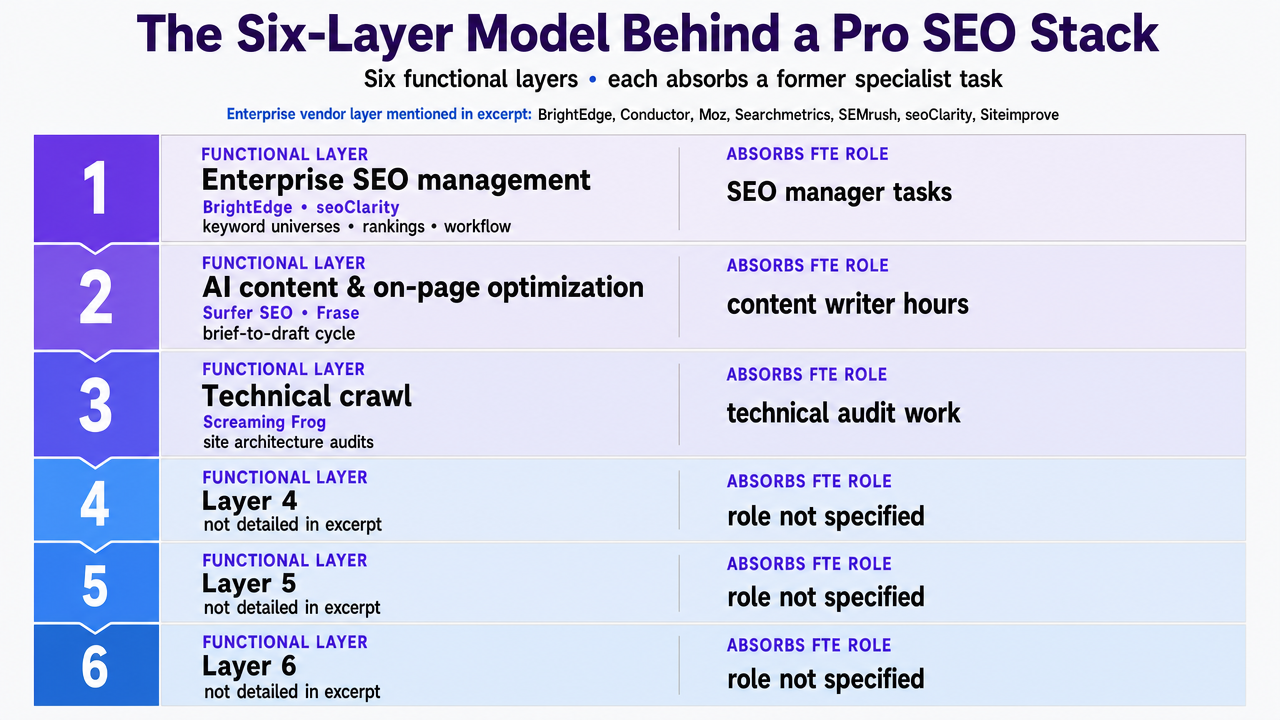 Visualize the six functional stack layers and the FTE role each absorbs, supporting the section's core framework
Nine Tools, Slotted by Stack Role
BrightEdge — Enterprise SEO Management for Multi-Client Delivery
BrightEdge sits in the enterprise SEO management layer that Forrester identified alongside Conductor, Moz, Searchmetrics, SEMrush, seoClarity, and Siteimprove as the platforms built to run SEO at organizational scale 2. For an agency SEO lead managing dozens of client domains, its value is workflow consolidation: keyword universes, ranking data, content recommendations, and share-of-voice tracking held in one workspace rather than stitched across spreadsheets.
The layer BrightEdge occupies absorbs the coordination work of a senior specialist who would otherwise reconcile ranking pulls, opportunity forecasts, and reporting cycles across accounts. Its Data Cube and Recommendations modules push priority actions to individual account teams, which shortens the distance between diagnosis and assignment.
BrightEdge stops paying for itself when the client roster is small enough that a single specialist can hold the keyword landscape in memory. Its per-domain pricing model rewards portfolios where the platform replaces recurring analyst hours across many accounts, not agencies running fewer than a dozen retainers.
Semrush — Cross-Layer Coverage with an AI Visibility Toolkit
Semrush appears in Forrester's enterprise SEO vendor list 2and in nearly every practitioner review of AI-assisted SEO platforms, largely because it spans keyword research, backlink analysis, on-page auditing, and — since 2024 — an AI Visibility Toolkit that tracks brand mentions inside LLM answers 4. That cross-layer footprint is the reason it earns a slot in stacks that would otherwise need three separate subscriptions.
The strategic read on Semrush is less about its feature list and more about what it displaces. A 2024 benchmark of businesses running SEO programs found 57.1% use ChatGPT as their primary AI tool, followed by SEO.ai at 18.2% and MarketMuse at 16.9% 1. That distribution shows most SEO teams reach for a general-purpose LLM before an SEO-native platform, which leaves keyword intent, SERP context, and ranking impact outside the loop.
Semrush's role in an agency stack is to close that gap by pairing AI-assisted content and visibility features with the ranking and backlink data the LLM does not have. The layer stops paying for itself when agencies also carry Ahrefs and a dedicated GEO tracker, because the overlap becomes duplicative rather than additive.
Surfer SEO — AI Content Briefs and On-Page Optimization
Surfer SEO earned top ranking in a practitioner review that tested more than 40 AI SEO platforms across hundreds of client campaigns, cited specifically for on-page optimization and its Content Editor that compresses draft-to-publish hours per article 3. It also added an AI Tracker to measure how brands surface inside LLM answers, extending its role from pure on-page work into the GEO layer 4.
Inside an agency stack, Surfer occupies the AI content and on-page layer that used to depend on a content writer building briefs manually from SERP analysis. The Content Editor scores drafts against ranking pages in real time, which means junior writers can produce briefs at senior-writer quality without the review cycle a specialist would otherwise run.
Surfer stops paying for itself when agencies publish fewer than a handful of new pages per client per month. Its per-workspace pricing rewards production volume; low-frequency content programs will find the same output cheaper through targeted freelance briefs.
Screaming Frog — Technical Crawl and Site Architecture Audits
Screaming Frog remains the reference tool in the technical crawl layer, cited by Search Engine Journal alongside Google Search Console and Google Analytics as core infrastructure for digital marketers 7. Its SEO Spider crawls up to millions of URLs, surfaces broken links, redirect chains, canonical conflicts, and structured data errors, and exports the results into formats a technical SEO can act on within an hour.
The role it plays inside an agency stack is absorbing the manual audit work of a technical SEO specialist. A crawl that would take a junior technical analyst most of a day to run and format now completes in minutes, with exports that plug directly into ticketing systems.
Screaming Frog stops paying for itself only when a stack already includes a full enterprise platform with equivalent crawl depth. For most agencies, the license cost is negligible against the specialist hours it removes from every technical audit cycle.
Ahrefs — Backlink Intelligence and Competitive Link Research
Ahrefs anchors the backlink intelligence layer in most independent tool reviews, including Search Engine Journal's roundup of the tools digital marketers rely on for tracking, measuring, and improving search performance 7. It also appeared in a 2024 practitioner test of AI SEO platforms, cited for backlink data depth and competitive link research across active campaigns 3.
The FTE role Ahrefs absorbs is the link researcher who would otherwise manually reconcile referring domain data, anchor text distributions, and lost-link recovery targets across a client portfolio. Its Site Explorer and Content Explorer condense that work into filtered lists that a link outreach coordinator can action the same day.
Ahrefs stops paying for itself when an agency's clients operate in verticals where earned links play a marginal role — some local service businesses, for example, rely more on directory citations and Google Business Profile signals than on domain authority accumulation. In those cases, the per-workspace subscription outstrips the analysis it enables.
Frase — AI-Assisted Content Briefs and SERP Analysis
Frase appeared in the same practitioner review that tested more than 40 AI SEO platforms, positioned specifically for AI-generated content briefs and SERP analysis workflows 3. It pulls the top-ranking pages for a target query, extracts common headings and questions, and generates a structured brief that a writer can execute against without spending hours on manual SERP reconciliation.
Inside the AI content layer, Frase overlaps with Surfer on brief generation but differentiates on question mining and outline density. That makes it the more useful choice for agencies producing long-form editorial or resource-hub content where structural completeness drives ranking.
Frase stops paying for itself when an agency's stack already carries Surfer for the same layer, or when clients publish short-form transactional pages where SERP analysis adds little strategic lift. The two tools rarely earn their combined subscription unless production volume splits cleanly between editorial and on-page optimization workstreams.
Whatagraph — Reporting Automation Across Client Portfolios
Whatagraph occupies the reporting and attribution layer that agency-focused reviews now flag as one of the highest-leverage automation targets, particularly with the addition of AI-powered report summaries that translate raw data into client-facing narrative 4. It pulls from Search Console, Google Analytics, Ahrefs, Semrush, and paid channels into templated client dashboards.
The FTE role it absorbs is the reporting analyst who would otherwise assemble monthly deliverables account by account. For an agency running 30 or more client reports per cycle, that is a full seat of specialist time reclaimed for strategy work.
Whatagraph stops paying for itself when clients require heavily bespoke reporting — custom attribution models, unique KPI hierarchies, or narrative-heavy quarterly business reviews. In those cases, the template efficiency inverts into rework, and a dedicated analyst still holds the pen.
Rankscale — GEO Tracking for LLM-Based Search Surfaces
Rankscale.ai occupies the AI visibility layer, purpose-built to track how brands appear inside ChatGPT, Perplexity, Google's AI Overviews, and other LLM-based answer surfaces 4. It monitors prompt-level mentions, competitor share of AI answers, and citation sources — the equivalent of rank tracking, but for generative engines rather than the classic ten blue links.
The FTE role Rankscale absorbs did not exist inside most agencies two years ago. GEO analyst work — running prompt panels, logging brand mentions, tracking citation provenance — was manual until dedicated platforms compressed it into monitored dashboards. For agencies with clients whose customers now open ChatGPT before Google, that layer is no longer optional.
Rankscale stops paying for itself when clients operate in verticals where LLM-driven discovery remains marginal, such as hyperlocal transactional services still dominated by map-pack visibility. In those portfolios, GEO tracking is a strategic hedge rather than a delivery requirement, and the subscription can wait until AI search share of voice becomes material.
Vectoron — Coordination and Approval Layer Across the Stack
The nine-tool stack described so far solves execution across six functional layers. It does not solve coordination. Forrester's 2025 review of US marketing agencies found that genAI adoption is accelerating inside operations but still functions as a cost center, largely because tools operate in parallel rather than as a governed workflow 9. That coordination gap is where Vectoron slots in.
Vectoron is an AI marketing execution platform with specialist strategists for content, SEO, PPC, backlinks, social, and call intelligence, routed through a unified Command Center that holds every recommendation for human approval before execution. Inside the pro SEO stack, its role is not to replace Ahrefs, Surfer, or Screaming Frog. It reads the signals those tools produce, ranks priorities against live business data, and executes approved work — with the strategic reasoning attached to each recommendation.
The layer Vectoron absorbs is the account director's coordination overhead: briefing cycles, status meetings, vendor handoffs, and the reconciliation of what each specialist tool recommends against what the client actually needs shipped this week. It stops paying for itself when an agency's delivery model still depends on manual approval routing outside a governed workflow.
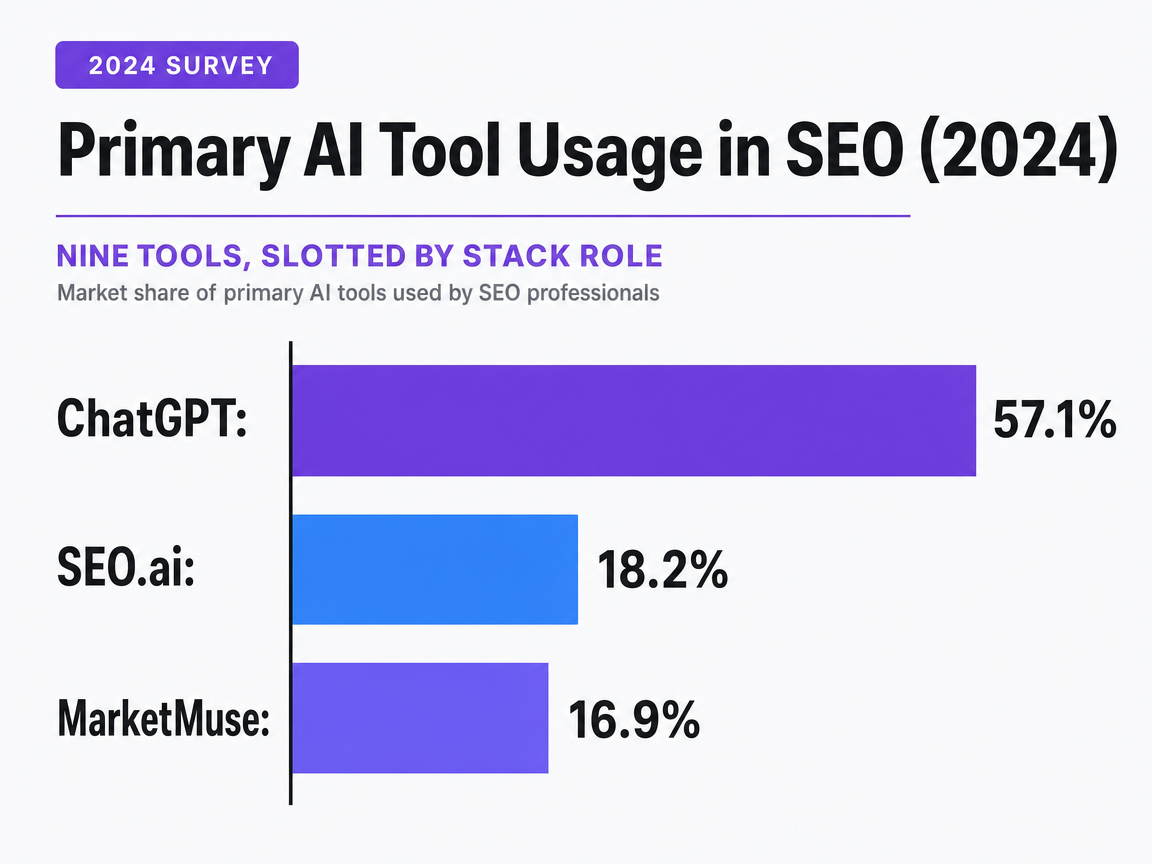 Primary AI Tool Usage in SEO (2024)
From a 2024 survey, this shows the market share of primary AI tools used by SEO professionals, indicating the dominance of general-purpose and specialized AI tools.
Test Professional SEO Workflows in Real Time
Experience full-scale SEO execution and publish live content with complete workflow access during your 7-day trial.
Mapping the Stack to Cost-to-Serve Per Client
The composition question resolves into a table. For agency SEO leads modeling delivery margin per retainer, the six functional layers map to a representative tool, the FTE task that layer absorbs, and the pricing model that determines how cost scales with portfolio size.
| Stack Layer | Representative Tool | FTE Task Absorbed | Pricing Model |
|---|---|---|---|
| Enterprise SEO Management | BrightEdge / Semrush | Specialist SEO coordination | Per domain |
| AI Content & On-Page | Surfer SEO / Frase | Content writer briefing | Per workspace |
| Technical Crawl | Screaming Frog | Technical auditor | Per seat |
| Backlink Intelligence | Ahrefs | Link researcher | Per workspace |
| Reporting & Attribution | Whatagraph | Reporting analyst | Per workspace |
| AI Visibility (GEO) | Rankscale | GEO analyst | Per domain |
Per-domain pricing scales with the client roster. Per-workspace pricing rewards centralization across accounts. Per-seat pricing tracks the specialist headcount the tool replaces. The stack pays off when at least four of the six layers absorb a role that would otherwise sit on the delivery org chart 9.
If You Manage a Portfolio of 30+ Client Domains
At 30 client domains and above, the delivery math changes. The per-domain and per-workspace pricing that looks expensive on a boutique roster starts absorbing specialist roles faster than headcount can replace them. Enterprise SEO platforms in the layer Forrester identified with BrightEdge, Conductor, Moz, Searchmetrics, SEMrush, seoClarity, and Siteimprove earn their license once the keyword universe crosses what a single specialist can hold in memory across accounts 2.
Reporting automation becomes the first pressure valve. A 2024 review of agency-focused AI SEO tools documented reporting layers that pull from Search Console, Analytics, Ahrefs, and Semrush into templated client dashboards, absorbing what would otherwise consume a full reporting analyst seat at that portfolio size 4. GEO tracking is the second. Agencies with 30+ retainers almost always carry at least a handful of clients where LLM-driven discovery already moves qualified traffic, which makes prompt-level visibility monitoring a delivery requirement rather than a hedge 4.
The composition question at this scale is not whether to add layers. It is which specialist roles stop scaling linearly with the account roster once each layer is in place.
See How Leading Agencies Scale SEO Delivery with Unified AI Workflows
Connect with a specialist to evaluate how streamlined, AI-driven SEO operations can increase throughput and maintain oversight across multiple client accounts—without increasing headcount.
Where AI Tooling Stops Paying for Itself
Every layer in the stack has a break-even point. Forrester's 2025 review of US marketing agencies found that genAI adoption is accelerating operationally but still registers as a cost center rather than a revenue line, largely because tools stack up faster than the workflow that governs them 9. The failure modes:
- The first is redundant coverage — two content platforms filling the same layer, an enterprise suite duplicating a technical crawler, a GEO tracker running against a client base where LLM discovery has not moved traffic.
- The second failure mode is production volume below the license threshold. Per-workspace pricing on tools like Surfer or Frase assumes weekly output across a client roster. An agency publishing five pages a month per client is buying capacity it cannot use.
- The third is oversight collapse. Forrester's 2025 agency-model prediction argues that AI-powered content production will accelerate as brands seek lower-cost external delivery 11, but that shift only holds margin when a governed approval workflow sits above the tool layer. Without it, the stack produces faster than the team can review, and quality control reverts to the specialist hours the tools were meant to absorb.
Composing the Stack Without Stapling Vendors Together
A pro SEO stack is not a purchase order. It is a workflow decision about which specialist roles the tools absorb and where human judgment stays in the loop. Forrester's 2025 review of US marketing agencies makes the point directly: genAI adoption is accelerating operationally, but the productivity gains have not translated into revenue lift because tools operate in parallel rather than as a governed system 9.
The composition test is simple. Each of the six layers should either replace a recurring specialist hour or produce a signal that another layer acts on. Ahrefs surfaces a link gap. Surfer builds the brief. Whatagraph reports the outcome. Rankscale tracks whether the resulting page earns citation inside an LLM answer. If a layer does neither — no absorbed hour, no downstream signal — it is a line item, not a stack component.
Coordination is the layer most agencies underprice. Vectoron sits above the tool set, routing recommendations through a Command Center that holds every action for human approval before execution. Stack composition, not tool count, is what turns AI from a cost center into delivery margin.
Frequently Asked Questions
References
- 1.AI SEO Benchmark Report: Key Stats & Insights.
- 2.Every Company Needs An SEO Platform.
- 3.17 Best AI SEO Tools We Tested on Real Campaigns.
- 4.7 AI SEO tools built for agencies (tested on clients).
- 5.The Forrester Wave™: Cognitive Search Platforms, Q4 2023.
- 6.The Cognitive Search Platforms Landscape, Q3 2023.
- 7.21 Best SEO Tools For Digital Marketers (Free & Paid).
- 8.Search Engine Optimization (SEO) Starter Guide.
- 9.The State Of Generative AI Inside US Marketing Agencies, 2025.
- 10.The state of AI in early 2024: Gen AI adoption spikes and starts to generate value.
- 11.Predictions 2025: Agencies Jettison Legacy Structures To Form New Agency Models.
- 12.The State Of Generative AI For Visual Content, 2025.