
Key Takeaways
- SE Ranking serves as a portfolio dashboard for agencies, with white-label reporting and check-frequency pricing that lets teams model profitability across multi-client retainers 1.
- AccuRanker delivers on-demand rank refreshes that let strategists verify keyword movement before QBRs or suspected algorithm shifts without waiting for a daily cycle 1.
- Semrush Position Tracking suits agencies already in the Semrush suite, unifying SERP feature coverage, local pack visibility, and cannibalization detection in one workspace 1.
- Ahrefs Rank Tracker pairs positional data with link graph context, turning rank fluctuations into diagnostics for content-heavy publishers, SaaS, and B2B accounts 11.
- Nightwatch handles messy inherited keyword sets through dynamic segmentation, ZIP-level tracking, and scoped scheduled reports that eliminate multiple templates per account 1.
- Wincher provides affordable daily updates that keep per-account tool costs proportionate to smaller local retainers, protecting margin on tail-end clients 1.
- SERPWatcher from Mangools produces clear, digestible reports for non-technical clients, saving analyst time on narrative writing when serving small businesses and professional services 1.
- Local Falcon's grid view exposes ranking variance across a geographic matrix, making it essential for multi-location clients where a single position hides underperforming branches 1.
- Moz Pro Rank Tracker leverages brand recognition to build stakeholder trust in mid-market and enterprise reporting, reducing time spent defending methodology 1.
- Sistrix supplies the Visibility Index that European and enterprise clients already track, giving agencies an executive narrative layer above daily keyword tracking 1.
The Two Evolving Roles of Rank Checking in Agencies
Rank checking has evolved beyond simply monitoring keyword positions. Agencies now face a dual mandate: maintaining traditional positional tracking and assessing visibility across Google's expanding array of search features, including SERP features, AI Overviews, AI Mode, and Discover generative surfaces. Google itself now reports on these directly in Search Console 9, highlighting their growing importance. This bifurcation creates different demands on rank tracking tools.
The first role emphasizes frequency, comprehensive keyword coverage, and clear portfolio dashboards. Agencies need daily positional data across a broad keyword universe, segmented by client, ready for quarterly business reviews (QBRs). The second role prioritizes breadth of surface coverage: understanding client presence in AI Overviews, identifying featured snippets replaced by generative answers, and tracking Discover impressions from generative feeds. Google's SEO documentation underscores the link between measurement, optimization, and outcomes 2, and effective trackers must account for both link-structure and content signals 11.
Most agencies currently purchase tools that attempt to cover both aspects. The following ten tools are assessed based on their strengths in addressing these distinct agency needs.
Agency-Centric Evaluation Criteria for Rank Tracking Tools
Our evaluation of rank tracking tools focused on four key operational questions pertinent to an agency's Head of SEO: portfolio scalability, alignment of update cadence with client reporting, potential for reducing analyst hours, and seamless integration with Google Search Console (GSC) as a foundational data source 6. Feature depth was secondary to a feature's impact on weekly delivery efficiency.
The GSC integration criterion holds significant weight, though it has limitations. The Search Console API provides performance data with a two to three-day delay and is capped at 50,000 rows per day per search type 7. For agencies managing numerous accounts with extensive keyword sets, this limit is quickly reached, preventing GSC from serving as a standalone rank tracker. Instead, it functions as a crucial baseline that third-party tools augment.
The remaining criteria—portfolio management, update cadence, and reporting labor—were weighted using insights from Zapier's independent platform comparisons 1, cross-referenced with agency-specific requirements such as white-label reporting, per-client project isolation, and pricing models that scale with check frequency rather than seat count.
Top Ten Rank Tracking Tools for Agencies
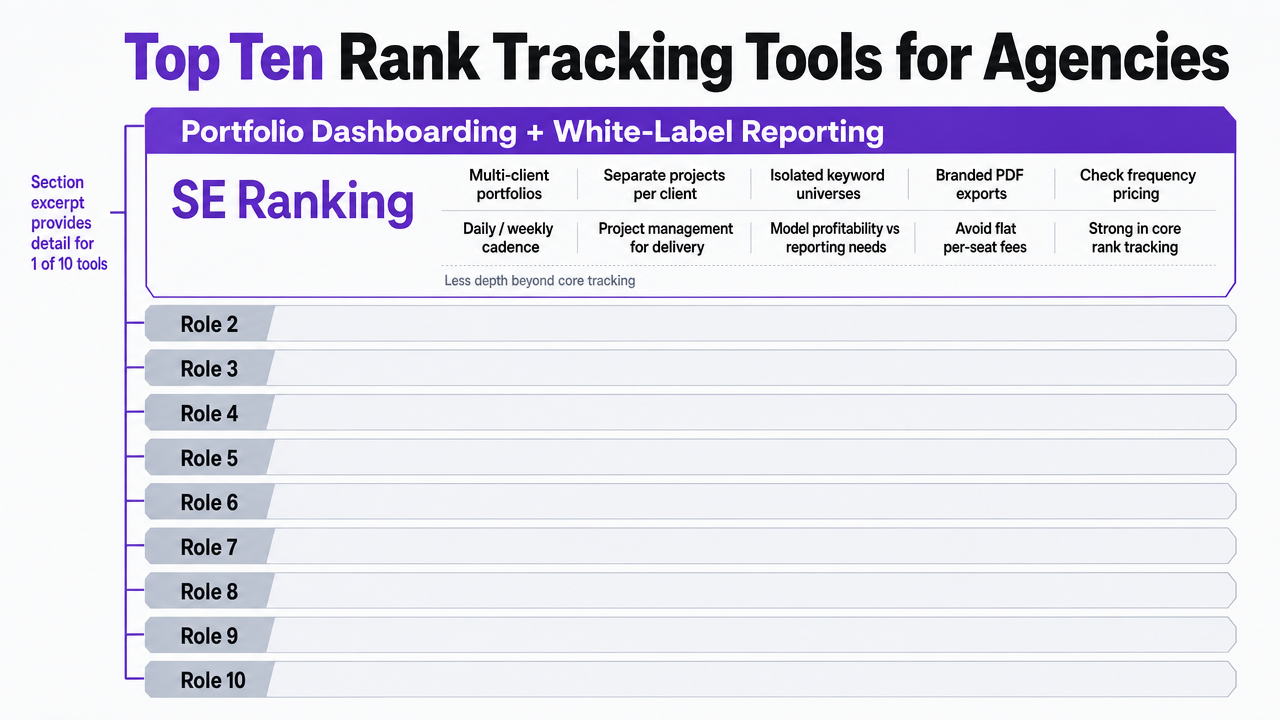
SE Ranking — Comprehensive Portfolio Dashboarding and White-Label Reporting
SE Ranking is frequently a top choice for agencies managing extensive client portfolios. Zapier's review identifies it as ideal for agencies due to its robust white-label reporting, flexible pricing based on check frequency, and project management features designed for multi-client delivery 1.
Its utility for agencies includes creating separate projects for each client with isolated keyword universes, generating branded PDF exports, and adjusting check cadences—daily for active campaigns and weekly for maintenance retainers. This pricing model, tied to check frequency, allows agencies to directly model account profitability against reporting needs, avoiding flat per-seat fees.
While strong in core rank tracking, SE Ranking's depth in areas like technical audits or backlink analysis is competent but not specialized. Agencies often pair it with other tools for these specific needs, viewing it as the central portfolio dashboard rather than an all-encompassing solution.
AccuRanker — Rapid, On-Demand Rank Verification
AccuRanker excels at providing quick, verifiable ranking snapshots, particularly useful when client meetings are imminent. Zapier's review highlights its precise on-demand tracking and refresh speed as key differentiators 1.
This speed allows strategists to trigger updates on critical keyword sets—branded terms, commercial queries, or client-specific keywords—the night before QBRs, ensuring current data without waiting for a full daily cycle. It's also invaluable for quickly verifying suspected algorithm shifts before clients raise concerns.
AccuRanker is not designed as a primary portfolio dashboard. Its per-keyword pricing can be higher than volume-focused tools, and its reporting is functional rather than white-label-ready. It best serves as a verification layer alongside a broader bulk tracker.
Semrush Position Tracking — Integrated SERP Feature and AI Overview Coverage
Semrush Position Tracking benefits significantly from its integration within the broader Semrush suite. Zapier's review notes Semrush's incorporation of generative AI features, which extends to Position Tracking's coverage of SERP features, local pack visibility, and cannibalization detection within a unified workspace 1.
For agencies already using Semrush for content, technical, and competitive research, Position Tracking offers a streamlined workflow, reducing tool-switching time. Its tagging system facilitates keyword segmentation by intent, funnel stage, or campaign, which is crucial for QBR presentations.
However, standard plans offer daily updates but lack AccuRanker's on-demand speed, necessitating a secondary tool for urgent verification. Additionally, per-project keyword limits on lower tiers can be restrictive for agencies managing many small accounts, potentially pushing them to higher, more costly tiers. Agencies should model account counts against tier limits carefully.
Ahrefs Rank Tracker — Link-Informed Ranking Context for Content-Heavy Portfolios
Ahrefs Rank Tracker's strength lies in its integration with Ahrefs' extensive link graph. Research indicates that page ranking algorithms consider both content-based and link-structure-based signals 11. Ahrefs allows strategists to analyze ranking fluctuations in conjunction with link acquisition, referring domain velocity, and internal link changes.
This context transforms a basic position report into a diagnostic tool, especially for publishers, SaaS content programs, or B2B accounts reliant on link building. A rank drop can be understood differently if it coincides with the loss of referring domains versus a competitor publishing superior content.
While competent, Rank Tracker's white-label reporting is not its primary strength. Agencies typically use it as an analytical workbench, exporting insights for client-facing reports generated elsewhere. Zapier's review categorizes Ahrefs as a suite, suggesting its pricing is more advantageous for agencies already invested in its ecosystem 1.
Nightwatch — Advanced Segmentation for Complex Keyword Universes
Nightwatch is ideal for agencies inheriting accounts with large, untagged keyword sets spanning multiple product lines, geographies, and languages. Its robust segmentation logic, including dynamic groups, filter-driven views, and granular location tracking (down to ZIP codes), enables analysts to impose structure without rebuilding keyword lists from scratch.
Zapier's review positions Nightwatch among platforms prioritizing reporting flexibility 1. Scheduled reports can be scoped to specific segments, allowing product leads to view only their relevant data, while executive reports aggregate the full portfolio. This eliminates the need for analysts to maintain multiple report templates per account.
The interface prioritizes control over immediate polish, leading to a steeper learning curve than more user-friendly tools. Agencies that value deep segmentation capabilities often accept this initial onboarding investment.
Wincher — Cost-Effective Daily Tracking for Budget-Conscious Retainers
Wincher addresses the challenge of providing daily rank data and weekly reports for retainers with limited tool budgets. Zapier's review identifies it as an affordable tracker offering daily updates as standard 1.
For agencies managing numerous smaller local accounts, Wincher allows each account to have its own project with a reasonable keyword count, daily refresh, and straightforward exports. This ensures that per-account tool costs remain proportionate to the retainer, preserving profit margins.
Wincher is not designed to replace a comprehensive portfolio dashboard for accounts with extensive keyword lists or complex SERP feature requirements. It is best suited for the smaller, tail-end clients in an agency's roster.
SERPWatcher (Mangools) — User-Friendly Reporting for Non-Technical Clients
SERPWatcher's primary advantage is its ability to generate reports that are easily understood by non-technical clients. Zapier's review praises the Mangools suite for its ease of use and clear visualizations 1. SERPWatcher inherits this design, offering features like a Dominance Index summary, share-of-voice tracking, and a report layout that requires minimal explanation.
This clarity is particularly beneficial for agencies serving small businesses or professional services clients who need quick, digestible insights. Analysts save time by not having to write extensive narrative captions, as the visualizations effectively convey the message.
The trade-off is depth. Keyword capacity per plan is modest, SERP feature coverage is less comprehensive than tools like Semrush or SE Ranking, and multi-project management relies on the broader Mangools account structure rather than agency-specific workspaces. It functions well as a tracker for smaller accounts, but not as a flagship solution.
Local Falcon — Grid View for Local Pack and Multi-Location Clients
Local Falcon is essential for agencies serving local service clients or multi-location businesses (e.g., dental groups, home services), where a single rank position is insufficient. Its grid view checks rankings across a geographic matrix around a business location, revealing variations like a position 1 at the storefront versus position 12 a few miles away. For multi-location clients, this matrix is the report, highlighting branches needing attention that a citywide average would obscure.
Zapier's review categorizes Local Falcon and similar grid-based trackers distinctly from national rank tracking 1, reflecting how agencies manage these different needs. National keyword tracking uses one tool, while local pack visibility is handled here, with pricing based on scan volume rather than seat count.
The output supports two key workflows: client-facing reports showing location-specific coverage gaps and internal prioritization for Google Business Profile (GBP) optimization, review generation, and localized content. Without a grid view, local delivery quality can suffer from guesswork.
Moz Pro Rank Tracker — Brand Equity and Stakeholder Trust
Moz Pro Rank Tracker maintains its relevance due to its brand recognition and the trust it instills in stakeholders. When a client's CMO or board recognizes and trusts the Moz brand, analysts spend less time defending methodology and more time focusing on strategy.
Zapier's review places Moz among established suites offering solid rank tracking, competitive analysis, and clean reporting, though it notes it's not category-leading in update speed or agency-scale project management 1. This profile suits agencies serving mid-market and enterprise clients where the Moz name adds credibility to reports.
For high-volume delivery, other platforms may offer better value. However, for accounts where stakeholder communication is a primary concern, the inherent trust associated with the Moz brand provides a significant advantage.
Sistrix — Visibility Index Tracking for European and Enterprise Portfolios
Sistrix's Visibility Index is a metric frequently referenced by enterprise and European clients, streamlining reporting conversations. Instead of debating the significance of rank movements, analysts can refer to an index movement that stakeholders already track independently.
Zapier's review positions Sistrix among platforms known for strong index-based visibility monitoring and deep European market data 1. Agencies with UK, DACH, or pan-European client bases use it as a visibility layer above per-keyword tracking, feeding executive dashboards while a lighter tracker handles daily keyword details.
Sistrix has an enterprise-level cost profile and an interface designed for strategists rather than account managers. It is best suited when the client roster justifies enterprise pricing and when index-level narrative is the primary reporting output; otherwise, it may be over-specified.
 Visualize the ten tools grouped by the agency job each does best, matching the section's framing of tools by role in the delivery stack
Test Real-Time Rank Tracking at Scale Now
Experience full platform access to assess multi-client rank monitoring efficiency before long-term commitment.
Modeling Cost-to-Serve Per Client Account
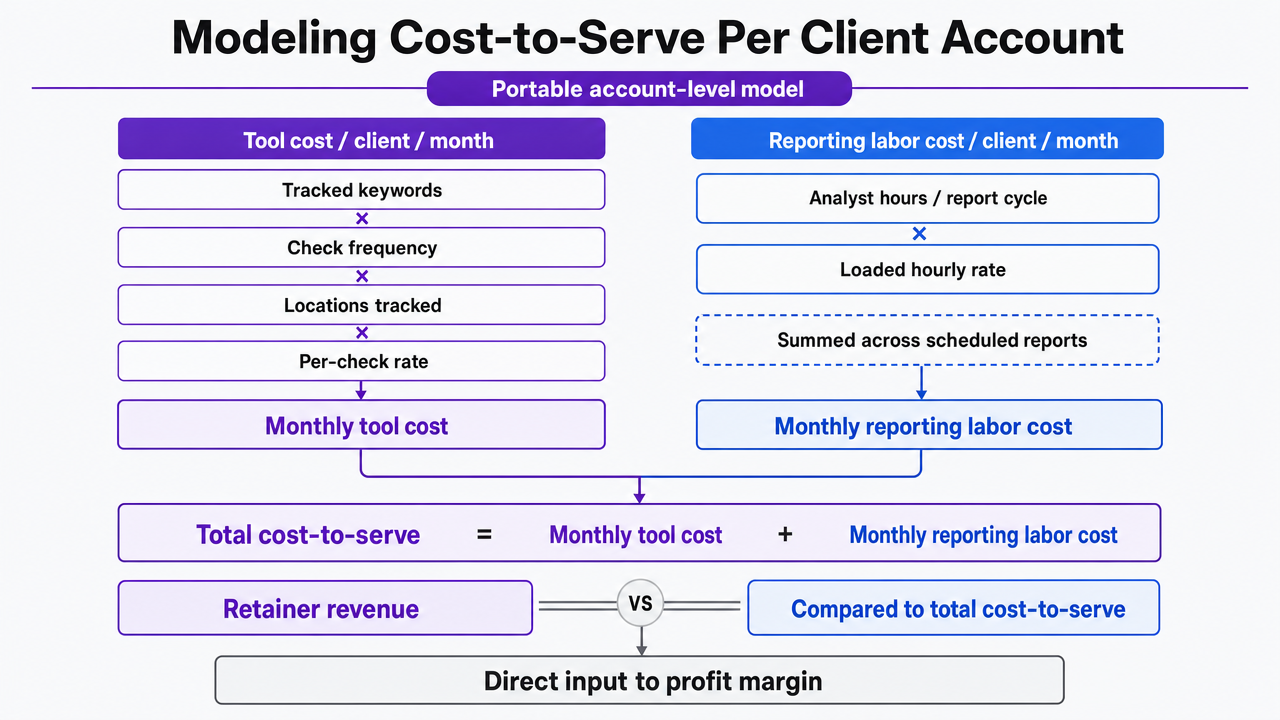
While tool pricing pages often highlight per-seat and per-keyword rates, the true measure for agencies is the cost-to-serve, which directly impacts profit margins. Forrester's Total Economic Impact framework for SEO evaluates benefits—such as traffic, conversions, and paid media savings—against costs, including technology fees and internal labor 5. Applying this framework at the account level yields a portable model that any Head of SEO can customize with agency-specific inputs.
This model comprises two main cost components. The tool cost per client per month is calculated by multiplying tracked keywords, check frequency, and locations tracked, then by the platform's per-check rate. The reporting labor cost per client per month is derived from analyst hours per monthly report cycle multiplied by the loaded hourly rate, summed across scheduled reports, ad hoc requests, and QBR preparation. The sum of these two components represents the total cost-to-serve. Subtracting this from retainer revenue reveals which accounts are truly profitable.
| Input | Formula | Where it moves |
|---|---|---|
| Billable checks per client per month | keywords × frequency × locations | Grows with daily cadence, grid-based local tracking, deep keyword universes |
| Tool cost per client per month | billable checks × per-check rate | Varies by platform pricing model — per keyword, per project, or per credit |
| Reporting labor cost per client per month | analyst hours × loaded rate | Shrinks with white-label automation, segmentation logic, and clean exports |
| Cost-to-serve per client per month | tool cost + reporting labor | The number that decides which retainers earn their tier |
Applying this model often reveals two common patterns: small retainers requiring daily national keyword tracking may lose money on tool costs alone, and mid-tier accounts can see margins eroded by reporting labor if analysts manually rebuild narratives each month instead of using automated white-label exports. The solution is typically not a cheaper tool, but rather aligning reporting cadence and pricing tiers with the actual revenue generated by each retainer.
 Illustrate the cost-to-serve formula described in the section's table, showing how tool cost and reporting labor combine into total cost-to-serve compared to retainer revenue
Beyond Data: The Execution Loop as the True Deliverable
A rank tracking dashboard that doesn't lead to action is merely a subscription, not a strategic asset. While the tools discussed provide valuable data, an agency's core function is to convert this data into prioritized, actionable work. This conversion process is where many delivery models become inefficient: strategists analyze dashboards, draft recommendations, await client approval, brief content creators, and navigate publishing delays, often while the SERP continues to evolve.
The effective operating loop for rank tracking investment involves four stages: rank data informs visibility intelligence, which drives prioritization, leading to approved execution, and finally, execution results feed the next rank analysis. The visibility intelligence stage has significantly changed. Google's planned 2026 integration of Search Generative AI performance reports in Search Console—covering impressions, pages, countries, devices, and dates for URLs in AI Overviews, AI Mode, and Discover generative surfaces—means the visibility layer now encompasses both traditional "ten blue links" and generative results 9. A rank tracker focusing solely on traditional positions will provide an increasingly incomplete picture.
Agencies often lose margin between prioritization and execution. The prioritized list of tasks might reside in one tool, the brief in another, content creation in a third, approvals via email, and publishing requiring a developer ticket. Vectoron addresses this gap by acting as the execution layer. It interprets rank and visibility signals, prioritizes tasks, routes recommendations for human approval, and automates the approved changes through to publication. Vectoron is not an eleventh rank checker; it is the critical link that transforms data from other tools into tangible results.
See How Leading Agencies Benchmark and Monitor Rankings at Scale
Request a walkthrough of advanced rank tracking and reporting workflows designed for high-volume, multi-client SEO operations. Learn how to eliminate manual audits while maintaining accuracy and oversight.
Exclusions from Our Tool Evaluation
Three categories of tools were intentionally excluded from this review. First, all-in-one SEO suites where rank tracking is a bundled module rather than the primary offering were omitted. Zapier's review similarly distinguishes dedicated trackers from broader platforms 1. Agencies already using a suite will leverage its integrated module, but those specifically seeking a rank tracker should avoid overpaying for unnecessary adjacent features.
Second, free browser extensions and manual SERP scrapers were excluded due to their inability to support portfolio-level delivery. Tools requiring manual checks do not scale for multiple accounts and lack the audit trail necessary for QBRs.
Finally, enterprise platforms with pricing models typically exceeding mid-market agency budgets—such as BrightEdge, Conductor, and seoClarity—were not included. While effective for in-house enterprise teams, their seat-based licensing often doesn't align with a multi-client retainer model.
Building Your Agency's Rank Tracking Shortlist
A robust SEO stack for an agency Head of SEO rarely relies on a single tool. Instead, it typically involves two or three tools, each optimized for a specific function. A common configuration for a retainer book includes a primary portfolio dashboard, a verification layer, and a specialized tool tailored to the client roster's dominant needs—be it local grid tracking, a visibility index, or link-informed diagnostics.
Begin by assessing your client portfolio's characteristics. For instance, a roster heavy with multi-location service clients would pair SE Ranking or Nightwatch with Local Falcon, as granular local grid data is indispensable for such accounts. Agencies managing publishers or SaaS content programs might combine Semrush Position Tracking or Ahrefs Rank Tracker with AccuRanker for rapid verification. European or enterprise-focused agencies could add Sistrix as an index layer above their daily tracker.
Before committing, apply the cost-to-serve model to your shortlisted tools. A tool that appears superior in feature comparisons might prove uneconomical due to cadence-priced tiers once your actual account volume is factored in. Always reserve a spot for an execution layer, like Vectoron, to translate rank data into approved, published work, thereby significantly reducing reporting labor costs.
Frequently Asked Questions
References
- 1.The 12 best rank tracker tools.
- 2.Search Engine Optimization (SEO) Starter Guide.
- 3.Identification of Positioning Factors in Academic SEO (ASEO) through a Scoping Review.
- 4.Identification of Positioning Factors in Academic SEO (ASEO ... [PDF].
- 5.You Can Quantify The ROI Of SEO.
- 6.How To Use Search Console.
- 7.Getting your performance data | Search Console API.
- 8.An improved way to view your recent performance data in Search Console.
- 9.Introducing Search Generative AI performance reports in Search Console.
- 10.Query your Google Search analytics data.
- 11.A systematic review on page ranking algorithms.