
Key Takeaways
- Ranking in 2026 is a portfolio problem: durable results come from a production system where most URLs clear every quality gate, not from optimizing isolated pages.
- Every URL should pass five concrete gates before publishing — intent match, original substance, technical eligibility, experience quality, and credible linking — each tied to documented Google requirements 1, 2.
- Appearance features like schema, titles, and AI Overviews are eligibility layers, not ranking levers; structured data manual actions affect rich results, not ordinary web ranking 6, 14.
- Focus delivery capacity upstream at the brief stage, where intent and originality decisions compound, and diagnose ranking drops by routing evidence back through the five gates 17.
Why ranking is a portfolio problem, not a page problem
Ranking a keyword in 2026 is decided by how a page performs across many interacting signals, not by any single optimization. Google's own documentation is explicit on this point: its systems use a mix of factors to identify content that demonstrates experience, expertise, authoritativeness, and trustworthiness, and E-E-A-T itself is not a specific ranking factor 1. Search Essentials describes three overlapping areas — technical requirements, spam policies, and content best practices — that together govern eligibility and performance 2. There is no weighted checklist to execute against.
For an agency head managing 10 or 100 client sites, that reality reframes the work. The question stops being "what should this page do to rank?" and becomes "what percentage of URLs across the portfolio clear every threshold Google defines before they ship?" One well-crafted page is a sample size of one. A production system that reliably produces pages passing intent, substance, technical, experience, and link tests is a repeatable outcome.
This is why ranking behaves like a portfolio problem. Core updates adjust how multiple systems weigh helpfulness together, not one lever at a time 3. A client site that ranks because three pages happened to clear every gate is fragile; a site where 80% of published URLs clear every gate is durable. The strategic unit of work is the gate, not the keyword. The rest of this piece defines those gates and the operational constraints around them.
The five thresholds every URL must clear before it ships
Every URL an agency publishes should pass five concrete gates before it goes live: intent match, original substance, technical eligibility, experience quality, and credible linking. Each gate maps to a documented Google requirement rather than a folk tactic.
- Intent match means the page answers the query a searcher actually typed, in the language they used, and resolves the task before scroll fatigue sets in 2.
- Original substance means the content carries first-hand information, specific evidence, or synthesis a reader cannot assemble by stitching together the top ten results 1.
- Technical eligibility covers the mechanical floor: crawlable, renderable, mobile-equivalent, and indexable, with no robots or canonical conflicts that quietly suppress the URL 2.
- Experience quality is the composite signal set Google describes under page experience, including Core Web Vitals, HTTPS, and uncluttered main content 8.
- Credible linking means the page sits inside an internal structure that signals topical relevance, and attracts or earns external references that are not transactional 10.
Surrounding all five is an outer policy perimeter. Google defines scaled content abuse as generating many pages primarily to manipulate rankings rather than help users, regardless of whether the pages are produced by humans, automation, or generative AI 4. A portfolio that clears the five gates on a per-URL basis but violates the perimeter at the system level still fails. The gates are per-page QA; the perimeter is production governance. Both have to hold.
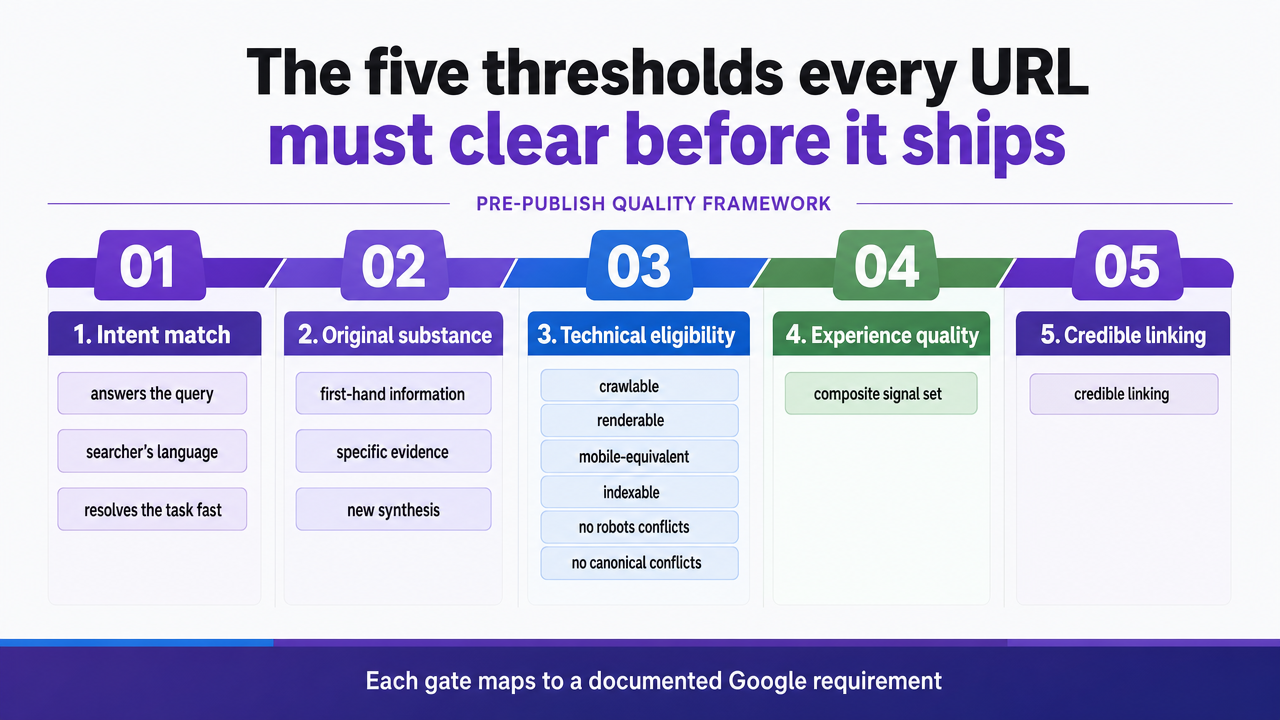 Visualize the five publishing gates described in this section as a sequential pre-publish quality framework, directly supporting the section's enumerated thresholds
Why no ranking-factor leaderboard will ever be accurate
The quarterly "top 200 ranking factors" post is a genre unto itself, and every version of it is wrong in the same way. Modern ranking is produced by learning-to-rank systems that combine many low-impact relevance signals into a single ordering, where performance depends heavily on the quality and volume of training data rather than on any fixed signal weight 20. The TREC Deep Learning track, which has evaluated these systems against graded human relevance judgments using metrics like NDCG@10, shows that neural retrieval and reranking models have to handle both lexical overlap and semantic matching, and that even strong models do not always beat well-tuned baselines on a given query set 19, 21. The signal that matters most for one query may be nearly irrelevant for the next.
That has two consequences for agency planning. First, any public list claiming to rank factors by weight is reverse-engineered from correlations, not from the model itself, and the model changes. Google has said core updates adjust how multiple systems weigh helpfulness together, not one lever at a time 3. Second, the operational response is to stop assigning budget against factor rankings and start assigning it against the five gates. Gates are stable because they map to documented eligibility and quality requirements 1, 2. Factor weights are not.
Intent match: the first gate most pages fail quietly
Intent match is where most agency-produced pages lose the ranking before any technical or link factor comes into play. The failure mode is rarely dramatic. A page targets a keyword, uses it in the title and H1, covers the topic accurately, and still underperforms because it answers a different question than the one the query actually encodes. Google's helpful-content guidance frames the test directly: does the page leave the reader feeling they've gotten enough information to accomplish what brought them to the search, or does it force another query 1? That question is a stricter filter than keyword presence.
Three intent mismatches account for most of the quiet failures:
- Format mismatch — a long explainer ranking for a query whose SERP is dominated by comparison tables, calculators, or product pages.
- Depth mismatch, where a page summarizes a topic the searcher wanted dissected, or dissects one they wanted summarized.
- Stage mismatch, where a bottom-of-funnel page competes for a term the SERP treats as research-stage, or vice versa.
Each is diagnosable by reading the current top ten results as the ranking system's revealed preference, not as competitors to outflank.
Operationally, intent match belongs upstream of the brief, not downstream in editing. Search Essentials recommends using the language searchers actually use in prominent locations and matching the task the query implies 2. For an agency, that means every brief should name the specific task the URL resolves and the format the SERP already rewards, before a writer or model touches it. Pages that skip this gate can clear every other threshold and still sit on page three.
Test AI-driven keyword ranking strategies risk-free
Benchmark your SEO execution on live projects before making a commitment.
Original substance under the scaled-content-abuse perimeter
Original substance is the gate that separates a page a reader finishes from a page that reads like it was assembled from the top ten results. Google's helpful-content guidance frames the test through questions about first-hand information, independent research, insight beyond the obvious, and whether the page offers substantial value compared to other results on the same topic 1. None of those tests ask whether a human or a model drafted the text. They ask what the finished page contributes that was not already indexed.
That distinction matters because Google's generative-AI guidance permits AI assistance when the output is accurate, original, useful, and compliant with Search Essentials, and specifically warns against producing large volumes of low-value pages aimed at ranking manipulation 5. The permission is not a safe harbor. It is a quality standard the output has to meet regardless of production method.
The perimeter around this gate is scaled content abuse, which Google defines as generating many pages primarily to manipulate rankings rather than help users, whether the production is human, automated, or AI-assisted 4. For an agency, enforcement risk is not triggered by using a model. It is triggered by the pattern: templated structures filled with paraphrased summaries, high publishing velocity against low originality density, and portfolios where most URLs could be rewritten by anyone with access to the same ten competing pages.
Two operational tests separate compliant scale from the perimeter:
- Every URL should carry at least one element a competitor cannot replicate from public SERP data — proprietary client data, named practitioner commentary, a specific case, a numbered breakdown of a process, or synthesis that cites primary sources the competing pages missed.
- The brief, not the draft, is where originality is enforced. If the brief does not specify what new information the page introduces, the draft will default to recombination, and recombination at volume is what the policy targets 4.
Agencies that treat originality as an edit-stage problem fail this gate at portfolio scale.
The technical eligibility floor: crawl, render, mobile, link
Technical eligibility is the gate with the least ambiguity and the highest failure rate at portfolio scale. The requirements are documented, the tests are mechanical, and yet client sites routinely ship URLs that Google cannot discover, cannot render, cannot resolve against the mobile crawl, or cannot follow onward. Search Essentials sets the floor: pages must be crawlable, return usable content, and avoid directives that suppress indexing 2. Nothing beyond that floor matters if a URL never enters the index in the first place.
Crawl and render are the first two failure points. Google processes JavaScript applications through crawling, rendering, and indexing as separate stages, and dynamically inserted links are only crawlable when they use standard anchor markup with href attributes 11. Agencies inheriting React or Vue builds from client dev teams should assume nothing: server-rendered or progressively enhanced output is easier to validate than client-rendered content that may or may not resolve during the render pass. Internal links delivered through onclick handlers or non-anchor elements are invisible to the discovery graph 10.
Mobile parity is the third. Google uses the mobile version of a site for indexing and ranking, crawled with a smartphone agent, and expects important content, metadata, and robots directives to match across versions 12. A responsive theme that hides sections, drops structured data, or alters canonical tags on small screens quietly amputates the indexed page. The audit question is not whether the site is mobile-friendly; it is whether the mobile DOM contains everything the desktop DOM contains.
The fourth is link architecture as a discovery mechanism, not an authority play. Google uses links both to find new pages and as a signal when determining relevance, and recommends HTML anchors with descriptive anchor text pointing to valid destinations 10. For an agency, that reframes internal linking as a weekly QA task: new URLs need inbound internal links from relevant existing pages within the same crawl cycle, or they sit orphaned regardless of content quality.
The technical floor is boring, which is why it fails. Treat it as a pre-publish checklist with four binary tests — crawlable, renderable, mobile-equivalent, internally linked — and the gate holds.
Page experience without the Core Web Vitals cargo cult
Page experience is a composite signal, not a scoreboard. Google defines it as a set of factors covering Core Web Vitals, HTTPS, mobile usability, intrusive interstitials, ad behavior, and whether the main content is easy to distinguish from everything else on the page 8. There is no single page-experience metric, and good results in the Core Web Vitals report do not guarantee top rankings 8. That caveat is the one most agency decks skip.
The thresholds themselves are well-defined. At the 75th percentile of real-user data, Google and the Web Vitals project both specify LCP within 2.5 seconds, INP at 200 milliseconds or less, and CLS at 0.1 or less 9, 18. Those are useful engineering targets. They are not a ranking recipe, and chasing them in isolation produces diminishing returns on a page that already fails intent or substance.
The operational implication for an agency is to treat page experience as a readiness check across the whole signal set rather than a monthly Lighthouse chase. A URL that clears the three CWV thresholds but ships with an interstitial covering the main content on mobile, or an ad layout that pushes content below the fold, fails the broader test 8. Fix the composite, log the field data, and move delivery capacity back to the gates where ranking is actually decided.
Appearance eligibility is not ranking: titles, schema, rich results
Agency decks routinely conflate two separate questions: whether a URL is eligible to appear in a given SERP feature, and whether that URL ranks for the query at all. Google's documentation treats them as distinct layers. Structured data can make a page eligible for a richer appearance, but a structured-data manual action affects rich-result eligibility and does not directly affect ordinary web-search ranking 14. Schema is an appearance switch, not a ranking lever.
The same distinction holds for titles. Google generates the displayed title link from the title element, visible page title, headings, prominent text, anchor text, and structured data, and may rewrite the title when another element better represents the result 13. A rewritten title is not a ranking penalty; it is a presentation decision made after the page already ranked. Fighting the rewrite with longer title tags or keyword stuffing wastes production hours that belong on the five gates.
Rich-result work should be prioritized against the search gallery, which lists the structured-data types Google actively supports and ties each to its own feature requirements 15. Markup must accurately represent visible content and follow feature-specific rules 14. For an agency, that reframes schema sprints: eligibility signals — indexability, mobile parity, crawlable links, accurate markup — determine whether a page can appear in a particular slot 2, 14, while ranking signals — relevance to query, helpfulness, link context — determine whether it does. Confusing the two produces schema roadmaps that ship on time and move no positions.
See How Leading Agencies Are Scaling Keyword Rankings Without Expanding Headcount
Request a walkthrough of data-driven workflows that enable agency teams to orchestrate multi-channel SEO execution, maintain quality control, and deliver measurable keyword growth at scale—no additional hires required.
AI Overviews and AI Mode as eligibility extensions of normal Search
The industry framing of generative search as a separate discipline requiring its own schema, its own markup, and its own optimization playbook does not match Google's documentation. A page must be indexed and eligible for a normal Search snippet to be eligible as a supporting link in AI Overviews or AI Mode, and Google states there are no additional technical requirements for appearing in these experiences 6. The pool AI features draw from is the same pool classic Search draws from.
Google's May 2025 guidance reinforces the point: pages should meet the technical requirements to be found, crawled, indexed, and considered for Search, and the same crawl, render, and index chain that governs ordinary results governs AI-feature eligibility 7. Googlebot cannot be blocked, important content must be indexable, and snippet controls remain the mechanism publishers use to limit how content appears in AI surfaces 7. None of that introduces a new technical layer. It restates the five gates.
For agency planning, that collapses what would otherwise be a parallel workstream. There is no separate GEO roadmap to budget, no AI-specific schema type to deploy, and no second QA pipeline to maintain. The URLs that clear intent, substance, technical eligibility, experience, and link gates are the URLs that qualify as supporting links in AI answers. Pages blocked from the index by a robots directive, a bad canonical, or a client-rendered template that fails to resolve are invisible to both surfaces simultaneously. Treating AI search as an eligibility extension rather than a new discipline frees delivery capacity to reinforce the production system that already determines ranking across every surface Google ships.
If you manage multiple client sites: throughput, QA gates, and where review becomes the bottleneck
Audience scope shifts here from single-site strategy to portfolio operations. For a Head of SEO running 10 to 100 client sites, the five gates stop being an editorial philosophy and start behaving like capacity constraints. Each gate consumes specialist time at a different rate, and each has a different failure cost. The scaled-content-abuse perimeter sets the ceiling on how aggressively any of those rates can be compressed 4.
The useful lens is throughput per specialist against pass rate per gate. Hold the production variables constant — URLs per week, review minutes per URL, pass rate at each gate — and the bottleneck surfaces on its own. A strategist producing 15 briefs a week against an intent-match pass rate of 60% is shipping nine useful briefs; the other six return for rework or get published and underperform. The gate that fails most often is the gate to fund next.
| Gate | Typical review minutes per URL | Failure mode when skipped | Scales with |
|---|---|---|---|
| Intent match | 10–20 (brief stage) | Format, depth, or stage mismatch against the live SERP 1 | Strategist judgment, not headcount |
| Original substance | 15–30 (edit stage) | Recombination patterns that trigger scaled-content-abuse review 4, 5 | Access to proprietary client data |
| Technical eligibility | 5–10 (automated + spot check) | Crawl, render, mobile, or internal-link failures 11, 12 | Automation and template controls |
| Experience quality | 5 (field data monitoring) | Composite page-experience degradation 8 | Dev capacity, not SEO capacity |
| Credible linking | 5–15 (weekly QA) | Orphaned URLs and weak internal relevance signals 10 | Editorial calendar discipline |
Human review is the gate that compresses first and recovers slowest. Technical checks automate well; experience monitoring runs on field data; link QA fits inside a weekly cycle. Intent match and original substance both depend on strategist attention that cannot be bulk-processed without drifting into the perimeter Google defines 4. Agencies hit the ceiling when brief-stage judgment and edit-stage originality compete for the same hours. The practical move is to push intent decisions upstream into the brief, where a 15-minute call compounds across every subsequent production hour, and to reserve edit-stage review for the originality tests that keep the portfolio outside the enforcement pattern.
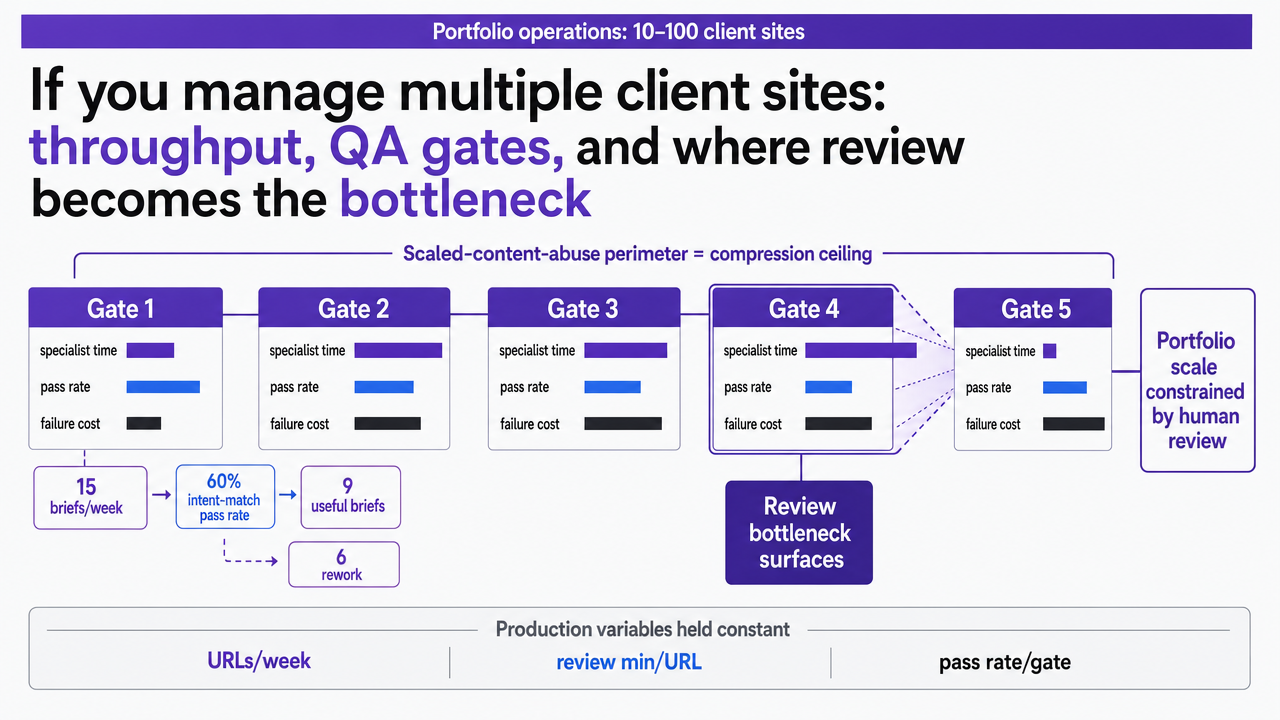 Visualize the gate-by-gate review time and scaling constraints from the section's table, highlighting where human review becomes the bottleneck at portfolio scale
Measurement and diagnosis when a ranking moves
When a ranking moves, the first question is not what to fix but what actually changed. Google's debugging guide specifies the sequence:
- Compare periods in the Performance report.
- Isolate the queries and pages that lost impressions or clicks.
- Check the crawl and page-indexing reports for corresponding technical issues.
- Account for seasonality, SERP-layout changes, and shifts in broader demand before concluding a content system is at fault 17.
Correlation with a core-update date is not causation, and treating it as such burns delivery capacity on the wrong gate.
Search Console is the operational floor for this work. The Performance report breaks traffic down by query, page, country, and device with trends for impressions, clicks, and position, and URL Inspection exposes current index status and loaded-resource detail at the page level 16. Average position is an aggregate that hides device, location, and feature variance, so portfolio diagnosis should segment before it interprets. A drop that looks site-wide at the domain level often resolves to a single template, a single query cluster, or a feature loss on mobile.
The diagnostic routing follows the five gates in reverse:
- Indexing exclusions and crawl errors point at technical eligibility 16.
- A query set that still ranks but earns fewer clicks points at appearance changes or SERP-feature shifts, not ranking loss.
- A page set that lost position on queries competitors gained points at intent or substance against a moved SERP 1.
Logging which gate the evidence implicates — before assigning the fix — keeps rework proportional to the actual failure.
What a 2026 ranking workflow looks like end to end
The workflow collapses into one loop: brief, produce, verify, publish, monitor, route. At the brief stage, a strategist names the specific task the URL resolves, the format the live SERP already rewards, and the one piece of information the page introduces that competitors cannot replicate from public data 1. Production, whether human or AI-assisted, is held to that brief; the originality test is enforced upstream, not during editing 5. Verification runs the technical floor as a binary checklist — crawlable, renderable, mobile-equivalent, internally linked — before anything ships 2, 11, 12.
Publishing is a transition point, not an endpoint. Field data on page experience, impressions and clicks in the Performance report, and indexing-status changes feed back into the next week's queue 8, 16. When a position moves, diagnosis follows Google's debugging sequence — compare periods, isolate queries and pages, check crawl and indexing reports, account for seasonality — before any gate is reopened for rework 17. The outcome is a system where ranking is the byproduct of a repeatable production discipline rather than the subject of weekly firefighting. Teams running this loop across many client sites — the operational problem Vectoron was built for — convert the five gates from an editorial philosophy into a governed production throughput.
Frequently Asked Questions
References
- 1.Creating helpful, reliable, people-first content.
- 2.Google Search Essentials (formerly Webmaster Guidelines).
- 3.What web creators should know about our March 2024 core update and new spam policies.
- 4.Spam Policies for Google Web Search.
- 5.Google Search’s guidance on using generative AI content.
- 6.AI Features and Your Website.
- 7.Top ways to ensure your content performs well in Google's AI experiences.
- 8.Understanding page experience in Google Search results.
- 9.Understanding Core Web Vitals and Google search results.
- 10.SEO Link Best Practices for Google.
- 11.Understand JavaScript SEO Basics.
- 12.Mobile-first indexing best practices.
- 13.Influencing Title Links in Google Search.
- 14.General Structured Data Guidelines.
- 15.Structured Data Markup that Google Search Supports.
- 16.How To Use Search Console.
- 17.Debugging drops in Google Search traffic.
- 18.Web Vitals.
- 19.OVERVIEW OF THE TREC 2020 DEEP LEARNING TRACK.
- 20.Evaluating Learning-to-Rank Methods in the Web.
- 21.Overview of the TREC 2023 Deep Learning Track.