
Key Takeaways
- Google Search Console works as the first-party truth layer beneath every client, exposing queries, clicks, and average position without a keyword cap or sampling logic clients can dispute 9.
- A Looker Studio dashboard connected to GSC delivers a white-labeled, auto-refreshing client artifact at zero license cost, though it only reads Google search data 6.
- Pro Rank Tracker's free tier fits narrow use cases like pilot tracking on new logos or competitive spot-checks, but cannot scale to a full agency roster 5.
- Paid tool free trials become legitimate stack line items when rotated deliberately across two or three platforms against the top 50 to 100 conversion keywords, not treated as recurring infrastructure 7.
- AIOSEO and embedded WordPress plugin tracking remove a login for smaller clients and give content teams position context inside the admin, trading SERP depth for convenience 4.
The Honest Answer Is a Stack, Not a Tool
Every 2026 comparison built for professional SEO work converges on the same uncomfortable conclusion: there is no single free rank tracker that carries an agency book from five clients to fifty. The tools that come closest either cap keywords at a level that only serves solo operators, or they surface Google-only data that misses the local, mobile, and multi-location detail delivery contracts require 2, 7. Framing the search as a hunt for one free winner misreads the problem.
The question worth answering is architectural. Which layer of the rank-tracking stack can genuinely run on zero incremental cost across a client book, and which layer has to be paid for because the delivery requirement itself is paid work? Practitioner guides that test tools on real campaigns land in the same place: Google Search Console operates as the baseline truth layer for every account, and paid infrastructure sits on top of it for daily refresh, geo-grid tracking, white-label PDFs, and API pulls 11, 3.
That leaves a narrow but real middle band where free tiers, trials, and a Looker Studio build actually earn a line item. This piece maps that stack, names the ceiling where free breaks, and works the math on when a rank-tracking spend consolidation returns margin. The tool list is deliberately short. The decisions inside it are what determine whether rank tracking stays a fixed cost or becomes a margin drag as the client count grows.
Google Search Console as the Truth Layer Beneath Every Client
Rank tracking guides tend to slot Google Search Console into the same list as Semrush, Ahrefs, and SE Ranking, which flattens what it actually does. GSC is not competing with those tools. It sits underneath them. Search Engine Journal's reference guide describes the Performance report as the surface that exposes clicks, impressions, click-through rate, and average position for every query and every page across Google Search 9. That combination is first-party data pulled directly from the index, not a third-party approximation built from a scraped SERP.
For an agency book, that distinction changes the reporting conversation. Every paid rank tracker in the market samples the SERP from a chosen location, device, and cadence, then reports a position. GSC reports what Google itself recorded when real users saw the client's URL. Four independent 2026 comparisons land on the same recommendation as a result: install GSC on every property before anything else is layered on top 3, 10, 11, 13. One practitioner stack calls it an "absolute must" and prices it at zero 13. Another treats it as the "baseline truth-layer for all SEO diagnostics" and the reference point paid tools should be reconciled against 11.
The operational implication for a Head of SEO is straightforward. GSC handles the questions a client's monthly report has to answer without a paid line item: which queries drove impressions, which pages captured the clicks, where average position drifted week over week, and which URLs lost visibility after a core update. A paid rank tracker answers a narrower question on top of that, which is where an untracked keyword sits in a specific geographic SERP on a given day.
Treating GSC as the truth layer also cleans up client disputes. When a paid tool shows position 4 and GSC shows an average position of 6.2, GSC wins the argument because it is measuring recorded impressions, not sampled SERPs 9. The paid tool is still useful for daily movement on tracked terms, but the reporting anchor lives in the first-party layer. Any free-stack architecture that skips this step is starting from a weaker foundation than the paid infrastructure sitting above it.
Where the Free Ceiling Actually Sits
Free rank tracking breaks at predictable points, and each one maps to a specific delivery obligation an agency already sells. Six capabilities separate the free layer from paid infrastructure:
- Daily refresh cadence
- Local and geo-grid tracking
- White-label reporting
- API access
- Multi-client dashboard rollups
- Historical depth beyond sixteen months
Free tiers and Google Search Console cover at most one or two of these. Paid tools cover all six, and their pricing scales explicitly around them 2, 12.
Daily refresh is the first fracture line. GSC reports aggregate performance on a rolling window, not a same-day snapshot of position for a defined keyword list, and most free tiers on dedicated trackers restrict updates to weekly or manual pulls. Practitioner comparisons rank SE Ranking as the cheapest reliable daily option specifically because free tools cannot deliver that cadence at agency scale 2. When a client contract promises weekly ranking movement commentary, the tracking layer has to refresh faster than the report.
Local and geo-grid tracking is the second. GSC returns country-level query data, not a Miami-versus-Fort Lauderdale SERP for the same term on the same day. Free tiers on Pro Rank Tracker and similar tools allow a handful of locations before the plan forces an upgrade, and no free option supports the grid-style geo sampling multi-location clients expect 5, 7. This is where free stops being a serious answer for any book with local service verticals.
White-label reporting is the third. Client-branded PDFs, scheduled sends, and dashboard portals sit exclusively inside paid agency tiers. Comparison tables tracking six major rank trackers show white-label as a paid-only feature whose availability moves in lockstep with keyword volume caps 12. API access is the fourth fracture and closes any hope of piping rank data into a custom warehouse or a consolidated agency dashboard without a paid seat.
Multi-client rollups and historical depth round out the ceiling. GSC keeps sixteen months of performance data and treats each property as a silo, which forces manual assembly for portfolio views 9. Free tiers on dedicated trackers rarely retain more than ninety days of position history. Any conversation about year-over-year visibility trends, quarterly board decks, or executive summaries across a client book runs into that wall almost immediately 11.
The pattern is consistent across every 2026 comparison: the free ceiling is not a keyword cap. It is a feature set the paid market has quietly standardized around agency delivery, and no combination of free tools reaches it 7, 12.
Test advanced rank tracking with live client data
Validate ranking performance at scale using real agency workflows and actual client projects—no sandbox limitations.
Five Free Options Worth a Line Item in the Stack
Google Search Console for First-Party Query Truth
GSC belongs in every client folder before a paid tool is ever provisioned. The Performance report surfaces queries, clicks, impressions, click-through rate, and average position across the full Google index for each verified property, with no keyword cap and no sampling logic that can be argued with in a client meeting 9. Practitioner stacks built for agency delivery mark it as the free first-party foundation the rest of the toolkit reconciles against 10, 13.
Where it earns its slot in this list is what it exposes that paid trackers do not: the long-tail query set the client actually ranks for, including terms nobody thought to add to a tracking project. Every 2026 comparison built for professional SEO work opens with the same instruction to install it first 3, 11. Skipping this layer forfeits data that no paid subscription can retroactively rebuild.
Looker Studio + GSC as a Built Dashboard
The second free line item is a build, not a buy. Piping GSC data into Looker Studio produces a client-facing dashboard that refreshes automatically, filters by page or query cluster, and stacks periods for trend commentary, all at zero recurring cost. Marketer Milk's 2026 review of fourteen rank trackers names this setup as the honest answer when the requirement is a 100% free tool that tracks specific Google search queries 6.
The caveat sits inside the same paragraph in that review: the connector reads Google search data only, so any client with meaningful Bing, YouTube, or app-store visibility falls outside the frame 6. For agencies whose books skew toward organic Google traffic, that limit is acceptable and often invisible to the client. The operational payoff is a repeatable template. One dashboard file gets duplicated per property, GSC gets connected, and a delivery team ships a weekly artifact that would otherwise sit inside a paid reporting seat. The build cost is analyst time, not license spend, and the output is white-labeled through the URL and header logo rather than a vendor's watermark.
Pro Rank Tracker Free Tier for Narrow Keyword Sets
Pro Rank Tracker is the dedicated tracker most consistently flagged as a budget-conscious option with a genuine free tier for monitoring a limited set of terms 5. Dreamgrow's 2026 review lands on it as the pick for budget-conscious users specifically because the free option and low-cost paid plans make it economical for teams tracking fewer keywords than a full agency book requires 5.
The honest use case in an agency context is narrow. A free tier here works for:
- Pilot tracking on a new logo before the contract expands
- Competitive spot-checks on a handful of priority terms
- Internal experiments the agency runs on its own properties
It does not scale to a full client roster, and stacking multiple free accounts to work around keyword caps is the kind of workaround that breaks the first time a client audits the reporting infrastructure.
Paid Tool Free Trials as a Rotation Tactic
Rank Masters' 2026 comparison of major rank trackers gives agencies a specific instruction: run free trials with at least two or three tools before committing, and focus that trial period on the top 50 to 100 high-intent keywords that drive conversions rather than vanity traffic 7. That guidance turns free trials into a legitimate stack line item rather than a shopping exercise.
The rotation tactic works in two directions. On the evaluation side, a scheduled rotation through Semrush, SE Ranking, Nightwatch, and AccuRanker trials produces a real accuracy comparison against the GSC baseline before a purchase order is signed. On the execution side, a well-timed trial can absorb a one-off deliverable, such as a quarterly competitive audit or a launch-window ranking sweep, without adding a paid seat to the standing stack. Both uses are finite by design. Treating trials as recurring free infrastructure is where agencies get in trouble.
AIOSEO and Embedded Plugin Tracking for WordPress-Heavy Books
For agency books skewed toward WordPress clients, rank-tracking functionality is increasingly packaged inside the SEO plugins already installed on the site. WPBeginner's 2026 showcase names All in One SEO as the best SEO rank tracker tool for most WordPress users, citing integrated keyword tracking and search statistics surfaced directly inside the admin interface 4.
The caveat is the depth-versus-convenience trade the same review flags: embedded plugin tracking does not match the SERP depth or accuracy of dedicated platforms and is packaged as part of the plugin's broader SEO feature set 4. The line-item value is different. It removes a login for smaller clients, gives content teams position context inside the same interface they already publish from, and reduces the surface area of tools the agency has to train junior analysts on.
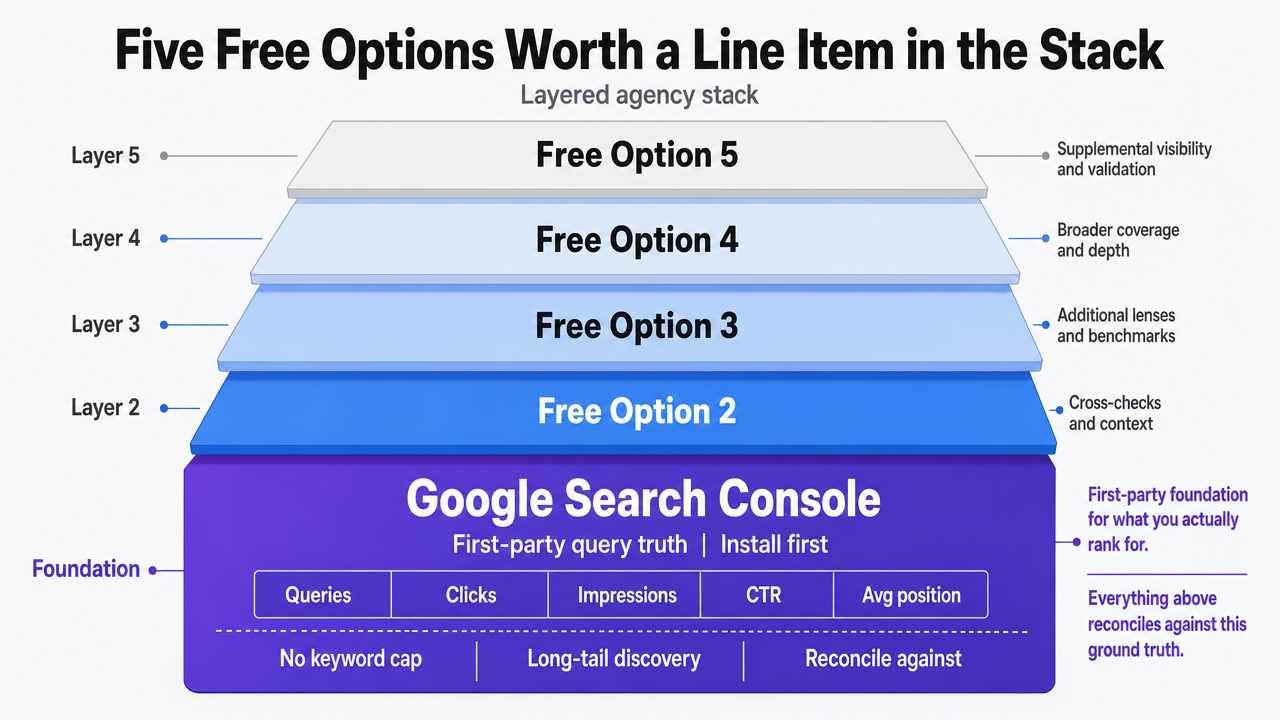 Visualize the five free rank-tracking options as a layered agency stack, matching the section's explicit list of tools and their roles
The Break-Point Math: When Free Stops Paying for Itself
The cleanest way to size the free ceiling is to run the load math against the delivery contract. Rank Masters' 2026 agency guidance sets the working benchmark at the top 50 to 100 high-intent keywords per client, focused on conversion-driving terms rather than vanity traffic 7. That number is the input the rest of the calculation runs on.
A five-client book tracking 75 keywords each at a weekly cadence generates 1,500 position checks per month. The same book pushed to daily refresh, which is what a competitive vertical actually requires, jumps to roughly 11,250 monthly checks. Scale that to twenty clients and the daily-refresh load lands near 45,000 checks. Free tiers on dedicated trackers cap at a fraction of that volume, and stacking free accounts across analyst logins to work around the limit collapses the moment a client asks for a consolidated dashboard.
Google Search Console absorbs the query-side load without a keyword cap, which is why it stays in the stack at every scale 9. What it cannot absorb is the daily-refresh, defined-keyword-list requirement that most delivery contracts are actually written against. That job sits inside a paid tier, and the pricing on those tiers scales explicitly with keyword volume and agency-tier feature access 12. SE Ranking earns the cheapest-reliable-daily verdict in the 2026 comparisons for exactly this reason: it hits the daily cadence at a per-keyword cost free tools cannot match 2.
The break-point lands somewhere between five and ten active clients for most agency books. Below that threshold, GSC plus a Looker Studio build plus a narrow Pro Rank Tracker free tier can cover the delivery obligation without a paid seat. Above it, the analyst hours spent stitching free sources into a client-ready artifact exceed the cost of a paid agency-tier subscription, and the margin case flips. Running the calculation quarterly against the actual client roster is what keeps a free-forward stack honest instead of aspirational.
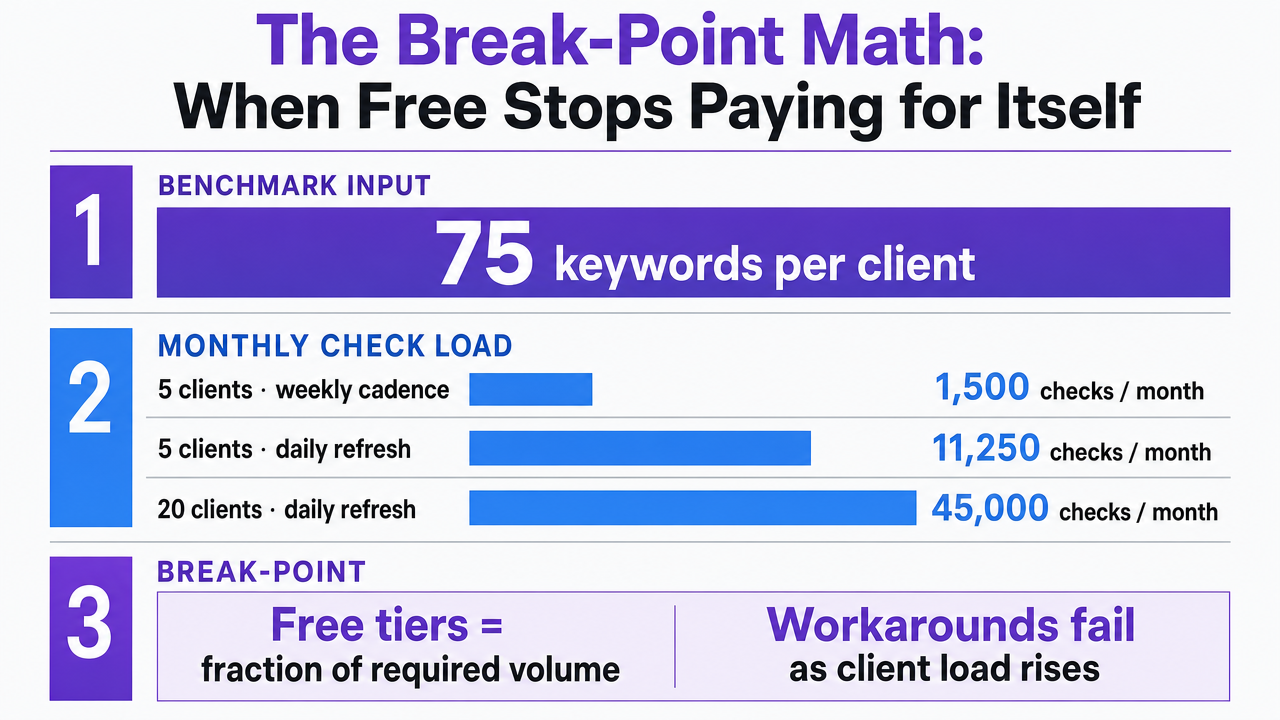 Show how monthly position-check load scales with client count at the 75-keyword-per-client benchmark cited in the section, illustrating where free tiers break
If You Manage Multiple Locations or Franchise Portfolios
Multi-location operators and franchise portfolios sit outside the standard agency-book scenario, and the free-stack calculus changes with them. A regional dental group with forty offices, a home services franchisor with two hundred territories, or a senior living portfolio with sixty communities is not tracking one client with 75 keywords. It is tracking one brand with 75 keywords per market, and every location generates its own local SERP that Google Search Console cannot geographically isolate 9.
The free layer collapses fastest on this profile. GSC reports country-level query data for the parent property, which hides the market-by-market variance operators actually manage against. Free tiers on Pro Rank Tracker and similar tools cap locations before any serious rollout, and no free option supports the geo-grid sampling that separates a location ranking in the local pack from one buried below the map 5, 7. Rank Masters' 2026 agency comparison lists multi-location visibility as one of the specific features that pushes serious operators onto paid infrastructure rather than free tools 7.
The load math amplifies the gap. A forty-location book tracking 75 keywords per market at a weekly cadence generates 12,000 position checks per month before any daily-refresh requirement is added. Paid agency tiers price around exactly this profile, with keyword volume caps and per-location fees scaling in lockstep 12. Free stacks stitched across analyst logins cannot produce the consolidated portfolio dashboard a franchise marketing director expects on a Monday morning.
One narrow free tactic still earns a line item at this scale. A Looker Studio build connected to each location's GSC property produces a per-market query and impression view at zero incremental cost, which absorbs the executive-summary layer of reporting even when a paid tracker handles the daily local SERP work underneath 6. The build is analyst hours, not license spend, and it survives audits because the data source is first-party. Everything else at portfolio scale is paid infrastructure, and the operators who pretend otherwise end up subsidizing the shortfall with analyst time that costs more than the subscription would have.
Compare Agency-Grade Rank Tracking Solutions Side by Side
Request a tailored analysis of free and enterprise rank trackers for agencies, including workflow integration insights and metric transparency benchmarks for high-volume SEO operations.
The Tracking Surface Google Search Console Cannot See
GSC reports what happens inside Google's ten blue links. It does not see the answer surface increasingly rendered above them. A technical content agency's 2026 software list names Scrunch as the tool it uses to track how often client content appears in AI-generated answers from ChatGPT, Perplexity, Google AI Overviews, and other answer engines 14. That surface is invisible to every free rank tracker on the market and to the paid ones still catching up.
The operational gap matters more than the novelty. When an AI Overview cites three sources for a high-intent query, the client either appears in the citation set or does not, and traditional position data cannot describe that outcome. A #4 organic ranking that gets buried under an Overview answers a different business question than the one a monthly report is answering. Free tools have not standardized here because the surfaces themselves have not standardized. AI Overview coverage varies by query, ChatGPT citations shift model to model, and Perplexity's source treatment is its own logic.
For a Head of SEO, the near-term move is narrow. Add a manual sampling routine on the top 50 to 100 conversion-driving keywords per client, screenshot the AI-answer surface where it appears, and log citation presence in the same dashboard that already reports GSC data. It is not automated, and it is not free of analyst time, but it closes a reporting gap the tracking market has not yet priced.
Tracking Is Table Stakes; Margin Lives in What Ships
Rank data is not the constraint. Every agency book already knows which queries moved, which pages lost impressions, and which markets slipped out of the local pack. The GSC layer, the Looker Studio build, and a paid tracker on top of them surface that picture cleanly enough that the reporting artifact writes itself 11, 13. The constraint is what happens between the ranking movement and the shipped work that responds to it.
That gap is where delivery margin lives. A dropped position on a conversion-driving term is worth nothing until a brief gets written, a page gets updated, an internal link gets added, or a fresh asset gets published against it. Rankings are one input into a multi-factor system, and acting on them requires coordinated execution across content, technical fixes, and link work rather than another dashboard 15. The agencies compressing that loop are the ones defending margin as client counts grow.
Vectoron sits at that execution layer, turning approved recommendations into shipped work across content, SEO, and the adjacent channels tracking data implicates. Free rank tracking answers the measurement question. The margin question is who ships next.
Frequently Asked Questions
References
- 1.The 12 best rank tracker tools.
- 2.9 Best Rank Tracker Tools in 2026: Cheap, Daily, Accurate.
- 3.10 Top Rank Tracker Tools (for Serious SEOs) in 2026.
- 4.8 Best SEO Rank Tracker Tools for Keyword Tracking in 2026.
- 5.The 9 Best SEO Rank Tracker Tools in 2026.
- 6.14 best rank tracker software I'm using for SEO in 2026.
- 7.Best SEO Rank Tracking Software for 2026: Top Tools Compared.
- 8.18 best SEO tools in 2026 (my toolkit for traffic growth).
- 9.Google Search Console: The Definitive Guide.
- 10.16 Secret SEO Tools Top Agencies Use to Rank Fast.
- 11.15 Best Rank Tracking Software (Tested on Real Campaigns).
- 12.6 Best Rank Tracker Tools for Agencies in 2026 (Tested & Approved).
- 13.10 Best SEO Tools for Agencies (My 2026 Stack).
- 14.My Picks for SEO Software for Digital Agencies.
- 15.An Analysis of Factors Used in Search Engine Ranking.