
Key Takeaways
- Treat the 14-day window as a portfolio-wide audit sprint that stress-tests keyword prioritization, intent segmentation, and reporting cadence, not as a simple product demo across client accounts.
- Segment every client's keywords by transactional, commercial, and informational intent before loading, then exclude brand queries and anchor to a 90-day Search Console baseline for defensible comparison 14.
- Assign tracking cadence by conversion value—daily for transactional, weekly for commercial, monthly for informational—so aggregation smooths noise instead of producing false alarms on low-volume terms 3.
- Interpret positions using three- and seven-day rolling windows paired with clicks, examination probability, and satisfaction signals, since raw position gains without click movement are cosmetic 6.
- Set a volatility floor using a control group of three to five unrelated domains, and annotate SERP features so algorithm-driven noise and AI overviews are not misread as delivery signal 11, 15.
- Preserve three portable artifacts beyond Day 14—the intent-segmented ledger, the smoothed baseline, and the documented volatility floor—so downstream reporting continues regardless of which tracker is licensed 2, 13.
The 14-Day Window as a Portfolio Audit, Not a Product Demo
A rank tracker free trial is often viewed as a simple product evaluation: load a few client domains, observe the dashboard, and decide on a subscription. For an agency managing 20 or more accounts, this approach underutilizes a valuable two-week period. Instead, the trial window should be leveraged as a portfolio-wide diagnostic sprint to stress-test keyword prioritization, intent segmentation, and reporting cadence across all retained clients simultaneously.
This approach differs significantly from a typical product evaluation. Position data alone is insufficient to indicate retrieval quality at the sample sizes agencies typically handle; absolute usage metrics fail to reliably reflect quality without paired comparison 3. Ranking movement gains meaning when considered alongside clickthrough behavior, examination probability, and user satisfaction signals 6. A 14-day sprint that categorizes keywords by intent, pairs positions with Search Console click data, and calibrates against known SERP volatility produces an audit artifact that remains valuable to the agency, regardless of the tracker chosen afterward.
This article outlines this audit protocol: what data to load, how to interpret signals, how to filter volatility, and which artifacts to retain beyond Day 14 for ongoing delivery.
What to Load: Intent-Segmented Keyword Prioritization from Day One
Segmenting the Portfolio by Query Intent Before the First Crawl
Agencies often export all tracked keywords from every client into a single trial project, expecting the tool to manage priorities. This results in a flat list lacking analytical structure and wastes valuable trial time reconciling noise. A more effective strategy is to segment the entire portfolio by query intent before any positions are pulled.
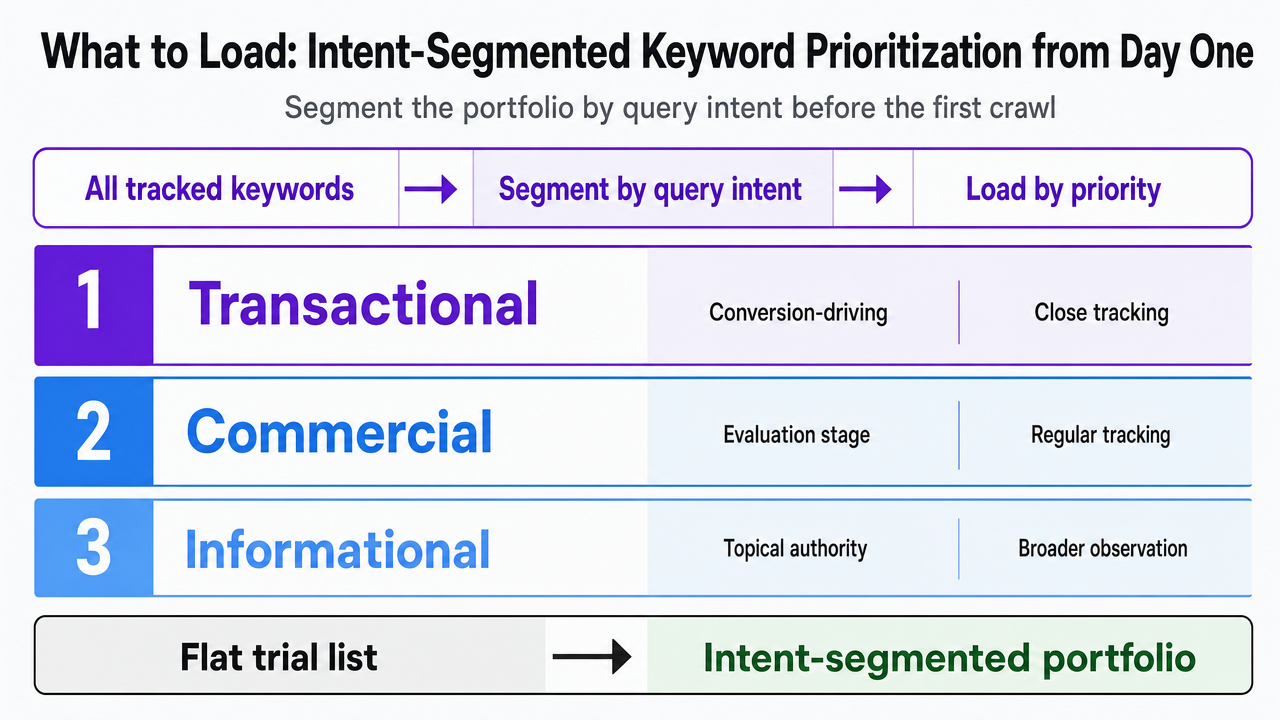
Research on query intent detection demonstrates that grouping terms by informational, commercial, and transactional intent enhances both content decisions and the retrieval quality search engines provide 13. This principle extends to measurement: transactional terms, which drive conversions, require close tracking; informational terms, signaling topical authority, can tolerate broader observation; and commercial-investigation terms fall in between.
An agency with 20 or more accounts should structure the trial project with three parallel keyword groups per client, rather than one. Transactional queries should be loaded first, with a tight cap per client. Commercial terms follow, and informational terms fill any remaining quota. This segmentation informs all subsequent trial decisions, including cadence, alerting thresholds, and reporting rollups. Attempting to apply intent tiers after positions are already tracked forces analysts to retrofit structure onto existing data, a known failure mode in intent analysis 16.
Excluding Brand Queries and Calibrating Against Search Console Baseline
Brand queries can skew organic ranking analysis. They typically rank at position one, their click behavior is unrelated to retrieval quality, and they inflate portfolio averages, obscuring actual delivery performance. Each client project in the trial should exclude branded terms and their variants from the primary tracked set, reserving a small, separate group for defensive monitoring only 14.
Before pulling positions, enable average position in Search Console for each client property and export a 90-day baseline by query and page 14. This baseline serves as the anchor against which trial positions are measured. Without it, the trial generates numbers without a comparative context, exacerbating the paired-comparison problem where absolute usage metrics fail to reliably indicate quality at typical sample sizes 3.
The correct operational sequence is crucial:
- Pull the Search Console baseline.
- Remove brand queries.
- Segment by intent.
- Load into the rank tracker.
Reversing this order leads analysts to spend time explaining discrepancies between tracker positions and Search Console averages, rather than deriving actionable insights from the differences.
Cadence by Conversion Value: Daily, Weekly, Monthly Tracking Tiers
Tracking cadence should be determined by a query's value, not by the tracker's default settings. Most trials default to daily crawls for all keywords, generating high-frequency data for informational terms where daily movement is irrelevant, and the same frequency for transactional terms where a single-day shift might warrant a landing-page adjustment.
The cadence framework directly aligns with the intent segmentation:
- Transactional queries—those leading to booked calls, form submissions, or qualified leads—require daily tracking. Movement in these terms has revenue implications, necessitating sufficient resolution to distinguish genuine shifts from crawl noise.
- Commercial-investigation queries are best tracked weekly. Their buying cycles are longer, position shifts propagate more slowly, and daily reads often produce false alarms.
- Informational queries can be aggregated monthly, as they are more relevant for topical coverage and internal linking decisions than for short-cycle interventions.
This framework is supported by research: absolute usage metrics do not reliably reflect retrieval quality at typical agency sample sizes, meaning daily reads on low-volume informational terms can appear as signal when they are merely noise 3. Weekly and monthly aggregation smooths this noise into actionable insights 2. Intent-based grouping makes this aggregation defensible because samples within each tier exhibit consistent behavior 13.
The trial's practical output is not just a tracked keyword list, but a cadence assignment for every term in the portfolio, ready for integration into the retained delivery workflow after Day 14.
 Visualize the three-tier intent segmentation framework with assigned cadence, directly supporting the section's operational guidance on loading keywords by intent tier
Test Rank Tracking Impact on Live Campaigns
Measure real keyword movement and client outcomes before committing to a full platform rollout.
Reading the Signal: Position Data Only Matters Paired With Behavior
Why Top-Slot Movement Is Not Linear With Lower-Slot Movement
A move from position 4 to position 2 is not equivalent to a move from position 14 to position 12, despite both being a two-slot gain. Examination probability significantly decreases further down the SERP, meaning the click and revenue impact of top-slot movement is disproportionately higher than the numerical change suggests 8. Trial dashboards that rank keywords by absolute position change can obscure this asymmetry, directing analyst attention to movements with no significant downstream behavior.
Position bias is fundamental to mainstream click models, and its correction is critical 5. Two keywords each gaining two positions can have vastly different click impacts depending on their starting and ending ranks. A transactional query moving from below the fold into the visible top group warrants immediate review, whereas a commercial query shifting from 18 to 16 does not.
Agencies managing 20+ clients should prioritize trial output by weighted position impact, not raw delta. This weighting transforms a keyword list into a triage queue, preventing wasted analyst hours that occur when the trial is treated merely as a dashboard.
Smoothing Trial-Window Noise Instead of Reacting to Daily Swings
Fourteen days of daily crawls generates a substantial amount of data, much of which is noise. Clickthrough and position data contain sparsity, bias, and sampling artifacts that require aggregation to become reliable signals; features derived from raw logs significantly improve ranking analysis once smoothed 2. A single-day swing on a mid-volume commercial query rarely justifies intervention.
The operational rule for the trial is to interpret positions using rolling three- and seven-day windows, rather than daily point values. Transactional terms receive a three-day smoothing window because their underlying sample is dense enough to show quick movement without collapsing into noise. Commercial and informational terms use seven-day windows. Alerts should be triggered by the smoothed series, not the raw feed.
This is where paired-comparison discipline is vital. Absolute usage metrics do not reliably reflect retrieval quality at typical sample sizes, so any interpretation must be relative to a baseline or comparison group 3. Analysts who react to daily swings during the trial will generate a backlog of intervention tickets that won't be sustainable post-trial. Those who aggregate data will produce a concise list of movements that genuinely warrant client-facing action.
Pairing Position With Clicks, Attention, and Satisfaction
Position is a proxy; the true measure is whether ranking reduces user effort and leads to satisfied sessions on the client's page. The Clicks, Attention, and Satisfaction framework integrates click behavior, examination probability, and satisfaction signals for a unified evaluation of search quality, rather than analyzing them in isolation 6. Rank trackers provide only position data; the other two components come from Search Console and the client's analytics.
The pSkip formulation clarifies this: ranking quality can be estimated by the probability that users encounter non-relevant results they must read and skip 1. A position gain that doesn't reduce skipping behavior is merely cosmetic. A position gain that converts impressions into clicks and lowers bounce rates is the outcome for which retainers are paid.
During the trial, the practical pairing is straightforward. For every transactional and commercial keyword, analysts should pull the tracker position, Search Console impressions and CTR for the matching query-page pair, and on-page engagement signals from client analytics. Position movement without a corresponding click movement indicates a SERP-feature or intent-mismatch problem, not a ranking win. Click movement without a corresponding position change suggests a title, snippet, or feature-eligibility change worth investigating. This discipline distinguishes a trial that produces a keyword list from one that generates a decision queue 12.
Calibrating for SERP Volatility and Feature-Heavy Results
The Quality-Update Floor: Setting a Volatility Threshold
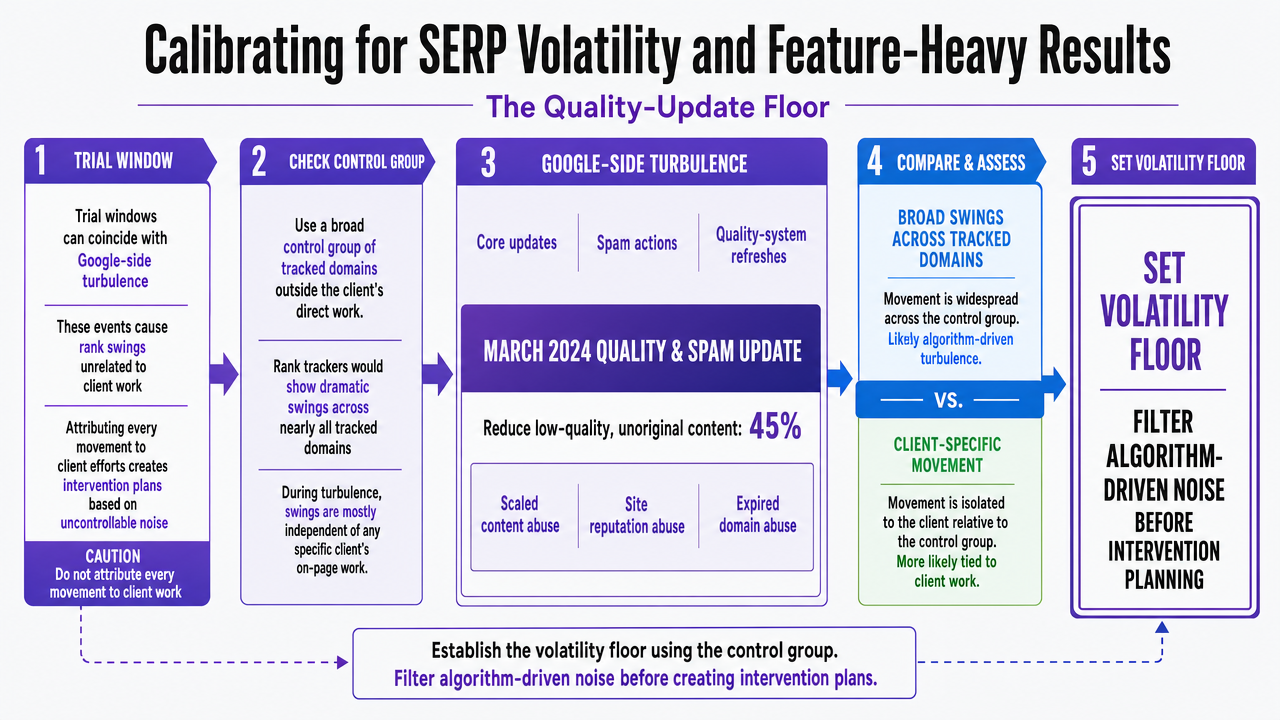
Trial windows frequently coincide with Google-side turbulence, such as core updates, spam actions, or quality-system refreshes. These events cause rank swings unrelated to client work. Analysts who attribute every movement to client efforts risk building intervention plans based on uncontrollable noise.
The March 2024 quality and spam update illustrates the potential scale of this volatility. Google announced this update aimed to reduce low-quality, unoriginal content in search results by 45%, with expanded action against scaled content abuse, site reputation abuse, and expired domain abuse 11. A rank tracker operating during this period would have shown dramatic swings across nearly all tracked domains, most of which were independent of any specific client's on-page or link efforts.
During a trial, the operational solution is to establish a volatility threshold before interpreting positions. Two calibration inputs make this threshold defensible:
- A control group of three to five unrelated domains within the same tracker project, tracking a comparable keyword mix, helps establish the ambient volatility floor.
- Paired-comparison discipline dictates that absolute usage metrics do not reliably reflect retrieval quality at typical sample sizes, so any client movement worth reporting must exceed the control group's activity 3.
Movement below this floor becomes an observation, not an action item; movement above it warrants a client-facing note.
This filter is crucial for preventing trial-window reporting from becoming a catalog of algorithm-driven noise presented as delivery signal.
Blended SERPs and AI Features: What Position 3 Now Means
Position three is no longer a static asset. Modern search results pages integrate various verticals—images, video, local packs, featured snippets, and now generative AI features—each influencing examination dynamics. Click modeling in federated search demonstrates that user behavior differs significantly in heterogeneous result sets, meaning a numeric position in a blended SERP does not directly translate to the click share it would earn on a traditional ten-blue-link page 7.
During a trial, the practical adjustment is to annotate every tracked keyword with the SERP feature set present at the time of loading. Terms appearing under an AI overview, featured snippet, or local pack behave differently from those on a clean results page. Reporting that ignores this feature context will misattribute click loss to ranking loss.
Google's 2026 extension of Search Console to include AI feature reporting formalizes this, providing impressions and pages appearing in AI features with hourly, daily, weekly, and monthly granularity 15. Trial-period analysis should pull the AI-feature dimension from Search Console alongside tracker positions for all commercial and transactional queries. A stable position coupled with declining impressions in the AI-feature layer indicates a modern visibility problem that a rank tracker alone will not reveal.
 Visualize the volatility floor calibration workflow using a control group, supporting the section's cited operational rule for filtering algorithm-driven noise
See How Leading Agencies Automate Rank Tracking at Scale—Risk-Free
Request access to a platform demo and free trial designed for agencies managing high-volume SEO. Evaluate workflow automation, real-time SERP monitoring, and unified reporting before committing resources.
Converting Trial Output Into a Retained-Client Workflow
Artifacts That Must Survive Day 14
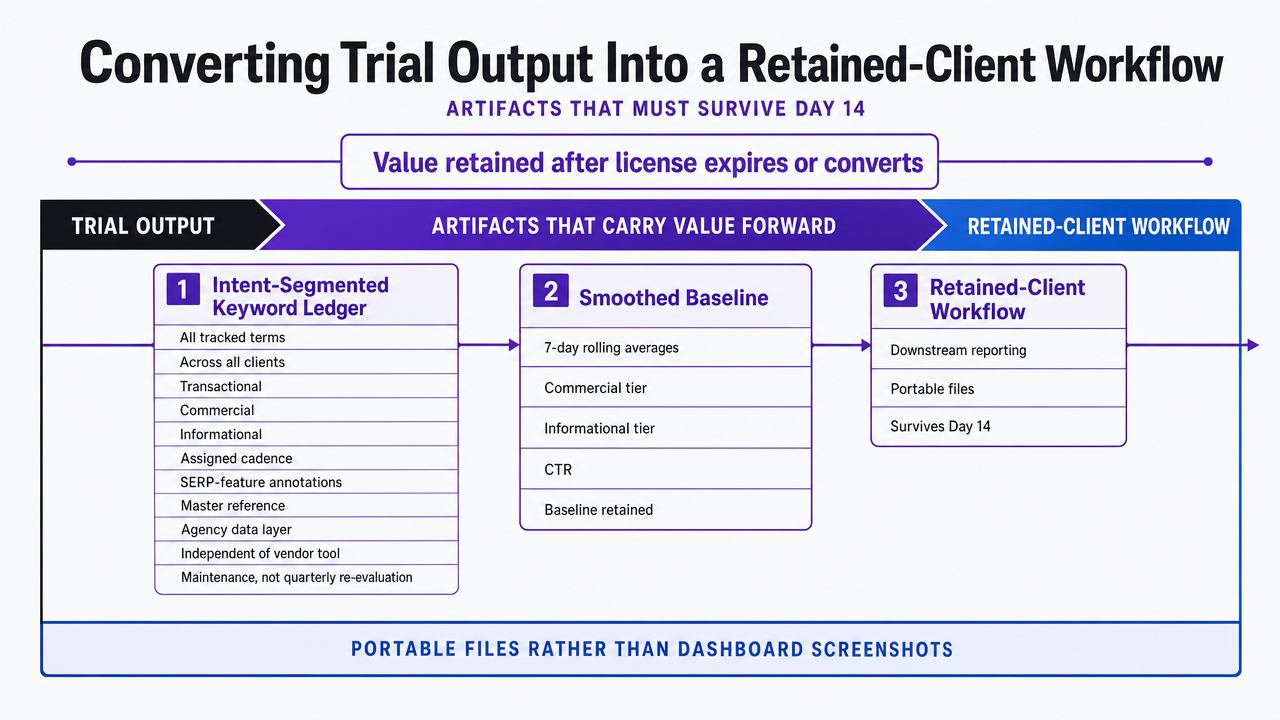
The true value of the trial lies not in the trial itself, but in the assets the delivery team retains after the license expires or converts. Three key artifacts, built as portable files rather than dashboard screenshots, justify the sprint:
- First, the intent-segmented keyword ledger. This includes every tracked term across all clients, tagged as transactional, commercial, or informational, with assigned cadence and SERP-feature annotations 13. This ledger becomes the master reference for all downstream reporting and resides within the agency's data layer, independent of any vendor tool. Intent classification, once established, requires maintenance, not quarterly re-evaluation.
- Second, the smoothed baseline. This comprises seven-day rolling averages for commercial and informational tiers, three-day averages for transactional, exported alongside the Search Console 90-day baseline per property 2, 14. This serves as the comparative surface for all future position readings. Without it, onboarding a new tracker feels like a fresh start rather than a continuation.
- Third, the control-group volatility floor established during the trial. This threshold acts as a filter, preventing over-reporting of future rank movement to clients. It must be documented as a numeric decision rule, not merely institutional knowledge held by a senior analyst.
If You Manage 20+ Clients: Analyst-Hour Consolidation Table
For agencies managing 20 or more accounts, the trial's true return is measured in consolidated analyst hours, not just position gains. This section focuses on portfolio economics and analyst utilization.
Consolidation stems from streamlining four activities that typically consume significant SEO analyst time before a structured trial workflow:
- Keyword loading and maintenance
- Weekly review cycles
- Client-facing reporting assembly
- Volatility triage
Each of these is compressed when the trial yields an intent-segmented ledger, a cadence framework, and a documented volatility floor. This compression is not theoretical; it results from eliminating analytically valueless rework.
The table below uses analyst-hour variables that an agency would supply for its own operations, without assuming tool pricing, headcount cost, or client retainer size. Agencies should substitute their actual pre-trial hours per activity to quantify portfolio-level savings.
| Activity | Per-client hours (pre-trial baseline) | Per-client hours (post-trial workflow) | Portfolio saving at 20 clients ||---|---|---|---|| Keyword loading & maintenance | H1 | ~H1 ÷ 3 (intent ledger already segmented) | (H1 − H1/3) × 20 || Weekly review cycle | H2 | H2 filtered to transactional tier only | (H2 − transactional-only H2) × 20 || Client reporting assembly | H3 | H3 with pre-built cadence rollups | (H3 − rollup H3) × 20 || Volatility triage | H4 | H4 gated by control-group floor | (H4 − gated H4) × 20 |
The mechanism is straightforward:
- Loading is faster because intent segmentation and brand exclusion are performed once, not per report.
- Weekly reviews are reduced as informational and commercial tiers are excluded from the weekly cycle.
- Reporting is compressed because cadence rollups are pre-computed against a stable baseline 2.
- Volatility triage is minimized because most movement never crosses the control group's established floor, and paired comparison against this floor makes the filter defensible 3.
These portfolio economics are critical because analyst utilization directly impacts delivery margin. Freeing an hour per client per week across 20 accounts effectively returns a full analyst FTE to strategic work, rather than dashboard maintenance.
Reporting Cadence, QBR Integration, and Retention Signal
Client reporting directly adopts the established cadence framework. Monthly deliverables prioritize transactional-tier position and click movement against the smoothed baseline, followed by commercial tier trends, with informational tier data appearing only in quarterly rollups. This structure prevents the common issue of monthly reports being padded with informational movement that clients cannot act upon.
QBR integration is where the trial artifacts demonstrate their retention value. The intent ledger, smoothed baseline, and volatility floor collectively enable a QBR narrative that distinguishes delivery impact from ambient SERP noise. When a core update occurs mid-quarter, the control group's movement is already documented, shifting the client conversation from defensive to analytical. Pairing position with impressions, CTR, and satisfaction signals from Search Console enhances the credibility of this conversation 6, 12.
The retention signal is subtle but powerful. Clients who consistently receive the same cadence, baseline comparison, and volatility-adjusted insights quarter after quarter tend to renew at higher rates than those who encounter a redesigned dashboard every time the agency tests a new tool. The trial's purpose is to embed this discipline once and ensure its ongoing application.
 Visualize the three portable artifacts that must survive Day 14, directly supporting the section's cited framework for retained-client delivery
Where a Structured Trial Fits Alongside Vectoron
The trial yields three enduring artifacts: an intent-segmented keyword ledger, a smoothed baseline, and a control-group volatility floor. Maintaining their utility across 20+ clients requires consistently analyzing position alongside clicks, attention, and satisfaction signals in every review cycle, not just during the initial sprint 6. This is primarily a coordination challenge, not merely a tooling issue. Vectoron's AI-powered content production integrates SEO strategy within the same approval workflow as content, backlinks, and call intelligence. This ensures that the cadence framework, volatility gating, and Search Console AI-feature reads 15 remain part of the retained delivery loop beyond Day 14. While the two-week trial might lead to a $599/month subscription, the audit discipline it instills is what truly compounds value.
Frequently Asked Questions
References
- 1.PSkip: estimating relevance ranking quality from web search clickthrough data.
- 2.Smoothing Clickthrough Data for Web Search Ranking.
- 3.How Does Clickthrough Data Reflect Retrieval Quality?.
- 4.Optimizing search engines using clickthrough data.
- 5.Click Models for Web Search and their Applications to IR.
- 6.Incorporating Clicks, Attention and Satisfaction into a Search Engine Evaluation.
- 7.Enabling User Click Modeling in Federated Web Search.
- 8.Search User Behavior Modeling (MLA 2016 slides).
- 9.A Comparative Study of Click Models for Web Search.
- 10.An improved way to view your recent performance data in Search Console.
- 11.New ways we’re tackling spammy, low-quality content on Search.
- 12.Optimizing Search Engines using Clickthrough Data.
- 13.Query Intent Detection from the SEO Perspective.
- 14.How to Track Rankings with Search Console.
- 15.Introducing Search Generative AI performance reports in Search Console.
- 16.Deriving Query Intents from Web Search Engine Queries.