
Key Takeaways
- STAT Search Analytics suits large portfolios with daily refreshes and bulk APIs that push data into warehouses like Snowflake or BigQuery for downstream reporting 3.
- AccuRanker delivers fast SERP capture and on-demand recrawls, giving agencies clean data to feed into their own BI layer for urgent investigations.
- seoClarity adds governance layers—permissions, approvals, audit trails—that matter for regulated, multi-brand books where compliance is non-negotiable.
- BrightEdge wraps rank data inside outcome dashboards tying visibility to traffic and revenue, aligning with the shift toward business-outcome measurement 18.
- Conductor offers scheduled tracking, alerting, and stakeholder dashboards built for accounts with heavy client-side teams that need governed content workflows 7.
- Semrush and Ahrefs cover the mid-market with white-label dashboards and expanding AI Overview reporting, though SERP capture depth trails data-heavy specialists 6.
- Advanced Web Ranking wins on client-facing report polish, making QBR decks quick to assemble for agencies tracking 200 to 2,000 keywords per client 5.
- Nozzle captures the full SERP as a structured object queryable like a database, suiting teams with SQL skills and existing downstream reporting infrastructure 5.
- SE Ranking handles multi-location portfolios with white-label dashboards and local pack alerts, though its '100% accurate' claim warrants agency spot checks 9.
- Vectoron sits above rank data as an outcome-attribution layer, connecting position changes to qualified calls, bookings, and pipeline to justify retainer value 18.
Why rank data alone stopped counting as proof
The enterprise SEO platforms market was valued at USD 4.38 billion in 2024 and is projected to reach USD 12.5 billion by 2032, growing at a 14% CAGR 16. This growth funds reporting layers that agency clients now expect: segmentation across brands and locations, portable data for BI stacks, and a visibility narrative connecting search movement to revenue.
Adobe's 2026 marketing measurement report highlights a shift from output metrics like campaign counts to business outcomes such as revenue and customer value 18. For search, this means a weekly position deck no longer justifies a retainer. CFOs want to know which ranking movements generated qualified pipeline and why.
Enterprise rank tracking has evolved to meet this demand. It now covers thousands to millions of keywords across domains, countries, and devices, integrating AI search visibility with classic SERP monitoring 1. The tools reviewed here are assessed on their ability to convert daily SERP data into actionable proof for agency heads of SEO, rather than just tracking positions.
The four-axis rubric used to score every tool
Enterprise rank tracking encompasses thousands to millions of keywords across multiple domains, search engines, countries, and devices, including AI search visibility 1. This scope necessitates a comprehensive evaluation beyond a simple feature checklist. Each tool is scored on four axes directly relevant to an Agency Head of SEO's reporting needs:
Proof-of-work reporting. : Does the tool generate a client-facing narrative—visibility changes, share of voice, competitor activity—without requiring weekly manual analyst intervention? Raw position exports are insufficient.
Segmentation depth. : Can data be segmented by client, brand, location, device, persona, and funnel stage within a single account? This is crucial for agencies managing diverse portfolios, from multi-location dental groups to national law firms.
API and BI portability. : Rank data must integrate with client data warehouses, Looker, or multi-channel dashboards. Tools that restrict data to a proprietary UI are less effective, regardless of keyword tracking capabilities.
AI-surface coverage. : Visibility in AI Overviews, Perplexity answers, and ChatGPT citations should be reported alongside classic SERP ranks 1. Tools that only report on traditional "ten blue links" can misrepresent actual visibility.
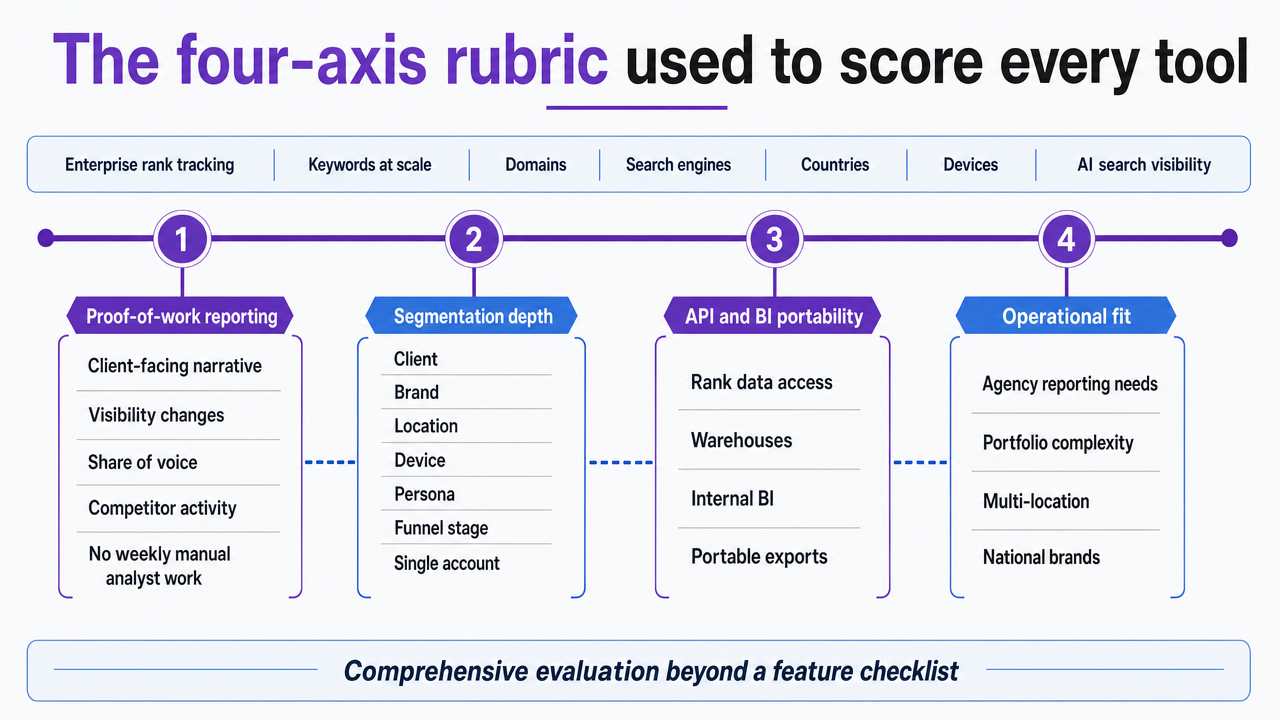 Visualize the four-axis evaluation framework used throughout the article to score each rank tracking tool, directly supporting the section's cited criteria
The nine tools, scored against agency reality
STAT Search Analytics: daily refresh at portfolio scale
STAT is a purpose-built enterprise tracker designed for very large keyword sets, offering daily refreshes and bulk APIs for data warehouse export 4. This makes it suitable for agencies managing extensive portfolios, ensuring fresh data is available for analysis.
STAT excels in segmentation depth and API portability. It allows slicing data by tags, market segments, and dayparted views across brands and locations within a single account. Its bulk API facilitates direct data transfer to platforms like Snowflake, BigQuery, or Looker 3. While proof-of-work reporting is functional, it is geared more towards data teams than immediate executive presentations. AI-surface coverage is less advanced compared to newer solutions.
Entry pricing for STAT is around $720/month for approximately 6,000 keywords 3, providing a benchmark for large-scale portfolio costs. Agencies often choose STAT after experiencing limitations with UI-centric tools.
AccuRanker: fast SERP capture with bulk API export
AccuRanker is another enterprise option offering bulk APIs and daily refreshes for large keyword sets 4. It is recognized in the enterprise tier alongside tools like Semrush, Ahrefs, and Advanced Web Ranking for consistent monitoring capabilities 6.
AccuRanker's key strengths are its speed of data capture and on-demand re-crawling. This allows agencies to trigger fresh SERP pulls for urgent investigations. Segmentation depth is robust across tags, locations, and devices, and API portability is straightforward.
AccuRanker's proof-of-work reporting is less native than tools designed for executive dashboards, providing clean data for agencies to customize. While AI-surface coverage is improving, it remains an evolving area. Agencies often pair AccuRanker with a downstream BI layer to maximize its utility.
seoClarity: governance for regulated and multi-brand books
seoClarity is an enterprise SEO suite that integrates daily rank tracking with content workflows, technical audits, and governance features 3. For agencies in regulated industries like healthcare, its governance layer—including permissions, approvals, and audit trails—is critical for compliance.
Segmentation depth is a strong point, supporting multi-brand rollups and location hierarchies within a single tenant. API and BI portability are competent. Its proof-of-work reporting leverages composite visibility framing, translating keyword changes into share-of-voice narratives easily understood by stakeholders 2.
Agencies adopting seoClarity commit to a comprehensive suite, which can be significant for lean generalist agencies but highly valuable for those managing regulated, multi-brand clients.
BrightEdge: rank data wrapped in outcome dashboards
BrightEdge is an enterprise suite where rank tracking is a component rather than the primary product 3. Its focus on outcome dashboards, which integrate visibility with traffic, engagement, and revenue signals, aligns with the industry shift towards business outcomes 18.
BrightEdge excels in proof-of-work reporting and AI-surface coverage, with significant investment in tracking AI Overview visibility. It supports multi-brand and multi-region segmentation. While API portability exists, it often functions best within BrightEdge's own reporting environment rather than external data warehouses.
Commercial considerations are a factor for agencies, as BrightEdge is typically priced for direct-to-enterprise deployments. Agencies often use it in co-managed engagements for specific enterprise clients, rather than as a universal tracker across their entire client base.
Conductor: governed workflows for stakeholder-heavy accounts
Conductor is designed for enterprise SEO teams requiring governed, scheduled rank tracking with automation and stakeholder-ready reporting 7. This makes it suitable for accounts with large, opinionated client-side teams that integrate SEO into broader content governance workflows.
Conductor's strengths lie in proof-of-work reporting and workflow governance, offering native scheduled tracking, alerting, and stakeholder dashboards. Segmentation depth supports multi-property portfolios. AI-surface coverage has expanded in line with the industry's focus on AI visibility 1.
API and BI portability are areas where Conductor typically trails specialized trackers like STAT and AccuRanker. While data export is possible, the platform's core strength is its internal reporting. This can be a point of friction for clients who prefer all data in their own Snowflake instance, but an advantage for those already integrated with Conductor.
Semrush and Ahrefs: the mid-market consensus tier
Semrush and Ahrefs are considered enterprise-tier tools, alongside Advanced Web Ranking and AccuRanker, for their consistent monitoring capabilities 6. Although not initially designed for warehouse-first operations, they have scaled to support agencies managing numerous client accounts, offering a comprehensive suite of features including rank tracking, keyword research, backlinks, and competitive intelligence.
Both platforms offer strong proof-of-work reporting through native client dashboards and white-label options. Segmentation depth is adequate for single-brand and modest multi-location projects but may struggle with extensive multi-brand or franchise scales. API portability is available for both, with practical rate limits influencing data integration into BI systems.
AI-surface coverage has rapidly improved on both platforms to meet reporting expectations for AI Overviews 1. A key consideration for agency heads of SEO is the depth of SERP capture; while these tools effectively cover the top of the SERP, they may not match the pixel-level detail offered by data-heavy specialists.
Advanced Web Ranking: agency-grade client reporting polish
Advanced Web Ranking (AWR) is highly regarded by agencies for its polished reports and scalable tracking 5. AWR prioritizes the client-facing report, making it ideal for agencies needing to present compelling QBR decks without extensive manual reconstruction.
AWR's strongest attribute is its proof-of-work reporting. Segmentation depth effectively handles multi-location and multi-device tracking. API and BI portability are functional, though the platform encourages using its integrated report builder. AI-surface coverage has been added to track AI Overviews alongside traditional positions 1.
AWR's limitations compared to STAT or AccuRanker include raw scale ceiling and SERP capture depth. However, for agencies focused on mid-market clients with 200 to 2,000 tracked keywords, these limitations are often not an issue, and the reporting polish provides significant value.
Nozzle: deep SERP intelligence for data-heavy teams
Nozzle offers the deepest SERP intelligence, catering to data-intensive SEO teams 5. Unlike most trackers that provide position and basic feature flags, Nozzle captures the entire SERP as a structured object—including every feature, competitor, and URL at pixel depth—allowing analysts to query it like a database.
Nozzle excels in API and BI portability, providing raw data depth that supports proof-of-work reporting once an agency's data team processes it. Segmentation depth is determined by how the agency structures its queries rather than being a UI feature. Its structural approach also benefits AI-surface coverage.
Nozzle is not designed for out-of-the-box dashboards. It is best suited for teams with SQL proficiency and an existing downstream reporting layer. While it may be overhead for lean generalist agencies, it offers significant leverage for those with data engineers on staff.
SE Ranking: multi-location tracking with automation claims
SE Ranking is positioned for repeatable multi-device and multi-location tracking, offering exports and alerts 7. Its enterprise page highlights
"boundless data tracking capabilities, intelligent workflow automation, seamless data integration, and strategic insights," claiming "100% accurate, scalable rank tracking" 9.
This accuracy claim, like any absolute number in a volatile SERP environment, requires scrutiny.
SE Ranking performs well in segmentation for multi-location portfolios such as home services franchises and dental DSOs, and in proof-of-work reporting via white-labeled client dashboards. API and BI portability are available, and AI-surface coverage has expanded with the category.
Compared to Conductor, SE Ranking offers more flexibility and a different price point, trading some workflow rigidity for adaptability. For agencies managing mid-market multi-location clients who need alerts for local pack drops, this flexibility often outweighs the need for deep governance.
Vectoron: the outcome-attribution layer above rank data
Vectoron operates as an outcome-attribution layer, complementing rank trackers rather than competing directly on daily refreshes or SERP depth. It integrates live business data—qualified calls, bookings, cost per lead, pipeline—to prioritize SEO efforts based on their impact on revenue. This aligns with Adobe's documented shift from output metrics to revenue and customer value 18.
Vectoron excels in proof-of-work reporting, particularly from a CFO's perspective: identifying which ranking movements drive qualified pipeline and justifying retainer value. Its segmentation depth covers clients, locations, and channels, coordinating content, SEO, PPC, backlinks, social, and call intelligence within a unified approval workflow. API and BI portability are managed through this same governed process.
Vectoron is not designed for pulling raw daily positions for massive keyword portfolios. Instead, it is paired with other rank trackers to transform raw rank data into actionable proof of business impact.
Test real-time rank tracking across live sites
Monitor and report actual keyword movements for your clients using live data before you commit.
Contextualizing rank movement against ranking factor weights
A position change in a QBR is a symptom, not proof. Clients, especially CFOs, demand to understand why ranks moved and if the agency's efforts caused the change. This requires linking rank tracking data to underlying ranking factor categories.
A 2025 correlational study of 10 million Google search results assigned weights to ranking signals:
- page experience at 28%
- content quality at 25%
- backlinks at 22%
- technical SEO at 18% 15
The remaining percentage is distributed among smaller signal groups. It is important to note that these are correlational, not causal, weights, meaning they describe what tends to rank, not what an agency can guarantee by manipulating a single lever.
These weights provide a diagnostic framework for reporting. If a client gains positions, the agency should be able to attribute the movement to a specific factor, such as a Core Web Vitals improvement, a content rewrite, new referring domains, or a technical internal linking fix. Conversely, if positions are lost, this framework helps explain whether the loss is within the agency's scope or an external factor. Rank trackers that only report position numbers force agencies to manually reconstruct this narrative. The tools reviewed here are valuable to the extent they allow analysts to tag movements against factor categories within the same view.
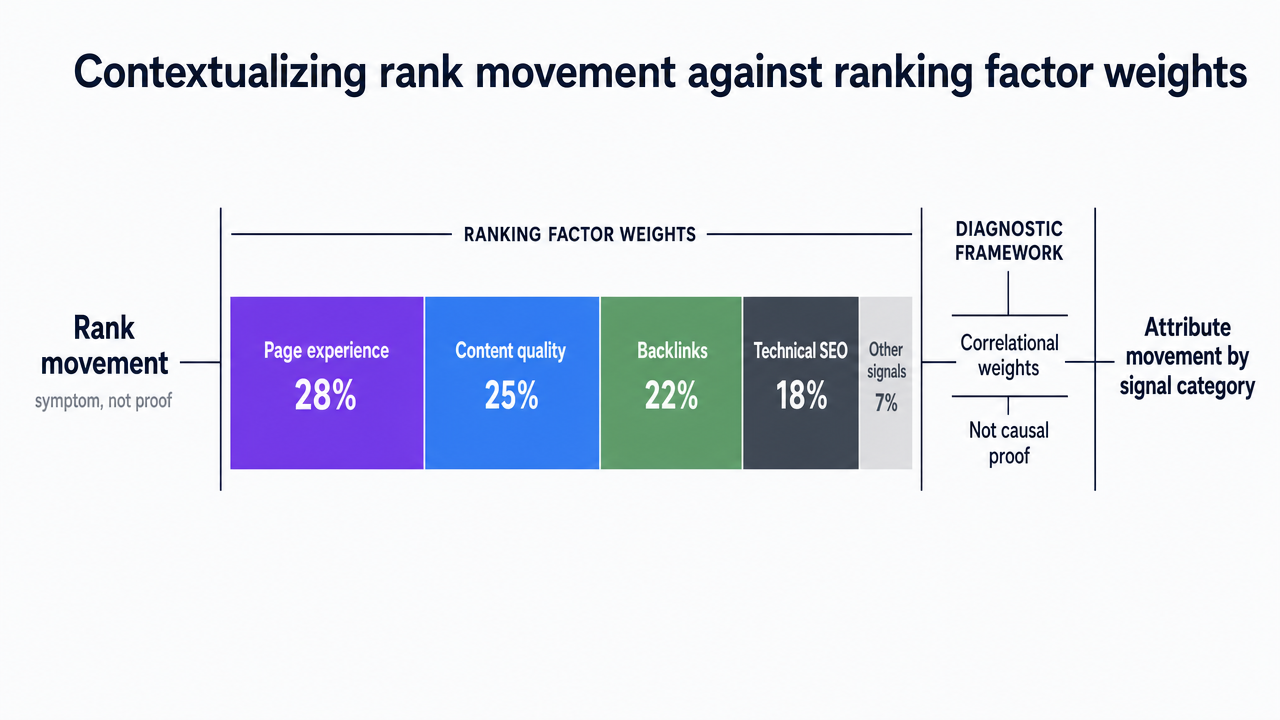 Show the correlational ranking factor weights from the 2025 study cited in this section (28/25/22/18), directly supporting the diagnostic framework discussed
Build vs buy: SERP API pipelines against managed trackers
The build-vs-buy decision is common in agency stack reviews. For a 50-client portfolio tracking 500 keywords per client (25,000 keywords daily), raw SERP API data costs $450 to $800 monthly at $0.018 to $0.032 per keyword 4. A managed rank tracker for the same portfolio costs $750 to $2,250 monthly at $0.03 to $0.09 per keyword 4. STAT's entry point of approximately $720/month for 6,000 keywords provides a real-world anchor for managed solutions at scale 3.
While the per-keyword cost difference appears significant, engineering time is the critical variable. A SERP API pipeline requires dedicated resources for crawl scheduling, retry logic, storage schema, segmentation, client dashboards, and alerting. Every hour spent on pipeline maintenance is an hour diverted from client delivery. Agencies without a data engineer should view the API path as a headcount decision, not just a tooling choice.
| Path | Cost per keyword / month | 25,000-keyword portfolio | Hidden variable |
|---|---|---|---|
| SERP API pipeline | $0.018–$0.032 4 | $450–$800/mo | Engineering hours to build and maintain |
| Managed rank tracker | $0.03–$0.09 4 | $750–$2,250/mo | Reporting flexibility inside vendor UI |
| STAT anchor point | — | ~$720/mo for ~6,000 keywords 3 | Bulk API export to warehouse included |
Agencies with SQL expertise and a downstream BI layer can leverage the API path effectively. Others benefit from paying the managed premium and reallocating engineering budgets to analyst hours for client narrative development.
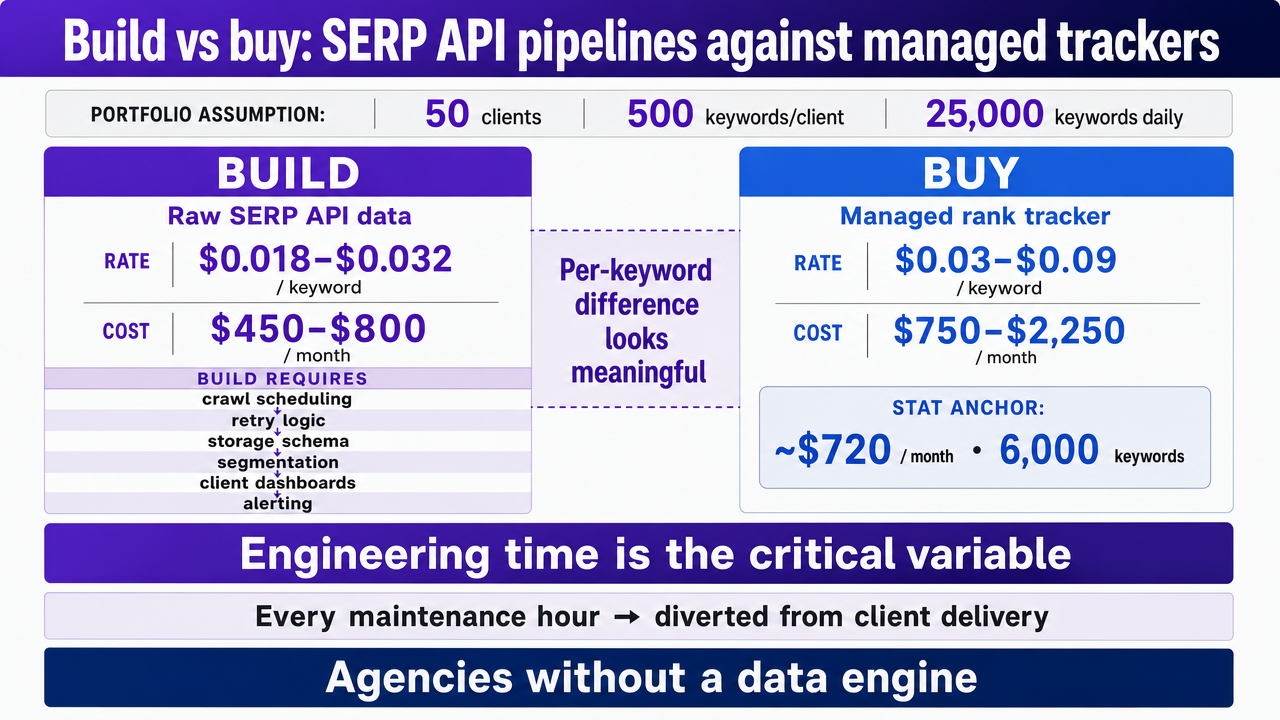 Visualize the build-vs-buy cost comparison table and hidden variables already presented in the section, reinforcing the decision framework
See How Enterprise Teams Track and Prove SEO Wins at Scale
Request a walkthrough of advanced rank tracking solutions built for agencies managing complex, multi-client SEO portfolios—compare real data workflows and reporting automation tailored for high-volume client delivery.
If you manage multi-location portfolios: rollups, segmentation, and churn signals
This section addresses Agency Heads of SEO managing multi-location portfolios—such as dental DSOs, home services franchises, or regional law firms—where a single client encompasses many individual locations. This scale introduces unique tooling requirements.
Three key requirements differentiate a portfolio-viable tracker from a basic keyword tool. First, rollups: the tracker must report national visibility for the parent brand, aggregate regional performance, and individual local pack presence within a single hierarchy, eliminating the need to stitch together multiple spreadsheets. seoClarity and SE Ranking are noted for their multi-brand and multi-location hierarchy capabilities 3, 7. Second, segmentation must be robust enough to slice data by service line, location tier, market maturity, and campaign cohort simultaneously. QBR questions often focus on specific segments, such as "how did the 12 underperforming locations in secondary markets respond to the September content push."
Third, and often overlooked, are churn signals. Enterprise tracker evaluations should prioritize scale, governance, and data portability over keyword limits 10. Data portability enables churn detection: piping rank changes into the same warehouse as qualified call volume and booking data allows for alerts when a location's local pack visibility drops significantly. This proactive detection can be the difference between retaining a client and receiving a cancellation notice.
How to shortlist in a week without stalling delivery
A focused, week-long stack review can yield the same shortlist as a months-long process, preserving retainer margins. The compressed approach involves four steps:
- Monday: define the portfolio shape. Quantify clients, keywords per client, location hierarchies, and AI-surface reporting needs. This determines whether to prioritize purpose-built trackers or full suites 3.
- Tuesday and Wednesday: score three tools against the four-axis rubric. Select only three tools. Use trial data from your largest live client to rebuild last month's QBR deck within each tool, timing the process.
- Thursday: pressure-test API and BI portability. Push a week's worth of rank data into the data warehouse used by your largest client. Tools that fail this step should be eliminated, as evaluation should prioritize scale, governance, and data portability over keyword limits 10.
- Friday: decide. The tool that most efficiently produces a defensible QBR narrative with minimal analyst time is the winner.
Frequently Asked Questions
References
- 1.12 Best Enterprise Rank Tracking Software Platforms in 2026.
- 2.10 Best Rank Trackers for Enterprise SEO (2026).
- 3.10 Best Enterprise SEO Software Daily Rank Tracking (2026).
- 4.Best Rank Tracking Software 2026: 12 Tools Tested.
- 5.15 Best Rank Tracking Software We're Using for 2026.
- 6.Top 10 Best Enterprise Rank Tracking Software | 2026 Edition.
- 7.Top 10 Best Enterprise Rank Tracking Software of 2026 - Gitnux.
- 8.7 Best Enterprise Rank Tracking Software Tools in 2026.
- 9.SE Ranking Platform for Enterprises.
- 10.Best Enterprise Rank Tracking Software for Global SEO ....
- 11.Search engine Performance optimization: methods and techniques.
- 12.Enterprise Seo Platforms Market Share, Size, Trends | 2035.
- 13.Enterprise SEO Platforms Analysis 2025 and Forecasts 2033.
- 14.Enterprise SEO Platforms Market Size Share & Growth.
- 15.SEO Ranking Factors Study 2025: Analysis of 10M Search Results.
- 16.Enterprise SEO Platforms Market Size, Share and Forecast 2032.
- 17.Global Enterprise SEO Platforms Market Forecast 2027–2035.
- 18.State of Marketing in an AI-Driven World: 2026 Adobe Report.