
Key Takeaways
- Rank tracking now splits into fast position monitoring and visibility intelligence covering SERP features and AI Overviews, and agencies need both to serve sophisticated clients 13, 12.
- A three-tier stack (high-velocity trackers, full-suite platforms, enterprise governance tools) plus an orchestration layer beats searching for one universal rank tracker.
- Entry-tier keyword limits differ sharply, with Ahrefs at 750, Semrush at 500, and Moz at 300, directly shaping upgrade paths and agency margins 10.
- AccuRanker's refresh speed makes it the go-to for live volatility analysis, letting strategists separate temporary fluctuations from real ranking losses across large portfolios 7, 8.
- SE Ranking bridges pure position monitoring and full suites, giving mid-market agencies research and reporting depth without enterprise pricing 7, 8.
- Wincher suits lean agencies under 25 clients that need clean daily updates and a simple interface alongside an existing research suite 8.
- Semrush Position Tracking earns its place through cannibalization reports plus multi-device and multi-location coverage on daily updates across all plans 9.
- Ahrefs Rank Tracker's 750-keyword entry ceiling and 28.7 billion keyword dataset support gap analysis and competitive reverse-engineering at scale 10, 11.
- Moz Pro's rank tracking is justified mainly by existing workflow lock-in, given its 300-keyword entry limit and 1.25 billion keyword dataset 10, 11.
- Enterprise platforms like BrightEdge, Conductor, Botify, and Semrush Enterprise ($500–$5,000+/mo) are chosen for SEO governance across many properties, not raw tracking speed 14.
- STAT delivers share-of-voice analytics at portfolio scale, replacing average position as the meaningful metric for enterprise and multi-brand accounts 8.
- AgencyAnalytics collapses reporting throughput into white-labeled dashboards, pairing well with a Tier 1 tracker to aggregate rank, Search Console, and paid data 8, 15.
Rank Tracking: Two Distinct Agency Jobs
The landscape of "rank tracking software" has diverged, now encompassing two fundamentally different roles. Agencies that seek a single tool for both functions risk inefficiencies and reduced delivery margins.
The first role is fast, cost-effective position monitoring. This involves daily or hourly checks against a defined keyword set, presented through a streamlined interface for quick strategist review. The second role is visibility intelligence, which extends beyond traditional blue-link positions to include classic SERP features, AI Overviews, and Google's advanced Search Console reporting. Google now provides Gen-AI performance data with hourly, daily, weekly, and monthly granularity, offering insights into AI-generated answers 13. Additionally, Search Console Insights links clicks and impressions to specific content, adding an engagement layer 12. Both aspects are indispensable for agencies serving sophisticated clients.
This evolution in rank tracking aligns with a broader strategic shift where leading organizations prioritize end-to-end workflows that yield measurable outcomes over fragmented automation 1. In this context, position data becomes an input to a decision-making loop, not the final deliverable. Tools that facilitate this loop are more valuable for scaling agency operations than those merely producing static reports.
The Three-Tier Stack for Agency Rank Tracking
Instead of searching for a single "best" rank tracker, agencies should consider a three-tier market structure, complemented by an orchestration layer that converts ranking changes into actionable tasks.
- Tier 1: High-Velocity Position Trackers include tools like AccuRanker, SE Ranking, and Wincher. These are designed for rapid, accurate position data across large keyword sets, with minimal feature bloat.
- Tier 2: Full-Suite Visibility Platforms, such as Semrush Position Tracking, Ahrefs Rank Tracker, and Moz Pro, integrate rank data with broader research, backlink analysis, and cannibalization workflows.
- Tier 3: Enterprise and Governance Platforms, including BrightEdge, Conductor, Botify, Semrush Enterprise, and Sistrix, cater to large organizations requiring SEO governance across multiple properties and stakeholders 14.
An orchestration layer sits above these tiers. This layer, exemplified by tools like STAT and AgencyAnalytics, and the two Search Console surfaces, integrates specialized functions such as share of voice, white-label reporting, and AI-surface visibility. The goal is to combine position monitoring, visibility intelligence, and execution routing seamlessly, avoiding the need for additional platforms later.
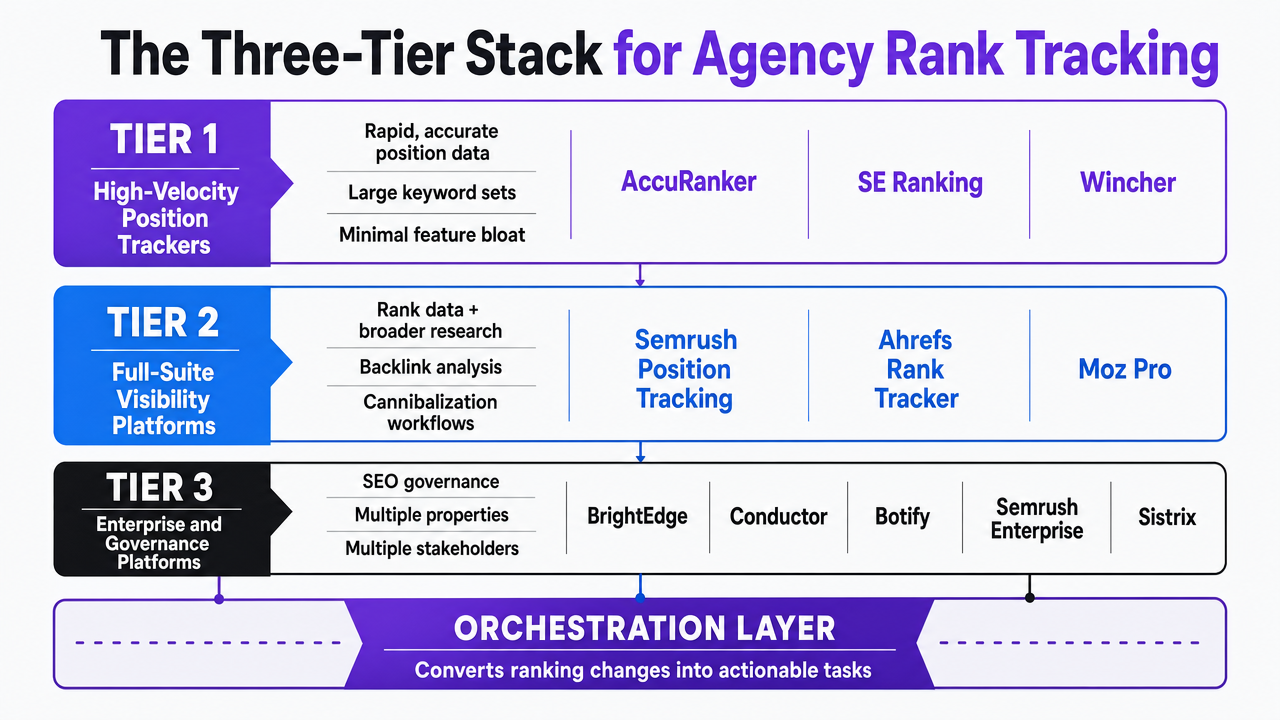 Visualize the three-tier stack structure plus orchestration layer described in this section, giving readers a clear mental model of how tools categorize
Agency Economics: Per-Keyword and Per-Client Considerations
For agencies, tool selection is fundamentally a margin calculation. The key factors are the number of clients, tracked keywords per client, and the keyword ceiling of the chosen plan. These determine the necessary seat count or upgrades, significantly impacting the long-term viability of a tool contract.
Entry-tier keyword limits vary considerably. For instance, Ahrefs offers 750 keywords, Semrush 500, and Moz 300 on starter plans 10. An agency managing 40 clients, each with 50 tracked keywords, requires 2,000 tracked keywords. This volume quickly exceeds most entry-level plans, pushing agencies into higher-cost tiers. The difference in keyword ceilings between tools like Ahrefs and Moz can lead to vastly different upgrade paths and costs.
The table below summarizes key economic factors for various tools. Undisclosed fields are marked as such.
| Tool | Starting price | Keywords at entry/agency tier | White-label reporting | API access | Best-fit portfolio size ||---|---|---|---|---|---|| Ahrefs | Not disclosed in sourced research | 750 10| Not disclosed in sourced research | Not disclosed in sourced research | Mid-market suites needing dataset depth || Semrush | Not disclosed in sourced research | 500 10| Not disclosed in sourced research | Not disclosed in sourced research | Mid-market to enterprise with cannibalization needs 9|| Moz Pro | Not disclosed in sourced research | 300 10| Not disclosed in sourced research | Not disclosed in sourced research | Smaller portfolios already inside Moz workflow || Semrush Enterprise | $500 to $5,000+/mo 14| Not disclosed in sourced research | Not disclosed in sourced research | Not disclosed in sourced research | Large agencies needing governance across many properties 14|| Agency-tier rank trackers (per uprankd guide) | Varies by tool 15| Compared explicitly at agency tier 15| Yes on tools reviewed 15| Yes on tools reviewed 15| Agencies scaling reporting throughput 15|
At the agency level, white-label reporting and API access are critical decision factors for scalability 15. White-label capabilities reduce the manual effort of creating client-branded reports, which becomes increasingly important as portfolios grow. API access enables the integration of ranking data into downstream workflows, preventing data from being siloed within vendor dashboards. Agencies that overlook these features often face significant infrastructure rebuilding as they expand.
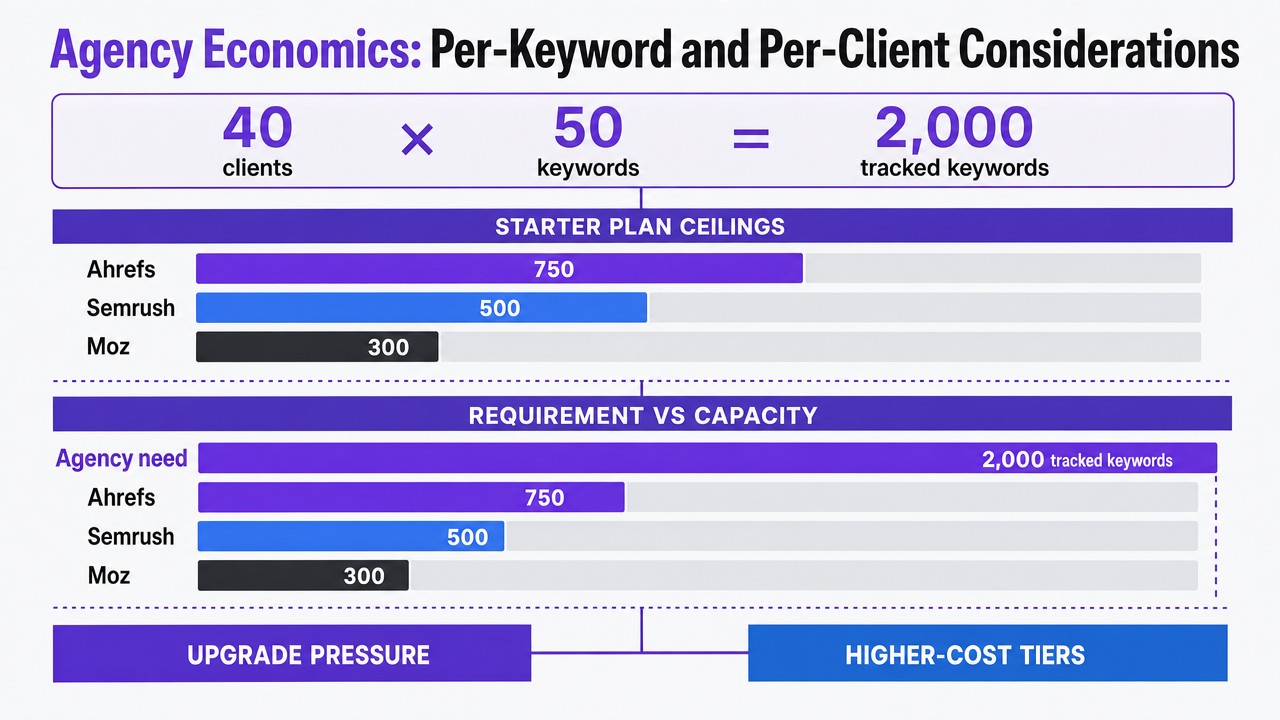 Compare entry-tier keyword tracking limits across the three major suites, a direct visualization of numeric data cited in the section
Tier 1: High-Velocity Position Trackers
AccuRanker: Speed and Volatility Analysis
AccuRanker is a top-tier choice for its refresh speed, making it ideal for live volatility analysis and rapid rank monitoring across extensive agency keyword portfolios 7, 8. This speed is crucial for strategists to quickly assess whether a client's ranking drop is a temporary fluctuation or a significant loss, especially on days with high SERP volatility.
AccuRanker focuses specifically on providing a reliable position layer. It does not aim to replace comprehensive research suites or backlink indexes. Instead, it allows small teams to efficiently scan dozens of client portfolios and then integrate with Tier 2 tools for deeper diagnostics like SERP feature history, competitor gap analysis, or cannibalization mapping. Agencies with demanding weekly reporting cycles often use AccuRanker as their primary source for position data, routing other tasks to complementary systems.
SE Ranking: Depth Without Enterprise Costs
SE Ranking offers significant value in Tier 1, providing depth without the high cost of enterprise solutions. It combines rank tracking with sufficient research and reporting features to support mid-market portfolios, often eliminating the need for a second subscription 7, 8. This positions it effectively between a pure position monitor and a full-suite visibility platform, catering to agencies with 25 to 100 clients.
SE Ranking is suitable for agencies that need more than just tracking but cannot justify the substantial annual expenditure of true enterprise platforms. Strategists benefit from integrated keyword research, competitor snapshots, and client-facing reports within a single interface. The trade-off is a less extensive dataset compared to Ahrefs or Semrush, which becomes a consideration for advanced competitive research best handled by Tier 2 tools.
Wincher: Clean Daily Updates for Lean Portfolios
Wincher is an excellent option for agencies with focused needs and smaller portfolios. It is recognized among the top rank trackers for agency use cases, alongside more robust platforms 8. Its appeal lies in its simplicity: consistent daily position updates, a user-friendly interface, and pricing that avoids unnecessary features for smaller operations.
This tool is particularly beneficial for agencies managing fewer than 25 clients or content teams that require only a monitoring layer alongside an existing research suite. Wincher prioritizes daily accuracy and ease of use over advanced features like SERP feature depth or share-of-voice calculations, providing essential functionality for lean teams at the position layer of their stack.
Test real-time ranking checks at scale now
Validate multi-client keyword performance and publish live reports during your trial—no limitations, full operational workflow.
Tier 2: Full-Suite Visibility Platforms
Semrush Position Tracking: Cannibalization and Multi-Device Coverage
Semrush is a go-to tool for professional SEO teams when rank tracking needs to be integrated into a broader research and diagnostic workflow. A 2026 comparison highlights its strength in rank tracking due to its cannibalization reports, multi-device and multi-location tracking, and daily updates across all plans 9. These features are particularly valuable for agencies managing clients with multiple landing pages competing for the same query across various devices and geographic areas.
A key consideration is the 500-keyword limit on its entry tier 10, which often necessitates an upgrade for agencies with more than a few dozen clients. Agencies that already use Semrush as their primary research tool find the position tracking capabilities to be a cost-effective addition. The cost is more easily absorbed by agencies with diverse portfolios that require cannibalization diagnostics alongside position data.
Ahrefs Rank Tracker: Dataset Depth and Higher Keyword Ceilings
Ahrefs excels in dataset breadth and a more generous tracked-keyword ceiling on its starter plan, which are critical for strategists engaged in extensive competitive analysis. Its entry tier supports 750 tracked keywords, surpassing Semrush's 500 and Moz's 300 10, simplifying client onboarding for agencies. Ahrefs' estimated dataset of 28.7 billion keywords, compared to Semrush's 27.3 billion and Moz's 1.25 billion 11, provides a deeper well of competitive data.
This data depth is invaluable for reverse-engineering competitor ranking strategies rather than just monitoring a fixed keyword list. While Ahrefs may not always be cited as the absolute best for rank tracking alone 9, its combination of a higher keyword ceiling and rich competitive data makes it a strong Tier 2 choice for agencies whose reporting relies heavily on gap analysis and content opportunity identification, in addition to position changes.
Moz Pro: For Existing Moz Workflow Users
Moz Pro is the most specialized of the Tier 2 options, and its justification for rank tracking often depends on existing workflow integration. Its entry plan limits tracked keywords to 300 10, and its keyword dataset is considerably smaller than Ahrefs and Semrush, estimated at 1.25 billion 11. Recent comparisons generally place Semrush and Ahrefs ahead of Moz for professional SEO tasks 9.
The primary argument for Moz Pro at the agency level is workflow lock-in. Agencies already utilizing Moz for domain authority scoring, on-page grading, and link analysis gain incremental value by adding its position layer without switching platforms. However, for agencies starting fresh, other options may offer better value and broader capabilities.
Tier 3: Enterprise and Governance Platforms
Enterprise platforms address a different set of challenges than Tier 1 and Tier 2 trackers. They are designed for program owners responsible for SEO governance across numerous properties, stakeholders, and complex review processes involving legal and brand oversight. This category includes BrightEdge, Conductor, Botify, Semrush Enterprise, and Sistrix. Their strengths lie in workflow control, multi-site operations, and integration with broader marketing stacks, rather than just raw tracking speed 14.
The pricing structure clearly distinguishes this tier. Semrush Enterprise, for example, ranges from $500 to $5,000+ per month with add-ons 14. Public pricing for other platforms like BrightEdge, Conductor, Botify, and Sistrix is typically not disclosed, indicating that these are negotiated, enterprise-level purchases rather than self-serve subscriptions. Agencies considering this tier should anticipate annual commitments significantly higher than mid-market suites.
The decision to adopt an enterprise platform is rarely driven by a need for superior rank data alone. It is primarily about establishing SEO governance across a large organization, a use case specifically highlighted for BrightEdge 14. Agencies serving multi-brand enterprises, multi-country domains, or clients with internal SEO teams requiring shared dashboards often find the investment justifiable. Conversely, agencies with broad but not deep portfolios (many mid-sized clients rather than a few enterprise accounts) may struggle to recoup the cost. This tier is appropriate when governance, not tracking, is the primary constraint.
STAT: Share-of-Voice at Portfolio Scale
STAT functions as a specialized component within the orchestration layer. It is recognized for large-scale SERP tracking and share-of-voice analytics, suitable for extensive agency programs 8. This tool is designed for teams monitoring tens of thousands of keywords across multiple clients, where average position becomes less informative and share of voice emerges as the critical metric for client reporting.
STAT's cost is justified when an agency manages enterprise or multi-brand accounts that require daily SERP snapshots, feature-level tracking, and robust share-of-voice calculations against a defined competitor set. Smaller portfolios typically do not warrant the overhead. Agencies often pair STAT with a Tier 2 suite, using STAT as the reporting backbone for their largest accounts while the suite handles research, backlinks, and cannibalization for the rest of their client base.
AgencyAnalytics: White-Label Reporting Throughput
AgencyAnalytics is not primarily a deep rank tracker but excels in collapsing reporting throughput across numerous client portfolios into a single white-labeled interface. It is often listed among top agency tools alongside Nightwatch, SERPWatcher, and Wincher 8, with position data being one of many integrated feeds.
Its operational value is clear: white-label reporting and API access are crucial for agency scalability 15. AgencyAnalytics streamlines the creation of client-branded dashboards, eliminating the need for manual PDF assembly by account managers. Agencies often combine it with a Tier 1 tracker like AccuRanker for precise position data, then leverage AgencyAnalytics to aggregate rank data, Search Console insights, and paid metrics into comprehensive client reports.
See How Leading Agencies Automate and Benchmark Ranking Checks at Scale
Connect with our team to access a live walkthrough of enterprise-grade ranking check automation, approval workflows, and actionable SERP reporting designed to streamline multi-client SEO management.
The Essential Search Console Layer
Search Console Insights: The Truth Layer for Engagement
While third-party rank trackers report position, Search Console Insights reveals actual user behavior. This distinction is vital when a client questions why a #3 ranking yielded fewer clicks than a previous #5. Google's own reporting surface allows agency teams to view total clicks and impressions from Search and their trends against specific content 12. This engagement data provides a crucial validation point for all paid trackers.
Operationally, strategists use a Tier 1 or Tier 2 tool for daily position data, then reconcile weekly against Insights to confirm if ranking improvements translate into clicks. When discrepancies arise, Insights, being Google's proprietary data, typically provides the definitive answer for client discussions.
Gen-AI Performance Reports: Hourly Granularity for AI Overviews
Google's Gen-AI performance reports in Search Console offer insights into site performance within Search Generative Experience (SGE) results, with hourly, daily, weekly, and monthly granularity across devices 13. This represents a distinct measurement challenge compared to traditional blue-link positions. A page might maintain a #2 organic ranking but lose visibility if the AI answer above it cites competitors instead of the client.
Agencies serving sophisticated clients in 2026 must integrate both data feeds. A Tier 1 tracker handles classic SERP positions, while Gen-AI reports track AI-surface citations and impressions. The hourly granularity is particularly impactful, allowing strategists to detect and address drops in a client's SGE presence within the same shift, rather than waiting for weekly reports. Any stack that overlooks this surface will be measuring a diminishing portion of the audience's actual search experience.
Vectoron: Orchestration Above the Stack
While the three tiers of tools address measurement, they do not inherently solve execution. A ranking change only delivers value when it triggers a content refresh, an internal link adjustment, or a landing page rewrite that is implemented promptly. The delay between identifying an issue and executing a solution is where agencies often lose margin.
Vectoron fills this gap as an orchestration layer. It ingests ranking and visibility signals from the underlying stack, prioritizes tasks by expected impact, and routes recommendations for human approval before execution across content, SEO, PPC, backlinks, social, and call intelligence. This approval-first approach aligns with the workflow transformation described by Deloitte and ServiceNow, where integrated, measurable workflows replace fragmented point solutions 1. It also supports Deloitte's guidance for marketing organizations to redesign workflows, standardizing templates, metadata, governance, and approval paths before scaling personalization 2. With Vectoron, rank data becomes an input to a governed production loop, rather than merely the last item a strategist reviews before a client call.
Matching Tier Selection to Portfolio Size and Vertical Risk
Portfolio size establishes the minimum tier requirement, while vertical risk determines the maximum. Agencies with fewer than 25 clients typically find a Tier 1 tracker combined with Search Console sufficient, as entry-level keyword ceilings can accommodate their entire client base. AccuRanker or Wincher for position tracking, a starter plan from Semrush or Ahrefs for research, and Search Console for data validation usually cover most needs without additional subscriptions 7, 8.
For agencies with 25 to 100 clients, tool choice significantly impacts margin. SE Ranking as a position layer or Semrush Position Tracking as a combined research-and-tracking solution are viable options. However, Semrush's 500-keyword entry-tier limit 10often necessitates an upgrade around 40 clients. Agencies exceeding 100 clients typically require a Tier 1 tracker for speed, a Tier 2 suite for in-depth research, and a white-label reporting solution like AgencyAnalytics for efficient throughput 15.
Vertical risk can elevate the required tier regardless of portfolio size. Clients in highly regulated or competitive sectors like law, behavioral health, DSO, and senior living face direct revenue loss from missed SGE citations or undetected cannibalization. For these accounts, Gen-AI performance reports and Search Console Insights are mandatory 12, 13, and enterprise governance platforms become justifiable even for smaller portfolios when the stakes warrant the investment.
Multi-Location and Franchise Portfolios: Unique Tracking Challenges
Multi-location and franchise businesses present distinct rank tracking complexities compared to single-brand agencies. A single parent brand might encompass hundreds of locations, each with unique local pack rankings, city-specific queries, and reputational risks. The keyword count per client becomes a dynamic variable, influenced by the number of locations, service lines, and metropolitan areas.
For example, an operator with 150 locations tracking 15 queries per location requires 2,250 tracked keywords for just one brand. This volume exceeds most entry-tier suite ceilings 10, pushing the account towards STAT-class share-of-voice tracking 8or an enterprise platform, which can cost $500 to $5,000+ monthly with add-ons 14. Gen-AI performance reports are even more critical here, as local SGE citations vary by metro, and hourly granularity 13is essential to detect regional visibility drops before they impact franchisees.
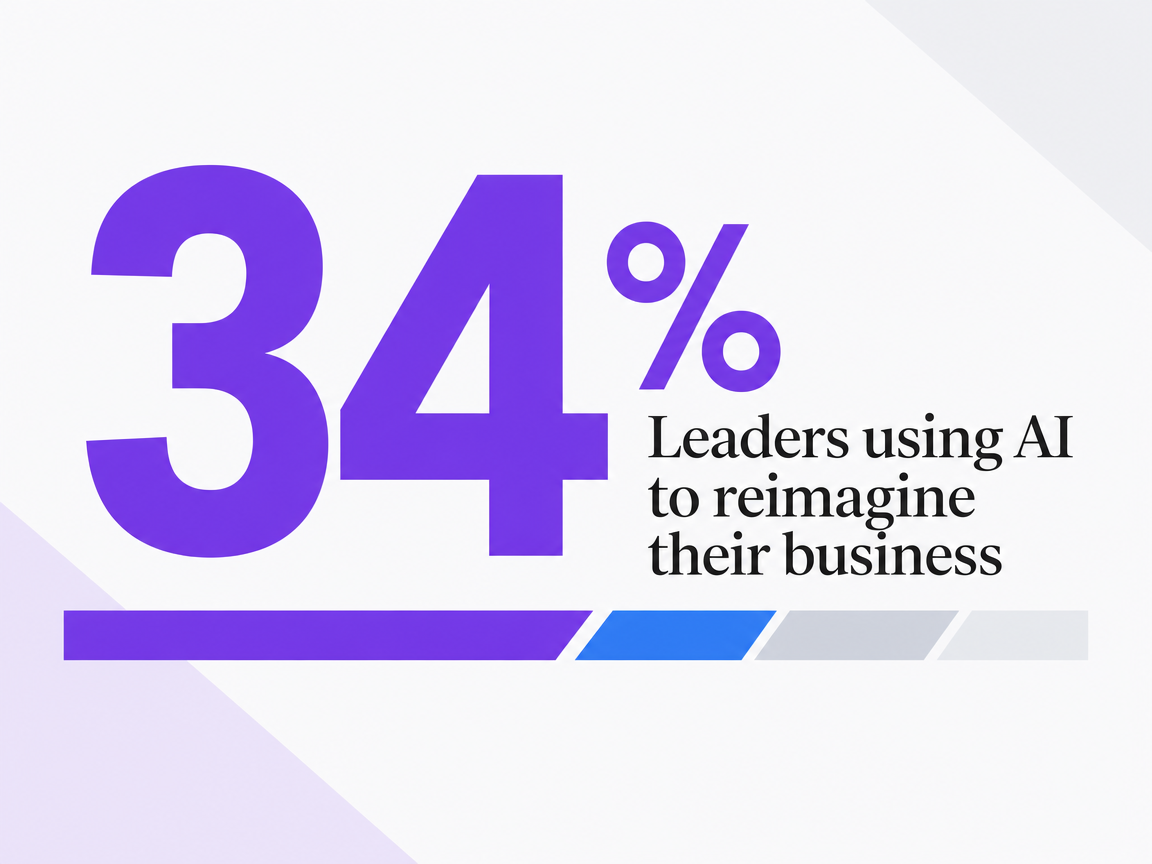 Leaders using AI to reimagine their business
Leaders using AI to reimagine their business
Frequently Asked Questions
References
- 1.2026 ServiceNow Workflow Automation Outlook.
- 2.The future of the marketing function: From execution to AI-orchestrated growth.
- 3.Economic potential of generative AI.
- 4.A marketing organization that thrives with AI.
- 5.AI Risk Management Framework.
- 6.The State of AI in the Enterprise - 2026 AI report.
- 7.15 Best Rank Tracking Software We're Using for 2026.
- 8.10 best rank tracking tools for agencies in 2026 - The Business Rover.
- 9.Ahrefs vs Moz vs Semrush Comparison for 2026.
- 10.Ahrefs vs Moz vs Semrush (2026) — Which is Best?.
- 11.Semrush vs Ahrefs vs Moz 2026: My Honest Take After Years ....
- 12.The new Search Console Insights report is here.
- 13.Introducing Search Generative AI performance reports in Search Console.
- 14.Best Enterprise SEO Software: 15 Platforms Compared (Pricing ...).
- 15.6 Best Rank Tracker Tools for Agencies in 2026 (Tested & Approved).