
Key Takeaways
- Agencies hit a coordination ceiling between 30 and 50 clients, where recommendations outrun strategist capacity and the bottleneck shifts from data to execution throughput.
- Modern ranking SEO software is a three-layer stack — visibility intelligence, content operations, and AI execution — evaluated by clients-per-strategist leverage rather than feature parity.
- Layer one, visibility intelligence from Forrester Wave incumbents, produces audits, forecasts, and prioritized recommendations but stops short of drafting, publishing, or absorbing production work 9.
- Layer two, content operations platforms, compresses the brief-to-publish middle of the loop and can reclaim roughly 11 hours per strategist per week on routine deliverables 8.
- Layer three, AI execution platforms with approval gates, accelerates campaign creation ten to fifteen times while keeping strategists in the loop as reviewers rather than producers 4.
- Consolidation math shows execution's share of marketer time can drop from 60–70% to 10–15% when always-on orchestration engages, expanding portfolio capacity per FTE 3.
- Governance under NIST's AI RMF Generative AI Profile and FTC enforcement against Rytr and Content at Scale makes audit trails and substantiated claims non-negotiable for agency vendors 5, 6, 7.
- Assembling a shortlist for 15–150 client portfolios means pairing one visibility incumbent, one content ops platform, and one AI execution layer scored on the same throughput questions.
The coordination ceiling agencies hit around 30 clients
Most agency SEO stacks are built for visibility, not for throughput. A Head of SEO running fifteen clients can keep the audit-brief-produce-publish-measure loop moving with a rank tracker, a crawler, and a shared editorial calendar. Somewhere between thirty and fifty active accounts, that loop breaks — not because the data thins out, but because coordination overhead grows faster than headcount. Briefs stall. Publishing cadence slips. Strategist utilization drops even as pipeline grows.
McKinsey quantifies the underlying pattern across marketing functions broadly: marketers currently spend 60 to 70 percent of their time on execution tasks, and always-on AI orchestration can compress that share to as little as 10 to 15 percent, with roughly a 30 percent lift in marketing ROI when workflows are rewired around AI capabilities 3. That is not a rank-tracking finding. It is an execution-capacity finding, and it maps directly onto what an agency SEO lead is actually managing across a portfolio.
Reframed that way, the shortlist question changes. "Best ranking SEO software" stops meaning "which tool surfaces the cleanest keyword data" and starts meaning "which platform absorbs the coordination load so specialists can spend their hours on strategy and QA rather than status updates." The rest of this piece works through that shortlist in three layers — visibility intelligence, content operations, and AI execution — and evaluates each by client-per-strategist leverage rather than feature parity.
Why 'ranking software' is now a three-layer stack
Forrester's 2025 SEO Solutions Landscape defines the enterprise category by four core capabilities: auditing site content and structure, identifying and valuing ranking opportunities, forecasting outcomes, and managing the SEO process at scale across complex web properties 10. That definition is useful, but it also reveals what the category no longer covers on its own. Auditing and forecasting produce recommendations; they do not produce briefs, drafts, technical fixes, or published pages. For an agency running dozens of clients, the recommendations layer is table stakes. The gap is everything downstream.
A more accurate picture of the 2025 shortlist is a three-layer stack. The first layer is visibility intelligence — the Forrester Wave incumbents evaluated across 21 criteria including technical audits, keyword discovery, rank tracking, and performance measurement 11. These platforms tell an agency what to work on. The second layer is content operations: brief templating, editorial workflow, assignment routing, QA checkpoints, and publishing handoffs. This layer converts recommendations into scheduled work. The third layer is AI execution with human approval gates — platforms that draft, optimize, and stage the actual deliverables, then route them for strategist sign-off before anything ships.
Forrester's own framing supports the stack view rather than a single-vendor view. The firm argues every company now needs an SEO platform to meet modern search demand, and its Wave-featured vendors concentrated on audit, forecasting, and security capabilities 9 — not on execution throughput. Agencies scaling past thirty clients need all three layers running in coordination, which is why the shortlist that follows evaluates tools by where they sit in the stack, not by which one wins a feature-parity contest. A visibility platform without a content ops layer produces recommendations that pile up unread. A content ops layer without an execution engine produces briefs faster than strategists can staff them. The layers are complements, and the ranking question is which combination compresses the loop for a given client mix.
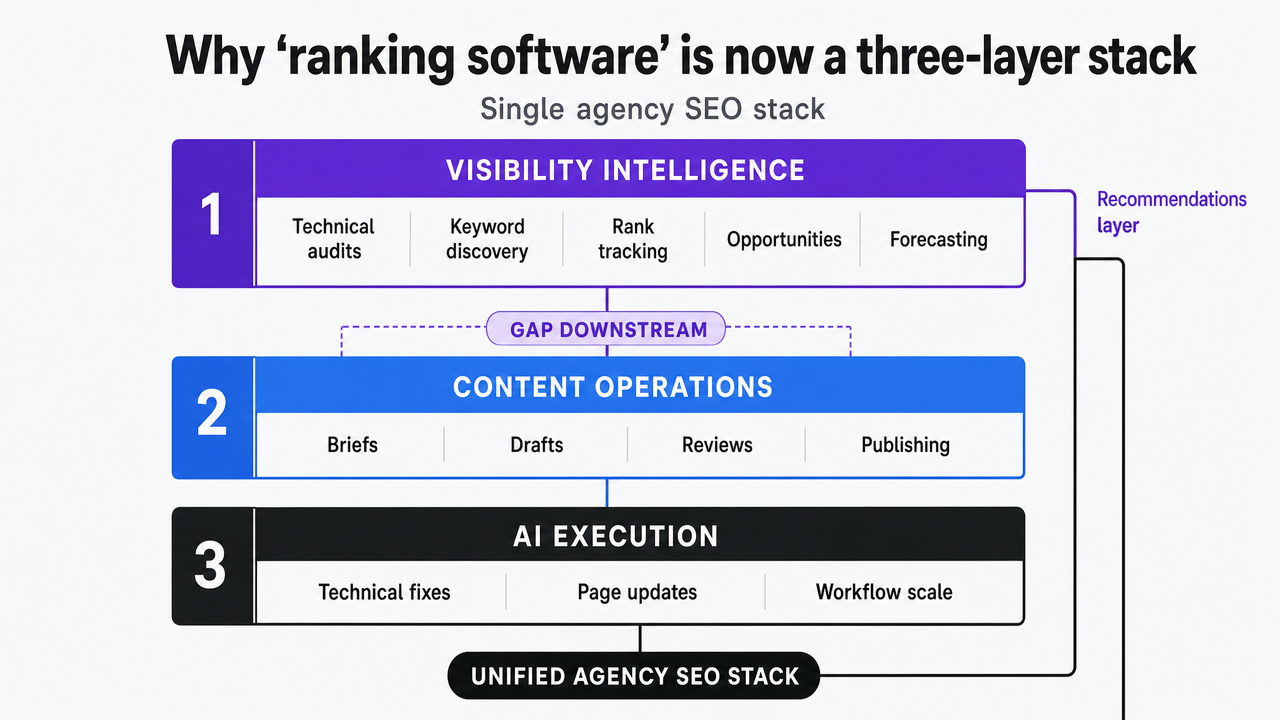 Visualize the three-layer stack framework introduced in this section, showing how visibility intelligence, content operations, and AI execution layers combine into a single agency SEO stack
Layer one: visibility intelligence platforms
What Forrester Wave incumbents actually deliver
The visibility layer is the most mature part of the stack, and its capability set is well-defined. Forrester's 2018 Wave scored SEO platforms against 21 criteria covering technical site audits, keyword discovery, rank tracking, competitive analysis, and performance measurement, weighted alongside strategy and market presence 11. Those criteria still describe what an agency gets when it licenses a seat on BrightEdge, Conductor, seoClarity, Botify, Semrush Enterprise, or Ahrefs at the enterprise tier. The tools crawl client sites, surface technical debt, cluster keyword opportunities by topic and intent, forecast traffic gains from specific fixes, and monitor SERP movement across markets.
Forrester's 2025 Landscape sharpens the definition further: enterprise SEO platforms exist to audit content and structure for natural-search visibility, identify and value ranking opportunities, and manage the SEO process across complex web properties 10. For an agency running dozens of clients, that translates into a single pane of glass for portfolio-wide crawl health, a queue of prioritized recommendations per domain, and defensible forecasts to bring into QBRs. The reporting substrate is genuinely strong. Where AI has entered these platforms, it mostly powers keyword clustering, content scoring against SERP competitors, and anomaly detection on rankings — not draft production or publishing.
Where enterprise visibility tools stop scaling for agencies
The ceiling shows up when recommendations outrun production capacity. A visibility platform can generate a hundred prioritized on-page fixes and thirty new topic clusters for a single mid-sized client in an afternoon. Multiply that across forty accounts and the strategist queue collapses. Forrester itself notes that its Wave-featured vendors concentrated on audit, forecasting, and security capabilities 9 — the diagnostic side of the loop, not the execution side.
Two other constraints matter for agency economics. First, seat-based licensing at the enterprise tier scales with users, not with clients served, so adding a new account rarely triggers a proportional platform cost, but it does trigger a proportional strategist-hour cost that the platform does not absorb. Second, the 2018 Wave criteria predated generative AI entirely 11, which means the incumbents' native workflows still assume a human writer receives the brief, drafts the page, and hands it back for QA. Newer platform releases have added AI writing assists, but the primary interaction model remains human-driven production against a machine-generated recommendation list.
Visibility intelligence belongs in the shortlist. It does not, on its own, move the throughput needle past the coordination ceiling. That job falls to the next two layers.
Test Real Ranking Gains With Full Access
Experience live ranking improvements on active client projects before making a commitment.
Layer two: content operations platforms
Brief-to-publish workflow as the real bottleneck
Recommendations are cheap. Published pages are not. The step that consumes strategist hours across a portfolio is the middle of the loop — turning a keyword cluster into a brief, routing that brief to a writer, running QA against on-page recommendations from the visibility layer, applying schema and internal links, and pushing the final asset into a CMS on a defensible cadence. Content operations platforms exist to compress that middle.
The category includes tools like Contentful, Sanity, and Storyblok on the headless CMS side, plus workflow-focused platforms such as Airtable, Asana, and specialized editorial systems like Parsely, StoryChief, and Narrato. What they share is a data model built around the asset lifecycle rather than around keywords. A brief is a record with owners, due dates, dependencies, and approval states. A published page is a record with performance signals attached. The platform's job is to keep dozens of these records moving in parallel without a strategist manually chasing status.
Deloitte's research puts a number on the leverage available at this layer: content marketers using generative AI for simpler deliverables reclaimed an average of 11 hours per week 8. That figure covers routine drafting and reformatting inside content ops workflows, not full autonomous execution. For an agency, 11 hours reclaimed per strategist per week is the difference between forty clients and fifty, assuming the reclaimed hours are redirected into QA and strategy rather than reabsorbed into more meetings.
Evaluating content ops tools by throughput per strategist
Feature checklists mislead at this layer. Two platforms can offer identical brief templating and approval routing and produce radically different throughput depending on how they handle three things: brief generation from visibility-layer inputs, QA loops against on-page targets, and CMS publishing without manual copy-paste. Those three integration points determine whether a strategist manages ten active briefs or forty.
Brief generation matters most. If the content ops platform ingests keyword clusters, SERP analyses, and on-page recommendations from BrightEdge, Conductor, or Semrush and produces a structured brief without a human retyping the inputs, one strategist can originate five to ten briefs a day. If not, brief creation stays a two-hour task per asset and the platform is a project tracker with better UI.
QA is the second lever. Platforms that surface real-time content scoring against target queries — the way MarketMuse, Clearscope, and Frase operate inside editorial workflows — let strategists approve or reject drafts against numeric thresholds rather than re-reading every paragraph. Publishing is the third. Native CMS connectors to WordPress, HubSpot, Webflow, and headless systems remove the last manual handoff.
Agencies evaluating this layer should score candidates on briefs originated per strategist per day, QA cycles per asset before publish, and mean time from brief to published page. Those metrics predict portfolio capacity. Feature counts do not.
Layer three: AI execution platforms with approval gates
Agentic workflows and what they compress
The execution layer is the newest part of the stack and the least understood. It sits downstream of visibility recommendations and content ops routing, and its job is to draft, optimize, and stage deliverables that a strategist then reviews. What distinguishes it from a writing assistant embedded inside a CMS is the coordination model. Agentic workflows treat content production as a sequence of specialized tasks — keyword expansion, SERP analysis, outline generation, draft, on-page optimization, schema application, internal linking — and assign each task to a purpose-built agent operating against structured inputs from the layers above.
McKinsey estimates that agentic systems will accelerate the creation and execution of marketing campaigns by ten to fifteen times 4. That figure covers end-to-end campaign work, not isolated drafting, and it assumes human oversight remains in the loop. Paired with Deloitte's finding that content marketers using generative AI for simpler deliverables reclaim an average of 11 hours per week 8, the two benchmarks bracket the throughput case: routine content work compresses from days to hours, and full campaign cycles compress from weeks to days.
For an agency lead running forty accounts, the operational consequence is a shift in where strategist hours land. Less time drafting from scratch. More time reviewing agent output, adjusting priorities, and defending recommendations to clients.
Shortlist criteria: approval gates, specialist coordination, throughput
Three criteria separate serious execution platforms from wrapper products. The first is the approval gate itself. A platform without a hard sign-off checkpoint before publishing is a liability in regulated verticals and a reputational risk in unregulated ones. The gate should route each deliverable — draft, technical fix, schema change, internal link update — to a named strategist with the underlying reasoning attached, and it should block execution until that strategist approves or rejects. Nothing should ship on autopilot.
The second criterion is specialist coordination. Content, on-page SEO, technical SEO, backlinks, and analytics are distinct disciplines with different decision logic. A single generalist agent producing generic output collapses that distinction and reintroduces the QA burden the platform is supposed to remove. Platforms that separate concerns into specialist agents — each with its own inputs, prompts, and output format — let a strategist review by discipline rather than by asset.
The third criterion is measurable throughput. The right questions during evaluation are concrete: how many net-new pages does the platform produce per week per client at acceptable quality, what percentage of drafts pass first-round review, and what is the mean time from approval to published asset. Answers to those three questions predict portfolio capacity more reliably than any feature list.
Named options in the AI execution layer
The execution layer is still consolidating, and the shortlist reflects that. Jasper positions itself around brand-governed content generation with team workflows, and it fits agencies that need volume drafting inside an existing content ops platform rather than end-to-end SEO execution. Writesonic and Copy.ai occupy adjacent ground with lighter governance. None of these are full execution platforms in the agentic sense — they produce drafts, not coordinated deliverables across specialties.
Closer to the agentic model, Relevance AI and Lindy let agencies compose custom agent workflows that chain research, drafting, and publishing steps, though the burden of designing and maintaining those chains falls on the agency. AirOps and MachineWriter target SEO-specific pipelines with SERP-aware drafting and CMS connectors, and both are credible for scaling content production against visibility-layer recommendations.
Vectoron sits in this layer with a different structural choice: six specialist agents — content, SEO, PPC, backlinks, social, and call intelligence — coordinated through a single Command Center where every recommendation and every deliverable routes for human approval before execution. The tradeoff is scope. An agency that only needs SEO drafting will find a narrower tool sufficient. An agency running SEO alongside paid, backlinks, and call tracking across a client portfolio benefits more from cross-channel coordination in a single approval loop. Either way, the evaluation criteria stay constant: approval gates, specialist separation, and measurable throughput per strategist.
Consolidation economics: modeling clients per strategist
The economics conversation shifts here from single-agency operations to multi-client portfolio math. A Head of SEO managing forty accounts is not optimizing one workflow; they are optimizing the ratio of active clients to strategist FTEs. Every hour reclaimed from execution and returned to strategy or QA raises that ratio, and every reclaimed hour reabsorbed into internal meetings does not.
Three sourced benchmarks bracket the leverage available across the stack. Content operations tooling at the middle layer reclaims roughly 11 hours per strategist per week on routine deliverables 8. Always-on orchestration at the execution layer compresses execution's share of marketer time from 60 to 70 percent down to 10 to 15 percent 3. Agentic workflows accelerate full campaign creation and execution by ten to fifteen times with human oversight in the loop 4. Stacked together, they describe a portfolio ceiling that moves up as each layer engages.
| Layer engaged | Sourced benchmark | Implied capacity signal per strategist |
|---|---|---|
| Visibility only | Baseline (Forrester Wave criteria) 11 | Recommendations produced; production capacity unchanged |
| + Content operations | ~11 hours/week reclaimed 8 | Reclaimed hours redirected into QA and brief origination |
| + AI execution | Execution share 60–70% → 10–15% 3; 10–15x campaign acceleration 4 | Strategist role shifts from producer to reviewer |
The variables an agency should plug in are its own: loaded strategist FTE cost, current active client count, mean revenue per client, and current briefs-to-publish cycle time. The benchmarks say what is achievable at each layer. The math says whether a given portfolio clears the coordination ceiling with the strategists already on staff.
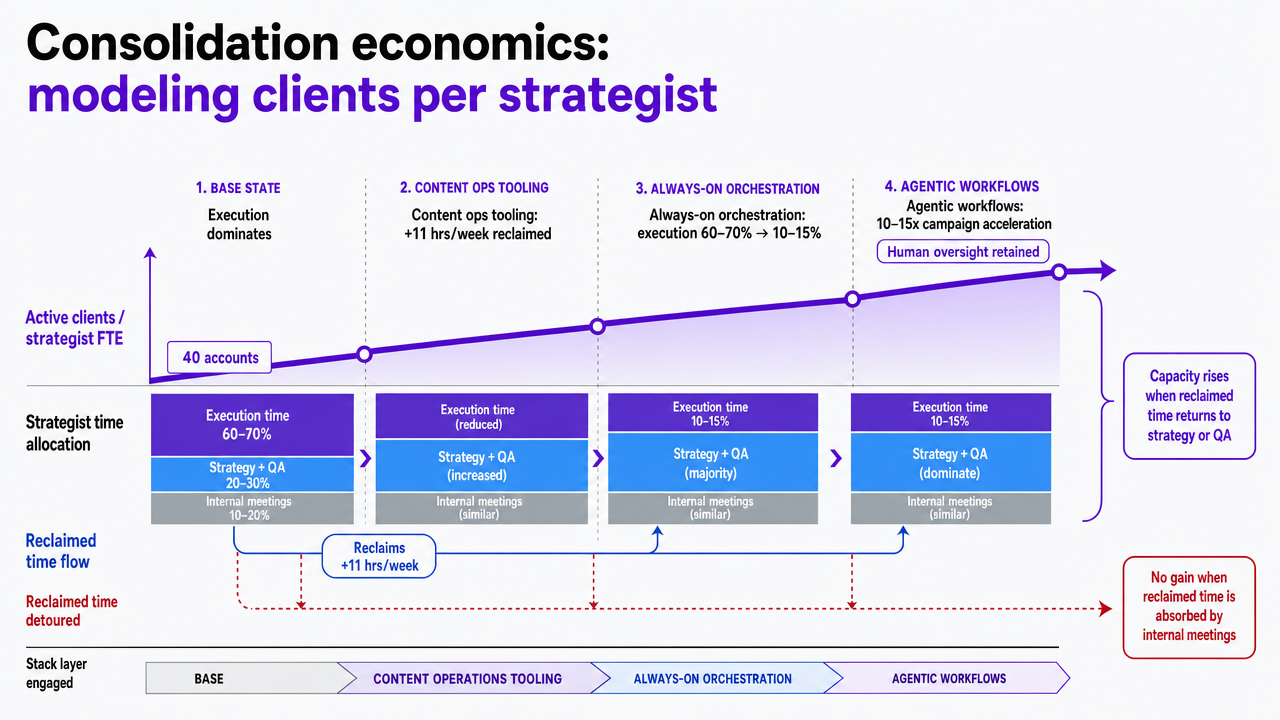 Reinforce the sourced throughput benchmarks presented in the section's comparison table, showing how each stack layer engaged shifts strategist capacity
See How Leading Agencies Scale SEO With Unified, Data-Driven Execution
Connect to learn how a multi-specialist, AI-powered platform streamlines SEO delivery and approval workflows across all client accounts—without increasing FTE or compromising on quality control.
Governance: NIST AI RMF and the FTC's line on AI marketing claims
Governance is where AI execution platforms either earn their place in an agency stack or get quietly deprecated after the first client incident. Two reference points define the current line. NIST's AI Risk Management Framework provides the technical governance baseline, and its Generative AI Profile — released July 26, 2024 — extends the framework to address risks specific to generative systems, including validation, monitoring, and content provenance controls 5. Agencies serving law firms, behavioral health providers, dental groups, and healthcare clients should treat the RMF as the minimum documentation standard their platform vendors need to support, not an optional overlay.
The enforcement side is where the risk becomes concrete. In December 2024, the FTC approved a final order against Rytr on the grounds that its service gave subscribers the means to generate false and deceptive online reviews 6. The Content at Scale order goes further into vendor territory, barring misleading claims about AI content detection accuracy and related representations 7. Read together, the two orders draw a line agencies need to respect during vendor due diligence: AI-produced assets must be truthful and substantiated, and platform performance claims — detection rates, quality scores, ranking guarantees — need evidence behind them.
For an agency Head of SEO, the operational takeaway is a short checklist applied once per vendor. The platform's approval gate must produce an audit trail identifying who approved each deliverable and when. Training data provenance, model update logs, and human-review records need to be retrievable per client. And any performance claim the platform makes in its own marketing — or that a strategist repeats to a client — must have documented substantiation. Governance framed this way is not a compliance drag on throughput. It is what keeps the throughput gains from becoming enforcement exposure.
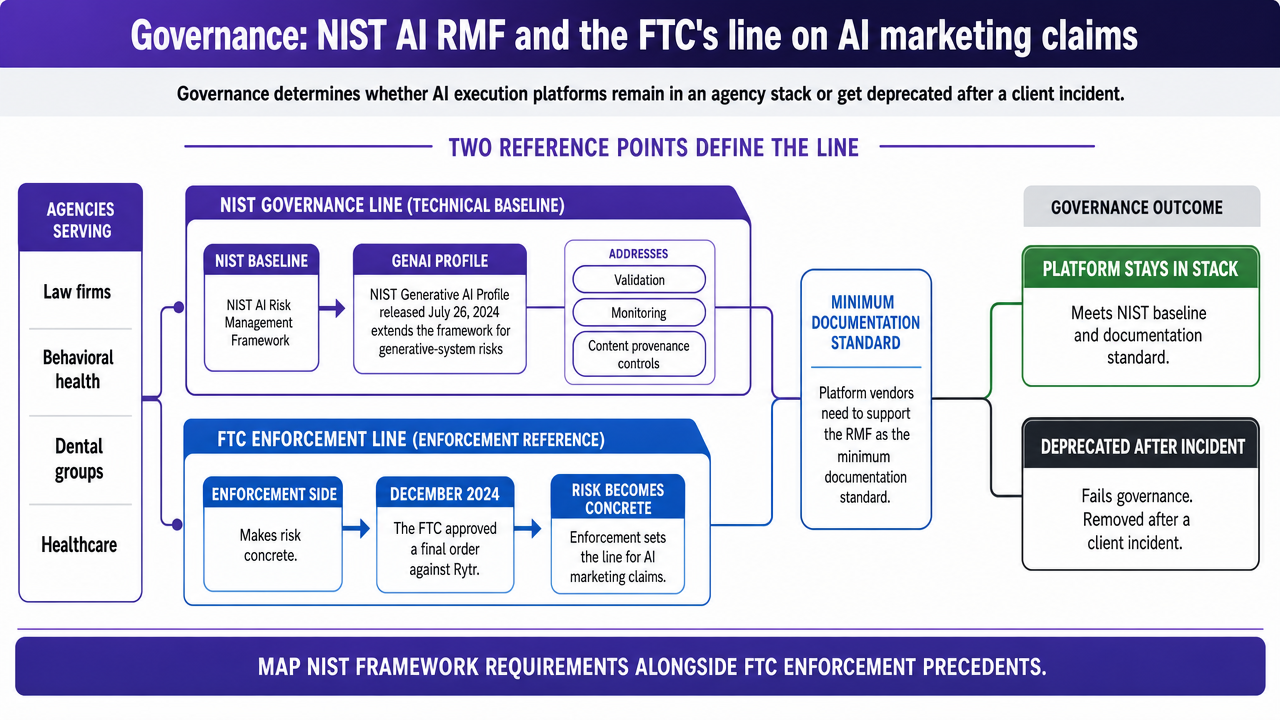 Visualize the governance checklist and enforcement line described in the section, mapping NIST framework requirements alongside FTC enforcement precedents
Assembling the shortlist for a 15–150 client portfolio
The right stack varies with portfolio size, but the assembly logic is consistent. Below fifteen clients, a single visibility platform plus a spreadsheet-grade workflow tool usually clears the loop. Between fifteen and forty, the middle layer earns its keep — a dedicated content operations system that ingests recommendations from BrightEdge, Conductor, or Semrush Enterprise and routes structured briefs to strategists and writers without retyping. This is where the eleven hours per week Deloitte documented on routine deliverables 8 convert into portfolio capacity rather than reabsorbed meeting time.
Past forty accounts, the AI execution layer becomes the deciding factor. Marketing and sales adoption of generative AI more than doubled between 2023 and 2024 2, which means the vendor field has widened but the evaluation criteria have not changed: approval gates, specialist separation, measurable throughput per strategist. Agencies serving law firms, behavioral health, and healthcare clients should add governance documentation to the shortlist filter before pricing.
A defensible 2025 shortlist typically pairs one visibility incumbent, one content ops platform, and one AI execution platform — Jasper, AirOps, Relevance AI, or Vectoron among them — evaluated against the same three throughput questions rather than compared feature-by-feature.
Frequently Asked Questions
References
- 1.Economic potential of generative AI.
- 2.The state of AI in early 2024: Gen AI adoption.
- 3.The future of marketing in the age of AI | McKinsey.
- 4.Reinventing marketing workflows with agentic AI.
- 5.AI Risk Management Framework.
- 6.FTC Approves Final Order against Rytr, Seller of an AI Testimonial & Review Service Providing Subscribers with the Means to Generate False or Deceptive Reviews.
- 7.Decision and Order.
- 8.AI―.
- 9.Every Company Needs An SEO Platform.
- 10.The Search Engine Optimization Solutions Landscape, Q1 2025.
- 11.The Forrester Wave™: Search Engine Optimization (SEO) Platforms, Q3 2018.