
Key Takeaways
- Treat a client migration as a URL-by-URL transfer of canonical authority, not a domain-level forwarding switch, because that early decision governs every downstream outcome.
- Default to 301 for content URLs and 308 for method-sensitive endpoints like APIs and form handlers; both preserve ranking signals when implemented as direct server-side responses 1, 5.
- Eliminate redirect chains before cutover, audit Cache-Control headers, reject dynamic destinations that accept query parameters, and keep canonicals, internal links, and sitemap lastmod values consistent with the new URLs 2, 8, 10.
- Maintain redirects for at least one year and monitor both Search Console properties through the recrawl window, since medium and larger sites can take weeks or longer to fully reindex 2.
The Migration Decision That Governs Every Other Migration Decision
A client site move's success or failure hinges on an early choice: whether the team treats the 301 redirect as a simple domain-level forwarding switch or as a meticulously mapped, tested transfer of canonical authority for every crucial URL from the old property. This distinction is not merely theoretical. Google's site-move guidance explicitly states that old URLs should be mapped to their corresponding new URLs, redirects should be direct and server-side, and redirect chains must be avoided 2. A single wildcard rule pointing to a new homepage fails to meet these requirements.
The 301 status code itself conveys a precise promise. RFC 9110 defines it as a signal that the target resource has been permanently assigned a new URI, delivered with a Location header indicating the preferred destination 3. Google, in turn, interprets permanent server-side redirects as the clearest signal for consolidating old and new URLs into a single canonical. It also confirms that 301 and other permanent redirects do not result in a loss of ranking signals 1.
Every subsequent step in a migration—including cache behavior, Search Console configuration, sitemap discipline, recovery windows, and the senior hours consumed by a portfolio—is influenced by the correctness of this initial decision. The remainder of this article explores these layers sequentially.
What a 301 Actually Promises: HTTP Semantics vs. Google's Ranking Behavior
The Protocol Contract: 301, 308, and the Location Header
The HTTP standard defines 301 Moved Permanently as a response indicating that the target resource has been assigned a new permanent URI. It instructs the server to generate a Location header containing the preferred URI reference for the destination 3. This constitutes the entire protocol contract: a status code plus a header specifying the resource's new location. MDN clarifies the practical outcome for user agents: a browser receiving a 301 automatically requests the resource at the URL provided in the Location header 4.
The 308 Permanent Redirect carries the same permanence signal but with an operational difference crucial for non-HTML endpoints. MDN's redirection guide notes that 301 behavior for methods other than GET can vary across user agents, whereas 308 is designed to preserve the original request method 5. For a client site move primarily involving GET requests to content URLs, this difference is rarely significant. However, for APIs, form endpoints, and POST-driven flows migrated during the same cutover, it becomes a critical factor for separate testing of non-HTML endpoints.
Neither status code addresses search rankings. RFC 9110 defines protocol semantics, not indexing behavior. Ranking transfer is a search engine's decision, layered on top of the HTTP response, and must be evaluated against Google's own documentation rather than inferred from the specification 3.
How Google Interprets Permanent Redirects in Search
Google interprets a permanent server-side redirect as the clearest signal that the destination URL should replace the source in Search. Its redirect documentation states that 301 and 308 responses signify a page has permanently moved, and Google tracks both the redirect source and target when determining the canonical URL for the consolidated resource 1. The old URL is not discarded; instead, it contributes as a signal to the canonical selection process for the new one.
Google also confirms a crucial outcome for agency leads: permanent redirects, including 301 and 308, do not result in a loss of PageRank 1. This claim is specific and warrants precise understanding. It applies to correctly implemented permanent server-side redirects, not to client-side meta refreshes, JavaScript hops, or "crypto redirects," which Google supports as fallbacks but considers less reliable than server-side responses 1.
During and after cutover, Google's site-move guidance sets expectations for the transfer window. Temporary ranking fluctuations are normal while Google recrawls and reindexes moved URLs. Medium-sized sites may require several weeks or longer for new URLs to fully appear in Search, with larger sites taking even more time 2. While signal transfer is preserved, the timeline is not instantaneous.
301 vs. 302 vs. 307 vs. 308 for Migration Work
The choice among 301, 302, 307, and 308 for a client migration boils down to two questions: is the move permanent, and does the endpoint require the request method to be preserved? Google recommends permanent server-side redirects whenever possible when changing the URL shown in search results, identifying 301 and 308 as the codes signaling permanent movement 1. Temporary redirects should be reserved for cases where the original URL should remain in search results, which is not the objective during a site move 1.
A concise comparison clarifies the decision:
| Status | Permanence signal | Method preservation | Canonical consolidation in Google Search | Recommended migration use |
|---|---|---|---|---|
| 301 | Permanent 3 | Not guaranteed across user agents for non-GET methods 5 | Yes; source and target used to select canonical 1 | Default for content URL moves 1 |
| 302 | Temporary 5 | Not guaranteed 5 | Old URL retained in Search 1 | Not appropriate for a permanent move 1 |
| 307 | Temporary 5 | Preserved 5 | Old URL retained in Search 1 | Not appropriate for a permanent move 1 |
| 308 | Permanent 3 | Preserved 5 | Yes; treated equivalently to 301 for permanence 1 | Method-sensitive endpoints migrated in the same cutover 5 |
The operational guidance is straightforward. Content URLs should be moved with 301 redirects. API endpoints, form handlers, and other method-sensitive routes migrated as part of the same project should use 308 to prevent POST and PUT requests from being silently converted to GET during the redirect 5. Any temporary redirects—for A/B tests, seasonal takeovers, or staged rollouts that will be reversed—should use 302 or 307 and not be included in the migration redirect map.
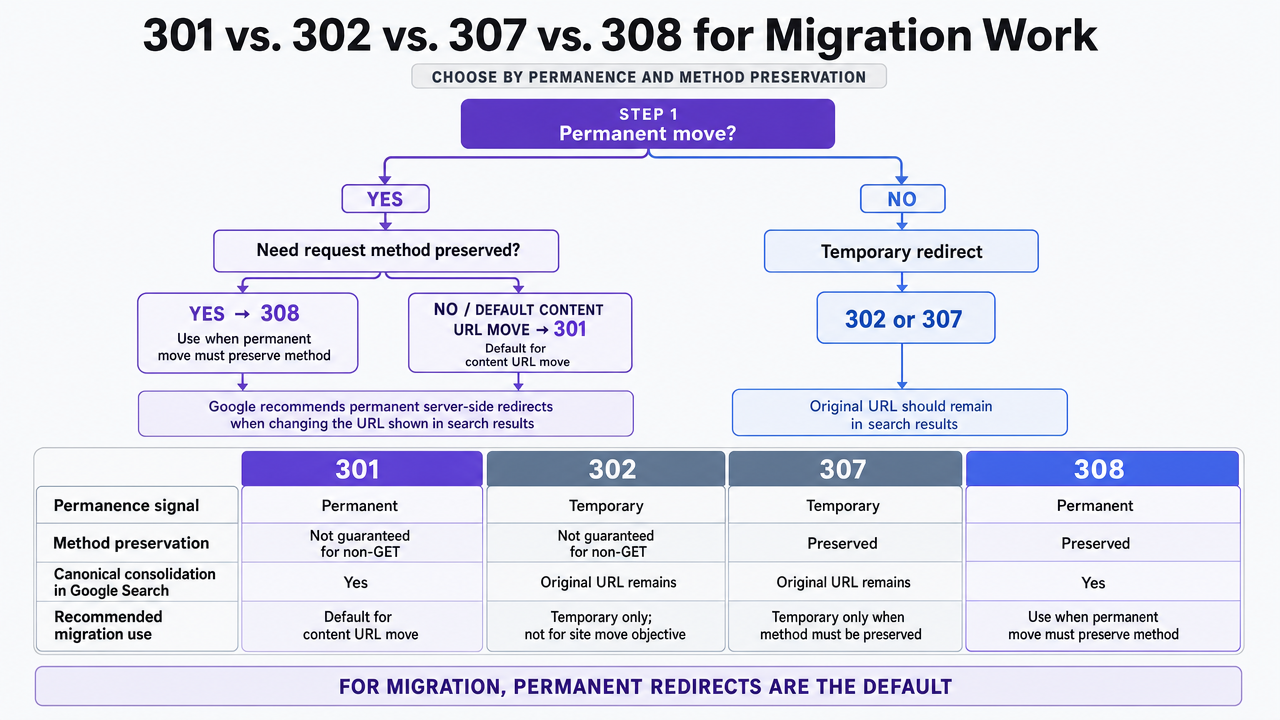 Visualize the section's comparison table of HTTP redirect status codes to help readers quickly distinguish which code to use for which migration scenario
Test 301 redirect strategies on real sites now
Validate the SEO impact of 301 redirects before committing to full-scale site migrations.
Treat the Move as a URL-by-URL Transfer, Not a Domain Forward
Building the Old-to-New URL Inventory
The critical artifact determining a migration's outcome is the mapping file, not the redirect rule. Google's site-move documentation is explicit: map old URLs to their corresponding new URLs, then implement direct server-side permanent redirects based on that map 2. The mapping must precede the rule, and the rule must accurately reflect the mapping.
A robust inventory should be built from multiple sources, not just a single crawl. Server access logs reveal URLs actually requested by Googlebot and users, including long-tail pages a crawler might miss from the current internal-link graph. XML sitemaps provide URLs explicitly declared by the client. Search Console performance data identifies URLs generating impressions and clicks that must be preserved during the move. A production crawl reconciles these three sources. Any URL appearing in logs, sitemaps, or Search Console but missing from the crawl should be reviewed for orphan status before cutover.
Each entry in the mapping should point to the closest topical equivalent on the new property, not simply to the domain root. Google's guidance recommends testing individual URLs with URL Inspection and validating large URL sets using command-line tools or scripts 2. This validation is only effective if the map itself is comprehensive. Pages without an equivalent should return a 410 status code or map to the nearest parent category, with editorial justification recorded in the mapping file for future audits.
Direct Redirects Only: Eliminating Chains Before Cutover
Google's site-move guidance specifically identifies redirect chains as a failure mode to avoid, instructing teams to implement direct redirects from the old URL to the final destination 2. This is an operational requirement, not merely a suggestion. Each hop between the requested URL and the final response represents an additional HTTP request the browser must make before retrieving the destination resource. Web.dev flags this additional request as a direct cause of slower page load 11. A migration that layers a new domain rule on top of an existing HTTP-to-HTTPS rule, which is then layered on top of a trailing-slash normalization rule, inadvertently creates a three-hop chain.
The performance cost is quantifiable, not speculative. Navigation Timing exposes redirectStart, redirectEnd, and redirectCount, which web.dev identifies as metrics for quantifying redirect delay in the field 7. The interval between redirectStart and redirectEnd increases with each hop and occurs before Time to First Byte begins, which web.dev highlights as an often-overlooked source of added latency, particularly for chains 6, 7.
Latency added by redirect hops, measured via Navigation Timing (redirectEnd − redirectStart) 6, 7, 11.
| Hops | Additional HTTP requests before destination | Redirect interval contribution to TTFB |
|---|---|---|
| 0 (direct) | 0 | None |
| 1 | 1 | One round trip added 11 |
| 2 | 2 | Two round trips added, compounding 7 |
| 3 | 3 | Three round trips added; flagged as avoidable 6 |
The pre-cutover check involves a script that requests every source URL in the mapping and records the sequence of status codes until a 200 is received. Any sequence longer than one redirect must be rewritten at the rule level before launch. Same-origin chains are within the client's control and should be collapsed; web.dev specifically recommends eliminating same-origin redirects where possible 6.
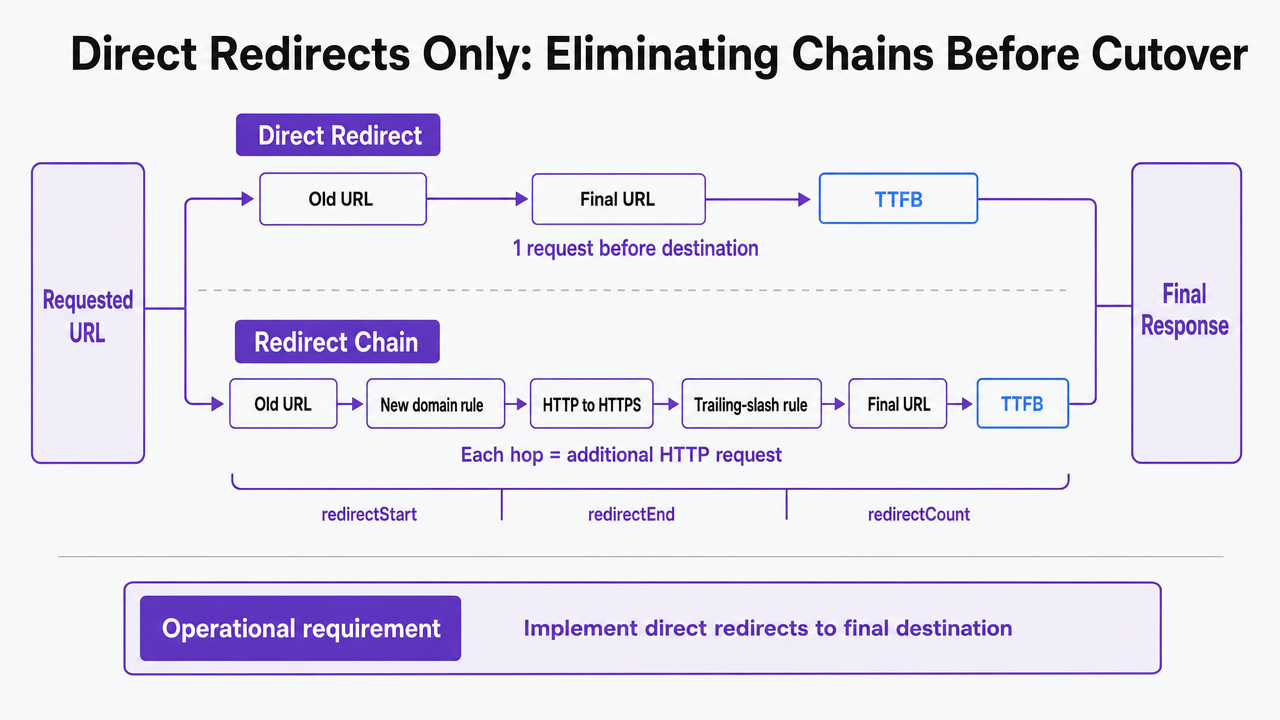 Illustrate the process-oriented cost of redirect chains referenced in the section, showing how each additional hop adds a round trip before TTFB
Canonicals, Internal Links, and Sitemap Lastmod Discipline
A correct 301 map is necessary but not sufficient. The signals surrounding the redirect must be consistent, otherwise the migration sends Google conflicting instructions. Canonical tags on new URLs should point to themselves, not back to the old property. Internal links across navigation, footers, in-body anchors, hreflang clusters, and structured data should reference the new URLs directly, rather than routing through the redirect layer. Every internal hop that resolves via a 301 creates an internal chain that both the crawler and the user must contend with. Web.dev's guidance to eliminate avoidable same-origin redirects applies equally to internal links as it does to external campaign URLs 6.
The new sitemap should be submitted after cutover, and its lastmod values must reflect actual page modification dates in W3C Datetime format, as specified by the Sitemap Protocol 9. Regenerating a sitemap with the current date for every URL misuses this field and diminishes its value as a recrawl hint. Accurate lastmod values highlight the URLs that genuinely changed during the move, which will be most of them at cutover and a much smaller subset in the subsequent weeks.
A short interim sitemap of the old URLs, kept accessible until Google has processed the redirects, aids in the discovery of the redirect responses themselves. Google's site-move documentation treats sitemap submission as an integral part of the migration sequence, not an afterthought 2. The mapping file, redirect rules, canonical tags, internal-link updates, and sitemap must all point to the same set of destinations. Any inconsistency in these layers will slow down the transfer process.
Cutover, Cache, and Security Realities Agencies Underestimate
Cache Invalidation Windows That Delay Visible Redirect Changes
A redirect rule is deployed instantly, but the response users and crawlers see is not. RFC 9111 defines HTTP caches as intermediaries governed by response headers that determine whether a stored response can be reused, specifying the fields that control freshness and cacheability 10. A 301 sent yesterday with a long Cache-Control max-age can continue to be served from a browser cache, a CDN edge, or a corporate proxy long after a deployment corrects the destination. The rule change is real; the visible effect is delayed.
Two failure modes frequently occur during cutover:
- If a pre-migration 301 pointed old URLs to an interim landing page and was aggressively cached, it will continue sending returning visitors and some intermediaries to that interim page even after the true destinations go live.
- Similarly, a wildcard redirect flipped at cutover, then patched hours later to fix a mapping error, may continue routing a fraction of traffic to the broken destination until cached responses expire.
The pre-cutover check involves auditing Cache-Control headers on every redirect response in the migration set and shortening max-age values in the days leading up to launch. Purging CDN caches on the source hostname at cutover is standard practice; however, planning for browser and downstream proxy caches that the team cannot purge is what distinguishes a clean launch from a week of intermittent reports 10.
Open-Redirect and Wildcard Risk Introduced During Migration
Migration work expands the attack surface for a class of vulnerabilities unrelated to search visibility. OWASP defines unvalidated redirects as those where attacker-controlled input determines the destination. It warns that attackers can modify an untrusted redirect destination to send users to a malicious site while making the link appear to originate from a trusted domain 8. A migration rule that accepts a query parameter such as ?next= or ?url= to preserve deep-link continuity precisely matches the pattern OWASP flags.
Wildcard rules carry a similar risk. A regex that forwards /old-path/(.*) to /new-path/$1 is safe when the destination is a fixed hostname on the client property. However, the same pattern becomes dangerous if the captured segment can influence the hostname, if an editor can inject values into the rule through a CMS field, or if the redirect table is generated from a database column that also accepts user input. OWASP's recommendation is server-side mapping against a strict allowlist, not dynamic destinations derived from request data 8.
The operational rule for a client migration is that every redirect destination must resolve to an entry in the static mapping file. Query parameters are preserved through the redirect, not used to select it. Any dynamic redirect endpoint introduced during the move must undergo a security review before cutover, not afterward 8.
Search Console Change-of-Address and the Monitoring Window
Search Console configuration is a specific step in Google's site-move sequence. When content is migrated to a new domain or subdomain, the Change of Address tool signals the move to Google, complementing the existing redirect and canonical layers 2. Both the old and new properties should be verified in Search Console before cutover so the tool can be used at launch and both sides can be monitored afterward.
The monitoring window is often where agencies underinvest. Google's guidance explicitly states that temporary ranking fluctuations are normal during recrawl and reindexing, and that medium-sized sites may require several weeks or longer for new URLs to fully appear in Search, with larger sites taking more time 2. This timeline dictates the reporting cadence. Impressions and clicks on the old property should decline as impressions and clicks on the new property rise; these two curves must be read together, not in isolation.
Weeks one through four constitute the diagnostic window. Coverage reports on the new property should show the migrated URLs indexed. Coverage on the old property should show the source URLs redirecting. URL Inspection confirms individual cases when aggregate reports lag 2. Anything the team cannot explain within this window becomes a work item, not a data point to revisit later.
Streamline 301 Redirects for Seamless Site Migrations at Scale
Connect with specialists who can help your team implement and monitor 301 redirects across complex site structures—minimizing traffic loss and preserving SEO equity during client migrations.
Managing Multiple Client Migrations Concurrently
Portfolio Execution Modes and Senior Hour Allocation
This section addresses agency delivery leads managing a portfolio of client sites through concurrent migrations. The technical playbook remains consistent, but the economics change. Senior SEO hours become a constrained resource, and the chosen execution mode for each account determines how these hours are consumed.
Three recurring execution modes exist across agency operations:
- fully manual mapping and QA,
- script-assisted mapping with manual QA, and
- a governed workflow that uses AI to generate and validate the mapping with human approval at each gate.
Variable inputs differ per client—such as URL inventory size, template diversity, non-HTML endpoint count, and whether the CMS exports clean URL data. However, the recovery window is set by Google, not the agency: medium-sized sites may need several weeks or longer for new URLs to fully appear in Search, and larger sites take even more time 2.
Portfolio execution modes for client migrations. Recovery window reflects Google's stated reindex expectation; other columns are variable inputs the delivery lead fills in per account 2.
| Execution mode | URLs mapped | Redirect chains eliminated pre-cutover | QA hours per 1,000 URLs | Monitoring hours, weeks 1-4 | Recovery window |
|---|---|---|---|---|---|
| Fully manual mapping and QA | Analyst-mapped | Manual chain audit | Variable, senior-heavy | Weekly review per account | Weeks to months 2 |
| Script-assisted mapping, manual QA | Rule-generated, analyst-reviewed | Script sweep, analyst confirms | Lower, mixed seniority | Weekly review per account | Weeks to months 2 |
| Governed AI-assisted workflow with human approval | Model-generated, approver-gated | Automated chain detection, approver-gated | Lowest, senior time on approval and exceptions | Dashboarded, exception-based | Weeks to months 2 |
The reallocation of hours is more significant than the raw hour count. In manual mode, senior SEO time is spent creating the mapping. In script-assisted mode, it's spent reviewing the mapping. In the governed AI-assisted mode, it's dedicated to approval decisions and managing the exception queue for URLs the model couldn't confidently map. The recovery window remains consistent across all three; the key difference is how much senior capacity remains for subsequent migrations.
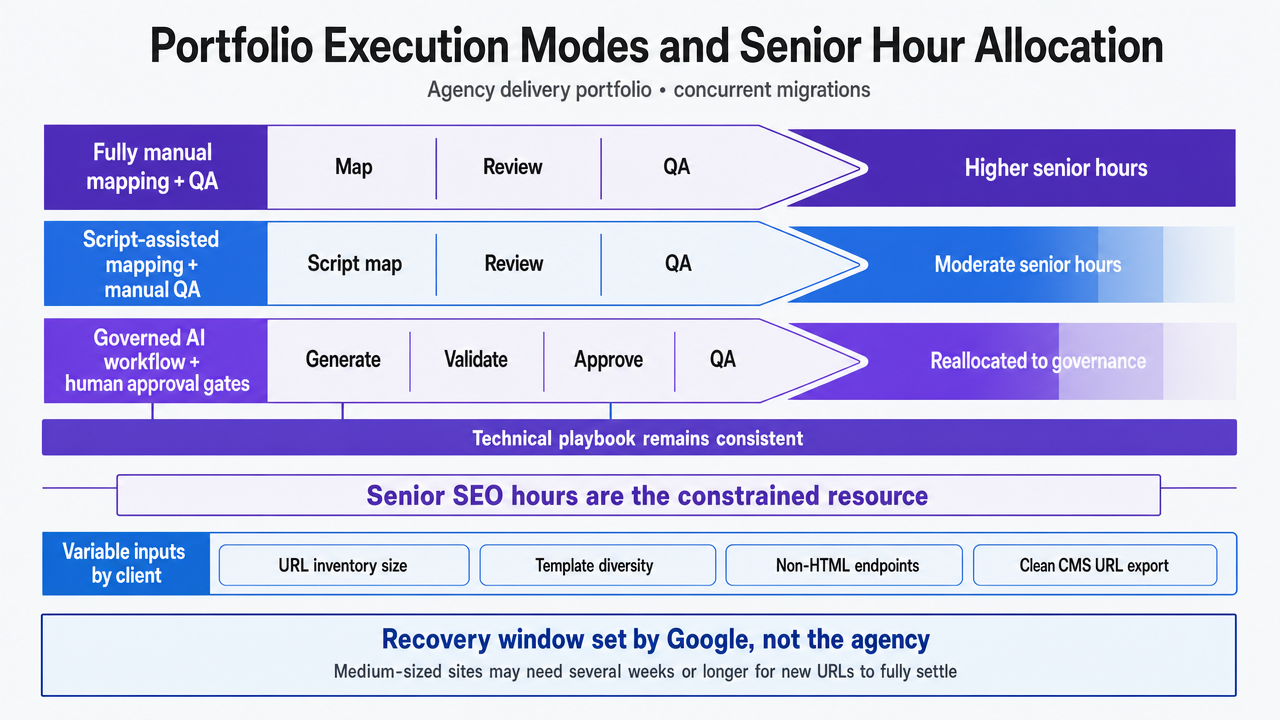 Visualize the section's operating model comparing three portfolio execution modes and how senior SEO hours are reallocated across them
Standardizing the Migration Runbook Across Client Accounts
A portfolio scales not on individual talent, but on a standardized runbook that every account applies without renegotiation. The steps are not proprietary. Google's site-move guidance already outlines them: prepare the URL inventory, map old URLs to their corresponding new URLs, implement direct server-side permanent redirects, submit the new sitemap, configure Search Console, and monitor traffic during recrawl 2. The agency's role is to solidify this sequence into a template inherited by each client account.
Four artifacts are essential for every account's runbook:
- the versioned and reviewed mapping file;
- the chain audit script, run against the mapping before cutover and immediately after;
- the
Cache-Controlaudit on redirect responses, tightened in the days before launch to prevent cached responses from outliving corrections 10; and - the Search Console monitoring dashboard for both properties, observed through weeks one to four while Google reindexes 2.
Standardization also mitigates security exposure. When every account uses the same static mapping pattern, dynamic redirect endpoints that accept query parameters as destinations do not accidentally enter production—a pattern OWASP identifies as an entry point for open-redirect abuse 8. A shared runbook is the mechanism that makes the technical rules from earlier sections repeatable across a client roster without relying on any single senior analyst remembering them.
The One-Year Retention Rule and How to Close Out a Migration
A migration is not complete at cutover. It is finished when redirects have been in place long enough for Google to fully process them, for external links to be updated at their sources, and for the recovery curve on the new property to stabilize. Google's site-move guidance sets the operational minimum: redirects should generally be maintained for at least one year 2. This is not a suggestion for the ambitious; it is the baseline for a defensible closeout.
The one-year window exists because signal transfer is gradual and the external web updates slowly. Google notes that temporary ranking fluctuations are normal during recrawl, and that medium-sized sites may need several weeks or longer for new URLs to fully appear in Search, with larger sites taking even more time 2. Inbound links from third-party sites, cached bookmarks, syndicated feeds, and older campaign assets will continue to hit the old URLs for months after launch. Removing redirects prematurely converts these requests into 404s and forfeits the authority the map was designed to transfer.
Closeout requires four artifacts:
- a log-based report demonstrating that traffic to old URLs has dwindled to a trickle and that each remaining request still resolves through a single 301;
- a Search Console coverage snapshot for both properties, showing the old property's indexed URL count near zero and the new property's count stable 2;
- an external-link outreach summary covering the highest-value referring domains, requesting direct updates to the new URLs; and
- a retention decision documenting when the redirects will be reviewed again, no sooner than the one-year mark 2.
Only then does the account transition from migration status to standard maintenance.
Frequently Asked Questions
References
- 1.Redirects and Google Search | Google Search Central | Documentation | Google for Developers.
- 2.Site Moves and Migrations | Google Search Central | Documentation | Google for Developers.
- 3.RFC 9110: HTTP Semantics.
- 4.301 Moved Permanently - HTTP - MDN Web Docs - Mozilla.
- 5.Redirections in HTTP - MDN Web Docs.
- 6.Optimize Time to First Byte | Articles | web.dev.
- 7.How to assess loading performance in the field.
- 8.Unvalidated Redirects and Forwards Cheat Sheet - OWASP.
- 9.Protocol - sitemaps.org.
- 10.RFC 9111: HTTP Caching.
- 11.General HTML performance considerations.