
Key Takeaways
- Technical health tools like Screaming Frog and Sitebulb protect indexation and Core Web Vitals, but only earn their seat when issues are prioritized by revenue impact, not raw count.
- Keyword and SERP intelligence platforms such as Ahrefs or Semrush justify budget only when they map queries to specific revenue pages and flag AI Overview click erosion.
- Content production and optimization is where lean teams win or lose pipeline, since only 19% of SaaS companies systematically refresh underperforming pages despite up to 15% traffic upside 10.
- Authority building tools deserve a higher evaluation bar; one backlink source usually suffices, and digital PR should be reserved for query clusters proven to be authority-constrained 8.
- Unified execution platforms become the lead seat when they report organic SQLs, page-level conversion, and cost per acquired customer in the same view finance already uses 11.
- Stack economics favor consolidation: standalone rank trackers, dedicated backlink tools, and content scoring often duplicate keyword platform data and can collapse six line items into three.
- Multi-location and multi-product operators need keyword tools that segment natively by location or product line and execution layers that attribute organic SQLs to the correct market 6.
- A 90-day consolidation plan—instrument, trial two platforms in parallel, then cancel duplication—lets a VP anchor the stack to pipeline metrics before the next renewal cycle 4.
The budget-versus-execution gap defining 2025 SEO tool selection
Forrester analysts predict SEO budgets will roughly triple in 2025 as AI-generated answers reshape how buyers find vendor sites, rebalancing spending between paid and organic channels 5. This shift has already changed marketing leadership discussions. The focus is now on whether teams have the operational capacity to effectively spend a tripled budget without wasting resources on tools that don't contribute to pipeline.
The execution side of this equation is less robust. Only 19% of SaaS companies actively optimize underperforming pages, despite systematic optimization potentially increasing sitewide traffic by up to 15% 10. This means four out of five marketing organizations are missing out on significant traffic gains achievable through disciplined work on existing pages, without needing new content, links, or headcount. This gap between projected SEO budgets and current execution capabilities elevates SaaS SEO tool selection to a VP-level decision.
This shortlist addresses that gap by categorizing platforms based on their role within a pipeline-first operating model, rather than brand recognition or feature parity. Each tier is evaluated against business metrics VPs already track: organic sales-qualified leads, conversion lift on key pages, cost per acquired customer from search, and the total cost of the stack. Vendors unable to connect their output to these metrics are considered overhead. The article details five critical categories for 2025, identifying valuable tools and highlighting how unified execution layers can consolidate multiple functions.
 Forrester's Predicted Growth for SEO Budgets in 2025
Forrester's Predicted Growth for SEO Budgets in 2025
How to evaluate SaaS SEO tools against pipeline, not rankings
The five jobs a modern SEO stack actually performs
Every SaaS SEO tool in 2025 performs a combination of five key functions.
- Technical health monitoring identifies indexation, rendering, and Core Web Vitals issues before they impact revenue pages.
- Keyword and SERP intelligence maps buyer intent to specific URLs and tracks how AI Overviews and feature snippets affect clicks.
- Content production and optimization manages briefs, drafts, and refreshes through a structured pipeline.
- Authority building handles digital PR, link acquisition, and internal linking efficiently.
- Execution and reporting integrates these four areas, presenting outcomes in a language finance understands.
Forrester's SEO solutions landscape similarly notes that SEO has historically struggled to be seen as business-critical because vendors focused on technical output over marketing outcomes 4. This five-job framework prompts a crucial question during renewals: which tool supports which job, and how does that job impact a VP's dashboard metric? Tools that cannot answer both are candidates for cancellation or integration into a more comprehensive platform. Enterprise SaaS SEO playbooks emphasize this, treating tool selection as an orchestration problem linked to organic conversion rate and market share, not just ranking counts 9.
Why point tools are commoditizing and platforms are absorbing budget
Keyword databases, rank trackers, and site crawlers now offer similar functionalities across vendors. Their datasets, interfaces, and AI-assisted features for keyword research and content optimization have become standard, rather than differentiators, in the organic search software category 6. As capabilities commoditize, buyers prioritize integration over paying premiums for similar features.
Forrester's recommendation to centralize on an SEO platform stems from this economic reality: fragmented stacks hinder visibility and scalability, while integrated platforms streamline data, workflows, and reporting for marketing teams managing complex properties 11. For a VP managing a team of four to twelve marketers, this means budget shifts from multiple mid-tier tools to a primary platform supplemented by one or two specialist tools for specific, uncovered tasks.
The market is clearly bifurcating. Point tools compete on price and specialized depth. Platforms compete on their ability to connect technical output to pipeline reporting and simplify a marketer's daily workflow. Each tool discussed below is evaluated against this division and a single test: does it move a pipeline metric a VP reports, or does it merely generate another dashboard?
Technical health: crawlers and performance tools that protect indexation
Technical SEO issues are often the first to impact performance. A JavaScript deployment breaking server-side rendering on a pricing page, or a CDN change slowing Time to First Byte on a high-converting article, can affect revenue weeks before ranking dashboards show a decline. This tier's tools—crawlers, log analyzers, and performance monitors—are essential for catching regressions before they escalate.
Site speed is a critical operational metric. Research on enterprise SaaS SEO indicates that 53% of mobile users abandon pages that take longer than three seconds to load, establishing a strict performance benchmark for all technical tools 9. A crawler that flags Core Web Vitals regressions on a 20,000-URL property but doesn't prioritize issues by page-level revenue contribution provides noise, not actionable intelligence. The key evaluation is whether the tool ranks issues by their potential revenue impact, not just by their count.
Three tools are particularly effective for lean teams in this area. Screaming Frog remains a standard for on-demand crawls under 500,000 URLs, integrating well with GA4 and Search Console exports. Sitebulb offers similar functionality with enhanced visual reporting for internal reviews. For enterprise properties with JavaScript rendering and multilingual complexities, hosted crawlers designed for scaled auditing become essential, especially where dynamic rendering and structured data validation are crucial for indexation 8. Google PageSpeed Insights and Search Console remain indispensable free resources.
Typically, one primary technical SEO seat is sufficient. Using a second crawler often indicates either underutilization of the main tool or a lack of consensus on a single source of truth for technical audits. Consolidation is advisable before renewing both.
Keyword and SERP intelligence: mapping intent to revenue pages
The keyword tier often sees the most overlap and least differentiated spending in SEO stacks. Ahrefs, Semrush, and Moz all perform similar functions: identifying keyword universes, scoring difficulty, tracking ranks, and revealing SERP features. In 2025, a valuable tool in this category distinguishes itself by mapping queries to specific revenue pages and identifying when AI Overviews are diverting clicks from those URLs.
The strategic focus is on intent, not just volume. Enterprise SaaS SEO research consistently shows that targeting lower-volume, higher-intent keywords generates more pipeline than pursuing broad head terms, especially when queries are structured into hub-and-spoke models around comparisons, alternatives, and jobs-to-be-done language 7. Long-tail, question-based queries also provide buyer signals that VPs want linked to organic SQLs, not just session counts 8. A keyword tool that cannot segment by intent and connect queries to specific pages in the site architecture provides a list, not a strategic plan.
Two tools generally suffice for most lean teams. Ahrefs or Semrush can handle keyword discovery, SERP feature tracking, and competitor gap analysis at the depth required for a VP to justify budget against paid channels 9. A secondary, lighter tool like Moz or a specialized SERP tracker can provide additional data for ranking validation on the 50 to 200 URLs that drive most of the pipeline. Anything beyond this typically results in duplicate coverage.
The renewal test for this tier is precise: does the platform report which queries convert, which pages they land on, and which SERP features are eroding those clicks? Tools that answer yes are retained. Tools that only report position and volume are candidates for integration into a platform layer that connects keyword data to the same reporting interface used by content and technical teams.
Test Pipeline-Driven SEO Execution Risk-Free
See actual pipeline impact by publishing SEO content and tracking results with full platform access during your trial.
Content production and optimization: the tier where lean teams win or lose
Content is where the SEO stack directly impacts the P&L. Crawlers cannot write comparison pages, keyword tools cannot refresh outdated product feature articles, and rank trackers cannot determine which buyer-journey stages a lean team should prioritize. The tools in this tier dictate whether a marketing team of six can produce the volume and quality expected by a tripled 2025 SEO budget.
The strategic importance of content as a primary lever is well-established. Enterprise SaaS SEO research indicates that producing more content targeting intent-rich queries often outperforms link-building as a growth mechanism, particularly for product-led categories with long-tail comparison and jobs-to-be-done language 7. The same research highlights that regular content refreshes and comprehensive coverage across awareness, comparison, product, and support queries are what convert organic traffic into pipeline, not just one-time publication efforts 8. This directly relates to the 19% optimization figure mentioned earlier: most teams have content to refresh but lack a systematic process to do so.
Three tool categories serve this tier:
- Content optimization platforms like Clearscope, MarketMuse, and Surfer score drafts against SERP-derived topical coverage, proving valuable when focused on high-value "money pages."
- Editorial workflow tools such as Airtable, Notion, or dedicated CMS-adjacent trackers ensure briefs, drafts, and refresh cycles are visible to VPs without constant status meetings.
- AI-assisted drafting and refresh systems have evolved from novelties to production realities across the organic search software category 6, increasingly integrated into unified platforms rather than existing as standalone tools.
The renewal test for this tier is throughput. If a content optimization tool isn't linked to a refresh queue and a page-level conversion metric, it's generating scores instead of pipeline. Consolidate workflow and drafting layers into the platform that already manages keyword-to-URL mapping from the previous tier.
Authority building: link and digital PR tools sized to actual return
Authority tooling is often where budget is allocated without a clear return. Backlink databases, outreach platforms, and digital PR services are expensive, and their output is genuinely harder to link to pipeline than a refreshed comparison page or a fixed rendering bug. The evaluation bar for these tools should be higher.
Enterprise SaaS SEO guidance confirms that authoritative link-building through guest posting and digital PR remains important for competitive query sets, especially when domain authority gaps prevent a site from ranking for high-intent commercial terms 8. Conversely, other research on scaling organic SQLs suggests that for product-led categories, additional content production for intent-rich queries often outperforms link acquisition as a growth lever 7. Both perspectives can be valid; the deciding factor at renewal is whether the site faces a content coverage gap or an authority gap.
One backlink tool is usually sufficient for most lean teams. Ahrefs or Semrush already provide comprehensive link data for gap analysis and outreach prioritization, negating the need for a third dedicated tool. Digital PR spending should be reserved for the two or three commercial query clusters specifically identified as authority-constrained, and the tool should be re-evaluated once that constraint is resolved.
Unified execution platforms: consolidating the stack around pipeline reporting
The execution tier determines whether the previous four categories function as a coordinated pipeline engine or remain disparate dashboards that a lean team struggles to interpret. Forrester advocates for centralizing on an SEO platform, arguing that fragmented stacks limit visibility and scalability, while integrated platforms consolidate data, workflows, and reporting for complex properties 11. This analyst perspective is echoed in Forrester's SEO solutions landscape, which frames tool selection as a marketing-outcomes problem, not a technical-output one 4. A unified execution platform serves as the central hub, translating technical audits, keyword mappings, content refreshes, and link acquisition into a single reporting interface that a VP can confidently present during quarterly reviews.
Three types of platforms compete in this space:
- Enterprise SEO platforms like Conductor, BrightEdge, and seoClarity integrate with existing stacks to centralize reporting, workflow, and stakeholder governance for large properties.
- Marketing operations platforms with SEO modules pull search data into a unified view alongside paid, social, and lifecycle reporting, directly addressing pipeline attribution.
- AI marketing execution platforms, including Vectoron, add an approval and execution layer that prioritizes recommendations based on live pipeline signals, routes work for human review, and connects strategy to delivered output without increasing headcount.
The boundaries of this category are converging. Forecasts for organic search software predict that AI-assisted keyword research, automated content optimization, and cross-channel analytics integration will merge within the same platform tier, rather than remaining as separate tools 6. For a VP managing a lean team, the practical evaluation is whether an execution platform can absorb the reporting, workflow, and prioritization logic currently handled in isolation by other tools. If it can, two or three point-tool seats can be consolidated at the next renewal. If not, the platform merely adds another dashboard to existing fragmentation.
The renewal test for this tier is paramount for the P&L: does the execution platform report organic SQLs, page-level conversion, and cost per acquired customer from search in a format the finance team already uses? Platforms that meet this criterion earn the lead position. Those that only report rankings, share of voice, or content scores remain specialist tools beneath a platform that provides a complete picture.
See How Leading SaaS Brands Streamline SEO Execution in 2025
Connect with our team to benchmark your current SEO workflow against AI-powered multi-channel execution platforms proven to increase organic pipeline efficiency—without increasing headcount or adding vendor complexity.
Stack economics: what a lean marketing team actually pays for
The financial assessment a VP should conduct at renewal is simpler than most stack audits suggest. A lean team of four to twelve marketers isn't paying for abstract keyword databases or crawler licenses. They are paying for the seats required to drive organic SQLs and for the coordination costs of managing those tools. Independent forecasts project the global SEO software market to reach USD 84.94 billion in 2025, growing to USD 295.04 billion by 2035 2. This trajectory indicates two things to a VP: budget will continue to flow into this category, and vendors will price their offerings expecting market consolidation, not fragmentation.
Adoption is already widespread. Over 80% of enterprise-scale companies use paid SEO tools because free options lack the depth or governance needed by lean teams 10. The question isn't whether to use paid tools, but how many line items in the stack can be justified when each seat is measured against a pipeline metric.
A typical lean-team stack often includes six line items:
- a technical crawler,
- a keyword and SERP intelligence platform,
- a content optimization tool,
- a rank tracker,
- a backlink or outreach tool,
- and a reporting or execution layer.
Overlap is common: between the keyword platform and the rank tracker, between the keyword platform's backlink module and a dedicated authority tool, and between content optimization scores and a platform's native on-page grader. Each instance of overlap presents an opportunity for a VP to optimize spending during renewal.
| Stack line item | Job it performs | Absorbed by a lead platform? |
|---|---|---|
| Technical crawler | Indexation, rendering, Core Web Vitals audits | Partial. Retain one specialist seat. |
| Keyword and SERP intelligence | Query universe, intent mapping, SERP features | Yes, when the platform reports queries to URLs. |
| Content optimization | SERP-derived topical coverage scoring | Yes, increasingly native to platform tier. |
| Rank tracker | Position monitoring on money pages | Yes. Duplicate of keyword platform in most cases. |
| Backlink or outreach | Authority gap analysis, PR prioritization | Partial. Data already inside keyword platforms. |
| Execution and reporting | Workflow, approval, pipeline attribution | This is the lead seat. Everything above reports into it. |
Two seats typically consolidate at the next renewal: the standalone rank tracker and the dedicated backlink tool, as their data is often duplicated within the keyword platform. A third seat, content optimization, integrates into the platform layer as AI-assisted scoring becomes a native feature. This leaves a lead execution platform, one keyword and SERP intelligence seat, and one technical crawler—reducing six line items to three, all measured against pipeline metrics rather than ranking dashboards.
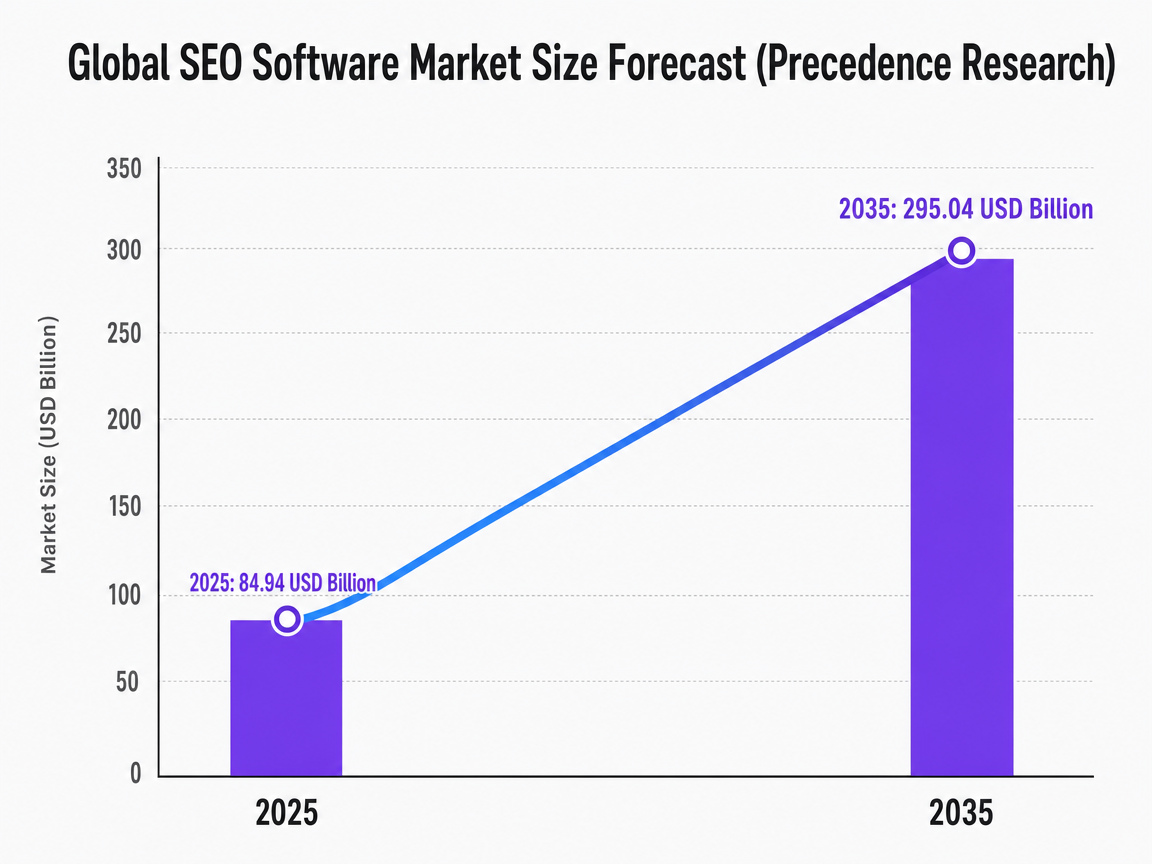 Global SEO Software Market Size Forecast (Precedence Research)
A third independent forecast of the SEO software market's growth from 2025 to 2035 by Precedence Research.
If you manage multiple locations or product lines: adjustments to the stack
The stack described so far assumes a single-domain SaaS property with one buyer journey. Multi-location operators and multi-product SaaS companies face different challenges: URL-level duplication, query-level cannibalization, and fragmented reporting when location or product filters are applied. For example, a dental group with 40 locations, a home services franchise with regional pages, or a SaaS platform selling three distinct product lines.
Two key adjustments are necessary. The keyword and SERP intelligence tool must natively segment by location or product line, rather than relying on spreadsheet exports. A platform that reports blended rankings across 40 city pages obscures which markets are losing pipeline. The execution and reporting layer must attribute organic SQLs to the specific location or product line that generated them. This is where cross-channel analytics integration within modern platforms proves its value 6. Without this attribution, a VP cannot justify refresh budgets for specific markets or identify which product lines are subsidizing others.
The technical crawler tier becomes more focused rather than expanded. One seat still covers the property. Structured data validation and multilingual rendering become essential when the same template drives hundreds of URLs 8. Capacity should be added where attribution is critical, not where audits are already functional.
A 90-day plan to consolidate around a lead platform
Stack consolidation is most successful when it begins with a pipeline audit, not a vendor selection meeting. The following 90-day sequence is designed for a lean team already using the six-line-item stack and a VP with budget approval for one platform decision at the next renewal cycle.
- Days 1 to 30: instrument before consolidating. Gather the last four quarters of organic SQLs, conversion rates by landing page, and cost per acquired customer from search. Map each current tool to the specific metric it influences. Tools that cannot be tied to a VP-reported metric are flagged for potential absorption. Forrester's framework—that SEO must connect technical output to marketing outcomes—serves as the audit rubric 4.
- Days 31 to 60: run two platform trials in parallel. Select one enterprise SEO platform and one AI marketing execution platform. Evaluate both against a single criterion: can this tool report organic SQLs, page-level conversion, and pipeline attribution in the same view that finance uses? Centralized data, workflow, and reporting are the decisive capabilities 11.
- Days 61 to 90: cancel duplication, name the lead seat. The standalone rank tracker and dedicated backlink tool are eliminated first. Content optimization scoring is next, if the chosen platform offers native coverage. The remaining stack will consist of the lead platform, one keyword and SERP intelligence tool, and one technical crawler, all operating against pipeline metrics rather than ranking dashboards.
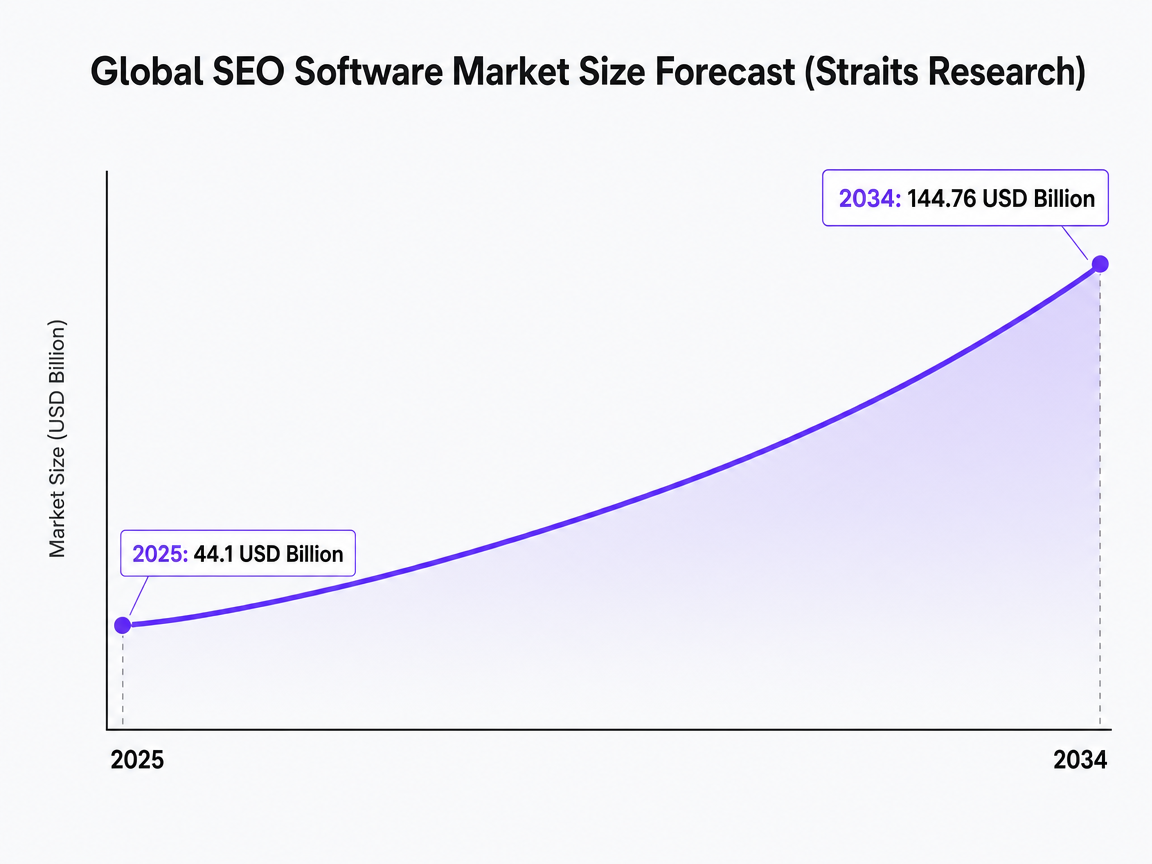 Global SEO Software Market Size Forecast (Straits Research)
An alternative projection of the global SEO software market size from 2025 to 2034 by Straits Research.
Frequently Asked Questions
References
- 1.SEO Software Market Size, Share, Growth, Analysis, Report, 2034.
- 2.SEO Software Market Size to Surpass USD 295.04 Billion by 2035.
- 3.Search Engine Optimization Advertising Software Market 2035.
- 4.SEO Must Solve Its Marketing Problem.
- 5.Less brand safety, more SEO spend in 2025, Forrester predicts.
- 6.Organic Search Software Market Forecast 2026–2033.
- 7.Enterprise SaaS SEO: 8 Techniques and Best Practices.
- 8.Mastering Enterprise SEO for SaaS in 2026: Strategy, Technical, and Content Playbook.
- 9.SEO for Enterprise SaaS: How to Ramp Up Your Organic SQLs.
- 10.Enterprise SaaS SEO: Your Guide To Strategy, Growth, & Results.
- 11.Every Company Needs An SEO Platform.