
Key Takeaways
- Expert SEM results come from measurement discipline, not senior hires, because field experiments at eBay, Yelp, and Edmunds produced opposite verdicts on identical tactics 3, 6, 4.
- Google's 89% incremental clicks figure is a ceiling, not a benchmark, so lean teams must run account-specific holdouts on the segments consuming the most spend 2.
- Weekly query-level reviews in Search Console and Google Ads catch drift on money terms before it compounds, provided every anomaly ends in a logged decision 1, 10.
- One structured monthly experiment, branded holdout, non-branded intent test, or competitor pause, generates twelve causal readings per year that no quarterly agency audit can match 3, 4, 5, 6.
- Quarterly reallocation treats SEO and paid as one budget scored against query clusters, because balanced allocation outperforms optimizing either channel alone 11, 3.
- Analytics-driven optimization on existing campaigns has produced a 128% CTR lift, doubled conversion rates, and 42% lower CPA in retail settings, without new spend or staff 14.
- Automation handles bidding well but routes spend toward reported conversions rather than causal lift, which is why 49% of PPC practitioners report reduced control 13, 3.
- For multi-location portfolios, headcount and agency retainers scale with spend or locations, while a lean owner with approval-gated execution scales primarily with judgment 1.
Why expert SEM results are a measurement problem, not a talent problem
Search is still where the money sits. U.S. internet advertising revenue reached $258.6 billion in 2024, and search alone accounted for $102.9 billion of that total, or 39.8% of all digital ad spend 8. For a VP running a $1M to $5M annual search program across multiple locations or practice groups, the category commands more budget scrutiny than any other digital line item, and the CFO knows it.
The instinct, when results plateau, is to hire. Another SEM manager. Another agency. A senior consultant billing $250 an hour to audit accounts and produce a deck. That instinct assumes expert results come from expert access to tactics. The evidence points somewhere else.
What separates the top decile of SEM programs from the middle is not proprietary keyword lists or a hidden bidding formula. It is measurement discipline. Field experiments at eBay, Yelp, and Edmunds have produced contradictory conclusions about paid search value using the same platforms and the same ad formats, which means the deciding variable was never the tactic 3, 6, 4. It was whether the team knew how to isolate causal lift from correlated clicks.
A 2023 systematic review of SEM literature reached the same conclusion from a different angle: campaign success depends on continuous optimization against performance data, not on static setups or one-time expert intervention 10. The reporting tools required to run that optimization loop, Google Search Console for organic performance and Google Ads for paid, are already sitting in the stack 1.
The rest of this piece treats expert SEM as an operating problem. What the lean in-house team needs is a measurement model, an experimentation cadence, and a budget frame that treats organic and paid as one system. Headcount is optional. Discipline is not.
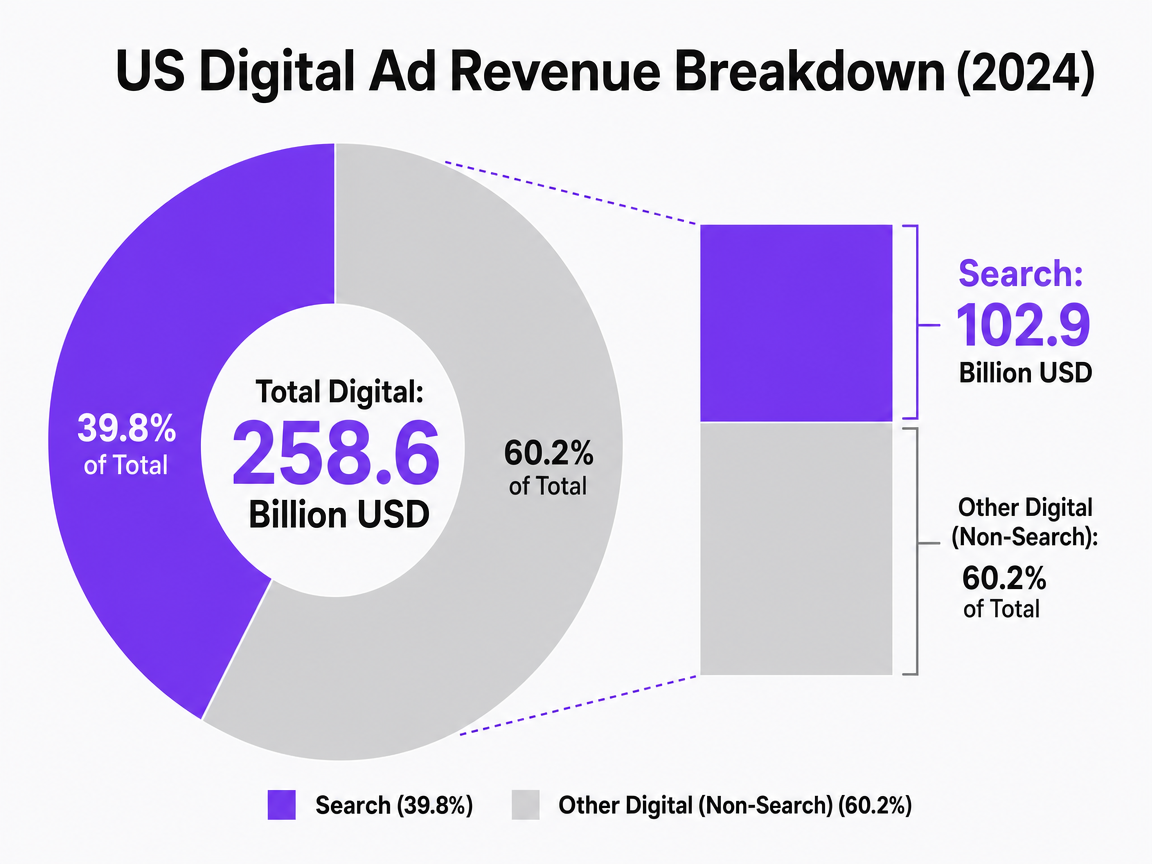 US Digital Ad Revenue Breakdown (2024)
A breakdown of total US digital ad revenue in 2024, showing the portion attributed to search advertising. Useful for a pie chart or bar chart showing market share.
The incrementality contradiction that reframes expertise
Three field experiments, three different verdicts
Three of the most-cited field experiments in search marketing arrived at incompatible conclusions using the same tool. That contradiction is where expert judgment starts.
At eBay, researchers ran a large-scale controlled experiment that turned paid search on and off across markets. Brand-keyword ads showed no measurable short-term benefit, and the entire paid search program added only 0.66% to sales, with an estimated average ROI of negative 63% 3. For a mature brand with strong organic presence, most of the clicks the team was paying for would have arrived for free.
At Edmunds, a similar test on branded search produced the opposite reading. When the team shut off brand-keyword ads, more than half of the paid traffic disappeared without a corresponding rise in organic clicks, suggesting the ads were doing real work rather than intercepting traffic that would have converted anyway 4.
At Yelp, a Harvard Business School experiment on restaurant advertising found paid campaigns lifted business page views by roughly 25% and increased purchase-intent actions such as directions, website visits, and calls. The effect collapsed to zero the moment the campaign ended 6.
Same ad format. Same platform. Three verdicts: value-destroying, value-preserving, and value-generating-but-perishable. The difference was not tactical skill. It was the underlying market, the brand's organic gravity, and the intent profile of the queries being bought. A senior consultant walking into any of those three accounts with a standard playbook would have been wrong two-thirds of the time.
The operating implication for an in-house team is direct. A search program's incrementality cannot be assumed from category norms or vendor case studies. It has to be measured inside the specific account, on the specific segments where the budget is concentrated, before optimization decisions carry any weight.
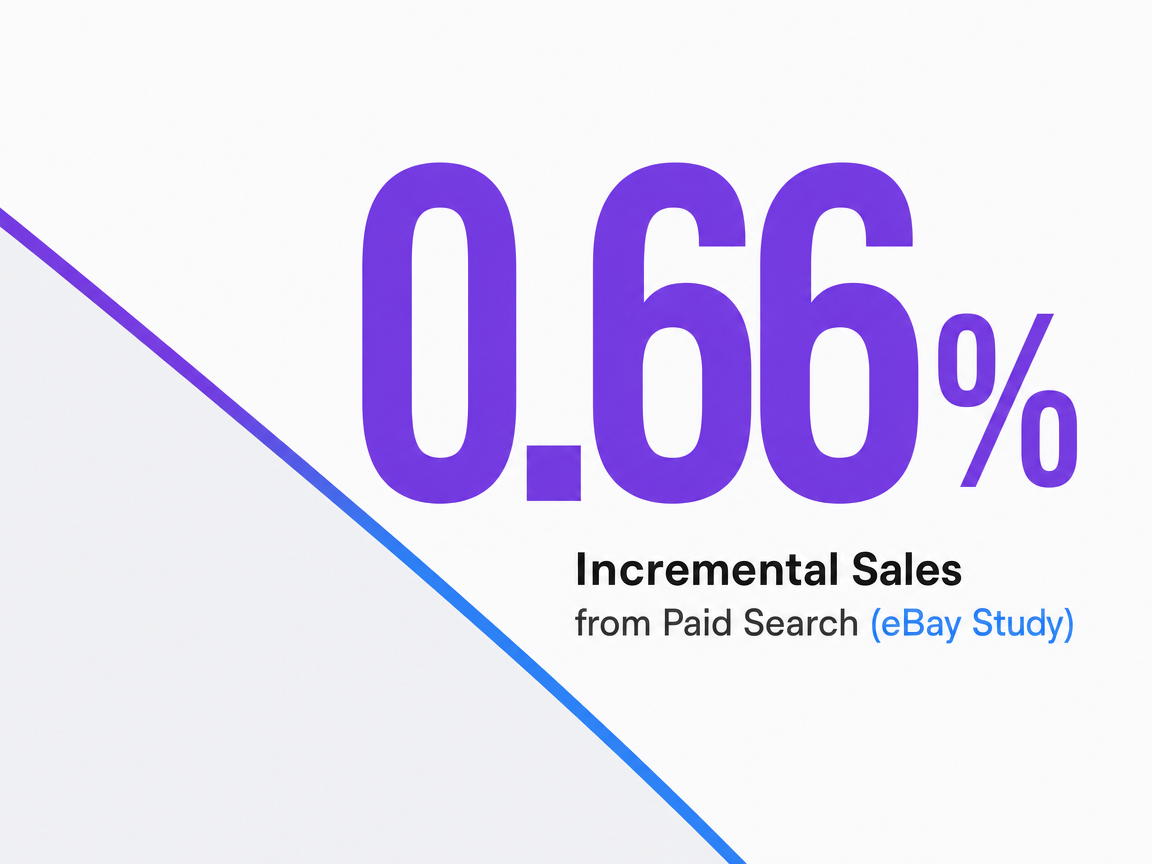 Incremental Sales from Paid Search (eBay Study)
Incremental Sales from Paid Search (eBay Study)
What the 89% incremental clicks meta-analysis actually means for a lean team
Google's own meta-analysis of search advertising incrementality reports that more than 89% of ad clicks are incremental, meaning the visit would not have happened without the ad 2. Read carelessly, that figure suggests paid search is almost always additive and the eBay result was an outlier.
Read carefully, it does not. The meta-analysis aggregates across advertisers, campaign types, and query classes. It says nothing about which 11% of clicks are not incremental, and nothing about how that share concentrates on branded terms for advertisers with strong organic rankings. The eBay and Edmunds studies live inside that variance, not outside it.
For a lean in-house team, the takeaway is a design principle rather than a benchmark. The 89% average is the ceiling the program can approach when non-branded and mid-funnel queries dominate the mix. The floor, on saturated branded terms for a category-leading brand, can sit near zero or below. Which end of that range the account operates on is an empirical question, answerable only through geo-based holdouts, ad scheduling experiments, or account-level pause tests on the segments that consume the largest share of spend.
Expert SEM output, in practice, means knowing which segments justify a holdout test this quarter and having the discipline to act on the result. It does not require a senior hire. It requires the team to stop treating aggregate incrementality claims as decision inputs and start generating account-specific ones.
The in-house operating model: cadence over headcount
Weekly reviews: query-level signal in Search Console and Google Ads
The weekly review is where drift gets caught before it compounds. It is also the meeting most in-house teams either skip or turn into a status update. Neither works. The purpose is to inspect query-level signal on a narrow set of segments and decide, within the hour, whether anything requires action before the next review.
Search Console's Performance report is the anchor for the organic side. It surfaces impressions, clicks, average position, and CTR by query, page, country, and device 1. The lean team's job is to filter down to the queries that carry commercial intent for the business, roughly the top fifty to two hundred depending on account size, and watch for three patterns:
- Position drops of more than two spots on money terms
- Impression gains on new queries that indicate a page is starting to rank
- CTR declines on top pages that usually signal a SERP feature ate the click
On the paid side, the equivalent review runs at the search-term report level in Google Ads. What matters is which terms are consuming the largest share of spend that week, which converted, and which are queries the account should not be paying for at all. A 2023 systematic review of SEM literature emphasized that campaign performance depends on continuous optimization against fresh data, not on quarterly audits or set-and-forget structures 10.
Two disciplines make this hour productive. First, the reviewer writes decisions, not observations. Every anomaly ends in either a change, a hypothesis to test next month, or an explicit no-action call. Second, nothing gets changed in-account during the review itself. Changes are queued, batched, and approved separately, so the review preserves the audit trail the CFO will eventually ask for.
Monthly experiments: branded, non-branded, and competitor holdouts
The weekly cadence catches drift. The monthly cadence generates the causal evidence that separates expert accounts from average ones. Each month, the team runs one structured experiment on a segment large enough to move the P&L and small enough to pause without political fallout.
The three experiment classes that produce the highest-value learning are branded holdouts, non-branded intent tests, and competitor-conquesting pauses. Branded holdouts answer the eBay-versus-Edmunds question directly inside the account: pause brand-keyword ads in a matched geo or time window and measure whether total conversions fall or organic simply absorbs the traffic. The two most-cited experiments on this question reached opposite conclusions, which is exactly why a mature program has to run its own 3, 4. Non-branded tests hold out mid-funnel query clusters to isolate whether generic category terms are converting or merely inflating impression counts. Competitor holdouts are the cheapest to run and often the highest-return: an empirical analysis of search advertising strategies found that poaching competitor traffic and cannibalizing organic clicks are frequently ineffective, so pausing those segments rarely destroys value and often frees budget 5.
The design constraint that matters most is not statistical sophistication. It is having a matched control. Geo-based holdouts work for multi-market accounts. Day-of-week or hour-of-day holdouts work for single-market accounts. Pre-post comparisons without a control are not experiments; they are anecdotes with a spreadsheet.
The Yelp restaurant experiment offers one additional design lesson worth internalizing. Advertising lifted page views by roughly 25% during the campaign, and the effect collapsed to zero the moment the ads stopped 6. That decay pattern means the measurement window has to sit inside the active campaign period. Post-campaign lift is not a reliable proxy. The team that runs one clean holdout per month for a year ends the year with twelve causal readings on the segments driving the largest share of spend. That is a level of account knowledge no external consultant assembles in a quarterly audit.
Quarterly reallocation: treating SEO and paid as one budget
Most in-house teams run SEO and paid search as separate P&Ls with separate owners and separate quarterly reviews. The structure is administratively convenient and analytically wrong. Search intent does not respect the org chart, and the same query often gets served by both an ad and an organic result on the same SERP.
An econometric model for evaluating SEO and paid search jointly, published in 2019, showed that balanced allocation between organic and paid investment produces better overall search ROI than optimizing either channel in isolation 11. The mechanism is intuitive. When organic ranks well on a query cluster, the incremental value of paying for those same clicks drops, sometimes toward zero as the eBay experiment demonstrated 3. When organic is weak or the SERP is dominated by ad units, paid carries the segment and organic investment yields little short-term traffic.
The quarterly reallocation exercise is where that logic becomes a budget decision. The team maps its top query clusters against two axes: current organic strength and paid incrementality from the monthly holdout results.
- Clusters where organic is strong and paid incrementality is low lose paid budget.
- Clusters where organic is weak but commercial intent is high gain paid budget, and organic content investment gets prioritized against the same list.
- Clusters where both channels are weak but the category matters get a discovery budget capped at a percentage the CFO agreed to in advance.
Done quarterly, this reallocation is a two-hour meeting with a spreadsheet. Done never, it is the reason paid budgets creep upward every year while organic contribution stagnates.
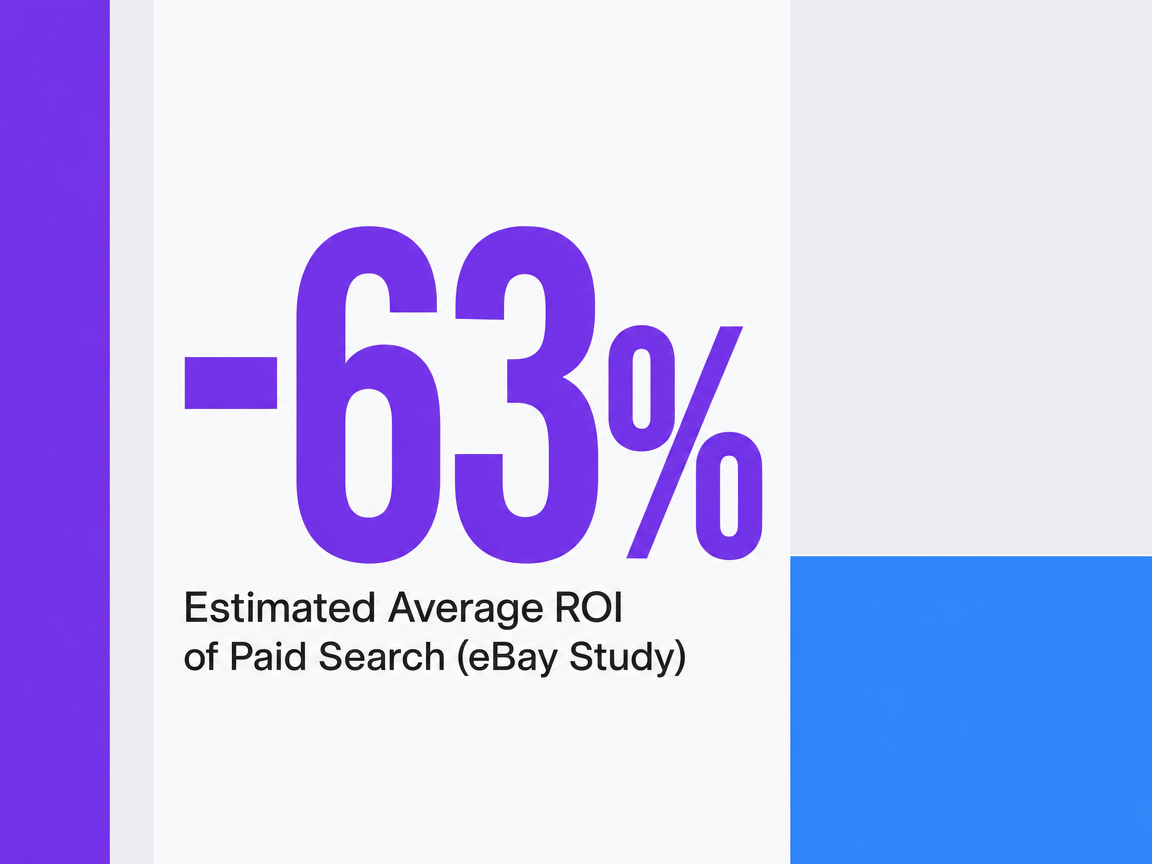 Estimated Average ROI of Paid Search (eBay Study)
Estimated Average ROI of Paid Search (eBay Study)
See Search Engine Marketing Results in Days
Test real campaigns and measure their impact with full platform access before making a commitment.
Where the payoff actually shows up
The return on this operating model is not a mystery, but it is narrower than most vendor decks suggest. The clearest quantified evidence sits in a retail-campaign study on analytics-driven SEM optimization, which found that applying descriptive, predictive, and prescriptive analytics to campaign management produced a 128% increase in click-through rate, more than a 100% increase in conversion rate, and a 42% decrease in cost per acquisition 14. Those deltas came from analytics discipline applied to existing campaigns, not from new spend or new staff.
Scope matters. The study measured retail campaigns, where transaction volume is high and conversion signal arrives quickly. A legal, dental, or senior living account with longer decision cycles and fewer weekly conversions will not see the same magnitudes on the same timeline. The mechanism, however, transfers. Analytics-driven optimization moves budget toward query clusters that convert and away from clusters that only impress, and it does so on a cadence the account can sustain.
The Nielsen 2024 marketer survey reinforces where in-house leadership should focus attention: proving and improving ROI is the priority global marketers cite for how they allocate budget and measure success 7. That priority maps directly onto the weekly, monthly, and quarterly loop already described. The payoff is compounding account knowledge, tighter CPA, and a defensible ROI story the CFO can read without a translator. It is not a hidden tactic. It is what disciplined measurement produces when a team runs it for four consecutive quarters.
Why automation alone does not close the gap
Smart Bidding, Performance Max, and generative ad tools have made the mechanical parts of paid search easier and the strategic parts harder to read. The State of PPC 2024, a survey of 1,135 practitioners, captures the tension directly: automation has lowered the barrier to launching campaigns and reduced time spent on manual optimization, yet 49% of respondents say managing PPC is harder than it was two years ago because of decreased insights and control 13. The tools are doing more. The team can see less.
That gap is where expert judgment reasserts itself. Auto-applied recommendations move budget between segments based on platform-defined conversion signals, not on the account's own incrementality readings. An algorithm optimizing toward reported conversions will happily route spend into branded queries that the eBay experiment showed produce near-zero causal lift for mature brands 3. The system is not wrong; it is answering a different question than the CFO is asking.
The lean team's job is to keep automation inside a decision perimeter set by human review. Bidding runs automated. Budget allocation across query classes, holdout design, and the decision to keep or kill a segment stay with the operator. The 2023 SEM literature review reached the same structural conclusion: sustained performance depends on continuous optimization against fresh data with organizational learning attached, not on trusting a black box to define what fresh data means 10.
Scale Search Engine Marketing Without Expanding Your Team
See how digital marketing leaders are achieving expert-level SEM execution, complete analytics integration, and measurable pipeline impact—all without adding headcount or managing additional vendor relationships.
If the team manages multiple locations: an economics comparison
The rest of this piece has treated the reader as a single-P&L operator. This section shifts scope. For VPs running search across a portfolio of locations, whether a dental support organization with sixty practices, a regional home services brand with forty branches, a senior living operator with twenty communities, or a multi-office law firm, the staffing math changes. The same $1M annual search budget that funds two in-house specialists at a single-location business has to cover query volume, landing page variants, and local-intent segmentation across dozens of markets. Headcount does not scale linearly. Judgment does.
The three staffing models most portfolio operators evaluate are:
- A traditional agency retainer priced as a percentage of media spend
- A small in-house SEM team with a licensed tool stack
- A lean in-house owner paired with an AI execution platform that runs work through human approval
The table below frames the annual cost variables without inventing numbers the reader cannot verify inside the account.
| Model | Annual fully-loaded cost | Execution capacity | Oversight model |
|---|---|---|---|
| Agency retainer | (agency % of $1M spend) + $1M media | Vendor-defined scope, quarterly reviews | Client-side approval on deliverables |
| Two in-house SEM specialists + tool stack | (2 × loaded salary) + tool stack + $1M media | Full account control, weekly optimization | Direct, meeting-driven |
| Lean owner + AI execution platform | (1 × loaded salary) + $599/mo platform + $1M media | Full account control, approval-gated automation | Approval-first, logged decisions |
The variables the CFO cares about are the ones the reader controls. Loaded salary for an SEM specialist varies by market. Agency retainers commonly quote as a percentage of managed spend, and the reader knows what that percentage is for the incumbent vendor. Tool stack cost sits in existing invoices. The single fixed input above is the platform price point, which lands at $599 per month after a two-week trial.
The structural point is not that one model always wins. It is that the agency retainer and the two-specialist model both scale cost with either media spend or location count, while a lean owner running approval-gated execution scales primarily with judgment. For portfolios where the same weekly Search Console review 1and monthly holdout design have to repeat across thirty or sixty accounts, the operating question is which model keeps oversight tight while pushing execution volume up without adding headcount.
The three habits that separate expert output from average output
Strip away the tooling debate, the automation debate, and the in-housing debate, and what remains is a short list of habits that show up in every SEM program that outperforms its category. None of them require a senior hire.
- Refusing to treat reported conversions as causal ones. Expert accounts run at least one holdout per quarter on a segment that consumes real budget, because the eBay and Edmunds experiments proved that identical tactics can produce opposite outcomes inside similar-looking accounts 3, 4. Average accounts optimize toward whatever the platform reports and never test whether the reports describe lift or coincidence.
- Writing decisions on a fixed cadence. Weekly query review, monthly experiment, quarterly SEO and paid reallocation, each one producing a logged decision rather than a discussion. The 2023 SEM literature review found that sustained performance depends on continuous optimization against fresh data, not on periodic audits or vendor deliverables 10. Cadence is what converts data access into judgment.
- Holding automation inside a decision perimeter. Bidding runs on the platform. Budget allocation across query classes, holdout design, and segment kill decisions stay with the operator, which is where the 49% of PPC practitioners reporting reduced control in the State of PPC 2024 survey lost ground 13. Approval-gated execution is how Vectoron structures the same loop for teams that want the operating model without the headcount.
Frequently Asked Questions
References
- 1.How To Use Search Console | Google Search Central | Documentation.
- 2.Incremental Clicks Impact Of Search Advertising.
- 3.Consumer Heterogeneity and Paid Search Effectiveness.
- 4.A Large-Scale Field Experiment to Evaluate the Effectiveness of Paid Search Advertising.
- 5.Empirical Analysis of Search Advertising Strategies.
- 6.Effectiveness of Paid Search Advertising: Experimental Evidence.
- 7.2024 Nielsen Annual Marketing Report.
- 8.Digital Ad Revenue Surges 15% YoY in 2024 - IAB.
- 9.Effectiveness of Online Marketing Based Search Engine Advertisements on Google and Bing.
- 10.An Overview of Search Engine Marketing: A Systematic Literature Review.
- 11.A Model for Analyzing the Efficiency of SEO and Adwords Campaigns.
- 12.Report: Most Digital Marketing Now Done In-House.
- 13.The State of PPC 2024 - Global Report.
- 14.Utilizing Data Analytics to Improve Search Engine Marketing Performance in Retail Companies.