
Key Takeaways
- A defensible SEO report follows a five-link evidence chain: crawl and index coverage, visibility, qualified organic sessions, revenue-relevant conversions, and prioritized actions with named owners and deadlines.
- Every objective performance claim inside the report needs a documented metric definition, source of truth, and comparison window on file before delivery to meet the reasonable-basis standard 8.
- Regulated verticals require named checkpoints the report surfaces but does not adjudicate: HIPAA tracking inventories 3, health-claim review 1, ADA accessibility routing 4, and endorsement disclosures 6.
- AI can compress data extraction, chart assembly, and first-pass drafting, but source-of-truth reconciliation, substantiation, prioritization, and content-risk calls stay with named human reviewers 7, 9.
Why most client SEO reports fail the retainer review
Most client SEO reports get killed in the retainer review for the same reason: they present data without connecting it to a decision the client has to make. A slide of ranking movements, a chart of organic sessions, and a backlink count do not tell a legal intake director whether last month's work produced booked consultations, or tell a DSO marketing lead whether the appointment-request form on the Cleveland location page is even being tracked correctly.
The failure is structural. Reports that stop at rankings and sessions skip the chain that clients actually pay for—whether the site is crawlable and indexed, whether it shows up for demand that matters, whether organic visitors are the right people, whether those visitors convert into revenue-relevant events, and what the agency is going to do about it next month with a named owner attached.
Reports also fail when they carry unsubstantiated performance claims. The FTC's substantiation policy expects a reasonable basis for objective advertising claims before they are disseminated 8, and that expectation does not stop at the client's homepage. It reaches into the agency's own reporting language about lead quality, cost savings, and outcomes. What follows is a report structure built to survive both scrutiny tests: business relevance and evidentiary defensibility.
The five-link evidence chain that makes a report defensible
Link one: crawl access and index coverage
Nothing else in the report matters if Googlebot cannot reach the pages the client is paying to rank. Link one documents crawl access and index coverage as the first evidentiary step, and it is the section where most junior analysts skim past a problem that invalidates the rest of their analysis.
The minimum contents: robots.txt directives and their diff since last month, XML sitemap submission status and last-read date, Search Console Index Coverage counts by status (Indexed, Crawled - currently not indexed, Discovered - currently not indexed, Excluded by noindex, Blocked by robots.txt), and a page-level reconciliation between sitemap URLs, indexed URLs, and revenue-relevant URLs. A pediatric dental group with 34 location pages in the sitemap and 19 in the index does not have a ranking problem yet—it has an indexation problem, and the report needs to say so before it discusses queries.
Server response codes, canonical conflicts, and hreflang errors round out this link. Each finding gets a severity flag and a named owner in the next report section.
Link two: visibility across query, page, and geography
Visibility is where the report answers a specific question: is the client showing up for demand that matters, in the places it matters, on the surfaces prospects actually use? Answering that requires more than a rank-tracker screenshot. Each data source in the client's stack reports a different slice of visibility, and the report needs a data-source map to keep analysts from double-counting the same signal across links.
- Search Console reports query-, page-, country-, click-, impression-, and position-level data for organic web results.
- GA4 reports channel attribution and key-event counts across sessions.
- Google Business Profile reports actions, calls, and direction requests for the local pack and Maps surface.
- Call intelligence reports qualified versus unqualified inbound calls tied to source.
Each of those surfaces answers a different question, and treating them as interchangeable produces reports that inflate wins or miss losses—an organic session lift with flat GBP call actions in a local service business is not the same win as a lift accompanied by rising qualified call volume.
Report visibility along three axes: query intent (branded, service, informational, competitor), page cluster (service pages, location pages, blog, resource hub), and geography (metro, state, or service-area polygon for local clients). Analytics governance sits alongside this link—consent-aware measurement, data minimization, and retention should be reviewed against a privacy-risk baseline before the visibility numbers are trusted 2.
Link three: qualified organic sessions, not raw traffic
Raw organic sessions are a vanity denominator. The third link filters visibility into sessions that could plausibly become revenue, which means segmenting by landing page type, geography match, and on-page behavior before any conversion analysis begins.
For a personal injury firm, a spike in sessions to a state-law explainer from users outside the firm's licensed jurisdictions is not a qualified lift—it is content traffic that will never convert and should not be counted in the same bucket as sessions to the practice-area landing pages in the correct metro. For a DSO, sessions to a location page from users more than 40 miles from the practice deserve a different qualification treatment than sessions from inside the primary service radius.
The report should present qualified organic sessions as a subset of total organic sessions, with the qualification rules written in plain language directly on the page: which landing page groups count, what geography filter was applied, and what engagement threshold (scroll depth, form field interaction, click-to-call tap) was required. Clients can then argue with the rules rather than the numbers, which is the argument the agency wants to have.
Link four: conversions tied to revenue-relevant events
Link four is where SEO reporting either earns its retainer or exposes its weakest assumption. A conversion count is not evidence of a conversion outcome. The report needs to name the specific key events being counted, the source of truth for each, and the deduplication logic across GA4, GBP actions, form-fill notifications, and call intelligence.
For a behavioral health outpatient network, revenue-relevant events are typically: verified insurance form submissions, scheduled intake calls, and completed intake appointments—not newsletter signups or PDF downloads. For a home services operator, they are booked estimates and completed jobs, not contact-form volume. For senior living, they are tour requests and completed tours, filtered by community and unit type.
Each event needs a defined source, a defined owner, and a stated confidence level. A GA4 key event fired on a thank-you page is a proxy; a call intelligence record tagged qualified by a trained reviewer is closer to ground truth. When the two disagree, the report should show both and explain the delta rather than picking the flattering number. This is also where any performance language in the report itself must meet the reasonable-basis test for objective claims before it goes out 8.
Link five: prioritized actions with named owners
The final link converts the preceding four into work. Every action in the report gets four attributes: the problem it addresses (with a pointer to the specific chart or table in an earlier link), the expected impact (which metric moves, in what direction, by what approximate magnitude), the owner (a named person or role, not "the team"), and the deadline.
Prioritization is the analyst's judgment call and needs to be visible. A tiering system—typically P0 revenue-blocking, P1 high-leverage, P2 incremental—forces the analyst to choose rather than list. A P0 for the pediatric dental group is fixing the 15 unindexed location pages surfaced in link one; a P1 is rewriting the three service-page title tags that are truncating in mobile SERPs; a P2 is adding schema markup to the FAQ hub.
Clients approve or reject each action inside the report itself. Rejected actions carry forward with a documented reason, which becomes the audit trail when a quarter-later conversation asks why a fix never shipped.
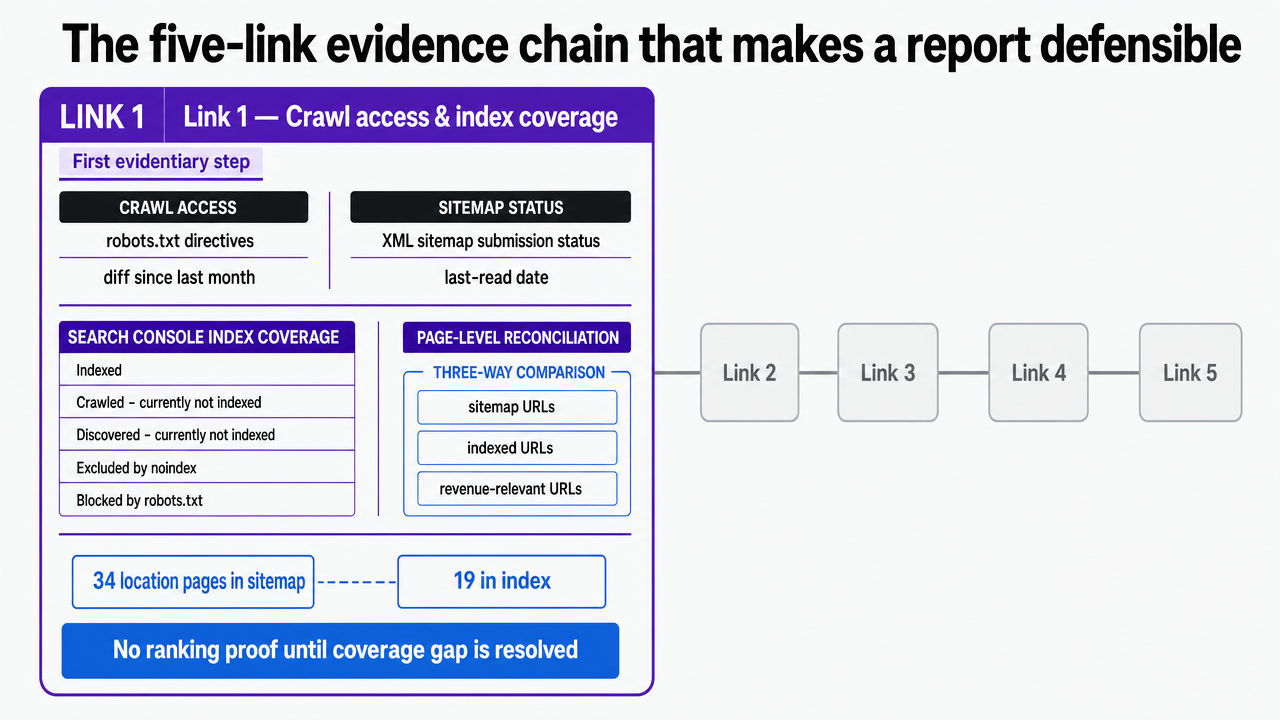 Visualize the five sequential evidence links described in this section as a linear process infographic, matching the exact five subsections that follow
The report schema: sections, sources, owners, decisions
A defensible report is built from a fixed schema, not assembled fresh each month. The schema names every section, its primary data source, the human owner accountable for the numbers, and the decision the section forces. Analysts stop rewriting narratives and start populating a known structure; clients stop hunting for the point.
The spine maps to the five-link chain. Crawl and index coverage pulls from Search Console Index Coverage and server logs; the SEO analyst owns it; the decision is whether any indexation blockers become a P0 in link five. Visibility pulls from Search Console query and page reports, GA4 channel data, and Google Business Profile insights; the analyst owns it; the decision is which query clusters or geographies deserve production investment. Qualified organic sessions pulls from GA4 with documented segmentation rules; the analyst owns it; the decision is whether traffic quality is trending with or against volume. Conversions pulls from GA4 key events, form-fill notifications, GBP actions, and call intelligence with a stated source of truth per event; the analyst and client lead co-own it; the decision is whether revenue-relevant events moved and why.
Two governance rows sit alongside the data rows. A substantiation review row covers any performance language in the report itself, owned by a compliance reviewer, with the decision being whether each objective claim meets the reasonable-basis standard before delivery 8. A prioritized actions row closes the schema, owned jointly by the analyst and the client lead, with tiering and named deadlines. Everything ships in the same order every month.
Generate and deliver complete SEO reports instantly
Test automated SEO reporting workflows and publish real client-ready deliverables during your trial—no delays or restrictions.
Substantiation: the reasonable-basis rule inside your own reports
The FTC's substantiation policy is usually discussed as a rule about what the client publishes. Agencies forget that the same rule attaches to the agency's own reporting language the moment that language is delivered as part of a commercial engagement. "Organic leads up 42%," "first-page rankings tripled," "cost per booked consultation down 30%"—each is an objective claim, and each needs a reasonable basis on file before it goes to the client 8.
The report schema treats substantiation as a named row with a compliance reviewer owner. Three tests apply to every performance sentence before delivery.
- Is the metric defined? "Leads" without a documented event definition fails on arrival.
- Is the source of truth stated? A conversion count pulled from GA4 with no reconciliation against form-fill notifications or call intelligence is a proxy, not a fact, and should be labeled as such.
- Is the comparison window disclosed? Month-over-month, year-over-year, and trailing-90-day comparisons produce different numbers from the same underlying data, and picking the flattering window without labeling it is where reasonable basis quietly collapses.
The practical output is a short substantiation log attached to each report: claim, metric definition, data source, query or filter used, comparison window, and reviewer initials. When a client's general counsel asks how the agency arrived at a headline number six months later, the log is the answer. When the log cannot be produced, the claim does not ship.
Regulated-vertical checkpoints: measurement, accessibility, endorsements
HIPAA tracking review for healthcare, dental, and senior living
For covered entities and business associates, the measurement stack that powers link four of the evidence chain is also the surface where the biggest regulatory exposure sits. HHS has directly addressed online tracking technologies used by HIPAA-regulated organizations and reminded them that Privacy, Security, and Breach Notification Rule obligations apply when tracking touches protected health information 3.
The report itself does not make the legal determination. What it does is flag every measurement surface where the question needs to be asked: appointment-request forms, symptom checkers, insurance-verification flows, patient portal entry pages, session replay pixels, call intelligence recordings tied to intake, and any third-party tag firing on pages that convey condition, provider, or treatment context. Each surface gets a row in a tracking inventory with the tag, the destination, the data captured, the page context, and a routing note to the client's privacy or compliance reviewer.
A dental group running a Meta pixel on its dental-implant consultation page and a senior-living operator running session replay on its memory-care tour form belong in the same checkpoint. The report's job is to surface the risk and hand it to the named owner, not to resolve it inside the SEO deliverable.
Health and behavioral-health content claims
Health claims made on service pages, blog articles, provider bios, and metadata carry a higher substantiation bar than general marketing copy. The FTC expects health-related claims to be backed by competent and reliable scientific evidence, and that expectation extends to claims conveyed indirectly through implication, imagery, or context 1, 5.
Inside the report, this becomes a content-risk row scoped to any page targeting a symptom, condition, treatment, outcome, or comparative efficacy query. A behavioral-health outpatient page ranking for "treatment-resistant depression" or a dental page ranking for "safest sedation for kids" needs a citation trail on file before the analyst recommends further optimization work against that query. New pages proposed in link five for high-risk clusters route to a medical-legal reviewer before production begins, not after.
The report should not attempt to adjudicate individual claims. It should mark which recommended pages fall inside the health-claim perimeter, name the reviewer, and log the disposition. Pages that fail review get pulled from the production queue and the reason gets recorded.
ADA accessibility in the technical audit link
Accessibility belongs inside the technical audit rather than as a standalone appendix. Inaccessible navigation, unlabeled form fields, missing text alternatives, low-contrast interactive elements, and keyboard traps depress conversions and can affect discoverability on the same pages the report is asking clients to invest in. The DOJ's web accessibility guidance frames the obligation for public-facing businesses under ADA Title III and for state and local governments under Title II 4.
The report identifies observed barriers on revenue-relevant templates—service pages, location pages, appointment forms, contact modules—and routes findings to qualified accessibility testing rather than certifying compliance itself. Each finding pairs a barrier description with the affected template, the estimated user impact, and an owner. A home services operator whose "request an estimate" form fails keyboard navigation gets the same treatment as a senior-living operator whose tour-request modal lacks focus management: flagged in the audit, routed for qualified review, and tracked in link five until resolved.
Reviews, testimonials, and local reputation recommendations
Local reputation work sits inside the report whenever the visibility link covers Google Business Profile or the actions link recommends review-generation campaigns. The FTC's endorsement guides govern how testimonials, reviews, and material connections must be presented, and the guides make clear that an endorsement cannot be used to make a claim the advertiser could not substantiate directly 6, 10.
The operational implication for the report is narrow and specific. Recommended review widgets, testimonial rotators, case-study modules, and influencer or provider endorsements go through a disclosure and substantiation check before they ship. A personal injury firm's rotating client testimonial that implies typical results, a dental practice's before-and-after gallery, and a behavioral-health case study that describes outcomes each need review against the same rule set. Star-rating aggregations pulled from third-party review platforms get a source-of-truth note and a refresh cadence.
The report closes the loop by logging which reputation assets passed review, which were revised, and which were held. Rejected assets carry forward to the next cycle with the documented reason, the same audit trail applied elsewhere in the schema.
Streamline Client SEO Reporting With Data-Driven Automation
Discover how leading agencies are leveraging AI to automate SEO report generation, maintain quality insights, and scale delivery—without increasing analyst headcount. Request a walkthrough tailored to complex, multi-client operations.
If you manage a portfolio: production economics across a client book
Audience switch: this section is written for agency operators running SEO reporting across a portfolio of clients, not for in-house leads producing a single report.
Once a report schema is fixed, the operator question stops being "what goes in the report" and starts being "what does each report cost to produce, and where can that cost be compressed without eroding the evidence chain." A portfolio of clients (call it N_clients) multiplies every design decision. Analyst hours per client per month (H_analyst) times review and QA cycles (R_cycles) times any compliance checkpoints required by the client's vertical is the monthly production load. Standardize the wrong step and the report loses defensibility; refuse to standardize the right step and the P&L never works.
The table below breaks the schema into its production components and marks where standardization is safe versus where human judgment must stay. Compliance-heavy verticals (healthcare, behavioral health, dental, senior living, legal) carry additional checkpoints that cannot be automated away; NIST's AI Risk Management Framework treats human review, approval ownership, and incident logging as governance functions that stay with people even as production scales 7.
| Report component | Analyst hours (H_analyst) | Review cycles (R_cycles) | Regulated-vertical checkpoint | Standardizable or judgment |
|---|---|---|---|---|
| Crawl and index coverage | Low | 1 | No | Standardizable |
| Visibility (query, page, geo) | Medium | 1 | No | Mostly standardizable; cluster naming is judgment |
| Qualified organic sessions | Medium | 1 | No | Judgment (segmentation rules) |
| Conversions and source-of-truth reconciliation | High | 2 | Yes (HIPAA tracking review) | Judgment |
| Substantiation review of report language | Low | 1 | Yes | Judgment |
| Content-risk review (health claims, endorsements) | Variable | 1–2 | Yes | Judgment |
| Prioritized actions with owners | Medium | 1 | No | Judgment |
The pattern is consistent. Data extraction, chart assembly, and schema population are safely standardizable across N_clients. Segmentation rules, source-of-truth calls, substantiation review, and prioritization are the judgment layer and stay with named humans. Agencies that compress the standardizable rows without touching the judgment rows keep H_analyst per client trending down as N_clients grows, and R_cycles stays flat because the review surfaces did not change.
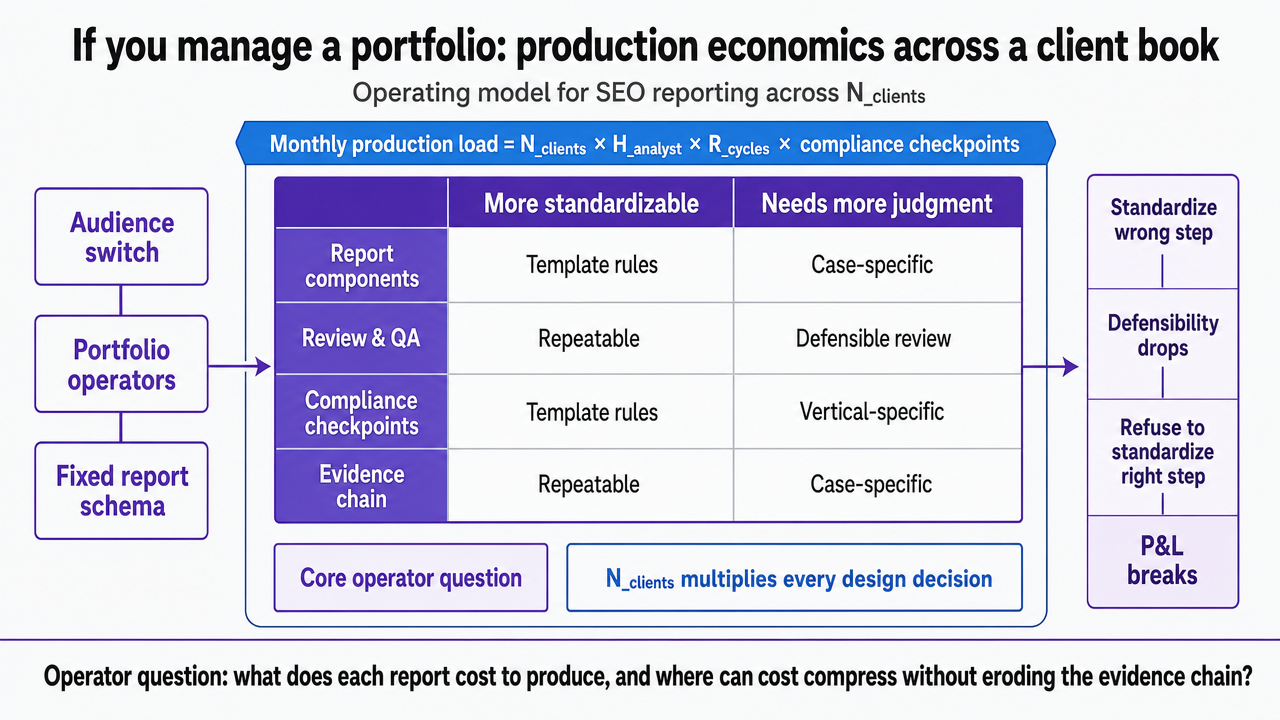 Translate the section's production-components table into a visual matrix showing which report components are standardizable versus judgment-based, directly reinforcing the operating model discussed
Governing AI-assisted report production without eroding oversight
AI assistance changes which parts of the report an analyst touches, not which parts a human owns. Data extraction, chart rendering, natural-language summaries of query movement, and first-pass draft copy are the rows most agencies compress first. The judgment rows—source-of-truth reconciliation, substantiation review, prioritization tiering, content-risk calls for regulated verticals—stay with named people because the failure mode of getting them wrong is a client loss, a retracted claim, or a privacy exposure that no amount of production speed offsets.
NIST's AI Risk Management Framework organizes AI governance around four functions: Govern, Map, Measure, and Manage 7. Applied to report production:
Govern : Names who approves AI-generated content before it reaches the client.
Map : Identifies which report sections use AI assistance and what inputs those systems see.
Measure : Sets checks for factual accuracy, source provenance, and bias in AI-drafted narratives.
Manage : Handles incident logging when an AI output ships with a wrong number or unverified claim, and closes the loop on what changed to prevent recurrence.
The Generative AI Profile adds specifics that matter for SEO reporting: selecting metrics for significant AI risks, documenting risks that cannot be measured, and tracking content provenance 9. Provenance is the one worth internalizing—every AI-drafted sentence in a client report should be traceable to the underlying data query and the human reviewer who approved it. Without that trail, the substantiation log described earlier cannot be reconstructed when a claim is challenged.
The operating rule is approval-first: AI drafts the standardizable rows, humans approve the judgment rows, and nothing reaches the client without a reviewer's sign-off. Agencies that invert that order—shipping AI output and reviewing exceptions—move H_analyst down for one quarter and lose retainers in the next.
Frequently Asked Questions
References
- 1.Health Claims | Federal Trade Commission.
- 2.Frequently Asked Questions - NIST Privacy Framework.
- 3.Use of Online Tracking Technologies by HIPAA Covered Entities and Business Associates.
- 4.Justice Department Issues Web Accessibility Guidance Under the Americans with Disabilities Act.
- 5.Health Products Compliance Guidance.
- 6.16 CFR Part 255: Guides Concerning the Use of Endorsements and Testimonials in Advertising.
- 7.Artificial Intelligence Risk Management Framework (AI RMF 1.0).
- 8.FTC Policy Statement Regarding Advertising Substantiation.
- 9.Artificial Intelligence Risk Management Framework: Generative Artificial Intelligence Profile.
- 10.Endorsements, Influencers, and Reviews.