
Key Takeaways
- Two analytics platforms rarely agree, so treat every SEO tool as a model with blind spots rather than a source of truth before it reaches a client deck 1.
- Judge platforms against the four functions Forrester scores—keyword research, organic tracking, technical auditing, and stakeholder workflow—instead of composite feature counts 9.
- Build the evaluation rubric on data quality, crawler accuracy, workflow coordination, and outcome attribution, using Forrester's 28 criteria as a checklist against vendor self-reports 5.
- Validate vendor numbers against Search Console, GA4, and manual SERP checks with documented tolerance thresholds so unreconciled figures never appear in client reporting 3.
- Decide between hub-and-spoke, parallel-stack, and consolidated models by counting which produces fewer reconciliation exceptions per client each month 6.
- Price the stack at portfolio scale using tool count times seats times client count, since license and reconciliation costs scale linearly with accounts 6.
- Add coordinated-execution as a scored dimension, recognizing that classic analysis platforms end at recommendations while execution platforms close the loop at the shipped change 8.
- Follow the selection sequence in order—anchor, score, test, reconcile, attribute, price—so purchase decisions defend both margin and measurement standards 8.
The data-reliability problem hiding inside every SEO stack
Two analytics platforms pointed at the same website will not agree. A 2022 peer-reviewed comparison of Google Analytics and SimilarWeb across 86 websites in 26 countries found systematic disagreement on four key metrics: SimilarWeb reported total visits about 19.4% lower than Google Analytics, unique visitors about 38.7% lower, bounce rate about 25.2% higher, and session duration about 56.2% higher, on average 1. These differences were statistically significant.
This finding reframes what an SEO analysis tool actually is. It is not a source of truth, but a model of a site's search behavior, built from a specific data pipeline with specific blind spots. When an agency Head of SEO pulls organic sessions from one platform and keyword-attributed traffic from another, the numbers presented to the client are already reconciling two different estimates of reality.
The scope of the PMC study is important. It compared a first-party tag (Google Analytics) against a third-party panel-and-modeling vendor (SimilarWeb). Most SEO analysis tools are closer to the SimilarWeb side, estimating search volume, clickstream, and competitive traffic from sampled panels, clickstream partners, and SERP scrapers rather than from the site's own server or tag. The divergence in the study represents a floor, not a ceiling, for expected disagreement.
For agency leaders managing multiple client accounts, tool selection must go beyond feature comparison. The primary questions are: which platform anchors the source of truth, which platforms feed it, and how conflicts between them are resolved before metrics reach a client.
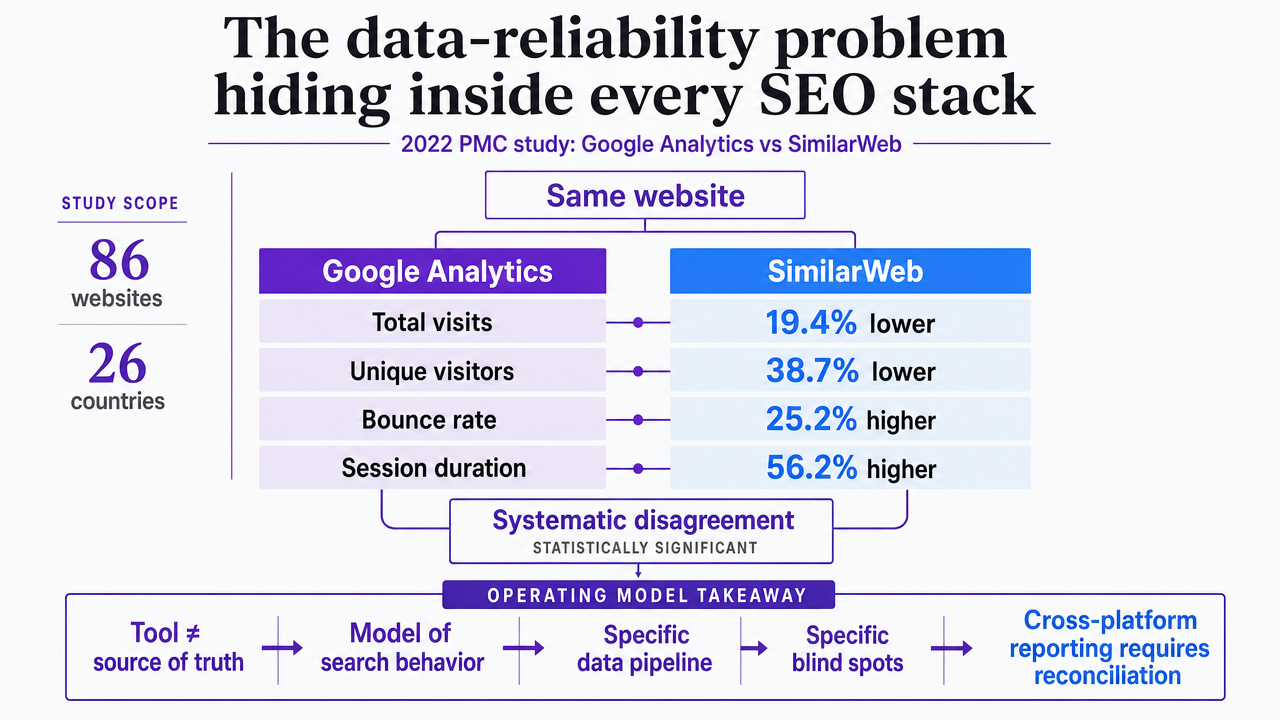 Visualize the statistically significant measurement gaps between Google Analytics and SimilarWeb reported in the 2022 PMC study, which is the anchor evidence for this section
What an SEO analysis tool actually has to do
Beyond dashboard aesthetics, an SEO analysis tool has a narrower job than most vendor presentations suggest. Forrester's definition, from its Wave evaluations, identifies four core functions: managing the SEO process across stakeholders, supporting keyword research, tracking organic performance, and auditing a site's technical foundation 9. Everything else is supplementary.
Each function has distinct failure modes:
- Keyword research fails when volume and difficulty estimates don't align with Search Console data.
- Organic performance tracking fails when ranking and traffic numbers cannot be reconciled with a first-party analytics tag.
- Technical auditing fails when the crawler misses render-blocked pages or reports issues that a client's development team cannot reproduce.
- Stakeholder workflow fails when the tool generates recommendations without clear assignment for execution.
A useful selection framework treats these as four separate accuracy tests, not a single composite score. The 2024 search performance study formalized this by naming recall, precision, F-measure, and average response time as indicators distinguishing a tool that accurately models search from one that produces merely plausible output 3. Agencies rarely apply these indicators to their own stack, which can lead to different diagnoses of the same client site even with identical tool setups.
The tool must perform these four functions well and demonstrate its capability. Feature counts are secondary.
Building the evaluation rubric from Forrester's 28 criteria
Data quality and source-of-truth alignment
Forrester's 2020 Wave evaluated seven platforms—Botify, Conductor, Moz, Searchmetrics, SEMrush, seoClarity, and Siteimprove—against 28 criteria spanning current offering, strategy, and market presence 5. Data quality is paramount because every subsequent capability, such as keyword prioritization, competitive analysis, and forecasting, depends on the accuracy of the underlying data pipeline.
The 2018 Wave, using 23 criteria, similarly emphasized data quality as a foundational scoring dimension alongside technical auditing, workflow, and reporting 10. Agency Heads of SEO evaluating a tool must answer three concrete questions before scoring anything else:
- What are the tool's data sources for search volume, clickstream, and SERP data (first-party integrations, third-party panels, scraped SERPs, or a blend)?
- How does the tool reconcile disagreements between its own estimates and the client's first-party data?
- What is the refresh cadence for each data type, and does it match the agency's reporting cycle?
A platform that directly ingests Search Console and GA4 as anchors will lead to different account decisions than one that treats its own modeled traffic estimates as authoritative. Both approaches can be valid, but an agency managing many client accounts needs to understand which model it is adopting.
Technical auditing, crawl accuracy, and response-time benchmarks
Technical auditing is where tool disagreement is most easily tested and exposed. Different crawlers analyzing the same domain will yield varying issue counts, render results, and priority orderings. The key question is which crawler most accurately reflects what search engines actually index.
The 2024 search engine performance optimization study formalized four indicators for crawler evaluation 3:
Recall : Did the crawler find every existing URL.
Precision : Are the flagged issues genuine.
F-measure : The harmonic balance of recall and precision.
Average response time : How quickly the audit completes at scale.
Recall failures manifest as missed pages in orphan reports. Precision failures result in development teams closing "cannot reproduce" tickets. F-measure captures the trade-off, and response time determines if a full audit of a large client site can be completed within a monthly reporting window.
Applying these indicators requires a controlled test: point every candidate crawler at the same three or four representative client sites, maintain consistent configuration, and compare outputs against Search Console coverage reports and manual spot-checks. Forrester's rubric includes technical auditing as a scored dimension in both its 2018 and 2020 Waves 5, 10; this framework allows an agency to generate an internal score rather than relying on vendor self-reports.
Workflow, stakeholder coordination, and reporting
Workflow is a common area where SEO platforms underperform in analyst evaluations, and where agencies often absorb hidden costs. Forrester's definition of an SEO platform includes managing the SEO process across stakeholders as a primary function, not merely a reporting add-on 9. The 2018 Wave similarly scored collaboration and governance capabilities alongside data and diagnostics 10.
For an agency Head of SEO, the practical test is whether the platform reduces or increases coordination overhead per client. A tool that identifies 400 technical issues but assigns none to a specialist, copy editor, or client-side developer produces a report, not an outcome. Workflow criteria for scoring include:
- Task assignment and ownership at the recommendation level
- Status tracking through implementation
- Revision history for content and technical changes
- White-labelable, schedulable reporting templates that don't require monthly rebuilding
Reporting is a subset of this. If two account managers on the same team produce different client decks from the same tool due to inconsistent export logic, the platform fails the coordination criterion, regardless of data strength. Forrester's Wave criteria score reporting depth, customization, and stakeholder access 5—an agency scorecard should do the same, weighted by the number of accounts each specialist manages.
Outcome attribution: connecting tool output to client KPIs
Rankings are an intermediate metric. Clients pay for pipeline, bookings, qualified calls, or revenue. An SEO analysis tool that cannot connect its outputs to these endpoints leaves the attribution argument to the client's finance team, which rarely benefits retention.
The 2025 web analytics research on measuring digital campaign success argues that properly configured analytics can objectively measure outcomes rather than proxying them through engagement metrics 2. This applies to SEO tooling: a platform earns its attribution score by linking keyword and page-level performance to client-defined conversions, not just by counting sessions. Peer-reviewed work on SEO strategy as a determinant of organizational outcomes reinforces this, framing optimization practices as drivers of measurable performance effects rather than isolated visibility gains 8.
Attribution criteria to score include:
- Native integration with GA4 and Search Console
- Support for server-side or CRM-linked conversion events
- Keyword-to-conversion path visibility
- The ability to segment organic performance by client-defined revenue categories
Government guidance on content optimization also emphasizes measurable improvements in discoverability and intent-matching as the ultimate goal 4. A platform that reports rankings without linking them to a defined outcome fails this criterion, regardless of its keyword database's comprehensiveness.
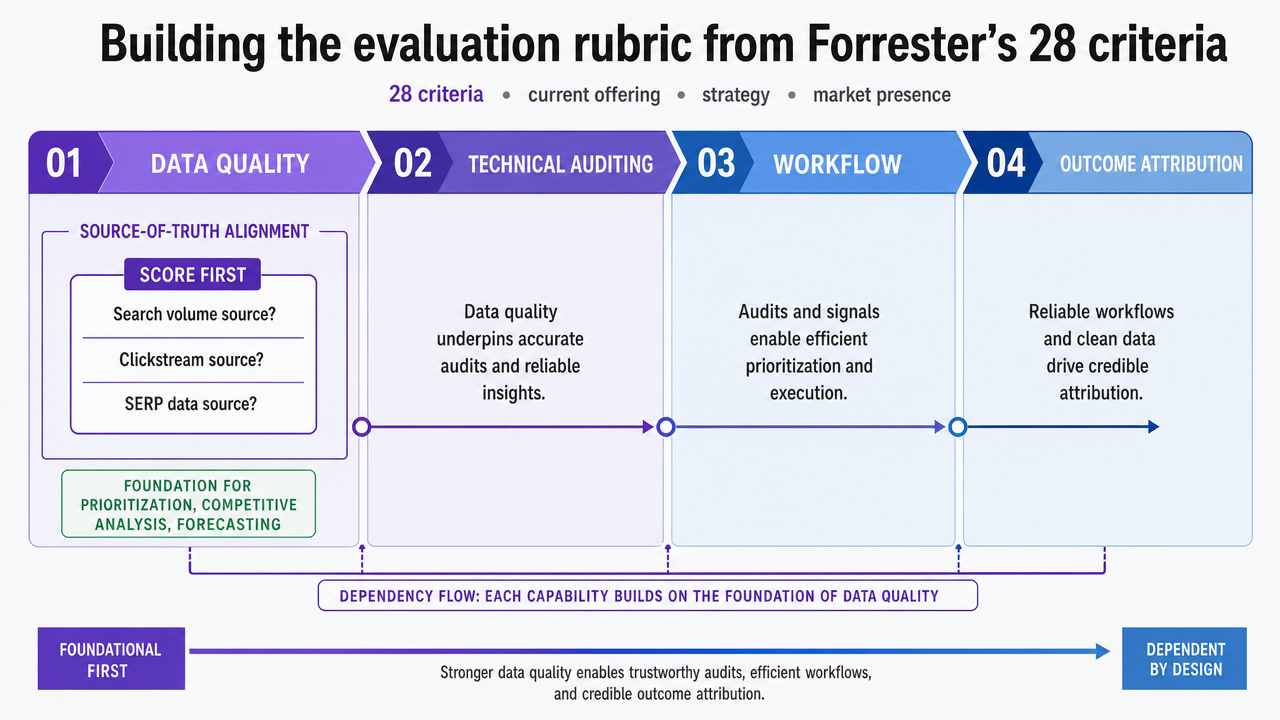 Process infographic visualizing the four sub-section scoring dimensions of the evaluation rubric (Data quality, Technical auditing, Workflow, Outcome attribution) as a structured framework the reader can apply
Test AI-driven SEO analysis workflows in production
Validate live SEO insights and content publishing on real projects before making a long-term commitment.
Validating vendor data before it reaches a client deck
Every metric an agency reports is a claim, and every claim is testable. The gap between vendor dashboards and first-party sources is significant, meaning Heads of SEO who don't validate data risk publishing unverified numbers.
A working validation protocol has three checkpoints:
- Cross-reference organic sessions and conversions in the SEO tool against Google Analytics and Search Console for the same date range and URLs. Persistent gaps beyond single digits indicate the tool is sampling, modeling, or attributing differently, each requiring a documented reconciliation rule before client reporting.
- Spot-check keyword rankings against manual SERP pulls from a clean browser session in the client's target geography.
- Compare crawl output against Search Console's coverage and indexing reports, treating divergence as a precision or recall failure to investigate, not merely a discrepancy to explain away 3.
The 2025 research on outcome-linked web analytics highlights the operational case: objective measurement that ties activity to defined outcomes distinguishes reporting from true attribution 2. A tool that passes validation earns its place in client dashboards; one that doesn't is relegated to internal research, not a client-facing source.
Agencies that formalize this protocol—with named owners, documented tolerance thresholds, and a monthly audit cadence—spend less time defending numbers during retention calls and more time acting on them.
Integration versus best-of-breed: reading the cheese board
Forrester's characterization of the SEO platform market is a "cheese board" of point solutions, noting that innovation lagged to the extent that the 2020 Wave named no Leaders, and most marketers still needed multiple tools for cross-functional SEO 6. This framing removes the false dichotomy in most tool-selection debates. The question isn't integration versus best-of-breed, but rather which functions an agency consolidates onto one platform and which it deliberately keeps separate.
Three integration patterns are common across agency stacks:
- A hub-and-spoke model designates one platform, usually the one closest to first-party data, as the reporting layer, with specialist tools feeding it for crawl, backlinks, or SERP tracking.
- A parallel-stack model runs two or three overlapping platforms, reconciling them at the report layer, accepting higher license costs for cross-checking vendor estimates.
- A consolidated-platform model relies on a single Wave-evaluated system for keyword research, tracking, and technical auditing, using lighter tools only for genuine gaps 9.
Each pattern has valid uses, but the selection criterion remains consistent: which model produces fewer reconciliation exceptions per client per month. An agency using a parallel-stack model for many accounts pays twice for overlapping data and again in analyst hours explaining discrepancies. An agency on a consolidated model is exposed to a single vendor's blind spots. Forrester's 28-criterion Wave scores platforms on breadth precisely because no single vendor covered every function well enough for a Leader designation 5.
The practical takeaway: assume fragmentation is the default, then decide which slices are worth paying for twice.
If you manage multiple client accounts: the portfolio economics of tool sprawl
The selection calculus changes when the unit of analysis shifts from a single site to an entire book of business. An agency Head of SEO evaluating a tool for one account might absorb a modest license premium for better data. However, that same premium multiplied across 40 or 60 accounts, each with two to four overlapping platforms, can become the largest controllable line item in the delivery P&L.
Forrester's assessment is that most marketers require several tools for cross-functional SEO, and the 2020 Wave did not name any Leaders because no single platform comprehensively covered every function 6. In terms of portfolio economics, fragmentation is not a stack design choice but the market default. The question is how quickly its costs scale.
The license surface of an agency stack follows a simple structure: tool count × seats per tool × client count. Holding tool count and seats constant, license cost scales linearly with client count. A stack of four platforms with three seats each means twelve license units per client; for 40 clients, that's 480 units, and for 80 clients, it's 960. Analyst hours spent reconciling disagreements between these platforms scale similarly, as every new account inherits existing reconciliation exceptions.
| Stack model | Tools per client | License surface at 40 clients | Reconciliation load |
|---|---|---|---|
| Parallel-stack | T (3–4) | T × seats × 40 | Linear with client count |
| Hub-and-spoke | T−1 | (T−1) × seats × 40 | Concentrated at hub |
| Consolidated | 1–2 | 2 × seats × 40 | Sub-linear; single vendor risk |
The variables are more critical than the arithmetic. Peer-reviewed work framing SEO strategy as a determinant of organizational outcomes supports treating tool spend as an investment tied to measurable performance rather than a fixed cost 8. An agency that can quantify its tool count (T), seats, and reconciliation load per client can justify consolidation on margin grounds. One that cannot is negotiating renewals blindly.
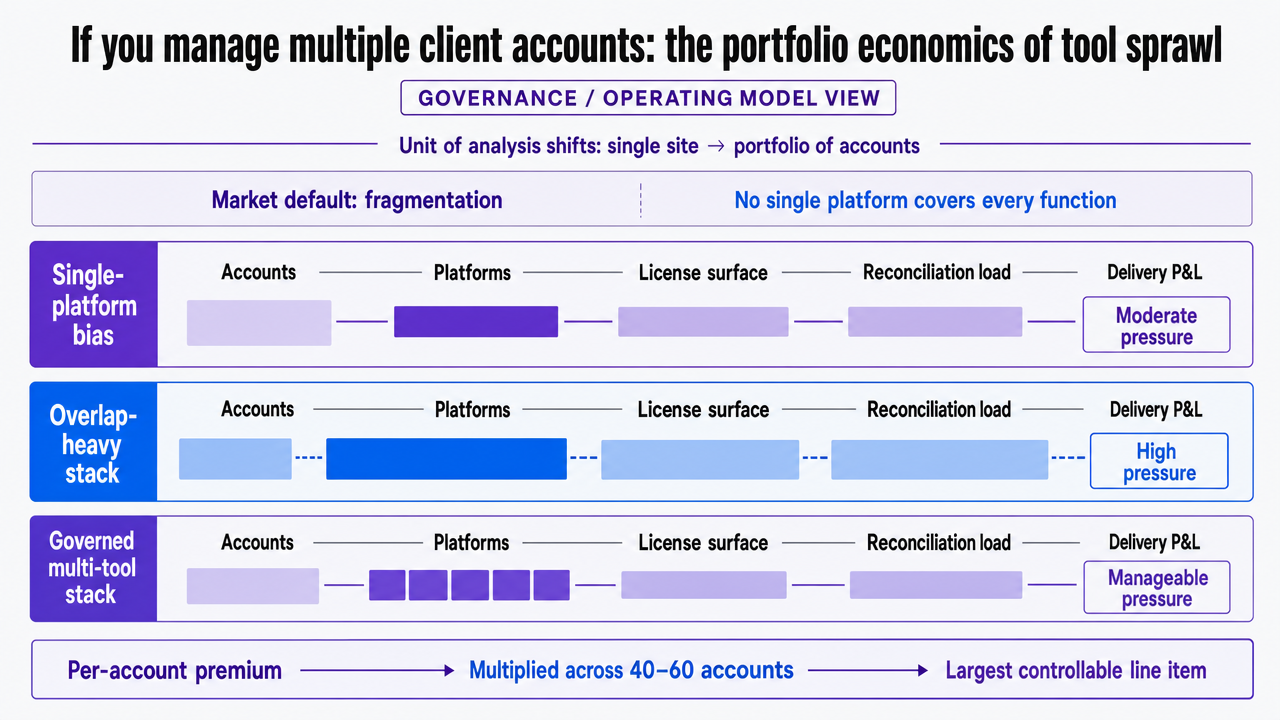 Visualize the comparison table in this section (three stack models and their license surface and reconciliation load) as a governance/operating model infographic
Benchmark Your SEO Analysis Workflow Against Leading Agency Standards
Connect with experts to evaluate your current SEO analysis stack, compare tool capabilities, and identify data-driven workflow improvements proven to increase efficiency across multi-client portfolios.
Where coordinated-execution platforms fit in the category
The Forrester Wave rubric was designed for platforms that analyze, recommend, and report, not those that execute. This distinction is crucial as agency stacks evolve. The 28-criterion evaluation scored capabilities like keyword research, technical auditing, workflow, and reporting 5. What it did not score, because the category was not yet mature, is coordinated execution: the layer that takes an approved recommendation and implements the content update, schema change, or internal link revision without a separate production handoff.
Coordinated-execution platforms complement, rather than replace, traditional SEO analysis tools. They draw from the same first-party sources (Search Console, GA4, CRM conversion events) that Forrester's rubric considers foundational for data quality 9, and they adhere to the same accuracy obligations defined by the recall, precision, F-measure, and response-time framework for search performance measurement 3. The difference lies in the workflow's endpoint. A classic SEO platform concludes its loop at the recommendation. A coordinated-execution platform, like Vectoron, completes it at the shipped change, with human approval as the gating step.
For an agency Head of SEO, this reframes the consolidation question. The choice is not only which analysis tool to standardize on, but also whether the execution layer—content production, technical implementation, reporting delivery—should be integrated into the same governed workflow. Vectoron is an example of an entrant in this coordinated-execution category; the broader point is that this category itself is now a scored dimension worth adding to any agency's selection rubric 8.
A selection sequence for agency Heads of SEO
The rubric condenses into a sequence. Following it in order will clarify tool selection; deviating from it risks defending a purchase decision instead of a measurement standard.
- Establish the source of truth. Google Search Console and a first-party analytics tag anchor the organic data against which all other platforms will be reconciled. The PMC comparison of first-party and third-party measurement underscores why this step is primary 1.
- Score candidate platforms on the four Forrester Wave functions—keyword research, organic tracking, technical auditing, and stakeholder workflow—using the 28-criterion breadth as a checklist, rather than vendor self-descriptions 5, 9.
- Conduct the recall, precision, F-measure, and response-time test on each candidate crawler against three representative client sites before committing 3.
- Define the reconciliation rule: when a tool disagrees with Search Console or GA4, determine which number is used in the client deck and who manages the exception log.
- Score attribution: does the platform link keyword and page performance to client-defined conversions, or does it stop at rankings 2?
- Price the stack at portfolio scale, not per account, using the unavoidable "tool count × seats × client count" structure dictated by the market 6.
Selection is a sequence, not a spreadsheet. Agencies that follow this order can defend both margin and measurement in the same conversation 8.
Frequently Asked Questions
References
- 1.Measuring user interactions with websites: A comparison of Google Analytics and SimilarWeb.
- 2.Web Analytics to Objectively Measure the Success of Digital Campaigns.
- 3.Search engine Performance optimization: methods and ....
- 4.Optimize your content.
- 5.The Forrester Wave™: SEO Platforms, Q3 2020.
- 6.The SEO Platform Landscape Is A Cheese Board Of Point Solutions.
- 7.Searching the Internet: Internet & Academic Search Engines (PowerPoint Presentation).
- 8.Search engine optimisation (SEO) strategy as determinants to ....
- 9.Every Company Needs An SEO Platform.
- 10.The Forrester Wave: Search Engine Optimization (SEO) Platforms, Q3 2018.