
Key Takeaways
- The modern SEO content writer role has split into two distinct functions: search intent translation, an analytical phase producing a decision brief, and structured drafting against a codified on-page specification.
- Accessibility standards now define the quality bar for SEO content, with institutional guidelines like a 20-word sentence limit 2, 7th-grade reading level 10, and single-H1 rule 5doubling as crawler-friendly signals.
- Content velocity rarely breaks at drafting; research and editing are the consistent bottlenecks, which is why adding writers to a stalled workflow fails to increase monthly published output.
- Managers should diagnose which step actually constrains output before hiring, then codify specifications and apply AI to structured tasks like outlining, drafting, and publishing while retaining human judgment for editing.
The role quietly split into two jobs
The job description for content managers often reflects an outdated model: research keywords, write, and publish. Modern content operations, however, reveal a different reality. The SEO content writer's role has evolved into two distinct functions, and failing to recognize this distinction often limits content teams to producing only four to eight posts per month.
The first function is search intent translation. This analytical phase occurs before any drafting begins. The writer must determine the core question a page answers, identify its primary keyword, and articulate how the proposed content will differentiate itself from existing top-ranking results. Ohio State's content guidance emphasizes that each page should target a unique primary keyword, as duplication dilutes both crawler signals and reader clarity 4. This decision-making process is analytical, not creative.
The second function is structured drafting. Once the intent is clear, the writer constructs the page according to a specific framework. This includes placing the primary phrase in the H1, H2s, and introduction without keyword stuffing 5, ensuring sentences are concise for readability 2, crafting headings that function as meaningful anchors, and optimizing metadata to encourage clicks. Michigan Tech highlights the goal as increasing the volume of quality, relevant, authoritative content, rather than merely chasing tactical gains 7. Similarly, Digital.gov stresses that high-quality content is consistent, navigable, authoritative, and keyword-optimized, in that specific order 3.
These two distinct jobs require different inputs, tools, and review processes. Content managers who separate these functions and staff or automate each half independently are better positioned to increase output without expanding their headcount.
What the modern SEO content writer actually produces
Search intent translation, not keyword insertion
The initial deliverable from a modern SEO content writer is not a draft, but a decision document. Before writing a single sentence, the writer defines the page's purpose, identifies the target audience's query, and outlines what constitutes a comprehensive answer. USAGov's content guidance prioritizes understanding user intent, then ensuring the content provides a complete answer with clear headings and short paragraphs 11.
This translation process yields three concrete outputs: naming the primary query, identifying the closest ranking pages, and specifying how the new page will offer unique value. Workello's role definition emphasizes that the writer researches topics and creates articles aligned with search intent, not just those containing specific terms 12.
A common pitfall is a draft that technically uses keywords but fails to address the correct question. For example, a page targeting "what a search engine optimization content writer does" is fundamentally different from one targeting "how to hire a search engine optimization content writer," despite keyword overlap. The University of Georgia's guidance stresses writing for the average reader seeking a real answer, not an expert scanning for jargon 6.
The outcome of this phase is a concise intent brief, typically one page, detailing the primary query, secondary queries, the specific gap in the current Search Engine Results Page (SERP), and the core promise of the page's opening 100 words. The success of all subsequent steps hinges on the accuracy of this document.
Structured drafting against a repeatable spec
Once intent is established, drafting becomes a structural exercise. Modern SEO content writers build content against a standardized checklist, much like those refined by public institutions. VA.gov's SEO guidance, for instance, recommends using the primary search phrase in the H1, H2s, and introduction, while strictly avoiding keyword stuffing 5. It also mandates a single H1 per page, unique title tags, and meta descriptions designed to attract clicks.
Ohio State's content optimization guidance complements this by stating that each page should target a unique primary keyword, and a site-wide keyword map should prevent internal competition for the same query 4. This rule proactively addresses content cannibalization and ensures the intent brief from the previous phase is effectively utilized.
Rice University's accessibility guidance further refines the sentence-level specification, advocating for short, clear sentences and paragraphs, descriptive link text instead of generic "click here," and meaningful alt text for images 10. Descriptive link text offers dual benefits: improved accessibility and enhanced crawler understanding.
A codified on-page specification checklist includes:
- One H1 containing the primary search phrase 5
- Primary phrase present in the intro and at least one H2, used naturally 5
- A unique primary keyword per page, tracked in a shared keyword map 4
- Meta title and description optimized for the query, not just branding 5
- Descriptive link text for all internal and external links 10
- Alt text on every image that conveys information 10
Implementing such a checklist internally and requiring its adherence on every draft significantly reduces subjective back-and-forth during revisions. Writers gain clarity on standards, and editors avoid repetitive debates.
Accessibility as the new quality bar
Historically, accessibility and SEO were treated as separate concerns. This distinction has largely dissolved. The characteristics that make a page usable for screen readers or low-literacy users—semantic structure, plain language, and a visual hierarchy that aligns with meaning—also make it easily digestible for search engine crawlers and generative AI systems.
Three institutional standards now collectively define a robust quality benchmark for content operations. The Centers for Medicare & Medicaid Services (CMS) recommends limiting sentences to 20 words or fewer and ensuring headings are independently meaningful, allowing readers to grasp the argument by scanning only the H2s 2. Rice University suggests writing at a 7th-grade reading level or lower where appropriate, combined with short paragraphs and descriptive link text 10. VA.gov mandates a single H1 per page, incorporating the primary search phrase, and unique title tags across the site 5.
These standards—a 20-word sentence limit, a 7th-grade reading level target, and a single H1 rule—are not aspirational. They are published guidelines from institutions that manage vast amounts of content and cannot compromise on clarity. Harvard's readability guidance further emphasizes visual aspects: utilizing semantic and visual space, avoiding all caps, and employing typography to reinforce heading hierarchy 9. Content meeting these accessibility benchmarks often naturally satisfies crawler expectations without resorting to keyword manipulation, making accessibility a practical quality standard for writers.
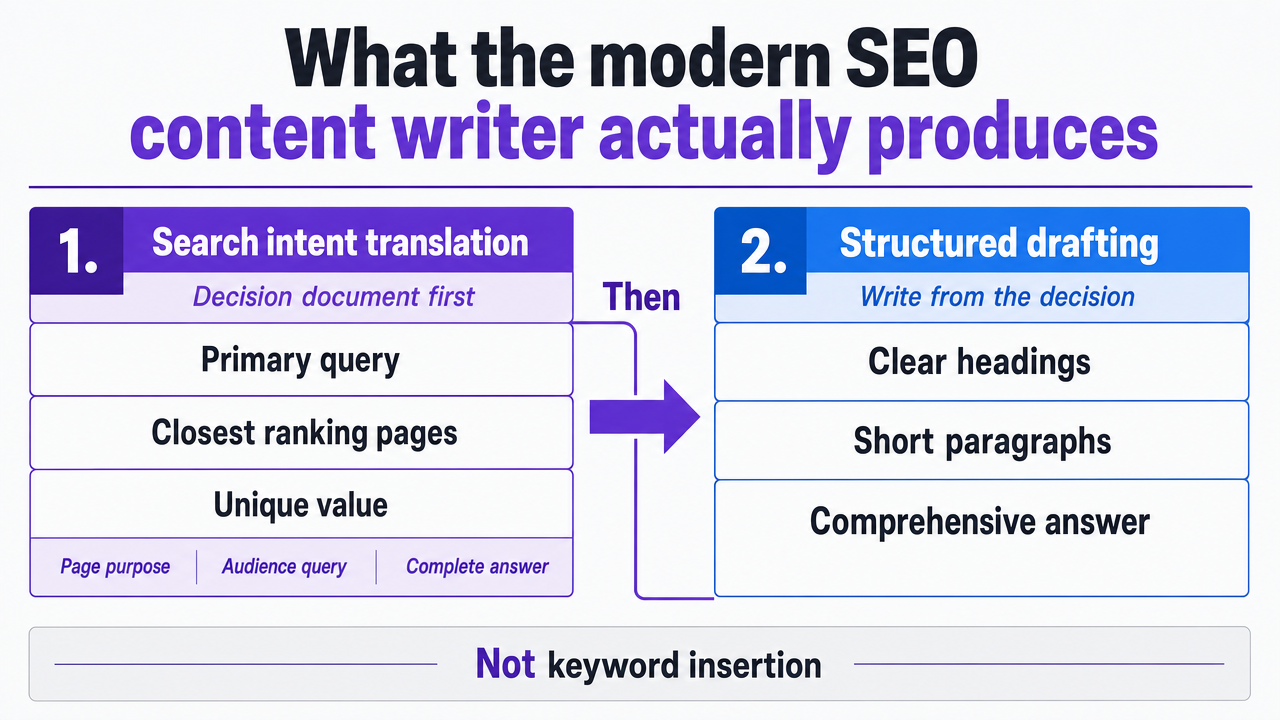 Visualize the two-function split of the modern SEO content writer role described in the section, showing the transition from search intent translation to structured drafting with their respective deliverables
The deliverable spec content managers should codify
Heading semantics and keyword mapping
Heading structure often reveals the quality of a draft. A page with multiple H1s, an illogical jump from H2 to H4, or competing primary keywords is not only difficult for crawlers but also confusing for readers. This structural integrity should be enforced through a clear specification, not merely caught during editing.
Ohio State's rule is foundational: each page must target a unique primary keyword, managed within a shared keyword map to prevent cannibalization 4. This map is a dynamic document, owned by the content manager and updated before topics are added to the editorial calendar. Writers who lack access to this map risk creating content that competes with existing pages.
VA.gov's heading guidelines complement this by requiring one H1 per page, containing the primary search phrase, with H2s that naturally incorporate the phrase or a close variant 5. CMS adds a semantic test: each heading should be independently meaningful, allowing a reader to follow the argument by scanning only the H2s 2.
A concise heading specification includes: one H1 with the primary phrase, H2s that function as standalone anchors, and a keyword map assigning each primary query to a single page. Adhering to these three rules ensures a structurally sound draft from the outset.
Sentence discipline and plain-language rules
Sentence-level issues can significantly slow down the editing process. When writing standards are implicit, every comment becomes a negotiation. When standards are explicitly defined in the brief, writers are more likely to meet them in their initial drafts.
The National Institutes of Health (NIH) plain-language guidance clarifies the objective: plain language benefits all readers, from language learners to experts, by reducing the cognitive load without sacrificing accuracy 1. This perspective reframes plain writing as a service to even the most knowledgeable readers.
Two key operational rules drive this. Northwestern University's web writing guidance mandates simple, concise copy broken into small paragraphs, based on the understanding that web users scan before reading 8. The University of Georgia advises writers to draft for the average reader, not the expert, and to eliminate vague or promotional language 6.
An effective sentence specification includes four elements: short sentences with an agreed-upon maximum length, paragraphs of one to four sentences, avoidance of promotional adjectives in favor of concrete nouns, and exclusion of jargon unfamiliar to the target audience. This clarity helps writers maintain consistent voice and reduces repetitive editorial corrections.
Metadata, alt text, and descriptive links
Metadata and link text are often overlooked when deadlines are tight, yet they are crucial for a page's click-through rate, crawler understanding, and accessibility. A specification that treats these as mandatory, rather than optional, ensures their consistent inclusion.
Wiley's SEO guidance instructs authors to include primary keywords in the title, abstract, and headings, but to avoid stuffing 19. Taylor & Francis directly warns against keyword stuffing, noting it produces unreadable text and does not improve visibility 16. Meta titles and descriptions should be crafted for the query, not just brand messaging.
Rice University's accessibility guidance completes the on-page requirements: alt text must convey information for users who cannot see images, and descriptive link text should replace generic phrases like "click here" to clearly indicate the destination 10. Both elements also provide valuable signals to crawlers about page connections and image content.
Every draft should require: a meta title optimized for the primary query, a meta description designed to earn clicks (under 160 characters), alt text for all informational images, and descriptive link text for every internal and external link.
Test SEO content workflows with real outputs
Experience hands-on SEO content creation and publish live articles during your trial, no commitment required.
Where velocity actually breaks
When content production stalls, content managers often attribute the slowdown to writers. However, a closer look at the workflow reveals a different pattern. The SEO content writer's job typically involves five steps, and bottlenecks almost always occur at the same two points.
Workello defines the responsibilities as researching topics, creating articles aligned with search intent, integrating keywords, and collaborating with editors 12. Coursera's skill map for content specialists includes writing, editing, keyword research, data analytics, and SEO 17. These collectively outline five discrete stages:
- Research: The writer analyzes the query, reviews top-ranking pages, and identifies content gaps. This analytical step is often time-consuming and rarely fits into short work blocks.
- Outline: The writer establishes headings, primary and secondary queries, and the core promise of the introduction. A well-constructed outline serves as a contract for the draft.
- Draft: When guided by a clear outline and codified specifications, drafting becomes the fastest stage, not the slowest.
- Edit: This stage is a common bottleneck. Without shared specifications, each draft can lead to lengthy negotiations over sentence structure, heading logic, and tone. Two revision cycles can extend a three-day article into a two-week project.
- Publish: This involves adding metadata, alt text, internal links, and schema. These tasks are often rushed under deadline pressure and may be neglected or patched later during audits that rarely happen.
The primary bottlenecks are not in drafting, but in the initial research and the editing phase. Content managers who track time-per-step will consistently observe that research takes longer than anticipated, drafting is quicker, and editing consumes any remaining buffer. Addressing the wrong step is why simply hiring more writers often fails to increase monthly output.
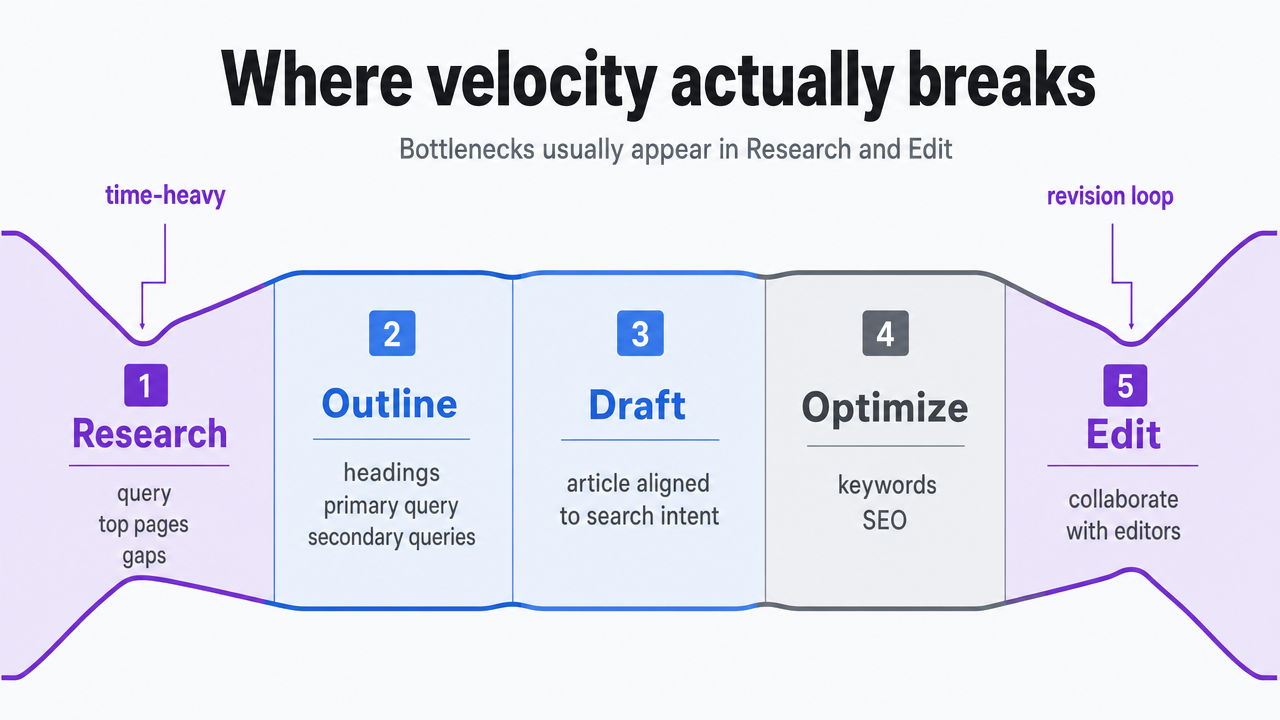 Illustrate the five-step content workflow described in the section and highlight where bottlenecks occur (Research and Edit stages), directly supporting the section's core argument about diagnosing constraints
Where AI assistance compresses the workflow and where it does not
AI's impact varies across the five-step content workflow. Applying AI uniformly often yields inconsistent results: some drafts accelerate, while others are inferior to human-produced content. A clear pattern emerges when mapped.
Research sees partial compression. AI can summarize top-ranking pages, cluster secondary queries, and identify relevant vocabulary. However, it cannot determine the unique value proposition of new content compared to existing SERP results. This critical judgment remains with the writer or content manager, as it depends on the site's strategic positioning and internal keyword map 4.
Outlining compresses effectively. Given a finalized intent brief and on-page checklist, AI can generate a heading structure that adheres to the single-H1 rule, incorporates the primary phrase in the intro and at least one H2, and ensures H2s are semantically meaningful 2, 5. The writer then refines this AI-generated outline rather than building from scratch.
Drafting offers the most significant compression, often leading teams to overemphasize this stage. A structured outline combined with codified specifications allows for first drafts to be produced in a fraction of the time a human would take. The caveat is that these drafts still require human review for subject-matter accuracy and voice, especially when NIH-style plain language must maintain technical precision 1.
Editing compresses the least. This phase involves subjective judgment related to taste, brand voice, and addressing the reader's true intent. The University of Georgia's guidance to write for the average reader and eliminate vague or promotional language exemplifies the kind of judgment that AI cannot cleanly automate 6. While AI can flag long sentences or passive voice, it cannot determine if a paragraph genuinely contributes to the content's purpose.
Publishing compresses reliably. Tasks like metadata generation, alt text drafting, and internal link suggestions respond well to automation, provided a human verifies the meta description aligns with the query and alt text conveys accurate information 10. The pattern is clear: AI excels at structured, rule-based tasks, while humans retain critical judgment, and the manager's role is to discern which is which.
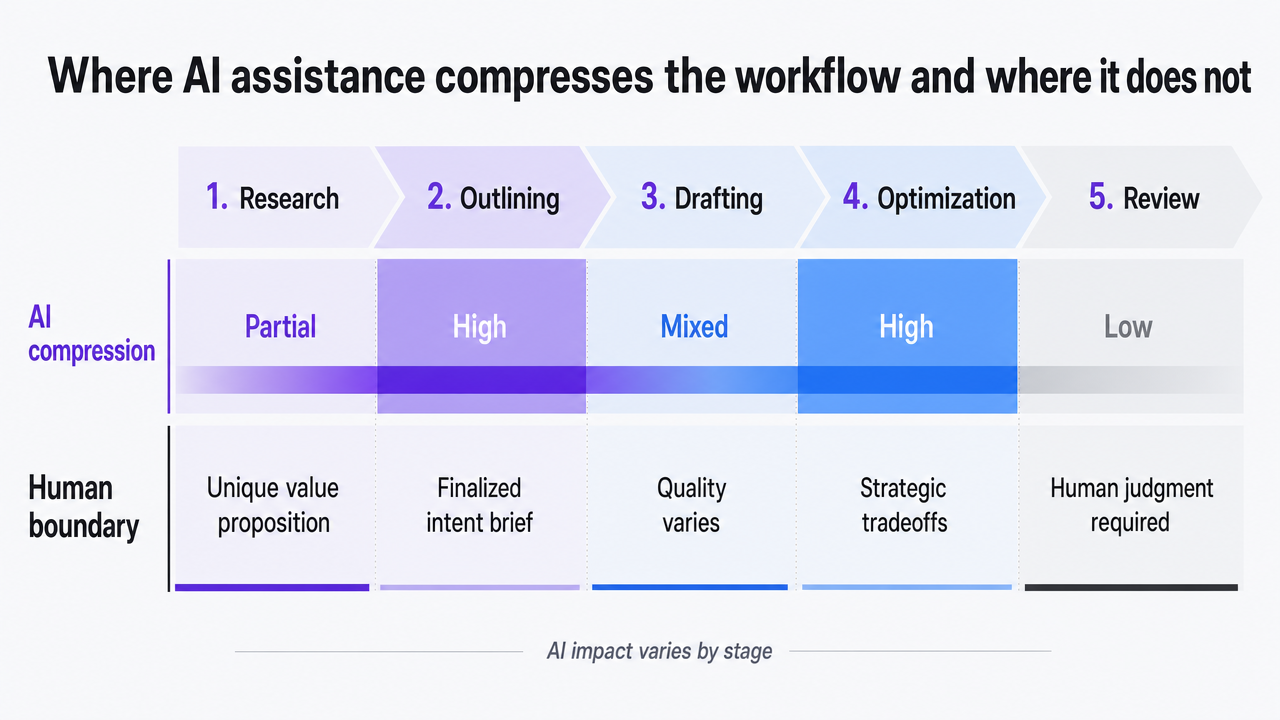 Provide a comparison matrix of the five workflow stages against AI compression potential, directly reinforcing the section's stage-by-stage analysis of where AI helps and where human judgment is required
Accelerate Content Production Without Compromising SEO or Brand Standards
See how leading teams coordinate SEO content workflows at scale—eliminating manual bottlenecks, maintaining quality, and increasing content velocity with unified oversight. Request a strategic walkthrough tailored to your current production challenges.
How the writer fits inside the content manager's operation
The SEO content writer operates within, not at the apex of, the content operation. The content manager holds the top position. Built In's role definition explicitly states that content marketing managers guide and execute the organization's content strategy, determining how best to meet audience needs based on research, metrics, trends, and competitor analysis 18. The writer executes this direction; the manager sets it.
This distinction fundamentally alters what constitutes an effective brief. The manager is responsible for the keyword map, editorial calendar, persona definitions, and performance targets. The writer, in turn, owns the intent brief, outline, draft, and adherence to the on-page checklist. Problems arise when managers overstep into outlining, causing writer delays, or when writers attempt to manage the calendar, leading to misaligned priorities.
Coursera's skill map for content specialists lists writing, editing, keyword research, data analytics, and SEO as core competencies 17. Only two of these relate directly to drafting; the other three are analytical and bridge the responsibilities of the manager and the writer. A functional operation clearly defines ownership for each side of this boundary before any brief is issued.
The practical test is straightforward: a manager should be able to provide a writer with a concise, one-page brief and receive a spec-compliant draft without needing a follow-up meeting. If a call is required, the brief is incomplete, not the writer deficient.
Hiring the bottleneck, not another headcount
When content production slows, the immediate reaction is often to hire more staff—another writer, freelancer, or agency. However, this approach rarely solves the underlying problem. If research and editing are the primary bottlenecks, adding a sixth writer to a five-person team will only increase the number of drafts stuck at those same checkpoints, not the volume of published posts.
A more effective strategy is to identify and hire against the specific bottleneck. If research is the constraint, the appropriate hire is an analyst or a senior writer capable of developing intent briefs, not a junior drafter. If editing is the bottleneck, the solution is an editor who can enforce codified specifications, rather than another author generating more content to be edited. Indeed's content writer job description subtly reflects this split, including preparing outlines, drafting, and proofreading for tone, style, clarity, and grammar 14. Many content managers hire for the drafting skill and then inherit a workflow that breaks at the beginning and end.
The alternative is to optimize the workflow itself. AI-assisted execution, guided by codified specifications, can significantly compress outlining, drafting, and publishing without requiring additional headcount. The manager retains ownership of the keyword map, intent brief, and final edit. Platforms like Vectoron are designed for this exact division: humans handle judgment, the system manages structured tasks, and nothing is published without approval. This approach increases output without expanding the team.
Frequently Asked Questions
References
- 1.Plain Language: Getting Started or Brushing Up.
- 2.Guidelines for effective writing.
- 3.Tapping Into SEO: How Government Websites Can Improve Content Reach.
- 4.Content Optimization.
- 5.Writing for SEO.
- 6.Maximizing content visibility online.
- 7.What is SEO? (Search Engine Optimization).
- 8.Writing for the Web and Optimization.
- 9.Design for readability.
- 10.Readability & Writing.
- 11.SEO Tips for Content Writing - USAGov.
- 12.SEO Content Writer Job Description Template | 2026 - Workello.
- 13.Chapter 3 — What's the Job Description of an SEO Copywriter?.
- 14.Content Writer Job Description [Updated for 2026] - Indeed.
- 15.What does a SEO writer do? - CareerExplorer.
- 16.Search engine optimization for academic articles | Research impact.
- 17.Content Marketing Specialist: What They Do and How to Become One.
- 18.What Is a Content Marketing Manager? How to Become One, Salary ....
- 19.Enhance your article's visibility: a guide to SEO.