
Key Takeaways
- Google Search Console delivers the exact query, impression, and indexing data that paid platforms only estimate, making it the non-negotiable base layer for every client property 2.
- GA4 captures post-click behavior Search Console cannot see, exposing when high-ranking keywords fail to convert into qualified leads or booked calls 1.
- Search Generative AI performance reports launched in Search Console in June 2026, forcing agencies to separate AI overview metrics from traditional organic in every client report 3.
- Screaming Frog remains the pre-billing diagnostic tool of choice, surfacing broken links, redirect chains, and schema errors before the first retainer invoice goes out 13.
- Sitechecker and Lumar take over once client portfolios exceed roughly 100,000 URLs, where desktop crawling stops being viable for governance and scheduled audits 10.
- Semrush consolidates keyword research, backlinks, audits, and local SEO into one interface, though its learning curve raises ramp-up costs for junior producers 14.
- Ahrefs holds its place on the strength of its backlink index, with agencies often running it alongside Semrush to catch referring domains the other misses 14.
- Moz Pro and SE Ranking give mid-market agencies comparable research at lower per-seat cost, sufficient for most shops under $5 million in revenue 14.
- Surfer SEO compresses brief, outline, and optimization into one document, cutting handoffs between strategists and writers when paired with skilled editorial judgment 9.
- AgencyAnalytics eliminates the monthly export-and-format grind by consolidating Search Console, GA4, and research platform data into scheduled white-label dashboards 13.
- Execution coordination is the emerging sixth job, addressing the manual labor between tools where producer margin actually disappears rather than adding another dashboard 13.
The Stack Is Compressing—And Agency Margins Depend on Noticing
The global SEO tools market, valued at $3.6 billion in 2025, is projected to reach $27.2 billion by 2035, growing at a 22.4% CAGR 4. This growth indicates a shift in the industry, where agencies are finding their margins thinning due to the increasing number of tool licenses they acquire.
Agencies serving multi-location clients often use six to ten tools simultaneously. This typically includes platforms like Semrush or Ahrefs for research, Screaming Frog for technical crawls, Google Search Console and GA4 for first-party data, content optimizers like Surfer, and reporting tools such as AgencyAnalytics 13, 14. While each tool may be justifiable individually, collectively they impose a significant production tax in terms of time spent on briefs, data exports, quality assurance, and report generation.
For agency owners in 2026, the key question is not which rank tracker offers the best features, but rather which combination of tools can produce client-ready output with the fewest handoffs per account. This focus is driving a compression of the tool stack, with reporting platforms integrating analytics, research suites incorporating content optimization, and new execution layers emerging to streamline the labor between these tools.
This article evaluates 11 tools based on the six essential jobs an agency stack must cover, distinguishing between genuine consolidation and mere vendor marketing claims.
The Six Jobs Every Agency SEO Stack Has to Cover
Regardless of headcount or client mix, every agency SEO stack performs six core functions. Defining these functions helps evaluate tools based on their specific utility rather than brand familiarity.
- First-party engine data: This foundational layer includes Google Search Console, which reports on queries, impressions, clicks, and indexing, and Google Analytics 4 (GA4), which tracks user behavior post-click 1, 2. No paid platform can replace these; they all build upon this data.
- Technical crawl: Tools like Screaming Frog are standard for diagnostics, with Lumar and Sitechecker used for higher URL volumes 13. These identify issues such as indexation problems, redirects, and schema errors.
- Keyword and backlink research: Semrush and Ahrefs are widely adopted, while Moz Pro and SE Ranking are common choices for mid-market agencies 13, 14.
- Content optimization: Platforms like Surfer SEO streamline the content creation process from brief to draft 14.
- Reporting: AgencyAnalytics and similar platforms consolidate performance data into client-facing dashboards and scheduled reports 11, 13.
- Execution coordination: This emerging function focuses on automating the labor involved in connecting the other five jobs, rather than just tracking performance.
Each tool discussed in this comparison fits into one of these six categories, which will be explored in detail.
 Google Search Console historical data window
Google Search Console historical data window
Job 1: First-Party Engine Data (The Non-Negotiable Base Layer)
Google Search Console: Where Every Paid Tool Actually Gets Its Truth
Google Search Console is a free tool that serves as the authoritative source for search performance data, which paid platforms often rely on. Google itself describes it as essential for measuring "site's Search traffic and performance, fix issues, and make your site shine in Google Search results" 2. Key metrics like impressions, clicks, average position, and index coverage originate here, providing more accurate data than estimates from third-party tools like Semrush or Ahrefs.
For agencies managing numerous client properties, Search Console is invaluable. It provides precise query data that drives impressions for a client's domain and immediately flags indexing problems. While third-party rank trackers offer approximations, Search Console delivers exact reports.
A crucial operational step is to verify every client property during onboarding and integrate its API with downstream reporting layers. Neglecting this means paying for estimated data that clients can access for free 1.
Google Analytics 4: The Behavior Layer Search Console Cannot See
While Search Console tracks activity up to the click, GA4 monitors user behavior afterward. Google considers these tools to provide "complementary data": Search Console reveals how users find a site, and Analytics details their actions once they arrive 1.
This distinction is vital for agencies focused on qualified leads, form submissions, or booked calls. A keyword might rank high and generate clicks, but if it leads to a low conversion rate compared to a lower-volume query, only GA4 can expose this discrepancy.
The practical setup involves creating a GA4 property for each client, configuring events to track specific conversion actions tied to the retainer, and linking it to Search Console. This integration ensures query data flows into a unified interface, making both tools essential for agencies 14.
The 2026 Wrinkle: Search Generative AI Performance Reports
In June 2026, Google introduced Search Generative AI performance reports within Search Console, providing data on impressions, clicks, and CTR for content appearing in AI-generated search experiences 3. This addition redefined what constitutes comprehensive client reporting.
Previously, agencies could focus solely on traditional "ten blue links" organic visibility. Now, client reports must differentiate between traditional search performance and AI overview performance, as these metrics can diverge. Most third-party reporting platforms are still adapting to pull these new dimensions via the Search Console API, though some offer raw exports.
This gap is significant: clients observing AI overview impressions in their own Search Console will notice if agency reports omit this data. Agencies should integrate SGE metrics into all recurring reports immediately, regardless of their chosen paid platform 3.
Job 2: Technical Crawling and Site Audits
Screaming Frog: The Diagnostic Every Agency Runs Before It Bills
Screaming Frog is the go-to crawl tool for agencies, often used even before client onboarding is complete. It remains a default site audit tool alongside Semrush and Ahrefs in 2026 practitioner stacks 13 because it effectively uncovers technical debt that clients might not disclose or previous agencies might have overlooked.
A single crawl can identify common issues such as broken internal links, redirect chains, missing or duplicate title tags, orphaned URLs, canonical mismatches, and schema errors. Producers can run a crawl locally, export CSVs, and provide a clear punch list to the client before the first retainer invoice is processed.
However, Screaming Frog's desktop application architecture limits crawl speed and depth based on the machine's resources. While suitable for a 5,000-URL site, it becomes a logistical challenge for larger portfolios, such as a dental group with 300 location pages across 40 brands. A cloud edition exists to address these scalability needs, and it is often listed in enterprise comparisons for such contexts 9.
Sitechecker and Lumar: When Crawl Volume Outgrows a Desktop App
When a client portfolio exceeds approximately 100,000 URLs, desktop crawling becomes impractical. Enterprise SEO comparisons define this threshold as the point where platforms designed for managing extensive URL volumes across multiple properties become necessary 10. At this scale, agencies transition to cloud-based crawlers.
Sitechecker offers an accessible cloud audit solution, frequently included in practitioner stacks as a lightweight tool for agencies needing scheduled crawls across a mid-sized client base 14. It automates reports and triggers alerts for regressions, reducing manual oversight.
Lumar operates at the enterprise level, recognized alongside Botify and seoClarity as a crawler built for governance, scale, and integration within a broader enterprise SEO platform 9. Pricing for such tools typically involves annual contracts rather than monthly seats, targeting agencies that serve a few large accounts rather than many smaller ones.
Test AI-Driven SEO Execution in Real Time
Validate workflow efficiency and measurable SEO outcomes before making a long-term commitment.
Job 3: Keyword and Backlink Research at Client Scale
Semrush: The All-in-One Most Agencies Standardize On
Semrush is a popular choice for agencies due to its ability to consolidate four key functions—keyword research, backlink analysis, site audits, and local SEO—into a single interface 13. For producers managing multiple client accounts, its value lies in its comprehensive coverage: a single login supports a content strategist's research, a link-building lead's backlink audit, and local pack tracking for multi-location clients.
In 2026, practitioner stacks often recommend Semrush as the "best for all-in-one SEO," though its steep learning curve for junior producers is a recognized drawback 14. This learning curve can increase ramp-up costs for new hires at agency scale.
Semrush also offers an enterprise tier, priced from approximately $5,000 to $15,000+ per month, designed for competitive research and scaled reporting for agencies with high-URL clients 9, 10. This significant price difference often leads mid-market agencies to stick with standard seats until a specific account justifies the upgrade.
Ahrefs: The Backlink Index Competitive Teams Still Pay For
Ahrefs maintains its position in agency stacks primarily due to its robust backlink index. Practitioner comparisons in 2026 continue to highlight it as "best for backlink analysis and competitor research," making it the tool of choice when the client's question revolves around competitive outranking rather than content creation 14.
While there is overlap with Semrush in areas like keyword research, backlink analysis, and site audits 13, many agencies use both platforms. The discrepancies between their research indexes often provide actionable insights, as one platform might identify referring domains that the other missed, which is crucial for competitive link-building strategies.
Ahrefs is known for being expensive for multi-user teams. Consequently, smaller agencies often limit its use to a single senior producer who shares exports, rather than purchasing seats for the entire team 14.
Moz Pro and SE Ranking: The Mid-Market Alternatives Worth Comparing
Not every agency requires the combined power of Semrush and Ahrefs. For agencies serving local service verticals or clients with smaller URL footprints, Moz Pro and SE Ranking offer comparable research capabilities at a lower per-seat cost. Both are recognized in 2026 agency stacks as viable mid-market alternatives 14.
Moz Pro is known for its domain authority scoring and a long-standing keyword database. SE Ranking emphasizes white-label reporting and rank tracking, which appeals to agencies that rebrand dashboards for their clients.
The decision between these tools is not about which has superior features, but whether an agency's client base generates enough enterprise-level research demand to justify premium platforms. For most agencies under $5 million in revenue, mid-market tools often suffice for their weekly query needs.
Job 4: Content Optimization
Surfer SEO: Brief-to-Draft Compression for Content Teams
Content optimization is a common area where agency margins can erode. The traditional process involves a senior strategist writing a brief, a junior writer drafting, and an editor refining the content against competitor analysis. This often requires producers to juggle multiple tabs to gather term coverage, heading structures, and word counts from ranking pages. Surfer SEO aims to consolidate this workflow into a single interface.
In 2026, Surfer is frequently cited in practitioner stacks as the content optimization tool agencies pair with their research platforms, and it also appears in enterprise comparisons for large-scale optimization 9, 14. Its value at agency scale lies not just in the optimization score, but in integrating the brief, outline, and real-time optimization within the same document, reducing back-and-forth between strategists and writers.
It is important to note that optimization scores are directional, not absolute. Over-reliance on scores without editorial judgment can lead to thin content. Surfer is most effective when it enhances the efficiency of skilled writers, rather than replacing their expertise.
Job 5: Multi-Client Reporting
Reporting is a labor-intensive process for agencies, often consuming significant time and eroding margins. Producers managing multiple accounts typically spend the last week of each month exporting data from various sources like Search Console, GA4, Semrush, and Screaming Frog, then manually populating client-specific slide templates. Reporting platforms are designed to eliminate this repetitive work.
AgencyAnalytics is a prominent tool for this purpose, consolidating data from research platforms, Google properties, and rank trackers into white-label dashboards that agencies can schedule for clients 13, 14. Enterprise reporting software serves a similar role for higher volumes, offering tools that "consolidate SEO performance data into dashboards, templates, and scheduled reports for large sites, many stakeholders, and ongoing campaigns" 11.
The financial implications of this consolidation are clear. The enterprise SEO platforms market, valued at $6.94 billion in 2022, is projected to reach $35.67 billion by 2032, with a 17.78% CAGR 7. As research and platform costs rise faster than retainer prices, agencies are compelled to streamline reporting by reducing the hours spent between data extraction and client-ready presentations.
A reporting tool proves its worth by eliminating recurring export and formatting tasks, not by simply adding another dashboard to monitor.
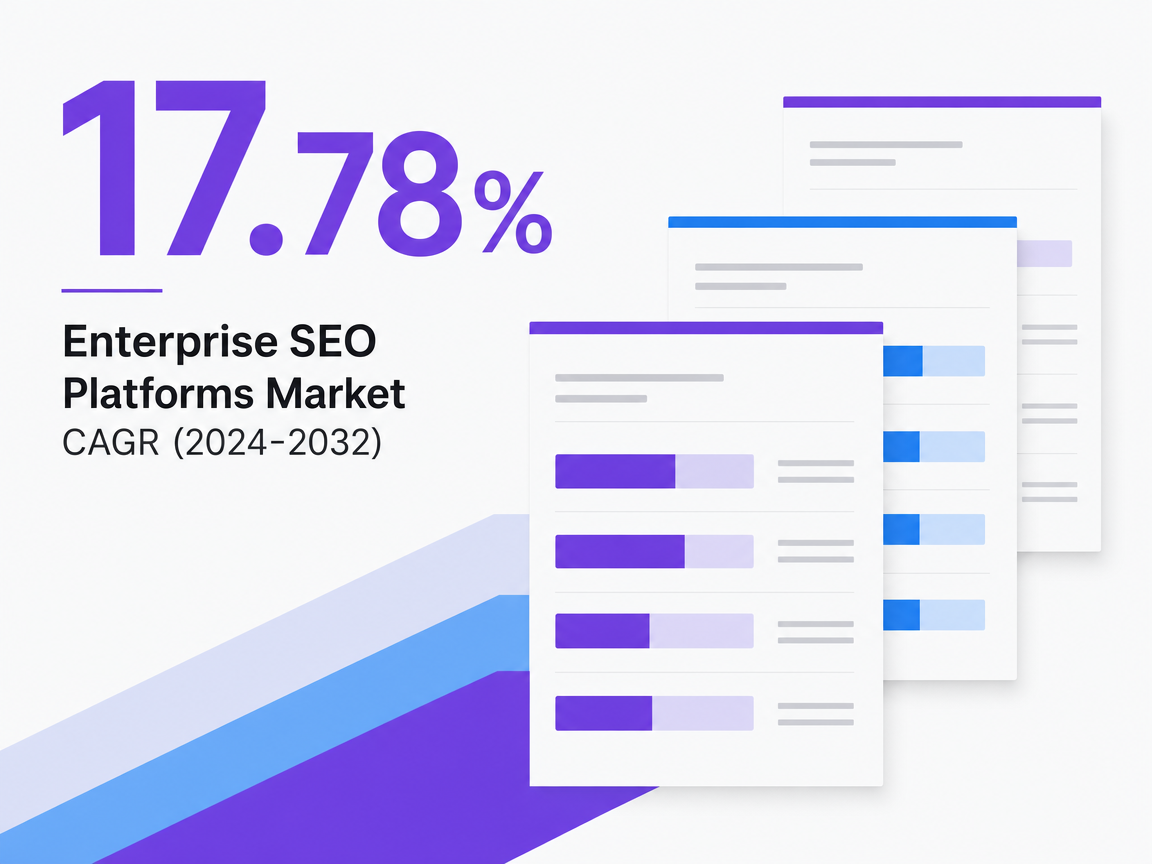 Enterprise SEO Platforms Market CAGR (2024-2032)
Enterprise SEO Platforms Market CAGR (2024-2032)
See How Leading Agencies Integrate AI-Driven SEO Tools for Scalable Results
Connect with our specialists to benchmark your agency’s SEO tool stack, explore workflow automation options, and review multi-channel execution models proven to reduce production overhead in high-volume client environments.
If You Manage Multiple Locations or Enterprise Clients: The Real Cost Curve
This section addresses agency operators who manage clients with over 100,000 URLs, multi-location portfolios, or strict enterprise governance requirements. For these clients, the financial and tool considerations differ significantly.
Enterprise SEO platforms are characterized by their ability to crawl high URL volumes and support extensive seat structures. Research typically defines the boundary at around 100,000 URLs, identifying platforms like BrightEdge, Conductor, Semrush Enterprise, Ahrefs Enterprise, Botify, and seoClarity as suitable for this tier 10. Pricing shifts from monthly seats to annual contracts, and the purchasing decision moves from a producer to an agency principal.
The costs at this level are substantial. BrightEdge, for example, starts at approximately $40,000+ per year, offering unlimited seats, SSO, high crawl scale, and geo-tracking for large multi-location deployments 10. Semrush Enterprise ranges from $5,000 to $15,000+ per month, with other estimates placing it between $500 to $5,000+ per month plus add-ons, depending on configuration 9, 10. These costs are too high for a typical mid-market retainer to absorb easily.
An agency principal needs a clear overview:
| Agency Job | Representative Tool | Sourced Price Range | Seat / Scale Constraint |
|---|---|---|---|
| First-party engine data | Google Search Console + GA4 | Free | Per-property verification; no seat cap 1, 2 |
| Technical crawl (enterprise) | Screaming Frog (cloud) / Lumar | Pricing not disclosed in source | Built for 100,000+ URL deployments 9, 10 |
| Research + reporting (governance) | BrightEdge | ~$40,000+/year | Unlimited seats, SSO, high crawl scale 10 |
| Research + scaled reporting | Semrush Enterprise | ~$5,000–$15,000+/month | High crawl scale, best-in-class geo tracking 9, 10 |
| Multi-client reporting layer | AgencyAnalytics | Pricing not disclosed in source | Consolidates data from platforms + Google properties 13, 14 |
Operationally, a single enterprise contract can exceed the combined cost of a mid-market stack comprising Semrush, Ahrefs, Screaming Frog, and AgencyAnalytics. This premium is justified only if a single account requires advanced governance features like unlimited seats, SSO, and high crawl scale, and if the agency is prepared to shift margin from labor to licensing costs.
Job 6: Execution Coordination—The Layer That Removes Labor Between Tools
The first five jobs in an agency stack generate data; the sixth job involves acting on that data, which is where significant agency hours accumulate. Producers managing multiple accounts often lose margin not within individual tools like Semrush or Screaming Frog, but in the manual steps between them: analyzing crawl exports, prioritizing fixes, briefing writers, coordinating with developers, and verifying changes before the next report.
Execution coordination is a relatively new category in the SEO stack. While reporting platforms consolidate outputs, they do not prioritize tasks, manage approvals, or track the implementation of recommended work. Practitioner stacks in 2026 still often describe agency workflows as a series of disconnected tools, highlighting the friction that erodes margins at scale 13.
This layer's value is measured by a reduction in a producer's monthly hours per account, not by the addition of another dashboard. Vectoron operates in this space, coordinating recommendations and approved execution across the other five jobs without competing with the research indexes that feed it.
How to Sequence a Stack Without Paying for Overlap
Tool sprawl in agencies often stems from a sequencing issue rather than a purchasing problem. Agencies frequently add new platforms before fully integrating existing ones into their reporting workflows, leading to redundant spending.
To avoid overlap, a straightforward sequencing approach is recommended. First, verify Google Search Console and GA4 for every client property, as these free tools form the essential base layer that all paid platforms build upon 1, 2. Next, introduce one research index (either Semrush or Ahrefs, but not both initially), deferring the second until a client specifically requires competitive backlink data that the first platform might miss 13, 14. Implement Screaming Frog for crawls before cloud crawlers, as its desktop capabilities suffice for most mid-market portfolios until URL counts exceed six figures 10. A content optimizer should be added only when writer throughput becomes a bottleneck. Finally, a reporting layer becomes necessary once manual export and formatting tasks consume more than a day per month per producer.
Execution coordination should be the last addition, implemented only after the first five layers are fully integrated. Introducing it earlier would mean automating an undefined workflow.
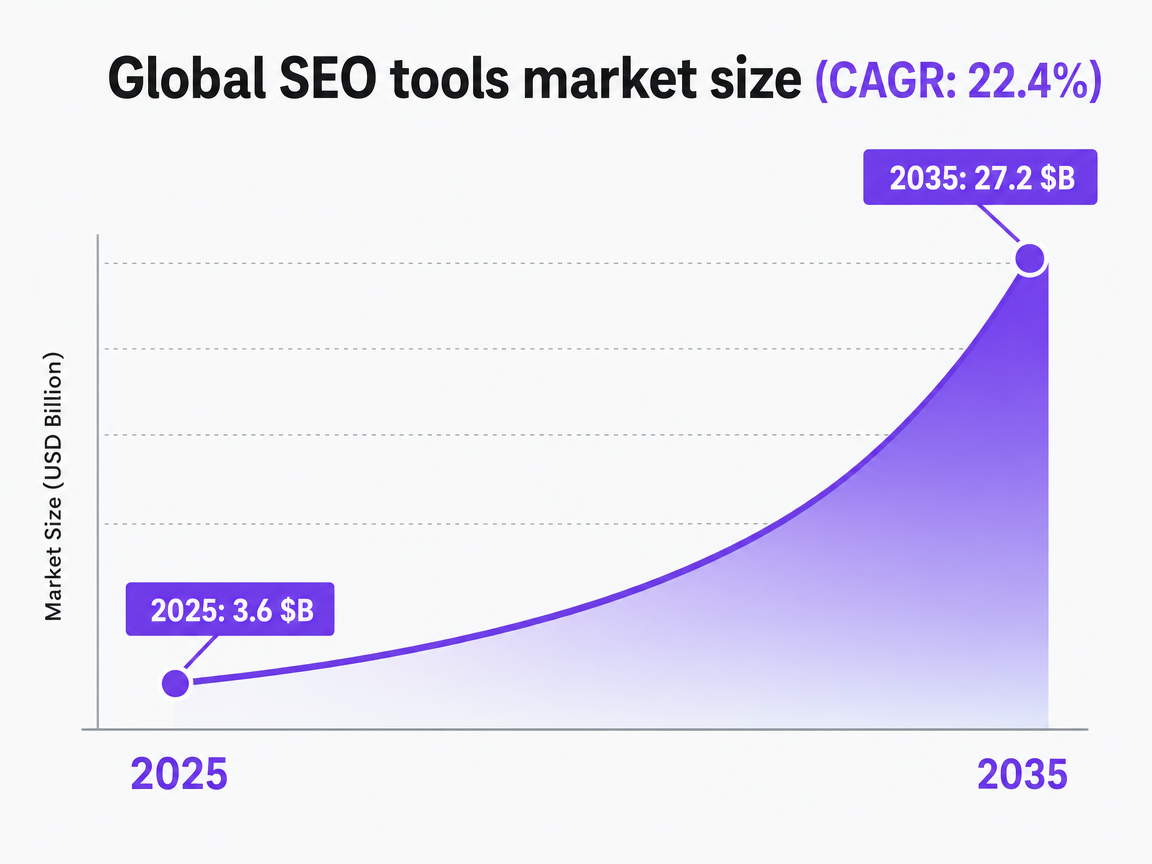 Global SEO tools market size (CAGR: 22.4%)
Source: Global Growth Insights - Search Engine Optimization (SEO) Tools Market Growth Driven by ...
Frequently Asked Questions
References
- 1.Using Search Console and Google Analytics Data for SEO.
- 2.Search Console for SEOs and developers | Google Search Central.
- 3.Introducing Search Generative AI performance reports in Search Console.
- 4.Search Engine Optimization (SEO) Tools Market Growth Driven by Digitalization and Online Competition.
- 5.Search Engine Optimization SEO Tool Market Growth and Forecast.
- 6.SEO Software Market Size Worth USD 265.91 Bn by 2034.
- 7.Enterprise SEO Platforms Market Research Report.
- 8.Enterprise SEO Platforms: A Marketer’s Guide.
- 9.Best Enterprise SEO Software: 15 Platforms Compared (Pricing ....
- 10.Best Enterprise SEO Tools in 2026 Compared - Konabayev.
- 11.Best Enterprise SEO Reporting Software 2026 - worldmetrics.org.
- 12.Top 10 Best Enterprise Seo Reporting Software of 2026 - WifiTalents.
- 13.13 Best SEO Tools for Agencies (My 2026 Stack).
- 14.15 Secret SEO Tools Top Agencies Use to Rank Fast.